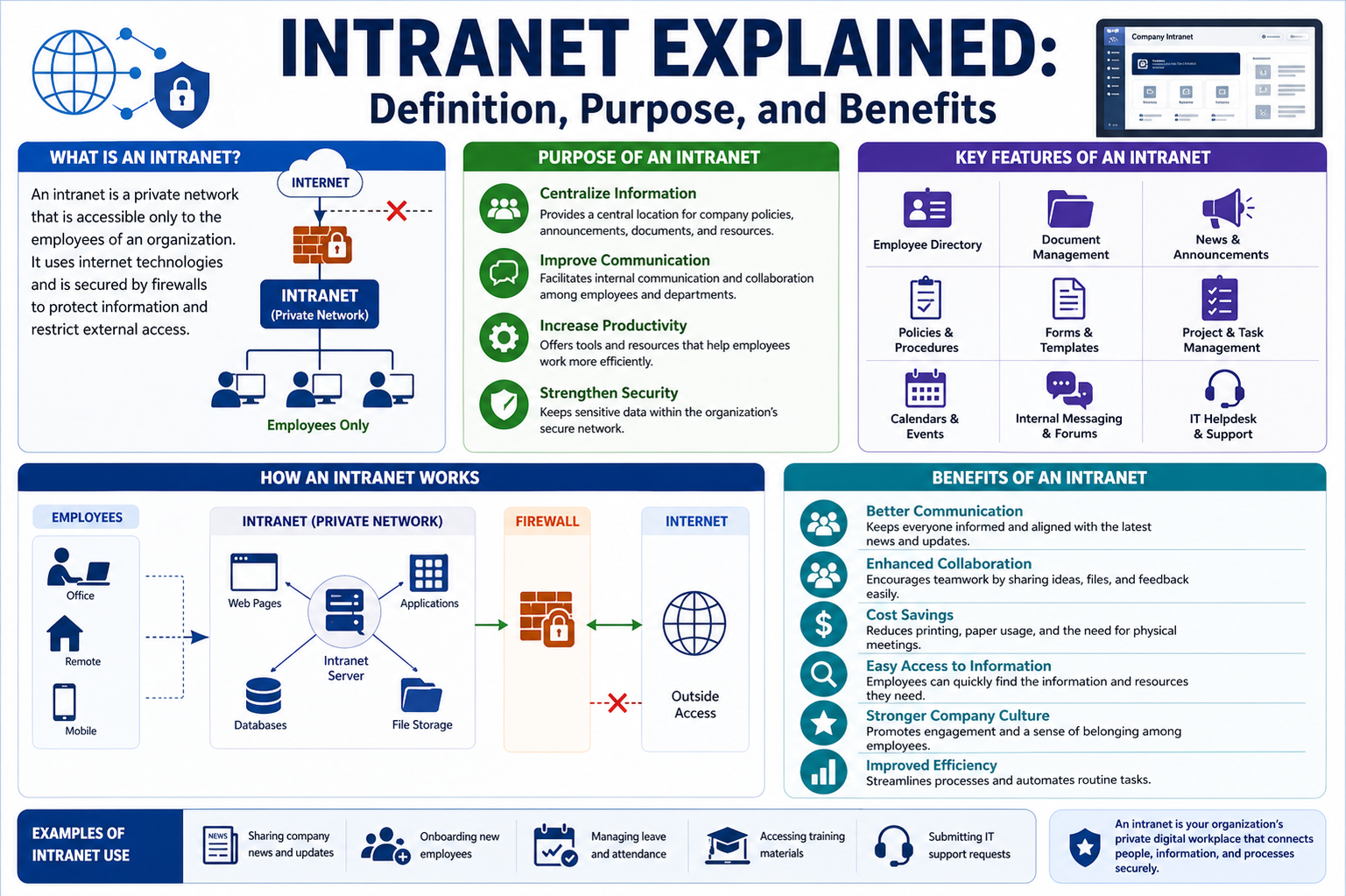
An intranet is a private digital network created within an organization to support communication, information sharing, and collaboration among authorized users. It operates using the same underlying technologies that power the internet, but it is restricted to a specific group such as employees of a company, members of an institution, or users within a defined organization. Unlike public networks, an intranet is not open to everyone, which allows it to maintain privacy, control, and security while still offering powerful digital connectivity.
At its core, an intranet functions as a controlled environment where people inside an organization can access shared resources, communicate efficiently, and work together more effectively. It acts as a central hub for documents, tools, applications, and internal communication channels, all integrated into one unified system. This structure helps reduce confusion, improve workflow efficiency, and ensure that essential information is always available to the right people at the right time.
Difference Between Intranet and Internet
To fully understand an intranet, it is important to compare it with the internet. The difference begins with the meaning of the prefixes. The term “intra” refers to something happening within a boundary, while “inter” refers to something occurring between multiple boundaries. Based on this distinction, an intranet is a closed network operating within a single organization, whereas the internet is a global network connecting millions of systems across the world.
The internet is open, public, and accessible to anyone with a connection, allowing unrestricted exchange of information. In contrast, an intranet is private and restricted, designed only for internal users who have permission to access it. This controlled nature gives organizations greater authority over how data is shared, stored, and protected.
Even though both systems use similar technologies such as web browsers, servers, and communication protocols, their purpose is very different. The internet is designed for global communication and information sharing, while an intranet is focused on internal productivity, coordination, and secure communication within an organization.
Private Nature and Controlled Environment
One of the most defining characteristics of an intranet is its private nature. Since it is restricted to authorized users only, organizations can customize it according to their specific needs without worrying about external interference. This privacy ensures that sensitive data, internal discussions, and confidential documents remain protected from unauthorized access.
Because of this controlled environment, companies can shape the intranet in ways that best suit their workflows. They can define user roles, set permissions, and determine what level of access each employee has. This helps ensure that individuals only interact with the data and tools relevant to their responsibilities, improving both security and efficiency.
The private structure also allows organizations to build tailored communication systems. Instead of relying on public platforms, internal messaging, announcements, and collaboration all happen within a secure and centralized system. This reduces the risk of data leaks while maintaining a smooth flow of communication.
Evolution into a Digital Workplace Platform
Modern intranets are no longer simple file-sharing systems or internal directories. They have evolved into advanced digital workplace platforms that support nearly every aspect of organizational activity. Today’s intranets integrate communication tools, workflow systems, collaboration applications, and knowledge management features into a single environment.
This transformation has made intranets essential for remote and hybrid work models. Employees can now access company resources from anywhere while still remaining connected to their teams. This flexibility has reshaped how organizations operate, allowing work to continue seamlessly beyond physical office boundaries.
The intranet now acts as the digital backbone of an organization. It connects employees, systems, and data in one unified space, enabling faster decision-making and improved coordination across departments. It is no longer just a supporting tool but a central component of modern business operations.
Principles of Effective Intranet Design
A well-functioning intranet is not created by simply installing software. It requires thoughtful design based on clear principles that ensure usability, efficiency, and long-term value. One of the most important principles is usability. If employees find the system difficult to use or confusing, they are unlikely to adopt it fully, which reduces its effectiveness.
Usability means that the intranet should be easy to understand, simple to navigate, and intuitive in structure. Every feature should serve a clear purpose, and unnecessary complexity should be avoided. When users can quickly find what they need, the intranet becomes a productive tool rather than a burden.
Another key principle is clarity in structure. Information should be organized in a logical way so users do not waste time searching for resources. A well-structured intranet allows employees to move through sections naturally, without confusion or unnecessary steps.
User-Centered Design Approach
A successful intranet is built around the needs of its users. This approach, often called user-centered design, focuses on how employees interact with the system in their daily tasks. It is not just about appearance but about how effectively the system supports real work processes.
User-centered design ensures that navigation is intuitive and that features are placed where users expect them to be. It also considers accessibility, ensuring that employees with different levels of technical experience can use the system comfortably. When users feel confident using the intranet, adoption rates increase significantly.
In addition to usability, user-centered design also focuses on relevance. Employees should only see information and tools that are meaningful to their roles. This reduces clutter and prevents information overload, making the system more efficient and easier to manage.
Simplicity and Navigation Efficiency
Simplicity plays a critical role in intranet effectiveness. A system overloaded with unnecessary features becomes difficult to use and reduces productivity. Instead, intranets should focus on essential tools that directly support work activities.
Clear navigation is closely linked to simplicity. Employees should be able to move between sections without confusion or extra effort. Logical menus, consistent layouts, and predictable structures help users feel comfortable and confident while interacting with the system.
When navigation is efficient, employees spend less time searching for information and more time completing meaningful tasks. This improves overall productivity and reduces frustration within the workplace environment.
Integration of Tools and Applications
A modern intranet is more than just a communication platform. It integrates multiple tools and applications into a single system, allowing employees to perform various tasks without switching between different platforms. These tools may include document sharing systems, task management tools, messaging systems, and collaborative workspaces.
Integration improves workflow efficiency by reducing fragmentation. Instead of using separate tools for different tasks, employees can access everything in one place. This centralized approach helps maintain consistency and reduces the learning curve for new users.
It also improves collaboration because teams can work on shared documents, track progress, and communicate in real time without leaving the intranet environment. This level of integration creates a more connected and productive workplace.
Scalability and Organizational Growth
As organizations grow, their intranet systems must be able to scale accordingly. Scalability refers to the ability of the system to handle increasing numbers of users, larger amounts of data, and expanding functionalities without performance issues.
A scalable intranet ensures that growth does not disrupt operations. Whether a company is adding new employees, expanding departments, or introducing new tools, the intranet should adapt smoothly to these changes.
Planning for scalability from the beginning helps organizations avoid costly system replacements or major redesigns in the future. It ensures long-term stability and supports continuous development without limitations.
Customization for Organizational Needs
Every organization has unique workflows, communication styles, and operational requirements. A flexible intranet allows customization so that it can be tailored to fit these specific needs.
Customization may include adjusting layouts, modifying dashboards, or integrating specialized tools relevant to different departments. This flexibility ensures that the intranet remains useful across various teams within the organization.
When users can personalize their experience, they are more likely to engage with the system regularly. This increases productivity and helps the intranet become a natural part of everyday work routines.
Collaboration as a Core Function
Collaboration is one of the most important purposes of an intranet. It enables employees to work together regardless of physical location or departmental boundaries. Through shared spaces, messaging systems, and document collaboration tools, teams can coordinate their efforts more effectively.
This collaborative environment reduces delays in communication and allows faster decision-making. Employees can share ideas, provide feedback, and solve problems collectively within the same platform.
By improving collaboration, intranets help break down organizational barriers and encourage a more unified work culture where information flows freely and efficiently.
Security Awareness in Intranet Systems
Although intranets are private networks, they still require strong security measures. Protecting sensitive information is essential to maintaining trust and operational stability within an organization
.
Security in intranets is managed through controlled access, authentication systems, and role-based permissions. These mechanisms ensure that only authorized users can access specific information or tools.
Proper security design not only protects data but also supports smooth collaboration. When employees know that the system is secure, they can share information confidently without fear of unauthorized exposure.
Advanced Intranet Architecture and System Structure
An intranet is built on a structured digital architecture that defines how information flows, how users interact with systems, and how different components of the network communicate with each other. This architecture is designed to support stability, security, and efficiency while allowing the system to scale as organizational needs evolve. At its foundation, an intranet typically includes servers, databases, authentication systems, and user interfaces that work together as a unified environment.
The structure is usually layered to separate responsibilities. One layer manages user interaction, another handles application logic, and a deeper layer controls data storage and retrieval. This separation helps maintain performance and makes the system easier to manage and update without disrupting the entire network.
A well-structured intranet architecture also ensures that communication between components is secure and efficient. Data flows through controlled pathways, reducing the risk of unauthorized access or system overload. This structured approach allows organizations to maintain high performance even as the number of users and amount of data increases significantly.
Cloud Based Intranets and Modern Deployment Models
Modern intranets are increasingly deployed using cloud-based infrastructure rather than traditional on-premises systems. Cloud-based intranets offer flexibility, scalability, and easier maintenance, allowing organizations to access their internal systems from virtually anywhere. This shift has transformed how businesses approach internal communication and collaboration.
In a cloud environment, the intranet is hosted on remote servers managed by service providers. This reduces the need for organizations to maintain physical hardware and reduces operational complexity. Updates, security patches, and system upgrades can be handled more efficiently, ensuring that the intranet remains up to date without disrupting daily operations.
Cloud-based intranets also support remote and hybrid work models more effectively. Employees can securely log in from different locations while still accessing the same tools, documents, and communication channels. This flexibility has become essential in modern workplaces where mobility and accessibility are key requirements.
Role of Intranets in Enterprise Communication
Intranets play a central role in improving communication within organizations by providing a unified platform for internal messaging, announcements, and collaboration. Instead of relying on scattered communication channels, employees can access all important updates in one place, reducing confusion and improving clarity.
Enterprise communication through intranets is often structured to ensure that messages reach the right audience. Departments, teams, or individuals can receive targeted updates relevant to their responsibilities. This reduces information overload and ensures that communication remains meaningful and effective.
In addition to formal communication, intranets also support informal interaction between employees. This helps build stronger workplace relationships and encourages a more connected organizational culture. When communication flows freely, teams become more aligned and responsive to organizational goals.
Collaboration Ecosystems within Intranets
An intranet functions as a collaboration ecosystem where multiple tools and features work together to support teamwork. These ecosystems often include shared workspaces, project management tools, discussion forums, and document editing platforms that allow employees to collaborate in real time.
This integrated environment eliminates the need for switching between different applications, which improves efficiency and reduces workflow interruptions. Teams can work on documents together, track project progress, and communicate instantly without leaving the intranet platform.
Collaboration ecosystems also support transparency within organizations. Employees can see updates, contributions, and changes made by others, which helps improve coordination and accountability. This level of visibility strengthens teamwork and ensures that everyone remains aligned with project objectives.
Knowledge Management and Organizational Intelligence
One of the most valuable functions of an intranet is its ability to serve as a centralized knowledge management system. Organizations generate large amounts of information, and without proper organization, this knowledge can become fragmented and difficult to access.
Intranets solve this problem by storing documents, policies, guidelines, and best practices in a structured and searchable format. Employees can quickly find the information they need without wasting time searching through multiple systems or outdated files.
This centralized knowledge base contributes to organizational intelligence by ensuring that valuable information is preserved and shared effectively. It also supports decision-making by providing employees with accurate and up-to-date resources whenever they need them.
Information Flow and Content Organization
Efficient information flow is essential for any intranet system to function effectively. Information must move smoothly between departments, teams, and individuals without delays or bottlenecks. This requires careful planning of content organization and access structures.
Content within an intranet is typically categorized based on relevance, department, or function. This helps users navigate the system more easily and locate important resources quickly. Logical organization also reduces duplication of content and ensures consistency across the platform.
When information flows efficiently, employees can make faster decisions and respond more effectively to changes within the organization. This improves overall productivity and strengthens internal coordination.
Employee Experience and Digital Workplace Design
The success of an intranet depends heavily on employee experience. If the system is difficult to use or poorly designed, employees are less likely to engage with it regularly. A well-designed digital workplace focuses on simplicity, clarity, and ease of use.
Employee experience is shaped by how easily users can navigate the system, find information, and complete tasks. A clean interface, intuitive navigation, and responsive design all contribute to a positive experience.
When employees enjoy using the intranet, it becomes an integral part of their daily workflow. This increases adoption rates and ensures that the system delivers its intended value to the organization.
Automation and Workflow Optimization in Intranets
Modern intranets often include automation features that help streamline repetitive tasks and improve workflow efficiency. Automation can be used for processes such as document approvals, task assignments, notifications, and reporting.
By reducing manual effort, automation allows employees to focus on more strategic and creative tasks. It also reduces the risk of human error and ensures that processes are completed consistently and efficiently.
Workflow optimization through intranets helps organizations operate more smoothly by standardizing procedures and improving coordination between different departments. This leads to faster execution and better overall performance.
Integration with Business Applications
Intranets are most effective when they are integrated with other business applications used within an organization. These may include customer management systems, project tracking tools, human resource platforms, and financial systems.
Integration allows data to flow seamlessly between systems, eliminating the need for manual data entry and reducing inconsistencies. Employees can access multiple tools from a single interface, which improves efficiency and reduces complexity.
This interconnected environment ensures that all business processes remain aligned and synchronized. It also enhances visibility across departments, making it easier for leaders to monitor performance and make informed decisions.
Scalability Challenges and Performance Optimization
As organizations grow, intranet systems face increasing demands in terms of users, data volume, and functionality. Scalability becomes a critical factor in ensuring that the system continues to perform efficiently under higher loads.
Performance optimization involves improving system speed, reducing latency, and ensuring that users can access resources without delays. This requires careful planning of server capacity, data management, and system architecture.
A well-optimized intranet ensures that performance remains stable even during peak usage periods. This reliability is essential for maintaining productivity and user satisfaction across the organization.
Mobile Accessibility and Remote Work Enablement
Modern intranets are designed to be accessible across multiple devices, including smartphones and tablets. Mobile accessibility ensures that employees can stay connected to their workplace systems regardless of location.
This capability is especially important in remote and hybrid work environments where employees may not always be physically present in the office. Mobile intranets allow users to access documents, communicate with colleagues, and manage tasks on the go.
By enabling remote access, intranets support flexible work arrangements and help organizations adapt to changing work trends. This flexibility improves employee satisfaction and ensures continuity of operations in various situations.
Governance, Policies, and Internal Compliance
Governance plays a crucial role in ensuring that intranet systems are used correctly and securely within an organization. It involves setting rules, guidelines, and policies that define how information is managed and shared.
Internal compliance ensures that employees follow established procedures when using the intranet. This includes proper handling of sensitive data, adherence to access controls, and compliance with organizational standards.
Strong governance helps maintain order within the intranet system and ensures that it operates in a secure and efficient manner. It also reduces risks associated with data misuse and helps organizations maintain accountability across all levels.
Intranet as a Central Hub for Organizational Knowledge
An intranet serves as a central hub where all organizational knowledge is collected, structured, and made accessible to authorized users. Instead of information being scattered across emails, local drives, or disconnected applications, everything is brought together into one unified environment. This centralization significantly improves efficiency because employees no longer waste time searching for documents or relying on outdated sources.
Knowledge within an intranet is typically organized into categories such as policies, procedures, training materials, project documentation, and internal announcements. This structured approach ensures that employees can quickly locate what they need without unnecessary complexity. Over time, this repository grows into a powerful knowledge base that reflects the collective intelligence of the organization.
The ability to preserve and organize knowledge also helps reduce dependency on individual employees. When information is properly documented and stored, it remains accessible even if employees leave or change roles. This continuity strengthens organizational stability and ensures that valuable expertise is not lost.
Search Systems and Information Retrieval Efficiency
A critical feature of any effective intranet is its search capability. As the volume of data grows, users need efficient tools to locate specific information quickly. Advanced search systems within intranets allow employees to find documents, conversations, and resources using keywords, filters, and metadata.
Search functionality improves productivity by reducing the time spent navigating through folders or menus. Instead of manually browsing through multiple sections, users can instantly retrieve relevant results based on their query. This makes the intranet far more practical for daily use.
Modern intranet search systems are often enhanced with intelligent indexing and relevance ranking. This ensures that the most useful and frequently accessed information appears first, further improving the user experience and reducing effort.
Role-Based Access and Permission Structures
Security and organization within an intranet depend heavily on role-based access control. This system assigns different levels of access to users based on their job roles, responsibilities, or departmental affiliation. It ensures that employees only interact with the information they are authorized to view or modify.
Role-based access helps protect sensitive data while maintaining operational efficiency. For example, financial records may only be accessible to accounting staff, while HR documents are restricted to human resource personnel. This separation prevents unauthorized access and reduces the risk of data leaks.
At the same time, permission structures improve workflow clarity. Employees are not overwhelmed by irrelevant data, allowing them to focus only on the tools and information necessary for their tasks. This targeted access improves both security and usability.
Digital Collaboration and Real-Time Interaction
One of the most powerful aspects of an intranet is its ability to support real-time collaboration. Employees can work together on documents, share feedback instantly, and communicate through integrated messaging systems without delay. This eliminates the need for long email chains and improves response times.
Real-time interaction allows teams to solve problems more quickly and make decisions collaboratively. When multiple users can contribute to a document simultaneously, productivity increases significantly, and project timelines become more efficient.
This level of collaboration also supports innovation. When employees can easily exchange ideas and build on each other’s input, creative solutions emerge more naturally. The intranet becomes a space where teamwork is continuous and dynamic rather than fragmented.
Employee Engagement and Workplace Participation
An intranet is not only a technical system but also a tool for improving employee engagement. When employees feel connected to their organization and have access to communication channels, they are more likely to participate actively in workplace activities.
Engagement features such as feedback forms, surveys, discussion boards, and internal forums allow employees to share their opinions and contribute to organizational improvement. This gives them a sense of involvement and value within the company.
When employees feel heard, morale improves and workplace satisfaction increases. This leads to a more positive organizational culture where individuals are motivated to contribute and collaborate effectively.
Internal Communication Transparency and Flow
Transparency in communication is essential for building trust within an organization. An intranet helps achieve this by making information easily accessible and ensuring that important updates are shared consistently across all levels.
Instead of information being filtered through multiple layers, intranets allow direct communication from management to employees. This reduces misunderstandings and ensures that everyone receives the same message at the same time.
Transparent communication also improves alignment between teams. When employees understand organizational goals and updates clearly, they can adjust their work accordingly and contribute more effectively to shared objectives.
Content Management and Information Lifecycle
Managing content within an intranet involves overseeing the entire lifecycle of information, from creation to storage and eventual archiving or removal. This ensures that the system remains organized and up to date.
Content management includes tasks such as updating documents, removing outdated information, and ensuring accuracy across all resources. Without proper management, intranets can become cluttered and inefficient over time.
A structured content lifecycle ensures that only relevant and accurate information is available to users. This improves trust in the system and prevents confusion caused by outdated or conflicting data.
Personalization and Adaptive User Experience
Modern intranets often include personalization features that adapt the interface based on user roles, preferences, and behavior. This means that each employee may see a slightly different version of the intranet tailored to their needs.
Personalized dashboards can display relevant tasks, announcements, and frequently used tools, making the system more efficient and user-friendly. This reduces the time spent navigating unnecessary content.
Adaptive experiences also improve engagement because users feel that the system is designed specifically for them. This encourages regular usage and strengthens the overall effectiveness of the intranet.
Communication Channels and Information Broadcasting
Intranets provide multiple communication channels that allow organizations to distribute information efficiently. These may include announcements, newsletters, alerts, and internal messaging systems.
Broadcasting important updates ensures that employees remain informed about organizational changes, policies, and events. This helps maintain consistency and prevents miscommunication.
At the same time, targeted communication channels allow specific messages to reach relevant groups without overwhelming the entire organization. This balance between broad and focused communication improves clarity and efficiency.
Digital Culture and Organizational Transformation
The introduction of an intranet often leads to significant changes in organizational culture. It encourages digital adoption, improves collaboration habits, and promotes more structured communication practices.
As employees become more familiar with digital tools, workflows become more efficient and less dependent on traditional methods such as paper-based communication or manual reporting. This transformation increases overall productivity.
Over time, the intranet becomes a core part of the organization’s identity, shaping how employees interact, share knowledge, and perform their tasks. It supports a more modern and connected workplace environment.
Workflow Coordination and Task Management
Intranets often include tools for managing tasks and coordinating workflows across teams. These tools help assign responsibilities, track progress, and monitor deadlines within a centralized system.
Workflow coordination ensures that projects move smoothly from one stage to another without confusion or delays. Employees can see what tasks are assigned to them and how their work contributes to larger objectives.
This structured approach reduces inefficiencies and improves accountability. When everyone understands their responsibilities clearly, projects are completed more effectively and on time.
Data Organization and Structural Consistency
Maintaining consistency in how data is organized is essential for intranet effectiveness. Without a clear structure, information can become fragmented and difficult to manage.
Standardized formats, naming conventions, and categorization systems help ensure that all content remains organized. This makes it easier for users to understand where information is located and how it is structured.
Consistent organization also improves long-term maintainability. As the intranet grows, a strong structural foundation ensures that it remains scalable and easy to navigate.
Cross-Department Collaboration and Integration
Intranets help break down barriers between departments by providing shared spaces where teams can collaborate. This encourages communication across different areas of the organization and reduces operational silos.
When departments can easily share information and work together, efficiency increases and duplication of effort decreases. This leads to better coordination and more effective problem-solving.
Cross-department collaboration also encourages innovation because diverse perspectives come together in a shared environment, leading to more creative solutions.
Operational Efficiency and Workplace Productivity
The overall goal of an intranet is to improve operational efficiency within an organization. By centralizing communication, automating processes, and improving access to information, it reduces wasted time and effort.
Employees can complete tasks faster because they have everything they need in one place. This streamlined environment eliminates unnecessary steps and simplifies workflows.
As productivity increases, organizations can achieve more with the same resources, making the intranet a valuable investment in long-term efficiency and growth.
Security Framework and Risk Management in Intranets
Security is one of the most critical foundations of any intranet system because it protects internal information from unauthorized access, misuse, or cyber threats. Since intranets handle sensitive organizational data such as employee records, financial documents, internal communications, and strategic plans, they must be built with strong security frameworks from the beginning.
A typical intranet security framework includes multiple layers of protection. These layers work together to ensure that even if one security measure is bypassed, others remain active to protect the system. This layered approach helps reduce risk and strengthens overall resilience against potential threats.
Risk management within an intranet involves identifying possible vulnerabilities, assessing their impact, and implementing safeguards to minimize exposure. Organizations continuously monitor their systems to detect unusual activity, unauthorized access attempts, or potential breaches before they cause harm.
Authentication Systems and Identity Verification
Authentication is the process of verifying the identity of users before granting access to the intranet. This is usually done through secure login credentials such as usernames and passwords, but modern systems often include additional verification methods for stronger protection.
Multi-factor authentication has become an important part of intranet security. It requires users to confirm their identity using more than one method, such as a password combined with a mobile verification code or biometric data. This significantly reduces the chances of unauthorized access.
Identity verification ensures that only legitimate users can enter the system. It also helps track user activity within the intranet, making it easier to detect suspicious behavior and maintain accountability across the organization.
Encryption and Data Protection Mechanisms
Encryption plays a vital role in protecting data within an intranet. It ensures that information is converted into a secure format that cannot be easily read by unauthorized users. Even if data is intercepted, encryption prevents it from being understood without the correct decryption key.
Data protection mechanisms also include secure storage systems, controlled data transmission, and regular backups. These measures ensure that information remains safe even in the event of system failures or cyber incidents.
By implementing strong encryption standards, organizations build trust in their intranet systems and ensure that sensitive information remains confidential at all times.
Monitoring Systems and Threat Detection
Continuous monitoring is essential for maintaining intranet security. Monitoring systems track user activity, system performance, and data access patterns to identify any unusual behavior that could indicate a security threat.
Threat detection tools analyze patterns within the network and alert administrators when suspicious actions occur. This allows organizations to respond quickly before potential issues escalate into serious problems.
Monitoring also helps improve system performance by identifying bottlenecks, inefficiencies, or technical issues. This ensures that the intranet remains both secure and efficient in its operation.
Backup Systems and Disaster Recovery Planning
Backup systems are essential for protecting intranet data from loss due to technical failures, cyberattacks, or accidental deletion. Regular backups ensure that important information can be restored quickly when needed.
Disaster recovery planning involves preparing strategies to restore the intranet system after a major disruption. This includes defining recovery procedures, identifying critical data, and ensuring minimal downtime during restoration.
A strong disaster recovery plan helps organizations maintain continuity even in unexpected situations. It ensures that operations can resume quickly without significant disruption to productivity.
Knowledge Distribution and Organizational Learning
Intranets play a major role in supporting organizational learning by distributing knowledge across employees in a structured and accessible way. Training materials, tutorials, and internal documentation are often stored within the system for easy access.
This centralized learning environment allows employees to develop skills at their own pace and stay updated with organizational practices. It also ensures consistency in training across different departments.
When knowledge is shared effectively, organizations become more adaptive and capable of handling change. Employees are better prepared to take on new responsibilities and contribute to continuous improvement.
Internal Training and Skill Development Platforms
Many intranets include dedicated training modules that help employees improve their skills and knowledge. These platforms may include video tutorials, interactive lessons, quizzes, and certification programs.
Internal training systems make learning more accessible by integrating it into the daily work environment. Employees do not need to rely on external platforms to gain new skills, as everything is available within the intranet.
This approach encourages continuous learning and professional development, which benefits both employees and the organization as a whole. It helps create a more skilled and capable workforce.
Employee Self-Service and Digital Empowerment
Employee self-service features allow individuals to manage certain tasks independently without requiring administrative assistance. These may include updating personal information, accessing payslips, submitting leave requests, or viewing company policies.
Self-service systems reduce administrative workload and improve efficiency by allowing employees to handle routine tasks on their own. This also speeds up processes and reduces dependency on HR or IT departments.
Digital empowerment through intranets gives employees more control over their work experience. It increases convenience and helps streamline everyday operations within the organization.
Corporate Culture Development through Intranets
An intranet contributes to shaping and strengthening corporate culture by promoting communication, transparency, and collaboration. It becomes a digital reflection of the organization’s values and working style.
Through internal announcements, recognition programs, and employee engagement tools, intranets help reinforce positive workplace behaviors. This builds a sense of belonging and shared purpose among employees.
A strong digital culture encourages employees to participate actively, share ideas, and contribute to organizational growth. Over time, this creates a more connected and motivated workforce.
Innovation and Digital Transformation Enablement
Intranets play an important role in enabling digital transformation within organizations. They provide the foundation for adopting new technologies, improving workflows, and integrating modern digital tools.
By centralizing communication and collaboration, intranets create an environment where innovation can thrive. Employees are more likely to experiment with new ideas when they have easy access to resources and support systems.
This continuous innovation helps organizations remain competitive and adapt to changing industry demands. The intranet becomes a catalyst for long-term digital growth and modernization.
Performance Tracking and Organizational Insights
Many intranet systems include analytics tools that help track usage patterns, employee engagement, and system performance. These insights allow organizations to understand how effectively the intranet is being used.
Performance tracking helps identify which tools are most valuable and which areas need improvement. This enables organizations to make data-driven decisions about system upgrades and enhancements.
Organizational insights derived from intranet usage also help leaders understand employee behavior and communication trends, which can guide strategic planning and development.
Scalability and Long-Term System Sustainability
As organizations continue to grow, intranet systems must remain scalable and sustainable. This means they should be able to handle increasing users, expanding data, and new functionalities without performance issues.
Long-term sustainability requires regular updates, system optimization, and continuous improvement. Without proper maintenance, intranets can become outdated and less effective over time.
A scalable and sustainable intranet ensures that the system continues to deliver value even as organizational needs evolve. It remains a reliable foundation for communication and collaboration.
Future of Intranets and Intelligent Digital Ecosystems
The future of intranets is moving toward more intelligent and automated systems. Artificial intelligence, machine learning, and advanced analytics are expected to play a larger role in shaping how intranets function.
Future intranets may include intelligent assistants that help employees find information, automate tasks, and provide personalized recommendations. This will make systems more adaptive and responsive to user needs.
As digital ecosystems continue to evolve, intranets will become even more integrated into everyday work processes, acting as central intelligence hubs for organizations.
Final Perspective
The evolution of intranets reflects the broader transformation of the modern workplace. From simple internal networks to advanced digital ecosystems, intranets have become essential tools for communication, collaboration, and knowledge management.
Their impact extends across all levels of an organization, improving efficiency, enhancing security, and supporting innovation. They help bridge gaps between teams, streamline workflows, and strengthen organizational structure.
As technology continues to advance, intranets will remain a key component of digital workplaces, shaping how organizations operate, communicate, and grow in an increasingly connected world.