Fiber optic technology has become the foundation of modern communication systems, enabling the transfer of massive amounts of data at incredible speeds across cities, countries, and continents. Unlike traditional copper-based wiring that transmits electrical signals, fiber optics rely on pulses of light traveling through ultra-thin strands of glass or plastic. This fundamental difference allows fiber cables to achieve extremely high bandwidth, minimal signal loss, and long-distance transmission without degradation.
In today’s digital environment, where streaming services, cloud computing, online gaming, artificial intelligence systems, and global business operations demand uninterrupted high-speed connectivity, fiber optics are no longer optional—they are essential. Every major internet backbone, data center, and enterprise network depends on fiber infrastructure to handle continuous and growing data loads.
Within fiber optic technology, there are two primary categories: single-mode fiber and multi-mode fiber. Single-mode fiber is designed for extremely long-distance communication and uses a very narrow core to carry light directly down the fiber. Multi-mode fiber, on the other hand, has a larger core and allows multiple light paths to travel simultaneously, making it more suitable for shorter distances and internal networking environments such as buildings, campuses, and data centers.
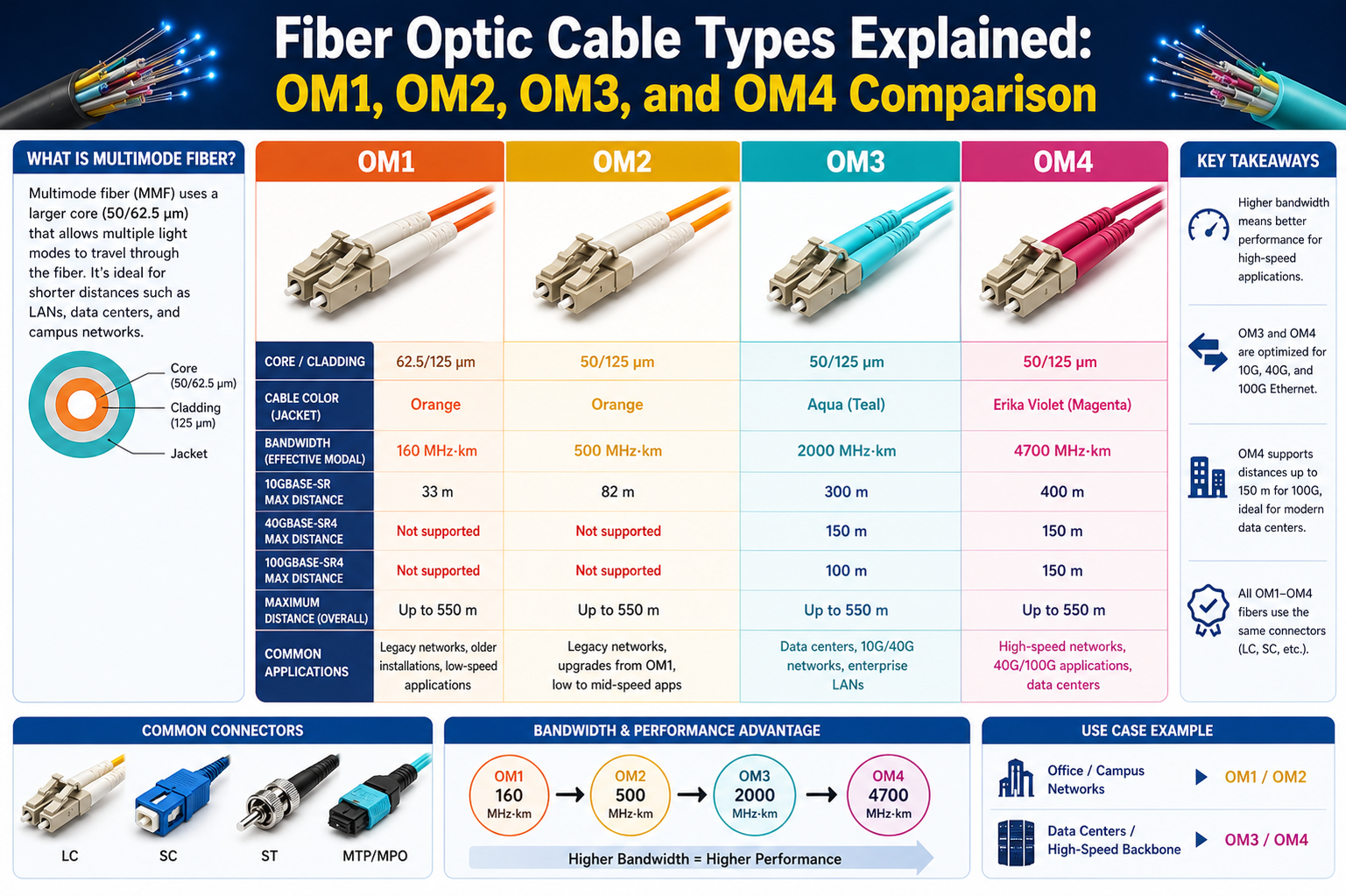
Multi-mode fiber itself is further divided into different performance categories known as OM types. These include OM1, OM2, OM3, and OM4. Each generation represents improvements in design, material quality, and bandwidth capacity. While newer types support higher speeds and longer distances, older types still exist in legacy systems and continue to influence upgrade decisions in network infrastructure planning.
Understanding these different fiber types is important because choosing the wrong cable can limit network performance, reduce scalability, and increase long-term costs. On the other hand, selecting the right fiber type ensures that a network remains stable, efficient, and ready for future technological demands.
Evolution and Role of Multi-Mode Fiber in Networking
Multi-mode fiber was originally developed to provide a cost-effective solution for short-range communication where extremely long distances were not required. Its larger core size allows multiple light signals to propagate through the fiber simultaneously, which simplifies the design of transmitters and receivers compared to single-mode systems.
However, this same characteristic also introduces a limitation known as modal dispersion. Since light rays travel through different paths within the fiber, they can arrive at the destination at slightly different times. Over longer distances, this can cause signal distortion and reduce effective bandwidth. As a result, early multi-mode fiber types were limited in both speed and distance.
Over time, improvements in manufacturing techniques, laser technology, and fiber material quality have significantly enhanced multi-mode fiber performance. Each new OM generation has focused on reducing signal distortion, increasing bandwidth capacity, and extending transmission distances while maintaining cost efficiency.
The progression from OM1 and OM2 to OM3 and OM4 reflects the growing demand for faster internal network connections, especially in environments like data centers where massive volumes of information must be transferred between servers, storage systems, and networking equipment with minimal delay.
OM1 Fiber Optic Cable Characteristics and Usage
OM1 fiber represents one of the earliest standardized forms of multi-mode fiber optic cable used in commercial and enterprise networks. It was widely deployed during the early stages of fiber adoption in the 1990s when network speeds were significantly lower than modern requirements.
The core size of OM1 fiber is typically around 62.5 micrometers, which is relatively large compared to newer multi-mode fibers. This larger core allows multiple modes of light to travel through the fiber simultaneously, but it also increases modal dispersion, limiting both speed and distance capabilities.
In practical applications, OM1 fiber is capable of supporting data transmission speeds of up to 1 Gbps over short distances. In some optimized conditions, it can handle 10 Gbps speeds, but only across very limited ranges, typically around 33 meters. Beyond this distance, signal quality degrades significantly, making it unsuitable for high-performance networking environments.
During its peak usage period, OM1 was commonly deployed in early local area networks where basic connectivity requirements were the primary concern. Offices, small enterprise buildings, and institutional networks often relied on OM1 for internal communication between network devices located in close proximity.
One of the defining characteristics of OM1 fiber installations is the orange-colored outer jacket. This visual identifier is still important today because it helps technicians quickly recognize legacy fiber infrastructure during maintenance or upgrade projects. In many older buildings, OM1 cabling may still be present, even though it is no longer used for new installations.
As network demands increased and higher speeds became necessary, OM1 quickly became insufficient for modern applications. Its limited bandwidth capacity and short transmission distance led to the development and adoption of improved fiber standards, particularly OM2 and later generations.
Despite being outdated, OM1 still holds relevance in certain scenarios. It may continue to function in legacy systems where network upgrades have not yet been implemented. In such cases, maintaining compatibility becomes more important than replacing the entire infrastructure immediately. However, for any new network deployment, OM1 is generally avoided due to its performance limitations.
OM2 Fiber Optic Cable Improvements and Capabilities
OM2 fiber was developed as an improvement over OM1, addressing some of its key limitations while maintaining cost-effectiveness. One of the primary enhancements in OM2 is the reduction of modal dispersion through improved fiber design and material quality.
Like OM1, OM2 also uses a 62.5-micrometer core in some early versions, but many modern OM2 cables utilize a more refined 50-micrometer core, which significantly improves light transmission efficiency. This change allows signals to travel more cleanly through the fiber with reduced distortion over distance.
In terms of performance, OM2 supports 1 Gbps speeds over longer distances compared to OM1. It can also support 10 Gbps transmission up to approximately 82 meters under optimal conditions. This represents a substantial improvement in usability for short-to-medium range network connections.
OM2 became widely adopted in the early 2000s as businesses began transitioning from basic network infrastructure to more data-intensive environments. It was commonly used in office buildings, educational institutions, and small data centers where moderate bandwidth was sufficient for daily operations.
The cable jacket of OM2 is also typically orange, which can sometimes cause confusion when distinguishing it from OM1. However, the internal performance differences between the two are significant, and OM2 provides a clear upgrade path in terms of bandwidth and reliability.
One of the key advantages of OM2 over OM1 is its ability to better support evolving network requirements without requiring a complete infrastructure overhaul. Many organizations adopted OM2 as a transitional solution, allowing them to improve network performance while keeping costs manageable.
However, as digital applications continued to grow in complexity, even OM2 began to show limitations. The rise of cloud computing, high-definition video streaming, virtualization, and large-scale data processing created a demand for even higher bandwidth and longer transmission distances.
This shift in requirements led to the development of OM3 and OM4 fiber types, which were specifically engineered to support high-speed data transmission over significantly greater distances. These newer standards use advanced laser-optimized designs that dramatically improve performance compared to earlier multi-mode fibers.
Transition from Early Fiber Types to Modern Standards
The evolution from OM1 and OM2 to more advanced fiber types reflects the rapid growth of digital communication needs. While early multi-mode fibers were sufficient for basic networking tasks, modern systems require much more efficient data handling capabilities.
One of the major limitations of older fiber types is their inability to support high-speed transmission over extended distances without signal degradation. This limitation becomes particularly important in environments such as data centers, where servers and storage systems may be spread across large physical spaces.
As network architecture became more complex, the need for fiber cables that could handle both high bandwidth and longer reach became critical. This necessity drove innovation in fiber design, leading to improved core materials, better light sources such as vertical-cavity surface-emitting lasers, and optimized transmission standards.
Although OM1 and OM2 are no longer considered suitable for modern high-performance networks, they still play an important role in understanding the development of fiber optic technology. Many existing infrastructures around the world still rely on these older standards, making them relevant in maintenance, troubleshooting, and gradual upgrade strategies.
In practical terms, network designers today must carefully evaluate existing fiber infrastructure before implementing upgrades. In some cases, partial reuse of OM2 systems may be possible, while in others a full migration to OM3 or OM4 is necessary to meet performance expectations.
The choice between maintaining legacy fiber and upgrading to newer standards often depends on a combination of factors, including budget constraints, performance requirements, and long-term scalability goals.
What is OM3 Fiber Optic Cable?
OM3 fiber optic cable represents a major step forward in multi-mode fiber technology, designed specifically to meet the demands of modern high-speed networking environments. Unlike earlier generations such as OM1 and OM2, OM3 is engineered as a laser-optimized fiber, meaning it is built to work efficiently with vertical-cavity surface-emitting lasers that produce more focused and stable light signals.
At a structural level, OM3 typically uses a 50-micrometer core, but what truly differentiates it is not just size, but the purity and precision of the glass used inside the fiber. The internal design is optimized to reduce modal dispersion, which is the primary limiting factor in multi-mode fiber performance. By minimizing the spread of light paths inside the fiber, OM3 ensures that data signals arrive more consistently and with less distortion.
This improvement allows OM3 fiber to support significantly higher bandwidth compared to OM1 and OM2. It is capable of handling extremely fast data transmission rates, including 10 Gbps over long distances and even much higher aggregated speeds in advanced network configurations. The improvement in signal quality also allows for more reliable performance in environments where data traffic is heavy and continuous.
One of the most important characteristics of OM3 fiber is its ability to support 10 Gbps transmission over distances up to approximately 300 meters. This is a major leap compared to OM2, which is limited to much shorter distances at the same speed. In practical terms, this makes OM3 suitable for larger network environments such as campuses, enterprise buildings, and high-performance computing systems.
In addition to 10 Gbps support, OM3 is also capable of handling even higher speeds in certain configurations, including 40 Gbps and 100 Gbps transmission using parallel optics technology. However, at these extremely high speeds, the effective distance is reduced, typically to around 100 meters, due to physical limitations in multi-mode transmission.
The development of OM3 was driven by the increasing demand for high-bandwidth applications such as virtualization, cloud computing, large-scale storage systems, and high-definition video streaming. These applications require not only fast data transfer but also consistent low-latency performance, which OM3 is designed to deliver.
Another important aspect of OM3 fiber is its compatibility with existing multi-mode infrastructure. Since it shares a similar core size with OM2, it can often be integrated into upgraded network systems without requiring a complete redesign. This makes it a practical choice for organizations looking to improve performance without completely replacing their existing fiber layout.
The cable jacket of OM3 is typically aqua-colored, which helps distinguish it from older OM1 and OM2 cables in physical installations. This visual distinction is especially useful in data centers and enterprise environments where large numbers of fiber cables are managed simultaneously.
The manufacturing process of OM3 fiber is more advanced than earlier generations, requiring tighter quality control and improved material composition. This results in a higher cost compared to OM2, but the performance benefits justify the investment in most modern networking environments.
Advantages of OM3 Fiber in Modern Networking
OM3 fiber provides several key advantages that make it one of the most widely used multi-mode fiber types in contemporary network design. One of its most significant benefits is its high bandwidth capacity, which allows it to support data-intensive applications with ease.
In environments where large volumes of data must be transmitted between servers, storage systems, and networking equipment, OM3 ensures that bottlenecks are minimized. This is especially important in data centers, where performance consistency is critical for application reliability and user experience.
Another major advantage of OM3 is its extended transmission distance compared to older fiber types. The ability to maintain high-speed performance over hundreds of meters allows network architects to design more flexible layouts without being constrained by distance limitations.
OM3 also offers improved energy efficiency in networking systems. Because it works effectively with laser-based transmission systems, it reduces the need for signal boosting and repeated retransmission, which can lower overall power consumption in large-scale installations.
In addition, OM3 provides better scalability for growing networks. As organizations expand their digital infrastructure, OM3 allows them to increase bandwidth capacity without requiring immediate replacement of fiber backbone systems. This makes it a cost-effective long-term solution for many enterprises.
Reliability is another strong advantage of OM3 fiber. The reduced signal distortion ensures more stable data transmission, which is essential for mission-critical applications where downtime or data loss is unacceptable. This reliability is one of the reasons OM3 is widely used in professional IT environments.
OM3 also supports multiple high-speed protocols, making it highly versatile. Whether used for Ethernet, storage area networks, or high-performance computing clusters, OM3 can adapt to different communication standards without significant performance degradation.
Applications of OM3 Fiber Optic Cable
OM3 fiber is widely deployed across a variety of modern networking environments where speed, reliability, and scalability are essential. One of its primary application areas is in data centers, where massive amounts of information are constantly being processed, stored, and transmitted.
In data center environments, OM3 is commonly used to connect servers to switches, storage systems to processing units, and different network layers within the infrastructure. Its ability to handle high bandwidth over moderate distances makes it ideal for the dense and complex layouts found in these facilities.
Another major application of OM3 fiber is in campus networks. Large educational institutions, corporate campuses, and research facilities often require high-speed connectivity between multiple buildings spread across significant physical distances. OM3 provides the necessary performance to maintain fast and stable communication across these distributed environments.
OM3 is also widely used in enterprise backbone networks, where it serves as the primary communication pathway between different segments of a business network. In these scenarios, OM3 ensures that data can move quickly and efficiently between departments, servers, and centralized systems.
In addition, OM3 plays a crucial role in large-scale wireless deployments. For example, in stadiums, airports, and convention centers, thousands of wireless access points may be deployed to support high user density. OM3 fiber provides the backbone connectivity required to support these access points with sufficient bandwidth.
High-performance computing environments also rely heavily on OM3 fiber. Research institutions, scientific laboratories, and engineering organizations use OM3 to connect computing clusters that process complex simulations, data models, and artificial intelligence workloads.
OM3 is also used in storage area networks, where rapid access to large volumes of data is required. In these systems, OM3 ensures that data can be retrieved and transferred between storage devices and servers without delays.
Because of its balance between cost and performance, OM3 is often considered the standard choice for many modern network installations. It provides a significant upgrade over OM2 without reaching the higher cost levels associated with OM4, making it a practical middle-ground solution.
Limitations of OM3 Fiber
Although OM3 fiber offers substantial improvements over older multi-mode fiber types, it still has certain limitations that must be considered when designing large-scale or future-focused networks.
One of the primary limitations is its distance constraint at very high speeds. While OM3 can support 10 Gbps over 300 meters, its range decreases significantly when operating at 40 Gbps or 100 Gbps speeds. This makes it less suitable for extremely large-scale backbone infrastructures.
Another limitation is its performance ceiling compared to newer fiber types like OM4. As network demands continue to grow, OM3 may eventually become insufficient for environments requiring ultra-high bandwidth and extended reach.
OM3 is also more expensive than OM2, which can be a consideration for budget-sensitive projects. While it delivers significantly better performance, the increased cost may not always be necessary for simpler network requirements.
Additionally, OM3 still experiences some level of modal dispersion, even though it is greatly reduced compared to earlier fiber types. This means that while it performs well in most scenarios, it is not completely free from signal distortion effects.
Despite these limitations, OM3 remains one of the most widely used fiber types in modern networking due to its strong balance between performance, cost, and compatibility
What is OM4 Fiber Optic Cable?
OM4 fiber optic cable represents an advanced evolution of multi-mode fiber technology, designed to deliver even higher performance than OM3 in terms of bandwidth, distance, and overall signal efficiency. It was developed in response to the increasing demand for ultra-fast data transmission in modern digital environments such as hyperscale data centers, cloud infrastructure, and high-performance computing systems.
At its core, OM4 uses a high-quality 50-micrometer graded-index fiber, similar in size to OM3, but with significantly improved manufacturing precision and material purity. The key improvement lies in its ability to reduce modal dispersion even further than previous generations. This allows light signals to travel more efficiently through the fiber with less distortion and improved consistency over longer distances.
OM4 is specifically optimized for laser-based transmission systems, particularly vertical-cavity surface-emitting lasers. This optimization allows OM4 to maintain high signal integrity even when operating at extremely high speeds. As a result, OM4 supports significantly greater bandwidth capacity compared to OM3, making it suitable for next-generation network demands.
One of the defining characteristics of OM4 fiber is its ability to support extremely high data rates, including 40 Gbps and 100 Gbps over relatively short to moderate distances. In some configurations, OM4 can even support aggregated speeds reaching up to 400 Gbps using parallel transmission technologies, although the effective distance varies depending on the specific setup.
In practical terms, OM4 can support 10 Gbps transmission over distances up to approximately 550 meters, which is a significant improvement over OM3. For higher speeds such as 100 Gbps, the effective range is reduced, typically around 125 meters, but this is still sufficient for most data center and enterprise backbone applications.
The development of OM4 reflects the shift in modern networking from simple connectivity toward high-density, high-performance environments where large volumes of data must be processed in real time. As cloud computing, artificial intelligence, and virtualization technologies continue to expand, OM4 provides the infrastructure needed to support these demanding workloads.
Another important feature of OM4 fiber is its enhanced differential modal delay performance. This technical improvement ensures that multiple light signals traveling through different paths inside the fiber remain more synchronized, reducing timing errors and improving overall transmission quality.
OM4 cables are typically identified by their aqua-colored jacket, similar to OM3, but they are often marked with additional labeling to distinguish their higher performance category. In many modern installations, OM4 is preferred when future scalability and long-term performance stability are key requirements.
The manufacturing process of OM4 is more advanced than OM3, requiring stricter quality control and more refined glass composition. This results in a higher production cost, but the performance benefits make it a valuable investment for mission-critical network environments.
Advantages of OM4 Fiber Optic Cable
OM4 fiber offers several significant advantages that make it one of the most powerful multi-mode fiber options available today. One of its primary advantages is its exceptional bandwidth capacity, which allows it to handle extremely high data throughput with minimal signal degradation.
This high bandwidth capability is especially important in environments where large volumes of data are transmitted simultaneously, such as enterprise data centers and cloud service infrastructures. OM4 ensures that multiple high-speed connections can operate efficiently without congestion or performance loss.
Another major advantage of OM4 is its extended transmission distance at high speeds. Compared to OM3, OM4 significantly increases the maximum reach for 10 Gbps and 100 Gbps connections, allowing for more flexible network design and reduced need for additional signal regeneration equipment.
OM4 also provides improved scalability for future network expansion. Organizations that anticipate increasing bandwidth requirements over time often choose OM4 to avoid frequent infrastructure upgrades. This makes it a strong long-term investment for growing digital environments.
Energy efficiency is another benefit of OM4 fiber. Because it maintains better signal integrity over longer distances, it reduces the need for repeated signal boosting, which can lower overall power consumption in large-scale networking systems.
OM4 also enhances network reliability by minimizing data loss and signal distortion. This is especially important for applications that require continuous uptime, such as financial systems, cloud platforms, and real-time analytics services.
Another advantage is compatibility with existing multi-mode infrastructure. Like OM3, OM4 can often be integrated into existing fiber networks with minimal changes, allowing for smoother upgrades and hybrid system designs.
OM4 also supports a wide range of high-speed networking protocols, making it highly versatile across different industries and applications. Whether used for storage networks, enterprise communication systems, or cloud data centers, OM4 delivers consistent performance.
Applications of OM4 Fiber Optic Cable
OM4 fiber is widely used in environments where maximum performance, high bandwidth, and future scalability are essential. One of its primary application areas is hyperscale data centers, where massive volumes of data are processed, stored, and transmitted continuously.
In these data centers, OM4 is used to connect high-performance servers, storage systems, and network switches. Its ability to handle extremely high data rates ensures that internal communication remains fast and efficient even under heavy workloads.
OM4 is also commonly used in enterprise backbone networks. These backbone systems form the core of organizational communication infrastructure, connecting different departments, buildings, and data processing systems. OM4 ensures that these connections remain stable and capable of handling growing data demands.
Another key application is in cloud computing infrastructure. As cloud services continue to expand globally, the need for high-speed internal connectivity between data centers and server clusters has increased significantly. OM4 provides the necessary bandwidth and reliability for these environments.
OM4 is also widely used in high-performance computing environments, including scientific research institutions, engineering simulation facilities, and artificial intelligence development centers. These environments require extremely fast data transfer between computing nodes to process complex calculations efficiently.
In storage area networks, OM4 plays a critical role in enabling fast data access and transfer between storage devices and servers. This ensures that large datasets can be retrieved and processed without delays, which is essential for enterprise-level data management.
Large-scale enterprise networks also benefit from OM4, especially in organizations with multiple buildings or distributed campuses. OM4 allows for high-speed interconnection between different network segments while maintaining long-term scalability.
OM4 is also used in advanced wireless infrastructure deployments, such as smart stadiums, airports, and industrial facilities. In these environments, OM4 supports the backbone connectivity required to manage thousands of wireless access points and connected devices.
Limitations of OM4 Fiber Optic Cable
Despite its high performance, OM4 fiber does have certain limitations that must be considered when designing network systems. One of the main limitations is cost. OM4 is more expensive than OM3, which can significantly increase installation costs in large-scale deployments.
Another limitation is its distance reduction at extremely high speeds. While OM4 performs exceptionally well at 10 Gbps over long distances, its range decreases when operating at 100 Gbps or higher, which may require careful network planning in large infrastructures.
OM4 also shares similar physical characteristics with OM3, which means it does not completely eliminate modal dispersion. Although greatly reduced, some level of signal variation still exists within the fiber.
Additionally, OM4 may be considered over-engineered for smaller or low-bandwidth networks. In environments where high-speed data transfer is not required, using OM4 may not provide a cost-effective advantage compared to OM3 or even OM2 in some cases.
However, despite these limitations, OM4 remains one of the most advanced and future-ready multi-mode fiber options available, widely chosen for environments where performance and scalability are top priorities.
OM3 Vs OM4: Key Performance Differences
OM3 and OM4 fiber optic cables are often compared because they belong to the same generation of laser-optimized multi-mode fibers and share a similar core size. However, their performance levels are not the same, and the differences between them become more important as network speed and distance requirements increase.
One of the most noticeable differences between OM3 and OM4 is bandwidth capacity. OM4 provides significantly higher effective bandwidth compared to OM3, which allows it to support more data traffic simultaneously. This improvement is the result of better manufacturing precision, reduced signal distortion, and enhanced material quality inside the fiber core.
Another major difference is transmission distance at high speeds. OM3 can support 10 Gbps transmission up to approximately 300 meters, while OM4 extends this capability to around 550 meters under similar conditions. This extended reach gives OM4 a clear advantage in larger network environments where devices are spread across wider physical spaces.
At even higher speeds such as 40 Gbps and 100 Gbps, both OM3 and OM4 experience reduced effective distances due to physical limitations of multi-mode transmission. However, OM4 still maintains a longer reach compared to OM3, making it more suitable for future-ready infrastructure designs.
Cost is another important factor that differentiates the two. OM3 is generally more affordable and widely used in standard enterprise networks, while OM4 comes at a higher price due to its improved performance characteristics. This cost difference often plays a major role in decision-making for network planners.
In terms of practical usage, OM3 is often sufficient for short to medium-range connections within buildings or between closely located network equipment. OM4, on the other hand, is preferred in environments where higher bandwidth and longer distance coverage are required, especially in modern data centers and enterprise backbones.
Both OM3 and OM4 use similar aqua-colored jackets, which can sometimes make physical identification difficult without proper labeling. However, OM4 cables are often marked with additional identifiers to distinguish their higher performance class in professional installations.
Ultimately, the choice between OM3 and OM4 depends on balancing current network requirements with future scalability needs. OM3 offers a cost-effective solution for many existing systems, while OM4 provides greater long-term performance potential.
Network Requirements and Performance Planning
When selecting between different fiber optic cable types, understanding network requirements is one of the most important steps in the decision-making process. Every network has unique demands based on the volume of data it handles, the number of connected devices, and the physical layout of the infrastructure.
For smaller networks with limited bandwidth needs, such as basic office environments or short-distance internal connections, lower-grade multi-mode fibers may still provide sufficient performance. However, as soon as data traffic increases or multiple high-speed applications are introduced, higher-grade fibers become necessary.
Modern networks increasingly rely on cloud-based applications, video conferencing, real-time data analytics, and large-scale storage systems. These applications require consistent high-speed data transfer, which places significant pressure on the underlying fiber infrastructure.
Latency and signal stability also play a critical role in performance planning. Even if a network supports high bandwidth, poor signal quality or excessive delay can negatively affect application performance. This is why fiber selection must consider both speed and reliability.
Another important factor is network topology. In simple point-to-point connections, shorter-distance fiber may be sufficient. However, in complex architectures involving multiple switches, routers, and data distribution points, higher-performance fiber is required to maintain efficiency.
Scalability is also a key consideration. Networks are rarely static; they expand over time as organizations grow and adopt new technologies. Choosing a fiber type that supports future expansion helps avoid costly infrastructure replacements later.
Environmental conditions can also influence fiber selection. In large buildings or industrial environments where cables must travel long distances or pass through multiple distribution points, higher-grade fibers like OM4 provide better stability and performance consistency.
In addition, compatibility with existing systems is often a deciding factor. Many organizations already have installed fiber infrastructure, and upgrading requires ensuring that new components integrate smoothly with existing hardware and cabling.
Future Scalability and Long-Term Network Growth
Future scalability is one of the most critical considerations in modern network design. As digital transformation continues to accelerate, data consumption is increasing at an exponential rate, and networks must be prepared to handle this growth without constant redesign.
One of the key advantages of higher-grade fiber optic cables is their ability to support future technologies without requiring immediate replacement. This makes them a strategic investment rather than just a short-term solution.
Emerging technologies such as artificial intelligence, machine learning, edge computing, and immersive digital experiences are driving unprecedented demand for bandwidth. These technologies rely heavily on fast and stable data transmission between distributed systems.
Cloud computing is another major factor influencing future network scalability. As more organizations move their operations to cloud-based platforms, internal data center traffic continues to grow significantly. This increases the need for fiber infrastructure that can handle large-scale data flows efficiently.
The rise of Internet of Things ecosystems is also contributing to increased network load. With thousands or even millions of connected devices generating continuous streams of data, fiber networks must be capable of supporting constant communication without congestion.
Future scalability is not only about speed but also about flexibility. Networks must be able to adapt to new architectures, hybrid cloud environments, and evolving communication protocols without requiring complete overhauls.
High-performance fiber types help reduce the need for frequent infrastructure upgrades. By investing in more advanced fiber early, organizations can extend the lifecycle of their network systems and reduce long-term operational costs.
Another important aspect of scalability is redundancy. As networks grow, ensuring continuous uptime becomes critical. Fiber systems that support higher bandwidth and longer distances help create more resilient network architectures with fewer points of failure.
Cost Considerations in Fiber Selection
Cost is always a major factor when designing or upgrading network infrastructure. While performance is important, budget limitations often influence the final decision between different fiber optic cable types.
Lower-cost fibers like OM3 are often chosen for projects where performance requirements are moderate and distance limitations are acceptable. This makes OM3 a popular choice for many standard enterprise deployments.
Higher-performance fibers such as OM4 come at a greater cost due to more advanced manufacturing processes and improved material quality. However, this additional cost is often justified by improved performance, longer distance support, and better future readiness.
It is important to consider not only the initial installation cost but also the long-term cost of ownership. Choosing a lower-cost fiber that becomes obsolete quickly may lead to expensive upgrades in the future.
Maintenance and upgrade costs should also be factored into the decision. A well-planned fiber infrastructure can reduce the need for frequent replacements and minimize downtime during network expansion.
In large-scale deployments, even small differences in cable cost can add up significantly. Therefore, network designers must carefully evaluate whether higher-performance fiber is necessary for all segments of the network or only for critical backbone connections.
A balanced approach is often the most effective strategy. Many modern networks use a combination of fiber types, deploying higher-grade fiber in backbone systems and more cost-effective options in less demanding areas.
Final Conclusion
Fiber optic technology continues to evolve as global data demands increase, and selecting the right fiber type plays a crucial role in building efficient, scalable, and future-ready networks. Each fiber category, from older OM1 and OM2 to advanced OM3 and OM4, represents a different stage in this technological evolution.
OM1 and OM2 remain part of legacy infrastructure and are no longer suitable for modern high-speed requirements. OM3 serves as a reliable and cost-effective solution for many enterprise and data center applications, offering strong performance for moderate to high bandwidth needs.
OM4 represents the most advanced multi-mode option, providing superior bandwidth, longer transmission distances, and better future scalability. It is ideal for environments where long-term performance and high data throughput are essential.
The decision between these fiber types ultimately depends on balancing performance requirements, budget constraints, and future growth expectations. A well-planned fiber infrastructure ensures stable communication, efficient data transfer, and long-term adaptability in an increasingly digital world.