Modern computing systems rely heavily on the ability to store and retrieve data efficiently, reliably, and at scale. In early computing environments, storage was tightly bound to the machine it served. A disk drive or storage medium was physically attached to a single system, meaning that all data access had to happen locally. This model worked when computing tasks were isolated and relatively simple, but it quickly became limiting as applications grew more complex and organizations began running multiple systems that needed access to the same datasets.
As businesses expanded their computing infrastructure, the need for shared storage became more urgent. Instead of duplicating data across multiple machines or physically moving storage devices between systems, engineers began exploring ways to make storage accessible across a network. This shift marked the beginning of networked storage, a foundational concept that transformed how enterprise systems operate today.
Block storage over a network is particularly important because it allows remote systems to interact with storage as if it were directly attached. Instead of working with files at a high level, operating systems see raw blocks of data that behave like a local disk. This abstraction enables high-performance applications such as databases, virtualization platforms, and large-scale transaction systems to operate efficiently across multiple servers.
The rise of networked storage also helped solve another major inefficiency: wasted capacity. In isolated systems, storage was often underutilized on one machine while another ran out of space. By centralizing storage resources and distributing them dynamically, organizations gained better control over capacity planning and resource allocation.
Understanding SCSI as the Foundation
To understand modern storage networking protocols, it is important to start with the Small Computer System Interface, widely known as SCSI. This protocol is one of the most influential building blocks in storage technology history and continues to shape modern systems even though its original form is rarely used today.
SCSI emerged as a standardized method for connecting and communicating with storage devices. Before its introduction, storage interfaces were often proprietary, meaning that hardware from one manufacturer would not necessarily work with another. This created fragmentation in the industry and limited interoperability. SCSI helped solve this problem by providing a common command structure that allowed different vendors to build compatible devices.
At its core, SCSI defines a set of commands used by a host system to communicate with storage devices. These commands include instructions for reading, writing, checking status, and managing data transfers. The simplicity and efficiency of this command set contributed to SCSI’s widespread adoption.
One of the key strengths of SCSI is its abstraction. It separates the logical commands issued by the operating system from the physical implementation of the storage device. This design allowed SCSI to evolve, adapting to new physical media and transmission methods while maintaining backward compatibility at the protocol level.
Even though traditional parallel SCSI systems used bulky ribbon cables and had strict limitations in terms of distance and device count, the underlying command structure proved durable. This longevity is one of the reasons why modern storage technologies still rely on SCSI semantics, even when the physical transport layer has changed completely.
From Direct-Attached to Shared Storage Concepts
The transition from direct-attached storage to shared storage represents one of the most important shifts in enterprise computing. In a direct-attached model, storage devices are connected directly to a single server. While this approach is simple and fast for individual systems, it does not scale well in environments where multiple servers need access to the same data.
As organizations began deploying clusters of servers, virtualization platforms, and high-availability systems, the limitations of direct-attached storage became more apparent. Data duplication increased operational overhead, and maintaining consistency across systems became increasingly difficult.
Shared storage addressed these issues by centralizing data resources and allowing multiple systems to access the same storage pool simultaneously. This enabled new computing architectures, such as failover clusters and distributed databases, where multiple servers could work together on the same dataset without conflicts.
Block storage played a crucial role in this evolution. Unlike file-based storage systems, which manage data at the file level, block storage operates at a lower level, giving operating systems direct control over how data is organized and accessed. This makes block storage ideal for performance-sensitive applications that require low latency and high throughput.
The introduction of storage networking protocols built on SCSI semantics allowed these block-level operations to be extended across network infrastructures. This was a breakthrough, as it combined the performance characteristics of local storage with the flexibility of centralized systems.
Emergence of Fibre Channel Architecture
As demand for high-performance shared storage increased, engineers began developing specialized networking technologies designed specifically for storage traffic. One of the most significant outcomes of this effort was Fibre Channel.
Fibre Channel was designed to address the limitations of traditional network protocols when applied to storage workloads. General-purpose networking protocols were not optimized for the predictable, low-latency, and lossless requirements of block storage communication. Fibre Channel was created to provide a dedicated, high-speed transport system for storage data.
Unlike standard Ethernet networks of its time, Fibre Channel was engineered with reliability and performance as core design principles. It supports deterministic behavior, meaning data delivery is highly predictable. This is particularly important for storage systems, where delays or packet loss can significantly impact application performance.
Fibre Channel also separates storage traffic from general network traffic. This isolation ensures that storage operations are not affected by congestion or variability in other types of network communication. As a result, Fibre Channel networks are often deployed as dedicated infrastructures within data centers.
Another important design aspect is the use of a layered architecture. Fibre Channel does not replace the SCSI protocol; instead, it transports SCSI commands across a specialized network. This separation of concerns allows each layer to focus on its own function: SCSI manages storage commands, while Fibre Channel handles delivery and transport.
Fibre Channel Components and How It Works
A typical Fibre Channel environment consists of several specialized components working together to create a high-performance storage network. One of the most important components is the Host Bus Adapter (HBA), which is installed in servers. The HBA is responsible for converting system-level storage requests into Fibre Channel communication.
On the storage side, devices are equipped with Fibre Channel interfaces that allow them to participate in the storage network. These devices are often part of larger storage arrays, which combine multiple disks into a unified system. These arrays frequently use redundancy techniques such as RAID to improve reliability and performance.
Fibre Channel networks are typically built using dedicated switches that form what is known as a fabric. The fabric acts as the backbone of the storage network, allowing devices to communicate with each other through a structured and managed topology. Unlike simple network hubs, Fibre Channel switches provide intelligent routing and traffic management capabilities.
A common design approach involves using multiple independent fabrics to improve redundancy. Servers are often connected to more than one fabric so that if one path fails, traffic can continue flowing through an alternate route. This design significantly improves fault tolerance and availability.
Within this architecture, storage is divided into logical units that can be assigned to different servers. These logical units allow administrators to control how storage capacity is distributed and accessed across the network. This flexibility is essential in environments where multiple applications require shared access to storage resources.
Fibre Channel Communication Behavior and Efficiency
One of the defining characteristics of Fibre Channel is its focus on lossless communication. In traditional network environments, packet loss can occur due to congestion or errors, requiring retransmission at higher layers. Fibre Channel avoids this by implementing mechanisms that ensure data is delivered reliably and in order.
This ordered delivery is critical for storage systems. When data blocks arrive out of sequence or are lost, storage integrity can be compromised. Fibre Channel’s design ensures that once a data transfer begins, it is completed in a predictable and controlled manner.
Another important aspect of Fibre Channel is its low latency. Because the protocol is optimized specifically for storage traffic, it avoids many of the overheads associated with general-purpose networking protocols. This makes it particularly well-suited for high-performance applications such as transactional databases and virtual machine storage backends.
Fibre Channel also supports scalable bandwidth. Over time, the technology has evolved to support increasingly higher data rates, allowing organizations to upgrade performance without redesigning their entire infrastructure. This scalability has helped Fibre Channel remain relevant in enterprise environments despite the emergence of alternative technologies.
Early Storage Networking Challenges and Design Motivations
The development of storage networking technologies like Fibre Channel was driven by several key challenges in early enterprise computing environments. One of the primary issues was the difficulty of sharing data across multiple systems without creating bottlenecks or inconsistencies.
Another challenge was performance variability. Traditional networking systems were not designed to handle the consistent, high-throughput demands of storage traffic. As a result, storage operations could be delayed or interrupted by unrelated network activity, leading to unpredictable system behavior.
Reliability was also a major concern. Storage systems require strict guarantees about data integrity. Even small errors in transmission can lead to corruption or system failures. This requirement pushed engineers to design specialized protocols that could ensure accuracy and consistency at all times.
Additionally, scalability became a pressing issue as organizations grew. Managing storage across multiple servers using direct connections or simple file-sharing systems quickly became unmanageable. A more structured and scalable approach was needed to support growing workloads.
Fibre Channel addressed many of these challenges by introducing a purpose-built architecture for storage networking. Its design reflects a careful balance between performance, reliability, and scalability, making it one of the foundational technologies in modern data center infrastructure.
iSCSI and the Shift Toward IP-Based Storage Networking
The rise of iSCSI marked a major turning point in storage networking because it introduced a fundamentally different idea: instead of building specialized infrastructure for storage traffic, why not reuse the existing IP networking world that already powers most enterprise communication?
This concept is simple but powerful. iSCSI, or Internet Small Computer System Interface, takes traditional SCSI storage commands and encapsulates them inside TCP/IP packets. These packets are then transmitted over standard Ethernet networks, just like web traffic, email, or file transfers.
This design immediately solved one of the biggest barriers to entry for shared block storage: cost and complexity. Organizations no longer need a dedicated Fibre Channel infrastructure. Instead, they could leverage their existing network equipment and expertise.
However, this convenience comes with trade-offs. To fully understand iSCSI’s role in storage networking, it is important to examine how it behaves, what it depends on, and why its performance characteristics differ from specialized technologies like Fibre Channel.
How iSCSI Encapsulation Works in Practice
At a conceptual level, iSCSI operates by wrapping SCSI commands inside TCP segments. These segments are then carried inside IP packets, which are finally transmitted over Ethernet frames. This layered structure allows storage communication to travel across standard network infrastructure without requiring dedicated hardware.
When a server issues a storage request, the operating system generates a SCSI command. This command is then handed to the iSCSI initiator, which is responsible for packaging it into a format suitable for network transmission. The initiator may be implemented in software or hardware, depending on system design.
Once encapsulated, the data travels through the TCP/IP stack. TCP ensures reliable delivery by handling retransmissions, sequencing, and congestion control. IP handles routing the packets across networks, potentially spanning multiple switches, routers, and subnets.
On the receiving side, the storage system contains an iSCSI target. This target reverses the encapsulation process, extracting the original SCSI command and passing it to the storage subsystem for execution. The response follows the same path in reverse.
This layered approach provides enormous flexibility but introduces additional processing overhead. Every layer in the stack contributes to latency and CPU usage, which becomes an important factor in performance-sensitive environments.
The Role of TCP/IP in Storage Communication
TCP/IP is one of the most widely used networking stacks in the world, forming the foundation of the modern internet. However, its general-purpose design means it was not originally optimized for storage traffic.
TCP ensures reliable delivery by acknowledging received packets and retransmitting lost data. While this is excellent for applications like web browsing or file downloads, it introduces overhead in storage systems where predictable, low-latency communication is critical.
For example, if a packet is dropped due to congestion, TCP will pause transmission and resend the missing data. This recovery mechanism ensures correctness but can create delays that affect storage performance.
Additionally, TCP implements congestion control algorithms that adjust transmission rates based on network conditions. While this prevents network overload, it also means that storage performance can fluctuate depending on traffic conditions elsewhere in the network.
Despite these limitations, iSCSI remains widely used because modern network speeds and hardware improvements have significantly reduced the impact of these overheads in many environments.
Ethernet Evolution and Its Impact on Storage Networking
Ethernet has undergone a dramatic transformation since its early development. Originally designed for simple local area networking, it has evolved into a high-speed, highly scalable transport technology capable of supporting data center workloads.
Early Ethernet networks operated at speeds measured in megabits per second, with relatively high collision rates and limited reliability guarantees. Over time, advancements in switching technology eliminated collisions and introduced full-duplex communication, dramatically improving performance.
Modern Ethernet networks now operate at speeds ranging from 10 Gbps to 400 Gbps and beyond. This exponential increase in bandwidth has made Ethernet a viable foundation for storage networking, especially when combined with protocols like iSCSI.
However, Ethernet alone does not guarantee the performance characteristics required for storage workloads. Unlike Fibre Channel, standard Ethernet is not inherently lossless. Packets can still be dropped under congestion, and the delivery order is not guaranteed at the hardware level.
To address these limitations, additional technologies and enhancements have been developed to make Ethernet more suitable for storage environments.
Storage Traffic Challenges in Shared Ethernet Networks
One of the key challenges of using iSCSI over Ethernet is the shared nature of the network. In most environments, storage traffic shares bandwidth with general-purpose network traffic such as email, web browsing, and application communication.
This creates potential for contention. If non-storage traffic consumes too much bandwidth, storage performance can degrade. This is particularly problematic for latency-sensitive applications like databases or virtualization platforms.
Another challenge is variability. Ethernet networks are designed to handle diverse traffic patterns, which means performance can fluctuate depending on load conditions. For storage systems, this unpredictability can lead to inconsistent application behavior.
Additionally, packet loss can have a more pronounced impact on storage workloads than on other types of traffic. Because storage operations often involve sequential reads and writes, retransmissions caused by packet loss can significantly increase latency.
To mitigate these challenges, network designers often implement Quality of Service (QoS) policies, traffic segmentation, and dedicated VLANs to isolate storage traffic from general network usage.
Fibre Channel over Ethernet as a Converged Approach
Fibre Channel over Ethernet, commonly referred to as FCoE, represents a different philosophy in storage networking design. Instead of choosing between dedicated Fibre Channel infrastructure or general-purpose IP networking, FCoE attempts to combine the strengths of both.
FCoE encapsulates Fibre Channel frames directly into Ethernet frames, allowing storage traffic to travel over Ethernet infrastructure without using TCP/IP. This approach preserves the Fibre Channel protocol while leveraging the physical and switching infrastructure of Ethernet networks.
Unlike iSCSI, FCoE does not rely on TCP. This eliminates the additional overhead associated with the TCP/IP stack and allows for more efficient data transmission. However, it also means FCoE requires special network conditions to function properly.
Because Fibre Channel expects a lossless transport environment, Ethernet networks carrying FCoE traffic must be enhanced to provide similar guarantees. This requirement leads to the use of specialized Ethernet features designed to support data center workloads.
The Role of Data Center Bridging in FCoE Environments
To make Ethernet suitable for FCoE, a set of enhancements known as Data Center Bridging (DCB) was introduced. These enhancements modify Ethernet behavior to support lossless or near-lossless communication, which is essential for Fibre Channel traffic.
One of the key components of DCB is Priority Flow Control (PFC). This mechanism allows certain types of traffic to be paused without affecting other traffic classes. In the context of FCoE, storage traffic can be assigned a high-priority class that receives lossless treatment, while other traffic continues to flow normally.
Another important feature is Enhanced Transmission Selection (ETS), which allows bandwidth allocation between different traffic classes. This ensures that storage traffic receives guaranteed bandwidth even during periods of network congestion.
Together, these enhancements transform Ethernet into a more deterministic transport medium, closer in behavior to Fibre Channel networks.
FCoE Architecture and Operational Model
In an FCoE environment, servers typically use Converged Network Adapters (CNAs), which combine traditional network interface card functionality with Fibre Channel capabilities. These adapters allow a single physical connection to carry both storage and regular network traffic.
On the switch side, FCoE-capable Ethernet switches handle both Ethernet frames and encapsulated Fibre Channel traffic. These switches must be capable of maintaining the lossless behavior required for storage communication while still supporting general network traffic.
Storage arrays in FCoE environments also support Fibre Channel interfaces that are extended over Ethernet transport. This allows them to integrate into converged data center networks without requiring separate Fibre Channel cabling.
One of the key benefits of this architecture is consolidation. Instead of maintaining separate networks for storage and data traffic, organizations can use a unified infrastructure. This reduces cabling complexity, hardware requirements, and operational overhead.
However, this convergence also increases the importance of proper network design. Misconfiguration or congestion in a converged network can impact both storage and application performance.
Performance Behavior Across iSCSI and FCoE
When comparing iSCSI and FCoE, one of the most important considerations is how each protocol behaves under load.
iSCSI relies heavily on TCP/IP, which introduces variability in performance due to congestion control, retransmissions, and routing behavior. While modern hardware offloads much of this processing, software-based implementations can still experience higher CPU utilization.
FCoE, on the other hand, avoids TCP entirely and operates closer to Fibre Channel behavior. This allows it to achieve lower latency and more consistent performance, provided the underlying Ethernet network is properly configured for lossless operation.
However, FCoE requires a more controlled environment. It is typically deployed in data center networks where administrators can tightly manage traffic classes and ensure consistent performance characteristics.
iSCSI is more flexible and easier to deploy across distributed environments, including wide area networks, because it operates over standard IP routing.
Storage Traffic Prioritization and Network Design Considerations
In modern storage networking environments, traffic prioritization plays a critical role in ensuring performance consistency. Both iSCSI and FCoE can be affected by congestion if network resources are not properly managed.
For iSCSI, QoS policies can be used to prioritize storage packets over less critical traffic. This helps reduce latency and packet loss during periods of high network usage.
For FCoE, traffic classification is even more important due to its reliance on lossless Ethernet behavior. Storage traffic must be carefully isolated and prioritized to prevent disruptions.
Network segmentation is another common strategy. By separating storage traffic into dedicated VLANs or physical networks, administrators can reduce interference from other workloads.
These design decisions directly influence the performance and reliability of storage systems, making network architecture just as important as the choice of protocol itself.
Comparative Behavior of Storage Protocol Layers
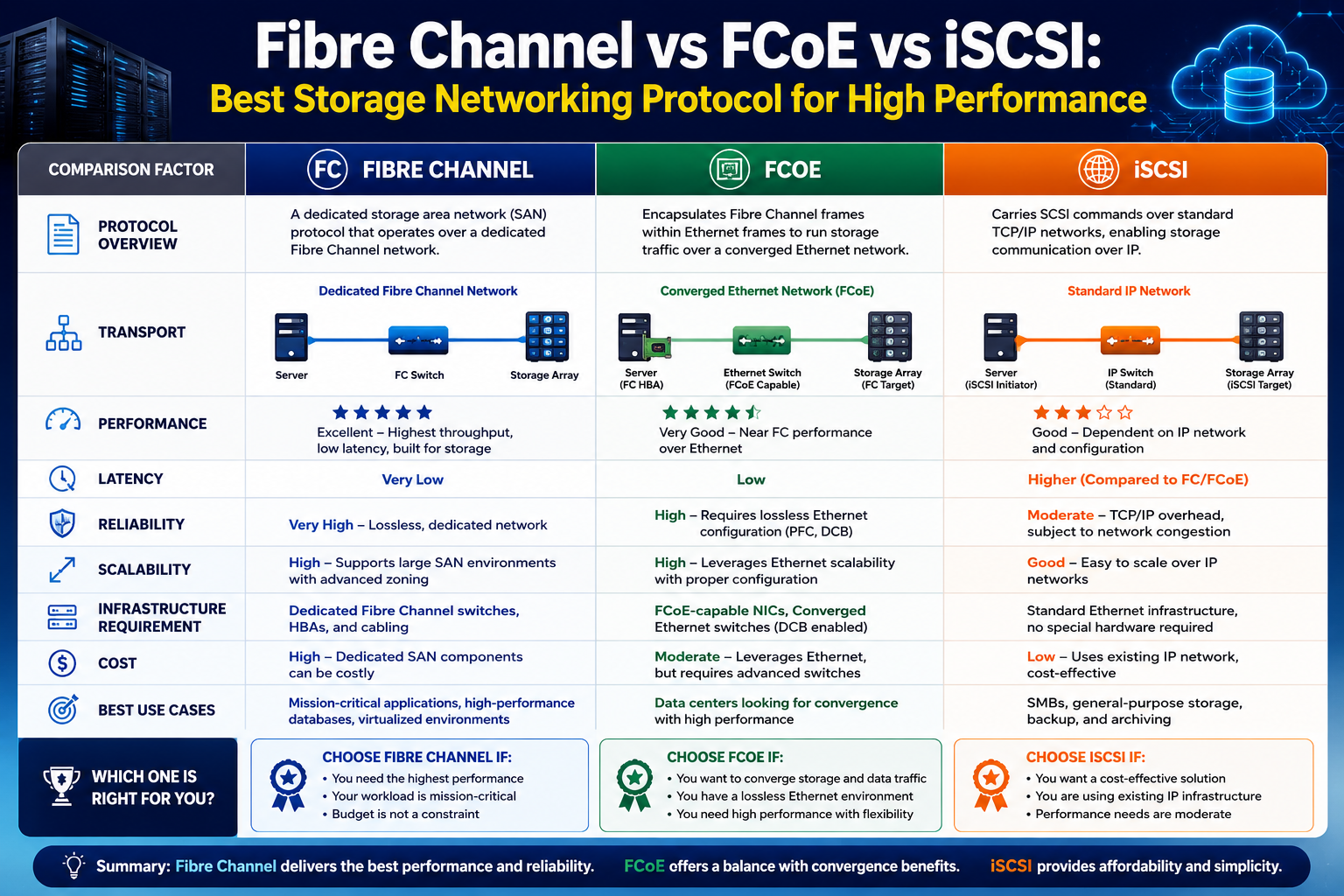
When examining Fibre Channel, iSCSI, and FCoE from a layered perspective, each protocol represents a different approach to solving the same fundamental problem: how to transport block storage commands efficiently across a network.
Fibre Channel operates as a dedicated transport system designed specifically for storage traffic, offering predictable performance and minimal overhead.
iSCSI leverages the general-purpose TCP/IP stack, prioritizing flexibility and compatibility over deterministic performance.
FCoE sits between these two approaches, preserving Fibre Channel semantics while using Ethernet as a transport layer, requiring enhancements to ensure reliable behavior.
Each approach reflects different design priorities, and understanding these differences is essential for evaluating storage architectures in real-world environments.
Performance Behavior in Real Enterprise Workloads
When organizations compare Fibre Channel, iSCSI, and FCoE, performance is usually the first concern, but “performance” in storage networking is not a single metric. It is a combination of latency, throughput, consistency, CPU overhead, and behavior under stress. Each protocol behaves differently because each one is built on a different transport philosophy.
Fibre Channel is designed from the ground up for storage traffic. Its architecture prioritizes predictable latency and consistent delivery. This is extremely important in workloads such as transactional databases, large virtualization clusters, and high-frequency financial systems where even small variations in latency can affect application behavior. Fibre Channel achieves this consistency by avoiding general-purpose networking overhead and by maintaining a lossless transport model.
iSCSI behaves differently because it depends on TCP/IP. In ideal conditions, modern iSCSI implementations can deliver very high throughput, especially when running over fast Ethernet links such as 10GbE, 25GbE, or higher. However, its performance is more sensitive to network congestion and CPU utilization. The TCP layer introduces additional processing, which can become noticeable under heavy load or when storage operations are extremely frequent and small in size.
FCoE sits between these two models. It avoids TCP overhead entirely, which reduces latency compared to iSCSI. However, it still depends on Ethernet infrastructure, which means its performance is tied to how well the network is engineered. If the underlying Ethernet environment is properly configured for lossless behavior, FCoE can closely match Fibre Channel performance characteristics.
The key difference is not just raw speed, but stability. Fibre Channel tends to deliver stable, predictable performance over time, while iSCSI and FCoE require more careful tuning to maintain consistent behavior under varying workloads.
Latency Sensitivity and Storage Application Behavior
Latency plays a critical role in storage systems because every read and write operation depends on how quickly data can be accessed or committed. Even small increases in latency can cascade into noticeable slowdowns for applications that rely heavily on storage.
Fibre Channel minimizes latency by eliminating unnecessary protocol layers. It provides a direct and efficient path for SCSI commands between servers and storage arrays. This is particularly beneficial in environments where thousands of small I/O operations occur per second, such as online transaction processing systems.
iSCSI introduces additional latency due to TCP/IP processing. Each storage operation must pass through multiple layers, including segmentation, routing, congestion control, and acknowledgment handling. While modern CPUs and network interface cards can offload much of this processing, it still adds overhead compared to Fibre Channel.
FCoE reduces latency compared to iSCSI by removing TCP from the path. However, it still relies on Ethernet switching behavior, which can introduce variability if the network is not carefully configured. For example, congestion in a shared Ethernet environment can affect storage flows unless traffic prioritization mechanisms are in place.
Latency sensitivity is not uniform across all workloads. Some applications, such as backup systems or archival storage, are more tolerant of delays. Others, such as virtual machine hosting or database systems, are extremely sensitive. This difference often influences protocol selection more than raw bandwidth capabilities.
CPU Utilization and Offloading Considerations
Another important performance factor is CPU usage. Storage protocols that rely heavily on software processing can consume significant CPU resources, which may otherwise be used for application workloads.
Fibre Channel typically uses dedicated Host Bus Adapters (HBAs) that handle much of the protocol processing in hardware. This offloads work from the CPU and ensures that storage operations do not compete heavily with application processes.
iSCSI, especially in software-based implementations, places more burden on the CPU. Every packet must be processed through the TCP/IP stack, which includes checksumming, segmentation, reassembly, and retransmission handling. While modern NICs support features such as TCP offload engines, the CPU impact is still generally higher than Fibre Channel.
FCoE uses Converged Network Adapters (CNAs) that combine Ethernet and Fibre Channel processing in hardware. This reduces CPU overhead significantly, bringing it closer to Fibre Channel efficiency. However, the effectiveness of offloading depends heavily on hardware quality and driver support.
In environments where CPU resources are limited or heavily utilized by applications, reducing storage-related CPU overhead becomes a critical factor in protocol selection.
Reliability Models and Fault Behavior
Reliability is another key dimension in storage networking. It is not only about avoiding failures, but also about how systems behave when failures occur.
Fibre Channel is designed with strong fault isolation and redundancy principles. Most deployments use dual fabrics, meaning that there are two completely independent network paths between servers and storage systems. If one path fails, the other continues operating without interruption. This design minimizes single points of failure and ensures high availability.
iSCSI relies on standard IP networking redundancy mechanisms. These may include multiple network paths, link aggregation, or routing failover. However, because iSCSI operates over shared networks, failure domains can be larger and more complex. A network issue can potentially affect both storage and non-storage traffic simultaneously.
FCoE inherits Fibre Channel’s logical model but runs over Ethernet infrastructure. This means reliability depends heavily on how the Ethernet network is designed. If Data Center Bridging features are properly implemented, FCoE can achieve strong reliability characteristics. However, misconfiguration or congestion in the Ethernet layer can impact storage performance.
A key difference is the scope of failure domains. Fibre Channel isolates storage traffic into dedicated networks, reducing cross-impact from other systems. iSCSI shares infrastructure with general traffic, increasing dependency on overall network health. FCoE attempts to balance these approaches but requires careful design to achieve similar isolation.
Scalability and Infrastructure Growth Patterns
Scalability refers to how easily a storage networking solution can grow as data volumes and system requirements increase. Each protocol scales differently due to its architectural design.
Fibre Channel scales by adding switches, ports, and fabrics. While it is highly reliable and performant, scaling often requires specialized hardware and careful planning. Expanding a Fibre Channel environment typically involves purchasing additional HBAs, switches, and cabling, which can increase cost and complexity.
iSCSI scales more naturally in many environments because it uses existing IP networks. Adding capacity often involves upgrading network bandwidth or adding additional storage targets. Because it runs over standard Ethernet, it can scale across large and geographically distributed environments more easily than Fibre Channel.
FCoE scales within data center environments where converged networking infrastructure exists. It is less flexible than iSCSI for wide-area deployments but more integrated than Fibre Channel in modern Ethernet-based data centers.
Scalability is not just about adding more devices. It also involves managing complexity. As storage systems grow, administrative overhead becomes a major factor. iSCSI generally offers simpler scaling from a hardware perspective, while Fibre Channel provides more structured and controlled scaling within dedicated environments.
Network Design Complexity and Operational Overhead
Operational complexity is often underestimated when choosing a storage protocol. While performance is important, the long-term cost of managing and maintaining the system can have an equally significant impact.
Fibre Channel networks are highly specialized. They require dedicated knowledge, including zoning, fabric management, and specialized troubleshooting techniques. While this complexity can lead to highly optimized systems, it also increases the skill requirements for administrators.
iSCSI integrates with standard IP networking, which most IT teams already understand. This reduces the learning curve and simplifies integration with existing infrastructure. However, because it shares networks with other traffic, proper configuration of QoS, VLANs, and routing policies becomes essential to maintain performance.
FCoE introduces a hybrid complexity model. It combines elements of both Fibre Channel and Ethernet networking. Administrators must understand storage concepts as well as advanced Ethernet features such as priority flow control and enhanced traffic management. This dual knowledge requirement can increase operational complexity.
The choice between these protocols often depends not only on technical performance but also on the availability of skilled personnel.
Cost Structures and Infrastructure Investment
Cost is a major deciding factor in storage networking design. Each protocol has a different cost profile, both in terms of initial investment and long-term maintenance.
Fibre Channel is typically the most expensive option. It requires specialized hardware, including HBAs, switches, and cabling. Storage arrays designed for Fibre Channel environments also tend to be more expensive. However, this cost is often justified in environments where performance and reliability are critical.
iSCSI is generally the most cost-effective option. It leverages existing Ethernet infrastructure, reducing the need for specialized hardware. Many organizations can deploy iSCSI using standard network interfaces and switches. This makes it particularly attractive for small to medium-sized environments or test and development systems.
FCoE falls between these two extremes. While it reduces the need for separate storage networks, it still requires enhanced Ethernet infrastructure and compatible hardware such as CNAs and Data Center Bridging-capable switches. This creates a moderate cost profile.
Cost considerations are not limited to hardware. They also include operational expenses, training, maintenance, and system downtime risk. A lower-cost system that is difficult to manage may become more expensive over time than a higher-cost but stable system.
Data Center Architecture and Modern Convergence Trends
Modern data centers are increasingly moving toward convergence, where multiple types of traffic share unified infrastructure. This includes storage, virtualization, application traffic, and management systems.
FCoE is a direct response to this trend, attempting to merge Fibre Channel storage traffic into Ethernet-based data center fabrics. This aligns with the broader industry shift toward unified networking models.
iSCSI naturally fits into this trend because it already operates over IP networks. As Ethernet speeds increase, iSCSI becomes more capable of handling high-performance workloads that previously required specialized storage networks.
Fibre Channel remains important in environments where stability and isolation are prioritized over convergence. Many large enterprises continue to rely on Fibre Channel for mission-critical systems due to its proven reliability.
The overall trend is not necessarily the replacement of one protocol by another, but rather coexistence. Different workloads often require different storage networking approaches.
Decision Factors in Real Deployment Scenarios
Choosing between Fibre Channel, FCoE, and iSCSI depends on multiple interconnected factors. These include workload type, performance requirements, budget constraints, existing infrastructure, and operational expertise.
High-performance transactional systems often favor Fibre Channel due to its predictable latency and strong isolation. Virtualized environments may use either Fibre Channel or FCoE, depending on infrastructure design. Distributed or cost-sensitive environments often lean toward iSCSI because of its flexibility and lower deployment cost.
There is no universal best choice. Each protocol represents a different balance between performance, complexity, cost, and flexibility. Understanding these trade-offs is essential for designing effective storage architectures that align with organizational goals and technical requirements.
Security Considerations in Storage Networking Protocols
Security behaves differently depending on whether storage traffic runs over a dedicated fabric or a shared network. This difference becomes especially important when comparing Fibre Channel, FCoE, and iSCSI.
Fibre Channel environments are often considered inherently more isolated because the storage network is physically separate from general-purpose traffic. This separation reduces exposure to external threats and limits the attack surface. However, Fibre Channel is not automatically secure by default. It still relies on mechanisms such as zoning and fabric-based access control to ensure that only authorized initiators can communicate with specific storage targets. Misconfigured zoning can lead to unauthorized access within the same fabric, even if external exposure is minimal.
iSCSI operates over IP networks, which makes it significantly more exposed to traditional network-based security risks. Because iSCSI traffic can traverse routed networks, it can potentially be intercepted or spoofed if not properly secured. Authentication mechanisms such as CHAP and network-level encryption options are often used to protect data in transit. Additionally, segmentation techniques like isolated VLANs or dedicated storage subnets are commonly implemented to reduce risk.
FCoE occupies a middle ground. Since it runs over Ethernet but avoids TCP/IP routing, it is less exposed to wide-area network threats than iSCSI. However, because it still shares Ethernet infrastructure, it depends heavily on internal network segmentation and Data Center Bridging configurations to maintain both performance and controlled access. In converged environments, improper configuration can expose storage traffic to unintended interference or lateral movement within the data center network.
Troubleshooting Complexity and Operational Visibility
Troubleshooting storage networking issues varies significantly across Fibre Channel, iSCSI, and FCoE, largely due to differences in protocol visibility and tooling.
Fibre Channel environments require specialized diagnostic tools and expertise. While the protocol is highly stable, identifying issues often involves analyzing fabric logs, switch port states, and HBA behavior. Because Fibre Channel networks are separate from IP networks, traditional network troubleshooting tools do not apply. This separation improves isolation but increases the learning curve for administrators.
iSCSI benefits from the extensive ecosystem of IP networking tools. Standard utilities used for diagnosing network latency, packet loss, and routing issues can also be applied to iSCSI traffic. This makes it easier for general network engineers to troubleshoot storage problems without specialized training. However, this shared visibility can also complicate root-cause analysis when storage performance issues are influenced by unrelated network congestion.
FCoE troubleshooting requires understanding both Ethernet and Fibre Channel behavior simultaneously. Administrators must interpret Ethernet-level diagnostics such as link status and congestion indicators alongside storage-level metrics such as LUN responsiveness and command latency. This dual-layer complexity can make issue resolution more challenging, especially in large converged environments.
Emerging Trends and the Evolution Beyond Traditional Protocols
Storage networking continues to evolve beyond the traditional boundaries of Fibre Channel, iSCSI, and FCoE. One of the most significant trends is the increasing focus on reducing latency at the storage protocol level itself.
Newer technologies such as NVMe-based storage networking are reshaping expectations for performance. These approaches are designed to eliminate inefficiencies in older SCSI-based models by enabling more direct communication between servers and storage devices. While Fibre Channel, iSCSI, and FCoE are still widely used, they are increasingly being evaluated alongside these newer architectures.
Another important trend is the continued convergence of networking and storage infrastructure. Modern data centers are moving toward unified fabrics where compute, storage, and application traffic coexist on high-speed Ethernet backbones. This reinforces the relevance of both iSCSI and FCoE, while also pushing Fibre Channel toward more specialized, high-performance niches.
Automation and orchestration are also changing how storage networks are managed. Instead of manually configuring zones, VLANs, or initiator mappings, many environments now rely on software-defined infrastructure to dynamically allocate storage resources. This reduces operational overhead and improves scalability across all three protocols.
Long-Term Strategic Alignment of Storage Protocol Choices
From a long-term perspective, choosing between Fibre Channel, FCoE, and iSCSI is not only a technical decision but also a strategic one that affects infrastructure direction, staffing, and upgrade paths.
Organizations that prioritize maximum stability and performance consistency often continue investing in Fibre Channel, especially for mission-critical workloads that cannot tolerate variability. These environments tend to evolve slowly and focus on incremental upgrades rather than architectural changes.
Environments that prioritize flexibility and cost efficiency often gravitate toward iSCSI, especially as Ethernet speeds continue to increase. This approach aligns well with cloud-oriented architectures, virtualization platforms, and distributed systems where scalability and ease of integration are more important than absolute determinism.
FCoE tends to be chosen in environments that are actively pursuing convergence strategies within the data center. It is most effective when organizations want to reduce infrastructure sprawl while still maintaining Fibre Channel semantics. However, its adoption often depends on the maturity of the Ethernet infrastructure and the availability of skilled personnel.
Over time, these choices tend to reflect broader architectural philosophies rather than isolated technical preferences. Storage networking becomes part of a larger design narrative that includes performance expectations, operational efficiency, and long-term infrastructure evolution.
Conclusion
Fibre Channel, iSCSI, and Fibre Channel over Ethernet each represent different approaches to solving the same core challenge: delivering reliable, high-performance block storage across a network. Fibre Channel remains the most specialized option, offering exceptional consistency, low latency, and strong isolation through dedicated infrastructure. It is widely trusted in mission-critical environments where predictable performance is essential, and cost is secondary to reliability.
iSCSI takes a more flexible and accessible approach by using standard TCP/IP and Ethernet networks. Its strength lies in simplicity, cost efficiency, and ease of integration into existing infrastructures. While it may introduce higher latency and variability compared to Fibre Channel, modern high-speed networks and optimization techniques have made it suitable for many enterprise and cloud-based workloads.
FCoE attempts to bridge the gap by combining Fibre Channel semantics with Ethernet transport, enabling network convergence while preserving storage performance characteristics. However, it requires careful design and specialized configuration to achieve optimal results.
Ultimately, the best choice depends on workload demands, infrastructure strategy, budget, and operational expertise. No single protocol is universally superior; each plays an important role in modern storage networking ecosystems.