In recent years, data has shifted from being a byproduct of business activity to becoming one of the most valuable assets an organization can possess. Every interaction, transaction, click, and operational process generates information that can be collected, stored, and analyzed. Companies across industries are now realizing that the ability to interpret this data effectively can directly influence decision-making, efficiency, customer satisfaction, and long-term profitability. This growing dependence on data has created a strong demand for professionals who can transform raw information into meaningful insights.
One of the key drivers behind this transformation is the sheer volume of data being generated every day. Organizations are no longer dealing with small, structured datasets. Instead, they are managing vast and complex streams of structured and unstructured information coming from websites, mobile applications, cloud systems, sensors, and customer interactions. Without proper analysis, much of this data remains unused and fails to deliver value. As a result, businesses are actively seeking ways to convert this unused potential into actionable intelligence.
At the same time, technological advancements have significantly reduced the barriers that once made data analysis accessible only to large enterprises. In the past, organizations needed expensive infrastructure, specialized software, and highly technical teams to work with data at scale. Today, modern analytics platforms have made it possible for even small and medium-sized businesses to leverage advanced data processing and visualization tools. This democratization of data technology has expanded opportunities for professionals in the field and increased the importance of structured learning and validation of skills.
Another important factor contributing to the rise of data analysis is competition. In highly competitive markets, businesses can no longer rely solely on intuition or traditional reporting methods. They need real-time insights, predictive models, and detailed performance metrics to stay ahead. Data-driven decision-making has become a core strategy rather than an optional enhancement. This shift has created a need for individuals who not only understand data but can also present it in a way that supports strategic business goals.
As organizations continue to evolve, data analysis is becoming deeply integrated into every function, from marketing and finance to operations and supply chain management. This widespread adoption highlights why structured knowledge frameworks and certifications in data analytics have gained attention among professionals aiming to build or transition into data-focused careers.
Understanding Microsoft DA-100 and Its Purpose in the Certification Landscape
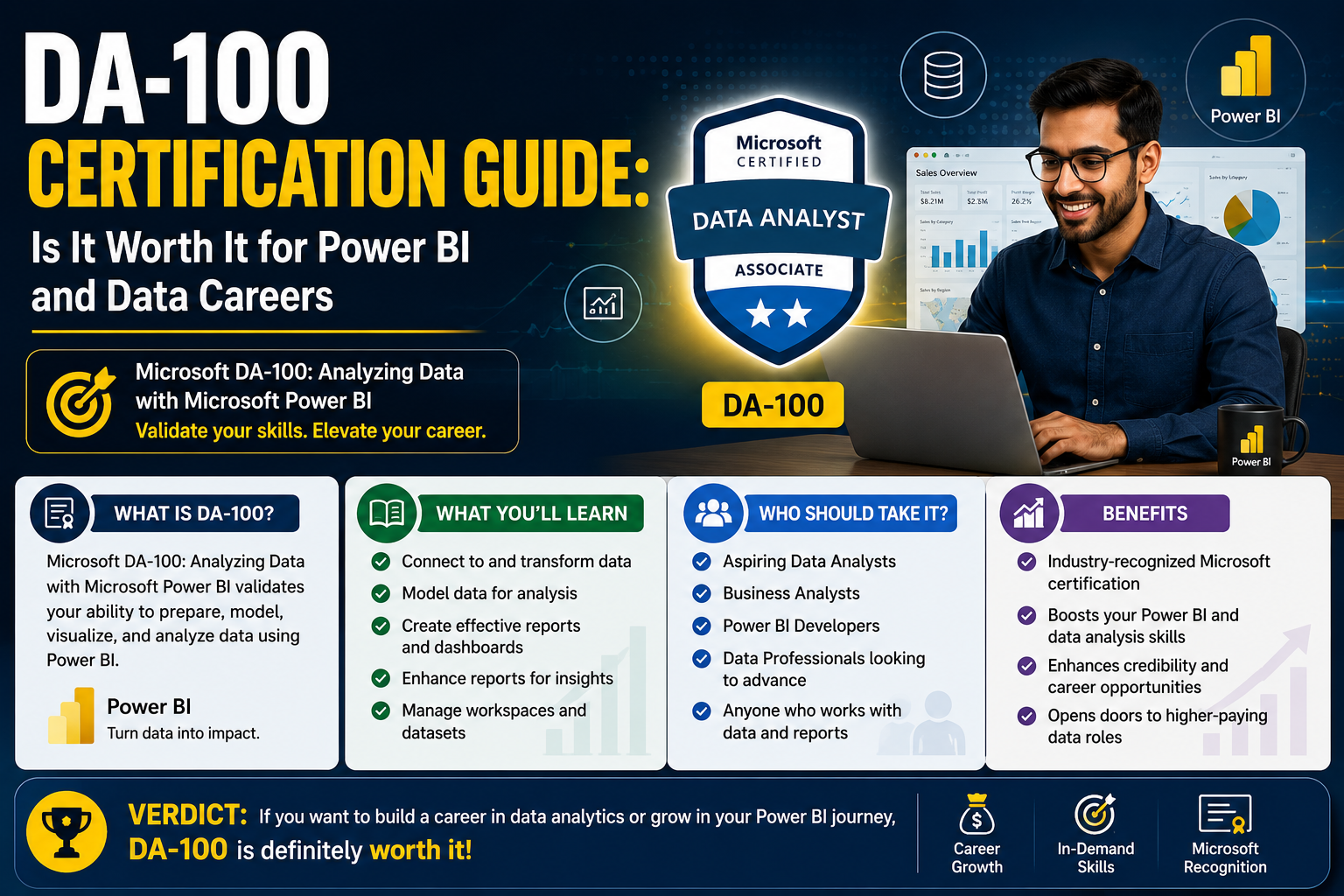
The DA-100 certification, officially known as Analyzing Data with Microsoft Power BI, was designed to validate the ability of professionals to work with data using modern business intelligence tools. It represents a structured approach to assessing skills related to preparing, modeling, visualizing, and analyzing data within a business context. Unlike traditional exams that focus heavily on theoretical knowledge, this certification emphasizes practical application and real-world data scenarios.
The certification sits within a broader movement toward role-based learning paths. Instead of focusing solely on a single tool or technology, it is designed to evaluate how effectively a professional can perform the responsibilities of a data analyst role. This includes understanding how to work with data from multiple sources, how to clean and structure it, and how to present it in a way that supports decision-making processes within organizations.
One of the most important aspects of this certification is its connection to Microsoft Power BI, a widely used business intelligence platform. Power BI plays a central role in the exam because it reflects the type of tools commonly used in modern organizations. By aligning the certification with a real-world platform, it ensures that individuals who achieve it have skills that can be directly applied in workplace environments.
The DA-100 certification also evolved from earlier exam formats that were more tool-specific. Over time, Microsoft recognized that employers were not just looking for tool proficiency but for individuals who could think analytically and understand business requirements. This shift led to a broader evaluation structure that includes conceptual understanding alongside technical execution.
Another important purpose of the certification is skill validation. Many professionals acquire data-related experience through on-the-job training, but this experience can sometimes leave gaps in understanding. The certification helps bridge these gaps by covering a wide range of topics that reflect real-world responsibilities. It serves as a benchmark for employers to assess whether a candidate has a well-rounded understanding of data analysis principles.
How Microsoft Power BI Fits into the Data Analytics Ecosystem
Microsoft Power BI plays a central role in modern data analytics workflows because it brings together data collection, transformation, modeling, and visualization into a single integrated environment. Its significance lies in its ability to connect to multiple data sources and unify them into a coherent structure that can be analyzed efficiently. This capability is especially important in environments where data is scattered across different systems and platforms.
One of the key strengths of Power BI is its accessibility. It is designed to be user-friendly, allowing professionals with varying levels of technical expertise to create meaningful reports and dashboards. While advanced users can leverage complex data modeling and transformations, even beginners can use its graphical interface to build basic visualizations. This flexibility makes it suitable for a wide range of users, from business analysts to decision-makers.
Another important aspect of Power BI is its ability to handle large datasets. Organizations today often deal with millions of data points, and traditional tools may struggle to process such volumes efficiently. Power BI is built to handle these challenges by optimizing data storage and processing mechanisms, enabling faster insights and smoother performance.
In addition to data handling, Power BI emphasizes visualization. Data on its own can be difficult to interpret, especially when dealing with complex datasets. By converting data into charts, graphs, and interactive dashboards, Power BI helps users identify patterns, trends, and anomalies more easily. This visual representation is crucial for communicating insights to stakeholders who may not have technical backgrounds.
The platform also supports real-time data updates, which are increasingly important in dynamic business environments. Organizations can monitor key metrics as they change, allowing for quicker responses to emerging trends or issues. This real-time capability enhances decision-making speed and accuracy, making Power BI a valuable tool in operational and strategic planning.
Overall, Power BI serves as the practical foundation for the DA-100 certification because it reflects the real tools and workflows used in data-driven organizations. Its integration into the certification ensures that professionals are prepared to handle actual business scenarios rather than theoretical exercises.
Core Competencies Measured in DA-100 and What They Represent
The DA-100 certification is structured around several core competency areas that collectively define the skill set of a data analyst. These competencies are designed to reflect the full lifecycle of data handling within an organization, from initial preparation to final reporting and maintenance.
One of the primary competency areas is data preparation. This involves collecting data from different sources, cleaning it, and ensuring it is suitable for analysis. In real-world scenarios, data is often incomplete, inconsistent, or poorly structured. The ability to transform such data into a usable format is a critical skill for any analyst. This stage also includes tasks such as removing duplicates, handling missing values, and standardizing formats.
Another key area is data modeling. Once data is prepared, it needs to be structured in a way that supports analysis. Data modeling involves defining relationships between different datasets, creating calculated fields, and organizing information in a logical manner. A well-designed data model ensures that analysis can be performed efficiently and accurately.
Data visualization is also a major component of the certification. This competency focuses on representing data visually to communicate insights effectively. It involves selecting appropriate chart types, designing dashboards, and ensuring that visual elements are clear and meaningful. Effective visualization helps stakeholders understand complex data without needing to interpret raw numbers.
Data analysis itself is another critical area. This involves interpreting data to identify patterns, trends, and insights that can support business decisions. Analytical thinking is essential here, as it requires the ability to go beyond surface-level observations and understand underlying causes and relationships within the data.
Finally, deployment and maintenance are also included in the certification framework. This involves sharing reports, managing access, and ensuring that data solutions remain functional and up to date. In real-world environments, data systems are constantly evolving, so maintaining their accuracy and relevance is an important responsibility.
Together, these competencies form a comprehensive skill set that reflects the responsibilities of a modern data analyst.
The Shift Toward Role-Based Data Analytics Skills
The evolution of data analytics certifications reflects a broader shift in how professional skills are evaluated. Instead of focusing solely on specific tools or software features, modern certifications emphasize role-based competencies. This means that the focus is on what a professional needs to accomplish in their job rather than just how to use a particular application.
In the context of data analytics, this shift is particularly important. Organizations are not just looking for individuals who can operate software; they need professionals who can understand business problems, translate them into data requirements, and deliver meaningful insights. This requires a combination of technical skills, analytical thinking, and communication abilities.
Role-based learning also helps bridge the gap between technical knowledge and practical application. Many professionals may be familiar with tools but lack experience in applying them to real business scenarios. By focusing on job roles, certifications like DA-100 ensure that candidates are prepared for actual workplace challenges.
This approach also aligns better with industry expectations. As data becomes more integrated into business operations, the demand for professionals who can think strategically about data is increasing. Employers value individuals who can connect data insights to business outcomes rather than simply generating reports.
Another advantage of role-based skills is adaptability. Tools and technologies evolve rapidly, but core analytical skills remain relevant over time. By focusing on underlying principles such as data modeling, visualization, and interpretation, professionals can adapt more easily to new platforms and systems.
This shift represents a significant change in how data-related skills are developed and validated, making certifications like DA-100 more aligned with real-world expectations.
Practical Data Preparation and Modeling in Real Business Environments
Data preparation and modeling are foundational elements of any data analysis process, and they play a crucial role in real business environments. Before any meaningful insights can be generated, data must be cleaned, organized, and structured in a way that supports analysis. This process often requires working with data from multiple sources, each with its own format, structure, and level of quality.
In practical scenarios, data preparation involves identifying inconsistencies such as missing values, duplicate entries, and formatting errors. These issues are common because data is often collected from different systems that may not follow the same standards. Cleaning this data ensures that the analysis is accurate and reliable.
Once the data is prepared, the next step is modeling. Data modeling involves creating relationships between different datasets so that they can be analyzed together. For example, customer data may need to be linked with sales data to understand purchasing behavior. This requires careful structuring to ensure that relationships are correctly defined.
In addition to relationships, data modeling also involves creating calculated fields and measures that support analysis. These calculations help derive new insights from existing data, such as total sales, average performance, or growth rates. Proper modeling ensures that these calculations are consistent and reusable across different reports.
Effective data modeling also improves performance. Well-structured models allow systems to process queries more efficiently, reducing the time required to generate reports. This is particularly important in large organizations where datasets can be extremely large and complex.
Overall, data preparation and modeling form the backbone of the analytical process, enabling accurate and efficient data interpretation in business environments.
Data Visualization as a Decision-Making Tool
Data visualization is one of the most powerful aspects of modern data analytics because it transforms complex datasets into visual formats that are easier to understand. In business environments, decision-makers often need to interpret large volumes of information quickly. Visual representations such as charts, graphs, and dashboards make this possible by highlighting key patterns and trends.
One of the main advantages of visualization is clarity. Raw data can be overwhelming, especially when dealing with large datasets. Visualization simplifies this information by focusing on important metrics and presenting them in an intuitive format. This allows stakeholders to grasp insights without needing technical expertise.
Another important aspect is interactivity. Modern visualization tools allow users to explore data dynamically by filtering, drilling down, and adjusting views. This interactive capability enables deeper analysis and helps uncover insights that may not be visible in static reports.
Visualization also plays a key role in communication. In many organizations, data analysts are required to present findings to non-technical audiences. Well-designed visualizations make it easier to communicate complex insights clearly and compellingly.
Additionally, visualization supports faster decision-making. When data is presented visually, patterns and anomalies become more apparent, allowing decision-makers to respond quickly to changes in business conditions.
Advanced Data Analysis and the Shift from Reporting to Insight Generation
As organizations mature in their use of data, the focus gradually shifts from basic reporting to deeper forms of analysis that can drive strategic decisions. Reporting typically answers what has happened, while advanced data analysis focuses on why it happened and what might happen next. This transition marks a significant evolution in how businesses use information, and it is one of the key areas reflected in modern data analyst skill expectations.
In real-world environments, data analysis is rarely a straightforward process. Analysts often begin with structured reports that summarize key metrics such as sales, revenue, customer engagement, or operational performance. However, these summaries are only the starting point. The real value emerges when analysts begin exploring relationships within the data, identifying patterns, and uncovering anomalies that are not immediately visible.
For example, a decline in sales might initially appear as a simple numerical drop. But through deeper analysis, it may reveal underlying issues such as seasonal changes, shifts in customer preferences, supply chain disruptions, or pricing inconsistencies. This type of insight requires not only technical skill but also analytical thinking and domain understanding.
Modern analytics tools have made this process more accessible by offering built-in functions for statistical analysis, forecasting, and trend detection. However, tools alone are not enough. The effectiveness of analysis depends heavily on the analyst’s ability to ask the right questions and interpret results in a meaningful business context.
Another important aspect of advanced analysis is segmentation. Instead of looking at data as a whole, analysts break it down into meaningful groups such as customer demographics, geographic regions, or product categories. This allows organizations to understand performance at a granular level and tailor strategies accordingly.
In addition, comparative analysis plays a crucial role in decision-making. By comparing current performance against historical data, benchmarks, or industry standards, organizations can evaluate progress and identify areas for improvement. This type of analysis is especially valuable in competitive markets where small differences in performance can have significant impacts.
Ultimately, advanced data analysis transforms raw information into actionable intelligence. It enables organizations to move beyond observation and into explanation, prediction, and optimization.
Building Analytical Thinking Through Structured Data Interpretation
One of the most important skills for any data professional is analytical thinking. This skill goes beyond technical knowledge and focuses on how effectively an individual can interpret data, identify relationships, and derive meaningful conclusions.
Analytical thinking begins with curiosity. Instead of accepting data at face value, analysts question why certain patterns exist and what factors might be influencing them. This mindset is essential because data rarely tells a complete story on its own. It must be interpreted within context.
For instance, an increase in website traffic might initially seem positive. However, without further analysis, it is unclear whether this traffic is relevant or converting into meaningful outcomes such as sales or engagement. Analytical thinking helps uncover these deeper layers of meaning.
Another important component is logical reasoning. Data analysis often involves connecting multiple pieces of information to form a coherent explanation. This requires the ability to identify cause-and-effect relationships and distinguish between correlation and causation.
Structured thinking also plays a role in breaking down complex problems into manageable components. Large datasets can be overwhelming, but by dividing them into smaller segments, analysts can focus on specific areas and build insights incrementally.
Pattern recognition is another critical aspect. Over time, analysts develop the ability to recognize recurring trends within data. These patterns can provide valuable insights into customer behavior, operational efficiency, or market dynamics.
Analytical thinking is not limited to technical environments. It is a transferable skill that can be applied across industries, including finance, healthcare, marketing, and logistics. This universality makes it one of the most valuable competencies in the modern data-driven economy.
The Role of Data Analysis in Business Decision-Making
Data analysis plays a central role in modern business decision-making processes. Organizations rely on data to reduce uncertainty, validate assumptions, and guide strategic planning. Instead of relying solely on intuition or experience, decision-makers increasingly depend on data-driven insights.
One of the key benefits of data analysis in decision-making is accuracy. Decisions based on data are generally more reliable because they are grounded in measurable evidence. This reduces the risk of bias and subjective judgment.
Another important benefit is speed. In fast-paced business environments, timely decisions are critical. Data analysis tools allow organizations to access real-time or near-real-time information, enabling quicker responses to market changes or operational challenges.
Data also enhances transparency in decision-making. When decisions are based on clearly defined metrics and visualized data, it becomes easier to justify and communicate those decisions to stakeholders. This improves accountability and alignment across teams.
In strategic planning, data analysis helps organizations identify growth opportunities. By analyzing market trends, customer behavior, and competitive dynamics, businesses can make informed decisions about expansion, product development, and investment.
Operational decision-making also benefits from data analysis. For example, supply chain optimization, resource allocation, and process improvement can all be guided by insights derived from data. This leads to increased efficiency and cost savings.
In many organizations, data has become a central part of decision-making culture. Instead of relying on isolated reports, teams collaborate using shared dashboards and analytical models that provide a unified view of performance.
Understanding Deployment and Data Solution Management in Real Environments
Once data models and reports are created, they must be deployed and managed within an organizational environment. Deployment refers to the process of making data solutions available to users, while maintenance involves ensuring that these solutions continue to function correctly over time.
In real-world scenarios, deployment is not simply about publishing reports. It involves setting up access controls, defining user permissions, and ensuring that data is securely shared with the right stakeholders. Security is a critical consideration because sensitive business information must be protected from unauthorized access.
Another important aspect of deployment is performance optimization. As the number of users and volume of data increase, systems must be able to handle higher loads without compromising speed or reliability. This often requires optimizing data models and queries to ensure efficient processing.
Data refresh mechanisms are also a key part of deployment. Since business data changes continuously, reports must be updated regularly to reflect the latest information. Automated refresh schedules help ensure that users always have access to current data without manual intervention.
Maintenance involves monitoring the health of data solutions over time. This includes identifying and resolving errors, updating data sources, and adapting models to changing business requirements. As organizations evolve, their data needs also change, requiring continuous adjustments to analytical systems.
Another important element of maintenance is version control. As reports and models are updated, it is essential to track changes to avoid inconsistencies and ensure that users are working with the correct versions of data assets.
Effective deployment and maintenance practices ensure that data solutions remain reliable, scalable, and aligned with business objectives.
The Expanding Role of Data Analysts in Modern Organizations
The role of a data analyst has evolved significantly over the past decade. Traditionally, analysts were primarily responsible for generating reports and summarizing historical data. Today, their responsibilities extend far beyond reporting and include interpretation, strategy support, and communication of insights.
Modern data analysts are expected to work closely with business teams to understand requirements and translate them into analytical solutions. This requires strong communication skills in addition to technical expertise. Analysts must be able to explain complex data concepts in a way that is understandable to non-technical stakeholders.
Another important aspect of the role is collaboration. Data analysts often work alongside data engineers, business managers, and IT teams to ensure that data flows smoothly across systems. This collaborative environment requires flexibility and the ability to work within cross-functional teams.
In many organizations, data analysts also play a role in identifying opportunities for process improvement. By analyzing operational data, they can highlight inefficiencies and suggest data-driven solutions to enhance performance.
The increasing importance of data-driven decision-making has also elevated the strategic value of the analyst role. Instead of being limited to back-end reporting, analysts are now actively involved in shaping business strategies and guiding executive decisions.
This expanded role requires a broader skill set that includes technical knowledge, analytical thinking, and business understanding. It also highlights the importance of structured learning paths that prepare professionals for real-world responsibilities.
The Relationship Between Tools and Analytical Understanding
While tools like Power BI are essential for data analysis, they are only part of the overall skill set required for effective analysis. Tools provide the infrastructure and capabilities needed to process and visualize data, but the true value comes from how those tools are used.
A common misconception is that mastering a tool alone is sufficient to become a data analyst. In reality, tools are simply enablers. Without a strong understanding of data principles, even the most advanced tools cannot produce meaningful insights.
For example, a visualization tool can generate charts and dashboards, but it is up to the analyst to determine which metrics are relevant and how they should be presented. Poorly chosen visualizations can lead to misinterpretation or confusion, even if the underlying tool is powerful.
Similarly, data modeling tools can help structure information, but incorrect relationships or poorly designed models can lead to inaccurate analysis. This highlights the importance of conceptual understanding alongside technical proficiency.
Analytical thinking, business context, and problem-solving skills are what ultimately differentiate effective analysts from those who simply operate tools. The combination of tool proficiency and analytical understanding creates a well-rounded professional capable of delivering meaningful insights.
Data Integration Challenges in Modern Systems
One of the most complex aspects of data analysis in real environments is data integration. Organizations often store data in multiple systems, including databases, cloud platforms, spreadsheets, and external applications. Bringing all this data together into a unified view is a significant challenge.
One common issue is inconsistency in data formats. Different systems may use different structures, naming conventions, or data types. This requires careful transformation to ensure compatibility.
Another challenge is data quality. Incomplete or inaccurate data can significantly impact the reliability of the analysis. Analysts must often spend considerable time cleaning and validating data before it can be used effectively.
Latency is also a concern in data integration. Some systems update in real time, while others operate on scheduled intervals. Aligning these different update cycles is necessary to ensure consistency in reporting.
In addition, scalability becomes an issue as data volume grows. Systems must be able to handle increasing amounts of data without degradation in performance.
Despite these challenges, effective data integration is essential for providing a complete and accurate view of business operations. It enables organizations to make decisions based on comprehensive information rather than isolated datasets.
The Evolution of Business Intelligence and the Growing Role of Data Analysts
Business intelligence has undergone a major transformation over the past decade. What once relied heavily on static reports and periodic summaries has now shifted toward dynamic, real-time insights that support continuous decision-making. This evolution has been driven by the increasing availability of data, improvements in computing power, and the widespread adoption of modern analytics platforms.
In earlier business environments, decision-making often depended on historical reports that were generated weekly or monthly. These reports provided a snapshot of past performance but offered limited insight into current conditions or future trends. As a result, organizations were often reacting to changes rather than proactively addressing them.
Today, business intelligence systems are far more interactive and responsive. They allow users to explore data in real time, filter information dynamically, and drill down into specific areas of interest. This shift has fundamentally changed how organizations operate, making data a continuous input into decision-making processes rather than a retrospective tool.
Data analysts now play a central role in this ecosystem. Their responsibilities extend beyond generating reports to include designing data models, building interactive dashboards, and interpreting complex datasets. They act as a bridge between raw data and business strategy, ensuring that insights are both accurate and actionable.
One of the key developments in this space is the integration of self-service analytics. This approach allows non-technical users to access and analyze data without relying entirely on specialized teams. While this increases accessibility, it also places greater importance on data governance and model design to ensure consistency and reliability.
As business intelligence continues to evolve, the role of the data analyst becomes increasingly strategic. Analysts are no longer just data providers; they are decision-support professionals who influence how organizations interpret and act on information.
Data Modeling as the Foundation of Reliable Analytics Systems
Data modeling is one of the most critical components of any analytics system. It provides the structure that allows data to be organized, related, and analyzed effectively. Without proper data modeling, even the most advanced visualization tools cannot produce accurate or meaningful insights.
At its core, data modeling involves defining how different datasets relate to one another. This includes identifying key entities such as customers, products, transactions, and time periods, and establishing relationships between them. These relationships form the foundation of analytical queries and reporting structures.
A well-designed data model ensures consistency across reports. When data is structured logically, different users can access the same information without discrepancies or conflicting interpretations. This is especially important in large organizations where multiple teams rely on shared data sources.
Another important aspect of data modeling is normalization and optimization. Data must be structured in a way that minimizes redundancy while maximizing efficiency. Poorly designed models can lead to slow performance, inaccurate calculations, and difficulty in scaling systems.
In analytical environments, data models often include calculated fields and measures that derive new insights from existing data. These calculations might include totals, averages, growth rates, or more complex aggregations. Properly designed measures ensure that insights remain consistent across different reports and dashboards.
Data modeling also supports flexibility. As business requirements change, models must be adaptable enough to incorporate new data sources or analytical needs. This requires careful planning and a deep understanding of both technical structures and business processes.
Ultimately, data modeling serves as the backbone of any analytics system, ensuring that data is reliable, scalable, and meaningful.
Data Visualization as a Communication Bridge Between Data and Decision-Makers
Data visualization plays a crucial role in transforming complex datasets into understandable and actionable insights. While raw data can be overwhelming and difficult to interpret, visual representations make it easier to identify patterns, trends, and relationships.
One of the primary purposes of visualization is to simplify complexity. Large datasets often contain thousands or even millions of data points, making it difficult to extract meaningful information without a structured representation. Charts, graphs, and dashboards help condense this information into visual formats that highlight key insights.
Another important function of visualization is storytelling. Data alone does not tell a story; it requires interpretation and context. Visualizations help analysts present data in a way that communicates a clear narrative, showing how different factors relate to each other and what those relationships mean for the business.
Interactivity has become a major feature of modern visualization systems. Users can now interact with dashboards by filtering data, selecting time ranges, and drilling down into specific categories. This allows for more detailed exploration and a deeper understanding of underlying trends.
Color, layout, and design also play an important role in effective visualization. Poorly designed visuals can lead to confusion or misinterpretation, while well-designed dashboards enhance clarity and focus attention on the most important metrics.
In addition, visualization supports faster decision-making. When information is presented visually, decision-makers can quickly grasp key insights without needing to analyze raw data. This speed is essential in environments where timely decisions can have significant business impacts.
Data visualization ultimately acts as a bridge between technical analysis and business understanding, enabling communication across different levels of an organization.
Analytical Thinking in Complex Data Environments
Analytical thinking is one of the most important skills required for working with data effectively. It involves the ability to break down complex problems, evaluate information logically, and draw meaningful conclusions based on evidence.
In real-world data environments, problems are rarely straightforward. Data may be incomplete, inconsistent, or influenced by multiple factors. Analytical thinking helps professionals navigate this complexity by focusing on structure and logic rather than assumptions.
One key aspect of analytical thinking is problem decomposition. Large analytical challenges are broken down into smaller, more manageable components. This allows analysts to focus on specific areas of interest and build insights step by step.
Another important element is critical evaluation. Not all data is equally reliable or relevant, and analysts must assess the quality and validity of the information they are working with. This includes identifying biases, inconsistencies, and potential errors.
Pattern recognition also plays a significant role. Over time, analysts develop the ability to identify recurring trends within datasets. These patterns can provide valuable insights into customer behavior, operational efficiency, or market dynamics.
Logical reasoning is essential for connecting different pieces of information. Analysts must often work with multiple datasets and determine how they relate to one another. This requires the ability to establish cause-and-effect relationships and evaluate alternative explanations.
Analytical thinking is not limited to technical roles. It is a transferable skill that can be applied across industries and disciplines, making it one of the most valuable competencies in the modern workforce.
The Increasing Importance of Data-Driven Decision Culture
Organizations today are increasingly adopting data-driven decision-making cultures. This means that decisions are based on evidence derived from data rather than intuition or personal experience alone. This shift has significant implications for how businesses operate and compete.
One of the main advantages of a data-driven culture is objectivity. Decisions based on data are less likely to be influenced by personal bias or subjective judgment. This leads to more consistent and reliable outcomes.
Another benefit is accountability. When decisions are supported by data, it becomes easier to track performance and evaluate results. This transparency helps organizations identify what is working and what needs improvement.
Data-driven cultures also promote continuous improvement. By regularly analyzing performance data, organizations can identify inefficiencies and implement changes to optimize processes. This creates a cycle of ongoing refinement and enhancement.
In addition, data-driven decision-making supports innovation. By analyzing trends and patterns, organizations can identify new opportunities and develop innovative solutions to emerging challenges.
However, adopting a data-driven culture requires more than just technology. It also involves changes in mindset, processes, and organizational structure. Employees must be trained to interpret data effectively, and leadership must prioritize evidence-based decision-making.
Data analysts play a key role in this transformation by providing the insights needed to support informed decisions across the organization.
Challenges in Working with Large and Complex Data Systems
As organizations grow, so does the complexity of their data systems. Managing large volumes of data from multiple sources presents several challenges that must be addressed to ensure effective analysis.
One of the most common challenges is data fragmentation. Information is often stored in different systems that do not communicate seamlessly with each other. This makes it difficult to create a unified view of the data.
Another challenge is data quality. Inconsistent or inaccurate data can lead to misleading insights. Ensuring data accuracy requires ongoing validation and cleaning processes.
Scalability is also a major concern. As data volumes increase, systems must be able to handle larger workloads without performance degradation. This often requires optimization of data models and infrastructure.
Data security is another critical issue. Sensitive information must be protected from unauthorized access while still being accessible to authorized users. Balancing accessibility and security is a key challenge in modern data environments.
Integration complexity further complicates data management. Combining data from different sources with varying formats and structures requires careful transformation and alignment.
Despite these challenges, effective data management is essential for enabling accurate and reliable analysis. Organizations that successfully address these issues are better positioned to leverage data as a strategic asset.
The Expanding Skill Set of Modern Data Professionals
The role of data professionals has expanded significantly in recent years. Modern analysts are expected to possess a diverse set of skills that go beyond traditional data handling.
Technical skills remain important, including data modeling, visualization, and familiarity with analytics tools. However, these skills are now complemented by broader capabilities such as business understanding, communication, and problem-solving.
Communication skills are particularly important because analysts must often present findings to non-technical audiences. The ability to translate complex data into clear and understandable insights is essential for effective collaboration.
Business understanding is another critical component. Analysts must understand the context in which data is used, including industry dynamics, organizational goals, and operational processes. This allows them to generate insights that are relevant and actionable.
Problem-solving skills enable analysts to approach complex challenges systematically. Instead of focusing solely on data outputs, they must identify underlying issues and develop solutions based on evidence.
Adaptability is also increasingly important. As tools and technologies evolve, data professionals must continuously update their skills and remain flexible in their approach to analysis.
This expanded skill set reflects the growing importance of data in modern organizations and highlights the need for continuous learning and development in the field.
Conclusion
The growing importance of data in modern organizations has fundamentally reshaped how businesses operate, make decisions, and plan for the future. What was once considered a supporting function has now become a central pillar of strategic thinking. Across industries, data is no longer just collected for record-keeping; it is actively analyzed, interpreted, and transformed into meaningful insights that influence everything from daily operations to long-term business direction.
As this shift continues, the role of data professionals has also evolved significantly. Today’s data analysts are expected to do far more than generate reports or visualize numbers. They are required to understand business problems, work with complex datasets, build reliable data models, and communicate insights in a way that supports decision-making at all levels of an organization. This combination of technical ability and analytical thinking makes the role both challenging and highly valuable.
Modern tools such as Power BI have played a key role in making data analysis more accessible and efficient. By enabling users to connect multiple data sources, transform raw information, and build interactive visualizations, these platforms have reduced technical barriers and expanded opportunities for professionals entering the field. However, while tools provide the foundation, the real value comes from how effectively they are used to interpret data and generate insights.
At the same time, organizations are increasingly recognizing that successful data analysis depends on more than just software proficiency. Strong data modeling, clear visualization practices, and structured analytical thinking are essential for ensuring that insights are accurate, consistent, and actionable. Without these foundational skills, even the most advanced tools cannot deliver meaningful results.
Another important aspect of this evolution is the shift toward data-driven decision-making. Businesses are now relying on evidence-based insights rather than intuition alone, leading to more objective, transparent, and efficient decision processes. This change has increased the demand for professionals who can bridge the gap between raw data and strategic action.
Despite the many opportunities in this field, challenges remain. Data complexity, integration issues, and quality concerns continue to require careful attention. As organizations grow and data systems become more interconnected, the ability to manage and interpret large datasets effectively becomes even more critical.
Ultimately, the field of data analysis represents a dynamic and continuously evolving landscape. It requires a balance of technical expertise, analytical reasoning, and business understanding. As data continues to expand in volume and importance, professionals who can harness its potential will play a crucial role in shaping the future of organizations.