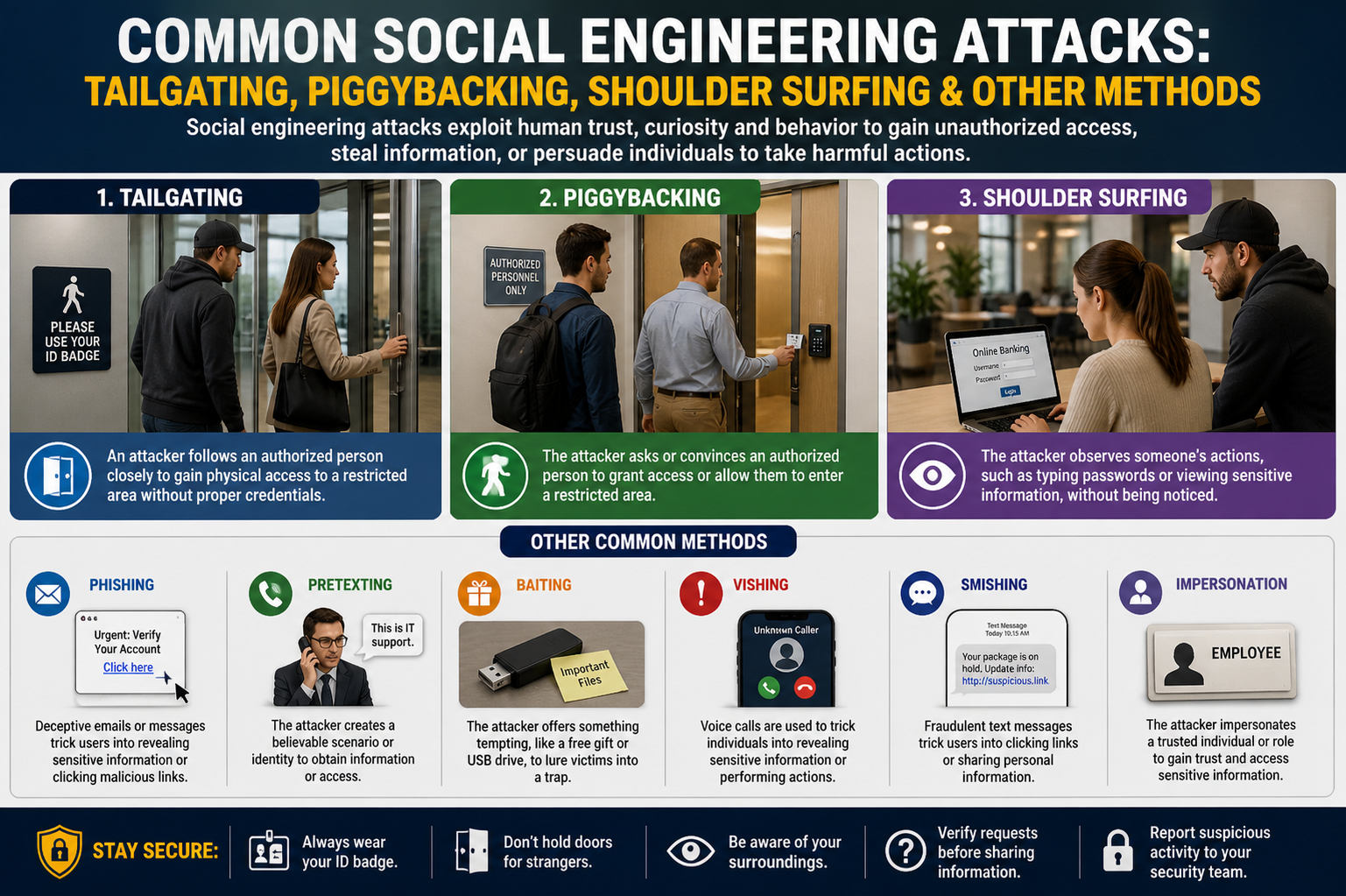
Social engineering is one of the most deceptive and effective forms of cybercrime because it targets human behavior rather than technological systems. Instead of breaking through firewalls or hacking complex code, attackers manipulate individuals into voluntarily giving away sensitive information or granting access. This manipulation is subtle, often disguised as routine communication or harmless interaction, which makes it extremely difficult to detect in real time.
The concept behind these attacks is simple but powerful: humans are often the weakest link in any security system. Even the most advanced cybersecurity infrastructure can be compromised if a single employee is tricked into revealing credentials or allowing unauthorized access. Social engineering attacks rely heavily on psychology, exploiting trust, fear, urgency, curiosity, and even kindness to achieve their objectives.
In modern digital environments, these attacks have evolved into highly sophisticated strategies. Attackers no longer rely only on obvious scams; instead, they carefully research their targets, understand organizational behavior, and design convincing scenarios that appear legitimate. This makes awareness and education a critical line of defense in any security framework.
Understanding the Core Concept of Social Engineering
Social engineering refers to the psychological manipulation of individuals into performing actions or disclosing confidential information that they normally would not share. Unlike technical hacking methods that exploit software weaknesses, this approach exploits human emotions and cognitive biases.
Attackers often appear trustworthy by impersonating colleagues, authority figures, service providers, or even IT support personnel. Their communication may seem urgent or routine, which lowers the victim’s guard. Once trust is established, the attacker can easily extract sensitive information such as passwords, financial details, or access permissions.
One of the key reasons these attacks are so effective is that humans are naturally inclined to be helpful and cooperative. In professional environments, employees are trained to respond quickly to requests and maintain good communication. Social engineers take advantage of this behavior by inserting themselves into normal workflows and exploiting moments of distraction or pressure.
Another important aspect is the blending of physical and digital techniques. Attackers may combine in-person manipulation with online strategies, creating a multi-layered approach that increases their chances of success. For example, an attacker might gather information through observation in a physical office and then use it in a phishing email to appear more credible.
Psychological Manipulation Behind Social Engineering Attacks
The success of social engineering lies in its ability to manipulate human psychology. Attackers carefully study behavioral patterns and use emotional triggers to influence decisions. Common psychological triggers include urgency, fear of consequences, authority compliance, and curiosity.
Urgency is often used to pressure individuals into making quick decisions without verifying authenticity. For example, an attacker may claim that immediate action is required to prevent account suspension or data loss. Fear is another powerful tool, as people tend to respond quickly to avoid negative outcomes.
Authority-based manipulation is also widely used. When individuals believe they are receiving instructions from a superior or official source, they are more likely to comply without questioning. Similarly, curiosity can lead users to click on unknown links or reveal information just to satisfy their interest.
These psychological tactics are carefully combined to create believable scenarios. The attacker’s goal is not to force compliance but to guide the victim into willingly cooperating. This subtle influence is what makes social engineering particularly dangerous compared to direct hacking attempts.
Tailgating as a Physical Security Exploitation Technique
Tailgating is a physical form of social engineering where an unauthorized individual gains access to a restricted area by following an authorized person. This method does not require technical skills; instead, it relies on human courtesy and momentary lapses in security awareness.
In many workplaces, employees naturally hold doors open for others as a sign of politeness. Attackers exploit this behavior by closely following someone with legitimate access, entering secure zones without presenting credentials. This can happen in office buildings, laboratories, data centers, or any facility with controlled entry points.
Tailgating is particularly effective in busy environments where employees are distracted or rushing. Attackers often blend in by dressing professionally or carrying items that make them appear legitimate, such as laptops, delivery packages, or uniforms resembling maintenance staff. These visual cues reduce suspicion and make it easier for them to slip through security checkpoints.
Another common tactic involves pretending to forget access credentials or claiming to have misplaced an ID badge. In such situations, attackers rely on sympathy and social pressure to convince employees to let them in. Most individuals hesitate to challenge someone who appears to belong, especially in formal or high-traffic environments.
The danger of tailgating lies in its simplicity. No hacking tools or digital access are required, yet it can lead to serious breaches such as unauthorized data access, theft of physical assets, or installation of malicious devices within secure networks.
Real-World Scenarios of Tailgating Attacks
In real-world environments, tailgating can occur in multiple subtle ways. An attacker may wait near a building entrance and observe employee behavior before choosing a target. Once a legitimate employee arrives, the attacker casually walks behind them, engaging in small talk or pretending to be on a call to avoid suspicion.
Another scenario involves posing as a delivery worker or maintenance technician. Since such roles are common in corporate environments, employees are less likely to question them. Once inside, the attacker can move freely, accessing restricted areas or gathering sensitive information.
Tailgating can also occur during shift changes or busy entry hours when security checks are less strict. In such moments, security personnel may focus on speed rather than verification, allowing unauthorized individuals to slip through unnoticed.
The consequences of these intrusions can be severe. Once inside, attackers may install malicious devices, steal confidential documents, or gain access to internal networks. Because physical access often bypasses digital security controls, the damage can escalate quickly before detection occurs.
Piggybacking as a Subtle Variation of Unauthorized Access
Piggybacking is closely related to tailgating but differs in one important aspect: it often involves some level of consent from the authorized individual. Instead of simply following someone through a door, the attacker manipulates or persuades the person to allow access.
This tactic relies heavily on social interaction and trust-building. Attackers may engage employees in conversation, appear friendly, or create a believable reason for needing entry. For example, they might claim to be a new employee, a contractor, or a guest of someone working inside the building.
Unlike tailgating, which is more opportunistic, piggybacking is often premeditated. Attackers may research the organization beforehand, learn employee names, or understand internal procedures to appear more convincing. This preparation increases their chances of being granted access without resistance.
The psychological pressure in piggybacking is often subtle. Employees may feel uncomfortable denying entry to someone who appears legitimate or who is being introduced as a guest. This hesitation is exactly what attackers exploit to gain unauthorized access.
Social Engineering Through Social Interaction and Trust Exploitation
Piggybacking highlights how deeply social engineering relies on human interaction. Attackers understand that people are more likely to comply when requests are framed politely or when they feel social pressure to assist others.
In workplace environments that emphasize collaboration and friendliness, employees may be even more susceptible to such manipulation. Attackers exploit this culture by blending into normal interactions and avoiding behavior that would raise suspicion.
For example, an attacker might engage in casual conversation in a lobby or cafeteria before gradually transitioning toward restricted areas. By the time they reach a secure entrance, their presence feels familiar enough that employees may not question it.
This gradual approach reduces resistance and increases the likelihood of success. Instead of forcing entry, the attacker becomes part of the environment, making detection more difficult.
Early Introduction to Shoulder Surfing as an Observational Attack
Shoulder surfing is another form of social engineering that relies on observation rather than direct interaction. In this method, attackers steal sensitive information by watching victims enter passwords, PINs, or other confidential data.
This can occur in crowded environments such as offices, public transportation, cafes, or airports. Attackers position themselves close enough to observe screens or keyboards without being noticed. Sometimes, they use recording devices such as smartphones or hidden cameras to capture information for later use.
The effectiveness of shoulder surfing lies in its simplicity. No direct contact is required, and victims often remain unaware that their information has been compromised. Even a brief observation can be enough to capture critical data.
In many cases, attackers combine shoulder surfing with other techniques. For example, they may first observe login credentials and then use that information in a later phishing attempt or unauthorized login attempt.
Human Behavior as the Central Weakness in Security Systems
Across all forms of social engineering, the central weakness is not technology but human behavior. People naturally trust others, follow social norms, and avoid confrontation. Attackers exploit these traits systematically to bypass security controls.
Even organizations with strong cybersecurity infrastructure remain vulnerable if employees are not properly trained. Awareness and vigilance are essential because technical defenses alone cannot prevent manipulation-based attacks.
Social engineering continues to evolve because it adapts to human behavior rather than fixed systems. As security measures improve, attackers refine their psychological strategies, making education and awareness an ongoing necessity in all environments.
Expanding the Landscape of Social Engineering Threats
Social engineering attacks are not limited to a few well-known techniques; they represent a wide spectrum of manipulative strategies designed to exploit human behavior. As organizations strengthen technical defenses, attackers increasingly focus on psychological manipulation because it bypasses encryption, firewalls, and authentication systems without directly confronting them.
These attacks evolve constantly, adapting to workplace culture, communication habits, and digital dependency. Modern attackers carefully analyze how people interact with systems and with each other, then design attacks that blend seamlessly into normal routines. This makes detection extremely difficult because the malicious activity often looks like everyday behavior.
The growing reliance on digital communication, remote work environments, and cloud-based systems has further expanded the attack surface. Employees frequently interact with unknown emails, shared devices, and external networks, creating more opportunities for manipulation. Social engineering thrives in such environments where trust is assumed and verification is often overlooked.
How Social Engineering Integrates Physical and Digital Environments
One of the most dangerous aspects of social engineering is its ability to bridge physical and digital worlds. Attackers no longer operate in isolated environments; instead, they combine in-person deception with online tactics to maximize effectiveness.
For example, an attacker may physically observe employees entering secure facilities and later use that information to craft highly convincing phishing emails. Similarly, credentials obtained through shoulder surfing can be used to access cloud systems or internal dashboards remotely.
This integration makes social engineering more powerful than purely technical attacks. Even if digital systems are secure, physical access or human error can provide attackers with the entry point they need. Once inside either environment, they often pivot to the other, expanding their control over the target system.
Organizations that fail to secure both physical and digital layers create gaps that attackers are quick to exploit. This interconnected vulnerability is one of the primary reasons social engineering remains such a persistent threat in cybersecurity.
The Role of Pretexting in Advanced Social Engineering Attacks
Pretexting is a sophisticated form of social engineering where attackers create a fabricated identity or scenario to gain trust. Unlike spontaneous manipulation, pretexting involves careful planning and research.
Attackers often gather information about employees, organizational structure, and internal processes before initiating contact. This allows them to construct believable identities such as IT support technicians, auditors, or vendors. Once the pretext is established, victims are more likely to comply with requests for information or access.
The success of pretexting depends on attention to detail. Small but convincing elements such as correct job titles, internal jargon, or awareness of company procedures make the attacker appear legitimate. Victims rarely suspect deception when the interaction aligns with their expectations.
Pretexting is commonly used in combination with other attacks like phishing or physical intrusion. By establishing credibility first, attackers significantly increase the likelihood of success in subsequent stages of the attack.
Baiting as a Curiosity-Driven Attack Technique
Baiting exploits human curiosity by offering something appealing in exchange for sensitive actions. This technique often involves physical or digital “traps” designed to lure victims into compromising their own security.
A common example is leaving infected USB drives in public places such as parking lots or office entrances. When someone picks up the device and connects it to a computer out of curiosity, malicious software is automatically installed.
Digital baiting follows a similar pattern. Attackers may offer free downloads, movies, software, or exclusive content that actually contains malware. The victim believes they are receiving something valuable, but instead unknowingly compromises their system.
The effectiveness of baiting lies in the psychological reward mechanism. Curiosity and the desire for free or exclusive content often override caution. Even trained individuals can fall victim when the bait is sufficiently enticing.
Quid Pro Quo Attacks and False Promise Strategies
Quid pro quo attacks rely on offering a service or benefit in exchange for information. Attackers often pose as technical support personnel offering help with system issues or account problems.
For example, an attacker might call an employee claiming to be from IT support and offer to fix a non-existent issue. In return, they request login credentials or remote access to the system. The victim, believing they are receiving legitimate assistance, complies without suspicion.
These attacks are particularly effective in large organizations where employees frequently interact with IT departments. The familiarity of support requests makes the scenario seem normal and reduces skepticism.
The false promise aspect is key to this technique. Victims believe they are gaining value—such as faster system performance or issue resolution—when in reality they are giving away control or sensitive information.
Watering Hole Attacks and Environmental Targeting
Watering hole attacks involve compromising websites or online platforms frequently visited by a specific group of users. Instead of targeting individuals directly, attackers infect trusted websites to indirectly reach their victims.
When users visit these compromised sites, malware is automatically downloaded or phishing pages are displayed. Since the website itself is trusted, users are less likely to suspect malicious activity.
This technique requires extensive research into target behavior, including which websites employees frequently visit. Once identified, attackers exploit vulnerabilities in those sites or inject malicious code.
Watering hole attacks are highly effective in corporate environments, government organizations, and research institutions. They allow attackers to reach large groups of high-value targets simultaneously without direct contact.
The Psychology Behind Trust Exploitation
At the core of all social engineering attacks is trust exploitation. Humans are naturally inclined to trust authority figures, familiar environments, and socially acceptable behavior. Attackers use this instinct to their advantage.
Trust is often built quickly through appearance, language, and context. A well-dressed individual with confident communication is more likely to be trusted, even without verification. Similarly, official-sounding messages or familiar branding can bypass skepticism.
Attackers also exploit cognitive overload. In busy work environments, employees may not have the time or mental capacity to verify every request. This leads to shortcuts in judgment, which attackers exploit by creating urgency or complexity.
Once trust is established, it becomes easier for attackers to manipulate behavior. Victims may continue complying even when small inconsistencies appear, because initial trust reduces critical thinking.
Social Engineering in Remote Work Environments
The rise of remote work has significantly expanded the attack surface for social engineering. Employees now interact primarily through emails, messaging platforms, and video calls, reducing face-to-face verification.
Attackers exploit this shift by impersonating colleagues, managers, or IT staff in digital communication channels. Fake emails and messages can appear highly convincing when they mimic internal communication styles.
Remote environments also reduce informal verification opportunities. In traditional offices, employees can quickly confirm requests by walking to a colleague’s desk. In remote setups, communication delays increase the likelihood of compliance without verification.
Additionally, shared digital tools and cloud systems make credential-based attacks more impactful. Once credentials are compromised through social engineering, attackers can access multiple systems without physical presence.
Common Indicators of Social Engineering Attempts
Recognizing social engineering requires attention to subtle warning signs. One common indicator is urgency without clear justification. Attackers often pressure victims to act immediately, discouraging verification.
Another sign is unusual requests for sensitive information. Legitimate organizations rarely ask for passwords or personal details through informal communication channels.
Inconsistencies in identity, communication style, or context can also signal an attack. For example, mismatched email addresses, unexpected attachments, or unfamiliar procedures should raise suspicion.
Unsolicited contact is another red flag. If an individual or message appears without prior interaction or expectation, it should be treated with caution until verified.
The Expanding Threat of Multi-Stage Social Engineering Campaigns
Modern attackers often use multi-stage campaigns rather than single attacks. These involve gradually building trust, gathering information, and executing the final breach over time.
In early stages, attackers may simply observe behavior or send harmless messages. Over time, they increase engagement, eventually introducing malicious elements once trust is established.
This gradual approach makes detection extremely difficult because each individual interaction may appear legitimate. Only when viewed as a whole does the pattern become clear.
Such campaigns highlight the importance of continuous vigilance rather than one-time awareness. Security is not a single checkpoint but an ongoing process of verification and monitoring.
Transition Toward Advanced Defensive Awareness
As social engineering techniques become more complex, organizations must shift from reactive to proactive defense strategies. Awareness training alone is not sufficient unless reinforced with practical application and continuous evaluation.
Employees must be encouraged to question unusual behavior, even in familiar environments. Security culture should prioritize verification over convenience, ensuring that caution becomes a natural response rather than an exception.
Understanding these evolving threats is essential for building resilience against manipulation-based attacks.
Evolving Techniques in Modern Social Engineering Attacks
Social engineering continues to evolve as attackers refine their methods to exploit both human psychology and technological dependence. Instead of relying on a single approach, modern attackers often combine multiple techniques in a coordinated manner, making detection significantly more difficult. They may start with information gathering, move to manipulation through communication, and finally execute physical or digital intrusion once trust is established. This layered approach increases success rates because each step reinforces the next, gradually lowering the victim’s defenses without raising immediate suspicion.
Attackers also adapt their strategies based on organizational culture. In environments where employees are highly cooperative, techniques that rely on politeness and trust work more effectively. In stricter environments, attackers may shift toward impersonation of authority figures or urgent scenarios that force quick compliance. This flexibility allows social engineering to remain effective across industries, from corporate offices to government institutions and even educational settings.
Another important evolution is the use of publicly available information. With the rise of social media and digital footprints, attackers can easily gather personal and professional details about individuals. This information is then used to craft highly personalized attacks that appear legitimate. When a message includes real names, job titles, or internal references, victims are far less likely to question its authenticity.
Information Gathering and Reconnaissance in Social Engineering
Before launching an attack, social engineers often conduct detailed reconnaissance to understand their target. This process involves collecting data about individuals, organizational structure, communication styles, and security procedures. Unlike technical hacking, this phase focuses entirely on observation and research rather than direct interaction.
Attackers may monitor social media profiles to identify relationships between employees, working hours, and job roles. They may also observe physical locations, entry points, and security routines. In some cases, they even visit the target location as visitors or delivery personnel to study access controls and employee behavior.
This information is then used to design believable scenarios. For example, knowing the name of a manager or internal department allows attackers to create convincing impersonation attempts. Even small details such as office layout or meeting schedules can be used to strengthen credibility during an attack.
The effectiveness of reconnaissance highlights a critical weakness in modern security: excessive information exposure. The more information is publicly available, the easier it becomes for attackers to build realistic pretexts and manipulate targets.
Advanced Tailgating Techniques and Variations
Tailgating is not limited to simply following someone through a door; attackers often use advanced variations to increase their chances of success. One such method involves blending into groups of employees during busy entry times. When multiple people enter a building simultaneously, security checks may become less strict, allowing attackers to slip in unnoticed.
Another variation includes staged scenarios, such as pretending to be part of a maintenance team or emergency service. Attackers may carry tools, wear uniforms, or display fake identification to appear legitimate. These visual cues reduce suspicion and increase compliance from employees and security personnel.
In some cases, attackers may also exploit emotional triggers. For example, they might pretend to be in distress or urgency, such as claiming they are locked out or need immediate access due to an emergency. Employees, wanting to help, may bypass standard verification procedures.
Tailgating can also extend into secure digital environments when physical access leads to system access. Once inside a building, attackers may plug in unauthorized devices, access unattended computers, or exploit network connections. This shows how a simple physical breach can escalate into a full-scale cyber intrusion.
Piggybacking Through Social Engineering Manipulation
Piggybacking is more psychologically complex than tailgating because it involves active interaction with the victim. Instead of silently following someone, the attacker engages in communication and persuasion to gain access. This often involves building rapport or creating a sense of familiarity before requesting entry.
Attackers may initiate casual conversations, ask for directions, or present themselves as new employees or contractors. By appearing friendly and non-threatening, they reduce the likelihood of being challenged. Once trust is established, they request to be let inside or escorted through secure areas.
This technique is particularly effective in workplaces with open and collaborative cultures. Employees may feel uncomfortable questioning someone who appears to belong, especially if they are introduced indirectly or supported by vague references.
Piggybacking also benefits from social pressure. In many situations, employees may feel that denying access is rude or unhelpful. Attackers exploit this hesitation by framing their requests in polite and reasonable ways, making refusal socially difficult.
Shoulder Surfing in Physical and Digital Environments
Shoulder surfing remains one of the simplest yet highly effective social engineering techniques. It involves directly observing sensitive information as it is entered or displayed. This can happen in physical spaces where attackers stand close enough to see screens or keyboards, or in digital environments where recording tools are used.
In crowded environments such as public transport, cafes, or shared offices, victims often enter passwords or PINs without considering who might be watching. Attackers take advantage of this lack of awareness to capture login credentials or financial information.
Advanced attackers may use technology to enhance shoulder surfing. Small cameras, binoculars, or mobile devices can be used to record input without detection. Even reflections from screens or surfaces can be exploited to gather information.
The risk of shoulder surfing increases significantly when people use short or predictable passwords, as attackers may only need a brief glimpse to reconstruct credentials. This makes awareness and physical protection of input devices essential in public and semi-public environments.
Human Error as the Primary Enabler of Attacks
Across all forms of social engineering, human error remains the most critical vulnerability. Mistakes such as rushing, assuming trust, or failing to verify identity provide attackers with opportunities to succeed. Unlike system vulnerabilities, human behavior is inconsistent and influenced by emotion, stress, and environment.
Attackers carefully design their strategies to exploit these weaknesses. For instance, they may create time pressure to reduce careful thinking or use authority figures to discourage questioning. They may also exploit routine behavior, knowing that repetitive tasks often lead to reduced attention.
Even well-trained individuals can fall victim when distracted or under pressure. This is why attackers focus less on technical sophistication and more on behavioral manipulation. The simplicity of the attack often hides its effectiveness.
Organizations that fail to address human error through continuous training and awareness programs remain highly vulnerable, regardless of how strong their technical defenses are.
Role of Communication Channels in Social Engineering
Communication channels such as email, messaging apps, phone calls, and even video conferencing platforms are commonly used in social engineering attacks. Each channel offers unique advantages to attackers depending on the type of manipulation required.
Email-based attacks often rely on impersonation and urgency, while phone-based attacks use voice authority and direct interaction to build trust. Messaging platforms allow attackers to blend into internal communication systems, making detection more difficult.
Video calls introduce a new dimension where attackers can impersonate real individuals using stolen identities or deepfake technology. This makes verification even more challenging, especially in remote work environments where face-to-face confirmation is rare.
The variety of communication channels increases the attack surface significantly. Attackers can switch between methods depending on what is most effective for their target, creating a flexible and adaptive attack strategy.
Increasing Sophistication of Social Engineering Campaigns
Modern social engineering campaigns are often long-term operations rather than single attempts. Attackers may spend weeks or even months building trust, collecting information, and slowly increasing engagement with their target.
These campaigns are carefully structured, starting with harmless interactions and gradually progressing toward sensitive requests. Each step is designed to appear normal and non-threatening, reducing suspicion over time.
Because of this gradual approach, victims often do not realize they are being targeted until significant damage has already occurred. This delayed recognition makes social engineering especially dangerous compared to immediate technical attacks.
The sophistication of these campaigns demonstrates that social engineering is not random manipulation but a highly strategic process that relies on patience, observation, and psychological insight.
Growing Dependence on Digital Identity and Its Risks
As organizations increasingly rely on digital identity systems, attackers have more opportunities to exploit weak authentication practices. Credentials become the primary target because they provide direct access to systems, data, and networks.
Once attackers obtain login details through methods like shoulder surfing or phishing, they can move laterally within systems, escalate privileges, and access sensitive information. This makes credential protection a critical aspect of cybersecurity.
The growing dependence on digital identity also increases the impact of successful attacks. A single compromised account can potentially expose entire systems, especially if multi-factor authentication is not enforced.
This dependency highlights the importance of combining technical security measures with strong human awareness to reduce exposure to social engineering threats.
Impact of Social Engineering on Organizations and Individuals
Social engineering attacks can create severe consequences for both organizations and individuals because they directly bypass technical safeguards by targeting human behavior. Once an attacker gains access, either physically or digitally, the damage can spread quickly across systems, networks, and sensitive data repositories. Organizations may face financial losses, operational disruption, reputational damage, and legal consequences due to data breaches or unauthorized access incidents.
For individuals, the impact can include identity theft, financial fraud, and loss of personal privacy. In many cases, victims remain unaware of the attack until significant damage has already occurred, such as unauthorized transactions or compromised accounts. The psychological impact is also important, as victims may lose trust in systems or feel responsible for the breach, even though they were manipulated.
Businesses are particularly vulnerable because social engineering often targets employees at all levels, including entry-level staff and senior executives. A single successful attack can provide entry points into critical infrastructure, making prevention far more important than recovery.
Financial and Operational Consequences of Attacks
The financial impact of social engineering attacks can be extremely high. Costs may include incident response, system recovery, legal fees, regulatory fines, and loss of business opportunities. In some cases, organizations may also face ransom demands or extortion attempts after data theft.
Operationally, attacks can disrupt business continuity by shutting down systems, delaying services, or forcing companies to rebuild compromised infrastructure. Even short-term disruptions can lead to long-term reputational harm, especially if customer trust is affected.
Large-scale breaches may also result in regulatory investigations and compliance penalties. Industries such as finance, healthcare, and government are especially at risk due to strict data protection requirements.
Beyond direct financial loss, there is also the cost of rebuilding security systems and retraining employees, which can take significant time and resources. These combined effects make social engineering one of the most expensive forms of cybercrime globally.
Importance of Security Awareness Culture
A strong security awareness culture is one of the most effective defenses against social engineering attacks. When employees are trained to recognize suspicious behavior and understand attack techniques, the likelihood of successful manipulation decreases significantly.
Security awareness should not be a one-time training session but a continuous process. Regular workshops, simulated phishing exercises, and real-world scenario training help reinforce good security habits. Employees must be encouraged to question unusual requests, even if they appear to come from trusted sources.
Creating a culture of accountability is also important. Employees should feel comfortable reporting suspicious activity without fear of blame or punishment. This encourages early detection and helps prevent small incidents from turning into major breaches.
Organizations that prioritize awareness tend to have lower incident rates because attackers rely heavily on human error and hesitation. Reducing these weaknesses directly reduces the effectiveness of social engineering attempts.
Strengthening Access Control and Authentication Systems
Robust access control systems play a critical role in limiting the damage caused by social engineering attacks. Multi-factor authentication (MFA) adds an additional layer of security by requiring more than just a password for access.
Role-based access control ensures that employees only have access to the information necessary for their job functions. This minimizes the potential damage if credentials are compromised through manipulation or observation.
Physical access control systems such as keycards, biometric scanners, and security checkpoints help prevent unauthorized entry into sensitive areas. However, these systems are only effective when combined with strict enforcement and employee awareness.
Regular audits of access logs and permissions are also essential. They help identify unusual activity and ensure that outdated or unnecessary access rights are removed promptly. This reduces the attack surface available to social engineers.
Role of Surveillance and Monitoring in Prevention
Surveillance systems are an important deterrent against physical social engineering attacks such as tailgating and piggybacking. Security cameras placed at entry points, hallways, and restricted zones help monitor unauthorized access attempts and provide evidence for investigation.
Monitoring systems can also detect unusual digital activity, such as repeated login failures, access from unknown locations, or unexpected data transfers. These indicators can signal a possible social engineering attack in progress.
Real-time monitoring allows security teams to respond quickly to suspicious behavior. Early detection is crucial because social engineering attacks often progress rapidly once initial access is gained.
Combining surveillance with trained security personnel increases effectiveness. Human observation can identify behaviors that automated systems might miss, such as suspicious body language or unusual interaction patterns.
Challenges in Defending Against Social Engineering
One of the biggest challenges in defending against social engineering is that it exploits natural human behavior. Unlike technical vulnerabilities, human trust, curiosity, and politeness cannot be patched or updated like software.
Attackers constantly adapt their methods, making it difficult for defenses to remain fully effective. As organizations improve security awareness, attackers develop more convincing and subtle techniques.
Another challenge is balancing security with convenience. Strict security measures can slow down operations, leading employees to bypass procedures for efficiency. This creates gaps that attackers can exploit.
Remote and hybrid work environments further complicate defense strategies. With reduced face-to-face interaction, verifying identity becomes more difficult, increasing reliance on digital authentication systems.
Future of Social Engineering Threats
The future of social engineering is expected to become even more sophisticated with the integration of artificial intelligence and automation. Attackers may use AI-generated voices, deepfake videos, and highly personalized messages to increase credibility.
Automated reconnaissance tools may allow attackers to gather and analyze large amounts of data quickly, making their attacks more precise and targeted. This level of personalization will make detection even harder.
As technology advances, attackers will continue to focus on human vulnerabilities rather than technical ones. This means that awareness, education, and behavioral security will remain essential components of cybersecurity strategies.
Organizations that fail to adapt to these evolving threats may face increased risk, as traditional defenses alone will not be sufficient to stop advanced manipulation techniques.
Final Conclusion
Defending against social engineering requires a combination of technology, awareness, and disciplined behavior. No single solution is enough to eliminate risk completely because the attacks target human psychology rather than system weaknesses.
The most effective defense strategy includes continuous employee training, strict access control policies, advanced monitoring systems, and a strong organizational security culture. Each layer reinforces the others, creating a more resilient defense structure.
Ultimately, awareness remains the strongest protection. When individuals understand how manipulation works and remain cautious in both physical and digital environments, the success rate of social engineering attacks decreases significantly.
A proactive mindset, combined with consistent security practices, ensures that organizations and individuals are better prepared to recognize, resist, and respond to these evolving threats.