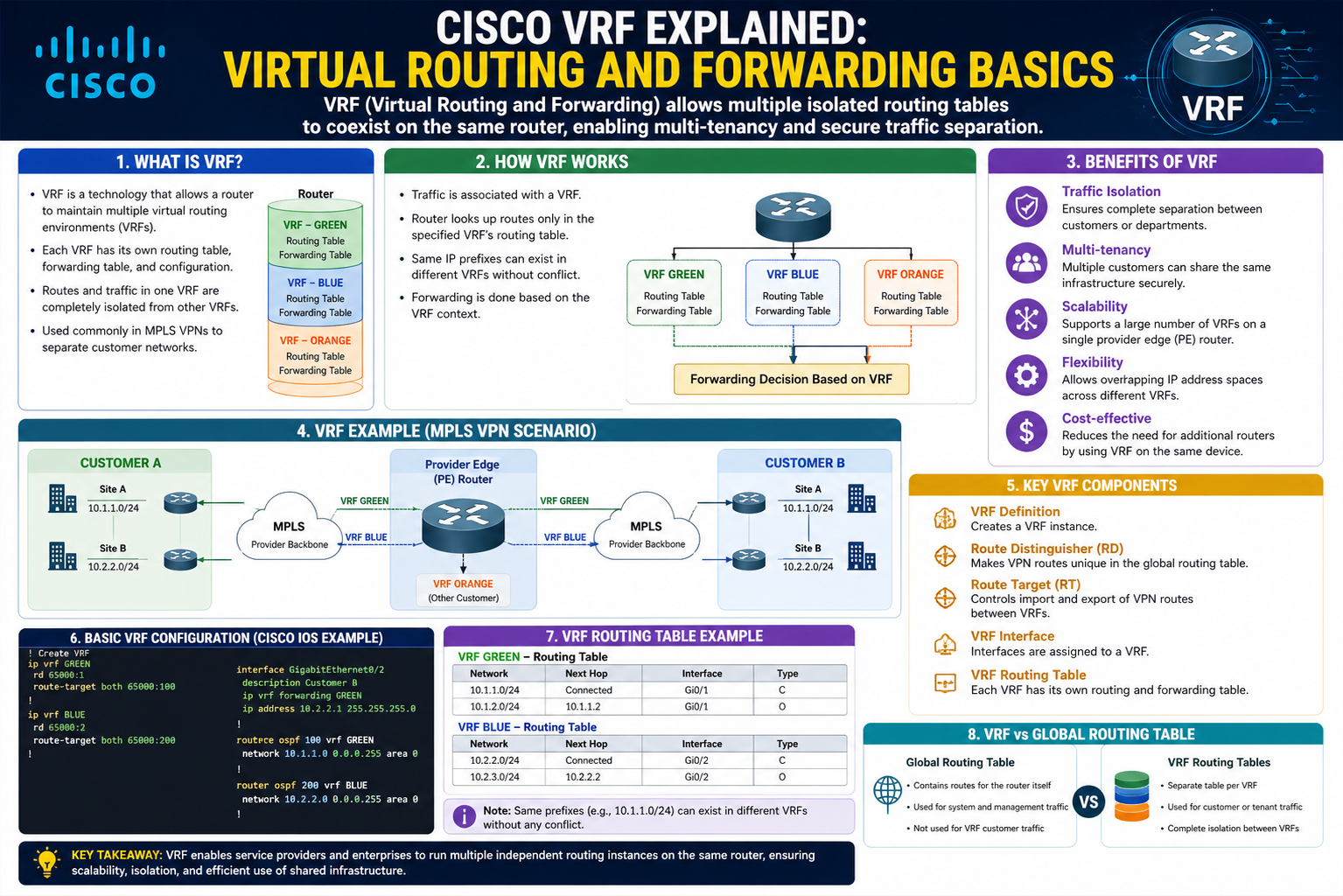
Cisco Virtual Routing and Forwarding is a networking capability that allows a single physical Layer 3 device, such as a router, to behave as if it is multiple independent routers at the same time. Each of these logical instances maintains its own separate routing table, meaning that traffic can be isolated, segmented, and managed independently without requiring additional physical hardware. This approach allows network designers to build highly scalable, secure, and flexible infrastructures while keeping operational complexity under control.
At its core, VRF is about virtualization of routing intelligence. Instead of relying on one global routing table that all interfaces share, VRF creates multiple virtual routing environments inside the same device. Each environment is isolated, so the same IP addresses can exist in different VRF instances without conflict. This makes it possible for organizations to reuse IP space and separate network traffic logically even when it shares the same physical infrastructure.
The Core Idea Behind Virtual Routing Separation
The main idea behind Cisco VRF is separation of network paths at the routing level. In a traditional router, every interface contributes to one shared routing table, which decides how packets move across the network. In contrast, VRF divides this single routing system into multiple independent domains. Each domain operates like a self-contained router with its own routes, forwarding decisions, and network policies.
This separation means that devices connected to one VRF cannot automatically communicate with devices in another VRF unless an explicit connection is configured. This provides a strong layer of logical isolation without physically separating the network hardware. It is especially useful in environments where multiple departments, clients, or services must coexist securely on the same infrastructure.
How Cisco VRF Works Inside a Router
Inside a Cisco device, VRF works by maintaining multiple routing tables in memory. Each VRF instance is assigned a unique routing table that stores its own set of IP routes. When a packet enters the router, the device first determines which VRF the incoming interface belongs to. After that, it uses only the routing table associated with that VRF to make forwarding decisions.
This process ensures that routing decisions remain completely independent between VRFs. Even if two VRFs contain identical IP networks, the router treats them as separate and unrelated because each one is tied to a different logical routing context. This behavior eliminates conflicts and allows overlapping address schemes to exist safely within the same physical device.
Why VRF Is Considered a Layer 3 Technology
Cisco VRF operates at the Network Layer, which is Layer 3 of the OSI model. This is because it deals directly with IP addressing, routing decisions, and packet forwarding between different networks. Unlike Layer 2 technologies that focus on local communication within a single broadcast domain, VRF is responsible for determining how data moves between distinct networks.
At Layer 3, the router’s primary job is to analyze destination IP addresses and decide the best path for forwarding packets. VRF enhances this process by introducing multiple independent decision-making tables. Instead of one global routing brain, the device effectively runs several isolated routing brains simultaneously, each handling its own traffic domain.
Relationship Between VRF and Virtualization Concepts
Cisco VRF can be understood as a form of network virtualization. Just as virtual machines allow multiple operating systems to run on a single physical server, VRF allows multiple routing environments to exist on a single physical router. Each virtual routing instance behaves as though it is a separate physical router, even though it shares underlying hardware resources.
This virtualization approach is especially powerful in modern networks where efficiency and scalability are critical. Instead of deploying multiple routers for different clients or departments, organizations can consolidate infrastructure while still maintaining strict separation between traffic flows.
How VRF Compares to Traditional Routing Approaches
In traditional routing setups, a single router maintains one routing table for all connected networks. This can create limitations when trying to isolate traffic or support overlapping IP address schemes. For example, two separate organizations connected to the same router cannot use the same private IP range without causing conflicts.
VRF solves this limitation by allowing multiple routing tables to coexist. Each table operates independently, so overlapping IP addresses are no longer an issue. This makes VRF particularly useful in service provider environments where multiple customers may have identical internal network structures but still require full separation.
Understanding VRF Through Real-World Network Separation
To better understand VRF, imagine a scenario where a company operates multiple branches across different locations. Each branch has its own internal network for employees, devices, and services. However, all branches need to connect securely to a centralized corporate system for data storage and management.
Without VRF, separating these branch networks securely would require multiple routers or complex firewall configurations. With VRF, each branch network can be placed into its own virtual routing instance, ensuring that branch-to-branch communication is restricted while still allowing controlled access to centralized resources.
This logical separation helps maintain security boundaries while simplifying infrastructure design. Each branch behaves as if it has its own dedicated router, even though all branches may share the same physical device at a central location.
VRF and Its Role in Network Isolation
One of the most important functions of VRF is network isolation. Isolation means that traffic from one virtual routing domain cannot interfere with or reach another unless explicitly permitted. This is different from simple filtering techniques because VRF enforces separation at the routing level itself rather than relying solely on packet filtering rules.
This type of isolation is particularly valuable in environments such as data centers, enterprise networks, and service provider backbones. It ensures that different customers, departments, or services remain securely separated even when they share infrastructure components.
Basic Functional Behavior of VRF Routing Tables
Each VRF instance maintains its own routing information base, which includes directly connected routes, static routes, and dynamically learned routes from routing protocols. When a routing decision is required, the router consults only the routing table associated with the VRF of the incoming interface.
This means that routing decisions are context-sensitive. The same destination IP address may lead to completely different next-hop paths depending on which VRF is handling the traffic. This contextual behavior is what gives VRF its flexibility and power in complex network designs.
Why Multiple Routing Tables Matter in Modern Networks
The ability to maintain multiple routing tables on a single device changes how networks are designed. Instead of building separate physical infrastructures for different services, organizations can consolidate everything into fewer devices while maintaining strict separation.
This reduces hardware costs, simplifies maintenance, and improves scalability. It also allows faster deployment of new network segments because new VRFs can be created without physically modifying the infrastructure. As a result, network expansion becomes more software-driven rather than hardware-dependent.
Initial Understanding of VRF Importance in Network Architecture
At a foundational level, VRF represents a shift from physical separation to logical separation in networking. Instead of relying on physical routers to divide traffic domains, engineers can now use virtual constructs within the same device. This reflects a broader trend in networking toward virtualization and software-defined infrastructure.
By enabling multiple independent routing environments within a single system, VRF helps organizations build networks that are more flexible, secure, and efficient. It also lays the groundwork for advanced architectures used in modern enterprise and service provider environments, where scalability and isolation must coexist.
Transition to Deeper Concepts of VRF Usage
Understanding the basic structure and behavior of Cisco VRF is the first step toward appreciating its full potential. Beyond simple routing separation, VRF plays a key role in security design, traffic engineering, and multi-tenant network environments. As networks grow in complexity, the importance of isolating traffic while maintaining shared infrastructure becomes increasingly critical.
The next level of understanding involves exploring how VRF differs from other segmentation technologies and how it integrates into real-world network designs where performance, security, and scalability must all be balanced carefully.
How Cisco VRF Creates Logical Network Segmentation
Cisco Virtual Routing and Forwarding enables logical segmentation of a network by dividing a single physical router into multiple independent routing environments. Each environment functions as if it were a separate router, with its own routing table, interfaces, and forwarding rules. This segmentation allows network administrators to isolate traffic flows without physically separating infrastructure, which significantly reduces complexity and cost in large-scale environments.
In practical terms, segmentation using VRF means that different business units, customers, or services can share the same hardware while remaining completely isolated at the routing level. Each VRF instance operates independently, so routes learned or configured in one instance are not visible to another. This ensures that communication paths remain strictly controlled and predictable.
Role of Route Tables in VRF Segmentation
At the heart of VRF-based segmentation is the concept of multiple routing tables. In a traditional router, all interfaces contribute to a single global routing table. However, with VRF, each virtual routing instance maintains its own separate table. These tables contain only the routes relevant to their specific VRF context.
This separation allows identical IP addressing schemes to exist across different VRFs without causing routing conflicts. For example, two different departments can use the same private IP range internally while still being isolated from each other. The router distinguishes between them based on VRF assignment rather than IP address uniqueness.
Interface Association with VRF Instances
Each physical or logical interface on a Cisco router can be assigned to a specific VRF. Once an interface is associated with a VRF, all traffic entering or leaving that interface is processed according to the routing table of that VRF only. This assignment is what enforces segmentation at the entry point of the network device.
The association between interfaces and VRFs is what makes isolation effective. Without this binding, traffic would default to a global routing context, potentially mixing with other network segments. By explicitly assigning interfaces, administrators ensure that traffic remains contained within its intended virtual routing domain.
Traffic Isolation and Security Advantages
One of the most significant benefits of VRF is traffic isolation, which directly improves network security. Since each VRF has its own routing table and forwarding logic, there is no implicit communication between different VRFs. This means that even if two devices are connected to the same physical router, they cannot interact unless explicitly configured.
This isolation reduces the risk of unauthorized access between network segments. For example, guest users, internal employees, and management systems can all operate on the same infrastructure while remaining logically separated. This reduces the attack surface and helps enforce strict security boundaries without relying solely on firewall rules.
Understanding VRF as a Virtualized Routing Environment
VRF can be viewed as a virtualization layer applied to routing. Instead of virtualizing servers or storage, it virtualizes the routing process itself. Each VRF behaves like a miniature router embedded within a larger physical device. These virtual routers operate independently but share the same underlying hardware resources.
This design allows efficient resource utilization because multiple routing domains can coexist without duplicating hardware. It also simplifies management because changes can be made to one VRF without affecting others. This separation of concerns is a key principle in scalable network architecture.
Overlapping IP Addressing Enabled by VRF
One of the most powerful features of VRF is its ability to support overlapping IP address spaces. In traditional networks, IP addresses must be unique across all connected systems to avoid conflicts. However, VRF removes this limitation by isolating routing tables.
Because each VRF maintains its own independent routing context, the same IP subnet can exist in multiple VRFs simultaneously. The router does not confuse these overlapping addresses because it always associates them with their respective VRF. This capability is especially useful in service provider environments where multiple clients may use identical private addressing schemes.
VRF in Multi-Tenant Network Environments
Multi-tenancy is a common requirement in modern networking, especially in cloud computing and service provider infrastructures. VRF plays a critical role in enabling multi-tenant environments by ensuring that each tenant has its own isolated routing domain.
Each tenant is assigned a dedicated VRF instance, which contains its own routing table and network policies. This ensures that tenants cannot access each other’s data or infrastructure unless explicitly allowed. Despite sharing physical hardware, each tenant experiences the network as if it were completely separate.
This approach provides strong isolation while maintaining high levels of infrastructure efficiency. It eliminates the need for separate physical networks for each tenant, which would otherwise be costly and difficult to manage.
How VRF Interacts with Routing Protocols
VRF is compatible with dynamic routing protocols, but each VRF maintains its own instance of these protocols. This means that routing protocols such as OSPF, EIGRP, or BGP can run independently within each VRF.
When a routing protocol operates inside a VRF, it only exchanges routing information relevant to that VRF’s routing table. This ensures that route updates remain isolated and do not leak between VRFs. As a result, each virtual routing domain can have its own dynamic routing behavior.
This separation allows different VRFs to use different routing strategies, metrics, or policies depending on their requirements. It adds flexibility to network design while preserving isolation.
Concept of Control Plane Separation in VRF
VRF not only separates data traffic but also separates the control plane. The control plane is responsible for managing routing information and making forwarding decisions. In a VRF-enabled device, each VRF has its own control plane instance that processes routing updates independently.
This means that routing decisions, protocol messages, and topology changes are handled separately for each VRF. This isolation ensures that changes in one VRF do not impact others, improving stability and predictability across the network.
By separating both control and data planes, VRF creates a highly modular routing architecture where each virtual instance behaves autonomously.
Scalability Benefits of VRF-Based Design
VRF significantly improves network scalability by reducing the need for additional physical infrastructure. Instead of deploying multiple routers for different services or departments, organizations can scale horizontally within a single device by adding more VRF instances.
This approach simplifies expansion because new routing domains can be created through configuration rather than hardware deployment. It also reduces operational overhead since fewer devices need to be managed, monitored, and maintained.
As networks grow, VRF allows administrators to maintain structure and organization without increasing physical complexity. This makes it ideal for large enterprises and service providers managing hundreds or thousands of network segments.
Resource Efficiency in VRF Implementations
Another important advantage of VRF is resource efficiency. By consolidating multiple routing domains into a single device, organizations reduce hardware costs, power consumption, and physical space requirements.
Instead of maintaining separate routers for each network segment, VRF allows shared use of CPU, memory, and interfaces. These resources are dynamically allocated based on VRF activity, making better use of existing infrastructure.
This efficiency is especially important in data centers and cloud environments where resource optimization directly impacts operational cost and performance.
Separation of Routing Domains in Practice
In practical network design, VRF is used to separate different functional areas such as production networks, management networks, and customer networks. Each of these areas is assigned its own VRF to ensure isolation.
This separation allows administrators to apply different policies, security rules, and routing behaviors to each domain. It also simplifies troubleshooting because issues can be isolated to a specific VRF without affecting the entire network.
By dividing the network into logical domains, VRF improves organization and reduces the complexity of managing large-scale environments.
Importance of VRF in Service Provider Networks
Service providers rely heavily on VRF to deliver isolated services to multiple customers over shared infrastructure. Each customer is assigned a unique VRF instance, ensuring complete separation of routing and traffic.
This model allows providers to offer scalable services without dedicating physical infrastructure to each customer. It also enables flexible service delivery, where customers can have customized routing policies and connectivity options.
VRF is therefore a foundational technology in modern ISP and cloud architectures, enabling large-scale multi-customer environments.
Foundation for Advanced Network Architectures
VRF serves as a building block for more advanced networking technologies such as MPLS VPNs and software-defined networking. By providing a mechanism for logical separation at the routing level, it enables more complex architectures that require strict isolation and scalable design.
As networks continue to evolve toward virtualization and automation, VRF remains a key component in ensuring that routing systems can support multiple isolated environments efficiently. It represents a shift toward flexible, software-driven networking models that prioritize scalability, security, and efficient resource usage.
Expanding Understanding of VRF Role in Modern Networks
As the concept of VRF becomes more integrated into network design, its role extends beyond simple routing separation. It becomes a foundational tool for building secure, scalable, and multi-tenant infrastructures. Understanding how VRF manages routing independence and traffic isolation is essential for designing modern enterprise and service provider networks.
The next stage of understanding involves exploring how VRF interacts with real-world deployment scenarios, including advanced configuration strategies, integration with other network technologies, and operational best practices that ensure stable and efficient performance across large-scale systems.
VRF and the Concept of Network Security Through Isolation
Cisco Virtual Routing and Forwarding strengthens network security primarily through strict logical isolation. Instead of relying only on filtering mechanisms such as firewalls or access control lists, VRF ensures that separation happens at the routing level itself. This means that networks placed in different VRF instances do not even share a common routing context, making unintended communication impossible unless explicitly designed.
This level of isolation is important because it reduces dependency on complex filtering rules. In traditional networks, security is often enforced after routing decisions are made. With VRF, the separation occurs before routing decisions are even possible across different domains. As a result, each VRF behaves like an independent network system, unaware of other VRFs unless a deliberate connection is configured.
How VRF Prevents Unintended Route Leaks
One of the critical security advantages of VRF is its ability to prevent route leakage between network segments. Route leakage occurs when routing information from one network unintentionally becomes visible to another, potentially exposing sensitive pathways or enabling unauthorized access.
VRF eliminates this risk by maintaining completely separate routing tables. Each table is only aware of routes assigned to its own VRF context. Even if two VRFs use identical IP address ranges, their routing information remains isolated. This ensures that routing decisions are always confined within their intended boundaries.
By preventing route sharing by default, VRF reduces configuration errors that could otherwise expose internal networks to unintended access.
VRF in Multi-Customer and Multi-Service Environments
In environments where multiple customers or services share the same physical infrastructure, VRF plays a central role in maintaining separation. Each customer or service is assigned a dedicated VRF instance, ensuring that their traffic remains isolated from others.
This model is widely used in service provider networks where infrastructure efficiency and customer privacy must coexist. Instead of building separate physical networks for each customer, providers use VRF to create virtualized environments that behave as independent networks.
Each VRF can support its own routing policies, address schemes, and connectivity rules, allowing service providers to offer customized network experiences while maintaining strong isolation.
VRF as a Foundation for Virtual Private Networks
VRF often acts as a building block for more advanced virtual private networking systems. While VRF itself does not encrypt traffic, it provides the structural isolation needed for VPN technologies to operate securely and efficiently.
By separating routing domains, VRF ensures that VPN tunnels or encrypted paths can be established without interference from other network segments. In many architectures, VRF is combined with tunneling technologies to create secure end-to-end communication channels between isolated networks.
This combination allows organizations to build secure overlays on top of shared infrastructure without compromising separation between different network domains.
Traffic Engineering Capabilities Enabled by VRF
Beyond security, VRF also enables advanced traffic engineering techniques. Since each VRF maintains its own routing table, administrators can control how traffic flows within each virtual routing environment independently.
This means that different VRFs can be configured with different routing paths, priorities, or performance characteristics. For example, one VRF may prioritize low-latency paths for real-time applications, while another may prioritize cost-efficient routes for bulk data transfer.
This level of control allows networks to be optimized based on business requirements rather than being constrained by a single global routing policy.
Understanding VRF in the Context of Service Differentiation
VRF allows network operators to differentiate services within the same infrastructure. Different VRFs can represent different service tiers, customer classes, or application types. Each of these can be assigned unique routing behavior based on performance or policy requirements.
For example, a premium service VRF might be configured to use high-speed backbone routes, while a standard service VRF might use shared or lower-priority paths. This differentiation enables flexible service offerings without requiring separate physical networks.
This capability is especially valuable in environments where service quality must be tailored to different user groups or applications.
The Role of VRF in IP Address Reuse
One of the most practical advantages of VRF is the ability to reuse IP address space across multiple network segments. In traditional networking, IP addresses must be unique across all connected devices to avoid conflicts. This limitation can create challenges in large-scale or multi-tenant environments.
VRF removes this limitation by isolating routing tables. Since each VRF operates independently, the same IP address ranges can exist in multiple VRFs without conflict. The router distinguishes between them based on VRF assignment rather than IP uniqueness.
This capability is especially useful for service providers and large enterprises that manage many independent network segments.
How VRF Supports Network Scalability
As networks grow, managing routing complexity becomes increasingly difficult. VRF helps address this challenge by dividing large networks into smaller, more manageable routing domains.
Each VRF can be configured, monitored, and modified independently, which reduces operational complexity. Instead of dealing with one massive routing table, administrators work with multiple smaller tables that are easier to understand and control.
This modular approach improves scalability because new network segments can be added simply by creating new VRF instances rather than redesigning the entire network structure.
Operational Independence Between VRFs
One of the defining characteristics of VRF is operational independence. Each VRF functions as a self-contained routing environment, meaning that changes made in one VRF do not affect others.
This independence applies to routing protocols, interface configurations, and forwarding decisions. As a result, network administrators can modify or troubleshoot one VRF without impacting the stability of the entire system.
This isolation reduces risk in large networks where multiple services depend on the same physical infrastructure.
VRF and Its Relationship with Routing Protocol Instances
When dynamic routing protocols are used within a VRF environment, each VRF maintains its own instance of the protocol. This means that routing updates are exchanged only within the context of that VRF.
For example, if a routing protocol learns a new route in one VRF, that information is not shared with other VRFs unless explicitly configured. This ensures that routing behavior remains consistent and isolated within each virtual domain.
This separation allows different VRFs to use different routing strategies or configurations depending on their specific needs.
Importance of Context-Based Routing Decisions
In VRF-based systems, routing decisions are always made within a specific context. The router first determines which VRF an incoming packet belongs to and then uses only the routing table associated with that VRF.
This context-based approach ensures that identical IP addresses can be interpreted differently depending on their VRF assignment. It also ensures that routing decisions remain consistent within each isolated domain.
This behavior is fundamental to how VRF achieves network separation without requiring additional physical devices.
VRF and Efficient Use of Network Resources
By consolidating multiple routing domains into a single physical device, VRF improves overall resource efficiency. Instead of deploying separate routers for different services, organizations can use a single router to handle multiple independent routing environments.
This reduces hardware costs, power consumption, and physical space requirements. It also simplifies maintenance because fewer devices need to be managed and monitored.
Efficient resource utilization is one of the key reasons VRF is widely adopted in modern networking environments.
How VRF Enhances Network Design Flexibility
VRF provides network designers with a high degree of flexibility. Instead of being limited by physical infrastructure, designers can create multiple logical networks that operate independently.
This flexibility allows for rapid changes in network design without requiring hardware modifications. New services, departments, or customers can be added by simply creating new VRF instances and assigning interfaces.
This adaptability is essential in dynamic environments where network requirements frequently change.
VRF in Large-Scale Infrastructure Environments
In large-scale infrastructures such as data centers and enterprise networks, VRF is used to organize complex routing systems into manageable segments. Each segment can represent a different application, service, or tenant.
This structured approach improves visibility and control over network behavior. It also makes troubleshooting easier because issues can be isolated to specific VRF instances rather than affecting the entire network.
Large-scale environments benefit significantly from this modular design approach.
Transition Toward Advanced VRF Applications
As VRF becomes more deeply integrated into network architectures, its role expands beyond simple segmentation. It becomes a foundational component for advanced networking concepts such as virtual private clouds, multi-tenant architectures, and software-defined networking systems.
Understanding these advanced applications requires recognizing how VRF provides the structural foundation for isolated and scalable network environments. Its ability to maintain independent routing domains makes it a critical tool in modern network design strategies.
The next stage of understanding involves exploring how VRF is implemented in real configurations, how it interacts with interfaces and routing policies, and how best practices ensure stable and efficient operation in production environments.
Cisco VRF Configuration in Real Network Environments
Configuring Cisco Virtual Routing and Forwarding in a real network involves defining isolated routing instances, assigning interfaces to those instances, and ensuring that each VRF has its own routing behavior. The configuration process is designed to be logical and structured so that each step builds toward a fully separated routing environment inside a single physical device.
At the beginning of the process, the network administrator enters global configuration mode on the router. From there, a VRF instance is created by defining a unique name. This name represents the isolated routing domain that will operate independently from other VRFs. Once created, the VRF is assigned an address family, typically IPv4 or IPv6, which determines the type of routing information it will handle.
After defining the VRF structure, the next critical step is associating interfaces with that VRF. Each interface that is assigned to a VRF becomes part of that isolated routing environment. From that point onward, all traffic entering that interface is processed only within the context of its assigned VRF routing table.
Interface Assignment and Its Impact on Traffic Flow
Interface assignment is one of the most important steps in VRF configuration because it determines how traffic enters and exits each virtual routing domain. Once an interface is bound to a VRF, it no longer uses the global routing table. Instead, it relies entirely on the VRF-specific routing table for all forwarding decisions.
This means that even if multiple interfaces exist on the same physical router, each interface can belong to a completely different routing environment. Traffic entering one interface cannot automatically reach another VRF unless explicit routing or forwarding rules are created.
This behavior enforces strict segmentation and ensures that traffic flow remains predictable and controlled across the network infrastructure.
How VRF Affects Routing Table Visibility
In a VRF-enabled system, routing table visibility is limited to the VRF context. Each VRF maintains its own set of routes, and these routes are not visible to other VRFs. This separation ensures that routing decisions are made only using relevant information.
For example, a route learned in one VRF through a dynamic routing protocol will not appear in another VRF unless it is explicitly imported or shared through advanced configuration techniques. This isolation prevents accidental route sharing and enhances overall network stability.
This structure also simplifies troubleshooting because each VRF can be analyzed independently without interference from unrelated routing information.
Routing Behavior Within a VRF Instance
When a packet arrives at a router interface assigned to a VRF, the router first identifies the VRF context. It then consults only the routing table associated with that VRF to determine the best path for forwarding the packet.
This process ensures that routing decisions are always context-aware. The same destination IP address may be treated differently depending on the VRF in which it exists. This allows identical addressing schemes to operate independently across multiple network segments.
This behavior is fundamental to VRF functionality and is what makes it possible to run multiple isolated networks on a single device.
Interaction Between VRF and Static Routing
Static routes can be configured within a VRF just as they are in traditional routing environments, but they are tied specifically to that VRF instance. A static route defined in one VRF does not affect any other VRF.
This allows administrators to define custom routing paths for each virtual network independently. Static routing within VRF is often used for predictable traffic flows, such as connecting branch networks to centralized services or defining fixed paths for specific applications.
Because each VRF has its own routing context, static routes remain contained and do not interfere with global network behavior.
Dynamic Routing Protocols Inside VRF Environments
Dynamic routing protocols can also operate within VRF instances, but each VRF runs its own separate instance of the protocol. This means that routing updates, neighbor relationships, and topology changes are all isolated within each VRF.
Protocols such as OSPF, EIGRP, or BGP can be configured independently per VRF. This allows different routing behaviors in different network segments, even on the same physical device.
This separation ensures that routing decisions are consistent within each VRF while preventing cross-contamination of routing information between unrelated networks.
VRF and Route Redistribution Concepts
In advanced configurations, route redistribution may be used to exchange routing information between VRFs or between VRFs and the global routing table. However, this must be done explicitly and carefully to avoid unintended exposure of routing information.
Route redistribution allows controlled communication between isolated routing domains. For example, a central service VRF may need to share specific routes with customer VRFs to enable access to shared services.
This mechanism provides flexibility while still maintaining the core principle of isolation unless explicitly overridden.
Understanding VRF Forwarding Logic
VRF forwarding logic is based on a simple but strict rule: each packet is forwarded only using the routing table of its assigned VRF. This eliminates ambiguity in routing decisions and ensures consistent behavior across the network.
When a packet enters a VRF-enabled interface, the router identifies the VRF, checks the destination IP address, and then consults only that VRF’s routing table to determine the next hop. This process is repeated independently for each VRF.
This logic ensures that routing decisions remain deterministic and isolated, which is essential for stable multi-tenant environments.
VRF and Overlapping Address Scenarios in Practice
One of the most practical advantages of VRF is its ability to support overlapping IP addresses. In real-world networks, especially in service provider environments, multiple customers often use the same private IP ranges.
Without VRF, this would create conflicts and routing ambiguity. However, because VRF isolates routing tables, the same IP address can exist in multiple VRFs without issue. Each VRF treats the address independently based on its own routing context.
This capability significantly simplifies network design in environments where address standardization cannot be enforced across all users.
Best Practices for VRF Deployment Planning
Successful VRF deployment requires careful planning before configuration begins. Network designers must identify how traffic should be segmented, which services require isolation, and how communication between VRFs should be handled if needed.
A common best practice is to define VRFs based on business function, customer groups, or service types. This ensures that routing separation aligns with organizational structure and operational requirements.
Scalability should also be considered during planning, as VRF environments may grow over time. Designing a consistent naming and addressing strategy helps maintain clarity as the number of VRFs increases.
Avoiding Common Configuration Mistakes in VRF
One common mistake in VRF configuration is failing to correctly assign interfaces to the intended VRF. If an interface is left in the global routing table by accident, it can lead to unexpected connectivity or security issues.
Another issue arises when routing protocols are not properly isolated per VRF, leading to missing routes or incomplete connectivity. Ensuring that each protocol instance is correctly bound to its VRF is essential for proper operation.
Careful verification of routing tables and interface assignments helps prevent these issues during deployment.
VRF Troubleshooting and Operational Visibility
Troubleshooting VRF-based networks requires understanding that each VRF operates independently. When diagnosing connectivity issues, administrators must check the routing table of the specific VRF involved rather than the global routing table.
Commands and diagnostic tools typically allow VRF-specific views, enabling administrators to inspect routes, interfaces, and protocol states within a single VRF context.
This separation improves clarity during troubleshooting because issues can be isolated to a specific virtual routing domain.
VRF Role in Modern Cloud and Enterprise Networks
In modern cloud and enterprise architectures, VRF plays a key role in enabling multi-tenant and segmented network designs. It allows cloud providers to host multiple customers on shared infrastructure while maintaining strict isolation between them.
Enterprises also use VRF to separate internal departments, production environments, and testing environments. This reduces risk and improves operational control over network traffic.
As networks continue to evolve toward virtualization, VRF remains a foundational technology for building scalable and secure infrastructures.
Long-Term Importance of VRF in Network Design Evolution
VRF represents a major step in the evolution of network design from physical separation to logical segmentation. It enables networks to scale more efficiently while maintaining strong isolation and security boundaries.
Its ability to support multiple independent routing environments within a single device makes it a critical tool for modern networking. As organizations continue to adopt virtualization and cloud-based architectures, VRF will remain an essential component of scalable network design strategies.
This concludes the full structured understanding of Cisco Virtual Routing and Forwarding, covering its concept, behavior, segmentation, benefits, configuration, and real-world applications.
Conclusion
Cisco Virtual Routing and Forwarding is a powerful network virtualization technology that allows a single physical router to operate multiple independent routing environments at the same time. By separating routing tables, interfaces, and forwarding decisions into isolated VRF instances, it enables secure, scalable, and highly efficient network design without requiring additional physical hardware.
This approach significantly improves network security by enforcing isolation at the routing layer, ensuring that different networks cannot communicate unless explicitly configured. It also enhances flexibility by allowing overlapping IP address spaces, supporting multi-tenant environments, and enabling service providers and enterprises to build complex infrastructures on shared hardware.
In modern networking, VRF plays a critical role in cloud systems, enterprise segmentation, and service provider architectures. It reduces operational complexity, improves resource utilization, and supports large-scale growth while maintaining strict separation between different network domains.
Overall, Cisco VRF is not just a routing feature—it is a foundational technology for building structured, secure, and scalable networks in today’s virtualized and cloud-driven world.