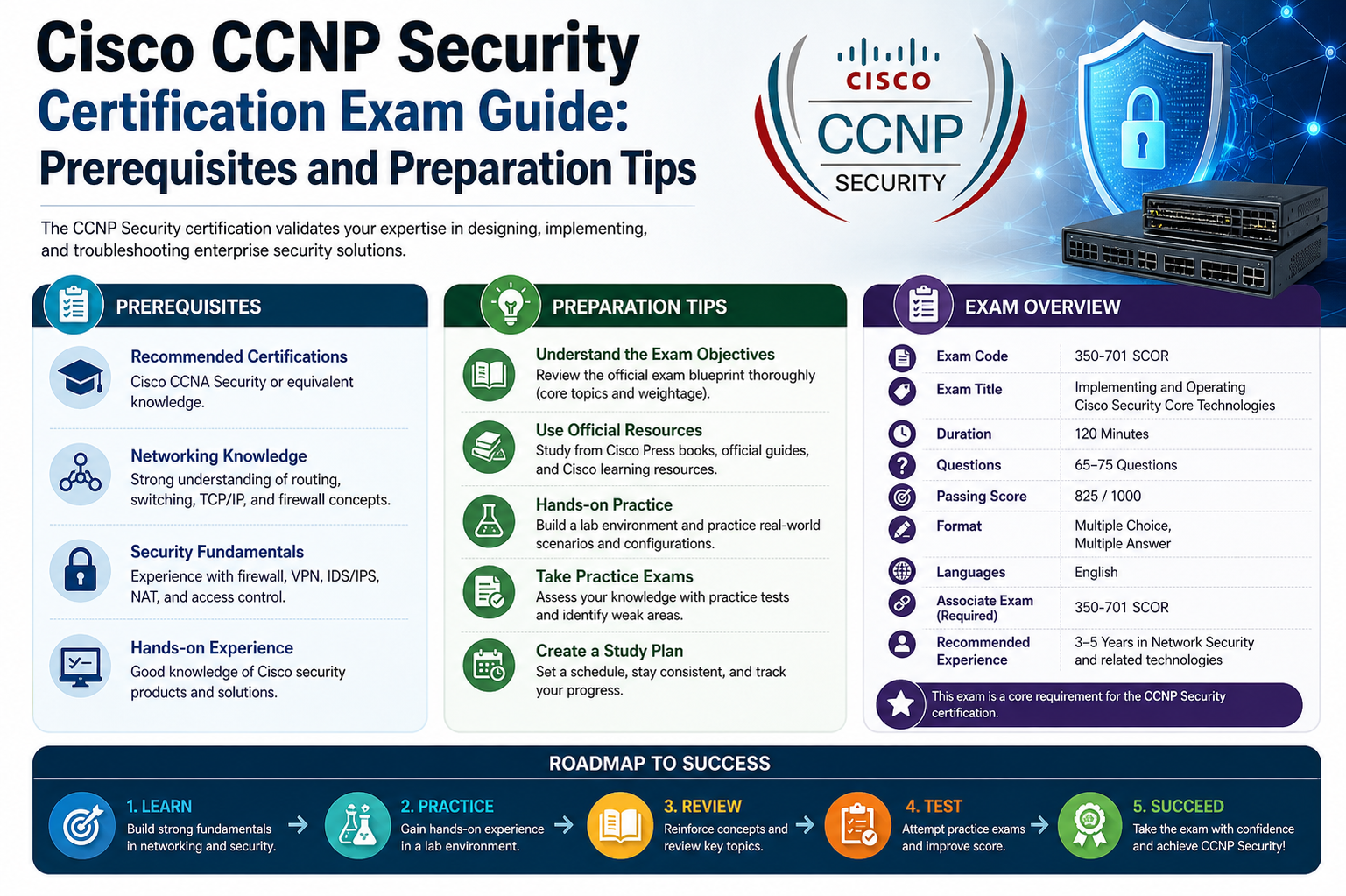
The CCNP Security certification represents an advanced-level qualification designed for IT professionals who specialize in protecting enterprise networks and managing complex security infrastructures. It focuses on equipping candidates with the knowledge required to design, implement, and maintain secure network environments in organizations that rely heavily on digital systems. This certification is widely respected because it validates both conceptual understanding and practical ability in dealing with modern cybersecurity challenges, making it a strong benchmark for security-focused career growth.
Importance of CCNP Security in Modern IT Environments
In today’s interconnected world, organizations face continuous security threats that target sensitive data, communication channels, and critical infrastructure. The CCNP Security certification plays a vital role in preparing professionals to address these challenges effectively. It emphasizes real-world security applications such as defending networks from unauthorized access, securing communication between systems, and ensuring compliance with organizational security policies. Professionals with this certification are often trusted to safeguard enterprise-level environments where even small security failures can lead to major operational and financial risks.
Core Focus and Skill Development Areas
The certification is structured to develop a broad range of advanced technical skills related to cybersecurity. It focuses on areas such as secure network access, threat defense, secure connectivity, endpoint protection, and visibility across network systems. Candidates also gain knowledge in managing and configuring security appliances that are used in real enterprise environments. This skill set is essential for professionals who aim to work in roles that require both strategic planning and hands-on implementation of security solutions.
Role of a CCNP Security Certified Professional
A professional holding this certification is typically responsible for designing and maintaining secure network architectures within an organization. Their duties may include configuring firewalls, managing virtual private networks, monitoring network traffic for suspicious activity, and deploying intrusion prevention systems. They are also involved in troubleshooting complex security issues and ensuring that all systems align with organizational security policies. This role demands a strong understanding of both networking fundamentals and advanced security technologies.
Structure of the Certification Path
The CCNP Security certification follows a structured approach that requires candidates to demonstrate both core knowledge and specialized expertise. It is divided into a core examination and a concentration-based examination. The core exam focuses on fundamental security technologies and concepts, while the concentration exam allows candidates to specialize in a specific area of interest within network security. This dual structure ensures that professionals are not only well-versed in general security principles but also capable of handling specialized tasks in real-world environments.
Core Examination Overview and Objectives
The core examination is designed to assess a candidate’s understanding of essential security technologies. It includes topics such as network security principles, cloud-based security, endpoint protection strategies, secure access control methods, and security enforcement mechanisms. The exam also evaluates the ability to analyze security threats and apply appropriate solutions in enterprise environments. It is structured to test both theoretical knowledge and practical application through a variety of question formats that simulate real-world scenarios.
Skills Measured in the Core Exam
Candidates are expected to demonstrate proficiency in several key areas during the core exam. These include identifying vulnerabilities in network systems, implementing secure communication protocols, configuring security devices, and managing access control policies. Additionally, they must understand how to monitor network activity and respond effectively to security incidents. The exam also assesses the ability to integrate security solutions into existing network infrastructures without disrupting operational efficiency.
Exam Format and Assessment Style
The core exam uses a combination of question formats to evaluate a candidate’s knowledge comprehensively. These formats may include multiple-choice questions, scenario-based problem solving, configuration tasks, and simulation-based exercises. This variety ensures that candidates are tested not only on memorized knowledge but also on their ability to apply concepts in practical environments. The assessment is designed to reflect real-world challenges that security professionals commonly face in enterprise networks.
Concentration Exam Flexibility and Specialization Options
After completing the core exam, candidates select a concentration exam that aligns with their career goals or technical interests. These specialization options allow professionals to focus on specific areas such as secure network solutions, identity services, email security, web security, VPN technologies, or security automation. This flexibility enables candidates to tailor their certification path according to their job role or future aspirations within the cybersecurity field.
Key Areas Covered in Specialization Tracks
Each concentration area focuses on a distinct segment of network security. For example, some tracks emphasize advanced firewall configuration and threat detection, while others focus on identity management systems or secure communication protocols. There are also specialization options that explore automation and programmability within security systems, reflecting the growing importance of efficient and scalable security management. These focused tracks help professionals build deeper expertise in a specific domain of cybersecurity.
Practical Application of Certification Knowledge
One of the most valuable aspects of this certification is its strong emphasis on practical application. Professionals are trained to work with real security tools and technologies that are commonly used in enterprise environments. This includes configuring security appliances, analyzing network traffic patterns, and responding to security incidents in real time. The ability to apply theoretical knowledge in practical situations significantly enhances job performance and problem-solving capabilities.
Relevance of CCNP Security in Career Development
Holding this certification can significantly enhance career opportunities in the IT and cybersecurity sectors. It is often required or preferred for advanced roles such as network security engineer, security architect, systems security administrator, and infrastructure security specialist. Employers value this certification because it demonstrates a strong foundation in both networking and security principles, along with the ability to manage complex security systems effectively.
Industry Demand and Professional Recognition
The demand for skilled security professionals continues to grow as organizations expand their digital infrastructure and face increasing cyber threats. The CCNP Security certification is widely recognized across industries as a benchmark for advanced security expertise. Professionals with this credential are often considered highly capable of handling enterprise-level security challenges, making them valuable assets to any organization focused on maintaining strong cybersecurity defenses.
Exam Preparation Approach and Learning Focus
Preparing for this certification requires a structured learning approach that combines theoretical study with hands-on practice. Candidates are encouraged to focus on understanding core networking concepts, security principles, and real-world application scenarios. Practical experience plays a crucial role in preparation, as it helps reinforce theoretical knowledge and builds confidence in handling complex security tasks. Consistent practice and scenario-based learning are essential for mastering the exam objectives.
Foundational Knowledge Expectations
Although there are no strict formal prerequisites, candidates are expected to have a solid understanding of networking fundamentals before attempting this certification. Familiarity with routing, switching, and basic security concepts is highly beneficial. Experience in working with network devices and security tools also provides a strong advantage, as it allows candidates to better understand the practical aspects of the exam topics.
Transition Toward Advanced Security Roles
This certification often serves as a stepping stone toward more advanced security roles within the IT industry. Many professionals use it as a foundation for progressing into higher-level certifications or specialized cybersecurity positions. It helps build the technical depth required to handle complex security infrastructures and prepares individuals for leadership roles in network security management.
CCNP Security Certification Path Structure
The CCNP Security certification is structured to ensure that professionals gain both broad foundational knowledge and specialized expertise in network security. The certification journey is divided into two major components: a core examination and a concentration examination. This structure is designed to build a strong base in essential security technologies before allowing candidates to specialize in a focused area of cybersecurity. The approach ensures that certified professionals are not only well-rounded in general security principles but also capable of handling advanced and specialized security responsibilities in real-world environments.
Core Knowledge Foundation in Security Technologies
The core component of the certification focuses on building a strong understanding of essential security concepts that are widely used across enterprise networks. These concepts include secure network architecture, threat defense mechanisms, access control systems, and security policy enforcement. Candidates are expected to develop the ability to recognize vulnerabilities, design secure solutions, and implement protective measures that ensure the integrity of network systems. This foundation is critical because it supports all advanced security operations performed in professional environments.
Understanding Enterprise Security Requirements
Modern enterprise networks require a comprehensive security approach that addresses multiple layers of protection. Professionals pursuing this certification are trained to understand how different security components interact within a complex network infrastructure. This includes securing internal communication, protecting external access points, and ensuring safe data transmission across systems. The certification emphasizes the importance of aligning security measures with organizational requirements, ensuring that security solutions do not hinder performance while still providing strong protection.
Role of Secure Network Design Principles
A key part of the certification involves learning how to design secure network architectures. This includes structuring networks in a way that minimizes vulnerabilities and reduces exposure to potential threats. Candidates are taught how to segment networks, implement secure routing practices, and design systems that support scalability while maintaining security integrity. Secure design principles also involve anticipating potential attack vectors and building defenses that can withstand evolving cyber threats.
Security Implementation in Real Network Environments
The certification emphasizes practical implementation of security technologies in live network environments. Professionals must understand how to deploy security solutions such as firewalls, intrusion prevention systems, and virtual private networks. These tools are essential for controlling traffic flow, detecting malicious activity, and ensuring secure communication between systems. Implementation skills are critical because they allow professionals to translate theoretical knowledge into functional security systems that operate effectively in real organizations.
Firewall Configuration and Management Concepts
Firewalls play a central role in network security, and candidates are expected to develop strong configuration and management skills in this area. The certification covers how firewalls filter network traffic, enforce security policies, and prevent unauthorized access to internal systems. Professionals must also understand how to configure advanced firewall rules that balance security with network performance. Proper firewall management ensures that only legitimate traffic is allowed while potential threats are blocked effectively.
Intrusion Detection and Prevention Systems Overview
Another important area of focus is intrusion detection and prevention. These systems are designed to monitor network activity and identify suspicious behavior that may indicate a security threat. Candidates learn how to configure and manage these systems to detect anomalies, generate alerts, and take automated actions when threats are identified. This helps organizations respond quickly to potential attacks and minimize damage caused by security breaches.
Secure Access Control Mechanisms
Access control is a fundamental aspect of network security, and this certification places strong emphasis on its implementation. Professionals are trained to define and enforce policies that determine who can access specific network resources. This includes authentication methods, authorization rules, and identity verification processes. Secure access control ensures that only authorized users can interact with sensitive systems and data, reducing the risk of unauthorized access.
Virtual Private Network Implementation Skills
Virtual private networks are widely used to ensure secure communication over public or untrusted networks. The certification covers the configuration and management of VPN technologies, including site-to-site and remote access VPNs. Candidates learn how to establish encrypted communication channels that protect data from interception. VPN implementation skills are essential for supporting remote work environments and securing data transmission across distributed networks.
Security Policy Development and Enforcement
Developing and enforcing security policies is a critical responsibility for professionals in this field. The certification teaches candidates how to create structured policies that define acceptable network behavior and security standards. These policies must be enforced consistently across all systems to ensure a unified security posture. Professionals also learn how to update and refine policies in response to emerging threats and changing organizational needs.
Concentration Exam Specialization Areas
After completing the core exam, candidates move on to a concentration exam that allows them to specialize in a specific area of network security. These specialization tracks are designed to deepen expertise in targeted domains such as secure network infrastructure, identity management, email security, web security, VPN technologies, and security automation. This flexibility enables professionals to align their certification with their career goals and job responsibilities.
Secure Network Infrastructure Specialization
One of the concentration options focuses on securing network infrastructure using advanced technologies. This includes configuring security appliances, managing traffic filtering systems, and implementing advanced threat defense mechanisms. Professionals in this specialization develop deep expertise in protecting enterprise networks from internal and external threats while ensuring optimal performance and reliability.
Identity and Access Management Specialization
Identity and access management is another critical specialization area within the certification path. This focus area involves managing user identities, authentication systems, and access policies across enterprise networks. Professionals learn how to implement centralized identity solutions that streamline access control while maintaining strong security standards. This specialization is essential for organizations that require strict control over user access and data protection.
Email and Web Security Focus Areas
Email and web communication are common entry points for cyber threats, making them important focus areas in the certification. Professionals specializing in these domains learn how to secure email systems against phishing, malware, and spam attacks. They also develop skills in protecting web traffic through filtering systems and secure browsing technologies. These skills help organizations safeguard communication channels and reduce exposure to online threats.
VPN and Secure Connectivity Specialization
Secure connectivity is a major concern for modern organizations, especially with the rise of remote work environments. This specialization focuses on advanced VPN configuration, secure tunneling protocols, and encrypted communication methods. Professionals gain the ability to design and maintain secure connections between remote users and enterprise networks, ensuring data confidentiality and integrity across all communication channels.
Security Automation and Programmability Concepts
Automation is becoming increasingly important in modern cybersecurity operations. This specialization introduces candidates to security automation tools and programmability concepts that streamline security management tasks. Professionals learn how to automate repetitive security processes, improve response times, and enhance overall efficiency in managing network defenses. This helps organizations scale their security operations effectively.
Integration of Security Solutions in Enterprise Networks
A key aspect of the certification is learning how to integrate multiple security solutions into a unified enterprise network. This involves ensuring that firewalls, intrusion prevention systems, VPNs, and access control mechanisms work together seamlessly. Proper integration ensures that security policies are consistently enforced across all network layers without creating performance bottlenecks or operational conflicts.
Real-World Application of Security Knowledge
The certification strongly emphasizes real-world application of knowledge through scenario-based learning. Candidates are exposed to practical situations where they must analyze security issues, design appropriate solutions, and implement corrective actions. This approach ensures that certified professionals are prepared to handle actual challenges they may encounter in enterprise environments, rather than relying solely on theoretical understanding.
Advanced Security Technologies in CCNP Security
The CCNP Security certification places strong emphasis on advanced security technologies that are commonly used in modern enterprise environments. These technologies are designed to protect complex networks from evolving cyber threats while ensuring smooth and secure communication between systems. Professionals are trained to work with layered security solutions that combine multiple tools and techniques, creating a comprehensive defense strategy. This includes threat detection systems, secure access mechanisms, encryption technologies, and centralized security management platforms that work together to maintain network integrity.
Threat Detection and Response Capabilities
A major focus area in this certification is the ability to detect and respond to security threats in real time. Candidates learn how to identify unusual network behavior that may indicate malicious activity. This involves monitoring traffic patterns, analyzing logs, and recognizing anomalies that could signal an attack. Once a threat is identified, professionals are expected to respond quickly by isolating affected systems, applying security patches, and preventing further damage. This proactive approach is essential for maintaining a secure and stable network environment.
Secure Network Access Control Systems
Access control is a critical component of enterprise security, and this certification develops advanced skills in managing it effectively. Professionals learn how to implement authentication systems that verify user identity before granting access to network resources. They also configure authorization policies that determine what level of access each user or device is allowed. These systems ensure that sensitive information is only accessible to authorized personnel, reducing the risk of internal and external security breaches.
Endpoint Protection and Device Security
Endpoint devices such as laptops, desktops, and mobile devices are common entry points for cyber threats. The certification emphasizes securing these endpoints to prevent unauthorized access and malware infections. Candidates gain knowledge of endpoint protection solutions that monitor device activity, detect malicious software, and enforce security policies at the device level. This ensures that every connected device within the network adheres to the organization’s security standards.
Cloud Security Integration Concepts
As organizations increasingly adopt cloud technologies, securing cloud environments has become a critical requirement. The certification covers how to extend security policies into cloud-based infrastructures. Professionals learn how to secure cloud applications, protect data stored in cloud environments, and manage secure access to cloud services. This ensures that security is maintained consistently across both on-premises and cloud systems, creating a unified protection strategy.
Secure Communication Protocols and Encryption
Encryption plays a vital role in protecting data as it travels across networks. Candidates are trained to understand and implement secure communication protocols that ensure data confidentiality and integrity. This includes encrypting data during transmission and securing communication channels between devices. By using strong encryption techniques, professionals can prevent unauthorized interception and tampering of sensitive information.
Network Visibility and Monitoring Techniques
Visibility across the network is essential for effective security management. The certification teaches professionals how to monitor network traffic and gain insights into system behavior. This involves using monitoring tools that provide real-time data on network activity, helping identify potential threats before they escalate. Improved visibility allows security teams to maintain better control over the network and respond more efficiently to incidents.
Security Policy Enforcement Strategies
Enforcing security policies consistently across an organization is a key responsibility of security professionals. The certification focuses on how to implement and maintain security rules that govern network behavior. These policies ensure that all users and devices comply with organizational standards. Professionals also learn how to update and adapt policies as new threats emerge, ensuring continuous protection in a changing security landscape.
Firewall Deployment and Advanced Configuration
Firewalls remain one of the most important security tools in any network infrastructure. The certification provides in-depth knowledge of firewall deployment and configuration techniques. Professionals learn how to set up firewall rules that control incoming and outgoing traffic, block unauthorized access, and allow only legitimate communication. Advanced configurations also include setting up application-level filtering and integrating firewalls with other security systems for enhanced protection.
Intrusion Prevention System Management
Intrusion prevention systems are designed to detect and block malicious activity before it can harm the network. The certification teaches candidates how to configure and manage these systems effectively. This includes setting up detection rules, analyzing security alerts, and responding to potential threats automatically. These systems play a crucial role in preventing cyberattacks and maintaining continuous network security.
Virtual Private Network Architecture and Security
Virtual private networks are essential for securing remote communication and ensuring safe data transfer over public networks. The certification covers VPN architecture, including how secure tunnels are established between remote users and enterprise systems. Professionals learn how to configure encryption settings, authenticate users, and maintain secure connections. This ensures that remote access does not compromise network security.
Identity-Based Security Implementation
Identity-based security focuses on verifying user identities before granting access to network resources. The certification teaches how to implement identity management systems that centralize authentication and authorization processes. This helps organizations maintain strict control over who can access specific systems and data. It also improves security by reducing the risk of unauthorized access through stolen credentials.
Security Incident Analysis and Troubleshooting
When security incidents occur, professionals must be able to analyze the situation and identify the root cause. The certification develops strong troubleshooting skills that help in diagnosing security problems quickly and accurately. Candidates learn how to examine logs, trace attack patterns, and determine how breaches occurred. This allows organizations to recover from incidents efficiently and prevent similar issues in the future.
Network Segmentation and Isolation Techniques
Network segmentation is an important security strategy that involves dividing a network into smaller, controlled sections. This helps limit the spread of attacks and improves overall security. The certification teaches how to design segmented networks that isolate sensitive systems from less secure areas. This approach reduces risk and enhances control over data flow within the organization.
Secure Remote Access Management
With the rise of remote work, secure remote access has become increasingly important. The certification covers how to manage secure connections for remote users accessing enterprise networks. This includes configuring authentication methods, encrypting communication channels, and monitoring remote sessions for suspicious activity. Secure remote access ensures that employees can work safely from any location without compromising network security.
Security Automation and Efficiency Enhancement
Automation plays a growing role in modern cybersecurity operations. The certification introduces concepts that help professionals automate repetitive security tasks such as monitoring, alerting, and reporting. This improves efficiency and allows security teams to focus on more complex challenges. Automation also helps reduce human error, making security systems more reliable and consistent.
Centralized Security Management Systems
Managing multiple security tools can be complex, which is why centralized security management systems are important. The certification teaches how to integrate various security components into a single management platform. This allows professionals to monitor and control firewalls, intrusion systems, and access policies from one interface. Centralized management improves visibility and simplifies overall security operations.
Continuous Security Improvement Practices
Security is not a one-time implementation but an ongoing process that requires continuous improvement. The certification emphasizes the importance of regularly reviewing and updating security measures. Professionals are trained to evaluate existing systems, identify weaknesses, and implement enhancements. This ensures that network security remains strong and effective against emerging threats.
Exam Preparation Strategy for CCNP Security
Preparing for the CCNP Security certification requires a disciplined and structured approach that balances theoretical understanding with practical application. Candidates are expected to develop a deep grasp of networking and security fundamentals while also gaining hands-on experience with security tools and technologies. Effective preparation involves studying core concepts systematically, practicing configuration tasks, and working through real-world scenarios that reflect enterprise security challenges. Consistency in learning and regular revision of key topics are essential for achieving strong performance in the examination.
Understanding Core Security Concepts in Depth
A strong preparation strategy begins with mastering fundamental security concepts. This includes understanding how networks operate, how data flows across systems, and how different security layers interact to protect information. Candidates must focus on learning how threats emerge, how vulnerabilities are exploited, and how security controls can be implemented to prevent attacks. A clear understanding of these foundational concepts provides the base required for handling more advanced topics covered in the certification.
Importance of Hands-On Practice
Practical experience is one of the most important aspects of preparing for this certification. Candidates should spend significant time working with network security tools and simulated environments. This includes configuring firewalls, setting up virtual private networks, managing access control systems, and analyzing network traffic. Hands-on practice helps reinforce theoretical knowledge and builds confidence in performing real-world security tasks. It also improves problem-solving skills, which are essential for scenario-based exam questions.
Lab-Based Learning and Simulation Practice
Using lab environments and simulation tools is highly recommended during preparation. These environments allow candidates to experiment with different configurations and observe the impact of their actions in real time. By working through simulated network setups, candidates gain practical insight into how security systems behave under different conditions. This type of learning helps bridge the gap between theory and real-world application, making exam preparation more effective.
Focus on Scenario-Based Problem Solving
The certification exam often includes scenario-based questions that test a candidate’s ability to apply knowledge in practical situations. These scenarios may involve troubleshooting security issues, designing secure network solutions, or identifying vulnerabilities in a system. Candidates must develop strong analytical thinking skills to interpret these scenarios correctly and choose the most appropriate solutions. Practicing similar scenarios during preparation helps improve decision-making abilities.
Strengthening Network Security Fundamentals
A solid understanding of network security fundamentals is essential for success in this certification. This includes knowledge of routing and switching principles, network protocols, and basic security mechanisms. Candidates must understand how data moves through networks and how security controls can be applied at different layers. Strengthening these fundamentals ensures that candidates can easily grasp advanced topics and apply them effectively during the exam.
Time Management During Preparation and Exam
Effective time management plays a key role in both preparation and exam performance. Candidates should create a structured study plan that allocates sufficient time for each topic. During the exam, managing time efficiently is equally important, as questions may vary in complexity. Practicing under timed conditions helps improve speed and accuracy, ensuring that candidates can complete all sections within the allotted time without stress.
Analyzing Security Logs and Data Interpretation
The ability to analyze security logs and interpret network data is an important skill for this certification. Candidates must learn how to read logs generated by firewalls, intrusion detection systems, and other security tools. This helps in identifying suspicious activity and diagnosing security issues. Strong analytical skills are essential for understanding patterns in network behavior and responding to potential threats effectively.
Understanding Real-World Security Challenges
The certification is designed to reflect real-world security challenges faced by organizations. Candidates must understand common attack methods such as phishing, malware infections, unauthorized access attempts, and distributed denial-of-service attacks. Learning how these attacks occur and how they can be prevented helps candidates develop practical security awareness that is valuable in professional environments.
Career Opportunities After CCNP Security Certification
Earning this certification opens up a wide range of career opportunities in the cybersecurity field. Professionals can pursue roles such as network security engineer, security analyst, security consultant, infrastructure security specialist, and systems security administrator. These roles involve designing secure systems, monitoring network activity, and responding to security incidents. The certification demonstrates advanced expertise, making candidates highly desirable to employers.
Industry Demand for Security Professionals
The demand for skilled cybersecurity professionals continues to grow as organizations face increasing threats from cyberattacks. Businesses across industries require experts who can protect sensitive data, secure communication systems, and maintain network integrity. CCNP Security certified professionals are well-positioned to meet this demand due to their advanced technical knowledge and practical skills in managing complex security environments.
Salary Potential and Professional Growth
Professionals with this certification often enjoy strong salary prospects due to the specialized nature of their skills. Compensation varies depending on experience, job role, and organizational requirements, but security professionals generally receive competitive pay in the IT industry. In addition to financial benefits, the certification also provides opportunities for career advancement into senior technical or managerial positions within cybersecurity teams.
Advancement Toward Higher-Level Certifications
Many professionals use CCNP Security as a stepping stone toward more advanced certifications in cybersecurity. It provides a strong foundation for pursuing expert-level certifications and specialized security credentials. This progression helps individuals deepen their expertise and expand their career opportunities in advanced security roles that require higher technical proficiency and leadership capabilities.
Continuous Learning in Cybersecurity Field
Cybersecurity is a constantly evolving field, and continuous learning is essential for long-term success. Professionals must stay updated with emerging threats, new technologies, and evolving security practices. The knowledge gained through this certification serves as a strong foundation, but ongoing learning ensures that professionals remain effective in addressing modern security challenges.
Recertification and Skill Maintenance
To maintain certification status, professionals must periodically renew their credentials. This can be done through various methods such as passing updated exams, earning continuing education credits, or participating in approved training activities. Recertification ensures that professionals remain current with the latest technologies and security practices, keeping their skills relevant in a rapidly changing industry.
Long-Term Value of CCNP Security Certification
The long-term value of this certification lies in its ability to provide both technical expertise and career growth opportunities. It equips professionals with the skills needed to handle complex security infrastructures and respond to evolving cyber threats. Over time, it helps build a strong professional reputation in the cybersecurity field, making it a valuable asset for sustained career development.
Future Career Path After CCNP Security Certification
After earning the CCNP Security certification, professionals often progress toward more advanced and specialized roles within the cybersecurity field. This certification acts as a strong foundation for moving into higher-level positions where deeper technical expertise and strategic decision-making are required. Many individuals transition into roles that involve designing large-scale security architectures, leading security teams, and managing enterprise-wide security operations. The knowledge gained at this level helps professionals confidently handle complex security environments and evolving cyber threats.
Progression Toward Expert-Level Security Certifications
A common path after CCNP Security is advancing toward expert-level certifications that focus on highly complex network security systems. These advanced certifications require a deeper understanding of security design, troubleshooting, and implementation across large infrastructures. Professionals who continue this journey often develop specialized expertise in areas such as advanced threat defense, secure network design, and enterprise security architecture. This progression significantly enhances technical authority and career credibility in the cybersecurity domain.
Expanding Skills Beyond Cisco Technologies
While CCNP Security is centered around Cisco technologies, many professionals broaden their skill set by exploring other security platforms and tools. This diversification helps them become more adaptable in environments where multiple vendors and technologies are used. Skills in cloud security, endpoint protection systems, identity management platforms, and multi-vendor network environments are highly valuable. Expanding beyond a single technology ecosystem increases employability and prepares professionals for a wider range of job opportunities.
Leadership Roles in Cybersecurity Teams
With experience and certification, professionals often move into leadership roles where they guide and manage security teams. These roles involve planning security strategies, overseeing implementation processes, and ensuring that organizational security policies are properly enforced. Leadership positions require both technical expertise and strong decision-making skills, as professionals are responsible for maintaining the security posture of entire organizations. Communication and coordination with other IT departments also become important aspects of these roles.
Real-World Application in Enterprise Security Environments
Professionals with this certification are frequently involved in managing real-world enterprise security environments where multiple systems and technologies must work together seamlessly. These environments require constant monitoring, configuration adjustments, and proactive threat management. Certified individuals play a key role in ensuring that security systems operate efficiently without disrupting business operations. Their ability to apply theoretical knowledge to real-world challenges makes them valuable contributors to organizational security frameworks.
Importance of Continuous Skill Enhancement
Cybersecurity is a rapidly changing field, and continuous skill enhancement is essential for long-term success. New threats, technologies, and security methodologies are constantly emerging, requiring professionals to stay updated. CCNP Security certified individuals are expected to regularly improve their knowledge and adapt to new security trends. This ongoing learning ensures that their skills remain relevant and effective in addressing modern cybersecurity challenges.
Adapting to Evolving Cyber Threats
Cyber threats are becoming more sophisticated, requiring advanced defense strategies and proactive security measures. Professionals must understand how attackers evolve their techniques and how to counter these threats effectively. This includes staying informed about malware trends, phishing techniques, ransomware attacks, and advanced persistent threats. The ability to anticipate and respond to these evolving risks is a critical skill developed through experience and continuous learning.
Integration of Security Across Modern IT Infrastructure
Modern IT environments are highly complex, often combining on-premises systems, cloud platforms, and hybrid infrastructures. CCNP Security professionals are responsible for ensuring that security measures are consistently applied across all these environments. This involves integrating different security tools and maintaining a unified security strategy. Proper integration helps organizations reduce vulnerabilities and maintain strong protection across all digital assets.
Role in Incident Response and Crisis Management
Security professionals with this certification often play an important role in incident response and crisis management. When security breaches occur, they are responsible for identifying the source of the issue, containing the threat, and restoring normal operations. This requires quick thinking, technical expertise, and the ability to work under pressure. Effective incident response minimizes damage and helps organizations recover quickly from security incidents.
Contribution to Organizational Security Strategy
Beyond technical tasks, CCNP Security professionals contribute to the overall security strategy of an organization. They help design long-term security plans, evaluate risks, and recommend improvements to existing systems. Their input is valuable in decision-making processes related to security investments and infrastructure development. This strategic involvement highlights the importance of their role beyond day-to-day technical responsibilities.
Importance of Hands-On Experience in Career Growth
Practical experience remains one of the most important factors in career development after certification. Working in real environments helps professionals refine their skills and gain deeper insights into complex security challenges. Hands-on exposure to different security tools and scenarios builds confidence and improves problem-solving abilities. This experience is often what differentiates advanced professionals from entry-level security engineers.
Global Relevance of CCNP Security Skills
The skills gained through this certification are globally relevant, making professionals eligible for opportunities in different regions and industries. Cybersecurity is a universal requirement across all sectors, including finance, healthcare, government, and technology. This global demand ensures that certified professionals have access to a wide range of career opportunities regardless of geographic location.
Long-Term Career Stability in Cybersecurity Field
Cybersecurity offers strong long-term career stability due to the ongoing need for skilled professionals. Organizations continue to invest heavily in securing their digital infrastructure, ensuring steady demand for security expertise. CCNP Security certified individuals benefit from this stability as their skills remain essential in protecting critical systems and data from cyber threats.
Final Career Outlook and Professional Growth
Overall, the CCNP Security certification provides a strong foundation for building a successful and sustainable career in cybersecurity. It equips professionals with advanced technical knowledge, practical skills, and problem-solving abilities that are highly valued in the industry. With continuous learning and experience, individuals can progress into senior roles, specialize in advanced security domains, and contribute significantly to organizational security success.
Conclusion
The CCNP Security certification stands as a powerful credential for professionals aiming to build a successful career in network security. It combines theoretical knowledge with practical skills, preparing individuals to manage and secure complex enterprise environments. With growing demand for cybersecurity expertise, this certification offers strong career prospects, continuous growth opportunities, and long-term professional value in the ever-evolving field of information security.