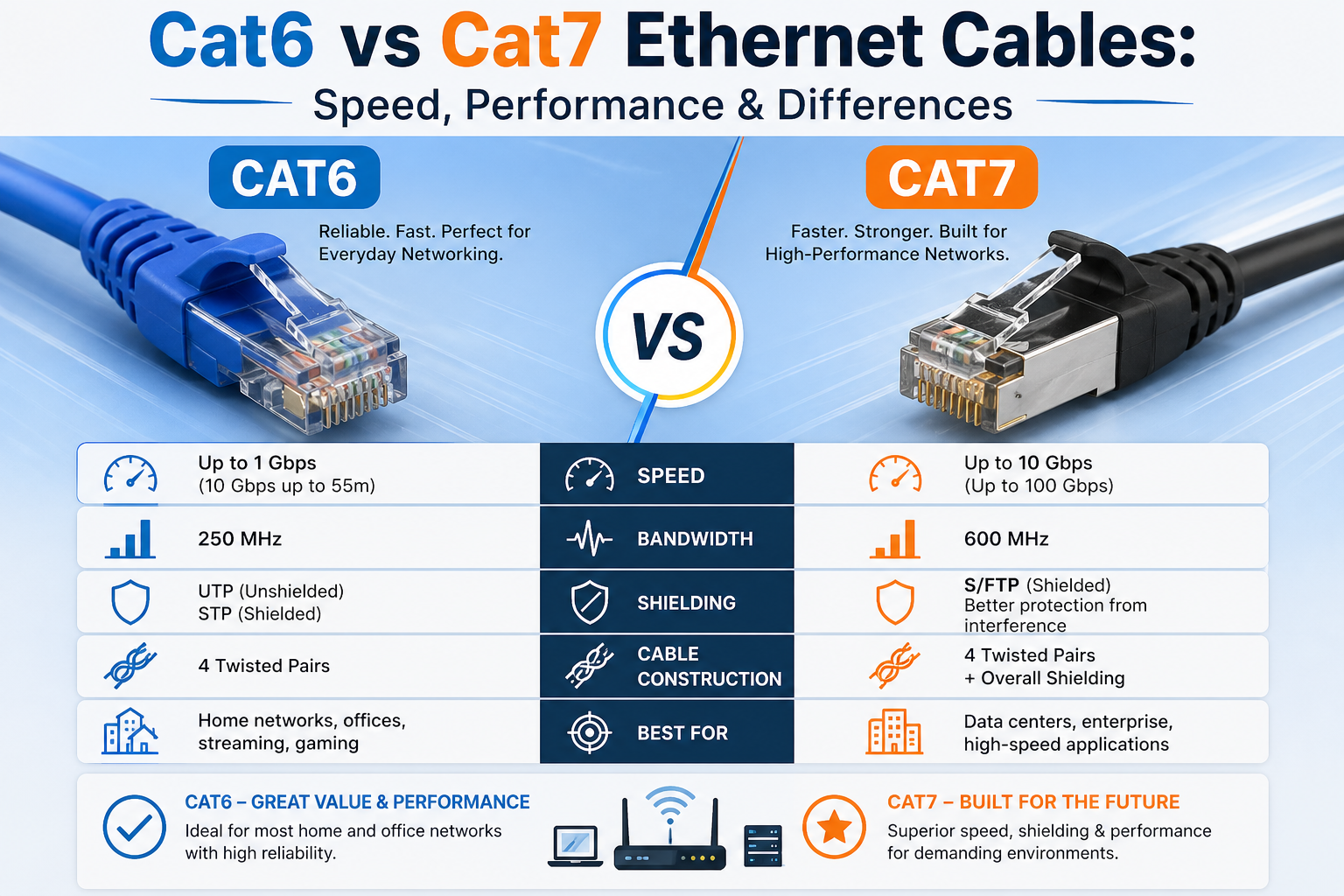
Ethernet cables may appear identical at first glance, but their internal construction and performance capabilities vary significantly depending on their category. The term “Cat” refers to “Category,” which defines a set of standards that determine how a cable performs in terms of speed, bandwidth, frequency, and resistance to interference. As networking technology continues to evolve, newer cable categories are introduced to support increasing data demands and more complex environments.
Many people assume that since all Ethernet cables contain eight copper wires arranged in twisted pairs, the differences between them must be minimal. In reality, these differences are quite important and directly impact how efficiently data is transmitted across a network. Factors such as how tightly the wires are twisted, whether shielding is used, and how well interference is controlled all play a role in determining overall performance.
Choosing the right Ethernet cable is not always straightforward. It can be tempting to go for the newest or most advanced option, assuming it will automatically provide better performance. However, the best choice depends on your specific needs, existing hardware, and environment. Understanding the differences between Cat6 and Cat7 is essential for making a smart and cost-effective decision.
Overview of Cat6 Ethernet Cable
Cat6 Ethernet cables represent a significant advancement over earlier cable standards. They were designed to meet the growing demand for faster and more reliable network connections, especially as internet usage expanded into high-definition streaming, cloud computing, and large-scale data transfers.
One of the key improvements in Cat6 cables is their ability to support speeds of up to 10 gigabits per second under optimal conditions. This makes them suitable for modern networks that require high-speed data transmission. In addition to speed, Cat6 cables offer increased bandwidth, which allows more data to be transmitted simultaneously without congestion or performance drops.
The internal structure of Cat6 cables is carefully engineered to reduce interference. The copper wire pairs are tightly twisted, which helps cancel out electromagnetic interference and crosstalk between the wires. Crosstalk occurs when signals from one wire interfere with another, potentially causing data errors or reduced performance. By minimizing this effect, Cat6 cables provide a more stable and reliable connection.
Another important advantage of Cat6 is its backward compatibility. It can be used with older networking equipment that supports previous cable categories, making it a flexible option for upgrades. This means you can improve your network performance without replacing all of your existing hardware at once.
Cat6 cables are also widely available and relatively affordable compared to newer standards. This balance of performance and cost makes them one of the most popular choices for both home and business networks.
Key Features and Benefits of Cat6
Cat6 cables are known for delivering strong performance across a wide range of applications. Their ability to handle high-speed data transmission makes them ideal for environments where large amounts of data need to be transferred quickly and efficiently.
One of the most notable benefits is their support for modern networking applications such as high-resolution video streaming, online gaming, and cloud-based services. These activities require consistent and reliable connections, which Cat6 is well-equipped to provide.
In addition to speed, Cat6 cables offer improved signal quality. The enhanced design reduces the chances of data loss or corruption, which is especially important in professional settings where accuracy and reliability are critical. Whether it’s transferring files between servers or supporting multiple devices on a network, Cat6 ensures smooth and stable performance.
Another advantage is their ability to support Power over Ethernet (PoE). This technology allows electrical power to be transmitted along with data through the same cable, enabling devices like security cameras, wireless access points, and IP phones to operate without separate power sources. This simplifies installation and reduces the need for additional wiring.
Durability is also a strong point for Cat6 cables. They are designed to withstand regular use and maintain performance over time, provided they are installed correctly. This makes them a long-term investment for network infrastructure.
Overview of Cat7 Ethernet Cable
Cat7 Ethernet cables are designed to push performance beyond what Cat6 can offer, particularly in environments where interference is a major concern. They build upon the foundation of earlier cable categories by introducing advanced shielding and higher frequency capabilities.
One of the defining features of Cat7 cables is their shielding design. Unlike Cat6, which typically relies on twisted pairs alone, Cat7 includes shielding around each individual pair of wires, as well as an overall shield for the entire cable. This significantly reduces electromagnetic interference and ensures cleaner signal transmission.
Cat7 cables support frequencies of up to 600MHz, which is more than double that of Cat6. This higher frequency allows for greater data capacity and provides the potential for faster speeds when used with compatible networking equipment. While both Cat6 and Cat7 are commonly associated with 10Gbps performance, Cat7 is built to handle future advancements that may exceed this limit.
Another important aspect of Cat7 is its focus on performance consistency. In environments where cables are densely packed or exposed to electrical noise, maintaining signal quality can be challenging. The enhanced shielding in Cat7 helps maintain stable connections even under demanding conditions.
However, it’s important to note that Cat7 cables are not always necessary for typical home or office use. Their advanced features are most beneficial in specialized environments such as data centers, industrial facilities, or locations with high levels of interference.
Key Features and Benefits of Cat7
Cat7 cables offer several advantages that make them suitable for high-performance networking environments. Their most significant benefit is their superior protection against interference. By shielding each pair of wires, they minimize signal degradation and ensure reliable data transmission.
This makes Cat7 an excellent choice for installations where cables are run alongside power lines or other sources of electromagnetic noise. In such environments, unshielded cables may struggle to maintain consistent performance, leading to slower speeds or connection issues.
Another advantage of Cat7 is its ability to support higher frequencies. This provides additional bandwidth capacity, which can be useful for advanced applications such as high-speed data transfers, real-time processing systems, and large-scale network operations.
Cat7 cables are also designed with durability in mind. Their robust construction helps protect the internal components from physical damage and environmental factors. This makes them suitable for long-term installations where reliability is critical.
Despite these benefits, Cat7 cables are more expensive and less flexible than Cat6. Their thicker design can make installation more challenging, especially in tight spaces or complex layouts. This is an important consideration when planning a network upgrade.
Comparing Practical Use Cases
When deciding between Cat6 and Cat7, it’s important to consider how and where the cable will be used. For most residential and small business networks, Cat6 provides more than enough performance to handle everyday tasks. It supports high-speed internet connections, streaming, gaming, and general data transfer without any issues.
In contrast, Cat7 is better suited for environments where performance demands are higher and interference is a concern. For example, data centers often have large numbers of cables running close together, which increases the risk of signal interference. In such cases, the shielding provided by Cat7 can make a noticeable difference.
Industrial environments are another scenario where Cat7 may be preferred. Machinery and electrical equipment can generate significant electromagnetic noise, which can disrupt network signals. The enhanced protection offered by Cat7 helps maintain stable connections in these conditions.
Ultimately, the choice between Cat6 and Cat7 depends on your specific requirements. While Cat7 offers advanced features, those features may not provide meaningful benefits in all situations. Understanding your network’s needs will help you choose the most appropriate option.
Understanding Speed in Ethernet Cables
When comparing Cat6 and Cat7 cables, speed is often the first factor people consider. Network speed refers to how quickly data can travel from one device to another, and it plays a crucial role in everything from browsing the internet to running complex enterprise systems. However, speed is not determined by the cable alone. It also depends on the networking equipment, cable length, and environmental conditions.
Both Cat6 and Cat7 cables are commonly associated with supporting speeds of up to 10 gigabits per second. This level of performance is more than sufficient for most modern applications, including streaming high-definition content, transferring large files, and supporting multiple connected devices simultaneously. Despite having the same advertised speed in many cases, the way these cables achieve and maintain that speed differs significantly.
Cat6 cables are designed to deliver 10Gbps performance over shorter distances, typically up to around 55 meters under ideal conditions. Beyond that range, performance may begin to degrade depending on interference and installation quality. For longer distances, speeds may drop to lower levels to maintain signal stability.
Cat7 cables, on the other hand, are built with higher performance margins. While they are also rated for 10Gbps, their improved construction allows them to maintain stable performance over longer distances and under more demanding conditions. This makes them a stronger candidate for environments where consistent high-speed connectivity is essential.
The Role of Bandwidth and Frequency
Bandwidth and frequency are closely related concepts that directly impact how much data a cable can handle at any given time. Frequency, measured in megahertz, represents the range of signals a cable can carry. A higher frequency means the cable can transmit more data simultaneously, which translates into greater bandwidth.
Cat6 cables operate at frequencies up to 250MHz. This provides enough capacity for most current networking needs, including gigabit and 10-gigabit connections. For typical home and office environments, this level of bandwidth is more than adequate to ensure smooth and efficient performance.
Cat7 cables significantly increase this capability by supporting frequencies up to 600MHz. This higher frequency allows for greater data throughput and provides additional headroom for future networking technologies. While current consumer equipment may not fully utilize this extra capacity, it becomes valuable in high-performance environments where data demands are constantly increasing.
The difference in frequency also contributes to signal quality. Higher-frequency cables like Cat7 are better equipped to handle complex data transmissions without degradation, especially in environments with multiple devices and heavy network traffic.
Performance in Real-World Scenarios
In real-world applications, the difference between Cat6 and Cat7 is not always as dramatic as the specifications might suggest. For most users, both cable types will deliver similar performance when used with standard networking equipment. Activities such as web browsing, video streaming, and online gaming typically do not require the advanced capabilities of Cat7.
However, performance differences become more noticeable in specialized scenarios. For example, in data centers where large volumes of data are transferred continuously, even small improvements in efficiency can have a significant impact. Cat7’s higher frequency and better shielding help maintain consistent performance under heavy loads.
Another example is in environments with high electromagnetic interference. Offices with extensive electrical wiring, industrial facilities with heavy machinery, or locations with dense cable installations can all introduce noise that affects signal quality. In these situations, Cat7 cables are more effective at preserving data integrity and reducing transmission errors.
It is also important to consider latency, which refers to the delay in data transmission. While both Cat6 and Cat7 offer low latency, the improved signal quality of Cat7 can help maintain consistent response times in demanding applications such as real-time systems, video conferencing, and online collaboration tools.
Impact of Cable Length on Performance
Cable length is another critical factor that influences performance. As the length of an Ethernet cable increases, the signal weakens, which can lead to reduced speeds and reliability. This effect is known as signal attenuation.
Cat6 cables perform exceptionally well over shorter distances, but their ability to maintain maximum speed decreases as the cable length approaches its upper limit. For installations that require longer cable runs, careful planning is needed to ensure optimal performance. This may involve using additional networking equipment such as switches or repeaters.
Cat7 cables handle longer distances more effectively due to their superior shielding and construction. The reduced interference allows signals to travel further without degradation, making Cat7 a better option for large installations where long cable runs are unavoidable.
Despite this advantage, it is still important to follow recommended installation guidelines for both cable types. Proper routing, avoiding sharp bends, and minimizing exposure to interference sources can significantly improve performance regardless of the cable category.
Compatibility with Networking Equipment
Another key consideration when evaluating speed and performance is compatibility with existing networking hardware. Ethernet cables are only one part of a network, and their performance is limited by the capabilities of the devices they connect.
Cat6 cables are widely supported by most routers, switches, and network interface cards. This makes them a practical choice for upgrades, as they can be integrated into existing systems without requiring major changes.
Cat7 cables, while backward compatible, may require specialized connectors or equipment to fully utilize their capabilities. In many cases, using a Cat7 cable with standard hardware will not result in noticeable performance improvements. To take full advantage of Cat7’s higher frequency and shielding, the entire network infrastructure must be designed to support it.
This includes not only cables but also connectors, patch panels, and networking devices. Without these supporting components, the benefits of Cat7 may not justify the additional cost.
Future Performance Potential
One of the main reasons people consider Cat7 cables is their potential for future use. As technology continues to advance, network speeds and data requirements are expected to increase. Investing in higher-performance cabling can help ensure that a network remains capable of handling these changes.
Cat6 cables are already capable of supporting current high-speed standards, and they are likely to remain relevant for many years. However, their lower frequency limit means they may eventually reach their maximum capacity as newer technologies emerge.
Cat7 cables offer more headroom for future developments. Their higher frequency and improved shielding make them better suited for next-generation networking standards that may exceed 10Gbps. For organizations planning long-term infrastructure investments, this can be an important consideration.
That said, future-proofing should be balanced against current needs and budget constraints. In many cases, the additional cost of Cat7 may not provide immediate benefits, especially if the existing network does not require such high performance.
Balancing Performance and Practicality
While it is easy to focus on technical specifications, practical considerations are just as important when choosing between Cat6 and Cat7. Performance gains must be weighed against factors such as cost, ease of installation, and compatibility.
Cat6 remains the most practical choice for the majority of users. It delivers reliable high-speed performance, is easy to install, and works seamlessly with existing equipment. For most home and office networks, it provides everything needed for efficient and stable connectivity.
Cat7, while offering superior performance on paper, is best suited for specific scenarios where its advanced features can be fully utilized. These include high-density networking environments, locations with significant interference, and systems that require maximum reliability.
Understanding these differences helps ensure that the chosen cable meets both current and future needs without unnecessary expense or complexity.
Shielding and Interference Protection
One of the most important differences between Cat6 and Cat7 cables lies in how they handle interference. In any networking environment, signals can be affected by electromagnetic interference (EMI), which is generated by nearby electrical devices, power lines, or even other cables. If not properly controlled, this interference can lead to slower speeds, data errors, and unstable connections.
Cat6 cables are typically unshielded, relying on the tight twisting of their internal wire pairs to reduce interference. This design works effectively in most standard environments, such as homes and offices, where sources of electrical noise are limited. The twisting helps cancel out unwanted signals, allowing data to travel with minimal disruption. For everyday use, this level of protection is usually more than sufficient.
Cat7 cables take a more advanced approach by incorporating shielding around each individual pair of wires, along with an additional overall shield for the entire cable. This layered protection significantly reduces the impact of external interference and prevents crosstalk between pairs. As a result, Cat7 cables can maintain cleaner and more stable signals, even in challenging conditions.
This enhanced shielding becomes particularly valuable in environments where cables are installed close together or near high-powered electrical equipment. In such cases, the extra protection helps ensure consistent performance and reduces the risk of connection issues. While Cat6 can handle moderate interference, Cat7 is designed for situations where signal integrity is critical.
Durability and Build Quality
Beyond performance, the physical construction of Ethernet cables also plays a role in their overall reliability. Cat6 cables are designed to be flexible and easy to install, making them suitable for a wide range of applications. Their lighter construction allows them to be routed through walls, conduits, and tight spaces without much difficulty.
Cat7 cables, due to their additional shielding, are thicker and more rigid. This makes them more durable in terms of protecting internal components, but it also makes installation more challenging. The added bulk can make it harder to bend the cable or fit it into confined spaces, which may require more careful planning during installation.
Despite being less flexible, Cat7 cables are built to withstand demanding environments. Their मजबूत construction helps protect against physical damage, environmental stress, and long-term wear. This makes them a reliable choice for installations where cables are expected to remain in place for extended periods without maintenance.
Proper handling and installation are important for both cable types. Avoiding sharp bends, excessive pulling, and exposure to harsh conditions can significantly extend the lifespan of any Ethernet cable.
Installation Considerations
Installing Ethernet cables involves more than simply connecting devices. The way cables are routed and managed can have a direct impact on performance and reliability. Cat6 cables are generally easier to work with due to their flexibility and simpler design. They can be installed quickly and do not require specialized tools or grounding in most cases.
Cat7 cables, on the other hand, often require more careful installation. Because of their shielding, proper grounding is essential to ensure optimal performance. Without proper grounding, the shielding may not function as intended, reducing its effectiveness against interference. This adds an extra layer of complexity to the installation process.
In addition, Cat7 cables may require compatible connectors and hardware to fully utilize their capabilities. Using standard connectors with a high-performance cable can limit its effectiveness, meaning that the entire network setup must be considered when upgrading to Cat7.
Another factor to consider is cable management. The thicker design of Cat7 cables can make it more difficult to organize large numbers of cables, especially in tight spaces such as server racks or conduits. Planning the layout in advance can help avoid complications during installation.
Cost Comparison and Value
Cost is often one of the deciding factors when choosing between Cat6 and Cat7 cables. Cat6 is widely available and relatively affordable, making it an attractive option for both small and large network installations. Its pricing is comparable to older cable categories, which makes upgrading to Cat6 a cost-effective way to improve network performance.
Cat7 cables are significantly more expensive due to their advanced shielding and construction. The cost difference can become substantial when installing large networks, as even a small increase in price per cable adds up quickly. In addition to the cables themselves, the need for compatible connectors and proper grounding can further increase the overall expense.
For most users, the performance benefits of Cat7 do not justify the higher cost. Cat6 already provides excellent speed and reliability for common applications, making it the better value in many situations. However, in environments where performance and stability are critical, the investment in Cat7 may be worthwhile.
Evaluating cost should always involve considering both immediate needs and long-term goals. While it may be tempting to choose the most advanced option available, it is important to ensure that the additional expense provides meaningful benefits.
Future-Proofing and Longevity
Future-proofing is a key consideration when designing or upgrading a network. Technology continues to evolve, and network demands are expected to grow over time. Choosing a cable that can support future requirements can help avoid the need for frequent upgrades.
Cat6 cables are already capable of supporting high-speed connections and are expected to remain relevant for many years. For most users, they provide enough capacity to handle current and near-future applications without any issues.
Cat7 cables offer greater potential for future expansion due to their higher frequency and improved shielding. They are better equipped to handle emerging technologies that may require higher speeds and increased data capacity. For organizations planning long-term infrastructure investments, this can be a significant advantage.
However, future-proofing should be approached carefully. Investing in higher-performance cabling does not guarantee improved performance unless the rest of the network infrastructure is also upgraded. Balancing current needs with future expectations is essential for making a practical decision.
Choosing the Right Cable for Your Needs
Selecting between Cat6 and Cat7 ultimately comes down to understanding your specific requirements. For most home users and small businesses, Cat6 provides more than enough performance. It supports high-speed internet, streaming, gaming, and everyday networking tasks with ease. Its affordability and ease of installation make it the most practical choice for general use.
Cat7 is better suited for specialized environments where performance and reliability are critical. This includes data centers, industrial facilities, and locations with high levels of electromagnetic interference. In these scenarios, the advanced shielding and higher frequency of Cat7 can provide noticeable benefits.
It is also important to consider the overall network setup. Upgrading cables alone will not improve performance if other components, such as routers and switches, are not capable of supporting higher speeds. A well-balanced network ensures that all components work together efficiently.
Common Mistakes When Choosing Ethernet Cables
One of the most common mistakes people make when selecting Ethernet cables is assuming that newer always means better. While Cat7 offers advanced features, it does not automatically improve performance unless the entire network infrastructure supports those capabilities. Many users upgrade to higher-category cables without upgrading routers, switches, or network cards, resulting in no noticeable improvement.
Another frequent issue is ignoring the actual requirements of the network. Not every setup needs extremely high bandwidth or advanced shielding. For typical home or office use, Cat6 is more than capable of handling daily tasks efficiently. Choosing Cat7 in such cases can lead to unnecessary expenses without delivering real benefits.
Improper installation is another mistake that can affect performance. Even the best cable will underperform if it is bent sharply, stretched excessively, or installed near strong sources of interference without proper planning. Cable management and routing are just as important as the cable itself.
Many users also overlook compatibility. Cat7 cables may require specific connectors or properly grounded systems to function as intended. Using incompatible hardware can limit performance and reduce the advantages of higher-category cables.
Expert Tips for Better Network Performance
To get the most out of your Ethernet cables, it is important to focus on the overall network rather than just one component. Start by ensuring that your router and switches support the speeds you expect to achieve. A high-performance cable cannot compensate for outdated networking equipment.
Always plan your cable layout carefully. Avoid running Ethernet cables parallel to power lines, as this can introduce interference. If this cannot be avoided, using shielded cables like Cat7 may help reduce the impact.
Keep cable lengths within recommended limits. Shorter cables generally provide better performance, as they reduce signal loss and interference. If long runs are necessary, consider using high-quality cables and proper installation techniques to maintain signal integrity.
Invest in proper cable management. Organizing cables neatly not only improves airflow and accessibility but also reduces the chances of interference and physical damage. This is especially important in environments with a large number of connections.
Testing your network after installation is another important step. This helps identify any issues early and ensures that your setup is performing as expected.
Real-World Recommendations
For most users, Cat6 remains the best overall choice. It offers excellent speed, reliability, and value, making it suitable for a wide range of applications. Whether you are setting up a home network, upgrading an office, or supporting multiple devices, Cat6 provides a strong and dependable foundation.
Cat7 becomes a better option in more demanding environments. If your setup involves heavy data transfer, high-density cable installations, or exposure to electromagnetic interference, the added shielding and higher frequency of Cat7 can make a meaningful difference. It is particularly useful in data centers, industrial settings, and advanced networking systems.
For long-term projects, it is worth considering future needs, but not at the expense of practicality. Investing in Cat7 may make sense if you expect your network to grow significantly or require higher speeds in the near future. Otherwise, Cat6 is more than sufficient for current and mid-term requirements.
When Upgrading Actually Makes Sense
Upgrading your Ethernet cables should be based on clear performance needs rather than assumptions. If your current network is already meeting your requirements, upgrading may not provide noticeable improvements. However, if you are experiencing slow speeds, frequent disconnections, or interference issues, it may be time to evaluate your cabling.
A good upgrade strategy involves assessing all components of your network. This includes checking your internet speed, hardware capabilities, and the condition of your existing cables. Replacing outdated or damaged cables with high-quality Cat6 can often resolve many common issues.
If you are building a new network from scratch, choosing the right cable from the beginning can save time and money in the long run. In such cases, balancing performance, cost, and future needs is key to making the right decision.
Quick Recap of Cat6 and Cat7
Cat6 and Cat7 Ethernet cables are both designed to support high-speed networking, but they serve different levels of performance needs. Cat6 is widely used and delivers excellent speed, stability, and affordability for most environments. It supports modern applications with ease and integrates smoothly with existing hardware.
Cat7, on the other hand, is built with advanced shielding and higher frequency capabilities. It is designed for environments where interference is a concern and where maximum signal integrity is required. While both cables can support similar speeds in many cases, Cat7 offers better consistency and future potential under demanding conditions.
Core Differences That Matter Most
When comparing these two cable types, a few key differences stand out as the most important in real-world usage. The first is shielding. Cat6 relies on twisted pairs to manage interference, while Cat7 adds multiple layers of shielding for stronger protection. This makes Cat7 more reliable in environments with high electromagnetic noise.
The second major difference is frequency. Cat6 operates at a lower frequency compared to Cat7, which limits its long-term scalability. Cat7’s higher frequency allows it to handle more data and prepares it for future networking advancements.
Cost is another critical factor. Cat6 is far more budget-friendly and provides excellent value for most users. Cat7 is more expensive and often requires additional investment in compatible hardware and installation practices.
Installation also plays a role. Cat6 is flexible and easy to install, while Cat7 is thicker and requires more careful handling, including proper grounding to achieve its full benefits.
Which One Should You Choose
Choosing between Cat6 and Cat7 depends entirely on your specific situation. For home users, gamers, and small offices, Cat6 is usually the best option. It delivers reliable performance, supports high-speed internet, and is easy to install without requiring major upgrades.
For businesses, data centers, or industrial environments, Cat7 may be the better choice. Its superior shielding and higher frequency make it ideal for handling heavy workloads and maintaining stable connections in challenging conditions.
If your network does not currently require advanced features, investing in Cat7 may not provide immediate benefits. However, if you are planning a long-term infrastructure with future expansion in mind, Cat7 can offer additional headroom.
Performance vs Practicality
A key takeaway when comparing Cat6 and Cat7 is the balance between performance and practicality. While Cat7 offers better technical specifications, those advantages are only meaningful if your network can actually use them. In many cases, the difference in everyday performance between the two is minimal.
Cat6 stands out because it delivers strong performance where it matters most, without unnecessary complexity or cost. It is a practical solution that meets current demands while remaining accessible and easy to manage.
Cat7 represents a more specialized solution. It is designed for scenarios where performance must remain consistent under pressure, even in environments filled with potential interference.
Long-Term Value and Network Planning
When planning a network, it is important to think beyond immediate needs. A well-designed system should be able to adapt to future demands without requiring constant upgrades. This is where the concept of long-term value becomes important.
Cat6 offers excellent longevity for most users and will continue to support modern applications for years to come. It is a safe and reliable investment for both residential and commercial use.
Cat7 provides additional future-proofing, but at a higher cost. Its value becomes more apparent in large-scale or high-performance environments where upgrading infrastructure later would be more difficult and expensive.
The key is to match your investment with your actual requirements. Overspending on features you may never use does not necessarily improve your network.
Understanding Real-World Network Environments
When discussing Ethernet cables like Cat6 and Cat7, it is easy to focus only on technical specifications such as speed and frequency. However, real-world performance depends heavily on the environment in which the cables are used. Factors such as building structure, electrical systems, network size, and device density all influence how well a cable performs.
In a typical home environment, interference levels are relatively low. Devices such as routers, televisions, and gaming consoles operate within manageable limits, allowing Cat6 cables to perform efficiently without requiring additional shielding. Even with multiple connected devices, Cat6 can maintain stable performance for streaming, gaming, and daily internet usage.
In contrast, office environments introduce more complexity. Multiple computers, printers, access points, and other networking equipment operate simultaneously, increasing data traffic and the likelihood of interference. While Cat6 still performs well in these scenarios, careful cable management becomes more important to avoid performance issues.
More demanding environments, such as industrial facilities or large data centers, present unique challenges. Heavy machinery, power systems, and densely packed cables can create significant electromagnetic interference. In such cases, the advanced shielding of Cat7 cables becomes highly beneficial, helping maintain signal quality and reduce errors.
High-Density Networking and Cable Management
As networks grow, the number of cables increases, leading to what is often referred to as high-density networking. This is commonly seen in server rooms and data centers, where hundreds or even thousands of cables are installed in close proximity.
In these environments, interference between cables can become a serious issue. When multiple cables are bundled together, signals from one cable can affect others, leading to crosstalk and reduced performance. Cat6 cables, while effective in smaller setups, may struggle to maintain optimal performance in such dense configurations.
Cat7 cables are specifically designed to address this challenge. Their individual pair shielding and overall cable shielding create a barrier that prevents interference between adjacent cables. This ensures consistent performance even in tightly packed installations.
Proper cable management is essential regardless of the cable type. Organizing cables, maintaining separation where possible, and using structured cabling systems can significantly improve network reliability. Even the best cables cannot compensate for poor installation practices.
Use Cases Where Cat6 Excels
Cat6 cables are the go-to choice for the majority of networking needs due to their versatility and cost-effectiveness. They are ideal for residential setups, where users require reliable internet for streaming, gaming, and smart home devices. With increasing demand for high-speed connections, Cat6 provides enough bandwidth to support multiple users without congestion.
Small and medium-sized businesses also benefit greatly from Cat6. Offices that rely on cloud applications, video conferencing, and file sharing can achieve excellent performance without investing in more expensive cabling. The ease of installation and compatibility with existing hardware make Cat6 a practical option for upgrades.
Educational institutions, retail stores, and general commercial environments also find Cat6 sufficient for their networking requirements. It strikes the right balance between performance and affordability, making it suitable for a wide range of applications.
Use Cases Where Cat7 Becomes Valuable
Cat7 cables are best suited for environments where performance and reliability are critical. Data centers are one of the most common examples. These facilities handle massive amounts of data and require consistent, high-speed connections. The advanced shielding of Cat7 helps maintain signal integrity in these demanding conditions.
Industrial environments are another area where Cat7 shines. Machinery and electrical systems can generate significant interference, which can disrupt network signals. Cat7’s shielding minimizes these effects, ensuring stable communication between devices.
Large enterprises with complex network infrastructures may also benefit from Cat7. In such setups, even minor performance improvements can have a significant impact on overall efficiency. The ability to handle higher frequencies and reduce interference makes Cat7 a strong candidate for these scenarios.
Impact of Emerging Technologies
As technology continues to evolve, network demands are increasing rapidly. Applications such as cloud computing, artificial intelligence, virtual reality, and the Internet of Things (IoT) require faster and more reliable connections. This growth is driving the need for improved networking infrastructure.
Cat6 cables are well-equipped to handle current technologies, but their limitations may become more apparent as data requirements continue to grow. While they can support high speeds today, future applications may push them closer to their maximum capacity.
Cat7 cables, with their higher frequency and improved shielding, are better positioned to support emerging technologies. They provide additional headroom for increased data transmission and can adapt more easily to future advancements.
However, it is important to note that cabling is only one part of the equation. Network performance also depends on hardware, software, and overall system design. Upgrading cables alone will not guarantee improved performance without corresponding upgrades in other areas.
Installation Challenges and Practical Limitations
While Cat7 offers clear advantages in certain scenarios, it also comes with practical challenges. Its thicker and more rigid design makes it harder to install, especially in tight spaces or complex layouts. This can increase installation time and labor costs.
Grounding is another important consideration. The shielding in Cat7 cables requires proper grounding to function effectively. Without it, the benefits of shielding may be reduced, limiting the cable’s performance.
Compatibility can also be an issue. Not all networking equipment is designed to fully support Cat7, which means users may not experience the full benefits unless the entire system is upgraded. This adds to the overall cost and complexity of implementation.
Cat6, in comparison, is much easier to install and does not require special considerations such as grounding. This simplicity makes it a more convenient choice for most users.
Cost vs Performance in Long-Term Planning
When planning a network, it is important to consider both immediate needs and long-term goals. Cat6 offers excellent performance at a lower cost, making it a practical choice for most applications. It provides reliable connectivity without requiring significant investment.
Cat7, while more expensive, offers better performance in specific scenarios and greater potential for future upgrades. For organizations planning large-scale or long-term installations, this can be a valuable investment.
The key is to balance cost and performance. Investing in high-end cabling may not always be necessary, especially if the network does not require it. Understanding your specific needs will help you make a more informed decision.
Final Conclusion
Cat6 and Cat7 Ethernet cables each have their own strengths and ideal use cases. Cat6 stands out as a versatile, cost-effective solution that meets the needs of most users. It provides reliable performance, supports modern applications, and is easy to install.
Cat7 takes performance a step further with advanced shielding and higher frequency capabilities. It is designed for environments where interference is a concern and where maximum reliability is required. However, its benefits come with increased cost and complexity.
For most users, Cat6 remains the best choice due to its practicality and value. Cat7 is best reserved for specialized scenarios where its advanced features can be fully utilized.
By understanding these differences and considering your specific requirements, you can choose the right cable for your network and ensure long-term performance and reliability.