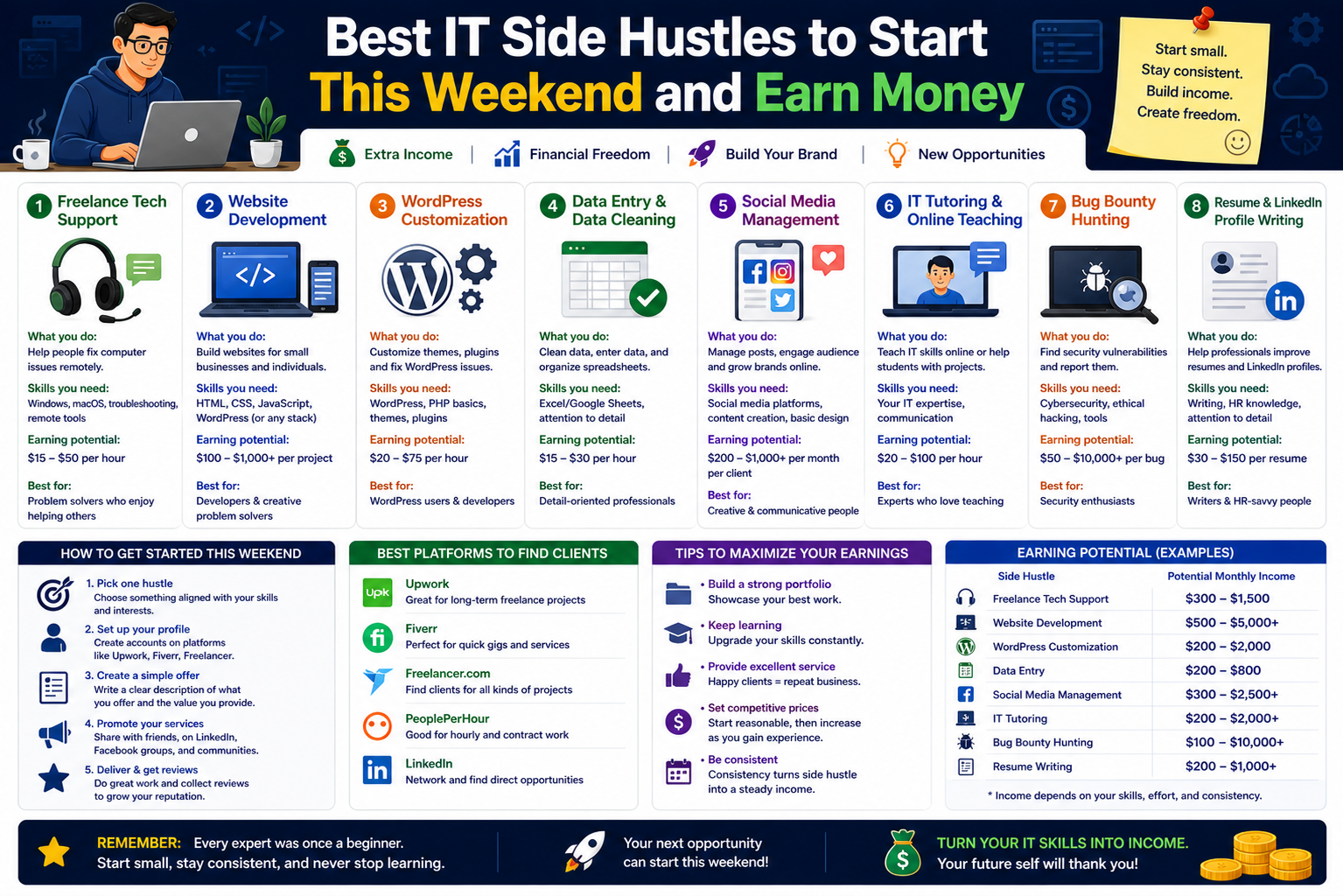
Side hustles have become a powerful way for individuals to take control of their financial future while exploring their professional potential. Across the world, people are using their evenings and weekends to create additional income streams that range from small supplemental earnings to substantial revenue that rivals full-time salaries. What makes IT side hustles particularly attractive is their flexibility, scalability, and alignment with in-demand technical skills.
Unlike many traditional side jobs, IT-based opportunities allow you to work remotely, set your own schedule, and continuously build valuable expertise. Whether you are already working in technology or just starting to develop your skills, a well-chosen side hustle can help you grow faster than relying on a standard job alone. It also gives you the freedom to experiment without the pressure of full-time expectations.
Beyond the financial benefits, side hustles provide a unique opportunity to sharpen your skills in real-world scenarios. Many professionals find themselves learning technologies like scripting, cloud computing, or system administration but lacking practical opportunities to apply them in their current roles. A side hustle bridges that gap, turning theoretical knowledge into hands-on experience.
Turning Free Time Into Productive Income
Evenings and weekends often go underutilized, but they hold significant potential when approached with purpose. Instead of viewing free time as something to simply pass, it can be transformed into a strategic investment in your future. A few focused hours each week can gradually evolve into a reliable income stream or even a long-term career shift.
The key is consistency rather than intensity. You do not need to dedicate every spare moment to your side hustle. Instead, setting realistic goals and maintaining steady progress can lead to meaningful results over time. This approach also helps prevent burnout, which is a common challenge when balancing a full-time job with additional work.
Starting small is often the smartest move. You can test different ideas, understand market demand, and refine your approach without taking significant risks. Over time, as your confidence and client base grow, you can decide whether to expand further or keep your side hustle as a supplemental income source.
Start IT Consulting
IT consulting is one of the most rewarding side hustles for professionals with solid technical experience. Organizations frequently encounter challenges that require specialized knowledge, whether it is deploying a new application, troubleshooting infrastructure issues, or navigating complex system integrations. When internal teams lack the expertise or time to handle these challenges, they turn to consultants.
As a consultant, your role is to provide solutions, guidance, and expertise tailored to specific problems. This can range from short-term projects to ongoing advisory roles. The value you bring is directly tied to your knowledge and ability to deliver results, which means skilled consultants can command high rates even with limited working hours.
However, consulting requires more than technical ability. Communication skills, problem-solving mindset, and professionalism play a critical role in building trust with clients. You need to understand business needs, not just technical requirements, and present solutions in a way that stakeholders can appreciate.
One of the realities of consulting is that income is not always consistent in the beginning. Since you are essentially self-employed, you only earn when you are actively working on projects. This is why many professionals start consulting as a side hustle before transitioning into it full-time. It allows you to build a client base gradually while maintaining financial stability.
Over time, as your reputation grows, consulting can evolve into a primary career path. Many successful consultants begin with small weekend projects and eventually develop long-term contracts or even establish their own consulting firms.
Teaching IT Skills for Profit and Impact
Another highly effective side hustle is teaching IT skills to others. Technology is constantly evolving, and there is a growing demand for accessible learning resources. If you possess expertise in areas such as networking, programming, cloud computing, or cybersecurity, you can turn that knowledge into a valuable teaching opportunity.
Creating educational content allows you to reach a wide audience while generating passive income. Online courses are particularly popular because they can be created once and sold repeatedly. This model provides scalability, meaning your effort can continue to generate returns long after the initial work is completed.
Developing a course typically involves recording lectures, creating demonstrations, and organizing structured lessons that guide learners from basic concepts to advanced topics. While this process requires time and effort upfront, it can become a reliable income stream once established.
Teaching is not limited to online platforms. In-person classes also offer valuable opportunities, especially for those who prefer direct interaction. Local institutions, training centers, and community programs often look for instructors who can teach technical skills during evenings or weekends. These sessions can complement your main job while allowing you to build confidence as an educator.
One of the overlooked benefits of teaching is how much it reinforces your own understanding. Explaining concepts to others forces you to think more deeply, identify gaps in your knowledge, and improve your communication skills. This not only benefits your side hustle but also enhances your performance in your primary job.
Additionally, teaching helps you build a personal brand. As more people recognize your expertise, new opportunities may arise, including consulting work, collaborations, or advanced training roles. Over time, what starts as a simple side activity can develop into a strong professional identity.
Building Confidence Through Practical Experience
Both consulting and teaching share a common advantage: they accelerate your growth through real-world application. Instead of passively learning, you actively engage with challenges, solve problems, and refine your approach based on feedback.
Confidence plays a crucial role in any side hustle. Many individuals hesitate to start because they feel they are not experienced enough. In reality, you do not need to know everything to begin. What matters is having a solid foundation and the willingness to learn as you go.
Each project you complete and each student you teach contributes to your overall expertise. Over time, you develop a portfolio of work that demonstrates your capabilities. This portfolio becomes a powerful tool when attracting new clients or opportunities.
It is also important to recognize that mistakes are part of the process. Side hustles provide a safer environment to learn from errors compared to high-pressure full-time roles. By approaching challenges with a growth mindset, you can turn setbacks into valuable lessons.
Balancing Skill Development and Income Goals
While earning extra money is a primary motivation for many, side hustles offer much more than financial rewards. They provide a pathway to continuous learning and professional development. The most successful individuals are those who strike a balance between immediate income and long-term growth.
Focusing solely on quick earnings may limit your potential, while investing too much time in learning without monetizing your skills can slow progress. A balanced approach ensures that you are both earning and improving at the same time.
For example, taking on small consulting projects can help you understand client expectations while refining your technical skills. Similarly, teaching basic concepts can strengthen your fundamentals and prepare you for more advanced topics.
As your expertise grows, you can gradually increase your rates, target higher-value projects, or expand your offerings. This progression allows your side hustle to evolve alongside your skills.
Laying the Foundation for Long-Term Success
Starting an IT side hustle is not just about immediate results; it is about building something sustainable. The early stages require patience, experimentation, and persistence. Not every idea will succeed, but each attempt provides valuable insights.
Establishing clear goals can help guide your efforts. Whether you aim to earn a specific amount, gain experience in a new technology, or transition into a different career path, having a defined objective keeps you focused.
Time management is another critical factor. Balancing a full-time job with a side hustle requires discipline and planning. Setting boundaries ensures that you remain productive without compromising your well-being.
Networking also plays an important role. Connecting with others in the industry can lead to new opportunities, collaborations, and valuable advice. Even a small network can significantly impact your growth.
Ultimately, the journey of building a side hustle is as important as the outcome. It challenges you to step outside your comfort zone, take initiative, and develop skills that extend beyond technical knowledge.
Contracting with Local Small Businesses
Contracting with small businesses offers a practical and often more stable alternative to traditional consulting. While consultants are typically brought in to solve specific problems, contractors are relied upon for ongoing support and daily IT operations. This distinction makes contracting an appealing option for those who prefer consistent work and long-term client relationships rather than short, project-based engagements.
Many small businesses operate without a dedicated IT department. They may not have the budget to hire full-time technical staff, yet they still depend heavily on technology to run their operations. From managing networks and maintaining systems to troubleshooting issues and ensuring data security, these businesses require dependable support. This gap creates a strong opportunity for IT professionals to step in and offer their services.
As a contractor, you can structure your services in a way that fits both your schedule and the needs of your clients. Some professionals prefer offering fixed monthly packages that include routine maintenance and support, while others operate on an hourly or on-call basis. Each model has its advantages, and the right choice depends on your availability and long-term goals.
However, contracting comes with its own set of challenges, particularly when it comes to availability. Small businesses often expect quick responses when something goes wrong, especially during critical operations. If you are balancing a full-time job, this can create conflicts. For example, handling an urgent server issue during your regular work hours may not always be possible.
To manage this effectively, setting clear expectations with clients is essential. Defining your working hours, response times, and scope of services helps avoid misunderstandings. Some contractors also collaborate with others or keep backup support available to handle emergencies when they are unavailable. This approach not only protects your reputation but also ensures that clients receive the support they need.
Another advantage of contracting is the opportunity to gain diverse experience. Working with different businesses exposes you to various systems, challenges, and industries. This variety accelerates your learning and makes you more adaptable, which is a valuable trait in the IT field.
Over time, consistent and reliable service can lead to long-term contracts and referrals. Small businesses often rely on word-of-mouth recommendations, so building trust with even a few clients can significantly expand your opportunities.
Web and Mobile App Development as a Creative Outlet
Web and mobile app development is one of the most exciting and flexible side hustles available in the IT world. It allows you to transform ideas into functional products while continuously improving your technical skills. Whether you are building websites, mobile applications, or full-scale platforms, this path offers both creative freedom and strong earning potential.
One of the biggest advantages of development work is the ability to create your own projects. These projects can be anything from simple tools to complex applications designed to solve real-world problems. Working on personal projects provides complete control over the development process, allowing you to experiment, learn, and innovate without external pressure.
However, this freedom can also be a challenge. Without deadlines or external accountability, it is easy to lose focus or leave projects unfinished. Successful developers often overcome this by setting personal goals, breaking projects into smaller tasks, and maintaining a disciplined workflow.
Even if a project does not achieve commercial success, it still holds significant value. Completed applications serve as proof of your skills and can be showcased in your portfolio. This portfolio becomes a powerful asset when seeking freelance work or career opportunities.
Freelancing is another important aspect of development as a side hustle. Many individuals and businesses need websites, mobile apps, or custom software solutions but lack the expertise to build them. This demand creates a steady stream of opportunities for developers at all skill levels.
Starting with smaller projects is often the best approach. These projects help you build confidence, understand client requirements, and develop communication skills. As you gain experience, you can take on more complex assignments and increase your rates.
Time management plays a crucial role in development work. Unlike routine tasks, coding often requires deep focus and uninterrupted time. Allocating dedicated ساعات for development ensures that you make steady progress without feeling overwhelmed.
Another important factor is staying updated with current technologies. The development landscape evolves rapidly, and keeping your skills relevant is essential for long-term success. Learning new frameworks, tools, and best practices not only improves your efficiency but also increases your market value.
Freelance Cloud Consulting and Modern Infrastructure
Cloud computing has become a cornerstone of modern IT infrastructure, and its rapid adoption has created a high demand for skilled professionals. Freelance cloud consulting is an excellent side hustle for those with experience in cloud platforms and services. It combines technical expertise with strategic thinking, allowing you to help businesses optimize their operations.
Organizations are increasingly moving their systems to cloud environments to improve scalability, reduce costs, and enhance flexibility. However, this transition is not always straightforward. It involves careful planning, architecture design, migration strategies, and ongoing management. This complexity creates opportunities for freelancers to provide valuable guidance.
As a freelance cloud consultant, your responsibilities may include designing cloud architectures, assisting with migrations, managing resources, and ensuring security and performance. Each project presents unique challenges, which keeps the work engaging and intellectually stimulating.
One of the key benefits of this side hustle is its scalability. You can start with small projects, such as helping a business set up basic cloud services, and gradually move to more advanced tasks like optimizing infrastructure or implementing automation. This progression allows you to grow your expertise while increasing your earning potential.
Flexibility is another major advantage. Cloud consulting can often be done remotely, giving you the freedom to work from anywhere. This makes it easier to balance your side hustle with other commitments.
Building trust is crucial in this field. Businesses rely on cloud consultants to handle critical systems and sensitive data, so professionalism and reliability are essential. Delivering consistent results and maintaining clear communication helps establish long-term relationships with clients.
Certifications and continuous learning also play an important role. Cloud technologies evolve quickly, and staying updated ensures that you remain competitive. Gaining recognized credentials can enhance your credibility and make it easier to attract clients.
Managing Multiple Income Streams Effectively
As you explore different side hustles, you may find yourself juggling multiple opportunities at once. While this can increase your income, it also requires careful management to avoid becoming overwhelmed. Balancing different types of work demands strong organizational skills and a clear understanding of your priorities.
One effective approach is to focus on a primary side hustle while treating others as secondary options. This allows you to concentrate your efforts and deliver higher-quality results. Once you establish stability in one area, you can gradually expand into additional opportunities.
Tracking your time and progress is essential. Understanding how much effort each activity requires helps you allocate your resources more efficiently. It also allows you to identify which side hustles provide the best return on investment.
Setting boundaries is equally important. Without clear limits, work can easily spill into personal time, leading to fatigue and reduced productivity. Defining specific working hours and sticking to them helps maintain a healthy balance.
Financial management is another key aspect. Keeping track of your earnings, expenses, and savings ensures that you make informed decisions. It also prepares you for potential growth, such as transitioning from a side hustle to a full-time venture.
Developing a Professional Mindset
Success in any side hustle is not just about technical skills; it also depends on your mindset and approach. Treating your side work with professionalism sets you apart and builds trust with clients and collaborators.
Reliability is one of the most valued traits. Meeting deadlines, communicating clearly, and delivering quality work consistently can make a significant difference in your reputation. Even small actions, such as responding promptly to messages, contribute to a positive impression.
Adaptability is another important quality. Each client and project is different, and being able to adjust your approach ensures that you can handle a variety of situations effectively. This flexibility also helps you stay relevant in a constantly changing industry.
Continuous improvement should be a core focus. Technology evolves rapidly, and staying ahead requires a commitment to learning. Whether through practice, research, or experimentation, ongoing development keeps your skills sharp and your opportunities open.
Confidence grows with experience, but it also requires taking initiative. Starting a side hustle involves stepping into unfamiliar territory, but each step forward builds momentum. Over time, what once felt challenging becomes routine.
Freelance Opportunities in the Expanding Digital Economy
The rapid growth of the digital economy has created a constant demand for skilled IT professionals who can work independently and deliver results. Freelancing has become one of the most accessible ways to tap into this demand, allowing individuals to offer their services to clients across different industries and locations. Unlike traditional employment, freelancing gives you the flexibility to choose projects, set your rates, and define your working style.
One of the main advantages of freelancing is the low barrier to entry. With the right skills and a willingness to learn, you can begin offering services without significant upfront investment. Many professionals start by taking on small tasks to build confidence and gradually move toward larger, more complex projects. This progression helps establish credibility and creates a steady flow of opportunities.
Freelancing also exposes you to a wide range of challenges. Each client has unique requirements, which means you are constantly adapting and expanding your skill set. This diversity not only keeps the work interesting but also accelerates your professional growth. Over time, you develop a deeper understanding of different technologies, workflows, and business needs.
However, success in freelancing requires discipline and self-motivation. Without a structured environment, it is easy to lose focus or struggle with time management. Creating a routine, setting clear goals, and maintaining consistency are essential for long-term success.
Building strong relationships with clients is equally important. Delivering quality work on time and maintaining clear communication can lead to repeat business and referrals. In many cases, a satisfied client can become a long-term partner, providing ongoing work and stability.
Building a Strong Personal Brand in IT
In a competitive market, having strong technical skills is not always enough. A well-defined personal brand can significantly enhance your visibility and attract better opportunities. Your brand represents how others perceive your expertise, reliability, and professionalism.
Creating a personal brand starts with showcasing your work. This can include completed projects, case studies, or practical demonstrations of your skills. A well-organized portfolio provides potential clients with a clear understanding of what you can offer and how you approach problem-solving.
Consistency plays a key role in branding. Whether it is the way you communicate, the quality of your work, or your online presence, maintaining a consistent standard builds trust. Clients are more likely to choose someone who appears reliable and professional.
Sharing knowledge is another effective way to strengthen your brand. Writing about your experiences, explaining technical concepts, or discussing industry trends can position you as someone who understands the field deeply. This not only attracts clients but also creates opportunities for collaboration and networking.
Your reputation grows over time through your actions and interactions. Every project you complete and every client you work with contributes to your overall image. By focusing on quality and professionalism, you can build a brand that stands out in the crowded IT landscape.
Pricing Your Services and Understanding Your Value
Determining how much to charge for your services is one of the most challenging aspects of starting a side hustle. Pricing too low may undervalue your skills and attract clients who do not appreciate quality work, while pricing too high without sufficient experience can make it difficult to secure projects.
A balanced approach is to start with competitive rates and adjust them as you gain experience and confidence. Researching market trends and understanding what others in your field are charging can provide useful guidance. Over time, your pricing should reflect not only your technical skills but also the value you bring to clients.
Value is not just about completing tasks; it is about solving problems and delivering results. Clients are often willing to pay more for professionals who can provide effective solutions and improve their operations. Communicating this value clearly helps justify your rates and builds trust.
It is also important to consider different pricing models. Some professionals prefer hourly rates, while others offer fixed project fees or subscription-based services. Each model has its advantages, and choosing the right one depends on the nature of your work and your preferences.
Tracking your time and evaluating your performance can help refine your pricing strategy. By understanding how long tasks take and how much effort they require, you can make more informed decisions and ensure that your work remains profitable.
Handling Clients and Managing Expectations
Working with clients is a central part of any IT side hustle, and managing these relationships effectively can determine your success. Clear communication from the beginning helps set expectations and prevents misunderstandings later on.
Defining the scope of work is essential. Clients should understand what is included in your services and what falls outside the agreed terms. This clarity reduces the risk of scope creep, where additional tasks are added without proper compensation.
Regular updates and progress reports help maintain transparency. Clients appreciate knowing how their projects are progressing, and this builds confidence in your abilities. Even when challenges arise, honest communication can strengthen the relationship rather than weaken it.
Handling feedback professionally is another important skill. Not all feedback will be positive, but viewing it as an opportunity to improve can lead to better outcomes. Being open to suggestions while maintaining your expertise creates a balanced approach.
Setting boundaries is equally important. While it is important to be responsive, being available at all times can lead to burnout. Establishing clear working hours and response times ensures that you can maintain productivity without sacrificing your well-being.
Over time, effective client management leads to stronger relationships and repeat business. Clients who trust your work are more likely to return for future projects and recommend your services to others.
Time Management and Avoiding Burnout
Balancing a full-time job with a side hustle can be demanding, and effective time management is crucial to maintaining both productivity and well-being. Without proper planning, it is easy to become overwhelmed and lose motivation.
One of the most effective strategies is to create a structured schedule. Allocating specific time blocks for your side hustle helps maintain consistency and ensures that you make steady progress. This approach also prevents work from interfering with other responsibilities.
Prioritization plays a key role in managing your workload. Not all tasks are equally important, and focusing on high-impact activities can improve efficiency. Identifying which tasks contribute most to your goals allows you to use your time more effectively.
Taking breaks and allowing time for rest is equally important. Continuous work without adequate recovery can lead to fatigue and reduced performance. Maintaining a healthy balance between work and personal life ensures long-term sustainability.
It is also helpful to recognize your limits. Taking on too many projects at once can compromise the quality of your work and increase stress. Being selective about the opportunities you accept allows you to deliver better results and maintain a positive reputation.
Developing efficient workflows can further improve productivity. Using tools, templates, and automation reduces repetitive tasks and frees up time for more meaningful work. Over time, these improvements can significantly enhance your efficiency.
Expanding Your Skill Set Strategically
A successful IT side hustle is closely tied to continuous learning. The technology landscape is constantly evolving, and staying updated is essential for maintaining relevance. However, learning without direction can be inefficient, so a strategic approach is important.
Focusing on in-demand skills can provide a competitive advantage. Areas such as cloud computing, cybersecurity, data analysis, and software development continue to grow in importance. Building expertise in these domains increases your value and opens up new opportunities.
Practical application is one of the most effective ways to learn. Instead of relying solely on theory, applying new concepts in real projects reinforces understanding and builds confidence. Side hustles themselves can serve as a platform for experimentation and growth.
Setting clear learning goals helps maintain focus. Whether it is mastering a specific tool, completing a project, or gaining a certification, having defined objectives ensures steady progress. Tracking your achievements also provides motivation and a sense of accomplishment.
Collaboration with others can further enhance learning. Engaging with peers, participating in discussions, and sharing knowledge creates a supportive environment for growth. This interaction often leads to new ideas and perspectives.
Over time, a strategic approach to learning transforms your side hustle into a powerful engine for career advancement. The skills you develop not only improve your current work but also prepare you for future opportunities.
Before You Start IT Freelancing: Important Considerations
Starting an IT side hustle can feel exciting and full of potential, but it is important to approach it with awareness and preparation. What may seem manageable in the beginning can quickly become overwhelming if key factors are ignored. Taking time to evaluate your situation before diving in can save you from unnecessary stress and complications later.
One of the first things to review is your current employment agreement. Many organizations have policies regarding outside work, especially if it overlaps with your professional expertise. Some agreements include restrictions that limit the type of work you can take on independently. Understanding these terms helps you avoid conflicts that could impact your primary job.
Even if there are no strict restrictions, it is still important to maintain professionalism and integrity. Avoid working with direct competitors of your employer or using company resources for personal projects. Keeping a clear separation between your job and your side hustle protects your reputation and ensures ethical conduct.
Another consideration is whether to disclose your side work. Some workplaces require approval for additional employment, while others leave it to personal discretion. The decision depends on your circumstances, but it is always wise to think carefully about how transparency might affect your position.
Understanding Your Strengths and Limitations
A common mistake when starting a side hustle is trying to do everything at once. While it is tempting to explore multiple areas, focusing on your strengths provides a stronger foundation. Working within your expertise allows you to deliver better results and build confidence more quickly.
This does not mean you should avoid learning new skills. Side hustles are an excellent opportunity to expand your knowledge, but growth should be gradual and manageable. Taking on projects that are slightly beyond your comfort zone can be beneficial, as long as they remain achievable.
Recognizing your limitations is just as important as understanding your strengths. Accepting work that is too complex or outside your skill set can lead to poor outcomes and damage your reputation. Being selective about the projects you take on ensures that you maintain quality and reliability.
Setting clear boundaries for the type of work you will and will not do helps streamline your efforts. It also makes it easier to communicate your services to potential clients and avoid unnecessary complications.
Maintaining Your Mental and Physical Well-Being
Balancing a full-time job with a side hustle requires energy, focus, and discipline. While the additional income and experience can be rewarding, it is important to consider the impact on your overall well-being. Overworking yourself can lead to burnout, which ultimately reduces productivity and satisfaction.
Time management plays a central role in maintaining balance. Allocating specific hours for your side hustle and sticking to that schedule prevents work from taking over your personal life. It also helps create a routine that supports consistency without causing exhaustion.
It is equally important to evaluate the type of work you are doing. If your side hustle mirrors your full-time job too closely, it may feel repetitive and draining. For example, spending the entire day managing systems and then continuing similar tasks at night can reduce motivation over time.
Incorporating variety into your work can make the experience more enjoyable. Choosing projects that challenge you in different ways or allow creative expression can help maintain interest and prevent fatigue.
Taking regular breaks and allowing time for rest is essential. Recovery is not a luxury; it is a necessity for sustained performance. Ensuring that you have time for relaxation, hobbies, and social interactions contributes to long-term success.
Financial Awareness and Tax Responsibilities
Earning additional income through a side hustle brings financial benefits, but it also comes with responsibilities. One of the most important aspects to consider is taxation. Income generated outside of your primary job is typically subject to taxes, and failing to account for this can lead to unexpected challenges.
Setting aside a portion of your earnings for tax obligations is a practical approach. This ensures that you are prepared when payments are due and avoids financial strain. Keeping accurate records of your income and expenses also simplifies the process and provides a clear picture of your financial situation.
Understanding your expenses is equally important. Costs such as software subscriptions, equipment, and other resources can impact your overall profitability. Tracking these expenses helps you evaluate the true value of your side hustle and make informed decisions.
Planning for the future is another key aspect. As your side hustle grows, you may need to invest in better tools, training, or support. Having a financial strategy in place allows you to scale effectively without unnecessary risk.
The Effort Behind Professional Growth
A side hustle is not just a source of income; it is an investment in your personal and professional development. The effort you put into building and maintaining it contributes directly to your growth. However, this effort requires patience, persistence, and a willingness to adapt.
Not everyone finds side hustles suitable for their lifestyle, and that is perfectly valid. The additional workload can be demanding, and it may not align with every individual’s priorities. For some, focusing on improving their primary career may be a more effective path.
Improving your skill set remains one of the most reliable ways to increase your earning potential. Gaining expertise in high-demand areas can open doors to better opportunities, whether within your current role or through new positions. Continuous learning ensures that you remain competitive in an ever-changing industry.
Certifications, hands-on practice, and real-world experience all contribute to your development. Each step you take enhances your capabilities and prepares you for more advanced challenges. Over time, this growth translates into greater confidence and broader opportunities.
Positioning Yourself for Long-Term Opportunities
The ultimate value of an IT side hustle lies in its ability to create opportunities beyond immediate income. It allows you to build a portfolio, expand your network, and develop a reputation within your field. These elements play a crucial role in shaping your long-term career path.
As you gain experience, you may discover new interests or areas of specialization. This clarity can guide your future decisions and help you focus on what truly aligns with your goals. Whether you choose to expand your side hustle or integrate it into your main career, the experience remains valuable.
Networking is another powerful outcome. Interacting with clients, collaborators, and other professionals exposes you to different perspectives and opportunities. These connections often lead to new projects, partnerships, or career advancements.
Consistency and professionalism are key to sustaining growth. Delivering quality work, maintaining clear communication, and continuously improving your skills build a strong foundation for success. Over time, these efforts compound, creating a lasting impact.
Final Thoughts
Starting an IT side hustle is a journey that combines ambition, learning, and practical experience. It offers the chance to increase your income, explore new skills, and take control of your professional growth. However, success requires more than just technical ability. It demands careful planning, disciplined execution, and a balanced approach.
By understanding your strengths, managing your time effectively, and maintaining a focus on continuous improvement, you can create a side hustle that supports both your financial goals and personal development. Each step forward, no matter how small, contributes to a larger picture of growth and opportunity.
In the end, the decision to pursue a side hustle depends on your priorities and circumstances. Whether you choose to build an additional income stream or focus on advancing your primary career, the key is to remain proactive and committed to your development.