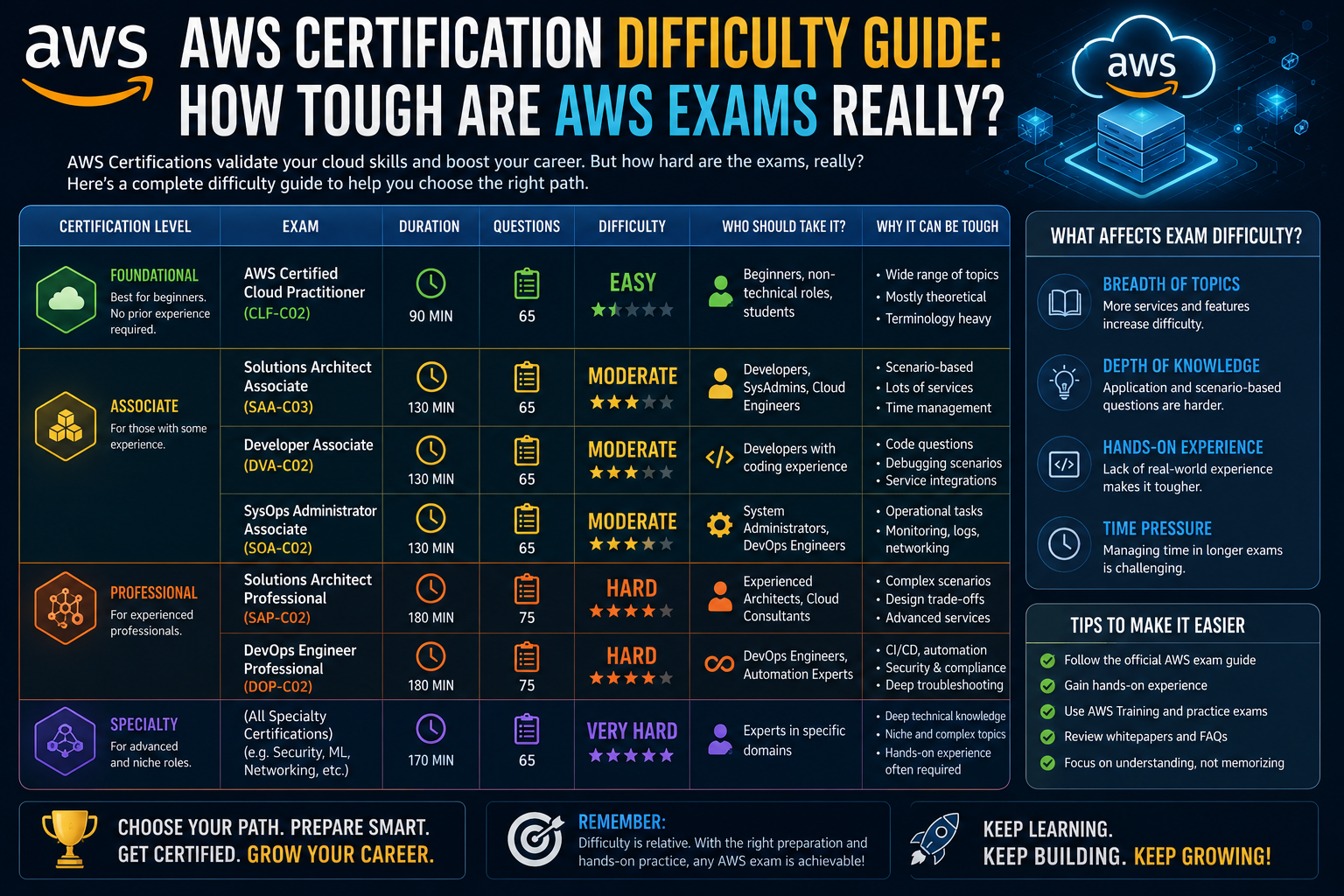
Amazon Web Services has evolved into one of the most extensive cloud computing ecosystems in the world. What began as a simple infrastructure offering has grown into a massive collection of interconnected services that cover computing, storage, networking, artificial intelligence, security, analytics, and enterprise operations. This rapid expansion is one of the main reasons AWS certifications are considered challenging by many learners and professionals.
The platform is not static. New services appear regularly, and existing services evolve with new features and architectural patterns. This means that anyone working with AWS is not simply learning a fixed set of tools but adapting to a continuously changing environment. That dynamic nature adds a layer of difficulty for certification candidates because the knowledge required is both broad and fluid.
Unlike traditional IT systems, where tools may remain stable for years, AWS encourages constant innovation. This results in overlapping services that can solve similar problems in different ways. For example, multiple services might exist for storage, databases, or application deployment, each with subtle differences in performance, pricing, and integration capabilities. Understanding when to use which service is a skill that takes time to develop.
This complexity is also intentional. AWS is designed to support everything from small personal projects to global enterprise systems. To accommodate this range, it provides highly specialized tools. However, specialization creates cognitive load for learners, especially those new to cloud computing. The sheer volume of services can feel overwhelming at first glance.
Certification exams are designed with this complexity in mind. They do not simply test memorization of service names but evaluate how well a candidate understands the relationships between services and how they are applied in real-world scenarios. This is why many candidates find AWS exams challenging even if they have studied the material thoroughly.
In essence, AWS is not difficult because of any single concept. It is difficult because of its scale, depth, and constant evolution. Mastery requires both structured learning and repeated practical exposure.
Building Foundational Understanding of the AWS Ecosystem
Before diving into any AWS certification, it is important to understand how the ecosystem is structured. At a high level, AWS is built around core categories such as compute, storage, networking, and security. Each category contains multiple services that solve different problems within that domain.
Compute services handle processing power and application execution. Storage services manage data persistence. Networking services control communication between resources. Security services ensure proper access control and compliance. While this sounds straightforward, each category contains multiple layers of abstraction that require careful study.
For example, compute is not limited to virtual machines. It also includes container orchestration, serverless functions, and application hosting platforms. Each option has different use cases, pricing models, and scaling behaviors. A learner must understand not only what each service does but why it exists and when it should be used.
This foundational understanding is crucial because AWS certification exams often present scenario-based questions. These questions do not ask for definitions but require decision-making. Without a strong conceptual base, candidates may struggle to identify the best solution among several plausible options.
Another important aspect of the AWS ecosystem is integration. Most services do not operate in isolation. Instead, they are designed to work together. A single application might involve storage, authentication, compute, monitoring, and networking services, all functioning as a unified system. Understanding these relationships is key to progressing beyond beginner-level knowledge.
Beginners often underestimate how interconnected AWS services are. They may focus on learning individual tools without realizing that real-world usage involves combining multiple services into a single architecture. Certification exams reflect this reality by testing how well candidates understand these interactions.
Developing a strong foundation is not about memorizing facts. It is about building mental models of how cloud systems operate. Once this foundation is in place, more advanced topics become significantly easier to grasp.
Core Architectural Concepts That Shape AWS Learning
Certain architectural concepts form the backbone of AWS knowledge. These include regions, availability zones, virtual private clouds, identity management, and scaling principles. These concepts appear repeatedly across all certification levels, making them essential for long-term success.
Regions represent geographic locations where AWS resources are hosted. Each region is isolated and contains multiple availability zones. Availability zones are physically separate data centers within a region that provide redundancy and fault tolerance. This structure ensures high availability and resilience, which are critical in cloud computing.
Virtual Private Clouds introduce the concept of isolated network environments within AWS. They allow users to define IP ranges, subnets, routing rules, and security boundaries. Understanding how VPCs operate is essential because almost every AWS architecture relies on networking configurations at some level.
Identity and Access Management is another core concept that governs how users and services interact with resources. It defines permissions, roles, and authentication policies. Misunderstanding IAM can lead to security vulnerabilities, which is why it is heavily emphasized in certification exams.
Scaling is also a fundamental principle in AWS architecture. Systems must be designed to handle varying levels of demand without performance degradation. This involves understanding load balancing, auto scaling, and distributed system design. Candidates are expected to know how AWS services support elasticity and fault tolerance.
These architectural principles are not isolated topics. They are interconnected and often appear together in exam scenarios. For example, a question might involve designing a secure, scalable application across multiple availability zones while maintaining cost efficiency.
Because these concepts are foundational, they often determine whether a candidate finds AWS certifications easy or difficult. Those with prior exposure to networking or systems administration tend to adapt more quickly, while beginners may need more time to internalize these ideas.
Understanding the Foundational Certification Level
The foundational certification level is designed as an entry point into AWS knowledge. It focuses on basic cloud concepts, introductory service knowledge, and a general understanding of AWS pricing and support structures. Despite being labeled as foundational, it still requires meaningful preparation.
One of the key challenges at this level is adjusting to cloud terminology. Many concepts may seem familiar to IT professionals, but they are often redefined in the context of AWS. For example, traditional infrastructure terms may have cloud-specific interpretations that require careful attention.
The foundational level also introduces the shared responsibility model, which defines how security responsibilities are divided between AWS and the customer. This concept is critical because it influences how cloud environments are secured and managed. Misunderstanding it can lead to incorrect assumptions about system security boundaries.
Another important area is billing and cost management. AWS uses a consumption-based pricing model, which differs significantly from traditional fixed-cost infrastructure. Understanding how services are billed, how usage is measured, and how costs can be optimized is an important part of foundational knowledge.
At this stage, candidates are also expected to recognize basic services and their purposes. However, the focus is not on deep technical configuration but on identifying what each service does at a high level. This includes compute, storage, database, and networking services.
While the foundational certification is considered the easiest among AWS exams, it is still not trivial for complete beginners. The difficulty largely depends on prior exposure to cloud concepts. Those with IT experience tend to find it more approachable, while newcomers may need more time to adjust to the new environment.
The exam is structured to test comprehension rather than deep technical ability. However, it still requires familiarity with AWS terminology and basic architectural thinking. Without preparation, even foundational-level questions can feel unfamiliar.
Who Finds the Foundational Level Easy and Who Does Not
The perception of difficulty at the foundational level varies significantly depending on background experience. Individuals with prior IT or networking knowledge often find the content easier to grasp because many cloud concepts build on traditional infrastructure principles.
For example, someone familiar with servers, databases, and networking will quickly understand how cloud equivalents operate. Virtual machines, storage systems, and network configurations are simply abstracted versions of concepts they already know. This familiarity reduces the learning curve significantly.
On the other hand, individuals without technical backgrounds may find the foundational level more challenging. The difficulty is not in complexity but in exposure. Terms like virtualization, redundancy, or cloud scaling may be entirely new, requiring additional time to understand.
Business professionals who enter AWS from non-technical roles may also experience a different learning curve. While they may not need to understand deep technical implementation, they still need to grasp how cloud services impact business operations, budgeting, and strategic planning.
Interestingly, motivation also plays a role in perceived difficulty. Learners who actively experiment with cloud environments tend to progress faster than those who rely solely on theoretical study. Hands-on experience helps reinforce abstract concepts and makes them easier to remember.
Another factor is learning style. Some individuals prefer structured documentation, while others learn better through experimentation. AWS content is dense and technical, which can be challenging without practical reinforcement.
Ultimately, the foundational level is not inherently difficult, but it demands adaptation. The more familiar a learner becomes with cloud thinking, the easier the material becomes.
Transitioning Mindset Toward Associate-Level Understanding
Moving from foundational knowledge to associate-level understanding requires a shift in thinking. At this stage, learners are expected to move beyond recognition and into application. Instead of identifying what a service does, they must understand how and why it is used in complex environments.
Associate-level thinking involves architectural decision-making. Candidates are often presented with real-world scenarios that require selecting the most efficient, secure, and cost-effective solution. This demands a deeper comprehension of service interactions and trade-offs.
One of the biggest changes at this stage is the introduction of ambiguity. Foundational questions are typically straightforward, but associate-level questions often have multiple plausible answers. The challenge lies in identifying the best possible solution rather than a correct one.
This transition also requires greater exposure to AWS environments. Reading about services is no longer enough. Candidates must understand how services behave when combined in real systems. This includes understanding performance limitations, scaling behavior, and integration constraints.
Another important shift is learning to think in terms of architecture rather than individual services. Instead of focusing on isolated tools, learners must consider entire system designs. This includes redundancy, fault tolerance, and scalability at a system level.
At this stage, learning becomes more analytical. Candidates are expected to evaluate scenarios critically rather than rely on memorized facts. This is where many learners begin to feel the difficulty increase significantly.
The associate level marks the point where AWS knowledge transitions from basic familiarity to applied understanding.
The Real Nature of Associate-Level Challenge in AWS Certifications
At the associate level, AWS certifications shift from introductory awareness into applied problem-solving. This is where many learners begin to understand that AWS exams are not testing memory alone, but the ability to think like a cloud architect or cloud engineer under realistic constraints.
The difficulty at this stage comes from the combination of breadth and depth. Candidates are no longer dealing with isolated facts about services. Instead, they are expected to understand how multiple services interact in a single architecture. This includes computing layers, storage systems, networking configurations, identity controls, monitoring tools, and deployment strategies working together as one system.
What makes this level particularly challenging is that AWS does not simplify real-world complexity for the sake of the exam. Instead, it reflects it. In real cloud environments, there are rarely single “correct” answers. There are only better or worse architectural decisions depending on cost, performance, security, and scalability requirements. The exam mirrors this ambiguity.
Another layer of difficulty is the increasing expectation of judgment. Candidates are expected to evaluate trade-offs between different solutions. For example, one service might be more cost-effective but less scalable, while another might be highly scalable but more expensive. Choosing the “best” answer requires understanding priorities in context, not just knowing what each service does.
This is where many learners realize that AWS certifications are not purely technical memorization tests. They are reasoning-based assessments that require structured thinking under pressure.
How Scenario-Based Thinking Changes Everything
One of the biggest shifts at the associate level is the introduction of scenario-based questions. These are long, descriptive problem statements that simulate real-world cloud architecture challenges. Instead of asking direct questions like “What does this service do?”, candidates are asked to solve business problems.
These scenarios often include multiple constraints such as cost limitations, security requirements, performance targets, and operational efficiency goals. Each constraint influences the final answer, making the decision process more complex.
Scenario-based thinking forces candidates to move beyond surface-level understanding. It is not enough to recognize a service name. One must understand how that service behaves under load, how it integrates with other services, and what its limitations are.
For example, a scenario might describe a system that needs to handle unpredictable traffic spikes while maintaining low latency and minimal downtime. Several AWS services might appear suitable, but only one aligns best with all requirements simultaneously.
This type of questioning introduces cognitive complexity. Candidates must hold multiple pieces of information in their minds at once, compare them, and eliminate incorrect options based on subtle differences.
Another challenge is that AWS deliberately includes answer choices that are partially correct. This means that even if a candidate understands the concept, they might still choose incorrectly if they fail to interpret the scenario carefully.
Scenario-based questions also test reading comprehension as much as technical knowledge. Misinterpreting a single requirement can lead to selecting an entirely wrong solution.
Solutions Architect Associate Breakdown and Its Complexity
The Solutions Architect Associate certification is one of the most widely taken AWS exams, and it is often the first major challenge for learners transitioning beyond foundational knowledge.
This certification focuses heavily on designing scalable, secure, and cost-efficient systems. Candidates must understand how to build cloud architectures that meet both technical and business requirements.
One of the primary challenges of this exam is the diversity of topics it covers. It includes compute services, storage architectures, networking design, security models, and database selection strategies. Each topic is broad enough on its own, but the exam combines them into integrated scenarios.
For example, a single question might require knowledge of networking boundaries, storage performance characteristics, and authentication methods simultaneously. This forces candidates to think holistically rather than in isolated segments.
Another difficulty is understanding service selection at a design level. It is not enough to know what a service does. Candidates must know when it is the most appropriate choice compared to alternatives.
This often involves subtle distinctions between similar services. For instance, multiple storage or database options may appear valid, but only one aligns with specific performance or scalability needs described in the question.
Solutions Architect Associate exams also test familiarity with best practices. AWS has established architectural principles such as designing for failure, decoupling systems, and enabling elasticity. Candidates are expected to apply these principles when selecting answers.
The exam rewards those who can think like system designers rather than tool users. This mindset shift is one of the main reasons the certification is considered challenging.
Developer Associate vs SysOps Associate Difficulty Comparison
Within the associate level, different certifications introduce different types of difficulty. The Developer Associate and SysOps Administrator Associate certifications test distinct skill sets, even though they operate within the same ecosystem.
The Developer Associate certification focuses on application development within AWS environments. It emphasizes understanding how applications interact with cloud services, how APIs are used, and how deployment pipelines function.
The challenge here lies in integration. Developers must understand how code interacts with services like storage systems, messaging queues, authentication layers, and serverless architectures. The exam tests whether candidates can build applications that function efficiently in distributed environments.
While this may seem straightforward, the complexity arises from service behavior under different conditions. Developers must understand how services behave during failures, scaling events, and latency fluctuations.
On the other hand, the SysOps Administrator Associate certification is more operationally focused. It emphasizes monitoring, deployment, system maintenance, and troubleshooting.
This exam is often considered more difficult by many candidates because it requires familiarity with real operational scenarios. It is not enough to understand architecture; candidates must also understand how to manage and maintain systems in production.
SysOps questions often involve diagnosing issues, identifying performance bottlenecks, and selecting corrective actions. This requires a deeper understanding of system behavior over time.
Both certifications demand hands-on experience, but in different ways. A Developer Associate leans toward application design and integration, while SysOps focuses on operational stability and troubleshooting.
The Role of Hands-On Labs in Mastering AWS Concepts
One of the most important factors in overcoming associate-level difficulty is hands-on experience. AWS is not a purely theoretical platform. Its services are designed to be used, configured, and tested in real environments.
Hands-on practice allows learners to see how services behave in real-time. This includes understanding setup processes, configuration dependencies, and error conditions. These experiences are difficult to replicate through reading alone.
For example, configuring a virtual network or deploying a serverless function provides insights that cannot be fully understood through documentation. It reveals how services interact and where common mistakes occur.
Practical experience also improves retention. Concepts that are actively used are more likely to be remembered than those that are only read about. This is especially important for exam scenarios that require quick recall under pressure.
Another benefit of hands-on labs is familiarity with the AWS interface. Many candidates struggle not because they lack knowledge, but because they are unfamiliar with how services are accessed and configured in the console.
The more time spent interacting with the platform, the more intuitive it becomes. This reduces cognitive load during exams and allows candidates to focus on problem-solving rather than recalling interface details.
Hands-on practice also helps bridge the gap between theory and real-world application. Many AWS concepts make more sense when experienced directly rather than studied abstractly.
Why AWS Whitepapers Become Essential at the Associate Level
As candidates progress into associate-level certifications, official architectural guidance becomes increasingly important. AWS publishes detailed documentation and design recommendations that explain best practices for using services effectively.
These documents are not light reading. They are dense, technical, and often require careful analysis. However, they provide insight into how AWS expects its services to be used in real-world scenarios.
At the associate level, understanding these principles becomes critical. Exam questions often reflect these best practices, even if they are not explicitly stated.
For example, architectural recommendations often emphasize scalability, fault tolerance, and security by design. These principles frequently appear in exam scenarios where candidates must choose the most appropriate architecture.
The challenge is not simply reading the material but internalizing it. Candidates must be able to apply these principles instinctively when evaluating scenarios.
Another difficulty is that these documents often cover multiple overlapping services. This reinforces the need to understand relationships between services rather than treating them individually.
Over time, consistent exposure to architectural guidance helps develop intuitive decision-making skills. This is one of the key differences between beginner-level understanding and associate-level competence.
Common Reasons Candidates Struggle with Associate Exams
Many candidates underestimate the associate-level exams because they assume prior IT experience is sufficient. While experience helps, it does not eliminate the need for AWS-specific understanding.
One of the most common reasons for difficulty is insufficient hands-on experience. Candidates who rely solely on theoretical study often struggle with scenario-based questions because they have not seen how services behave in practice.
Another issue is overconfidence in partial knowledge. AWS exams often include distractor answers that seem correct but are not optimal. Without a deep understanding, candidates may select answers based on familiarity rather than accuracy.
Time management is another challenge. Associate exams include complex questions that require careful reading and analysis. Spending too much time on a single question can reduce overall performance.
A lack of understanding of service interactions is also a major factor. Many candidates learn services in isolation but fail to understand how they integrate in real architectures.
Finally, some candidates struggle with the breadth of topics covered. AWS associate exams are not narrow; they span multiple domains, requiring well-rounded knowledge.
Misconceptions About Memorization and AWS Exam Success
A common misconception is that AWS certifications can be passed through memorization alone. While memorization plays a role in learning service names and features, it is not sufficient for success at the associate level.
The exams are designed to test reasoning rather than recall. This means that even if a candidate memorizes facts, they may still struggle with applying them correctly in unfamiliar scenarios.
Another misconception is that studying one resource is enough. AWS exams draw from a wide range of topics, and no single source covers everything. Candidates must synthesize knowledge from multiple perspectives.
Some learners also believe that reading documentation is enough. While documentation is important, it does not replace hands-on experience or scenario practice.
The reality is that AWS exams require a combination of understanding, application, and judgment. Memorization alone cannot bridge the gap between knowledge and decision-making.
Cognitive Load and Time Pressure in Exam Conditions
One of the less discussed challenges of AWS associate exams is cognitive load. Each question often contains a large amount of information that must be processed quickly.
Candidates must read, interpret, compare, and decide within a limited timeframe. This creates mental pressure that can affect performance.
Time pressure forces candidates to make decisions without overanalyzing. However, rushing can lead to misinterpretation of key details. Balancing speed and accuracy becomes a critical skill.
Another challenge is maintaining focus across multiple long questions. Fatigue can set in during the exam, especially when dealing with complex scenarios repeatedly.
Managing cognitive load requires practice. Familiarity with question structure and service behavior reduces mental strain and improves efficiency.
Building Mental Architecture Models for AWS Understanding
One of the most effective ways to succeed at the associate level is to develop mental models of AWS architectures. Instead of memorizing isolated facts, candidates build conceptual frameworks that represent how systems operate.
These mental models help simplify complexity. For example, instead of thinking of services individually, candidates understand how compute, storage, and networking interact as part of a system.
This approach allows faster decision-making during exams. When faced with a scenario, candidates can map it to an existing mental model and identify the most appropriate solution.
Mental modeling also improves retention. Concepts that are connected logically are easier to remember than disconnected facts.
Over time, these models become more refined and accurate, allowing for more confident decision-making in both exams and real-world scenarios.
Service Overlap Confusion and How It Impacts Learning
One of the unique challenges of AWS is that multiple services often appear to solve similar problems. This overlap can create confusion for learners.
For example, there may be several ways to store data, process events, or deploy applications. Each option has specific strengths and limitations, but distinguishing between them requires experience.
This overlap is intentional. AWS provides flexibility, but it also increases complexity. Learners must understand subtle differences to make correct decisions.
In exams, this overlap is often used to create distractor answers. Candidates must carefully analyze requirements to determine which service is most appropriate.
Understanding overlap requires not just knowledge of services but also awareness of use cases. This is where practical experience becomes especially valuable.
The Leap From Associate to Professional-Level Thinking
The transition from AWS Associate to Professional certifications is not just an increase in difficulty—it is a complete shift in how problems are approached. At the Professional level, AWS expects candidates to think like senior architects or cloud consultants who are responsible for designing and managing large-scale systems under real-world constraints.
While Associate exams focus heavily on selecting the correct service or combination of services, Professional exams go much further. They test whether a candidate can design systems that remain efficient, resilient, secure, and cost-effective at enterprise scale. This requires a level of judgment that cannot be developed through memorization alone.
At this stage, AWS assumes that candidates already understand core services deeply. Instead of asking what a service does, questions are framed around how multiple services should be orchestrated together in complex environments. The emphasis shifts from knowledge to synthesis.
This means candidates must evaluate entire architectures rather than isolated components. A single question may involve migration strategies, hybrid cloud integration, disaster recovery planning, or global-scale application deployment. Each of these topics requires layered understanding and experience.
The complexity of Professional exams also comes from ambiguity. There is rarely a straightforward solution. Instead, candidates must identify the most efficient or scalable approach among multiple valid options. This is where experience plays a critical role.
Why Professional-Level AWS Exams Feel Overwhelming
One of the defining characteristics of AWS Professional exams is cognitive overload. Questions are long, detailed, and often describe entire system architectures with multiple constraints. Candidates must process all this information quickly and accurately.
Unlike Associate-level questions, which may focus on specific services or scenarios, Professional questions often involve entire ecosystems. These ecosystems may span multiple regions, include hybrid infrastructure, or involve complex data pipelines.
The challenge is not just understanding individual components but understanding how they interact under pressure. For example, a system might need to handle sudden traffic spikes, maintain global availability, ensure data consistency, and minimize cost simultaneously.
Each of these requirements introduces trade-offs. A solution that improves performance might increase cost. A solution that improves resilience might add complexity. Candidates must decide which trade-offs are acceptable based on the scenario.
This level of decision-making mirrors real-world enterprise architecture roles. AWS uses Professional exams to validate whether a candidate can operate at this level of responsibility.
Another reason these exams feel overwhelming is time pressure. The questions are not only complex but also lengthy. Reading and analyzing each scenario requires focus, and fatigue can quickly build up over time.
Architectural Depth Required at Professional Level
Professional AWS certifications require a deep understanding of architecture design principles. These include scalability, fault tolerance, elasticity, security layering, and cost optimization.
At this level, it is not enough to know what each service does. Candidates must understand how services behave under different architectural patterns. For example, how systems behave when distributed across multiple regions or when designed for high availability under extreme load conditions.
One of the key expectations is understanding distributed systems. AWS environments are rarely centralized. Instead, they rely on distributed components that communicate across networks. This introduces challenges such as latency, consistency, and synchronization.
Candidates must also understand redundancy strategies. Systems must continue operating even when individual components fail. This requires knowledge of replication strategies, failover mechanisms, and load balancing configurations.
Another important aspect is data architecture. Professional-level questions often involve complex data flows, requiring candidates to understand how data is stored, processed, and retrieved efficiently at scale.
Security is also a major focus. At this level, security is not treated as an isolated feature but as a foundational design principle. Candidates must understand identity management, encryption strategies, access control, and compliance requirements in depth.
Solutions Architect Professional Complexity Explained
The Solutions Architect Professional certification is widely regarded as one of the most challenging AWS exams. It requires candidates to design and evaluate complex cloud architectures across multiple domains.
One of the biggest challenges is the sheer scale of topics covered. Unlike Associate-level exams, which focus on foundational architectural decisions, the Professional exam spans enterprise-level design considerations.
Candidates must be comfortable working with multi-tier architectures, hybrid cloud environments, migration strategies, and global deployments. Each of these areas introduces its own set of design challenges.
For example, migration scenarios often involve moving legacy systems to the cloud while minimizing downtime and preserving functionality. This requires understanding both traditional infrastructure and modern cloud-native approaches.
Hybrid architectures add another layer of complexity. These systems combine on-premises infrastructure with cloud services, requiring secure and efficient communication between environments.
Global deployments introduce concerns about latency, data residency, and regional failover strategies. Candidates must understand how to design systems that remain consistent and responsive across multiple geographic locations.
Another difficulty is that Solutions Architect Professional questions often require selecting the “best” architecture among several highly optimized options. This demands strong judgment and experience.
DevOps Professional and Operational Complexity
The AWS Certified DevOps Engineer Professional certification introduces a different kind of difficulty. Instead of focusing solely on architectural design, it emphasizes operational excellence, automation, and continuous delivery.
This certification requires candidates to understand how systems are deployed, monitored, and maintained at scale. It is heavily focused on automation pipelines, infrastructure as code, and operational monitoring.
One of the main challenges is understanding continuous integration and continuous deployment workflows. Candidates must know how to design pipelines that automatically build, test, and deploy applications across environments.
Another key area is monitoring and logging. Candidates must understand how to collect system metrics, analyze performance data, and respond to operational events in real time.
Fault detection and recovery are also critical components. Systems must be able to detect failures automatically and recover without manual intervention whenever possible.
The difficulty of this exam lies in its operational depth. Candidates are expected to think like system operators who are responsible for maintaining production environments rather than just designing them.
This requires familiarity with real-world system behavior under load, failure conditions, and scaling events.
Specialty Certifications and Their Unique Difficulty Structure
AWS Specialty certifications introduce a different kind of challenge compared to both the Associate and Professional levels. Instead of broad coverage, they focus on deep expertise in a specific domain.
These domains include areas such as networking, security, and machine learning. Each Specialty certification requires highly specialized knowledge and practical experience in that field.
Unlike broader certifications, Specialty exams do not test general cloud knowledge. Instead, they evaluate whether candidates have mastered a narrow but highly technical subject area.
This creates a unique difficulty structure. While the scope is narrower, the depth is significantly greater. Candidates must understand detailed configurations, advanced use cases, and domain-specific best practices.
For example, networking-focused exams may require knowledge of complex routing architectures, hybrid connectivity solutions, and multi-region network designs.
Security-focused exams require a deep understanding of encryption methods, identity management systems, compliance frameworks, and threat detection mechanisms.
Machine learning-focused exams require knowledge of model training, tuning, deployment, and lifecycle management within AWS environments.
Each Specialty certification demands not just theoretical understanding but also hands-on experience in that domain.
Why Specialty Certifications Feel Intense but Focused
Specialty certifications are often described as intense but manageable for experienced professionals. This is because they concentrate on a specific area rather than covering the entire AWS ecosystem.
Candidates who already work in a specialized field may find these exams more intuitive. Their real-world experience aligns closely with the exam content, making it easier to understand scenarios and select appropriate solutions.
However, for candidates without direct experience in the specialization, these exams can feel extremely difficult. The depth of knowledge required is significant, and there is little room for guesswork.
Another factor that increases difficulty is the level of detail required. Specialty exams often include very specific technical scenarios that require a precise understanding of service behavior.
Unlike broader exams, where general principles may be sufficient, Specialty exams require exact knowledge of configurations and workflows.
This makes preparation highly dependent on practical exposure rather than theoretical study alone.
How AWS Exams Test Real-World Thinking Ability
Across all levels—Foundational, Associate, Professional, and Specialty—AWS certifications are designed to test real-world thinking rather than academic knowledge.
This is one of the reasons they are considered challenging. The exams simulate situations that professionals encounter in actual cloud environments.
Instead of asking straightforward questions, AWS presents scenarios that require decision-making under constraints. These constraints may include cost limitations, performance requirements, security policies, or scalability expectations.
Candidates must evaluate all constraints simultaneously and determine the most appropriate solution.
This mirrors real-world cloud engineering, where decisions are rarely simple and often involve balancing competing priorities.
For example, a solution that maximizes performance may increase cost, while a cost-optimized solution may reduce redundancy. AWS expects candidates to understand these trade-offs.
This focus on applied knowledge is what differentiates AWS certifications from many other technical certifications.
The Importance of Experience in Reducing Exam Difficulty
Experience plays a major role in determining how difficult AWS certifications feel. Candidates with hands-on experience in cloud environments tend to perform significantly better than those relying solely on study materials.
This is because experience helps build intuition. When someone has worked with AWS services in real environments, they understand how those services behave under different conditions.
They also develop familiarity with common architectural patterns and operational challenges. This makes it easier to interpret exam scenarios and eliminate incorrect answers.
Experience also reduces cognitive load during exams. Instead of trying to recall abstract information, experienced candidates can draw on real-world examples.
This allows them to process questions more quickly and accurately.
In contrast, candidates without experience must rely heavily on memorization and theoretical understanding. This makes it harder to interpret complex scenarios.
Cognitive Complexity and Decision Fatigue in Advanced Exams
At higher levels of AWS certification, cognitive complexity becomes a major factor. Candidates must process large amounts of information, compare multiple solutions, and make decisions under time pressure.
This can lead to decision fatigue, where mental energy decreases over time. As fatigue increases, the likelihood of misinterpreting questions or selecting suboptimal answers also increases.
Managing cognitive load becomes essential for success. Candidates must develop strategies to stay focused and maintain clarity throughout the exam.
This includes practicing time management, familiarizing oneself with question patterns, and building confidence through repeated exposure to similar scenarios.
The Hidden Skill AWS Exams Are Really Testing
Beyond technical knowledge, AWS certifications are ultimately a test of structured thinking. Candidates must demonstrate the ability to analyze complex systems, evaluate trade-offs, and make informed decisions under constraints.
This skill is highly valuable in real-world cloud engineering roles. It reflects the ability to design systems that are not only functional but also efficient, scalable, and secure.
In many ways, AWS exams are less about cloud knowledge and more about engineering judgment.
This is why they are considered challenging at every level. The difficulty is not just in the content but in the way the content must be applied.
As candidates progress through certification levels, they gradually shift from learning services to thinking in systems.
Conclusion
AWS certifications are widely recognized not just because of their popularity in the cloud industry, but because of the depth of understanding they demand at every level. From foundational knowledge to professional expertise, each stage introduces a new layer of complexity that builds on the last. This progressive structure is what makes AWS certifications both valuable and challenging at the same time.
At the foundational level, the difficulty is mainly about exposure. Candidates must become familiar with cloud terminology, basic services, and core architectural concepts. While this stage may seem manageable, it still requires focused learning, especially for those new to cloud computing. Understanding how AWS organizes its ecosystem is the first real step toward building confidence.
The associate level marks a significant shift in expectations. Here, candidates are no longer tested on simple recognition but on applied understanding. Scenario-based questions require analytical thinking, where multiple correct answers may exist, but only one is optimal. This level introduces the reality of cloud decision-making, where trade-offs between cost, performance, and scalability must be carefully evaluated.
At the professional level, AWS certifications become significantly more demanding. Candidates are expected to think like experienced architects who design and manage large-scale systems. The complexity of scenarios increases, requiring deep architectural knowledge, strong judgment, and the ability to synthesize multiple services into cohesive solutions. This stage reflects real-world enterprise challenges where there is rarely a single perfect answer.
Specialty certifications add another dimension by focusing deeply on specific domains such as networking, security, or machine learning. While narrower in scope, they require advanced expertise and practical experience, making them highly intensive for those working in those fields.
Ultimately, the difficulty of AWS certifications is relative. It depends on experience, preparation, and familiarity with real-world cloud environments. However, what remains consistent is that these certifications are designed to measure not just knowledge, but the ability to think, design, and solve problems in a structured and scalable way.