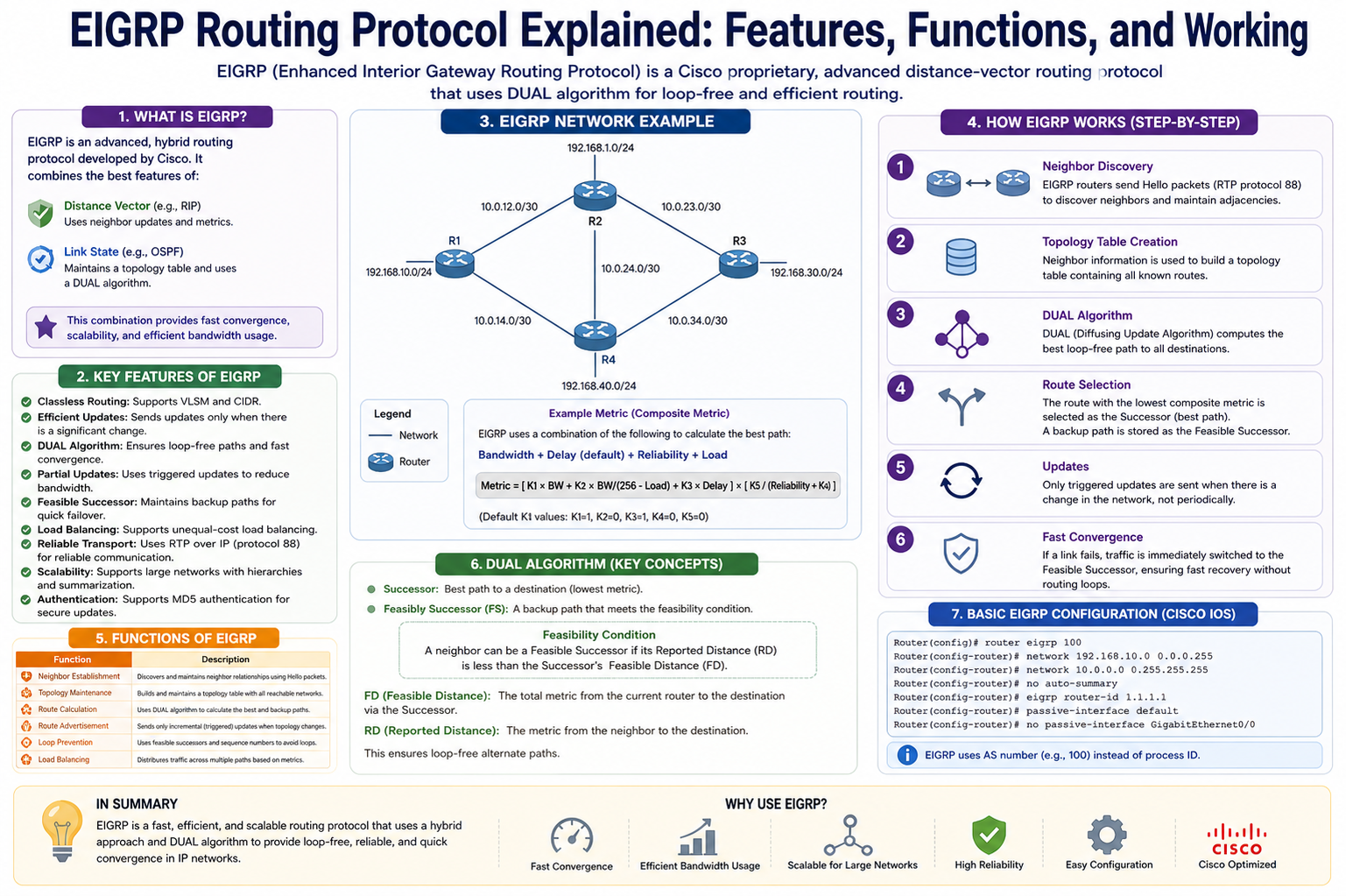
Enhanced Interior Gateway Routing Protocol, commonly known as EIGRP, is a dynamic routing protocol designed to allow routers within a network to exchange information efficiently and intelligently. It plays a critical role in ensuring that data packets find the most optimal path from a source to a destination. Unlike static routing, where paths are manually configured, EIGRP automatically learns routes and adapts to changes in the network, making it highly suitable for large and complex environments. It was originally developed to overcome the limitations of earlier routing protocols and to provide faster, more reliable routing decisions in enterprise networks.
Evolution from Traditional Routing Protocols
To understand EIGRP properly, it is important to recognize the environment in which it was created. Earlier routing protocols such as distance-vector protocols had several limitations, including slower convergence times and inefficient use of bandwidth. These protocols required routers to periodically send entire routing tables to their neighbors, even if there were no changes in the network. This approach consumed unnecessary bandwidth and could lead to delays in adapting to network failures. EIGRP was designed as an improvement, introducing more intelligent mechanisms to exchange only necessary updates and to respond quickly when network conditions changed.
Hybrid Nature of EIGRP
One of the defining characteristics of EIGRP is its hybrid design. It combines features from both distance-vector and link-state routing protocols. Traditional distance-vector protocols rely on simple metrics and periodic updates, while link-state protocols build a complete map of the network. EIGRP takes the best aspects of both approaches. It maintains detailed information about routes like a link-state protocol but shares updates selectively like a distance-vector protocol. This hybrid nature allows EIGRP to achieve a balance between efficiency, scalability, and speed.
Core Functionality of EIGRP
At its core, EIGRP enables routers to share routing information dynamically. Each router maintains a record of available routes and continuously evaluates them to determine the best path for data transmission. When a router learns about new routes or detects a change in the network, it updates its routing information and shares only the necessary changes with neighboring routers. This selective update mechanism ensures that the network remains efficient and avoids unnecessary overhead. As a result, EIGRP can handle large-scale networks without significant performance degradation.
Fast Convergence and Its Importance
Convergence refers to the time it takes for all routers in a network to agree on the best paths after a change occurs. In many networks, quick convergence is essential to prevent data loss and maintain performance. EIGRP excels in this area by using advanced algorithms that allow routers to quickly recalculate routes when a link fails or a new path becomes available. Instead of waiting for periodic updates, EIGRP reacts immediately to changes, ensuring that the network remains stable and responsive even under dynamic conditions.
Efficient Bandwidth Utilization
Bandwidth is a valuable resource in any network, and inefficient routing protocols can waste it by sending unnecessary information. EIGRP addresses this issue by transmitting only incremental updates rather than full routing tables. When there is no change in the network, no updates are sent, which significantly reduces bandwidth consumption. This efficiency makes EIGRP particularly suitable for environments where bandwidth is limited or where network performance is critical.
Support for Multiple Network Protocols
Another advantage of EIGRP is its ability to support multiple network layer protocols. While modern networks primarily use IP, earlier networks often relied on other protocols as well. EIGRP was designed to accommodate this diversity, allowing it to route different types of traffic simultaneously. This flexibility made it highly adaptable and useful in environments where multiple protocols needed to coexist. Even today, this design reflects the protocol’s robustness and forward-thinking architecture.
Backward Compatibility and Flexibility
EIGRP was designed to work seamlessly with older systems, providing backward compatibility with earlier routing technologies. This ensured that organizations could upgrade their networks without completely replacing existing infrastructure. Such flexibility allowed for gradual transitions and reduced the cost and complexity of network upgrades. This adaptability remains one of the reasons why EIGRP continues to be relevant in many enterprise environments.
Understanding EIGRP Operational Principles
The operation of EIGRP is based on several fundamental principles that enable its efficiency and reliability. One of these principles is modular design, where different components handle specific tasks related to routing. This modularity allows EIGRP to manage routing information more effectively and to support various network protocols independently. Each module operates in coordination with others, ensuring that the routing process remains consistent and accurate.
Role of the Diffusing Update Algorithm (DUAL)
A key component of EIGRP is the Diffusing Update Algorithm, which is responsible for route calculation and loop prevention. This algorithm ensures that all routing decisions are made in a way that avoids routing loops, which can cause data packets to circulate endlessly in a network. DUAL evaluates all available paths and selects the most efficient route while keeping backup routes readily available. This proactive approach allows EIGRP to switch to an alternative path immediately if the primary route fails.
Reliable Communication Between Routers
Communication between routers must be reliable to maintain accurate routing information. EIGRP uses a specialized mechanism to ensure that updates are delivered successfully. Instead of assuming that all messages are received, it verifies delivery and retransmits information if necessary. This reliability ensures that all routers maintain consistent and up-to-date routing tables, which is essential for smooth network operation.
Neighbor Discovery and Relationship Building
EIGRP relies on the concept of neighbor relationships to function effectively. Routers identify and establish connections with other routers on the same network segment. These relationships form the foundation for exchanging routing information. By maintaining a list of trusted neighbors, EIGRP ensures that only valid and relevant information is shared. This approach enhances both the efficiency and security of the routing process.
Hello Packets and Their Function
Hello packets are small messages sent periodically by routers to discover and maintain neighbor relationships. These packets serve as a simple yet effective way to ensure that neighboring routers are still reachable. If a router stops receiving hello packets from a neighbor, it assumes that the neighbor is no longer available and updates its routing information accordingly. This mechanism helps detect network failures quickly and initiate the process of finding alternative routes.
Scalability in Large Networks
Scalability is a crucial requirement for modern networks, especially in large organizations with complex infrastructures. EIGRP is designed to scale efficiently by minimizing unnecessary communication and maintaining only essential routing information. Its ability to handle large numbers of routes and adapt to changes without significant performance impact makes it a preferred choice for enterprise environments. As networks grow, EIGRP continues to provide consistent performance and reliability.
Adaptive Behavior in Dynamic Environments
Networks are constantly changing due to factors such as link failures, new device additions, and traffic variations. EIGRP is built to adapt to these changes dynamically. It continuously monitors network conditions and adjusts routing decisions accordingly. This adaptive behavior ensures that data always follows the most efficient path, even as the network evolves. Such responsiveness is essential for maintaining high performance and minimizing downtime.
Importance of Routing Tables and Topology Awareness
EIGRP maintains detailed information about network topology, which allows it to make informed routing decisions. It stores multiple routes for each destination, including both primary and backup paths. This comprehensive view of the network enables EIGRP to respond quickly to changes and to provide reliable data delivery. By keeping track of all possible routes, it ensures that the network remains resilient and efficient under various conditions.
Foundation for Advanced Networking Skills
Understanding EIGRP provides a strong foundation for anyone interested in networking. It introduces key concepts such as dynamic routing, path selection, and network convergence. These concepts are essential for designing, managing, and troubleshooting modern networks. By mastering EIGRP, individuals can gain valuable insights into how large-scale networks operate and how to optimize their performance effectively.
EIGRP Configuration Fundamentals and Initial Deployment
Configuring EIGRP in a network environment involves enabling the protocol on routers and defining how it should operate across different interfaces. The process begins by activating the routing protocol within the router’s configuration mode and assigning it an autonomous system number. This number acts as an identifier that groups routers into the same routing domain, allowing them to exchange information seamlessly. All routers that are intended to participate in the same EIGRP process must share this number, ensuring consistent communication and proper route exchange.
Role of the Autonomous System in EIGRP
The autonomous system, often abbreviated as AS, is a central concept in EIGRP configuration. It defines the boundary within which routing information is shared. Routers belonging to the same AS trust each other and exchange updates, while those in different systems do not interact unless explicitly configured. This separation provides better control over routing policies and helps administrators organize large networks into manageable segments. The AS structure also enhances security by preventing unauthorized routing updates from external sources.
Defining Network Participation in EIGRP
Once EIGRP is enabled, the next step is to specify which interfaces should participate in the routing process. This is done by identifying the network ranges associated with those interfaces. By doing so, the router knows where to send and receive routing updates. Only the selected interfaces will actively engage in EIGRP communication, which helps reduce unnecessary traffic and improves efficiency. Properly defining these networks ensures that routing information is shared accurately and that all relevant devices are included in the routing domain.
Understanding Interface Activation and Routing Scope
When an interface is included in the EIGRP configuration, it becomes part of the routing process and begins exchanging information with neighboring routers. Each active interface contributes to the overall topology by advertising its connected networks. This selective activation allows administrators to control the scope of routing, ensuring that only required parts of the network are involved. It also prevents accidental exposure of sensitive segments and keeps routing tables concise and manageable.
Verification of EIGRP Operation
After configuration, it is essential to verify that EIGRP is functioning correctly. Routers provide diagnostic commands that display neighbor relationships, topology details, and routing tables. These outputs help confirm that routers are discovering each other, exchanging routes, and selecting optimal paths. Verification is a critical step because even minor configuration errors can prevent proper communication. Regular monitoring also helps identify potential issues before they impact network performance.
Monitoring Neighbor Relationships
One of the first aspects to check during verification is the list of neighboring routers. This information confirms that routers have successfully established connections with each other. If neighbors are not detected, it may indicate issues such as mismatched configurations or connectivity problems. Maintaining stable neighbor relationships is essential because they form the foundation for all routing updates. Without them, routers cannot share information, and the network becomes fragmented.
Analyzing the Topology Information
The topology view provides detailed insights into all known routes, including primary and backup paths. This information is crucial for understanding how the network is structured and how data flows between different segments. By examining the topology, administrators can identify redundant paths, evaluate route metrics, and ensure that the network is optimized for performance. This level of visibility is one of the strengths of EIGRP, as it allows for precise control and analysis of routing behavior.
Examining the Routing Table
The routing table is the final decision-making component that determines how data packets are forwarded. It contains the best routes selected from the topology information. By reviewing this table, administrators can confirm that the expected paths are being used and that the network is operating efficiently. Any discrepancies between the topology and routing table may indicate issues that require further investigation.
Fine-Tuning EIGRP Metrics for Optimal Performance
EIGRP uses metrics to evaluate and select the best path for data transmission. These metrics are based primarily on bandwidth and delay, which together provide a comprehensive measure of a route’s quality. Adjusting these values allows administrators to influence routing decisions and optimize network performance. For example, increasing the perceived bandwidth of a preferred path can make it more attractive to the routing algorithm, ensuring that traffic flows through it.
Understanding Metric Calculation and Its Impact
The calculation of metrics in EIGRP is more sophisticated than in many traditional routing protocols. It considers multiple factors to determine the overall cost of a route. This approach provides greater accuracy in selecting the most efficient path. However, it also requires careful configuration to avoid inconsistencies. All routers must use the same parameters to ensure that they calculate metrics in a consistent manner, preventing routing conflicts and instability.
Route Summarization for Efficiency and Stability
Route summarization is a technique used to combine multiple routes into a single, simplified entry. This reduces the size of routing tables and minimizes the amount of information that needs to be exchanged between routers. By summarizing routes at appropriate points in the network, administrators can improve scalability and enhance stability. Fewer routes mean fewer updates and less processing overhead, which contributes to better overall performance.
Benefits of Reducing Routing Table Complexity
Simplifying routing tables has several advantages. It reduces memory usage on routers, speeds up route lookup processes, and minimizes the impact of network changes. When a summarized route is used, minor changes within the summarized range do not need to be communicated across the entire network. This containment of updates helps prevent unnecessary disruptions and keeps the network running smoothly.
Enhancing Security Through Authentication
Security is a critical concern in modern networks, and EIGRP provides mechanisms to protect routing information. Authentication ensures that only trusted routers can participate in the routing process. By verifying the identity of neighboring devices, the network can prevent unauthorized access and malicious updates. This feature is particularly important in environments where sensitive data is transmitted, as it helps maintain the integrity of routing information.
Managing Routing Traffic with Stub Configurations
In large networks, not all routers need to have complete knowledge of the entire topology. Stub configurations allow certain routers to limit the amount of routing information they receive and advertise. This is especially useful for branch or remote locations with limited resources. By reducing the volume of routing traffic, stub routers conserve bandwidth and processing power, making the network more efficient.
Balancing Resource Usage in Distributed Networks
Efficient resource management is essential for maintaining network performance. EIGRP provides flexibility in how routing information is distributed, allowing administrators to tailor configurations based on specific requirements. By carefully selecting which routers act as full participants and which operate as stubs, it is possible to achieve a balance between comprehensive routing knowledge and efficient resource utilization.
Introduction to EIGRP Packet Structure
EIGRP relies on structured packets to exchange information between routers. These packets follow a defined format, ensuring that all devices can interpret the data correctly. The structure includes various fields that carry essential information such as routing updates, neighbor status, and queries. This standardized approach enables consistent communication and supports the protocol’s reliability.
Purpose of Organized Packet Communication
Organized packet communication ensures that routing information is transmitted efficiently and accurately. Each packet type serves a specific function, reducing ambiguity and improving the clarity of interactions between routers. This organization also helps minimize errors and ensures that updates are processed correctly, contributing to the overall stability of the network.
Types of Packets Used in EIGRP
EIGRP uses several types of packets to perform its functions. Each type is designed for a particular purpose, such as discovering neighbors, sharing routing updates, or requesting additional information. This specialization allows the protocol to operate efficiently, as each packet carries only the information needed for its specific task. By dividing responsibilities among different packet types, EIGRP achieves a high level of performance and reliability.
Hello Packets and Neighbor Maintenance
Hello packets play a vital role in maintaining communication between routers. They are sent at regular intervals to confirm that neighboring devices are still reachable. This continuous exchange helps detect failures quickly and ensures that routing information remains up to date. If a router stops receiving hello packets, it can take immediate action to update its routing table and find alternative paths.
Update Packets and Route Distribution
Update packets are used to share routing information when changes occur. Instead of sending entire routing tables, EIGRP transmits only the affected routes, making the process more efficient. These updates are delivered reliably, ensuring that all routers receive accurate information. This selective approach reduces bandwidth usage and speeds up the dissemination of changes across the network.
Query and Reply Mechanisms
Query and reply packets are used when a router needs additional information about a route. If a router loses a path and does not have a backup, it sends a query to its neighbors. The neighbors respond with replies that provide alternative routing information. This collaborative process helps the network quickly identify new paths and maintain connectivity even in the face of disruptions.
Efficiency in Packet Exchange Process
The packet exchange process in EIGRP is designed to be both efficient and reliable. By using different packet types for specific tasks, the protocol minimizes unnecessary communication and ensures that each message serves a clear purpose. Reliable delivery mechanisms further enhance this efficiency by preventing data loss and ensuring consistency across all routers.
Maintaining Continuous Communication Between Routers
Continuous communication is essential for keeping routing information accurate and up to date. EIGRP achieves this through regular exchanges of hello packets and timely updates when changes occur. This ongoing interaction ensures that routers remain aware of the network’s state and can respond quickly to any changes. As a result, the network maintains high levels of performance and reliability even under dynamic conditions.
Deep Dive into EIGRP Neighbor Discovery and Adjacency Formation
Neighbor discovery is one of the most critical processes in EIGRP because it establishes the foundation for all routing communication. Routers must first identify which other devices are participating in the same routing domain before they can exchange any meaningful information. This process begins with the transmission of hello packets, which are sent periodically across interfaces that have EIGRP enabled. These packets act as a simple introduction, allowing routers to announce their presence and detect others operating within the same network segment. Without successful neighbor discovery, no routing updates can be shared, making this step essential for network functionality.
Mechanism of Hello Packet Transmission
Hello packets are lightweight and designed to minimize overhead while maintaining consistent communication. They are sent to a specific multicast address so that all nearby routers configured for EIGRP can receive them. This multicast approach ensures efficiency because a single packet can reach multiple devices simultaneously. The frequency of hello packet transmission is carefully balanced to provide timely updates without consuming excessive bandwidth. If a router fails to receive hello packets from a neighbor within a specified timeframe, it assumes that the neighbor is no longer reachable and removes it from its neighbor table.
Establishing and Maintaining Adjacencies
Once a router receives a hello packet from another device with matching parameters, it forms an adjacency. This adjacency represents a trusted relationship through which routing information can be exchanged. Establishing this relationship requires several conditions to be met, including matching autonomous system numbers and compatible configuration settings. After the adjacency is formed, routers begin sharing routing updates and maintaining synchronization of their routing data. The stability of these adjacencies directly impacts the overall performance and reliability of the network.
Neighbor Table and Its Importance
The neighbor table is a data structure that stores information about all directly connected EIGRP neighbors. It includes details such as the neighbor’s address, interface, and the time since the last communication was received. This table is continuously updated as routers send and receive hello packets. By maintaining an accurate neighbor table, routers can ensure that they are communicating with valid devices and can quickly detect any changes in connectivity. The neighbor table serves as a reference point for initiating updates and queries, making it a central component of EIGRP operation.
Topology Table and Route Awareness
Beyond neighbor relationships, EIGRP maintains a topology table that contains comprehensive information about all known routes within the network. This table includes both primary routes and backup paths, along with their associated metrics. The topology table allows routers to evaluate multiple options for reaching a destination and to keep alternative routes readily available. This proactive approach ensures that the network can respond quickly to changes without needing to recalculate routes from scratch.
Understanding Successors and Feasible Successors
Within the topology table, EIGRP identifies specific routes known as successors and feasible successors. A successor is the best available path to a destination, selected based on the lowest metric. This route is installed in the routing table and used for forwarding traffic. A feasible successor, on the other hand, is a backup route that meets certain criteria ensuring it is loop-free. Having feasible successors readily available allows EIGRP to switch to an alternative path instantly if the primary route fails, significantly reducing downtime and improving network resilience.
Loop Prevention Through Intelligent Design
Routing loops can severely disrupt network operations by causing packets to circulate endlessly. EIGRP addresses this issue through its advanced algorithms and strict conditions for accepting routes. The concept of feasible successors plays a key role in loop prevention, as only routes that satisfy specific feasibility conditions are considered as backups. This ensures that all routing decisions maintain a loop-free topology, enhancing the stability and reliability of the network.
Routing Table and Forwarding Decisions
The routing table is where final forwarding decisions are made. It is derived from the topology table and contains only the best routes for each destination. When a data packet arrives at a router, the routing table is consulted to determine the next hop. By maintaining a streamlined routing table, EIGRP ensures fast lookup times and efficient packet forwarding. The separation between the topology table and routing table allows for detailed analysis without compromising performance.
Load Balancing for Efficient Resource Utilization
EIGRP supports load balancing, which enables traffic to be distributed across multiple paths. This feature is essential for optimizing resource utilization and preventing congestion on any single link. When multiple routes have equal cost, EIGRP can distribute traffic evenly among them. This approach maximizes throughput and ensures that all available paths are used effectively, reducing the risk of bottlenecks.
Equal-Cost Load Balancing Explained
Equal-cost load balancing occurs when multiple routes to the same destination have identical metrics. In such cases, EIGRP can use all these paths simultaneously to forward traffic. This distribution is typically done in a balanced manner, ensuring that each path carries a portion of the load. The ability to use multiple paths improves overall network performance and provides redundancy in case one path fails.
Unequal-Cost Load Balancing and Flexibility
One of the unique features of EIGRP is its support for unequal-cost load balancing. Unlike many routing protocols that only use equal-cost paths, EIGRP can also utilize routes with different metrics, provided they fall within an acceptable range. This is controlled through a configurable parameter that defines how much variance is allowed. By enabling unequal-cost load balancing, networks can take advantage of additional paths that might otherwise remain unused, further enhancing efficiency.
Preventing Network Bottlenecks
Load balancing plays a crucial role in preventing bottlenecks, which occur when too much traffic is concentrated on a single path. By distributing traffic across multiple routes, EIGRP ensures that no single link becomes overwhelmed. This balanced approach leads to smoother data flow and better utilization of network resources. It also improves the user experience by reducing delays and maintaining consistent performance.
EIGRP Convergence Mechanisms in Detail
Convergence is the process by which routers update their routing information to reflect changes in the network. EIGRP is known for its rapid convergence capabilities, which are achieved through a combination of proactive planning and efficient communication. When a change occurs, such as a link failure, EIGRP quickly evaluates alternative paths and updates its routing table accordingly. This rapid response minimizes disruption and ensures continuous connectivity.
Immediate Failover Using Backup Routes
One of the key reasons for EIGRP’s fast convergence is its use of feasible successors. Because these backup routes are precomputed and stored in the topology table, the router can switch to them instantly when the primary route fails. This eliminates the need for time-consuming recalculations and reduces the impact of network failures. Immediate failover is especially important in critical environments where downtime must be minimized.
Query Scoping and Controlled Updates
In situations where no feasible successor is available, EIGRP uses a query process to find alternative routes. However, instead of broadcasting queries to the entire network, it limits their scope to relevant routers. This technique, known as query scoping, reduces unnecessary traffic and speeds up the process of finding new routes. By controlling the spread of queries, EIGRP maintains efficiency even in large and complex networks.
Reducing Network Overhead During Convergence
Efficient convergence is not just about speed but also about minimizing the impact on network resources. EIGRP achieves this by sending only necessary updates and limiting the scope of its queries. This approach reduces bandwidth usage and prevents congestion during periods of change. As a result, the network remains stable and responsive even when multiple changes occur simultaneously.
Advanced Optimization Techniques in EIGRP
EIGRP includes several advanced features designed to optimize network performance. These techniques allow administrators to fine-tune the protocol based on specific requirements and conditions. By leveraging these features, networks can achieve higher efficiency, better scalability, and improved reliability.
Stub Routing for Controlled Information Flow
Stub routing is a technique used to limit the amount of routing information exchanged with certain routers. In many networks, some devices do not need to know the full topology and can operate effectively with a limited set of routes. Configuring these devices as stub routers reduces the volume of updates they receive and send, conserving resources and improving overall efficiency. This approach is particularly useful for branch offices and remote locations.
Route Summarization for Simplified Topology
Route summarization combines multiple routes into a single entry, reducing the size of routing tables and simplifying network management. By summarizing routes at strategic points, administrators can contain the impact of changes and improve scalability. This technique also enhances stability by reducing the number of updates that need to be processed, allowing the network to operate more smoothly.
Balancing Performance and Stability
Optimization in EIGRP involves finding the right balance between performance and stability. While it is important to achieve fast convergence and efficient routing, it is equally important to maintain a stable network environment. By carefully configuring features such as load balancing, stub routing, and summarization, administrators can create a network that performs well under various conditions while remaining resilient to changes and failures.
Troubleshooting EIGRP Neighbor Relationship Issues
One of the most common challenges in EIGRP environments is the failure of routers to establish or maintain neighbor relationships. Since all routing updates depend on these relationships, any issue at this level can disrupt the entire routing process. When routers do not recognize each other as neighbors, the first step is to examine whether they are configured within the same autonomous system. If the system identifiers do not match, routers will ignore each other completely. Another important factor is ensuring that the interfaces are correctly configured and belong to the same network segment, allowing direct communication between devices.
Importance of Consistent Configuration Parameters
Consistency across router configurations is essential for stable EIGRP operation. Parameters such as metric calculation values must align on all participating devices. If there is a mismatch in these values, routers may fail to establish adjacency or may reject routing updates. This requirement ensures that all routers interpret routing information in the same way and make consistent decisions about path selection. Maintaining uniform configurations across the network simplifies troubleshooting and reduces the likelihood of unexpected behavior.
Detecting and Resolving Connectivity Problems
Physical and logical connectivity issues can also prevent neighbor relationships from forming. Faulty cables, misconfigured interfaces, or incorrect addressing schemes can interrupt communication between routers. Identifying these issues requires systematic testing, including verifying interface status and ensuring that devices can reach each other at the network layer. Once connectivity is restored, EIGRP can resume its normal operation and reestablish neighbor relationships automatically.
Understanding Route Flapping and Its Impact
Route flapping refers to a situation where routes continuously appear and disappear from the routing table. This instability can lead to inconsistent network performance and increased processing overhead. Frequent changes in route availability cause routers to constantly update their tables, consuming bandwidth and CPU resources. In severe cases, route flapping can degrade network performance to the point where normal operations are disrupted.
Stabilizing the Network with Summarization Techniques
One effective way to address route flapping is through route summarization. By grouping multiple routes into a single summary entry, the network reduces the number of updates that need to be processed. This simplification helps stabilize routing tables and limits the spread of frequent changes. Summarization acts as a buffer, preventing minor fluctuations in specific routes from affecting the entire network.
Controlling Routing Updates with Filtering Mechanisms
Another approach to managing instability is controlling which routes are advertised or accepted by routers. Filtering mechanisms allow administrators to define policies that limit unnecessary updates. By restricting the flow of routing information to only what is necessary, the network becomes more stable and efficient. This control helps prevent excessive updates and ensures that routers focus on relevant routing information.
Addressing Inconsistent Routing Tables
In some cases, routers may have conflicting information about the best paths to certain destinations. This inconsistency can lead to inefficient routing and potential communication failures. Resolving this issue requires verifying that all routers use the same criteria for evaluating routes. Consistent metric values and uniform configurations ensure that all devices agree on the best paths, resulting in a more cohesive network.
Identifying and Eliminating Routing Loops
Routing loops occur when data packets circulate endlessly between routers without reaching their destination. These loops can consume bandwidth and cause severe network disruptions. EIGRP is designed to prevent loops through its advanced algorithms, but misconfigurations or unusual conditions can still introduce them. Detecting loops involves analyzing routing paths and ensuring that all routes follow a logical, loop-free structure. Correcting these issues restores normal data flow and improves network reliability.
Using Logs and Monitoring Tools for Diagnosis
Effective troubleshooting often relies on analyzing logs and monitoring network activity. Routers generate detailed logs that record events such as neighbor changes, route updates, and errors. By examining these logs, administrators can identify patterns and pinpoint the root cause of issues. Monitoring tools provide real-time insights into network performance, making it easier to detect and resolve problems before they escalate.
EIGRP in Large-Scale Enterprise Environments
EIGRP is widely used in large enterprise networks due to its scalability and efficiency. In such environments, the ability to handle thousands of routes and adapt quickly to changes is essential. EIGRP meets these requirements by minimizing unnecessary communication and maintaining a comprehensive view of the network topology. Its design allows organizations to build complex networks that remain stable and responsive under heavy workloads.
Ensuring High Availability Through Redundancy
High availability is a critical requirement for modern networks, especially in business environments where downtime can have significant consequences. EIGRP supports redundancy by maintaining multiple routes to the same destination. If one path fails, another can be used immediately without interrupting data transmission. This capability ensures continuous operation and enhances the reliability of the network.
Efficient Data Routing in Dynamic Conditions
In real-world scenarios, networks are constantly changing due to factors such as traffic fluctuations and infrastructure updates. EIGRP’s ability to send updates only when necessary makes it highly efficient in these dynamic conditions. Instead of overwhelming the network with constant updates, it focuses on delivering relevant information at the right time. This approach reduces overhead and maintains optimal performance.
Applications in Distributed Network Architectures
EIGRP is particularly well-suited for distributed networks that span multiple locations. Its ability to manage multiple paths and provide quick updates ensures reliable communication between different sites. Organizations with branch offices or remote locations benefit from EIGRP’s flexibility, as it can adapt to varying network conditions and maintain consistent performance across all locations.
Integration with Other Routing Protocols
Modern networks often use multiple routing protocols to meet different requirements. EIGRP can integrate with other protocols by exchanging routing information through controlled processes. This integration allows different parts of the network to operate using the most suitable protocol while still maintaining overall connectivity. By enabling communication between diverse systems, EIGRP contributes to a unified and efficient network architecture.
Route Redistribution and Interoperability
Route redistribution is the process of sharing routing information between different protocols. This capability is essential for interoperability in hybrid networks. EIGRP can import routes from other protocols and advertise its own routes to them, ensuring seamless communication across the entire network. Proper configuration of redistribution policies is crucial to avoid conflicts and maintain stability.
Connecting Multiple Sites with Reliability
EIGRP excels at interconnecting multiple sites within an organization. Its fast convergence and efficient routing mechanisms ensure that communication remains reliable even when network conditions change. By providing consistent performance across geographically dispersed locations, EIGRP supports the needs of modern enterprises that rely on interconnected systems.
Adapting to Complex Network Requirements
As networks grow in size and complexity, routing protocols must adapt to meet new challenges. EIGRP’s advanced features and flexible design make it capable of handling a wide range of requirements. Whether it is optimizing performance, ensuring security, or maintaining stability, EIGRP provides the tools needed to manage complex network environments effectively.
Final Thoughts
EIGRP remains a powerful and versatile routing protocol that continues to play a significant role in enterprise networking. Its combination of efficiency, scalability, and reliability makes it a strong choice for managing dynamic and complex networks. By understanding its operation, configuration, and troubleshooting techniques, network professionals can design systems that deliver high performance and maintain consistent connectivity even under challenging conditions.