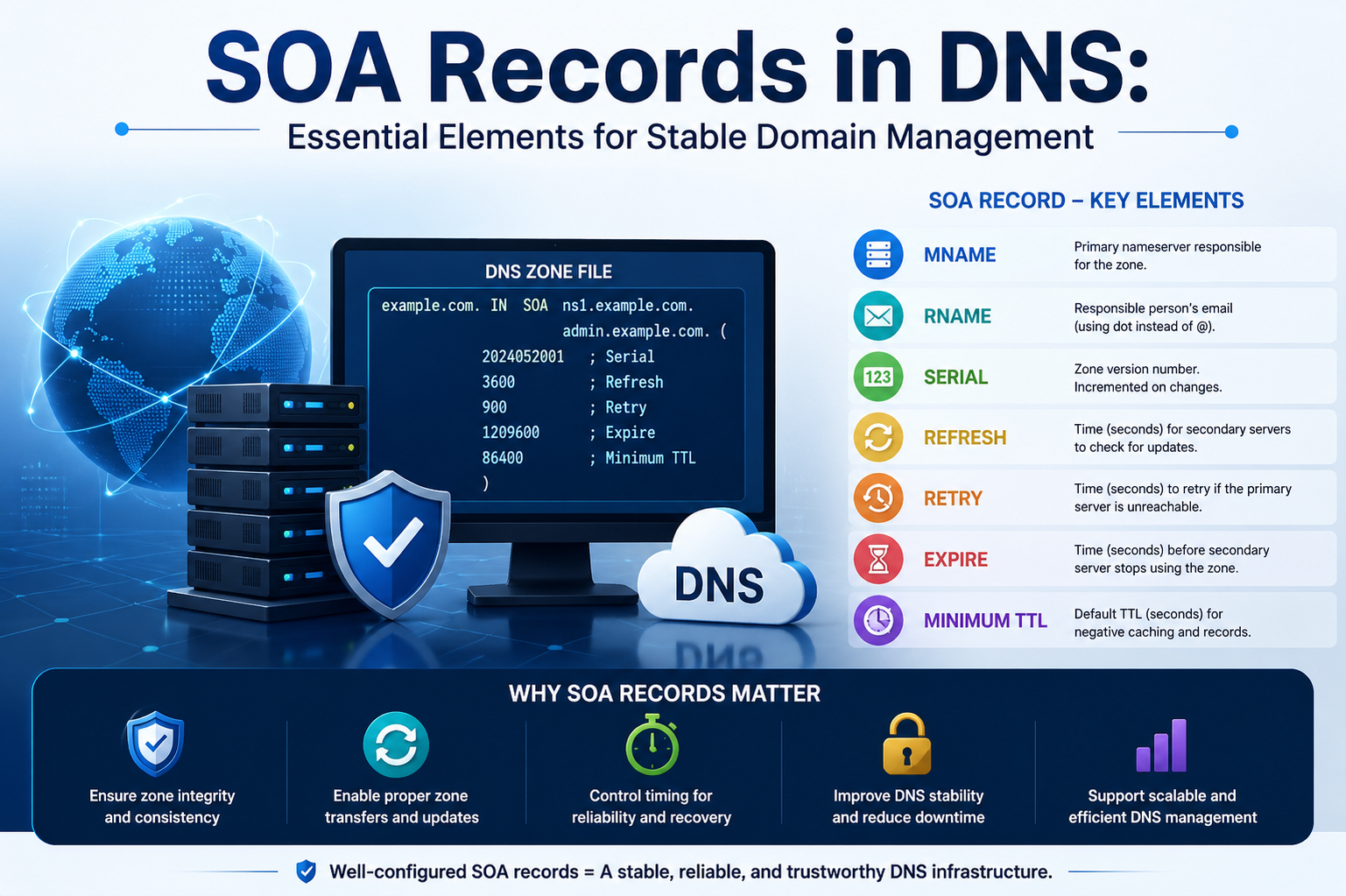
The Start of Authority (SOA) record represents one of the most fundamental components within the Domain Name System structure, acting as the primary source of administrative control for any DNS zone. It functions as the initial point of reference that defines how a particular zone should behave, how it should be managed, and which server holds the original authoritative information for that zone. Every DNS zone begins its configuration with an SOA record, making it the foundation upon which all other DNS records and operations depend. Without this record, the structure of a DNS zone would lack direction, authority, and synchronization rules necessary for stable internet communication.
At its core, the SOA record establishes ownership and responsibility over a DNS zone. It identifies the primary server that contains the original and most accurate version of the zone data. This ensures that all other servers interacting with the zone know where the master copy resides. Beyond just identifying authority, the SOA record also defines how updates are handled, how synchronization occurs between servers, and how long cached information should remain valid. This combination of control and timing makes it an essential mechanism for maintaining consistency across distributed networks.
The importance of SOA records becomes even more evident when considering how DNS operates globally. DNS is not managed by a single machine or centralized system; instead, it is distributed across countless servers worldwide. In such an environment, maintaining consistency is a complex task. The SOA record acts as a guiding structure that ensures all participating servers remain aligned with the most recent version of zone data. It helps prevent conflicts, outdated responses, and mismatched information that could disrupt connectivity or accessibility.
The Role of SOA in DNS Zone Architecture
Within the architecture of a DNS zone, the SOA record serves as the administrative backbone that governs how information flows between primary and secondary servers. It is responsible for defining the rules that control synchronization, update intervals, and data validity. Every DNS zone relies on this record to maintain order and consistency across its infrastructure, ensuring that all changes made in one location are properly reflected throughout the network.
The SOA record also acts as a reference point for secondary servers that store copies of zone data. These servers depend on the SOA information to determine when they should check for updates or replace outdated records. Without this structured communication system, secondary servers might operate with stale or inconsistent data, leading to errors in resolving domain names. The SOA record eliminates this risk by establishing clear instructions for synchronization behavior.
Another critical aspect of its role is maintaining administrative clarity. It identifies the individual or entity responsible for managing the DNS zone, ensuring accountability in case of issues or required updates. This administrative reference is not just a technical detail but an essential part of maintaining operational integrity in large-scale networks. By embedding both technical and administrative information, the SOA record provides a complete governance framework for DNS zones.
Why SOA Records Are Essential for Internet Stability
The stability of internet navigation relies heavily on accurate and synchronized DNS data. SOA records contribute directly to this stability by ensuring that DNS zones remain consistent across all servers. Without them, there would be no standardized mechanism to determine which server holds the authoritative version of information or how updates should be distributed. This could lead to conflicting data, inconsistent access results, and general instability in internet communication.
SOA records also play a key role in preventing outdated information from persisting in DNS caches. Since DNS resolvers store temporary copies of records to improve performance, there must be a system that defines when this cached data should expire. The SOA record provides these timing instructions, ensuring that resolvers periodically request fresh data from authoritative sources. This prevents users from being directed to outdated or incorrect destinations.
In addition, SOA records support resilience in DNS infrastructure. When primary servers become temporarily unreachable, secondary servers rely on SOA-defined rules to determine how long they can continue responding with stored data. This ensures that DNS services remain available even during disruptions, although within controlled limits. Such mechanisms contribute to the overall robustness of global internet systems.
Core Structure of an SOA Record
The structure of an SOA record is composed of several essential parameters, each serving a specific purpose in DNS management. These parameters work together to define authority, control updates, manage synchronization, and regulate data validity. Each element within the SOA record contributes to maintaining order and efficiency across DNS zones.
The first key component is the primary name server parameter, which identifies the authoritative server responsible for the DNS zone. This server holds the original and most accurate version of all zone data. It acts as the central point from which all updates originate and is considered the final source of truth for that zone.
The second component is the responsible contact information, which identifies the administrator or entity in charge of managing the DNS zone. This information is typically encoded in a specific format that replaces conventional symbols to comply with DNS standards. It ensures that there is a clear point of contact for maintenance, troubleshooting, or administrative changes.
The third component is the serial number, which plays a crucial role in version control. Every time a change is made to the DNS zone, this number is updated. Secondary servers rely on this value to determine whether they need to refresh their stored data. If the serial number has increased, it signals that updates are available and must be synchronized.
Primary Authoritative Server (MNAME)
The primary name server parameter, often referred to as MNAME, is one of the most important elements within the SOA record. It specifies the authoritative server that contains the master copy of the DNS zone. This server is responsible for handling updates, managing changes, and distributing accurate zone data to secondary servers. It acts as the central authority in the DNS structure.
The MNAME parameter ensures that all DNS operations are anchored to a single trusted source. When changes occur within a DNS zone, they are first applied to this primary server. From there, the updates are propagated to secondary servers through synchronization processes defined by other SOA parameters. This centralized approach prevents inconsistencies and ensures that all servers operate using the same data foundation.
Without a clearly defined primary server, DNS zones would lack a stable reference point, leading to fragmented data and inconsistent resolution results. The MNAME parameter eliminates this uncertainty by establishing a fixed authority for all zone operations.
Responsible Contact Information (RNAME)
The responsible person parameter, known as RNAME, defines the administrative contact associated with a DNS zone. This field is used to identify the individual or team responsible for maintaining the zone’s configuration and ensuring its proper operation. It plays a crucial role in accountability and operational management.
Unlike standard email formats, the RNAME uses a modified structure where conventional symbols are replaced to comply with DNS formatting rules. This ensures compatibility within the system while still providing accurate contact identification. The presence of this parameter allows administrators to quickly identify who is responsible for resolving issues or making necessary updates.
In large-scale environments where multiple DNS zones exist, having a clearly defined responsible contact helps streamline communication and troubleshooting processes. It ensures that issues can be addressed efficiently without confusion about ownership or responsibility.
Serial Number and Version Tracking
The serial number is a critical component of the SOA record that functions as a version identifier for the DNS zone. Every modification made to the zone requires an update to this number. This allows secondary servers to detect changes and determine whether they need to refresh their stored data.
This version tracking system ensures consistency across all servers within the DNS infrastructure. Without it, secondary servers would have no reliable way of knowing whether their data is current or outdated. The serial number acts as a simple yet powerful mechanism for maintaining synchronization.
It also supports efficient update propagation. Instead of continuously transferring full zone data, servers only compare serial numbers. If a change is detected, only then is an update initiated. This reduces unnecessary network traffic and improves overall efficiency.
Refresh Mechanism in DNS Synchronization
The refresh parameter defines the time interval at which secondary servers check the primary server for updates. This mechanism ensures that changes made to the DNS zone are regularly detected and synchronized across all servers. It acts as a scheduled verification system that maintains consistency.
When the refresh interval expires, secondary servers query the primary server to compare serial numbers. If differences are found, an update process is initiated. This ensures that secondary servers remain aligned with the authoritative version of the zone data.
The refresh mechanism is essential for maintaining real-time accuracy in distributed DNS systems. It balances the need for timely updates with network efficiency, ensuring that servers are not constantly communicating unnecessarily.
Retry Behavior in DNS Communication
The retry parameter defines how secondary servers should behave when an attempt to contact the primary server fails. Instead of immediately abandoning the update process, secondary servers wait for a specified interval before trying again. This ensures that temporary network issues do not disrupt synchronization.
This retry mechanism enhances reliability within DNS infrastructure. It accounts for potential connectivity problems and ensures that updates are eventually completed once communication is restored. Without this feature, even minor disruptions could lead to prolonged inconsistencies.
By controlling retry behavior, the SOA record ensures that DNS systems remain resilient and capable of recovering from temporary failures without manual intervention.
Expiration Control for Secondary Servers
The expiration parameter defines how long a secondary server can continue responding with cached zone data if it cannot reach the primary server. Once this time limit is reached, the secondary server stops providing authoritative responses for that zone.
This mechanism prevents outdated or potentially incorrect data from being served indefinitely. It ensures that DNS integrity is maintained even in cases of extended server outages. Once the expiration threshold is reached, the system prioritizes accuracy over availability.
This balance between reliability and data freshness is a key aspect of DNS management, ensuring that users are not directed to outdated information for extended periods.
Caching Control Through TTL Settings
The TTL parameter determines how long DNS resolvers should cache zone records before requesting fresh data. This helps optimize performance by reducing repeated queries to authoritative servers while still ensuring data accuracy.
When TTL values expire, resolvers discard cached data and request updated information. This mechanism ensures that users receive relatively fresh data without overwhelming DNS infrastructure with constant queries.
Proper configuration of TTL values is essential for balancing performance and accuracy, making it a key element in SOA record design.
Understanding How SOA Coordinates DNS Zone Communication
The Start of Authority (SOA) record plays a central role in coordinating communication between different DNS servers within a zone. In a distributed DNS environment, multiple servers are responsible for storing and serving copies of the same zone data. The SOA record ensures that these servers remain synchronized by defining clear rules for how and when they should communicate. This coordination prevents inconsistencies and ensures that all servers reflect the same authoritative information.
At the heart of this communication model is the relationship between primary and secondary DNS servers. The primary server holds the original version of the zone data, while secondary servers maintain replicated copies for redundancy and performance. The SOA record governs how these copies are updated and validated. Without it, secondary servers would operate independently, increasing the risk of outdated or conflicting DNS responses.
The SOA record also establishes a structured update mechanism that reduces unnecessary network traffic. Instead of continuously transferring full DNS zone files, secondary servers periodically check the SOA parameters to determine whether updates are required. This approach ensures efficient communication while maintaining data accuracy across the system.
Role of SOA in Zone Transfer Mechanisms
Zone transfers are a critical part of DNS operations, allowing secondary servers to receive updated copies of zone data from the primary server. The SOA record plays a foundational role in controlling and managing these transfers. It ensures that updates are performed only when necessary and in a controlled manner, preventing unnecessary data duplication or synchronization errors.
The serial number within the SOA record acts as the primary trigger for zone transfers. When a secondary server checks the SOA record and detects a higher serial number on the primary server, it understands that changes have been made. This initiates a zone transfer process where updated records are retrieved and stored locally. This version comparison mechanism ensures that only modified data is transferred, improving efficiency.
Additionally, the SOA record defines how secondary servers should behave during transfer failures or delays. If a transfer attempt fails, retry parameters come into effect, ensuring that the system continues attempting synchronization until successful. This resilience is essential for maintaining consistency in large-scale DNS networks where temporary disruptions are common.
Synchronization Between Primary and Secondary Servers
Synchronization is one of the most important functions supported by the SOA record. It ensures that all DNS servers within a zone remain aligned with the most recent version of data. This is achieved through a combination of timed checks, version tracking, and controlled updates.
Secondary servers rely heavily on SOA parameters to determine synchronization intervals. The refresh value dictates how often they should compare their stored data with the primary server. During each refresh cycle, the secondary server queries the SOA record and checks the serial number. If no changes are detected, the server continues using its cached data without performing unnecessary updates.
This structured synchronization process reduces network load while maintaining data accuracy. It ensures that updates are propagated efficiently without overwhelming the system with constant communication. The SOA record essentially acts as a scheduling mechanism that controls the flow of synchronization across all servers.
Importance of Serial Number Management
The serial number within the SOA record is one of the most critical elements for maintaining DNS consistency. It functions as a version identifier that tracks every change made to the DNS zone. Each modification, no matter how small, requires an update to this number to ensure that secondary servers can detect changes accurately.
Proper serial number management is essential for preventing synchronization issues. If the serial number is not updated correctly after changes, secondary servers may continue using outdated data. This can lead to inconsistencies where different servers provide conflicting responses to DNS queries. Such issues can disrupt accessibility and create confusion in network resolution processes.
Different methods exist for updating serial numbers, but the core principle remains the same: every change must be reflected in an incremented value. This ensures a reliable version tracking system that all DNS servers can interpret consistently.
Refresh Interval and Its Role in System Efficiency
The refresh interval defined in the SOA record determines how frequently secondary servers check for updates from the primary server. This parameter plays a significant role in balancing system efficiency with data freshness. A shorter refresh interval results in more frequent updates, while a longer interval reduces network traffic but may delay synchronization.
Choosing an appropriate refresh value requires careful consideration of the DNS environment. High-traffic or frequently updated zones may require shorter intervals to ensure timely propagation of changes. On the other hand, stable zones with infrequent updates can use longer intervals to reduce unnecessary communication overhead.
The refresh mechanism ensures that secondary servers remain updated without continuously querying the primary server. This scheduled approach helps maintain system stability while optimizing resource usage across the network.
Retry Mechanism for Handling Communication Failures
The retry parameter in the SOA record provides a fallback mechanism for situations where communication between primary and secondary servers fails. Network issues, server downtime, or temporary disruptions can prevent successful synchronization attempts. The retry mechanism ensures that these failures do not permanently interrupt the update process.
When a zone transfer attempt fails, the secondary server waits for the duration specified in the retry interval before attempting again. This controlled retry process prevents excessive network congestion caused by constant reconnection attempts. It also ensures that synchronization continues once normal communication is restored.
This mechanism adds a layer of reliability to DNS infrastructure by allowing systems to recover from temporary failures without manual intervention. It ensures that DNS zones eventually achieve consistency even under unstable network conditions.
Expiration Policy and Data Validity Control
The expiration parameter defines how long a secondary server is allowed to continue serving zone data if it cannot reach the primary server. This parameter acts as a safety mechanism to prevent outdated information from being used indefinitely in DNS responses.
If the secondary server fails to communicate with the primary server within the expiration period, it stops serving the zone authoritatively. This ensures that users are not directed to potentially outdated or incorrect information. Instead, the system prioritizes accuracy over availability once the expiration threshold is reached.
This mechanism is particularly important in environments where data accuracy is critical. It prevents long-term inconsistencies and ensures that DNS integrity is maintained even in cases of extended server outages.
TTL Management and DNS Caching Behavior
The TTL (Time to Live) parameter in the SOA record defines how long DNS resolvers are allowed to cache zone records before requesting updated information. This plays a key role in controlling how frequently data is refreshed across the internet.
When a resolver receives a DNS response, it stores the data for the duration specified by the TTL value. During this period, it can respond to queries without contacting the authoritative server. Once the TTL expires, the resolver discards the cached data and requests fresh information.
This caching mechanism improves performance by reducing the load on authoritative servers while still ensuring that data remains reasonably up to date. Proper TTL configuration is essential for achieving a balance between efficiency and accuracy in DNS operations.
Impact of SOA on DNS Performance Optimization
The SOA record significantly contributes to overall DNS performance optimization by regulating how data is distributed and updated across servers. By controlling synchronization intervals, retry behavior, and caching durations, it ensures that DNS infrastructure operates efficiently without unnecessary overhead.
Efficient SOA configuration reduces network congestion by minimizing redundant queries between servers. It also improves response times for end users by allowing resolvers to serve cached data when appropriate. At the same time, it ensures that updates are propagated in a timely and controlled manner.
This balance between performance and accuracy is one of the key reasons why SOA records are essential in DNS architecture. They provide a structured framework that supports both scalability and reliability in global networks.
Role of SOA in Distributed DNS Systems
In distributed DNS systems, where servers are spread across different geographical locations, maintaining consistency becomes increasingly complex. The SOA record addresses this challenge by providing a unified set of rules that govern all zone-related operations.
Each server in the distributed system relies on SOA parameters to determine its role and behavior. Whether it is a primary or secondary server, the SOA record ensures that all systems follow the same synchronization logic. This uniformity is essential for maintaining global consistency in DNS responses.
Without SOA-based coordination, distributed systems would struggle to maintain accurate and synchronized data across multiple locations. The SOA record acts as the central control mechanism that aligns all servers within the zone.
Administrative Importance of SOA Records
Beyond technical functions, SOA records also hold significant administrative importance. They define the responsible party for a DNS zone, ensuring that there is clear accountability for its management. This is essential in large organizations where multiple zones may be managed by different teams.
The administrative information embedded within the SOA record allows for efficient communication during troubleshooting or maintenance. When issues arise, administrators can quickly identify the responsible contact and take appropriate action. This reduces resolution time and improves overall operational efficiency.
The SOA record therefore serves both technical and organizational purposes, bridging the gap between system functionality and human management.
SOA Records and Their Role in DNS Reliability and Continuity
The Start of Authority (SOA) record is a key mechanism that ensures continuity and reliability within the Domain Name System by controlling how DNS zones behave during normal operation as well as during disruptions. It acts as a stabilizing framework that keeps distributed DNS environments functioning consistently even when parts of the system experience delays, failures, or heavy load. By defining structured rules for synchronization, validity, and authority, the SOA record ensures that DNS remains dependable across global networks.
Reliability in DNS is not achieved by a single server but through coordination between multiple servers working together. The SOA record is what enables this coordination by establishing a clear hierarchy of authority and a predictable update system. Every DNS zone depends on this structure to ensure that data is not only available but also accurate and consistent across all responding servers. This makes the SOA record a foundational element in maintaining uninterrupted internet functionality.
In addition to maintaining consistency, the SOA record ensures continuity of service when certain servers become temporarily unreachable. Through carefully defined parameters such as expiration and retry intervals, it allows secondary servers to continue operating under controlled conditions. This prevents immediate service breakdown while also enforcing strict limits to avoid serving outdated data indefinitely.
Maintaining Data Consistency Across DNS Infrastructure
Data consistency is one of the most critical outcomes supported by the SOA record. In a distributed DNS environment, inconsistencies can occur when different servers hold different versions of zone data. The SOA record prevents this situation by enforcing a structured update and verification process that ensures all servers eventually align with the authoritative version.
The serial number is central to maintaining this consistency. It provides a simple but powerful method for detecting changes in DNS zone data. Whenever a modification occurs, the serial number is updated, allowing secondary servers to recognize that their stored version is outdated. This triggers synchronization, ensuring that all servers move toward a unified dataset.
Consistency is not achieved instantly but through repeated cycles of comparison and update. The SOA record defines how often these checks occur and how servers should respond when differences are detected. This structured approach ensures that even in large-scale networks, all DNS servers gradually converge toward a consistent state.
SOA Record Behavior During Network Disruptions
Network disruptions are inevitable in any distributed system, and DNS infrastructure must be able to handle them without causing service failure. The SOA record plays a critical role in managing these situations by defining fallback behaviors that maintain partial functionality even when communication between servers is interrupted.
When a secondary server cannot reach the primary server, it does not immediately stop functioning. Instead, it follows the retry interval defined in the SOA record. This ensures that temporary network issues do not cause immediate disruption to DNS resolution. The server continues attempting to reconnect while still serving cached data within allowed limits.
If the disruption persists beyond a certain threshold, the expiration parameter comes into effect. This ensures that servers do not continue serving outdated information indefinitely. Instead, they stop authoritative responses, preventing the propagation of potentially incorrect data. This balance between availability and accuracy is a key strength of SOA-based design.
Ensuring Controlled Data Propagation in DNS Systems
Data propagation in DNS refers to the process by which changes in zone data spread across all servers in the network. The SOA record ensures that this process is controlled, efficient, and consistent. Without structured propagation rules, DNS updates could become chaotic, leading to mismatched data across different regions.
The refresh interval plays a major role in controlling propagation. It determines when secondary servers should check for updates, ensuring that changes are not propagated too frequently or too slowly. This timing mechanism helps maintain system balance by preventing unnecessary synchronization while still ensuring timely updates.
Propagation is also influenced by the serial number system, which acts as a trigger for update detection. Together with refresh intervals, it ensures that changes move through the system in a controlled and predictable manner. This prevents sudden spikes in network traffic and ensures smooth distribution of updated data.
Balancing Availability and Accuracy in DNS Operations
One of the most important challenges in DNS management is balancing availability with accuracy. Systems must remain accessible even during partial failures, but they must also ensure that users receive correct and up-to-date information. The SOA record is designed specifically to manage this balance through its structured parameters.
Availability is supported through mechanisms like retry and expiration settings, which allow secondary servers to continue responding during temporary issues. At the same time, accuracy is enforced by limiting how long outdated data can be used and by requiring regular synchronization checks.
This dual approach ensures that DNS systems do not sacrifice reliability for speed or vice versa. Instead, they operate within a controlled framework that adapts to changing network conditions while maintaining strict data integrity standards.
SOA Role in Zone Authority Delegation
The SOA record is also responsible for defining and maintaining authority within a DNS zone. Authority in DNS refers to the ability of a server to provide the definitive response for a domain. The SOA record establishes which server holds this authority and how that authority is recognized by other servers in the system.
By clearly identifying the primary name server, the SOA record eliminates ambiguity in DNS resolution. Secondary servers and resolvers know exactly which source is authoritative and must be consulted for updates or verification. This prevents conflicts that could arise if multiple servers attempted to act as authoritative sources independently.
Authority delegation is essential in distributed systems because it ensures that responsibility is clearly defined. The SOA record provides this structure, making it possible to manage complex DNS environments with multiple servers while maintaining a single source of truth.
Impact of SOA on DNS Scalability
Scalability is a major requirement for modern DNS systems, especially as internet usage continues to grow. The SOA record contributes significantly to scalability by enabling efficient management of large numbers of DNS zones and servers without increasing operational complexity.
Through its structured update mechanisms, the SOA record reduces the need for constant communication between servers. Instead of continuous data exchange, servers operate based on scheduled checks and version comparisons. This reduces system load and allows DNS infrastructure to scale efficiently.
As more zones and servers are added, the SOA framework ensures that each zone operates independently yet consistently. This modular approach allows DNS systems to expand without losing control over synchronization or data accuracy.
Reducing Network Load Through SOA Optimization
Efficient SOA configuration directly contributes to reducing network load. By controlling how often servers communicate and when updates occur, it minimizes unnecessary data transfer across the network. This is especially important in large-scale DNS environments where excessive communication could lead to congestion.
Caching mechanisms supported by TTL values also help reduce load by allowing resolvers to store and reuse data for defined periods. This means that not every query needs to reach the authoritative server, significantly reducing traffic volume.
When properly optimized, SOA settings create a balance between performance and resource usage. This ensures that DNS systems remain responsive without overwhelming network infrastructure with redundant communication.
Role of SOA in DNS Fault Tolerance
Fault tolerance refers to the ability of a system to continue functioning despite failures in one or more components. The SOA record enhances DNS fault tolerance by allowing secondary servers to continue operating even when primary servers are temporarily unavailable.
This is achieved through expiration rules and retry mechanisms that define how long secondary servers can rely on cached data. Instead of immediately failing, the system degrades gracefully, maintaining partial functionality until full recovery is possible.
This design ensures that DNS remains operational even during infrastructure failures, making it highly resilient and dependable in real-world conditions.
SOA and Time-Based Control Mechanisms
Time-based control is one of the most important features of the SOA record. Nearly every parameter within the SOA structure is time-dependent, including refresh, retry, expiration, and TTL values. These time-based controls regulate the behavior of DNS systems in a predictable and structured manner.
By defining specific time intervals for each operation, the SOA record ensures that DNS processes occur in a controlled rhythm. This prevents chaotic or unpredictable behavior and allows administrators to fine-tune system performance based on operational needs.
Time-based control also improves efficiency by ensuring that servers only perform actions when necessary, rather than continuously checking or updating data.
SOA Record Contribution to System Stability
System stability in DNS is achieved through consistent behavior, predictable updates, and controlled synchronization. The SOA record provides all these elements by defining strict operational rules for DNS zones. It ensures that all servers operate under the same guidelines, reducing the risk of conflicts or inconsistencies.
By managing updates, synchronization, and data validity, the SOA record prevents instability caused by mismatched data or unsynchronized servers. This makes it one of the most important components in maintaining long-term DNS stability across global networks.
SOA Records and Their Role in DNS Security and Integrity
The Start of Authority (SOA) record is not only a structural component of DNS management but also a key contributor to maintaining the security and integrity of DNS zones. While it does not directly encrypt or authenticate data like specialized security protocols, it plays a foundational role in ensuring that DNS information remains consistent, traceable, and controlled across all servers. By defining strict rules for updates and synchronization, the SOA record reduces the risk of unauthorized or inconsistent modifications spreading through the system.
DNS integrity depends heavily on ensuring that all servers reflect the same authoritative data. The SOA record enforces this by establishing a single source of truth for each DNS zone. This prevents conflicting records from being treated as valid and ensures that all secondary servers rely on verified data from the primary server. In this way, the SOA record helps protect against accidental misconfigurations and unauthorized changes that could disrupt DNS resolution.
Another important aspect of integrity is version tracking, which is handled through the serial number. Since every change must be reflected in an updated serial value, it becomes easier to detect unauthorized or unexpected modifications. Any mismatch in expected serial progression can signal configuration issues or synchronization failures, allowing administrators to take corrective action before widespread disruption occurs.
Preventing DNS Conflicts Through SOA Structure
DNS conflicts can occur when different servers provide inconsistent responses for the same query. The SOA record helps prevent these conflicts by enforcing structured synchronization rules across all servers in a DNS zone. It ensures that secondary servers do not operate independently but instead rely on controlled updates from the authoritative source.
The refresh and retry mechanisms play a key role in avoiding conflicts. These parameters ensure that secondary servers regularly verify their data against the primary server and attempt reconnection if updates fail. This continuous validation process reduces the likelihood of divergence between servers over time.
By ensuring that all servers follow the same update cycle, the SOA record eliminates ambiguity in DNS responses. Users receive consistent results regardless of which server responds to their query, maintaining trust in the system and preventing routing errors.
SOA Record Contribution to DNS Data Validation
Data validation in DNS involves ensuring that the information being served is accurate, current, and consistent with the authoritative source. The SOA record supports this process by providing a framework for verifying zone data across all servers.
The serial number acts as a validation checkpoint. When a secondary server compares its stored serial number with that of the primary server, it can immediately determine whether its data is up to date. If the numbers differ, validation fails, triggering a synchronization process to restore consistency.
This simple yet effective validation mechanism ensures that outdated data does not persist within DNS infrastructure. It also reduces the need for manual checks, as validation is automatically handled through SOA-defined rules.
Managing DNS Zone Lifecycle Through SOA Records
Every DNS zone goes through a lifecycle that includes creation, modification, propagation, and eventual updates. The SOA record plays a central role in managing each stage of this lifecycle by controlling how data is introduced, distributed, and maintained.
At the creation stage, the SOA record is the first entry defined for a zone. It establishes the foundational rules for how the zone will operate, including authority designation and update behavior. Without this initial setup, the zone cannot function correctly within the DNS system.
During the modification stage, the SOA record ensures that all changes are properly tracked and communicated. Any update requires a change in the serial number, which then triggers synchronization processes across all secondary servers. This ensures that updates are not isolated but consistently applied across the entire system.
As the zone continues to operate over time, the SOA record maintains ongoing stability by controlling refresh intervals and data validity. This lifecycle management ensures that DNS zones remain organized and predictable throughout their existence.
Importance of Timing Precision in SOA Configuration
Timing precision is a critical factor in SOA configuration because DNS systems rely heavily on time-based operations. Each parameter within the SOA record defines a specific time interval that controls how servers behave. These intervals must be carefully balanced to ensure both performance and accuracy.
If timing values are too short, the system may generate excessive network traffic due to frequent updates and checks. If they are too long, changes may take too long to propagate, leading to outdated information being served. Therefore, proper tuning of timing parameters is essential for maintaining optimal DNS performance.
The refresh, retry, expiration, and TTL values all work together to create a coordinated timing system. This system ensures that DNS operations occur at appropriate intervals, preventing both overload and stagnation within the network.
SOA Record and Distributed System Coordination
In distributed DNS environments, multiple servers across different locations must work together seamlessly. The SOA record acts as the coordination mechanism that aligns these servers under a unified operational structure.
Each server follows the same SOA-defined rules, ensuring consistent behavior regardless of geographic location. This uniformity is essential for maintaining global DNS reliability, as users may connect to different servers depending on their location.
By providing a shared framework for synchronization and updates, the SOA record ensures that distributed systems behave as a single cohesive network rather than isolated components. This coordination is key to maintaining seamless internet functionality on a global scale.
Handling Data Staleness in DNS Systems
Data staleness occurs when DNS servers continue to serve outdated information due to delayed updates or communication failures. The SOA record addresses this issue through expiration controls that limit how long stale data can be used.
When a secondary server cannot reach the primary server for updates, it continues serving cached data only within the allowed expiration window. Once this limit is reached, the server stops providing authoritative responses for that zone. This prevents outdated information from circulating indefinitely.
This mechanism ensures that DNS systems prioritize accuracy over continuous availability when necessary. It provides a controlled way to handle stale data while minimizing disruption to users.
SOA Role in DNS Troubleshooting and Diagnostics
The SOA record also plays an important role in troubleshooting and diagnosing DNS issues. Because it contains critical information about zone structure, authority, and synchronization behavior, it is often one of the first points of reference when resolving DNS problems.
For example, mismatched serial numbers can indicate synchronization failures between primary and secondary servers. Incorrect refresh or retry settings may point to update delays or communication issues. By analyzing SOA parameters, administrators can quickly identify the root cause of DNS inconsistencies.
The inclusion of administrative contact information within the SOA record further supports troubleshooting efforts by providing a direct point of contact for resolving issues. This makes it easier to coordinate responses during system outages or configuration errors.
SOA Record in Modern DNS Infrastructure
Modern DNS infrastructure is highly complex, supporting billions of queries every day across distributed networks. The SOA record remains a fundamental component of this infrastructure, providing structure and control within an otherwise decentralized system.
Even as DNS technologies evolve with advanced security and performance enhancements, the SOA record continues to serve as the foundational layer for zone management. It ensures backward compatibility while still supporting modern operational requirements.
Its simplicity and effectiveness make it a long-standing standard in DNS design. Despite the introduction of newer protocols and optimizations, the SOA record remains essential for maintaining basic DNS functionality and structure.
Best Practices for Long-Term SOA Management
Long-term management of SOA records requires careful planning and consistent maintenance. One of the most important practices is ensuring that serial numbers are updated correctly whenever changes are made. Failure to do so can lead to synchronization issues across DNS servers.
Another best practice is optimizing timing parameters based on zone activity. Frequently updated zones may require shorter refresh intervals, while stable zones can use longer intervals to reduce overhead. This ensures efficient system performance without compromising accuracy.
Security considerations should also be taken into account, including secure zone transfer mechanisms and restricted access to authoritative servers. These practices help protect DNS integrity and prevent unauthorized modifications.
Regular monitoring of SOA settings is also essential to ensure that configurations remain aligned with operational needs. As network conditions change, SOA parameters may need adjustment to maintain optimal performance.
Final Conclusion
The Start of Authority (SOA) record stands as a foundational element of DNS architecture, ensuring structured management, synchronization, and consistency across distributed systems. Through its carefully designed parameters, it governs how DNS zones are created, updated, and maintained over time. It plays a critical role in maintaining data integrity, system reliability, and operational continuity across global networks.
By controlling authority, managing updates, and enforcing time-based rules, the SOA record ensures that DNS systems operate in a predictable and efficient manner. It supports scalability, enhances fault tolerance, and maintains consistency even in complex distributed environments. Its continued relevance in modern internet infrastructure highlights its importance as a core building block of reliable domain management.