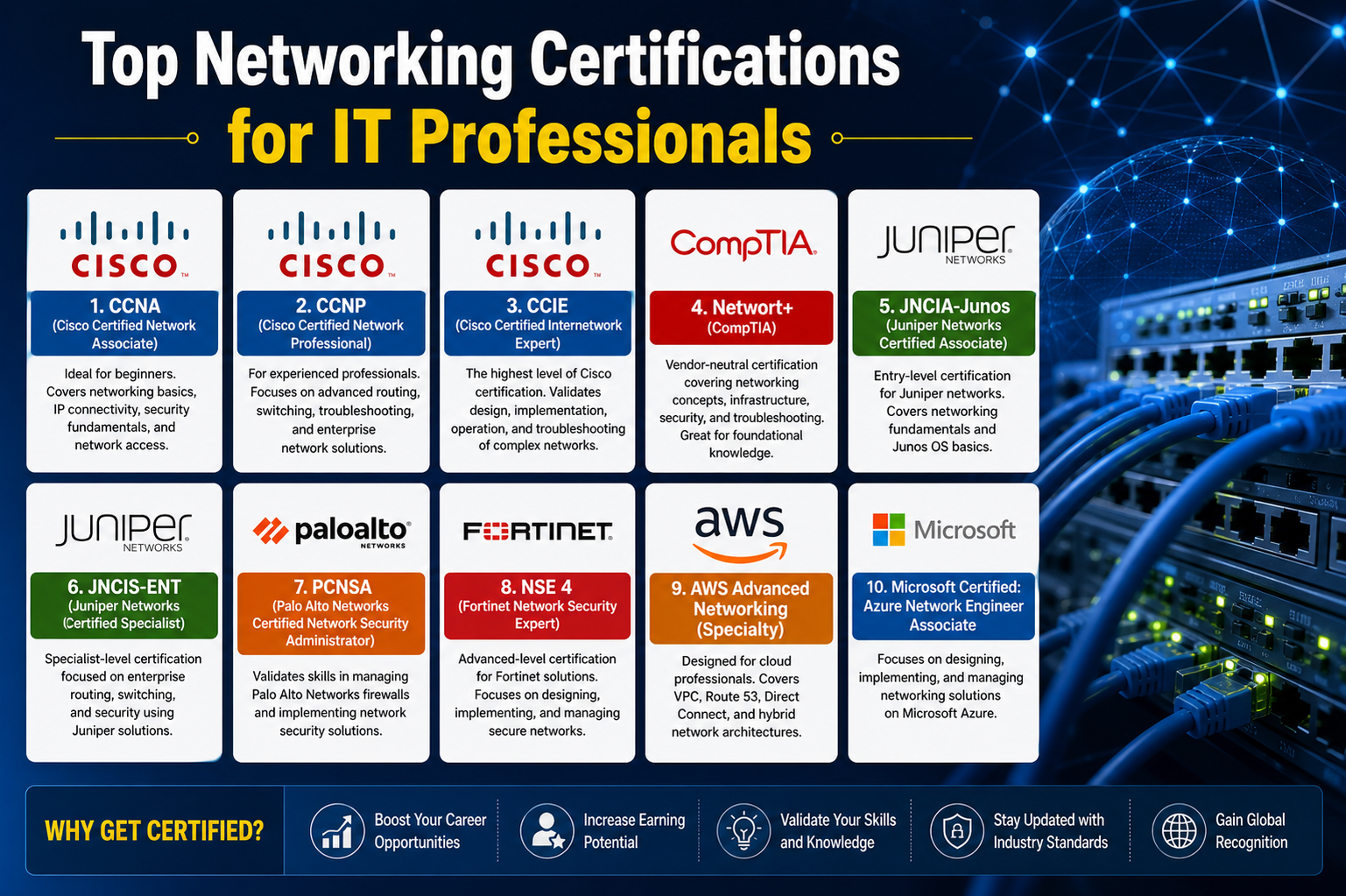
Modern networking has moved far beyond simple connectivity between machines. Today’s systems handle massive global traffic, cloud-based infrastructure, hybrid environments, advanced virtualization, and highly secure data exchanges in real time. What once required basic routing and switching knowledge has transformed into a highly sophisticated discipline that blends automation, security, scalability, and cloud integration.
A decade ago, many of the technologies now considered standard would have sounded experimental or futuristic. Software-defined networking, cloud-native architectures, zero-trust security models, and AI-assisted network monitoring have reshaped how digital communication systems operate. As organizations continue to expand their digital footprints, the demand for skilled networking professionals has grown rapidly, creating a strong and stable career path for those willing to build expertise in this field.
Because of this constant evolution, structured learning and formal validation of skills have become more important than ever. One of the most reliable ways to demonstrate capability in this competitive industry is through professional certifications that validate both theoretical knowledge and hands-on technical ability.
Are Networking Certifications Still Worth It
Networking certifications continue to hold strong value and their importance has not diminished despite the rise of self-learning platforms and real-world project experience. Certifications remain one of the clearest and most trusted indicators of technical competence in IT hiring.
Employers often rely on certifications because they provide a standardized benchmark. When a recruiter sees a recognized credential on a resume, they immediately understand the level of knowledge, discipline, and technical exposure associated with it. Unlike informal learning paths, certifications are structured, tested, and verified through standardized examinations that ensure consistent evaluation.
Another reason certifications remain relevant is their ability to bridge the gap between theory and practice. Many certification paths include labs, simulations, and scenario-based questions that closely mirror real-world networking challenges. This helps professionals develop not only conceptual understanding but also practical problem-solving skills that are directly applicable in enterprise environments.
Certifications also demonstrate commitment. In a fast-moving industry where technologies change frequently, maintaining up-to-date credentials signals that a professional is actively engaged in learning and adapting to new tools and methodologies.
Why Certifications Matter in Networking Careers
In networking, experience alone is often not enough to secure advanced opportunities. Many organizations require proof of validated expertise before allowing professionals to manage critical infrastructure. Certifications help establish that trust.
They also play a significant role in career progression. Entry-level professionals often use certifications to secure their first roles, while experienced engineers use advanced certifications to move into specialized or senior positions. In both cases, certifications act as structured milestones that guide career development.
Additionally, certifications help professionals align with industry standards. Since networking technologies are often built around major vendors and frameworks, certification programs ensure that individuals understand best practices, security protocols, and operational methodologies that are widely accepted across the industry.
This alignment reduces errors in real-world environments and improves overall system reliability, which is essential for organizations that depend heavily on network performance and uptime.
Vendor-Neutral vs Vendor-Specific Networking Certifications
Networking certifications generally fall into two major categories: vendor-neutral and vendor-specific. Each category serves a different purpose and offers unique advantages depending on career goals and job requirements.
Vendor-neutral certifications focus on broad networking principles that apply across multiple platforms and technologies. These certifications emphasize foundational concepts such as routing, switching, network security, and infrastructure design without tying knowledge to a specific company’s hardware or software. This approach allows professionals to develop flexible skills that can be applied in diverse environments.
Vendor-specific certifications, on the other hand, are built around the technologies of a particular company. These programs focus deeply on how to configure, manage, and troubleshoot systems within a specific ecosystem. For example, organizations heavily invested in Cisco, Juniper, or VMware technologies often prefer candidates who hold certifications aligned with their infrastructure.
While vendor-neutral certifications provide versatility, vendor-specific certifications often lead to more direct job opportunities in organizations that rely on those technologies. Both types are valuable, and many professionals choose to pursue a combination of both to maximize career flexibility and specialization.
Understanding How Employers View Certifications
From an employer’s perspective, certifications provide clarity in hiring decisions. They reduce uncertainty about a candidate’s technical abilities and help filter applicants based on proven skills.
Hiring managers often interpret certifications as indicators of readiness. For example, an entry-level certification suggests foundational knowledge, while advanced certifications indicate the ability to handle complex enterprise environments. This structured hierarchy helps organizations assign roles more effectively and reduce training overhead.
Certifications also signal dedication and discipline. Since most certification exams require structured preparation, candidates who earn them are often viewed as more committed to professional growth. This can make a significant difference in competitive job markets where multiple candidates have similar experience levels.
In many cases, certifications also influence salary potential and promotion opportunities. Professionals with recognized credentials are more likely to be considered for higher-responsibility roles, especially in environments where network stability and security are critical.
Best Networking Certifications for Beginners
Starting a career in networking can be challenging because many employers expect candidates to already have some level of practical experience. Certifications help bridge this gap by providing structured learning paths that build foundational knowledge while also validating skills for entry-level positions.
For beginners, the goal is not only to learn networking concepts but also to gain credibility in the job market. Entry-level certifications help achieve both objectives by introducing essential topics such as networking fundamentals, hardware components, basic security principles, and troubleshooting techniques.
Several certifications stand out as strong starting points for individuals entering the networking field, each offering a slightly different focus depending on career direction.
CompTIA A+
The CompTIA A+ certification is widely recognized as one of the most comprehensive entry-level IT certifications available. It covers a broad range of foundational topics including hardware, operating systems, networking basics, mobile devices, and introductory security concepts.
While it is not exclusively focused on networking, it provides a strong technical foundation that supports all IT-related career paths. Understanding how systems interact at a basic level is essential for anyone planning to specialize in networking later.
The certification is structured around multiple exams that assess both theoretical understanding and practical problem-solving skills. It is often considered a gateway certification for individuals who are new to the IT industry and want to build a solid base before moving into more specialized networking roles.
Because of its wide coverage, it helps professionals understand how networking fits into the larger IT ecosystem, making it easier to transition into advanced certifications later in their careers.
Cisco Certified Technician (CCT)
The Cisco Certified Technician certification is designed for individuals who want to begin working directly with Cisco networking equipment. It focuses on practical, hands-on skills related to diagnosing, repairing, and maintaining Cisco devices.
Unlike broader certifications, this one is highly focused on operational tasks. It prepares candidates for entry-level technical roles where they may be responsible for troubleshooting hardware issues and performing basic network maintenance.
The certification is divided into specialized tracks that cover different areas of Cisco technology, allowing candidates to choose a focus based on their interests or job requirements. These tracks provide targeted knowledge that is directly applicable in environments where Cisco infrastructure is widely used.
For beginners aiming to enter organizations that rely heavily on Cisco systems, this certification can serve as a strong stepping stone into real-world networking roles.
VMware VCTA
The VMware Certified Technical Associate certification introduces candidates to virtualization technologies, which have become a critical part of modern networking environments. Virtualization allows multiple virtual machines and networks to operate on a single physical infrastructure, improving efficiency and scalability.
This certification focuses on foundational virtualization concepts, including data center operations, virtual networking, and resource management. It is especially useful for individuals who want to work in cloud computing or enterprise environments that rely heavily on virtual infrastructure.
Because virtualization is now deeply integrated into networking systems, understanding these concepts is increasingly important for networking professionals. The VCTA helps bridge the gap between traditional networking and modern cloud-based architectures.
It is considered slightly more advanced than some entry-level certifications due to its focus on abstract infrastructure concepts, but it remains accessible to beginners willing to learn virtualization fundamentals.
Juniper JNCIA-Junos
The Juniper Networks Certified Associate certification, known as JNCIA-Junos, is an excellent entry point for those working with Juniper technologies. It focuses on foundational networking concepts while also introducing the Junos operating system.
This certification provides knowledge of basic routing, switching, and device configuration within Juniper environments. It is particularly valuable for individuals entering organizations that use Juniper hardware and software in their network infrastructure.
One of its key strengths is its balance between general networking theory and vendor-specific implementation. Candidates gain a solid understanding of how networks function while also learning how to operate within a specific enterprise ecosystem.
This combination makes it a strong starting point for individuals planning to specialize in Juniper-based networking environments or seeking a structured introduction to enterprise networking systems.
Best Networking Certifications for Advancing Your Career
As professionals move beyond entry-level roles, networking careers begin to shift from basic configuration and troubleshooting toward more strategic responsibilities. At this stage, certifications play a very different role. Instead of simply validating foundational knowledge, they help professionals specialize, deepen expertise, and signal readiness for higher-level responsibilities such as network design, optimization, security implementation, and infrastructure planning.
Career advancement in networking often depends on the ability to demonstrate both breadth and depth of knowledge. Employers expect professionals not only to understand how networks operate but also to make decisions that improve performance, scalability, and resilience. Certifications designed for mid-level professionals are built to reflect these expectations by introducing more complex scenarios and advanced technical concepts.
These certifications also encourage hands-on problem solving, where there may not be a single correct answer. Instead, candidates are evaluated on their ability to analyze situations, apply best practices, and choose solutions that align with organizational needs.
CompTIA Network+
The CompTIA Network+ certification is one of the most respected vendor-neutral certifications for early to mid-level networking professionals. It focuses specifically on networking concepts, making it a natural progression after foundational IT knowledge.
This certification covers essential topics such as network architecture, IP addressing, routing and switching concepts, network troubleshooting, and security fundamentals. Unlike entry-level certifications that introduce general IT knowledge, Network+ is more focused and technical in nature, offering a deeper understanding of how networks are designed and maintained.
One of its key strengths is its vendor-neutral approach. This means the knowledge gained can be applied across different technologies and environments, whether an organization uses Cisco, Juniper, or hybrid cloud systems. This flexibility makes it highly valuable for professionals who want to work in diverse IT environments.
The certification is also known for its difficulty relative to its level. It requires a strong understanding of networking principles and the ability to apply that knowledge in practical scenarios. Many professionals consider it a turning point in their careers, where they transition from general IT support roles into more specialized networking positions.
Cisco CCNA
The Cisco Certified Network Associate certification is one of the most widely recognized credentials in the networking industry. It serves as a major milestone for professionals seeking to establish a serious career in networking.
The CCNA focuses heavily on Cisco technologies while also covering core networking concepts that apply across the industry. Topics include IP connectivity, network access, security fundamentals, automation, and programmability. This combination ensures that candidates are not only capable of configuring Cisco devices but also understand broader networking principles.
What makes this certification particularly valuable is its depth. It goes far beyond basic networking concepts and introduces professionals to real-world enterprise networking environments. Candidates learn how large-scale networks operate, how data flows between systems, and how to troubleshoot complex connectivity issues.
The CCNA is often considered a career-defining certification because it opens doors to a wide range of networking roles. Many professionals use it as a foundation for long-term careers in network engineering, infrastructure design, and systems administration.
Juniper JNCIS-ENT
The Juniper Networks Certified Specialist certification in Enterprise Routing and Switching is designed for professionals who already have some experience working with networking systems and want to deepen their expertise in Juniper environments.
This certification focuses on more advanced topics such as dynamic routing protocols, network tunneling, and enterprise-level switching concepts. It also emphasizes configuration and troubleshooting within the Junos operating system, which is central to Juniper’s networking ecosystem.
Unlike entry-level certifications, this one requires a stronger understanding of how networks behave under real-world conditions. Candidates are expected to analyze network behavior, identify inefficiencies, and apply configuration changes that improve performance and reliability.
This certification is particularly useful for professionals working in organizations that rely heavily on Juniper infrastructure. It helps them move from basic operational roles into more technical and analytical positions where they are responsible for optimizing network performance and solving complex issues.
How Mid-Level Certifications Shape Career Growth
At the mid-career stage, certifications do more than validate skills. They actively shape the direction of a professional’s career. Choosing the right certification can influence whether an individual moves toward network engineering, security specialization, cloud networking, or infrastructure architecture.
These certifications also encourage professionals to expand their technical thinking. Instead of focusing only on individual devices or configurations, they begin to understand how entire systems interact. This shift is critical for career growth because modern networks are increasingly complex and interconnected.
Another important factor is recognition within organizations. Professionals who earn mid-level certifications are often considered for promotions, leadership roles, or specialized projects. This is because these certifications demonstrate not only technical knowledge but also the ability to handle increased responsibility.
In many cases, employers use these certifications as benchmarks for career progression. They help define job roles, salary ranges, and expectations for performance. As a result, earning them can have a direct impact on both career trajectory and professional credibility.
Skill Development Through Certification Preparation
Preparing for advanced networking certifications is often just as valuable as the certification itself. The study process requires deep engagement with technical concepts, hands-on practice, and problem-solving exercises that mirror real-world scenarios.
Unlike beginner-level learning, where memorization plays a larger role, mid-level certifications demand analytical thinking. Candidates must understand how different networking components interact and how changes in one area can affect the entire system.
This process strengthens critical thinking skills and builds confidence in managing complex systems. It also exposes professionals to a wider range of technologies and tools, expanding their overall technical awareness.
Many professionals find that certification preparation helps them identify gaps in their knowledge that would otherwise go unnoticed. This makes them more effective in their current roles while also preparing them for future responsibilities.
The Role of Networking Certifications in Real-World Environments
In real-world IT environments, networking certifications often translate directly into job performance. Professionals who hold certifications are typically more efficient at diagnosing issues, implementing solutions, and maintaining system stability.
This is because certification programs are designed around industry standards and best practices. They reflect real challenges that networking professionals face, including performance bottlenecks, security vulnerabilities, and configuration errors.
As a result, certified professionals are often better prepared to handle unexpected issues in production environments. They are also more likely to follow structured troubleshooting methodologies, which reduces downtime and improves system reliability.
In team environments, certifications also help establish a shared technical language. When multiple team members hold similar certifications, communication becomes more efficient, and collaboration improves.
Vendor Influence on Mid-Level Certifications
Vendor-specific certifications like those from Cisco and Juniper play a significant role at the mid-level stage of networking careers. These certifications are closely aligned with real enterprise environments, where specific technologies dominate infrastructure design.
Because of this, professionals who pursue vendor-specific certifications often gain direct access to job opportunities within organizations that use those technologies. This alignment between certification content and real-world systems makes these credentials highly practical.
At the same time, vendor-neutral certifications continue to provide value by reinforcing universal networking principles. Many professionals choose to combine both approaches, ensuring they have both deep technical specialization and broad conceptual understanding.
This combination is particularly effective in environments where hybrid infrastructure is common. Organizations often use multiple vendors and technologies simultaneously, requiring professionals who can adapt and integrate different systems.
Building Long-Term Career Stability Through Certifications
One of the most important benefits of networking certifications at the mid-career level is long-term career stability. The IT industry evolves rapidly, but core networking principles remain consistent over time.
By continuously upgrading certifications, professionals ensure that their skills remain relevant even as technologies change. This adaptability is essential in an industry where automation, cloud computing, and virtualization are constantly reshaping traditional networking roles.
Certifications also provide a structured path for continuous learning. Instead of randomly exploring new technologies, professionals can follow defined certification tracks that gradually increase in complexity and specialization.
This structured approach helps maintain career momentum and ensures steady professional development over time.
Best Networking Certifications for Network Administrators
As networking professionals progress into network administration roles, their responsibilities expand significantly. At this stage, work is no longer limited to basic configuration or troubleshooting. Instead, it includes managing complex infrastructures, ensuring system reliability, optimizing performance, implementing security policies, and planning long-term network scalability.
Network administrators are expected to understand not just how networks function, but how to design and maintain them in real enterprise environments. This requires a deeper level of technical expertise and the ability to handle advanced configurations that may involve multiple systems, vendors, and technologies working together.
Certifications at this level are designed to strengthen problem-solving ability, improve architectural thinking, and build confidence in managing mission-critical systems. They also serve as a bridge between mid-level technical work and senior engineering responsibilities.
Cisco CCNP Enterprise
The Cisco Certified Network Professional Enterprise certification represents a major step forward for anyone aiming to advance in enterprise networking. It focuses on complex network design, implementation, and troubleshooting in large-scale environments.
At this level, professionals are expected to work with advanced routing protocols, multilayer switching, enterprise wireless systems, and network automation tools. The certification also introduces more strategic concepts such as infrastructure scalability, redundancy planning, and performance optimization.
A key feature of this certification is its emphasis on real-world enterprise scenarios. Candidates are not only tested on theoretical knowledge but also on their ability to apply that knowledge in situations that mirror actual workplace challenges.
This certification is often associated with roles such as senior network engineer or network architect. Professionals who earn it typically gain access to higher-level responsibilities, including designing enterprise networks and managing large infrastructure deployments.
It also encourages a strong understanding of automation and programmability, reflecting the industry’s shift toward software-driven networking environments. This makes it especially relevant in modern IT ecosystems where manual configuration is being replaced by automated network management tools.
Cisco CCNP Data Center
The Cisco Certified Network Professional Data Center certification is designed for professionals who specialize in data center environments. It focuses on the technologies and architectures that support large-scale computing, storage, and networking systems.
This certification covers advanced topics such as data center switching, virtualization, storage networking, and infrastructure automation. It also includes deep knowledge of Cisco-specific technologies, which are widely used in enterprise data centers around the world.
Professionals working toward this certification are expected to understand how data centers operate as integrated systems rather than isolated components. This includes managing compute resources, optimizing storage performance, and ensuring seamless communication between virtual and physical environments.
The certification also emphasizes high availability and disaster recovery strategies. These concepts are critical in environments where downtime can lead to significant operational and financial impact.
By earning this certification, professionals demonstrate their ability to manage complex data center infrastructures and support mission-critical business applications. It is often associated with roles in enterprise data center engineering and infrastructure specialization.
Juniper JNCIP-DC
The Juniper Networks Certified Internetworking Professional Data Center certification is an advanced credential focused on Juniper’s data center technologies and solutions.
This certification goes deeper into topics such as data center interconnects, virtualization technologies, and advanced routing and switching configurations. It also emphasizes large-scale network design principles used in modern data center environments.
Professionals pursuing this certification are expected to have strong hands-on experience with Juniper systems and a solid understanding of enterprise networking concepts. The exam challenges candidates to demonstrate their ability to design and troubleshoot complex data center architectures.
A key focus area is the implementation of scalable and efficient network designs that support multi-tenant environments. This is especially important in cloud and hosting environments where multiple clients share infrastructure resources securely and efficiently.
This certification is particularly valuable for professionals working in organizations that rely heavily on Juniper technologies for their data center operations. It helps establish expertise in high-performance networking environments and supports career growth into senior infrastructure roles.
The Importance of Network Administration Certifications
At the network administration level, certifications serve as more than just proof of knowledge. They become tools for professional identity and career positioning.
Employers often rely on these certifications to determine readiness for advanced responsibilities. Managing enterprise networks requires a high level of trust, and certifications help establish that trust by demonstrating verified technical competence.
These certifications also help professionals transition into leadership-oriented roles. Network administrators are often responsible for guiding technical decisions, coordinating with teams, and ensuring that infrastructure aligns with business goals.
Another important aspect is specialization. As networks become more complex, professionals often choose to specialize in areas such as data centers, enterprise routing, or network security. Certifications help define and validate these specializations.
Advanced Problem Solving and Real-World Application
One of the key characteristics of network administration certifications is their focus on real-world problem solving. Unlike earlier stages where concepts are more foundational, these certifications require professionals to analyze complex systems and make informed decisions under pressure.
This includes identifying network bottlenecks, resolving configuration conflicts, and ensuring system stability in high-demand environments. Professionals must also consider scalability and long-term performance when implementing solutions.
These skills are critical in enterprise environments where even small configuration errors can lead to significant disruptions. Certification training helps professionals develop a structured approach to troubleshooting and decision-making.
By working through advanced scenarios, candidates learn how to evaluate multiple solutions and choose the one that best fits operational requirements. This strengthens both technical ability and strategic thinking.
Growing Responsibility in Network Administration Roles
As professionals advance into network administration, their responsibilities extend beyond technical execution. They become responsible for maintaining the overall health and efficiency of network infrastructure.
This includes monitoring system performance, implementing security policies, managing upgrades, and coordinating with other IT teams. Administrators also play a key role in ensuring compliance with organizational and industry standards.
Certifications at this level help prepare professionals for these responsibilities by introducing them to enterprise-level planning and decision-making processes. They also provide exposure to best practices used in large organizations.
In many cases, certified professionals are entrusted with critical infrastructure projects. This reflects the trust organizations place in individuals who have demonstrated advanced technical capability through certification.
Vendor Ecosystems and Enterprise Infrastructure
At the network administration level, vendor ecosystems become increasingly important. Many organizations rely heavily on specific vendors for their networking infrastructure, which makes vendor-specific certifications highly relevant.
Cisco and Juniper, for example, dominate many enterprise environments, especially in large-scale networking and data center operations. Understanding how to work within these ecosystems is essential for effective network management.
Vendor certifications ensure that professionals are aligned with the tools, configurations, and best practices used in real-world systems. This reduces operational risk and improves system efficiency.
At the same time, professionals who understand multiple vendor environments gain a significant advantage. Many modern infrastructures are hybrid, combining technologies from different providers. The ability to integrate and manage these systems is highly valuable.
Career Progression Through Administration-Level Certifications
Network administration certifications often mark a turning point in a professional’s career. They represent the transition from operational roles into more strategic and specialized positions.
Professionals at this stage are often considered for senior engineering roles, infrastructure design positions, or technical leadership opportunities. Certifications help validate readiness for these responsibilities.
They also provide a clear pathway for continued advancement. After achieving administration-level certifications, professionals often move toward expert-level credentials or specialized certifications in areas like security, cloud networking, or automation.
This structured progression helps maintain long-term career growth and ensures that professionals remain competitive in a rapidly evolving industry.
Best Networking Certifications for Network Engineers
At the network engineering level, the focus shifts from managing and maintaining networks to designing, automating, and optimizing them at scale. Network engineers are expected to build resilient architectures, integrate automation frameworks, and solve highly complex infrastructure challenges that go beyond routine administration.
This stage of the career is often considered the peak of technical networking expertise. Engineers are not only responsible for keeping systems running but also for shaping how those systems evolve over time. This includes improving efficiency, reducing downtime, enhancing security, and ensuring that networks can support rapidly growing digital demands.
Certifications for network engineers are designed to validate mastery of advanced networking concepts while also introducing modern skills such as programmability, automation, and large-scale system design.
Cisco DevNet Professional
The Cisco DevNet Professional certification represents a major shift in how networking expertise is defined. It combines traditional networking knowledge with software development and automation skills, reflecting the growing importance of programmability in modern infrastructure.
This certification focuses on integrating APIs, automating network configurations, and building applications that interact directly with network devices. It encourages professionals to think beyond manual configuration and instead design systems that are efficient, scalable, and automated.
A key aspect of this certification is its alignment with modern IT trends. As networks become more software-driven, engineers are expected to understand both infrastructure and code. This includes working with automation tools, scripting languages, and network orchestration platforms.
Professionals who earn this certification are often involved in designing intelligent network systems that can self-adjust, monitor performance, and respond to changes dynamically. This makes it highly valuable in organizations adopting cloud-native and DevOps-driven environments.
It also opens opportunities in advanced engineering roles where automation and innovation are central to network operations.
Juniper JNCIE
The Juniper Networks Certified Internet Expert certification is one of the most advanced credentials in the networking industry. It represents expert-level mastery of Juniper technologies and is widely respected across enterprise and service provider environments.
This certification is not limited to theoretical knowledge. It requires deep hands-on expertise in designing, building, and troubleshooting complex network architectures. Candidates are expected to demonstrate full control over Junos-based systems in high-pressure, real-world scenarios.
The exam process itself is highly practical and challenging, requiring candidates to build and manage network environments that meet strict technical requirements. It tests not only technical skill but also problem-solving ability, efficiency, and attention to detail.
Professionals who achieve this certification are often considered elite-level engineers. They are capable of designing large-scale infrastructures that support critical enterprise and service provider operations.
The certification also covers multiple specializations, including data center networking, enterprise routing, security, and service provider environments. This allows engineers to focus on areas that align with their career goals while still maintaining expert-level recognition.
The Role of Automation in Modern Network Engineering
One of the most significant changes in modern networking is the shift toward automation. Traditional manual configuration methods are no longer sufficient for managing large-scale, dynamic environments.
Network engineers are now expected to design systems that can configure, monitor, and optimize themselves with minimal manual intervention. This includes using APIs, automation frameworks, and orchestration tools to streamline operations.
Automation not only improves efficiency but also reduces the risk of human error. In large environments, even small configuration mistakes can lead to major outages. Automated systems help standardize processes and ensure consistency across the entire infrastructure.
Certifications like DevNet Professional and Juniper JNCIE reflect this shift by incorporating automation and programmability into their core objectives. Engineers who master these skills are better equipped to handle the demands of modern IT environments.
Network Engineering and Cloud Integration
Another major focus area for network engineers is cloud integration. As organizations migrate workloads to cloud platforms, networks must evolve to support hybrid and multi-cloud environments.
This requires engineers to understand how traditional networking principles apply in virtualized and cloud-based infrastructures. It also involves managing connectivity between on-premises systems and cloud platforms while maintaining performance and security.
Cloud networking introduces new challenges such as dynamic scaling, distributed architectures, and software-defined infrastructure. Engineers must design networks that can adapt to changing workloads and traffic patterns in real time.
Certifications at this level often include concepts related to cloud networking, virtualized environments, and infrastructure-as-code principles. These skills are essential for engineers working in modern enterprise environments.
Expert-Level Problem Solving in Networking
At the network engineer level, problem solving becomes significantly more complex. Engineers are expected to diagnose issues that may span multiple systems, layers, and technologies.
This includes identifying performance bottlenecks in distributed systems, resolving conflicts between virtual and physical networks, and ensuring seamless communication across hybrid environments.
Unlike earlier stages, there may not be a single clear solution to these problems. Engineers must evaluate multiple approaches, consider trade-offs, and implement solutions that balance performance, cost, and reliability.
Certifications help prepare professionals for this level of complexity by exposing them to advanced troubleshooting scenarios and real-world case studies.
Strategic Impact of Network Engineers
Network engineers play a critical role in shaping the overall strategy of IT infrastructure. Their decisions directly impact system performance, scalability, and long-term sustainability.
They are often involved in designing network architectures that support business growth, ensuring that systems can scale efficiently as demand increases. This requires both technical expertise and strategic thinking.
Engineers also contribute to technology selection, helping organizations choose the right tools, platforms, and architectures for their needs. This makes their role both technical and advisory in nature.
Certifications at this level validate not only technical skills but also the ability to make informed architectural decisions that align with business objectives.
Career Growth and Industry Recognition
Earning expert-level networking certifications significantly enhances professional recognition within the industry. These credentials are often associated with senior engineering roles, architecture positions, and specialized consulting opportunities.
Professionals who achieve this level of certification are typically viewed as subject matter experts. They are often invited to lead complex projects, design large-scale systems, and mentor junior engineers.
These certifications also provide long-term career stability. As networking continues to evolve, engineers with advanced certifications remain in high demand due to their ability to adapt to new technologies and solve complex infrastructure challenges.
In many cases, expert-level certifications serve as the highest formal validation of networking expertise, representing years of experience, study, and hands-on practice.
Final Conclusion
Networking certifications represent far more than academic achievements. They are structured career development tools that guide professionals from foundational knowledge to expert-level mastery.
Each stage of certification builds on the previous one, creating a clear pathway from beginner roles to advanced engineering positions. Along the way, professionals develop not only technical expertise but also critical thinking, problem-solving ability, and strategic awareness.
From entry-level certifications that introduce basic networking concepts to expert-level credentials that validate architectural mastery, the certification ecosystem remains one of the most reliable ways to grow in the IT industry.
As networking continues to evolve with automation, cloud computing, and AI-driven systems, certifications will remain essential for staying relevant, competitive, and prepared for future technological changes.