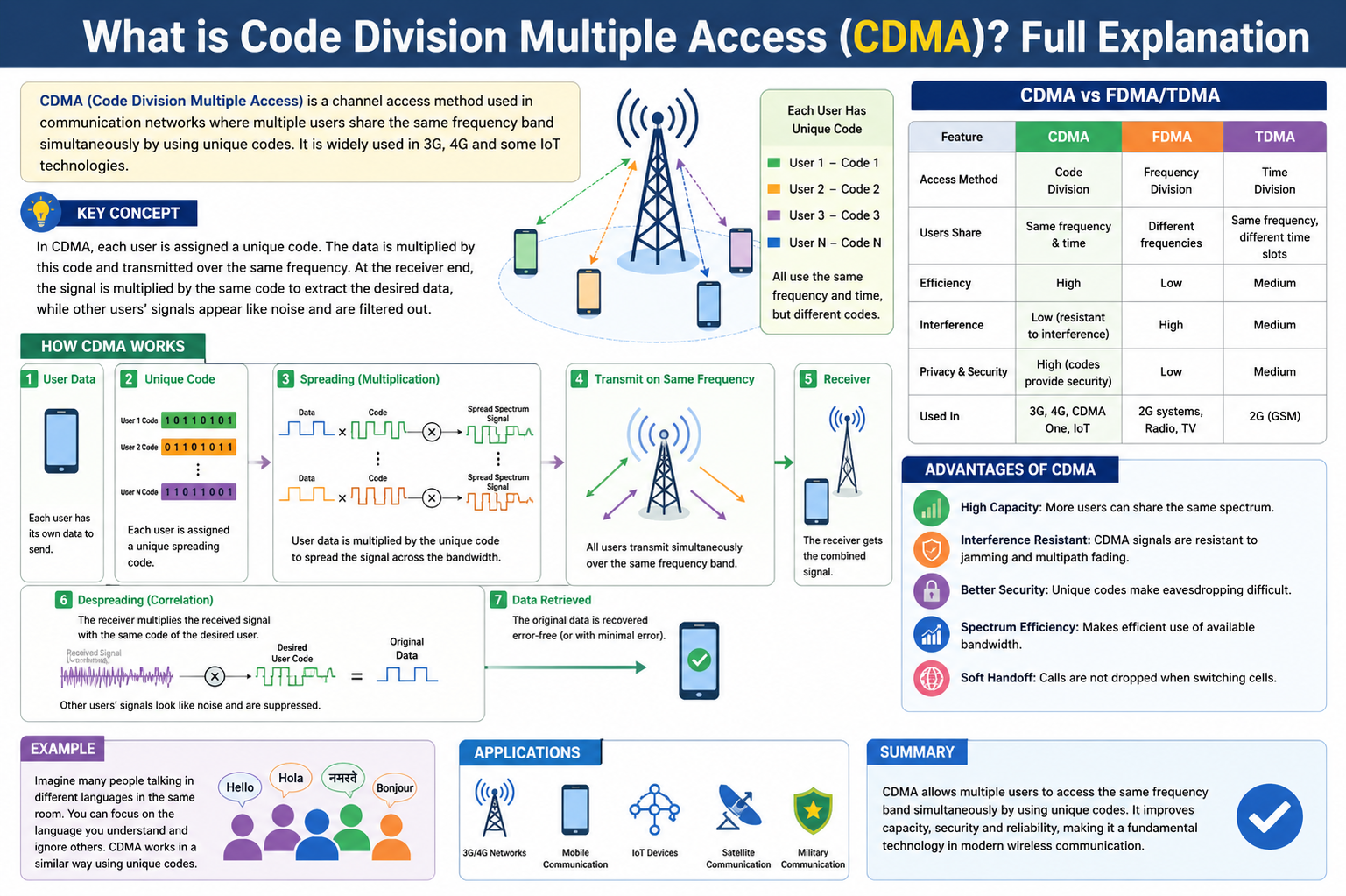
Code-Division Multiple Access, commonly referred to as CDMA, is a wireless communication technology that allows multiple users to share the same frequency spectrum at the same time without causing significant interference to one another. Unlike traditional communication methods that divide access by time slots or frequency bands, CDMA assigns a unique code to each user. This code acts like a signature, enabling the system to distinguish between multiple transmissions even when they overlap in both time and frequency. As a result, CDMA represents a highly efficient and intelligent approach to managing limited wireless resources, especially in environments where many users need to communicate simultaneously.
CDMA became widely recognized during the evolution of second-generation and third-generation mobile communication systems, where it played a major role in improving voice clarity, network capacity, and overall performance. By spreading signals across a wide bandwidth and using mathematical coding techniques, CDMA minimizes interference and enhances the reliability of wireless connections. Its design is rooted in spread spectrum technology, which was originally developed for secure military communications but later adapted for commercial telecommunications due to its robustness and efficiency.
At its core, CDMA is more than just a transmission method; it is a system that redefines how signals coexist within the same communication environment. Instead of forcing users to take turns or occupy separate channels, it allows them to transmit simultaneously while maintaining signal integrity. This capability has made CDMA a foundational concept in the advancement of modern wireless networks, influencing technologies that followed, including advanced cellular systems.
Core Concept of CDMA Communication
The fundamental idea behind CDMA revolves around the concept of encoding and spreading signals. Each user’s data is combined with a unique digital code before transmission. This process transforms the original signal into a form that appears as noise to unintended receivers but can be easily decoded by the intended recipient who knows the correct code. The spreading of the signal across a wider bandwidth not only reduces the likelihood of interference but also enhances security, as unauthorized users cannot easily interpret the encoded data.
To better understand this concept, imagine a crowded room where multiple people are speaking simultaneously. In a normal situation, it would be difficult to distinguish one conversation from another. However, if each pair of individuals speaks a different language, listeners can focus only on the language they understand and ignore the rest. CDMA operates in a similar way, where the unique codes function like different languages, allowing multiple transmissions to coexist without confusion.
This approach contrasts sharply with older methods such as time-based or frequency-based access, where users must wait for their turn or be assigned a specific portion of the spectrum. By removing these limitations, CDMA significantly increases the number of users that can be supported within a given bandwidth. It also ensures that communication remains stable even in high-density scenarios, such as urban environments with heavy network traffic.
Spread Spectrum Technology in CDMA
A defining feature of CDMA is its use of spread spectrum technology, which involves distributing a signal over a broader frequency range than is strictly necessary for transmitting the data. This spreading is achieved through the application of a pseudo-random code that modifies the original signal. Although the transmitted signal occupies more bandwidth, it becomes more resistant to interference, noise, and signal fading.
Spread spectrum techniques offer several advantages. One of the most significant is resilience against interference. Since the signal is distributed across a wide range of frequencies, the impact of narrowband interference is minimized. Even if part of the spectrum is affected, the overall signal can still be recovered accurately. This makes CDMA particularly useful in environments where signal disruption is common.
Another advantage is enhanced privacy. Because the signal appears as random noise without the correct decoding code, it is difficult for unauthorized users to intercept or decode the transmission. This inherent level of security made spread spectrum technology attractive for both military and civilian applications. In commercial networks, it contributes to the protection of user data and communication integrity.
Additionally, spread spectrum allows multiple users to share the same frequency band without requiring strict separation. Each user’s signal is uniquely encoded, ensuring that it can be isolated at the receiver despite overlapping transmissions. This efficient use of the spectrum is one of the key reasons why CDMA gained popularity in mobile communication systems.
Unique Code Assignment and Signal Separation
One of the most important aspects of CDMA is the assignment of unique codes to each user. These codes are carefully designed sequences that have low correlation with one another, meaning they do not easily interfere when combined. When a user transmits data, it is multiplied by their assigned code, spreading the signal across the available bandwidth.
At the receiving end, the system applies the same code to extract the original signal from the combined transmission. Signals encoded with different codes appear as low-level noise and are effectively ignored. This process, known as correlation, allows the receiver to focus only on the desired signal while filtering out others.
The effectiveness of this approach depends on the quality and design of the codes used. Ideally, the codes should be orthogonal or nearly orthogonal, ensuring minimal interference between users. In practice, achieving perfect orthogonality can be challenging, especially in real-world environments with varying signal strengths and propagation conditions. However, advanced techniques such as power control and error correction help maintain reliable communication.
Unique code assignment also enables flexibility in network management. New users can be added without requiring significant changes to the existing system, as long as appropriate codes are available. This scalability makes CDMA suitable for growing networks where demand can increase rapidly over time.
Interference Management and Power Control
Interference is a critical challenge in any wireless communication system, and CDMA addresses this issue through a combination of code separation and power control mechanisms. While unique codes help distinguish signals, variations in signal strength can still lead to interference if not properly managed.
Power control plays a vital role in maintaining balance within the network. Each user’s transmission power is carefully adjusted այնպես that signals arrive at the base station with roughly समान strength. If one user transmits at a much higher power level than others, it can overwhelm the system and make it difficult to detect weaker signals. This phenomenon, often referred to as the near-far problem, is effectively mitigated through dynamic power control algorithms.
By continuously monitoring signal quality and adjusting transmission power, CDMA networks ensure that all users can communicate effectively without causing excessive interference. This approach not only improves overall performance but also enhances battery efficiency for mobile devices, as they transmit only the शक्ति necessary to maintain a stable connection.
In addition to power control, CDMA systems use advanced signal processing techniques to further reduce interference. These include filtering, error correction, and adaptive algorithms that respond to changing network conditions. Together, these methods create a robust communication environment capable of supporting multiple users simultaneously.
Comparison with Other Multiple Access Techniques
To fully appreciate the advantages of CDMA, it is helpful to compare it with other multiple access methods commonly used in wireless communication. Traditional systems often rely on dividing resources either in time or frequency, which can limit efficiency and flexibility.
In time-based systems, users are assigned specific time slots during which they can transmit data. While this approach is straightforward, it requires precise synchronization and can lead to delays if many users are competing for access. Frequency-based systems, on the other hand, allocate separate frequency bands to each user. This reduces interference but can result in underutilization of the spectrum if some users are inactive.
CDMA differs fundamentally by allowing all users to transmit simultaneously over the same frequency band. Instead of dividing resources, it overlays multiple signals using unique codes. This results in better spectrum utilization and higher capacity, especially in scenarios with fluctuating demand.
Another key difference is resilience to interference and noise. While other methods may struggle in challenging environments, CDMA’s spread spectrum approach provides greater robustness. It can maintain communication جودة even when signal conditions are less than ideal, making it suitable for a wide range of applications.
Role of CDMA in Mobile Communication Evolution
CDMA played a transformative role in the development of mobile communication systems, particularly during the transition from analog to digital networks. Its ability to support more users while maintaining high-quality connections made it a preferred choice for many network operators.
During the era of second-generation and third-generation networks, CDMA enabled significant improvements in voice quality, data transmission, and network efficiency. It allowed service providers to accommodate growing numbers of subscribers without requiring proportional increases in उपलब्ध spectrum. This efficiency was crucial in meeting the demands of rapidly expanding mobile الأسواق.
Beyond voice communication, CDMA also facilitated the introduction of mobile data services. It supported early forms of wireless internet access, enabling users to browse the web, send emails, and access multimedia content on their devices. These capabilities laid the groundwork for the advanced mobile experiences that are now commonplace.
Although newer technologies have since emerged, the principles underlying CDMA continue to influence modern communication systems. Concepts such as spread spectrum, code-based separation, and efficient spectrum utilization remain relevant in the design of advanced wireless networks.
Applications of CDMA in Real-World Communication
Code-Division Multiple Access has been applied across a wide range of communication systems, making it one of the most impactful technologies in the evolution of wireless connectivity. Its ability to support simultaneous transmissions while maintaining signal clarity has enabled its use in both commercial and specialized environments. In mobile communication networks, CDMA became a backbone technology that allowed service providers to deliver reliable voice and data services to millions of users. By efficiently utilizing available bandwidth, it ensured that networks could handle increasing demand without compromising performance.
Beyond traditional cellular networks, CDMA has also been used in telemetry systems where remote data collection is essential. Industries such as agriculture, environmental monitoring, and infrastructure management rely on telemetry to gather real-time data from sensors distributed over large areas. CDMA’s resistance to interference and its ability to maintain stable connections make it particularly suitable for such applications. Even in challenging environments where signal quality might fluctuate, CDMA can provide consistent data transmission.
Another significant application lies in satellite communication and secure military systems. The inherent security features of CDMA, derived from its code-based transmission, make it difficult for unauthorized parties to intercept or decode signals. This characteristic has made it valuable in scenarios where confidentiality and reliability are critical. In addition, CDMA has been used in wireless broadband services, enabling users to access the internet in areas where traditional wired infrastructure is not available.
The versatility of CDMA demonstrates its adaptability to various communication needs. Whether it is supporting everyday mobile usage or enabling specialized industrial operations, CDMA has proven to be a dependable and efficient solution for managing complex communication requirements.
Role of CDMA in Voice Communication
One of the most notable contributions of CDMA has been in the field of voice communication. Before its widespread adoption, voice calls in mobile networks often suffered from issues such as dropped connections, background noise, and limited capacity. CDMA addressed these challenges by introducing advanced techniques that improved call clarity and stability.
By spreading signals across a wide frequency range and using unique codes for each user, CDMA minimizes cross-talk, which occurs when signals from different users interfere with each other. This results in clearer conversations, even in environments where many users are connected to the network simultaneously. The technology also incorporates error correction mechanisms that help maintain audio quality, ensuring that voice data is transmitted accurately.
Another advantage of CDMA in voice communication is its ability to handle soft handoffs. As a user moves from one coverage area to another, the connection is seamlessly transferred between base stations without interrupting the call. This process reduces the likelihood of dropped calls and enhances the overall user experience. Unlike hard handoffs, where the connection is briefly broken before being reestablished, soft handoffs allow multiple base stations to communicate with the user simultaneously during the transition.
The impact of these features was particularly evident during the peak of CDMA adoption, when mobile networks experienced rapid growth. Users benefited from more reliable voice services, and service providers were able to support larger numbers of subscribers without degrading call quality. This combination of efficiency and performance made CDMA a preferred choice for voice communication systems.
CDMA and Data Transmission Capabilities
In addition to voice communication, CDMA has played a crucial role in enabling data transmission over wireless networks. As the demand for mobile internet access grew, CDMA evolved to support higher data rates and more complex communication needs. This transition marked a significant step forward in the development of mobile التكنولوجيا, as it allowed users to access digital services on the go.
CDMA-based systems introduced packet data transmission, which allows information to be sent in small units rather than as a continuous stream. This approach improves efficiency by ensuring that network resources are used only when data is being transmitted. It also enables multiple users to share the same network infrastructure without causing significant delays.
The technology’s ability to maintain stable connections even in the presence of interference makes it well-suited for data applications. Whether it is sending emails, browsing websites, or streaming media, CDMA provides a reliable platform for wireless data communication. Its performance is particularly beneficial in المناطق where network conditions may not be ideal, as it can adapt to varying signal جودة.
Furthermore, CDMA supports advanced features such as adaptive modulation and coding, which optimize data transmission based on current network conditions. By adjusting parameters such as transmission rate and error correction, the system can maintain an optimal balance between speed and reliability. This adaptability ensures that users receive consistent performance regardless of changes in the communication environment.
Internet Access and the Rise of Mobile Connectivity
The introduction of CDMA-based networks marked a turning point in the accessibility of internet services. Prior to this, internet access was largely confined to fixed-line connections, limiting mobility and convenience. With CDMA, users could connect to the internet from virtually anywhere within network coverage, paving the way for the modern mobile experience.
Third-generation mobile systems built on CDMA technology enabled significantly higher data speeds compared to earlier generations. This improvement allowed users to perform tasks that were previously difficult or impossible on mobile devices, such as streaming audio and video, participating in online communication, and accessing cloud-based services. The increased سرعة and reliability of CDMA networks contributed to the widespread adoption of smartphones and other portable devices.
Another important aspect of CDMA in internet access is its ability to provide consistent performance in densely populated areas. As more users connect to the network, maintaining جودة service becomes increasingly challenging. CDMA addresses this issue through efficient spectrum utilization and interference management, ensuring that users can access online services without significant degradation in performance.
The impact of CDMA on mobile connectivity extends beyond individual users. Businesses and organizations have also benefited from its capabilities, using wireless networks to support operations, communication, and data exchange. From remote work to real-time collaboration, CDMA has enabled new ways of working and interacting in a connected world.
Key Benefits of CDMA Technology
CDMA offers several advantages that distinguish it from other communication technologies. One of its most significant benefits is the ability to support a large number of users within a limited bandwidth. By allowing simultaneous transmissions over the same frequency spectrum, CDMA maximizes the efficiency of available resources. This capability is particularly valuable in environments where spectrum availability is محدود.
Another important benefit is improved call quality. The use of unique codes and spread spectrum techniques reduces interference, resulting in clearer voice communication. Users experience fewer dropped calls and better overall audio جودة, even in areas with high network traffic. This reliability has been a key factor in the widespread adoption of CDMA-based systems.
Security is another area where CDMA excels. The encoding of signals using unique codes makes it difficult for unauthorized parties to intercept or decode communications. This inherent level of protection enhances user privacy and makes CDMA suitable for applications where data security is critical.
CDMA also provides efficient use of network infrastructure. Because it can accommodate multiple users simultaneously, service providers can deliver high مستويات of performance without requiring extensive إضافات to their systems. This efficiency reduces costs and enables more scalable network deployments.
Additionally, CDMA’s مقاومت to interference and noise ensures stable communication in a variety of conditions. Whether in urban environments with high مستويات of signal congestion or rural areas with weaker coverage, CDMA maintains reliable performance. This versatility makes it a valuable technology for a wide range of applications.
Scalability and Flexibility in Network Deployment
One of the defining characteristics of CDMA is its scalability, which allows networks to grow and adapt to changing demands. As more users join a network, CDMA can accommodate the increased load without requiring significant تغييرات to the underlying infrastructure. This flexibility is achieved through the efficient allocation of codes and dynamic management of network resources.
Unlike traditional systems that may require additional frequency bands or time slots to support new users, CDMA can integrate them seamlessly into the existing framework. This capability simplifies network expansion and reduces the complexity of managing large-scale communication systems. It also enables service providers to respond quickly to changes in demand, ensuring that users receive consistent service جودة.
CDMA’s flexibility extends to its ability to support a variety of services, including voice, data, and multimedia applications. By adapting to different types of traffic, it provides a unified platform for communication, eliminating the need for separate systems. This integration enhances efficiency and simplifies network management.
Furthermore, CDMA networks can be optimized to meet specific requirements, such as coverage, capacity, and performance. Engineers can adjust parameters such as transmission power, code allocation, and signal processing techniques to achieve desired outcomes. This level of control allows for precise tuning of network performance, ensuring that it meets the needs of both users and الخدمة providers.
Hardware Components Required for CDMA Systems
The successful operation of a Code-Division Multiple Access system depends heavily on a well-designed hardware infrastructure. At the center of this setup are base stations, which serve as the primary communication hubs within the network. These stations are responsible for transmitting and receiving signals from multiple users simultaneously while managing code assignments and signal processing. A base station typically includes transmitters, receivers, signal processors, and control units that coordinate network activity.
Subscriber units form another critical part of the hardware ecosystem. These are the devices used by end users, such as mobile phones or specialized communication उपकरण. Each subscriber unit is equipped with the ability to encode outgoing signals using unique codes and decode incoming signals intended specifically for that device. The interaction between subscriber units and base stations forms the backbone of CDMA communication.
Antennas also play a crucial role in ensuring effective signal transmission. They are used to broadcast and receive radio signals between base stations and subscriber units. Depending on the requirements of the network, antennas can be either omnidirectional or directional. Omnidirectional antennas transmit signals in all directions, making them suitable for general coverage, while directional antennas focus signals in specific directions, enhancing coverage and reducing interference in targeted areas.
In addition to these primary components, supporting hardware such as power supplies, cooling systems, and backhaul connections are essential for maintaining stable network operations. Backhaul connections link base stations to the core network, enabling data to be routed efficiently across the system. Together, these hardware elements create a robust infrastructure capable of supporting the complex demands of CDMA communication.
Software Systems and Network Management
While hardware forms the physical foundation of CDMA networks, software systems are responsible for controlling, managing, and optimizing their performance. Network management software plays a central role in overseeing all aspects of operation, from configuration and monitoring to troubleshooting and performance analysis. These tools provide network engineers with the ability to adjust parameters, track system behavior, and respond to issues in real time.
Configuration software is used to set up base stations and subscriber units, ensuring that they operate according to predefined specifications. This includes assigning unique codes, setting transmission power levels, and defining communication protocols. Proper configuration is essential for maintaining efficient and reliable network performance, as even small misconfigurations can lead to interference or degraded service गुणवत्ता.
Monitoring tools continuously collect data on network performance, including metrics such as signal strength, error rates, and მომხმარებელი activity. By analyzing this data, engineers can identify patterns, detect anomalies, and make informed decisions بشأن network optimization. Advanced software systems may also incorporate automation and machine learning techniques to predict potential issues and implement corrective measures proactively.
Another important aspect of CDMA software systems is security management. This includes authentication mechanisms, encryption protocols, and access control measures that protect the network from unauthorized use. By ensuring that only authorized devices can connect and communicate, these systems enhance the overall integrity and reliability of the network.
Deployment Planning and Site Selection
Deploying a CDMA network requires careful planning and strategic decision-making to ensure optimal performance and coverage. One of the first steps in this process is conducting a site survey, which involves analyzing the geographical and environmental characteristics of the المنطقة. Factors such as terrain, भवन density, and संभावित sources of interference must be considered when selecting locations for base stations.
Site selection is a critical component of network deployment. Base stations must be positioned in a way that maximizes coverage while minimizing interference between neighboring cells. ارتفاع, location accessibility, and proximity to المستخدم populations are all important considerations. In urban areas, base stations may be placed on rooftops or towers to achieve बेहतर coverage, while in rural areas, they may need to be spaced further apart to cover larger مناطق.
Network planning also involves determining the number of base stations required to support the expected user load. Engineers must հաշվի take into account factors such as population density, usage patterns, and भविष्य growth. By accurately estimating demand, they can design a network that فراہم consistent performance without unnecessary खर्च.
Regulatory compliance is another महत्वपूर्ण aspect of deployment. CDMA networks must adhere to local and national regulations governing spectrum usage, transmission power, and infrastructure placement. These regulations are designed to ensure safe and efficient use of communication resources while minimizing potential impacts on the environment and public safety. Compliance with these requirements is essential for obtaining necessary approvals and maintaining lawful operation.
Base Station Configuration and Frequency Planning
Configuring base stations is a కీలक step in establishing a functional CDMA network. Although CDMA allows multiple users to share the same frequency band, careful planning is still required to prevent interference between adjacent cells. Frequency planning involves allocating spectrum რესურსები in a way that minimizes overlap and ensures efficient utilization.
Power control settings are particularly important in base station configuration. Each user’s signal must پہنچ the base station with a similar strength to avoid overpowering other signals. This requires continuous adjustments based on factors such as distance, वातावरण conditions, and network load. Effective power control helps maintain signal balance and improves overall network प्रदर्शन.
Handoff parameters are another essential aspect of configuration. These parameters determine how connections are transferred between base stations as users move through the network. Properly configured handoff mechanisms ensure that calls and data sessions remain uninterrupted, providing a seamless user अनुभव. Soft handoffs, in particular, allow multiple base stations to communicate with a user simultaneously during transitions, reducing the risk of dropped connections.
Timing and synchronization also play a vital role in base station operation. Accurate timing ensures that signals are processed correctly and that code sequences remain aligned. This synchronization is achieved through precise clocks and coordination mechanisms that maintain consistency across the network.
Subscriber Unit Setup and Authentication
Before a device can communicate within a CDMA network, it must undergo a setup and registration process. This process involves configuring the subscriber unit with the necessary parameters to establish a secure and reliable connection. Each device is assigned a unique identifier and associated with specific authentication credentials that verify its legitimacy.
Authentication mechanisms are designed to protect the network from unauthorized access. When a subscriber unit attempts to connect, it must provide valid credentials, such as encryption keys or पहचान codes. The network verifies these credentials before granting access, ensuring that only approved devices can participate in communication.
Quality of Service parameters are often configured during the setup प्रक्रिया. These parameters განსაზღვრავს how network resources are allocated to different types of traffic, such as voice, data, or multimedia. By prioritizing certain types of communication, the network can maintain consistent performance even under heavy load.
Subscriber units also نیاز to be configured for mobility management. This includes settings that allow devices to move seamlessly between different coverage areas without losing connectivity. By maintaining continuous communication with the network, subscriber units ensure that users can stay connected regardless of their location within the coverage area.
Network Optimization and Performance Tuning
Once a CDMA network is deployed and operational, ongoing optimization is necessary to maintain high levels of performance. Network engineers लगातार monitor विभिन्न parameters to identify areas where improvements can be made. This process involves analyzing data, adjusting configurations, and implementing enhancements that improve coverage, capacity, and reliability.
Signal strength optimization is a key aspect of performance tuning. Engineers may adjust antenna angles, transmission power, or base station placement to ensure that signals reach all مناطق effectively. By addressing कमजोर coverage areas, they can enhance the user experience and reduce the likelihood of dropped connections.
Interference management is another important focus. যদিও CDMA is designed to minimize interference, external factors such as overlapping cells or environmental conditions can still impact performance. Engineers use advanced tools to measure signal-to-noise ratios and identify sources of interference, ثم take corrective action to mitigate their effects.
Capacity planning ensures that the network can handle increasing demand without compromising quality. This involves analyzing usage patterns, predicting future growth, and scaling infrastructure accordingly. By proactively addressing capacity requirements, engineers can prevent congestion and maintain consistent सेवा गुणवत्ता.
Performance tuning also includes software updates and النظام enhancements that تحسين network efficiency. As technology evolves, new algorithms and techniques can be implemented to further optimize CDMA systems. This continuous improvement process ensures that the network remains capable of meeting the needs of users in a dynamic communication environment.
Troubleshooting Challenges in CDMA Networks
Even with careful design, deployment, and optimization, CDMA networks can experience a range of operational challenges that affect performance and reliability. Troubleshooting these issues requires a deep understanding of how the system behaves under different conditions, as well as the ability to interpret technical data accurately. Because CDMA relies on shared spectrum and simultaneous transmissions, even minor imbalances in signal behavior can create noticeable समस्याएं across the network.
One of the most common challenges in CDMA systems is maintaining consistent signal quality across مختلف coverage areas. Environmental factors such as buildings, terrain, and weather conditions can affect how radio signals propagate. These variations can lead to weak signal zones, unexpected interference, or fluctuations in call quality. Engineers must continuously monitor these conditions and adjust network parameters to maintain stable communication.
Another challenge arises from the dynamic nature of user activity. As the number of active users increases, the level of interference within the network also rises. This can lead to reduced performance if not properly managed. CDMA systems address this through power control and code management, but these mechanisms must be carefully tuned to ensure that all users receive acceptable service गुणवत्ता.
Troubleshooting in CDMA networks is not a one-time task but an ongoing process. Engineers must remain vigilant, using advanced tools and analytical techniques to detect समस्याएं early and resolve them before they impact a large number of users. This proactive approach is essential for maintaining the reliability and efficiency of the network over time.
Signal Interference and Its Impact
Signal interference is one of the most significant factors that can degrade the performance of a CDMA network. Although CDMA is designed to minimize interference through code separation and spread spectrum techniques, it is not entirely immune to external and internal disruptions. Interference can originate from various sources, including overlapping cells, electronic devices, and other wireless systems operating in nearby frequency ranges.
When interference levels rise, the جودة of communication can decline. Users may experience distorted audio during voice calls, slower data transmission rates, or even complete loss of connectivity in severe cases. The shared nature of the CDMA spectrum means that interference from one user or source can affect multiple users simultaneously, making it a critical issue to address.
To manage interference effectively, CDMA networks rely on a combination of तकनीकी strategies. Power control ensures that signals are transmitted at appropriate levels, reducing the likelihood of one signal overpowering others. Code management techniques help maintain separation between signals, while filtering and error correction mechanisms improve the system’s ability to recover data accurately.
Engineers also use specialized tools to identify and analyze interference sources. By examining signal patterns and frequency उपयोग, they can pinpoint the origin of disruptions and اتخاذ appropriate corrective measures. This may involve adjusting base station settings, reconfiguring नेटवर्क parameters, or حتی modifying physical infrastructure to reduce interference تأثيرات.
Call Dropping and Handoff Failures
Call dropping is another common issue encountered in CDMA networks, often resulting from problems in handoff management or ضعف signal conditions. As users move through different coverage areas, their connection must be transferred seamlessly from one base station to another. If this process is not executed correctly, the call may be interrupted or terminated.
CDMA systems typically use soft handoff techniques to minimize the risk of dropped calls. During a soft handoff, a user’s device communicates with multiple base stations simultaneously, allowing the network to select the best signal at any given time. However, even with this approach, challenges can arise بسبب factors such as network congestion, improper configuration, or rapid movement of the user.
Weak signal areas, often referred to as dead zones, can also contribute to call dropping. These areas may occur بسبب physical obstructions, فاصلة distance from base stations, or insufficient network coverage. عندما a device enters such a zone, it may struggle to maintain a stable connection, leading to call termination.
To address these issues, engineers analyze handoff parameters and optimize them to ensure smooth transitions between cells. They may also تعزيز network coverage by adjusting antenna placement or increasing the number of base stations in critical areas. Continuous monitoring and fine-tuning are essential to reducing the frequency of dropped calls and improving the overall user अनुभव.
Data Packet Loss and Network Latency
In addition to voice communication issues, CDMA networks can experience problems related to data transmission, such as packet loss and latency. Packet loss occurs when data packets fail to reach their destination, resulting in incomplete or corrupted information. Latency refers to delays in data transmission, which can affect the responsiveness of applications and services.
These issues can arise بسبب various factors, including network congestion, interference, and insufficient resource allocation. When too many users محاولة to access the network simultaneously, the available bandwidth may become strained, leading to delays and البيانات loss. Similarly, high levels of interference can disrupt the transmission of data packets, reducing overall efficiency.
CDMA systems use several techniques to mitigate these problems. Error detection and correction mechanisms help identify and recover lost or corrupted data, while adaptive resource allocation ensures that bandwidth is distributed effectively among users. Engineers may also implement traffic management strategies to prioritize critical data and reduce the impact of congestion.
Monitoring tools play a crucial role in identifying packet loss and latency issues. By analyzing performance metrics such as throughput, delay, and error rates, engineers can determine the root cause of the problem and implement targeted solutions. This ongoing optimization process helps maintain reliable data communication and ensures that users receive consistent service جودة.
Diagnostic Tools and Monitoring Techniques
Effective troubleshooting in CDMA networks يعتمد heavily on the use of advanced diagnostic tools and monitoring techniques. These tools provide valuable insights into network performance, allowing engineers to identify and resolve issues بسرعة and efficiently. Without proper monitoring, it would be difficult to detect subtle problems that can gradually impact the overall system.
Signal analyzers are commonly used to measure parameters such as signal strength, جودة, and noise levels. These devices help engineers assess the condition of the network and identify areas where performance may be degraded. By examining signal characteristics, they can determine whether issues are caused by interference, ضعف coverage, or equipment malfunction.
Spectrum analyzers are another essential tool, used to analyze frequency usage and detect sources of interference. By scanning the spectrum, engineers can identify unauthorized transmissions, overlapping signals, or other anomalies that may affect network performance. This information is critical for اتخاذ corrective actions and maintaining a clean communication environment.
Network monitoring software provides a comprehensive view of system performance, tracking metrics such as user activity, error rates, and resource utilization. These platforms often include alert systems that notify engineers of potential issues before they escalate. By leveraging real-time data and analytics, engineers can make informed decisions and maintain optimal network operation.
Final Thoughts
Code-Division Multiple Access has played a transformative role in the development of wireless communication, offering a unique approach to managing multiple users within a shared spectrum. Its use of spread spectrum techniques, code-based signal separation, and dynamic power control has enabled efficient, reliable, and secure communication across a wide range of applications.
From its early adoption in mobile networks to its influence on modern communication systems, CDMA has demonstrated the قدرت of innovative engineering in overcoming complex challenges. It has supported the growth of mobile connectivity, improved the quality of voice and data services, and laid the groundwork for future advancements in wireless technology.
While newer technologies have largely replaced CDMA in many क्षेत्रों, its underlying principles continue to shape the design of contemporary communication systems. Concepts such as efficient spectrum utilization, مقاومة to interference, and scalable network architecture remain central to the evolution of wireless networks.
Understanding CDMA provides valuable insights into how modern communication systems operate and highlights the أهمية of continuous innovation in meeting the demands of an increasingly connected world.