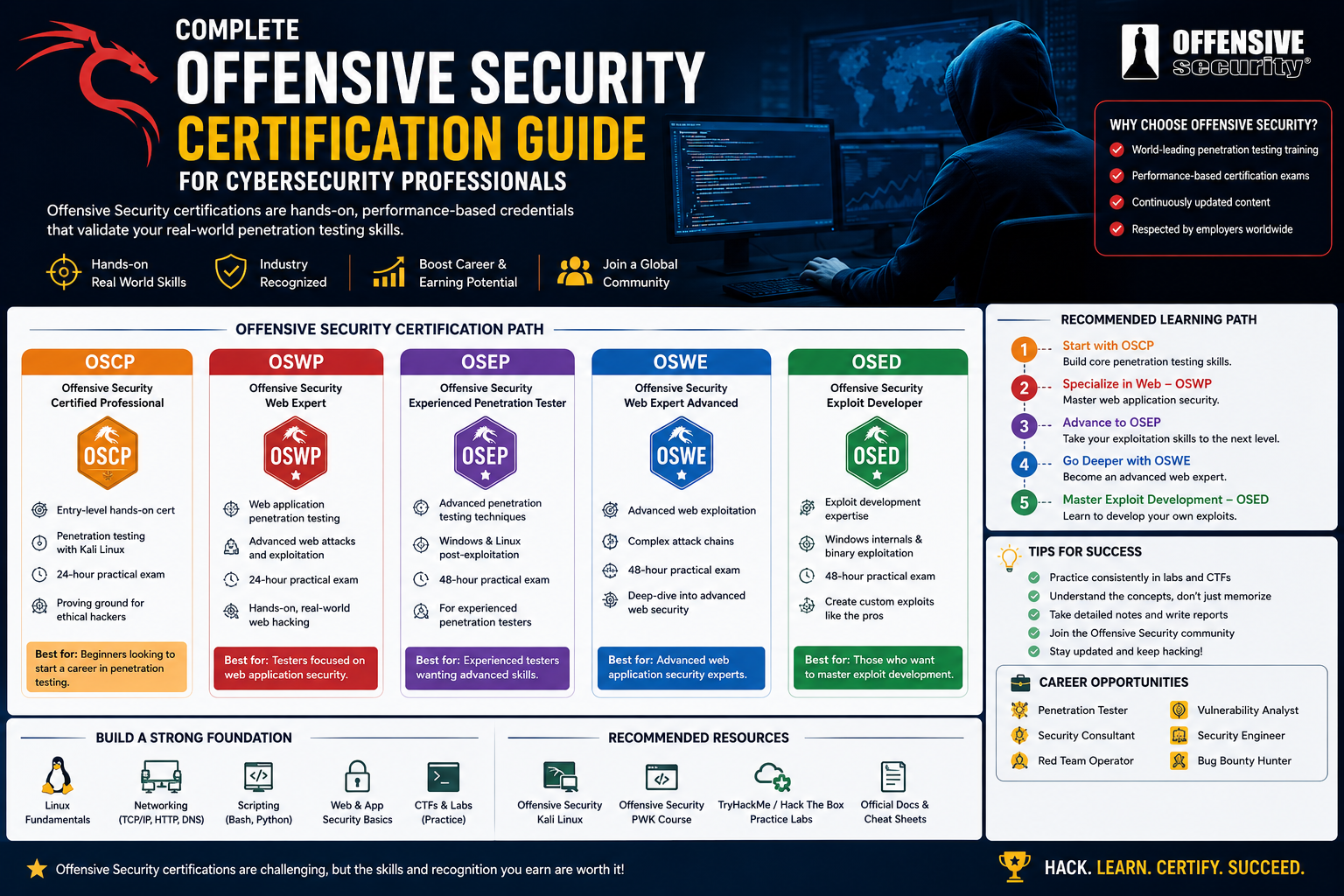
In today’s digital landscape, cybersecurity is no longer an optional layer of protection—it is a critical necessity for organizations of every size. As businesses expand their digital presence, they also expand their exposure to cyber threats. These threats are no longer simple attempts by amateur attackers but highly coordinated, well-funded operations that target weak points in networks, applications, and human behavior.
Offensive security represents a proactive approach to this challenge. Instead of waiting for attackers to exploit vulnerabilities, security professionals simulate real-world attacks to identify and fix weaknesses before they can be exploited. This is where offensive security certification becomes highly relevant.
Unlike traditional theoretical certifications that focus on knowledge recall, offensive security certifications are designed to measure practical ability. They challenge candidates to think like attackers, break into systems ethically, and demonstrate real-world problem-solving skills under pressure. This approach has made offensive security certifications some of the most respected and demanding credentials in the cybersecurity industry.
These certifications are not just academic achievements; they are performance-based validations of technical capability, resilience, and critical thinking under intense conditions.
The Philosophy Behind Offensive Security Certification
Offensive security certifications are built on a fundamental philosophy: real skills cannot be measured through multiple-choice questions alone. Instead, they must be demonstrated in realistic environments where candidates must analyze systems, identify vulnerabilities, and exploit them ethically.
This philosophy changes the entire nature of certification. Instead of memorizing facts, candidates must develop hands-on expertise. They must understand how systems behave under attack, how vulnerabilities emerge, and how different layers of security interact.
At the core of this approach is the belief that cybersecurity professionals must think like attackers to defend effectively. This mindset requires curiosity, persistence, creativity, and the ability to work under pressure.
The certification process is intentionally designed to be challenging. Candidates are placed in controlled environments that simulate real networks, complete with vulnerabilities, defenses, and layered systems. Their task is not simply to find issues but to demonstrate full exploitation pathways and document their findings clearly.
This approach ensures that certified professionals are not just knowledgeable but capable of performing under real-world conditions.
Why Offensive Security Certifications Are Considered Elite
Offensive security certifications have earned a reputation for being among the most difficult credentials in the cybersecurity field. This reputation is not accidental; it is the result of their structure, expectations, and evaluation methods.
One of the primary reasons these certifications are considered elite is the level of endurance required. Exams are not short or symbolic tests. They often span long durations, requiring sustained focus, technical accuracy, and mental resilience. Candidates may need to work continuously for many hours to complete their objectives, simulating the pressure of real penetration testing engagements.
Another reason for their difficulty is the lack of multiple-choice questions. Instead of selecting answers, candidates must actively perform tasks. This includes scanning networks, identifying vulnerabilities, writing or modifying exploit code, and gaining access to systems. Every step must be justified and documented.
Additionally, there is no guessing involved. Either a candidate successfully compromises a system, or they do not. This binary outcome makes the evaluation highly objective but also significantly more demanding.
The certification environment also removes artificial guidance. Candidates are expected to rely on their own skills, research abilities, and problem-solving strategies without external hints. This independence is a key factor in determining real-world readiness.
The Role of Ethical Hacking in Offensive Security
Ethical hacking forms the foundation of offensive security certification programs. Ethical hackers, also known as penetration testers, simulate cyberattacks on systems with permission to identify vulnerabilities before malicious attackers can exploit them.
This process involves multiple stages, including reconnaissance, scanning, exploitation, and post-exploitation analysis. Each stage requires a different set of skills and tools, as well as a strong understanding of networking and system architecture.
Ethical hacking is not about destruction or disruption. It is about controlled testing, responsible disclosure, and improving security posture. Professionals in this field must follow strict ethical guidelines, ensuring that their activities remain legal and authorized at all times.
Offensive security certifications test these abilities in depth. Candidates must demonstrate that they can operate within ethical boundaries while still performing complex attack simulations. This balance between technical aggression and professional responsibility is what defines the discipline.
Understanding the Structure of Offensive Security Exams
Offensive security exams differ significantly from traditional certification tests. Instead of answering questions, candidates are placed in live environments where they must achieve specific objectives.
These objectives typically involve gaining access to multiple systems, escalating privileges, and maintaining control over compromised environments. Candidates must also provide detailed documentation of their methods, including how vulnerabilities were discovered and exploited.
The structure of these exams is intentionally open-ended. There is often more than one way to achieve a goal, and candidates are evaluated on both effectiveness and efficiency.
A defining characteristic of these exams is their duration. Unlike standard exams that last a few hours, offensive security exams can extend far beyond a typical testing window. This extended timeframe is designed to simulate real-world penetration testing scenarios where attackers may spend days probing systems.
The extended duration also tests endurance. Candidates must manage fatigue, maintain focus, and continue problem-solving over long periods without losing accuracy or judgment.
The Importance of Practical, Hands-On Learning
One of the most significant differences between offensive security certifications and other cybersecurity credentials is the emphasis on hands-on learning. Theoretical knowledge alone is not sufficient. Candidates must actively engage with systems, tools, and vulnerabilities.
This approach reflects real-world cybersecurity work. In practice, security professionals are rarely asked theoretical questions. Instead, they are tasked with identifying and resolving actual vulnerabilities in live environments.
Hands-on learning develops critical thinking skills. It forces candidates to adapt to unpredictable situations, troubleshoot issues, and explore multiple approaches to solving a problem.
It also builds confidence. Professionals who have successfully navigated complex environments during certification preparation are better equipped to handle real incidents in professional settings.
The emphasis on practical skills ensures that certified individuals are not just knowledgeable but operationally effective.
Introduction to the Offensive Security Ecosystem
The offensive security ecosystem includes a range of certifications, tools, and methodologies designed to simulate real-world attack scenarios. While each certification focuses on different aspects of cybersecurity, they all share a common foundation in ethical hacking and penetration testing.
The ecosystem is built around realism. Instead of artificial lab exercises with predictable outcomes, candidates are exposed to dynamic environments that require adaptability and critical thinking.
A central element of this ecosystem is the use of specialized tools and operating systems designed for penetration testing. These tools are not only used during certification but also in professional security work.
The ecosystem encourages continuous learning. Cyber threats evolve constantly, and offensive security professionals must keep their skills updated to remain effective.
The Role of Kali Linux in Offensive Security Training
One of the most widely used platforms in offensive security is Kali Linux. It is a specialized operating system designed specifically for penetration testing and security auditing.
Kali Linux includes a wide range of tools that support different phases of ethical hacking. These tools allow professionals to scan networks, analyze vulnerabilities, test wireless security, and simulate attacks.
The system is built on a flexible and customizable foundation, making it suitable for both beginners and advanced users. It provides direct access to powerful utilities without requiring complex setup or configuration.
Familiarity with Kali Linux is essential for offensive security certification candidates. Many exam environments are built with the assumption that candidates can efficiently navigate and utilize their tools.
However, Kali Linux is not inherently complex. Its effectiveness comes from the combination of tools it provides rather than the difficulty of its interface. With practice, users can become proficient in using it as a central part of their cybersecurity workflow.
Why Offensive Security Certification Focuses on Real-World Scenarios
The cybersecurity landscape is constantly evolving. Attackers continuously develop new techniques, and systems grow increasingly complex. In this environment, theoretical knowledge alone is not sufficient.
Offensive security certification focuses on real-world scenarios to ensure that candidates are prepared for actual challenges. Instead of abstract questions, candidates are placed in environments that mimic real networks with real vulnerabilities.
This approach ensures that certified professionals can transition directly into operational roles. They are not just familiar with concepts but capable of applying them in practice.
Real-world scenarios also help bridge the gap between learning and application. Many cybersecurity professionals struggle when transitioning from training environments to live systems. Offensive security certification minimizes this gap by exposing candidates to realistic conditions during evaluation.
The Mental and Physical Demands of Offensive Security Exams
Offensive security exams are not only technically challenging but also mentally and physically demanding. Candidates are required to maintain focus for extended periods, often under high-pressure conditions.
Fatigue can significantly impact performance. As a result, time management and mental endurance become as important as technical knowledge. Candidates must balance exploration, analysis, and execution while maintaining accuracy.
The pressure of limited time, combined with complex problem-solving, creates a unique testing environment. Success requires discipline, patience, and the ability to remain calm under stress.
This combination of technical and psychological challenges is one of the reasons offensive security certifications are so highly respected in the industry.
The Growing Demand for Offensive Security Professionals
As cyber threats continue to increase in scale and sophistication, the demand for skilled offensive security professionals has grown significantly. Organizations across industries are investing heavily in penetration testing and proactive defense strategies.
Offensive security professionals play a critical role in identifying vulnerabilities before they are exploited. Their work helps organizations strengthen defenses, protect sensitive data, and maintain operational continuity.
This growing demand has elevated the value of offensive security certifications. Employers recognize that individuals who have completed these certifications have demonstrated not only technical ability but also resilience and practical problem-solving skills.
The result is a strong career pathway for those who pursue this field, with opportunities across corporate, government, and consulting environments.
Foundations for Advancing into Specialized Security Domains
Offensive security certification also serves as a foundation for more specialized areas of cybersecurity. Once professionals develop core penetration testing skills, they can branch into areas such as web application security, wireless security, exploit development, and advanced system exploitation.
Each of these domains builds on the same foundational principles but requires deeper specialization. The certification ecosystem allows professionals to gradually expand their expertise based on their interests and career goals.
This structured progression ensures continuous development and long-term career growth within the cybersecurity field.
Understanding the Structure of the Offensive Security Certification Path
The offensive security certification ecosystem is not built as a simple linear ladder. Instead, it functions more like a modular system where each certification focuses on a distinct area of cybersecurity expertise. While there is a natural progression in difficulty and specialization, professionals are not strictly required to follow a single fixed route.
This flexible structure reflects the reality of cybersecurity careers. Different professionals specialize in different domains depending on their interests, strengths, and job requirements. Some focus on web applications, others on wireless systems, while some pursue advanced exploit development or system-level vulnerabilities.
Each certification is designed around real-world attack scenarios. Rather than testing memorization, they evaluate how effectively a candidate can analyze systems, identify weaknesses, and execute controlled exploitation techniques.
What makes this structure unique is its emphasis on mastery through practice. Each certification builds on hands-on experience rather than theoretical learning, reinforcing the idea that cybersecurity is a skill-based profession.
Offensive Security Certified Professional (OSCP): The Core Foundation of Penetration Testing
The Offensive Security Certified Professional certification is widely regarded as the foundation of offensive security training. It is often the first major milestone for individuals entering the field of penetration testing.
OSCP focuses on developing core skills required to identify and exploit vulnerabilities in real systems. These skills include network scanning, enumeration, privilege escalation, and exploitation of common weaknesses in operating systems and applications.
A key characteristic of OSCP is its hands-on nature. Candidates are placed in simulated environments that mimic real networks. These environments contain multiple systems with varying levels of security, and the candidate’s task is to compromise them using ethical hacking techniques.
Unlike traditional exams, OSCP does not rely on multiple-choice questions. Instead, candidates must actively demonstrate their ability to break into systems and document their process. This makes the certification highly practical and closely aligned with real-world penetration testing work.
OSCP also emphasizes independent thinking. Candidates are not guided step-by-step through the process. Instead, they must rely on their own research, troubleshooting abilities, and problem-solving skills to achieve objectives.
This independence is a defining feature of the certification. It ensures that individuals who earn OSCP are capable of operating in real security environments without constant supervision.
Another important aspect of OSCP is its focus on persistence. Candidates are often required to spend long hours analyzing systems and testing different approaches. Success depends on patience, creativity, and the ability to adapt strategies when initial attempts fail.
The OSCP Mindset: Thinking Like an Attacker
One of the most important outcomes of OSCP training is the development of an attacker’s mindset. This does not mean engaging in malicious behavior, but rather understanding how attackers think and operate.
Security professionals must learn to anticipate vulnerabilities from an offensive perspective. This involves questioning how systems are designed, how data flows through networks, and where potential weaknesses might exist.
The OSCP mindset encourages curiosity. Instead of accepting systems as secure by default, candidates are trained to assume that vulnerabilities exist and must be discovered through analysis and experimentation.
This shift in thinking is crucial for effective cybersecurity work. Defensive strategies are only as strong as the understanding of offensive techniques used against them.
Offensive Security Certified Expert (OSCE): Advanced Exploitation Techniques
The Offensive Security Certified Expert certification represents a significant step beyond OSCP. It focuses on advanced exploitation techniques and a deeper technical understanding of system vulnerabilities.
While OSCP covers foundational penetration testing skills, OSCE dives into more complex areas such as advanced buffer overflows, exploit development, and bypassing security mechanisms.
Candidates pursuing OSCE are expected to have a strong understanding of programming concepts and system architecture. This includes knowledge of memory management, debugging techniques, and low-level system behavior.
One of the key areas of OSCE is exploit creation. Instead of using existing tools or scripts, candidates are often required to develop their own exploits based on identified vulnerabilities.
This requires not only technical knowledge but also creativity. Each vulnerability may require a different approach, and candidates must be able to adapt their methods accordingly.
OSCE also introduces more sophisticated defensive bypass techniques. Modern operating systems include protections such as address space layout randomization and data execution prevention. Candidates must understand how these protections work and how they can be bypassed in controlled environments.
The certification emphasizes precision and accuracy. Small mistakes in exploit development can lead to failure, making attention to detail a critical skill.
OSCE Skill Development: Precision, Analysis, and Adaptation
OSCE training significantly enhances analytical skills. Candidates must break down complex systems into smaller components to understand how vulnerabilities arise.
This analytical approach is essential in real-world cybersecurity work. Systems are often complex and interconnected, requiring professionals to isolate specific components to identify weaknesses.
Adaptation is another key skill developed through OSCE. Unlike predictable environments, real systems behave dynamically. Candidates must adjust their strategies based on system responses and unexpected behavior.
This ability to adapt under pressure is one of the reasons OSCE-certified professionals are highly valued in the industry.
Offensive Security Web Expert (OSWE): Mastering Web Application Security
The Offensive Security Web Expert certification focuses specifically on web application security. As modern businesses rely heavily on web-based platforms, this area has become increasingly important in cybersecurity.
OSWE is designed to test a candidate’s ability to analyze web application source code, identify vulnerabilities, and develop effective exploitation techniques.
Unlike general penetration testing, OSWE requires a deep understanding of how web applications are built. This includes knowledge of server-side logic, client-side interactions, authentication systems, and database structures.
Candidates are expected to perform source code review, which involves reading and analyzing application code to find security flaws.
This is a highly technical process that requires both programming knowledge and security expertise. Candidates must be able to identify issues such as insecure input handling, authentication bypasses, and logic flaws.
Once vulnerabilities are identified, candidates must develop custom exploits. This requires understanding how web requests are processed and how application logic can be manipulated.
OSWE is particularly challenging because it combines multiple skill sets: programming, security analysis, and exploitation. Success requires a deep understanding of how web systems function internally.
The Complexity of Web Application Attacks
Web applications present unique security challenges because they operate across multiple layers. These include the user interface, application logic, server processing, and database interactions.
Each layer introduces potential vulnerabilities. For example, improper input validation can lead to injection attacks, while flawed authentication systems can allow unauthorized access.
OSWE training helps candidates understand how these layers interact. Instead of viewing applications as single entities, they learn to analyze each component individually.
This layered understanding is essential for identifying complex vulnerabilities that may not be visible through surface-level testing.
Offensive Security Wireless Professional (OSWP): Securing Wireless Networks
Wireless networks present a different type of security challenge compared to wired systems. The Offensive Security Wireless Professional certification focuses on identifying and exploiting vulnerabilities in wireless communication systems.
OSWP covers topics such as wireless encryption, network authentication, and wireless traffic analysis.
Candidates learn how to evaluate the security of wireless networks by analyzing signal behavior, encryption strength, and authentication mechanisms.
Wireless attacks often involve intercepting or manipulating network traffic. OSWP teaches candidates how these attacks work in controlled environments so they can better understand how to defend against them.
One of the key areas of focus is wireless encryption protocols. Candidates study how different encryption standards function and where weaknesses may exist.
They also learn how attackers can exploit weak configurations or outdated security protocols to gain unauthorized access.
Real-World Importance of Wireless Security
Wireless networks are widely used in homes, businesses, and public environments. This makes them a frequent target for attackers.
Unlike wired networks, wireless signals can be intercepted without physical access to the infrastructure. This creates unique security challenges.
OSWP helps professionals understand these risks and develop strategies to mitigate them.
By simulating real wireless attacks, candidates gain insight into how attackers operate in uncontrolled environments.
This knowledge is essential for securing modern networks, especially in environments where wireless connectivity is a primary communication method.
Offensive Security Exploitation Expert (OSEE): Advanced System-Level Exploitation
The Offensive Security Exploitation Expert certification represents one of the highest levels of technical difficulty in the offensive security ecosystem.
OSEE focuses on advanced exploitation techniques, including memory corruption, kernel-level attacks, and deep system manipulation.
Candidates are expected to have an expert-level understanding of operating systems, particularly Windows environments.
One of the key areas of OSEE is exploit development at the system level. This involves understanding how operating systems manage memory, processes, and hardware interactions.
Candidates must also learn how to bypass advanced security mechanisms designed to prevent exploitation.
These include techniques such as address space randomization bypass, kernel exploitation, and custom shellcode development.
OSEE requires a high level of technical precision. Small errors can lead to system instability or failed exploits.
The Depth of System-Level Security Understanding
System-level security is one of the most complex areas in cybersecurity. It involves understanding how operating systems interact with hardware and how vulnerabilities can arise at the lowest levels of computing.
OSEE training requires candidates to study these interactions in detail. They must understand how memory is allocated, how processes are managed, and how system calls function.
This deep technical knowledge allows professionals to identify vulnerabilities that are not visible at higher abstraction levels.
System-level exploitation is often used in advanced cyberattacks, making this knowledge highly valuable for defensive security as well.
Progressive Skill Development Across Certifications
Each offensive security certification builds upon the previous one in terms of complexity and specialization. While OSCP focuses on foundational penetration testing skills, OSCE and OSEE move into advanced exploitation and system-level analysis.
OSWE and OSWP focus on specialized domains such as web applications and wireless networks.
This progression allows professionals to develop a broad and deep understanding of cybersecurity.
Rather than limiting learning to one area, the certification path encourages exploration of multiple attack surfaces and techniques.
This holistic approach ensures that professionals are well-rounded and capable of handling diverse security challenges.
The Real-World Impact of Advanced Offensive Security Skills
Advanced offensive security skills are highly valued in the cybersecurity industry. Organizations rely on skilled professionals to identify vulnerabilities before they can be exploited by attackers.
These skills are used in penetration testing, security auditing, incident response, and security consulting.
Professionals with advanced certifications are often involved in high-level security assessments, where they simulate sophisticated attacks against enterprise systems.
Their work helps organizations strengthen defenses, improve security policies, and reduce risk exposure.
As cyber threats continue to evolve, the demand for advanced offensive security expertise continues to grow across industries.
Building a Realistic Preparation Mindset for Offensive Security Certifications
Preparing for offensive security certifications requires a fundamentally different mindset compared to traditional IT exams. Success is not achieved through memorization or short-term revision strategies. Instead, it depends on sustained practice, experimentation, and deep technical understanding developed over time.
Candidates who perform well typically adopt a hands-on learning approach early in their preparation. They spend significant time working in simulated environments, exploring vulnerabilities, and learning how systems respond under different types of attack scenarios. This type of learning builds intuition, which becomes critical during real exam conditions.
A major challenge during preparation is overcoming the expectation of guidance. In traditional learning environments, step-by-step instructions are common. However, offensive security assessments deliberately remove this structure. Candidates are expected to investigate independently, identify problems without hints, and develop solutions based on their own analysis.
This shift can be difficult at first, especially for individuals accustomed to structured learning paths. However, it is essential for developing a real-world penetration testing capability. Cybersecurity professionals rarely receive clear instructions in operational environments, so independence becomes a core skill.
Another important aspect of preparation is consistency. Sporadic study sessions are not effective for building the depth of understanding required. Instead, steady, repeated exposure to security concepts and practical environments is necessary to build long-term retention and skill fluency.
Developing a Structured Offensive Security Learning Path
Although offensive security certifications are flexible in structure, successful candidates often follow a loosely organized learning progression. This progression typically begins with foundational networking and system knowledge, followed by hands-on security practice, and eventually advanced exploitation techniques.
The foundation includes understanding how networks operate, how operating systems manage processes, and how applications interact with system resources. Without this knowledge, it becomes difficult to interpret vulnerabilities or understand attack chains.
Once foundational knowledge is established, learners move into practical exploration. This involves scanning networks, identifying services, and understanding how systems respond to different types of inputs. At this stage, curiosity plays a significant role. The ability to ask questions about system behavior is more important than memorizing procedures.
As learners advance, they begin focusing on exploitation techniques. This includes privilege escalation, vulnerability chaining, and understanding how small misconfigurations can lead to full system compromise.
Eventually, preparation expands into specialized areas such as web application security, wireless networks, or advanced system exploitation, depending on certification goals.
This structured approach ensures gradual skill development without overwhelming the learner with complexity too early in the process.
The Importance of Hands-On Practice Environments
Hands-on practice environments are central to offensive security preparation. These environments simulate real networks and systems with intentionally placed vulnerabilities. They allow candidates to test their skills in controlled but realistic conditions.
Unlike theoretical exercises, practice environments require active problem-solving. Candidates must identify entry points, analyze system behavior, and determine exploitation strategies without external assistance.
These environments also introduce variability. Each system behaves differently, requiring adaptability and creative thinking. This unpredictability mirrors real-world cybersecurity scenarios where attackers and defenders constantly evolve their techniques.
Repeated exposure to such environments builds familiarity with common vulnerability patterns. Over time, candidates begin to recognize weaknesses more quickly and develop efficient strategies for exploitation.
However, success in these environments does not come from repetition alone. Reflection is equally important. After each exercise, candidates must analyze what worked, what failed, and why certain approaches were effective or ineffective.
This reflective process strengthens understanding and helps build long-term technical intuition.
Time Management and Endurance in Offensive Security Exams
One of the most defining characteristics of offensive security certifications is the extended duration of exams. These assessments often span many hours, requiring sustained concentration and technical performance under pressure.
Time management becomes a critical factor in success. Candidates must decide how long to spend on each system, when to pivot to alternative targets, and how to prioritize tasks effectively.
Poor time allocation can significantly reduce overall performance. Spending too much time on a single challenge can limit progress on other objectives, while rushing can lead to missed opportunities or errors.
Endurance is equally important. Long-duration exams test mental stamina, focus, and resilience. Fatigue can affect decision-making, reduce accuracy, and slow down problem-solving ability.
Successful candidates often develop strategies for maintaining focus over extended periods. These include structured breaks, task prioritization, and maintaining a clear mental roadmap of objectives.
The ability to remain calm under pressure is another key factor. High-stress situations can lead to mistakes, especially when candidates encounter unexpected system behavior or complex vulnerabilities.
Career Opportunities in Offensive Security
Offensive security certifications open pathways into a wide range of cybersecurity roles. These roles are centered around identifying vulnerabilities, simulating attacks, and strengthening organizational defenses.
One of the most common career paths is penetration testing. In this role, professionals simulate cyberattacks on systems to identify weaknesses before malicious actors can exploit them. This involves testing networks, applications, and infrastructure for security flaws.
Another related role is security consulting. Security consultants assess organizational security posture and provide recommendations for improvement. They often work across multiple industries and systems, applying offensive security techniques to evaluate risk.
Security engineering is another pathway. Security engineers design and implement defensive systems based on findings from offensive testing. Their work helps build stronger and more resilient infrastructure.
There are also specialized roles in areas such as application security, where professionals focus on securing software systems, and infrastructure security, where the focus is on protecting networks and server environments.
As organizations increasingly prioritize cybersecurity, demand for professionals with offensive security skills continues to grow across both private and public sectors.
Employer Perspective: Why Offensive Security Certifications Matter
From an employer’s perspective, offensive security certifications provide strong evidence of practical ability. Unlike theoretical certifications, they demonstrate that a candidate can perform real technical tasks under pressure.
Employers value these certifications because they reduce uncertainty during hiring. Candidates who have completed rigorous hands-on assessments are more likely to succeed in real-world roles that require independent problem-solving.
Another important factor is credibility. Offensive security certifications are widely recognized in the cybersecurity industry as indicators of advanced technical capability. This recognition helps employers trust that certified professionals have undergone meaningful evaluation.
Employers also value the discipline required to complete these certifications. The effort involved demonstrates persistence, focus, and commitment—qualities that are essential in cybersecurity roles.
In many cases, certification holders are considered for more advanced roles or higher responsibility positions due to their proven skill level.
Salary Expectations and Career Growth Potential
Offensive security professionals often have strong earning potential due to the specialized nature of their skills. Organizations are willing to invest in individuals who can identify and mitigate complex security risks.
Entry-level professionals with foundational offensive security certifications typically begin in junior penetration testing or security analyst roles. As experience increases, they can progress into senior positions with greater responsibility.
Mid-level professionals often work on more complex systems and may lead security assessments or coordinate testing efforts. At this stage, salaries tend to increase significantly due to the level of expertise required.
Senior professionals may take on leadership roles, security architecture responsibilities, or specialized consulting positions. These roles involve strategic decision-making and advanced technical oversight.
Career growth in this field is strongly tied to continuous learning. As cyber threats evolve, professionals must regularly update their skills to remain effective.
Ethical and Legal Responsibilities in Offensive Security
Ethics play a central role in offensive security. Professionals operate in environments where they simulate attacks, but only within authorized and controlled conditions.
Strict legal boundaries define what actions are permitted. Unauthorized testing or exploitation is illegal and unethical. Certified professionals must always operate with explicit permission and within defined scopes.
Ethical responsibility also extends to data handling. Sensitive information encountered during testing must be protected and reported responsibly.
Another important aspect is responsible disclosure. When vulnerabilities are discovered, they must be reported in a controlled manner so that organizations can address them without exposing themselves to external threats.
This ethical framework ensures that offensive security practices contribute positively to cybersecurity rather than creating additional risks.
Common Challenges Faced During Certification Preparation
Many candidates encounter challenges during preparation that can slow progress or create frustration. One common issue is over-reliance on tools without understanding underlying concepts.
While tools are important, they are not a substitute for knowledge. Candidates who focus solely on tools often struggle when environments change or behave unpredictably.
Another challenge is the difficulty in transitioning from guided learning to independent problem-solving. Many learners are used to structured instructions, making open-ended environments initially overwhelming.
Time management during practice sessions is another frequent challenge. Candidates may spend too much time on a single problem instead of learning when to move on and return later.
Mental fatigue is also a significant factor. Long study sessions and repeated failure in practice environments can lead to burnout if not managed properly.
Overcoming these challenges requires patience, structured practice, and gradual skill development.
The Role of Documentation and Reporting Skills
Technical ability alone is not sufficient in offensive security roles. Professionals must also be able to clearly document their findings.
Reporting is a critical part of penetration testing. After identifying vulnerabilities, professionals must explain their findings in a structured and understandable format.
This includes describing the vulnerability, explaining how it was discovered, detailing the exploitation process, and providing recommendations for remediation.
Good documentation ensures that technical findings can be understood by non-technical stakeholders, including management and development teams.
Clear communication also enhances the value of security assessments. Without proper documentation, even significant vulnerabilities may be misunderstood or overlooked.
Continuous Learning and Evolution in Offensive Security
Cybersecurity is a constantly evolving field. New vulnerabilities, attack techniques, and defensive mechanisms emerge regularly.
Offensive security professionals must engage in continuous learning to remain effective. This includes staying updated on emerging threats, practicing new techniques, and refining existing skills.
Continuous learning also involves adapting to new technologies. As systems evolve, attackers target new layers of infrastructure, requiring updated defensive strategies.
Professionals who fail to keep pace with these changes risk becoming outdated in a rapidly advancing field.
Building Long-Term Expertise in Offensive Security
Long-term success in offensive security is not achieved through certification alone. It requires ongoing practice, experience, and exposure to diverse environments.
Experts in this field develop deep intuition about system behavior. They can quickly identify unusual patterns, recognize vulnerabilities, and anticipate potential attack paths.
This expertise is built over time through repeated exposure to real and simulated environments.
It also involves collaboration with other professionals. Sharing knowledge, discussing techniques, and analyzing real-world incidents contribute to continuous growth.
Ultimately, offensive security expertise is a combination of technical skill, analytical thinking, and practical experience developed over years of consistent effort.
Building Realistic Home Labs for Offensive Security Practice
One of the most effective ways to strengthen offensive security skills outside formal certification environments is by building personal lab environments. These labs are controlled, isolated systems that allow learners to experiment safely with different attack and defense scenarios without risking real-world systems.
A well-structured lab typically includes multiple virtual machines representing different roles, such as a vulnerable server, a client machine, and a monitoring system. This setup allows learners to simulate real network interactions and observe how attacks propagate through systems. The key advantage of this approach is repetition with variation. Each time a system is rebuilt or reconfigured, it presents new behavioral patterns that require fresh analysis.
Unlike static training exercises, personal labs encourage creativity. Learners can intentionally introduce vulnerabilities, test different exploitation techniques, and observe how security configurations impact system behavior. This iterative experimentation builds a deeper understanding than passive learning methods.
Another important aspect of lab development is diversification. Using different operating systems, application types, and network configurations helps simulate the complexity of real organizational environments. This diversity ensures that learners do not become overly dependent on predictable patterns and instead develop adaptable problem-solving skills.
Over time, consistent lab practice helps bridge the gap between theoretical knowledge and professional penetration testing capability. It also builds confidence, as learners become more familiar with unpredictable system behavior.
Psychological Resilience and Decision-Making Under Pressure
Offensive security work requires more than technical ability; it demands strong psychological resilience. During both certification exams and real-world engagements, professionals often encounter situations where progress is slow, unclear, or temporarily blocked.
In these moments, emotional control becomes as important as technical knowledge. Frustration can lead to rushed decisions, overlooked details, or unnecessary mistakes. Successful practitioners learn to manage these reactions and maintain a structured approach to problem-solving.
Decision-making under pressure is another critical skill. Offensive security scenarios often present multiple possible attack paths, and choosing the most effective one requires careful evaluation. This includes assessing risk, potential impact, and likelihood of success.
Developing this ability takes time and repeated exposure to challenging environments. Over time, professionals learn to recognize when to persist with a strategy and when to shift direction.
This mental adaptability is what allows skilled practitioners to operate effectively in high-stakes environments where conditions can change rapidly.
Evolving Toolsets and Adaptation in Offensive Security Work
The tools used in offensive security are constantly evolving as both attackers and defenders develop new techniques. While foundational tools remain widely used, new utilities and frameworks are regularly introduced to address emerging vulnerabilities and system architectures.
Professionals must therefore maintain a flexible approach to tool usage. Relying on a single set of tools can limit effectiveness, especially when encountering unfamiliar environments or updated security controls.
Instead of focusing solely on tools, successful practitioners prioritize understanding underlying principles. This allows them to adapt quickly when tools change or when specific utilities are unavailable in a given environment.
Adaptation also involves understanding when not to use tools. In many cases, manual analysis provides deeper insight than automated scanning, particularly when dealing with complex or layered vulnerabilities.
This balance between automation and manual investigation is a defining characteristic of advanced offensive security practice.
Conclusion
Offensive security certifications represent far more than a formal credential; they reflect a shift toward proving real-world capability in a field where practical skill matters more than theoretical knowledge. Across all levels—from foundational penetration testing to advanced exploit development—these certifications are designed to test how well individuals can think, adapt, and perform under realistic and often high-pressure conditions.
What makes this pathway unique is its emphasis on hands-on problem-solving. Candidates are not evaluated on how much information they can recall, but on how effectively they can apply technical knowledge in dynamic environments. This approach mirrors the actual demands of cybersecurity roles, where professionals must constantly analyze systems, identify weaknesses, and respond to evolving threats.
Equally important is the mindset developed throughout this journey. Offensive security training encourages curiosity, persistence, and structured thinking. It teaches professionals to approach systems from an attacker’s perspective while maintaining ethical boundaries and professional responsibility. These skills extend beyond certification exams and directly influence performance in real security operations.
As organizations continue to face increasingly sophisticated cyber threats, the demand for professionals with offensive security expertise continues to grow. Those who pursue this path position themselves in a field that values depth of skill, practical experience, and continuous learning.
Ultimately, offensive security certification is not just about passing an exam—it is about building the ability to understand, challenge, and strengthen the systems that modern digital life depends on.