The Domain Name System, commonly referred to as DNS, is one of the most fundamental systems that keeps the internet functioning in a usable way for everyday people. While users typically interact with it without noticing, DNS acts as the underlying translator between human-friendly domain names and machine-readable numerical addresses. Every time a website is accessed, an email is sent, or an online service is used, DNS plays a role in directing that request to the correct destination.
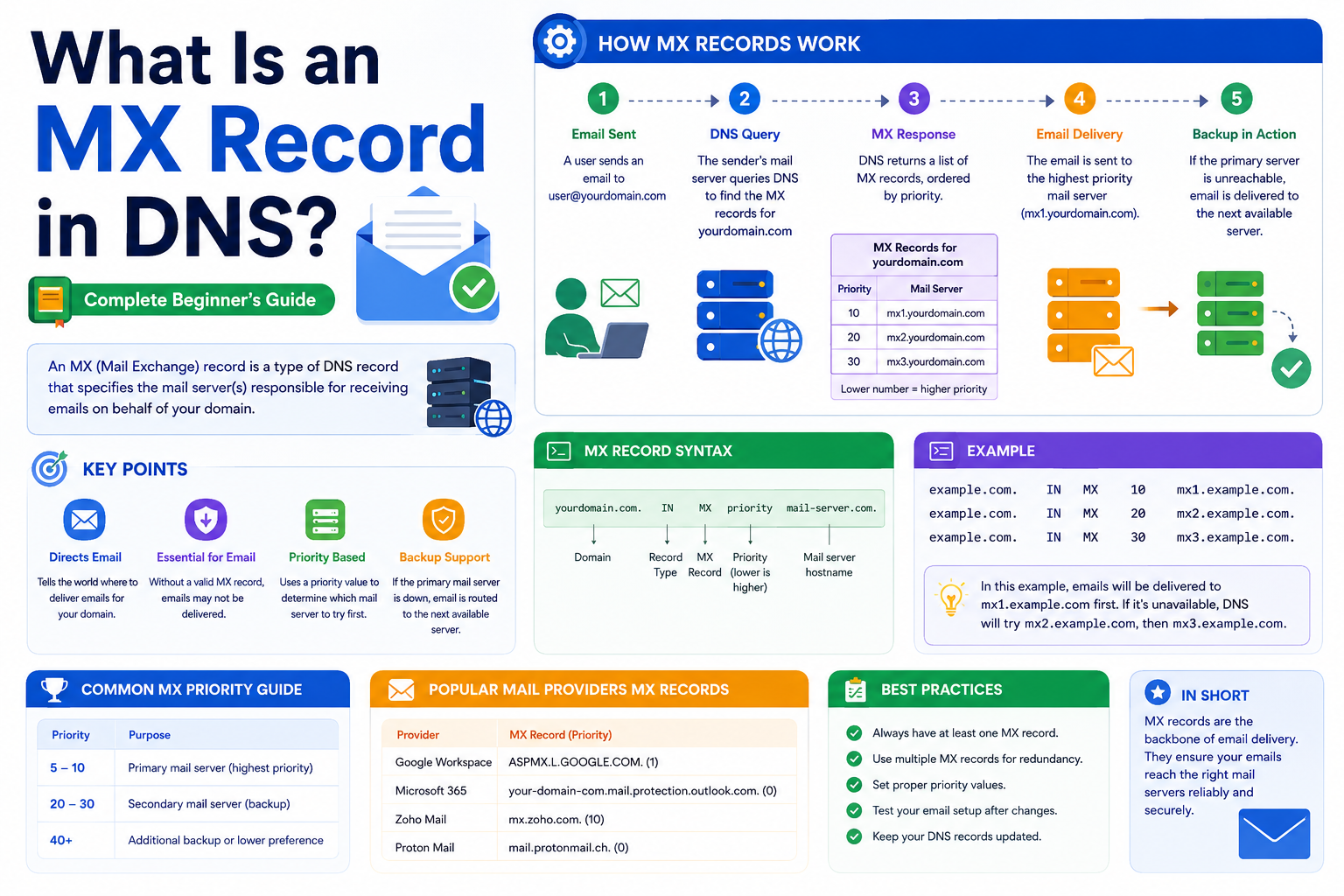
Within this system, different types of DNS records exist, each serving a specific purpose. Among them, MX records are responsible for handling email traffic. MX stands for Mail Exchange, and these records define which mail servers are responsible for receiving email messages on behalf of a domain. Without them, email delivery across domains would not function reliably, as sending systems would have no instructions about where to deliver messages.
To understand MX records properly, it is important to first understand their position within DNS. DNS does not operate as a single database but rather as a distributed hierarchy. This hierarchy includes root servers at the top, followed by top-level domain servers, and then authoritative name servers that contain the actual DNS records for a domain. MX records reside within this final layer, meaning they are stored and controlled by the domain owner or hosting provider.
MX records do not store email messages themselves. Instead, they function like routing instructions. When an email is sent to a domain, the sending mail server queries DNS to retrieve the MX record for that domain. The response tells it which mail server should receive the message. This separation between routing information and actual email storage is what allows email systems to scale globally.
Another important aspect of MX records is that they are specifically designed for email traffic using standard protocols such as SMTP, which is the Simple Mail Transfer Protocol. SMTP is responsible for transferring email between servers, and MX records ensure that SMTP knows where to send those messages. Without MX records, SMTP would not have a destination reference for delivery.
MX records also introduce flexibility into email systems. A single domain can have multiple MX records, allowing multiple mail servers to handle incoming email. This is essential for redundancy, ensuring that if one mail server becomes unavailable, another can take over. This design improves reliability and reduces the chances of missed or delayed emails.
Understanding MX records also requires recognizing that they are only one part of a larger DNS ecosystem. Alongside them are records like A records, which map domains to IP addresses, and CNAME records, which create aliases for domains. Each record type serves a distinct role, but MX records are uniquely focused on email routing.
As organizations rely more heavily on digital communication, MX records become increasingly important. Proper configuration ensures that emails are delivered efficiently and securely, while misconfiguration can lead to lost messages or delivery failures. This makes MX records a critical component of both small personal domains and large enterprise systems.
How Email Moves Across the Internet Using DNS and SMTP
Email delivery is a multi-step process that involves several systems working together behind the scenes. While users typically experience it as simply clicking “send,” the actual journey of an email is more complex. It relies on the interaction between SMTP servers and DNS infrastructure, with MX records acting as a guiding mechanism.
When an email is sent, the sender’s email client first communicates with an outgoing mail server. This server is responsible for initiating the delivery process. Instead of immediately sending the email to the recipient’s device, it must first determine where that email should go. This is where DNS comes into play.
The sending mail server performs a DNS lookup for the recipient’s domain. Specifically, it searches for MX records associated with that domain. The DNS system responds with a list of mail servers that are authorized to receive email for that domain. These servers are typically listed in order of priority.
Once the sending server receives this information, it attempts to establish a connection with the highest priority mail server. If that server is available, the email is transmitted using SMTP. If it is unavailable, the system automatically tries the next server in the list. This process continues until the email is successfully delivered or all options are exhausted.
SMTP plays a central role in this process. It is responsible for the actual transfer of email data between servers. However, SMTP alone does not determine where messages should go. Instead, it relies on DNS and MX records to provide routing instructions. This separation of responsibilities allows email systems to remain flexible and scalable.
After the receiving mail server accepts the message, it performs additional checks. These may include verifying the recipient’s mailbox, checking for spam or malicious content, and applying security policies. Once the message passes these checks, it is stored in the recipient’s mailbox until it is retrieved.
This entire process happens within seconds, even though it involves multiple systems communicating across the internet. DNS queries, server connections, and SMTP transactions all occur rapidly to ensure that email delivery feels instant to the user.
MX records are particularly important in this workflow because they determine the entry point for email traffic into a domain. Without accurate MX records, emails may be sent to incorrect servers or fail to be delivered entirely. This is why they are considered essential for reliable email communication.
The distributed nature of DNS also contributes to the speed and reliability of email delivery. DNS servers are located around the world, reducing the time required for lookups. Additionally, caching mechanisms allow frequently accessed records to be stored temporarily, further improving performance.
Anatomy of an MX Record in DNS Configuration
An MX record is structured in a way that provides clear instructions to email systems about how to handle incoming mail for a domain. While it may appear simple on the surface, each part of an MX record plays a specific role in email routing and delivery behavior.
At its core, an MX record includes two main components: a priority value and a mail server address. The mail server address indicates the destination server that should receive email for the domain. This is usually a hostname rather than a direct IP address, which allows flexibility in server management.
The priority value determines the order in which mail servers should be used. Lower numbers indicate higher priority, meaning servers with lower values are tried first. If multiple servers share the same priority, they may be used in a load-sharing configuration, distributing email traffic across multiple systems.
MX records also work in conjunction with another DNS setting known as TTL, or Time to Live. TTL defines how long a DNS record should be cached before it is refreshed. This helps balance performance and accuracy by reducing the number of DNS queries while ensuring updated information eventually propagates across the system.
A domain can have multiple MX records, which is a common practice for redundancy. In such cases, email servers are listed with different priority values. The primary server handles most traffic, while secondary servers act as backups. If the primary server becomes unavailable, the system automatically switches to the next available server.
The mail server address within an MX record typically points to a fully qualified domain name. This name must resolve to an IP address through an A record or similar DNS record type. This indirect mapping allows administrators to change server IP addresses without modifying MX records directly.
Another important characteristic of MX records is that they cannot point directly to IP addresses. This is a strict rule within DNS design. Instead, they must always reference a hostname. This ensures consistency and compatibility across email systems.
MX records are also sensitive to configuration errors. Even small mistakes, such as incorrect priority values or misspelled server names, can disrupt email delivery. Because of this, they are often carefully managed and tested before being deployed in production environments.
The structure of MX records reflects the broader philosophy of DNS: separation of naming, routing, and service delivery. By isolating email routing into dedicated records, DNS allows email systems to remain independent from website hosting or other services associated with a domain.
MX Record Lookup Process and Email Routing Behavior
When an email is sent across the internet, one of the most critical steps in the delivery process is the MX record lookup. This process determines where the email should be delivered and ensures that it reaches the correct mail server for the recipient’s domain.
The lookup begins when the sending mail server receives a message destined for an external domain. Before attempting delivery, the server queries DNS to retrieve the MX records associated with that domain. This query is handled by a DNS resolver, which communicates with authoritative DNS servers to obtain the required information.
Once the MX records are returned, the sending server evaluates them based on priority. The server with the highest priority is selected first. The system then attempts to establish a connection using SMTP. If successful, the email is transmitted immediately.
If the connection fails, the sending server does not stop the process. Instead, it moves to the next MX record in the list and attempts delivery again. This retry mechanism continues until a successful connection is made or all servers are unreachable.
This behavior ensures that email delivery is resilient. Temporary server outages or network issues do not result in immediate email loss. Instead, the system automatically adapts by selecting alternative delivery paths.
During the lookup process, DNS caching can also play a role. If the MX records for a domain have been recently retrieved, they may be stored temporarily in cache memory. This reduces the need for repeated DNS queries and speeds up the overall delivery process.
The MX lookup process is also influenced by DNS propagation. When changes are made to MX records, it can take time for those changes to spread across all DNS servers globally. During this period, different servers may receive different versions of the MX record information.
Despite these complexities, the process is designed to be seamless from the user’s perspective. Email delivery typically occurs within seconds, even though multiple systems and protocols are involved in the background.
Priority and Failover Behavior in Email Delivery Systems
One of the most important features of MX records is their ability to define priority levels for mail servers. This priority system ensures that email delivery remains stable even when multiple servers are available for a single domain.
Priority values are numerical, and the rule is simple: lower numbers represent higher priority. When a sending mail server performs an MX lookup, it receives a list of servers sorted by these values. The server with the lowest number is always tried first.
This priority system allows administrators to design failover mechanisms. In a typical setup, the primary mail server is assigned the highest priority, while secondary servers are assigned higher numerical values. If the primary server is unavailable, email traffic is automatically redirected to backup servers.
Failover behavior is essential for maintaining email reliability. Without it, any server outage could result in lost or delayed messages. By distributing responsibility across multiple servers, MX records ensure continuous availability.
In some configurations, multiple MX records share the same priority value. In such cases, email traffic may be distributed evenly across those servers. This approach is often used for load balancing, helping prevent any single server from becoming overloaded.
The combination of priority and redundancy creates a flexible system that can adapt to different network conditions. Whether dealing with hardware failures, maintenance downtime, or traffic spikes, MX records help maintain consistent email delivery.
This system also interacts with retry mechanisms in SMTP. If a delivery attempt fails on one server, the sending system will automatically attempt the next available server in the priority list. This layered approach significantly improves reliability.
Relationship Between MX Records and DNS Infrastructure
MX records do not exist in isolation; they are deeply integrated into the broader DNS infrastructure. DNS itself is a hierarchical and distributed system designed to translate domain names into actionable network information.
At the highest level of DNS are root servers, which direct queries to top-level domain servers. These servers then direct requests to authoritative name servers, which contain the actual DNS records for a domain, including MX records.
This hierarchical structure ensures that DNS queries are resolved efficiently and reliably across the global internet. MX records reside at the authoritative level, meaning they are the final source of truth for email routing information.
Because MX records depend on DNS infrastructure, their performance is influenced by DNS resolution speed, caching behavior, and server availability. Efficient DNS design helps ensure that MX record lookups happen quickly, minimizing email delivery delays.
MX records also interact with other DNS record types. For example, the mail server specified in an MX record must resolve through an A or AAAA record to an IP address. This interconnection ensures that email routing is consistent with broader network addressing systems.
The relationship between MX records and DNS infrastructure highlights the importance of proper configuration and maintenance. Any issues within DNS can directly impact email delivery, making DNS reliability critical for communication systems.
As email continues to be a core communication tool across industries, MX records remain a foundational component of internet infrastructure, quietly ensuring that messages reach their intended destinations across complex networks.
Advanced MX Record Behavior in Modern Email Systems
As email infrastructure has evolved, MX records have remained a constant yet increasingly sophisticated component of how messages are delivered across the internet. While their basic purpose—directing email to the correct mail servers—has not changed, the environments in which they operate have become far more complex. Today, MX records must function reliably in cloud-based systems, hybrid infrastructures, and globally distributed networks where availability, redundancy, and security are critical.
Modern email systems are no longer limited to a single server or even a single geographic location. Instead, they often rely on clusters of mail servers spread across multiple data centers. MX records play a crucial role in coordinating how incoming email traffic is distributed across these systems. This ensures that messages are not only delivered but also balanced efficiently across available resources.
In large-scale environments, MX records are often configured to support dynamic routing. This means that email traffic can be shifted between servers based on load conditions, maintenance schedules, or geographic proximity. Although DNS itself does not actively manage traffic, the priority-based structure of MX records enables administrators to design intelligent routing strategies around it.
Another important aspect of modern MX record usage is its integration with highly available infrastructure. Many organizations deploy redundant mail gateways that sit in front of internal mail systems. These gateways are referenced in MX records, ensuring that all incoming email passes through security and filtering layers before reaching internal mailboxes.
This layered architecture is essential for protecting against spam, phishing attempts, and malicious attachments. MX records serve as the entry point for these security systems, making them a critical control point in email defense strategies.
MX Records in Cloud-Based Email Architecture
Cloud computing has significantly changed how email systems are designed and managed. Instead of hosting mail servers on-premises, many organizations now rely on cloud-based email platforms that provide scalable and globally distributed infrastructure. In these environments, MX records remain essential because they determine how external email is routed into cloud systems.
When a domain is configured to use a cloud-based email service, its MX records are typically updated to point to the provider’s mail exchange infrastructure. These infrastructure systems are designed with multiple layers of redundancy, ensuring that email can be received even during outages or high traffic conditions.
One of the key advantages of cloud-based email systems is automatic scaling. As email volume increases, additional resources are allocated dynamically without requiring changes to MX records. However, MX records still serve as the fixed entry point that directs all incoming mail traffic into the cloud environment.
In distributed cloud architectures, MX records may point to geographically distributed mail gateways. This allows incoming email to be routed to the nearest available data center, reducing latency and improving delivery speed. Although DNS itself does not make real-time routing decisions based on user location, multiple MX records with different priorities can simulate this behavior.
Cloud-based systems also simplify failover management. Instead of manually configuring backup mail servers, redundancy is built into the provider’s infrastructure. MX records simply reference a set of highly available endpoints, and the underlying system ensures continuous operation.
Despite this abstraction, understanding MX records remains important even in cloud environments. Misconfigurations at the DNS level can still prevent email delivery entirely, regardless of how robust the backend infrastructure is.
Security Layers Supported by MX Record Configuration
MX records are not just about routing email—they also play a foundational role in email security. Because all inbound email flows through the servers defined in MX records, these entry points become critical enforcement points for security policies.
One of the most important security mechanisms associated with email delivery is authentication. While MX records themselves do not perform authentication, they work alongside protocols that verify the legitimacy of email senders. These include SPF, DKIM, and DMARC, which collectively help prevent email spoofing and impersonation.
SPF, or Sender Policy Framework, allows domain owners to specify which mail servers are authorized to send email on their behalf. When an email arrives, receiving servers compare the sending server against the SPF record. If there is a mismatch, the message may be flagged or rejected.
DKIM, or DomainKeys Identified Mail, adds a cryptographic signature to outgoing emails. This signature is verified by receiving servers to ensure that the message has not been altered during transit. MX records ensure that these signed messages are delivered to the correct validation systems.
DMARC builds on both SPF and DKIM by defining policies for handling unauthenticated email. It allows domain owners to specify whether suspicious emails should be delivered, quarantined, or rejected entirely. MX records ensure that these policies are enforced at the point of entry.
In addition to authentication protocols, MX records are often integrated with spam filtering systems. These systems analyze incoming email traffic before it reaches user mailboxes. Since all email must pass through MX-defined servers, these systems have a centralized point of control.
Advanced security setups may also include rate limiting, intrusion detection, and malware scanning at the MX level. By controlling email at this entry point, organizations can significantly reduce exposure to threats.
DNS Propagation and MX Record Update Behavior
When MX records are changed, the updates do not take effect instantly across the entire internet. Instead, they go through a process known as DNS propagation. This process involves the gradual updating of cached DNS information across multiple servers worldwide.
DNS caching plays a major role in this behavior. To improve performance, DNS resolvers store previously retrieved records for a period defined by the TTL value. During this time, they do not request fresh data from authoritative servers, which means changes to MX records may not be immediately visible everywhere.
Propagation time can vary depending on TTL settings, ISP behavior, and regional caching policies. In some cases, changes may be visible within minutes, while in others, it may take several hours or even longer for full global consistency.
This delayed propagation is particularly important when migrating email systems. If MX records are updated to point to a new mail server, both the old and new systems may receive email during the transition period. Proper planning is required to ensure no messages are lost or misrouted.
To manage propagation effectively, administrators often reduce TTL values before making changes. This ensures that DNS caches expire more quickly, allowing updates to spread faster. However, lowering TTL values can also increase DNS query traffic, so it must be balanced carefully.
MX record propagation is also influenced by the hierarchical nature of DNS. Because queries pass through multiple layers of resolvers, each layer may cache results independently. This creates variability in how quickly updates become visible across different regions.
Understanding propagation behavior is essential for maintaining reliable email delivery during infrastructure changes or migrations.
Email Queueing, Retries, and MX Record Failover Logic
When an email cannot be delivered immediately, it does not simply disappear. Instead, mail servers use queueing systems to store messages temporarily and retry delivery later. MX records play a central role in determining how these retries are handled.
If the primary mail server defined in an MX record is unavailable, the sending server moves to the next available server in the priority list. If all servers are unreachable, the email is placed in a queue and retried at regular intervals.
This retry process can continue for hours or even days, depending on the configuration of the sending mail server. Each retry attempt may involve a new MX record lookup to check for updated routing information.
Failover logic built into MX records ensures that temporary outages do not result in immediate email loss. Instead, the system gradually works through available delivery options while maintaining message integrity.
If delivery ultimately fails after repeated attempts, the sender typically receives a bounce notification. This message indicates that the email could not be delivered and may include diagnostic information explaining the reason for failure.
Queueing systems also help manage traffic spikes. During periods of high email volume, messages may be temporarily delayed, but are still processed in order. MX records ensure that these queued messages are directed to the correct destination once capacity becomes available.
This combination of queueing, retries, and MX-based routing creates a resilient email delivery system capable of handling both temporary disruptions and long-term infrastructure changes.
Multi-Region Email Infrastructure and MX Record Distribution
Global organizations often operate email systems across multiple geographic regions. In such environments, MX records are configured to support a distributed infrastructure that spans continents.
Multi-region email systems rely on geographically diverse mail servers to reduce latency and improve reliability. MX records may include multiple entries that correspond to different regions, allowing email traffic to be distributed based on availability and priority.
Although DNS does not inherently support real-time geographic routing, administrators can simulate regional behavior using carefully designed MX priority structures. For example, servers in one region may be assigned higher priority for nearby domains, while secondary regions serve as backups.
This approach improves resilience by ensuring that email can still be delivered even if an entire region becomes unavailable. It also enhances performance by reducing the distance between sending and receiving servers.
In advanced setups, MX records may be combined with intelligent load balancing systems that operate at higher network layers. These systems dynamically route email traffic based on real-time conditions, while MX records provide the foundational routing structure.
Multi-region architectures also introduce additional complexity in synchronization. Mail queues, user data, and authentication systems must remain consistent across all regions to ensure seamless email delivery.
Despite this complexity, MX records remain the primary entry point for all incoming email traffic, making them a critical component of global email infrastructure design.
Interaction Between MX Records and SMTP Session Handling
SMTP session handling is a key part of how email is transmitted between servers. When a sending mail server connects to a receiving server identified by an MX record, it initiates an SMTP session that governs the entire delivery process.
This session begins with a handshake, during which both servers exchange identification information. Once the connection is established, the sending server transmits the email content, including headers and message body.
MX records determine which server the SMTP session connects to, but the session itself manages the actual data transfer. If the session fails at any point, the sending server may attempt to reconnect or switch to another MX record.
SMTP sessions are also responsible for handling delivery errors. If a receiving server rejects a message, it may provide a reason code that is used to generate bounce notifications.
The interaction between MX records and SMTP sessions ensures that email delivery is both structured and flexible. MX records provide routing guidance, while SMTP handles execution.
In high-volume systems, multiple SMTP sessions may be active simultaneously across different MX targets. This allows email systems to process large amounts of traffic efficiently.
Session reuse and persistent connections further optimize performance by reducing the overhead associated with establishing new connections for each email.
Reliability Engineering and MX Record Optimization Strategies
Ensuring reliable email delivery requires careful planning of MX record configurations. Reliability engineering focuses on designing systems that remain operational even under adverse conditions, and MX records are a key part of this design.
One common strategy is redundancy through multiple MX entries. By defining multiple mail servers with different priorities, organizations ensure that email delivery continues even if one server fails.
Another strategy involves the geographic distribution of mail servers. By placing servers in different locations, organizations reduce the risk of localized outages affecting email delivery.
Load balancing is also an important consideration. While MX records do not directly distribute traffic evenly, assigning equal priority values allows sending servers to distribute email across multiple destinations.
Monitoring and logging systems are often integrated with MX record infrastructure to detect issues early. These systems track delivery success rates, latency, and error patterns to identify potential problems.
Regular testing of MX configurations is also essential. This includes verifying failover behavior, checking DNS resolution accuracy, and simulating server outages to ensure redundancy systems function correctly.
Over time, MX record optimization becomes part of a broader email reliability strategy that includes infrastructure scaling, security enforcement, and performance tuning.
DNS Layer Dependencies and MX Record Stability Considerations
MX records depend heavily on the stability of the DNS infrastructure. Any disruptions in DNS resolution can directly impact email delivery, even if mail servers themselves are functioning correctly.
One of the key dependencies is resolver performance. DNS resolvers must be able to quickly and accurately retrieve MX records from authoritative servers. If resolvers are slow or misconfigured, email delivery may be delayed.
Another dependency is caching behavior. While caching improves performance, it can also introduce inconsistencies if outdated MX records remain stored in resolver memory.
Authoritative DNS server availability is also critical. If these servers are unreachable, new MX record queries cannot be resolved, potentially affecting email routing.
Security at the DNS layer is another important factor. DNS spoofing or cache poisoning attacks can redirect email traffic to unauthorized servers. This makes DNS security an essential part of MX record integrity.
To mitigate these risks, modern DNS systems often implement redundancy, encryption, and validation mechanisms. These protections help ensure that MX records remain accurate and trustworthy.
MX record stability ultimately depends on the reliability of the entire DNS ecosystem, making it a shared responsibility across multiple infrastructure layers.
MX Record Troubleshooting in Real-World Scenarios
Even though MX records are conceptually simple, issues with email delivery are often traced back to incorrect or incomplete MX configurations. Troubleshooting these problems requires understanding how DNS, mail servers, and routing behavior interact in real environments.
One of the most common issues is missing or improperly configured MX records. If a domain does not have any MX records defined, sending mail servers have no instructions for delivery. In such cases, some systems attempt fallback delivery using A records, but this behavior is not guaranteed and often results in failed or delayed email delivery.
Another frequent issue is incorrect priority settings. When multiple MX records exist, their priority values determine the order in which mail servers are contacted. If these values are misconfigured—such as assigning a higher priority number to the primary server—email may be routed inefficiently or sent to backup systems unnecessarily.
Typographical errors in mail server hostnames are also a major cause of failures. Since MX records rely on domain names rather than IP addresses, even a small spelling mistake can break the resolution chain. When the hostname cannot be resolved to an IP address, the email delivery attempt fails immediately.
DNS caching can also create confusion during troubleshooting. Because MX records are cached across multiple resolvers, changes may not appear instantly. This leads to situations where some users can send or receive emails successfully while others experience failures, depending on which cached version their resolver is using.
Another subtle issue involves incorrect TTL settings. If TTL values are set too high, outdated MX information may persist longer than expected. On the other hand, if TTL values are too low, DNS servers may be overloaded with frequent queries, increasing latency.
Diagnosing MX-related issues typically involves verifying DNS resolution at multiple points. Administrators often check whether the correct MX records are visible from different networks and whether mail servers are reachable using SMTP connections.
In some cases, email delivery issues are not caused by MX records themselves but by downstream systems. For example, a correctly configured MX record may successfully route email to a mail server, but that server may reject messages due to spam filtering, authentication failures, or mailbox configuration errors.
Understanding the full delivery path is essential for accurate troubleshooting. MX records are only the entry point, not the entire email system.
MX Records in Email Migration and System Transition
Migrating email systems is one of the most sensitive operations involving MX records. Whether moving from an on-premises server to a cloud provider or switching between hosting platforms, MX records must be carefully updated to avoid disruption.
The migration process typically begins by setting up the new mail infrastructure while keeping the existing system active. During this phase, both systems may operate in parallel to ensure continuity.
Before changing MX records, administrators often reduce TTL values to speed up DNS propagation. This allows updates to spread more quickly once the migration begins, minimizing the period of inconsistency between old and new systems.
Once MX records are updated, incoming email begins flowing to the new mail servers. However, due to DNS caching, some messages may still be delivered to the old system during the transition period. This overlap is expected and must be accounted for in migration planning.
To prevent email loss, both systems are usually configured to synchronize or forward messages during the transition phase. This ensures that no emails are stranded in the old environment.
Testing is a critical part of migration. Before fully switching MX records, administrators often perform controlled tests to verify that the new mail system can correctly receive and process incoming messages.
After migration, monitoring continues to ensure that email delivery is stable. Logs are analyzed for bounce rates, latency, and routing inconsistencies. Only after stability is confirmed are legacy systems fully decommissioned.
MX record migration is not simply a DNS change—it is a coordinated system transition involving multiple layers of infrastructure, authentication, and data integrity.
Performance Optimization Through MX Record Design
Although MX records do not directly control email processing speed, their configuration has a significant impact on overall email performance. Efficient design can reduce latency, improve reliability, and enhance user experience.
One important optimization strategy is geographic alignment. By positioning mail servers closer to users or sending regions, organizations can reduce the physical distance that email data must travel. While DNS itself does not route based on geography, multiple MX entries can approximate this behavior.
Another performance consideration is load distribution. When multiple mail servers share the same priority level, incoming email traffic can be spread across them. This prevents overload on a single server and ensures more consistent processing speeds.
Redundancy also contributes indirectly to performance. When backup servers are available, failed delivery attempts are minimized, reducing delays caused by retries or queue buildup.
Efficient DNS resolution is another factor. Fast and reliable DNS infrastructure ensures that MX lookups are completed quickly, allowing SMTP sessions to begin without delay. Poor DNS performance can introduce noticeable lag in email delivery.
Caching strategies also play a role. While caching improves speed, it must be balanced against the need for up-to-date MX information. Proper TTL configuration ensures that cached data remains useful without becoming outdated.
In high-performance environments, MX records are often part of a broader optimization strategy that includes server tuning, network optimization, and intelligent routing systems operating above the DNS layer.
Security Risks and MX Record Exploitation Scenarios
Because MX records define the entry point for email delivery, they can become targets for malicious activity if not properly secured. One of the primary risks is DNS spoofing, where attackers attempt to manipulate DNS responses to redirect email traffic.
If an attacker successfully alters MX records or poisons DNS caches, they could redirect incoming emails to unauthorized servers. This can lead to data interception, phishing attacks, or complete disruption of email services.
Another risk involves unauthorized changes to DNS configurations. If access to DNS management systems is not properly secured, attackers or unauthorized users could modify MX records directly, causing widespread email failures.
Phishing campaigns often exploit weak email authentication combined with misconfigured MX records. If email servers are not properly secured with SPF, DKIM, and DMARC, malicious messages may pass through MX entry points undetected.
Distributed denial-of-service (DDoS) attacks can also target mail servers referenced in MX records. By overwhelming these servers with traffic, attackers can disrupt email delivery for entire domains.
To mitigate these risks, organizations implement strict access controls for DNS management systems. Multi-factor authentication, role-based access, and audit logging are commonly used to protect MX configurations.
DNSSEC (Domain Name System Security Extensions) is another important protection mechanism. It adds cryptographic validation to DNS responses, ensuring that MX records cannot be tampered with during transmission.
Security monitoring systems continuously analyze email traffic patterns to detect anomalies that may indicate MX-related attacks. Sudden changes in routing behavior or unexpected spikes in traffic can signal potential compromise.
MX record security is therefore not just a DNS concern but part of a broader cybersecurity strategy that spans infrastructure, authentication, and network monitoring.
Future Trends in MX Record Usage and Email Infrastructure Evolution
While MX records have remained largely unchanged in structure for decades, the systems around them continue to evolve rapidly. The future of MX records is closely tied to advancements in cloud computing, automation, and security.
One emerging trend is increased automation in DNS management. Instead of manually configuring MX records, systems are beginning to dynamically adjust routing based on real-time conditions such as server load, latency, and availability.
Another trend is deeper integration with cloud-native email platforms. As organizations move entirely to cloud-based infrastructure, MX records increasingly serve as simple pointers into highly abstracted systems where routing decisions are handled internally by providers.
Artificial intelligence and machine learning are also beginning to influence email infrastructure. Predictive systems can anticipate traffic patterns and optimize routing strategies, indirectly affecting how MX-based systems are utilized.
Security is expected to become even more tightly integrated with MX infrastructure. Enhanced authentication mechanisms and real-time threat detection will further strengthen the role of MX entry points in defending against malicious email traffic.
Despite these advancements, the fundamental role of MX records is unlikely to change. They will continue to serve as the primary DNS mechanism for directing email to the correct mail servers, acting as a stable foundation for an increasingly complex communication ecosystem.
Conclusion
MX records remain one of the most essential building blocks of email communication on the internet. Although they operate quietly in the background, they play a decisive role in ensuring that every email sent across domains reaches the correct destination. By acting as routing instructions within DNS, MX records guide mail servers toward the appropriate receiving systems using a structured and reliable priority-based mechanism.
Their importance becomes even more evident when considering how complex modern email systems have become. Today’s environments involve cloud platforms, distributed server networks, layered security systems, and global traffic routing. Despite this complexity, MX records continue to provide a simple and stable reference point that ties all these systems together. Without them, email delivery would lack direction, consistency, and reliability.
MX records also contribute significantly to resilience and fault tolerance. Through multiple record configurations and priority settings, they allow email systems to recover automatically from server failures and maintain uninterrupted communication. This built-in redundancy ensures that messages are not lost even when infrastructure issues arise.
At the same time, MX records work closely with other DNS components and email protocols, including SMTP, SPF, DKIM, and DMARC, to support secure and authenticated communication. This interconnected structure helps protect users from spam, spoofing, and other malicious activities while maintaining efficient message delivery.
As digital communication continues to expand, the role of MX records remains foundational. While technologies around them will evolve, their core function—directing email traffic reliably and securely—will continue to be a critical part of the internet’s infrastructure for years to come.