In today’s highly connected digital world, protecting networks from unauthorized access and malicious activity has become a fundamental requirement for organizations of all sizes. Cyber threats are no longer limited to external attackers attempting to break through firewalls from the internet. Internal threats, misconfigured systems, and compromised devices within the network can also pose serious risks. This evolving threat landscape has led to the development of specialized security technologies designed to detect and prevent malicious activity in real time or near real time.
Two of the most widely used security mechanisms in this area are the Intrusion Detection System (IDS) and the Intrusion Prevention System (IPS). While both are designed to identify malicious behavior in network traffic, they operate in fundamentally different ways. Understanding how they function, where they sit in the network, and what level of control they provide is essential for designing effective security strategies.
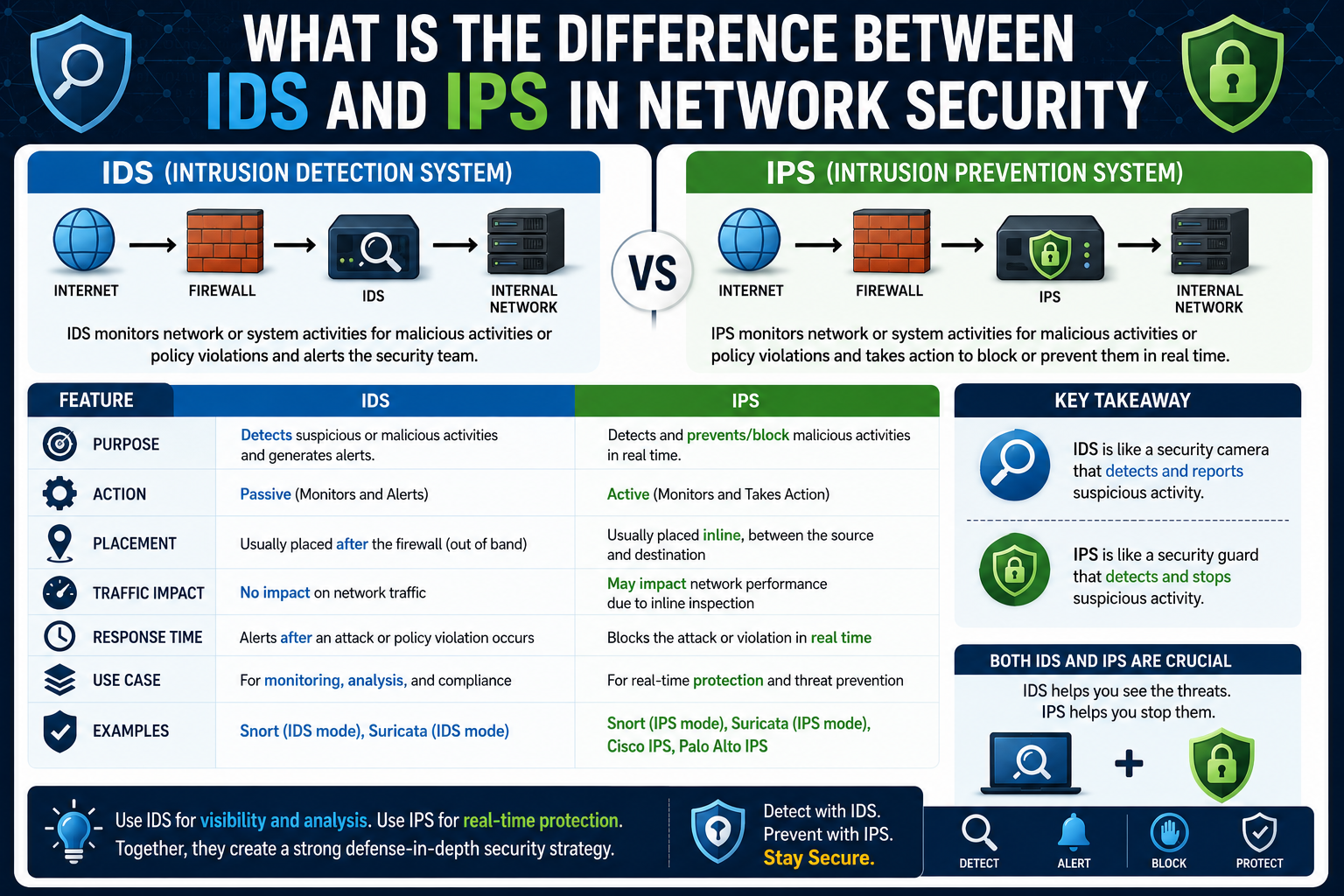
At a high level, IDS focuses on monitoring and alerting, while IPS focuses on actively blocking or preventing threats. However, the distinction goes much deeper than this simple comparison. Their placement in the network architecture, their processing methods, and their response capabilities all define how they contribute to overall cybersecurity defense.
Understanding Intrusion Detection Systems (IDS)
An Intrusion Detection System is designed primarily as a monitoring and analysis tool. Its main purpose is to observe network traffic or system activity and identify suspicious patterns that may indicate malicious behavior. Unlike active enforcement systems, an IDS does not intervene directly in traffic flow. Instead, it serves as a security observer that generates alerts when potential threats are detected.
One of the defining characteristics of an IDS is that it operates outside the direct flow of network traffic. It receives copies of data rather than handling the actual data stream itself. This positioning allows it to analyze traffic without affecting network performance or introducing latency. However, it also means that it cannot stop or block malicious packets in real time.
When suspicious activity is detected, the IDS generates alerts or logs that can be reviewed by security administrators. These alerts may include information about the type of attack, the source and destination of the traffic, and the nature of the anomaly detected. Security teams then use this information to take manual or automated action depending on the severity of the threat.
IDS solutions are commonly used in environments where visibility is more important than immediate intervention. They help organizations understand what is happening across their networks, detect early signs of compromise, and gather forensic evidence after an incident occurs.
How IDS Works in a Network Environment
To understand how an IDS operates, it is important to visualize how network traffic flows in a typical environment. In most configurations, network devices such as switches and routers handle the actual forwarding of data between devices. An IDS is placed in a way that allows it to receive a mirrored copy of this traffic without interfering with the original flow.
This process is often achieved through techniques such as port mirroring or network tapping. The IDS receives duplicated traffic streams and analyzes them using a set of predefined rules, known attack signatures, or behavioral patterns.
Because it is not directly in the path of communication, the IDS cannot modify, delay, or block packets. It simply inspects them and evaluates whether they match known malicious patterns or deviate from normal network behavior.
This architecture provides a significant advantage in terms of network performance. Since the IDS is not handling live traffic, it does not introduce bottlenecks or latency. However, it also limits the system’s ability to respond immediately to threats.
The effectiveness of an IDS depends heavily on the quality of its detection mechanisms. Signature-based detection relies on known patterns of malicious activity, while anomaly-based detection identifies unusual behavior compared to established baselines of normal network activity.
Types of Intrusion Detection Systems
Intrusion Detection Systems can generally be categorized based on where they are deployed and what type of data they analyze.
A Network-Based Intrusion Detection System focuses on monitoring traffic moving across the entire network. It is typically placed at strategic points within the infrastructure, such as near gateways or core switches, where it can observe large volumes of traffic. This type of IDS is effective at detecting widespread attacks, scanning attempts, and unusual traffic patterns affecting multiple devices.
A Host-Based Intrusion Detection System operates directly on individual devices or endpoints. Instead of analyzing network traffic alone, it examines system logs, file changes, application behavior, and operating system activity. This makes it particularly useful for detecting attacks that originate internally or bypass network-level monitoring.
Each type provides a different perspective on security events. Network-based systems offer broad visibility across the infrastructure, while host-based systems provide deep insight into specific device behavior.
Understanding Intrusion Prevention Systems (IPS)
An Intrusion Prevention System takes the concept of intrusion detection a step further by actively participating in network traffic flow. Unlike IDS, an IPS is placed directly in line with the communication path between devices. This means all traffic must pass through it before reaching its destination.
Because of this inline placement, the IPS is able not only to detect malicious activity but also to take immediate action against it. If a packet or stream of data is identified as harmful, the IPS can block it, drop it, or modify its behavior before it reaches its target.
This proactive capability makes IPS a more aggressive security solution compared to IDS. It is designed not just to observe threats but to prevent them from impacting the network.
However, this inline position also introduces additional responsibility. Since all traffic flows through the IPS, it must process data in real time without causing delays or disrupting legitimate communication. This requires careful optimization and high-performance hardware or software configurations.
How IPS Works in Real-Time Traffic Flow
The operation of an IPS is closely tied to its placement within the network path. When data packets are transmitted between devices, they must pass through the IPS before continuing to their destination. This allows the system to inspect every packet in real time.
As traffic flows through the IPS, it is analyzed using similar detection techniques as IDS, including signature matching and anomaly detection. However, the key difference lies in the response capability.
If a packet is identified as malicious, the IPS can take immediate action. This may include dropping the packet entirely, blocking the source IP address, or resetting the connection. In some cases, it may also modify traffic or apply rate limiting to reduce the impact of suspicious behavior.
Because it operates in real time, the IPS must balance security enforcement with performance efficiency. Any delay introduced by inspection must be minimal to avoid affecting user experience or application responsiveness.
IDS vs IPS Architecture Differences
The most fundamental difference between IDS and IPS lies in their architectural placement within the network.
An IDS is deployed out-of-band, meaning it does not sit directly in the traffic flow. It receives copies of data and analyzes them independently. This separation ensures that network performance is not affected, but it also limits the system to passive monitoring.
An IPS, on the other hand, is deployed in-band or inline. All traffic must pass through it, making it an active participant in network communication. This positioning allows it to block threats instantly, but also introduces the risk that any failure or misconfiguration could disrupt network connectivity.
This architectural difference also influences how each system is used. IDS is often deployed for monitoring, analysis, and alerting purposes, while IPS is used for enforcement and active threat prevention.
Role of IDS and IPS in Internal and External Threat Protection
Modern cybersecurity strategies must account for both external attackers and internal threats. External threats typically originate from the internet, where attackers attempt to exploit vulnerabilities in exposed systems. Internal threats, however, originate within the network itself, either through compromised devices or malicious insiders.
IDS and IPS systems are designed to handle both scenarios. An IDS can detect unusual traffic patterns between internal devices, helping identify lateral movement by attackers who have already gained access. Similarly, an IPS can block suspicious internal traffic before it spreads across the network.
For example, if a compromised device begins scanning other systems within the network, an IDS can detect the scanning behavior and alert administrators. An IPS can go further by actively blocking the scanning activity in real time, preventing further propagation.
This dual capability makes both systems essential for comprehensive security coverage. Organizations often use them together to achieve both visibility and enforcement.
Deployment Considerations in Network Security Design
Implementing IDS and IPS solutions requires careful planning based on network architecture, performance requirements, and security goals.
In environments where performance is critical and downtime is unacceptable, IDS may be preferred due to its non-intrusive nature. It provides visibility without affecting traffic flow, making it suitable for monitoring large-scale or sensitive systems.
In contrast, IPS is often deployed in environments where active threat prevention is required. This includes perimeter defenses, data centers, and high-risk network segments where immediate blocking of malicious activity is essential.
Some modern security architectures integrate both IDS and IPS functionalities within the same system or platform. This hybrid approach allows organizations to benefit from both passive detection and active prevention capabilities.
The placement of these systems within the network is also a key factor. Strategic positioning near entry and exit points of network traffic ensures maximum visibility and control over data flows.
In large-scale environments, multiple IDS and IPS devices may be deployed across different network segments to provide layered security coverage.
How Modern IDS and IPS Systems Analyze Network Traffic
Beyond their placement in a network, the real intelligence of IDS and IPS systems lies in how they analyze traffic. These tools are not simply watching packets pass by; they are applying structured logic, pattern recognition, and behavioral modeling to determine whether activity is safe or malicious.
At the core of both technologies is packet inspection. Every piece of data traveling across a network is broken into packets, and each packet contains headers and payload information. The headers provide metadata such as source IP address, destination IP address, protocol type, and port numbers, while the payload contains the actual data being transmitted.
IDS and IPS solutions inspect both layers depending on the configuration. Header analysis helps identify suspicious communication patterns, while payload inspection reveals malicious content such as exploit code, command injection attempts, or unauthorized data transfers.
However, the depth of inspection varies based on system capabilities. Basic implementations may only inspect packet headers, while advanced systems perform deep packet inspection (DPI), allowing them to analyze full application-level content.
This deeper inspection is essential for detecting modern threats, especially those that attempt to disguise themselves within legitimate traffic.
Signature-Based Detection and Its Role in Security Accuracy
One of the most widely used detection techniques in both IDS and IPS systems is signature-based detection. This method relies on a database of known attack patterns, often referred to as signatures.
A signature is essentially a fingerprint of malicious activity. It could represent a specific sequence of bytes in a packet, a known exploit pattern, or a recognizable behavior associated with malware or intrusion attempts.
When network traffic passes through an IDS or IPS, it is compared against this database. If a match is found, the system identifies the traffic as malicious and triggers an alert or response action.
Signature-based detection is highly effective against known threats. It provides fast and accurate identification of attacks that have already been documented and analyzed. However, its effectiveness is limited when dealing with new or unknown threats.
Because it depends on predefined patterns, signature-based systems cannot detect zero-day attacks that do not yet have a known signature. This creates a gap in protection that must be addressed through additional detection techniques.
Behavioral and Anomaly-Based Detection in Depth
To overcome the limitations of signature-based detection, IDS and IPS systems often incorporate behavioral or anomaly-based detection mechanisms. Instead of relying on known attack patterns, this method focuses on identifying deviations from normal network behavior.
The system first establishes a baseline of typical activity within the network. This baseline may include average bandwidth usage, normal connection rates, typical protocol usage, and standard communication patterns between devices.
Once this baseline is established, the system continuously compares ongoing traffic against it. Any significant deviation from expected behavior may be flagged as suspicious.
For example, if a device that normally sends a small amount of data suddenly begins transmitting large volumes of encrypted traffic to an unknown external server, this could be identified as anomalous behavior.
Unlike signature-based detection, anomaly detection can identify previously unknown threats. However, it also introduces challenges such as false positives, where legitimate behavior is mistakenly flagged as malicious due to unusual but harmless activity.
The Challenge of False Positives and False Negatives
One of the most important operational challenges in IDS and IPS deployment is balancing detection accuracy. Two key issues arise in this context: false positives and false negatives.
A false positive occurs when legitimate traffic is incorrectly identified as malicious. This can lead to unnecessary alerts, system disruptions, or even blocked traffic in the case of IPS systems. High false positive rates can overwhelm security teams and reduce trust in the system.
A false negative, on the other hand, occurs when malicious activity is not detected. This is often more dangerous because it allows attacks to proceed unnoticed within the network.
Tuning IDS and IPS systems is therefore a critical task. Security administrators must carefully adjust detection thresholds, refine rule sets, and continuously update signature databases to maintain an optimal balance between security sensitivity and operational stability.
In real-world environments, this tuning process is ongoing rather than static. As network behavior evolves, detection rules must be adjusted accordingly.
Performance Impact of Intrusion Prevention Systems
Unlike IDS systems, which operate outside the main traffic flow, IPS systems directly handle live network traffic. This introduces performance considerations that must be carefully managed.
Because every packet passes through the IPS, the system must process data at wire speed to avoid introducing latency. Any delay in processing can affect application performance, especially in high-throughput environments such as data centers or enterprise networks.
To handle this workload, IPS solutions rely on optimized hardware architectures, parallel processing, and hardware acceleration technologies. Some systems use specialized processors designed specifically for packet inspection and security analysis.
Despite these optimizations, performance limitations still exist. High traffic volumes, complex inspection rules, and deep packet analysis can all contribute to processing delays.
In contrast, IDS systems do not face the same performance constraints because they analyze mirrored traffic. This allows them to handle large volumes of data without directly impacting network speed.
However, this advantage comes at the cost of real-time response capability.
Inline Security Risks and IPS Failure Considerations
Because IPS systems sit directly in the communication path, they introduce a potential single point of failure. If the IPS malfunctions, becomes overloaded, or is misconfigured, it can disrupt or completely block network traffic.
To mitigate this risk, many IPS deployments include fail-open or fail-close configurations.
In a fail-open configuration, traffic continues to flow even if the IPS fails. This ensures network availability but reduces security during failure conditions.
In a fail-close configuration, traffic is blocked if the IPS fails. This maximizes security but can cause network outages if the system experiences problems.
Choosing between these modes depends on organizational priorities. Environments that prioritize uptime may prefer fail-open, while high-security environments may prefer fail-close.
This tradeoff highlights one of the fundamental challenges of IPS deployment: balancing security enforcement with operational continuity.
Evasion Techniques Used Against IDS and IPS Systems
Attackers are constantly developing techniques to bypass intrusion detection and prevention systems. Understanding these evasion methods is critical for strengthening defensive strategies.
One common technique is packet fragmentation. By breaking malicious payloads into smaller fragments, attackers attempt to evade signature detection systems that may only analyze individual packets rather than reassembled traffic.
Another method involves encryption. When traffic is encrypted, IDS and IPS systems may have limited visibility into payload content unless they perform SSL/TLS inspection. This can allow malicious data to pass through undetected.
Polymorphic malware is another challenge. This type of malware changes its signature or structure each time it spreads, making signature-based detection less effective.
Attackers may also use low-and-slow techniques, where malicious activity is spread out over time to avoid triggering anomaly-based detection thresholds.
To counter these techniques, modern IDS and IPS systems incorporate advanced correlation engines, behavioral analytics, and machine learning-based detection models.
Encrypted Traffic and Visibility Challenges in Modern Networks
Encryption has become a standard in modern network communication. While it significantly improves privacy and data protection, it also creates visibility challenges for IDS and IPS systems.
When traffic is encrypted, security systems cannot directly inspect the payload unless decryption is performed. This limits the ability to detect embedded threats such as malware or exploit code.
To address this, some IDS and IPS solutions implement SSL/TLS inspection. In this process, encrypted traffic is temporarily decrypted, inspected, and then re-encrypted before being forwarded to its destination.
While effective, this approach introduces additional processing overhead and raises privacy considerations. Organizations must carefully decide where and how decryption is performed within the network.
In some cases, only specific traffic flows are decrypted based on risk level or policy rules, allowing a balance between visibility and performance.
Integration of IDS and IPS with Modern Security Architectures
Modern cybersecurity environments rarely rely on IDS or IPS systems in isolation. Instead, these technologies are integrated into broader security architectures that include firewalls, endpoint protection systems, security information and event management (SIEM) platforms, and threat intelligence systems.
When integrated into a SIEM platform, IDS and IPS alerts can be correlated with other security events across the network. This provides a more comprehensive view of potential threats and helps identify coordinated attacks.
In advanced deployments, IPS systems may also receive real-time threat intelligence updates. These updates provide information about newly discovered threats, malicious IP addresses, and emerging attack patterns, allowing the IPS to respond more quickly to evolving risks.
This integration transforms IDS and IPS from standalone tools into components of a larger, adaptive security ecosystem.
Deployment Scenarios and Practical Use Cases in Enterprise Networks
Different organizations deploy IDS and IPS systems in different ways depending on their infrastructure and security requirements.
In large enterprise networks, IDS is often deployed for monitoring internal traffic between departments, data centers, and user segments. This helps identify internal threats and lateral movement of attackers.
IPS is typically deployed at network perimeters, such as internet gateways, where it can block external threats before they enter the internal network.
In cloud environments, virtual IDS and IPS solutions are used to monitor traffic between virtual machines, containers, and cloud services. These systems must adapt to dynamic and scalable infrastructures where network boundaries are constantly changing.
In industrial environments, IDS systems are often preferred due to their non-intrusive nature, ensuring that critical systems are not disrupted by inline inspection.
Each deployment scenario reflects a different balance between visibility, control, performance, and risk tolerance.
Evolution of IDS and IPS in Modern Cybersecurity Architectures
As networks have evolved from simple on-premises infrastructures into highly distributed, hybrid, and cloud-native environments, intrusion detection and prevention technologies have also undergone significant transformation. Traditional IDS and IPS systems were originally designed for relatively static network environments where traffic flowed through predictable paths. However, modern architectures are far more dynamic, requiring security systems that can adapt to constantly changing conditions.
In early implementations, IDS and IPS solutions were deployed primarily at network perimeters. Their main responsibility was to monitor traffic entering and leaving an organization’s internal network. Over time, however, it became clear that this perimeter-focused approach was not sufficient. Threats began to originate from inside the network, and attackers developed techniques to bypass perimeter defenses altogether.
This shift led to the evolution of distributed security models where IDS and IPS capabilities are embedded at multiple layers of the infrastructure. Instead of relying on a single inspection point, organizations now deploy detection and prevention mechanisms across endpoints, servers, cloud workloads, and network segments.
This distributed approach improves visibility and reduces blind spots, but it also introduces complexity in terms of management, correlation, and performance optimization.
Next-Generation Intrusion Prevention Systems (NGIPS)
Modern Intrusion Prevention Systems have evolved into what are often referred to as next-generation IPS solutions. These systems go beyond simple packet inspection and signature matching by incorporating deeper contextual awareness, application-level analysis, and advanced behavioral modeling.
Unlike traditional IPS, which primarily focuses on traffic flow, NGIPS solutions analyze application behavior, user identity, device posture, and historical activity patterns. This allows them to make more informed decisions about whether traffic is legitimate or malicious.
For example, instead of simply identifying a suspicious packet based on a signature, a next-generation IPS might evaluate whether the user generating the traffic has appropriate permissions, whether the device is compliant with security policies, and whether the behavior aligns with historical usage patterns.
This contextual awareness significantly reduces false positives and improves detection accuracy. It also allows the system to enforce more granular security policies that go beyond simple allow or block decisions.
NGIPS systems are often integrated with broader security platforms, enabling coordinated responses across multiple security layers.
IDS and IPS in Cloud Computing Environments
The rise of cloud computing has fundamentally changed how intrusion detection and prevention systems are deployed and operated. In traditional on-premises environments, network boundaries are clearly defined. In contrast, cloud environments are highly dynamic, with workloads constantly being created, modified, and destroyed.
This dynamic nature requires IDS and IPS systems that can scale automatically and adapt to changing network topologies. Instead of relying on physical appliances, cloud environments typically use virtualized or cloud-native security solutions.
Cloud-based IDS systems monitor traffic between virtual machines, containers, and cloud services. They often integrate directly with cloud provider APIs to gain visibility into network flows, security groups, and workload configurations.
Similarly, cloud-based IPS systems are deployed as virtual appliances or integrated security services that can inspect traffic at scale. These systems must be capable of handling rapid changes in traffic patterns while maintaining consistent security enforcement.
One of the key challenges in cloud environments is maintaining visibility across multiple layers of abstraction. Network traffic may traverse virtual networks, software-defined boundaries, and managed services, making it more difficult to inspect using traditional methods.
To address this, cloud security architectures often rely on centralized logging, distributed sensors, and unified security management platforms.
Microsegmentation and Its Relationship with IDS and IPS
Microsegmentation is a security strategy that involves dividing a network into smaller, isolated segments to limit lateral movement by attackers. This approach is particularly effective in preventing the spread of threats within internal networks.
IDS and IPS systems play an important role in microsegmented environments by monitoring traffic between segments and enforcing security policies at a granular level.
In a microsegmented architecture, each segment may have its own security controls, including IPS enforcement points that inspect traffic entering or leaving that segment. IDS systems may be deployed to provide visibility into inter-segment communication patterns.
This layered approach significantly enhances security by ensuring that even if one segment is compromised, the attacker cannot easily move to other parts of the network without triggering detection or prevention mechanisms.
Microsegmentation also improves the effectiveness of anomaly-based detection systems, as behavioral baselines can be established for smaller, more predictable traffic domains.
Role of Machine Learning in Modern IDS and IPS Systems
Machine learning has become an increasingly important component of modern intrusion detection and prevention systems. Traditional rule-based systems rely heavily on predefined signatures and static thresholds, which can struggle to keep up with rapidly evolving threats.
Machine learning-based systems, on the other hand, are capable of analyzing large volumes of network data and identifying patterns that may not be immediately visible through traditional methods.
These systems can learn what constitutes normal behavior for a network, user, or application, and then detect deviations from that baseline. This allows them to identify previously unknown threats, including zero-day attacks and advanced persistent threats.
Machine learning models used in IDS and IPS systems can be trained on historical traffic data, security logs, and threat intelligence feeds. Over time, they become more accurate as they are exposed to new data.
However, machine learning is not without challenges. These systems require large amounts of high-quality data to train effectively, and they can be vulnerable to adversarial manipulation if attackers attempt to poison training datasets or mimic normal behavior patterns.
Despite these challenges, machine learning continues to enhance the capabilities of IDS and IPS technologies, particularly in complex and high-volume network environments.
IDS and IPS in Zero Trust Security Models
The zero-trust security model is based on the principle that no user, device, or system should be trusted by default, even if it is inside the network perimeter. Instead, every access request must be verified, authenticated, and continuously monitored.
In this model, IDS and IPS systems play a critical role in enforcing continuous monitoring and threat detection. IDS provides visibility into all network activity, while IPS actively enforces security policies by blocking unauthorized or suspicious behavior.
Within a zero-trust architecture, IDS and IPS are not limited to perimeter defenses. They are deployed throughout the network, including at microsegmentation boundaries, cloud environments, and endpoint layers.
This distributed deployment ensures that security is maintained at every stage of communication, rather than relying on a single point of control.
IPS systems are particularly important in zero-trust environments because they can enforce policy decisions in real time. If a device or user behaves in a way that violates trust assumptions, IPS can immediately block or restrict access.
Security Operations Centers and IDS/IPS Integration
In enterprise environments, IDS and IPS systems are typically integrated into Security Operations Centers (SOCs). A SOC is a centralized unit responsible for monitoring, analyzing, and responding to security incidents across an organization.
IDS and IPS generate large volumes of alerts and logs, which are collected and analyzed within the SOC. These alerts are correlated with other security data sources, such as endpoint detection systems, firewall logs, and threat intelligence feeds.
Security analysts within the SOC use this information to investigate potential incidents, determine their severity, and coordinate response actions.
IPS systems may also be configured to automatically respond to certain types of threats without human intervention. For example, if a known malicious IP address is detected, the IPS may immediately block traffic from that source.
However, more complex or ambiguous threats are typically escalated to human analysts for further investigation.
This integration between IDS/IPS and SOC operations is essential for maintaining effective security in large and complex environments.
Incident Response and Forensic Analysis Using IDS Data
One of the most valuable functions of IDS systems is their ability to support incident response and forensic investigations. Because IDS continuously logs network activity, it provides a detailed record of events that can be analyzed after a security incident occurs.
When a breach is detected, security teams can use IDS logs to reconstruct the sequence of events leading up to the incident. This may include identifying the initial point of entry, tracking lateral movement within the network, and determining which systems were affected.
This forensic capability is particularly important in cases where attacks go undetected for extended periods of time. IDS data can help organizations understand how attackers gained access and what actions they took while inside the network.
IPS systems also contribute to incident response by preventing further damage once a threat is identified. By blocking malicious traffic in real time, IPS helps contain the scope of an attack and limit its impact.
Together, IDS and IPS provide both retrospective visibility and real-time protection, making them essential tools for incident response teams.
IDS and IPS Tuning and Optimization Strategies
Effective deployment of IDS and IPS systems requires continuous tuning and optimization. Without proper configuration, these systems can generate excessive false positives or fail to detect important threats.
Tuning involves adjusting detection rules, refining signature databases, and modifying anomaly detection thresholds to better align with the specific characteristics of the network.
For example, a network that experiences frequent high-volume traffic may require higher baseline thresholds for anomaly detection to avoid false alerts. Similarly, certain applications may need to be excluded from inspection or treated differently based on their behavior.
Optimization also involves performance tuning, particularly for IPS systems. Since IPS operates inline, it must be configured to handle expected traffic loads without introducing latency.
Organizations often conduct regular reviews of IDS and IPS performance metrics, including alert accuracy, response times, and system utilization, to ensure optimal operation.
IDS and IPS Limitations in Modern Threat Landscapes
Despite their importance, IDS and IPS systems are not without limitations. One major challenge is their reliance on known patterns and behavioral baselines. While this works well for many threats, highly sophisticated attacks may still evade detection.
Encrypted traffic also poses a significant challenge, as previously discussed. Without visibility into payload content, detection accuracy can be reduced.
Additionally, attackers continuously develop evasion techniques designed to bypass detection systems. These include traffic obfuscation, protocol manipulation, and distributed attack patterns that blend into normal network activity.
Resource constraints can also impact performance. In high-throughput environments, deep inspection of all traffic may not be feasible, requiring selective monitoring strategies.
Because of these limitations, IDS and IPS systems are typically used as part of a broader, layered security strategy rather than as standalone solutions.
Future Direction of IDS and IPS Technologies
The future of intrusion detection and prevention systems is likely to be shaped by increased automation, artificial intelligence, and deeper integration with security ecosystems.
As networks become more complex and distributed, security systems will need to operate with greater autonomy and intelligence. Machine learning models will continue to improve detection accuracy, while automation will enable faster response times.
Integration with threat intelligence platforms will also become more important, allowing IDS and IPS systems to react to global threat trends in real time.
In addition, the shift toward edge computing and IoT environments will require lightweight, scalable security solutions capable of operating in resource-constrained environments.
These developments will continue to expand the role of IDS and IPS systems in modern cybersecurity architectures, making them even more essential for protecting digital infrastructure.
Automation and SOAR Integration in IDS and IPS Operations
Modern security environments generate an overwhelming number of alerts from IDS and IPS systems, especially in large-scale enterprise networks. To manage this volume effectively, organizations increasingly rely on Security Orchestration, Automation, and Response (SOAR) platforms that work alongside detection and prevention tools.
In this integrated model, IDS and IPS alerts are not treated as isolated events. Instead, they are automatically enriched with contextual data such as asset information, user identity, threat intelligence indicators, and historical behavior patterns. This enrichment allows security systems to determine the severity and relevance of each alert more accurately.
Once an alert is classified, automated response workflows can be triggered. For example, if an IPS detects repeated malicious connection attempts from a single IP address, the SOAR system may automatically update firewall rules, isolate affected segments, and notify security teams without requiring manual intervention.
This level of automation significantly reduces response time, which is critical in preventing fast-moving attacks such as ransomware outbreaks or credential-stuffing campaigns. It also helps reduce analyst fatigue by filtering and prioritizing only meaningful security events.
However, automation must be carefully governed. Overly aggressive automated responses can disrupt legitimate business operations if false positives occur. As a result, organizations typically implement tiered response strategies, where low-risk actions are automated while high-impact decisions still require human approval.
IDS and IPS Role in API and Microservices Security
As modern applications increasingly shift toward microservices architectures and API-driven communication, traditional network boundaries have become less relevant. In these environments, services communicate continuously through APIs, often across distributed systems and cloud platforms.
IDS and IPS technologies have evolved to address this shift by extending visibility beyond traditional packet inspection into API traffic monitoring. Instead of only analyzing network-level behavior, modern systems can inspect API requests, response patterns, authentication tokens, and payload structures.
This capability is especially important in detecting threats such as API abuse, injection attacks, and unauthorized data access. For example, an IDS may detect unusual spikes in API calls originating from a single service, indicating possible credential compromise or bot activity.
An IPS, in contrast, can actively block suspicious API requests in real time, preventing malicious commands from reaching backend services. This is particularly useful in protecting sensitive microservices that handle authentication, payments, or personal data.
In microservices environments, traffic patterns are highly dynamic, making anomaly detection especially valuable. Each service may have unique communication behaviors, and IDS/IPS systems must learn these patterns individually to detect deviations accurately.
This granular level of inspection helps ensure that security is enforced not just at the network perimeter, but also within the internal communication fabric of modern applications.
Compliance, Governance, and Security Visibility Requirements
Beyond threat detection and prevention, IDS and IPS systems play a critical role in meeting regulatory compliance and governance requirements. Many industry standards and security frameworks require organizations to maintain continuous monitoring of network activity and maintain detailed logs of security events.
IDS systems provide comprehensive visibility into network traffic, creating audit-ready records that can be used to demonstrate compliance with security policies. These logs often include timestamps, source and destination information, and detailed descriptions of detected anomalies or policy violations.
IPS systems contribute by enforcing compliance rules in real time. For example, if certain types of traffic are prohibited under organizational policy, an IPS can block them automatically and generate audit logs showing enforcement actions.
This combination of detection and enforcement supports regulatory frameworks that require both preventive controls and documented monitoring. It also helps organizations prove that they are actively managing risk rather than simply reacting to incidents after they occur.
From a governance perspective, IDS and IPS data also provide valuable insights into network behavior trends. Security teams can analyze long-term patterns to identify weaknesses in policy design, misconfigured systems, or recurring attack attempts.
This visibility supports continuous improvement of security posture, ensuring that defenses evolve alongside emerging threats and changing regulatory requirements.
Conclusion
IDS and IPS technologies play a central role in modern network security by providing two complementary approaches to handling malicious activity: detection and prevention. While both systems analyze network traffic and identify suspicious behavior, their operational differences determine how they are used within security architectures and how effectively they respond to threats in real time.
An Intrusion Detection System focuses on visibility and awareness. It monitors network traffic by analyzing copies of data and identifying potential security incidents based on signatures, anomalies, or behavioral deviations. Because it operates outside the direct traffic flow, it does not interfere with communication or affect performance. Instead, it provides alerts and detailed logs that help security teams understand what is happening across the network. This makes IDS especially valuable for monitoring, forensic analysis, and long-term security assessment.
An Intrusion Prevention System, on the other hand, is designed for active defense. Positioned directly within the traffic path, it has the ability to inspect, block, and stop malicious data before it reaches its destination. This inline placement allows IPS to respond to threats instantly, reducing the risk of damage or data compromise. However, it also requires careful configuration and performance optimization to avoid disruptions in legitimate network traffic.
In real-world environments, IDS and IPS are not competing technologies but rather interconnected components of a layered security strategy. Organizations often deploy both systems together to achieve a balance between visibility and enforcement. IDS provides deep insight into network activity, while IPS delivers immediate protective action against confirmed threats.
As cyber threats continue to evolve in complexity and scale, the importance of these systems becomes even more significant. Modern implementations now integrate advanced analytics, machine learning, and cloud-native capabilities to improve detection accuracy and response efficiency. Despite their limitations, IDS and IPS remain foundational elements of cybersecurity infrastructure.
Ultimately, the effectiveness of these tools depends not only on technology but also on proper deployment, continuous tuning, and integration with broader security operations. When used strategically, they form a powerful defense layer that helps organizations detect, prevent, and respond to threats in an increasingly hostile digital landscape.