In almost every modern computer network, devices rely on a system that automatically assigns them an IP address so they can communicate. This system is known as the Dynamic Host Configuration Protocol, commonly referred to as DHCP. It plays a critical role in reducing manual configuration work for network administrators and ensuring that devices can join a network smoothly without user intervention.
When a device connects to a network—whether it is a laptop, smartphone, printer, or server—it needs a unique identifier called an IP address. Without it, communication over the network becomes impossible. DHCP acts like an automated coordinator that assigns these identifiers dynamically from a predefined pool of available addresses.
The importance of DHCP becomes even more evident in large organizations where hundreds or thousands of devices connect and disconnect frequently. Manually assigning IP addresses in such environments would be inefficient and prone to errors. DHCP solves this problem by automating the entire process.
However, like many essential network services, DHCP can become a target for malicious activity. One such threat is known as a DHCP starvation attack, which takes advantage of how DHCP allocates IP addresses.
How DHCP Allocates IP Addresses in a Network
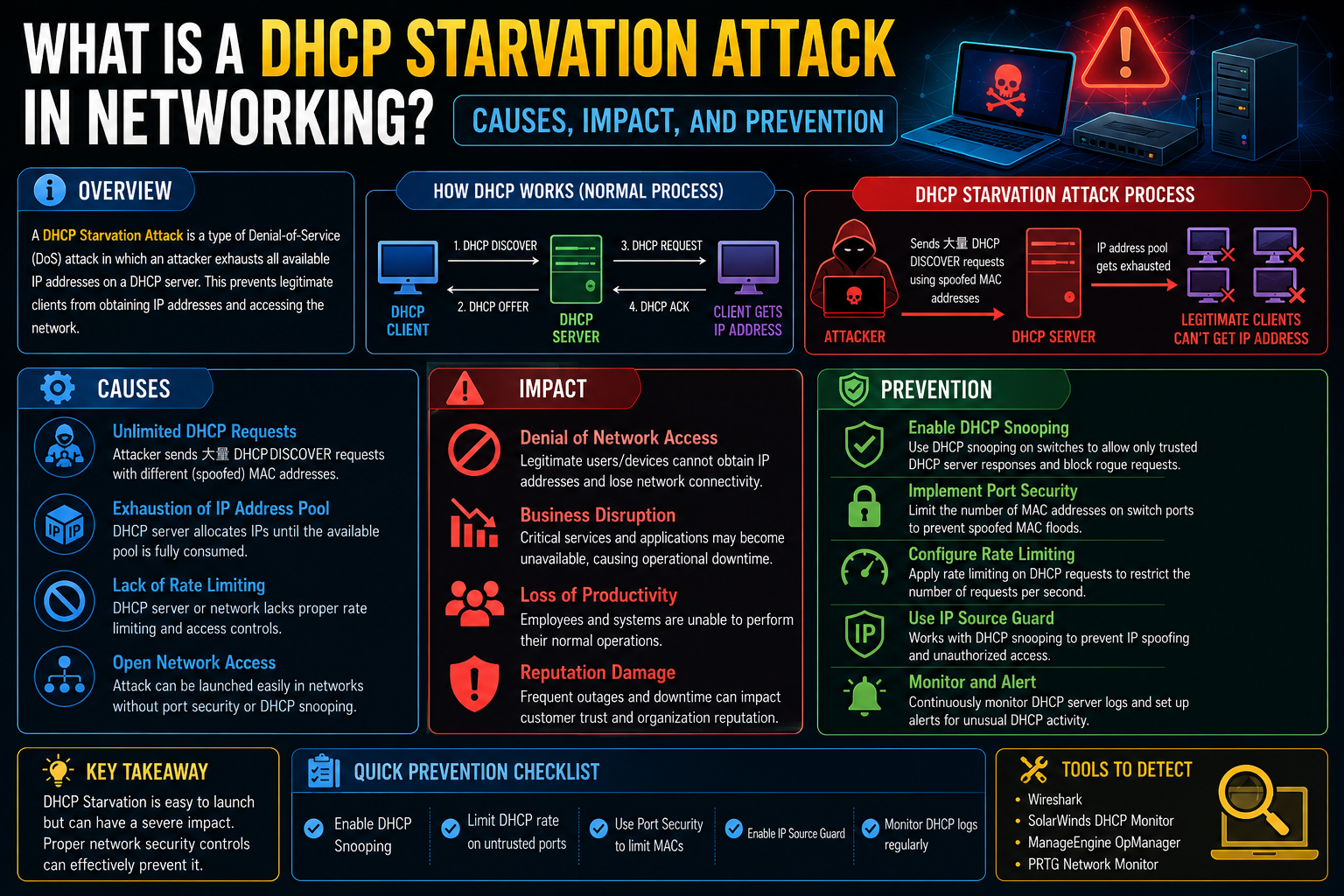
To understand DHCP starvation attacks, it is important to first understand how DHCP normally operates. The process of IP address allocation follows a structured communication pattern often summarized in four steps.
When a device connects to a network and requires an IP address, it begins by sending a request to locate a DHCP server. This initial request is broadcast across the network because the device does not yet know where the server is located. The DHCP server responds by offering an available IP address from its pool. The device then accepts the offer, and finally, the server confirms the assignment.
This interaction ensures that each device receives a unique IP address and avoids conflicts within the network. The DHCP server maintains a record of assigned addresses and keeps track of which ones are still available.
The available pool of IP addresses is limited. For example, in a typical small network, there may only be a few hundred usable addresses. Some are reserved for critical network infrastructure such as routers, gateways, and servers. This means the actual number of assignable addresses is always lower than the theoretical maximum.
This limited resource is exactly what makes DHCP vulnerable to starvation attacks.
The Concept Behind DHCP Starvation Attacks
A DHCP starvation attack is a type of denial-of-service attack that targets the availability of IP addresses in a network. Instead of attacking systems directly or attempting to break encryption, the attacker focuses on exhausting the DHCP server’s IP address pool.
The core idea is simple but highly disruptive. The attacker floods the DHCP server with a large number of fake requests for IP addresses. Each request appears legitimate at first glance because it mimics normal network behavior. However, these requests are not made by real devices.
Instead, the attacker generates thousands of artificial requests using spoofed hardware identifiers. Since the DHCP server cannot easily distinguish between legitimate and fraudulent requests, it begins allocating IP addresses to these fraudulent requests.
As the pool of available IP addresses becomes exhausted, legitimate devices attempting to join the network are unable to obtain an IP address. Without an IP address, these devices cannot communicate on the network, effectively causing a denial of service.
This disruption can bring business operations to a halt, especially in environments where network connectivity is essential for daily tasks.
Why DHCP Starvation Attacks Are Effective
The effectiveness of DHCP starvation attacks lies in the trust-based nature of the DHCP protocol. DHCP was designed to prioritize ease of use and automation rather than strict authentication. As a result, it does not inherently verify whether a request is coming from a legitimate device or a malicious source.
Another reason these attacks are effective is the limited size of IP address pools. Since networks often operate with a finite number of available addresses, it does not take long for an attacker to exhaust the supply if enough fake requests are generated.
Additionally, DHCP servers are designed to respond quickly to requests to ensure smooth network operation. This responsiveness can be exploited by attackers who overwhelm the system with rapid, repeated requests.
The combination of trust, limited resources, and responsiveness creates an environment where DHCP starvation attacks can succeed with relatively simple techniques.
Impact on Network Availability and Performance
When a DHCP starvation attack succeeds, the immediate impact is a loss of connectivity for legitimate users. Devices that attempt to join the network fail to obtain an IP address, which prevents them from accessing internal resources or the internet.
In a corporate environment, this can lead to significant disruptions. Employees may be unable to access email, shared files, or business applications. In more critical environments such as hospitals, manufacturing systems, or financial institutions, the consequences can be even more severe.
Beyond complete denial of service, partial exhaustion of IP addresses can also cause instability. Some devices may receive temporary access while others are denied, leading to inconsistent connectivity across the network.
The attack can also create confusion for network administrators who may initially suspect hardware failures or configuration issues rather than a deliberate attack.
Relationship Between DHCP Starvation and Rogue DHCP Servers
A DHCP starvation attack is often not the final objective of an attacker. Instead, it is frequently used as a stepping stone for more advanced attacks.
Once the legitimate DHCP server has exhausted its IP address pool, the attacker may introduce a rogue DHCP server into the network. This malicious server begins offering IP addresses to newly connected devices.
Because devices trust DHCP responses automatically, they may accept these malicious configurations without suspicion. This allows the attacker to control critical network parameters such as default gateways and DNS servers.
By manipulating these settings, the attacker can redirect traffic through their own system, enabling surveillance, data interception, or modification of network traffic. This technique is commonly associated with man-in-the-middle scenarios, where the attacker positions themselves between users and their intended destinations.
The Role of Spoofing in DHCP Starvation Attacks
A key technique used in DHCP starvation attacks is address spoofing. In a normal network environment, every device has a unique hardware identifier, often referred to as a MAC address. DHCP servers use this identifier to track which device has been assigned which IP address.
During a starvation attack, the attacker generates a large number of fake requests, each with a different spoofed MAC address. This creates the illusion that many different devices are requesting IP addresses when in reality, all requests originate from a single machine or a small group of machines controlled by the attacker.
Because DHCP servers rely heavily on MAC addresses to differentiate clients, this spoofing technique allows attackers to bypass basic tracking mechanisms and rapidly consume the available IP address pool.
Network Conditions That Increase Vulnerability
Certain network configurations can make DHCP starvation attacks easier to execute or more damaging.
Smaller IP address pools are particularly vulnerable because they can be exhausted quickly. Networks that do not implement proper segmentation or monitoring are also more exposed, as unusual traffic patterns may go unnoticed.
In addition, environments where DHCP servers are directly accessible without filtering or restrictions are at higher risk. If a single compromised device can send unlimited requests, the server can be overwhelmed without resistance.
Wireless networks are also more susceptible in some cases, as attackers may be able to connect without physical access to the network infrastructure.
Early Signs of a DHCP Starvation Attack
Although DHCP starvation attacks are disruptive, they often leave behind observable patterns. One of the earliest signs is a sudden increase in DHCP request traffic. This spike is usually abnormal compared to regular network behavior.
Another indicator is the rapid depletion of available IP addresses in the DHCP pool. Network administrators may notice that legitimate devices are failing to obtain addresses despite no configuration changes.
Additionally, logs may show repeated requests originating from unfamiliar or rapidly changing hardware identifiers. This pattern suggests spoofing activity, which is commonly associated with DHCP starvation attacks.
Performance issues may also appear indirectly, such as delays in network access or inconsistent connectivity across devices.
The Broader Security Significance
DHCP starvation attacks highlight a broader issue in network security: the vulnerability of foundational infrastructure services. DHCP is not an optional component—it is essential for almost every modern network. When such a critical service is disrupted, the entire network becomes unstable.
These attacks demonstrate how attackers do not always need to break encryption or exploit complex software vulnerabilities. Instead, they can target basic operational mechanisms to achieve significant disruption.
Understanding DHCP starvation attacks is therefore not just about learning a specific threat, but about recognizing how essential services can be exploited when proper safeguards are not in place.
Transition to Defensive Understanding
While the mechanics of DHCP starvation attacks show how disruption can occur, the more important aspect for network security is understanding how to recognize and mitigate such threats. By analyzing the behavior of DHCP systems and the patterns of abnormal traffic, network defenders can design more resilient infrastructures.
The next part will focus on how these attacks evolve in real network environments, how attackers combine them with other techniques, and how organizations can strengthen their defenses against them without disrupting normal DHCP functionality.
How DHCP Starvation Escalates Inside a Live Network
Once a DHCP starvation attack begins inside a real network, it does not remain a simple flood of requests for long. What starts as an overload of DHCP DISCOVER messages gradually evolves into a structured disruption of network stability. The attacker’s goal is not just to consume IP addresses but to control how the network assigns identity to connected devices.
In a normal environment, DHCP requests are sparse and predictable. Devices request IP addresses only when they connect, reboot, or renew leases. During a starvation attack, this pattern is completely broken. Instead of steady, natural traffic, the DHCP server suddenly experiences an abnormal surge of allocation requests.
This surge forces the server into a constant state of decision-making. It must continuously assign, track, and reserve IP addresses for what appears to be a rapidly growing number of devices. However, many of these “devices” do not exist. They are artificially generated identities created by the attacker.
As this process continues, the DHCP server’s ability to distinguish between legitimate and illegitimate requests becomes increasingly strained. The exhaustion of IP addresses is only the first visible symptom. Behind the scenes, the server is also dealing with excessive processing load, memory usage, and log generation.
The Role of Fake Client Identity Generation
A key technique in DHCP starvation attacks is the generation of false client identities. Since DHCP servers rely heavily on MAC addresses to identify devices, attackers exploit this by fabricating large numbers of unique hardware identifiers.
Each request sent during the attack appears to originate from a different device. To the DHCP server, these requests look legitimate because they follow the correct communication format. The server has no immediate reason to suspect malicious intent.
This identity fabrication allows a single attacker-controlled machine to simulate hundreds or even thousands of devices on the same network. The DHCP server, believing it is servicing genuine clients, continues allocating IP addresses until none remain available.
The efficiency of this technique depends on how quickly the attacker can generate and rotate these fake identities. In modern attack scenarios, automation is often used to maintain a continuous flow of spoofed requests.
IP Lease Exhaustion and Its Hidden Consequences
When a DHCP server reaches the point where its IP address pool is exhausted, the most obvious effect is that new devices cannot connect to the network. However, the underlying consequences are more complex.
IP lease exhaustion not only affects new devices; it also impacts devices that attempt to renew their existing leases. If the DHCP server is overwhelmed or fully depleted, renewal requests may fail or be delayed. This can cause already-connected devices to lose connectivity once their lease expires.
In enterprise environments, this can result in widespread disruption. Devices that were previously functioning normally may suddenly lose network access without warning. This creates confusion among users and complicates troubleshooting efforts.
Additionally, some DHCP servers may begin operating in degraded mode when overwhelmed, leading to inconsistent behavior. This instability can manifest as delayed responses, partial allocations, or incomplete network configuration assignments.
Impact on Network Services Beyond IP Assignment
Although DHCP is primarily responsible for IP address assignment, it also distributes additional configuration parameters such as DNS servers, default gateways, and subnet information. When a DHCP starvation attack disrupts this process, the impact extends far beyond simple connectivity loss.
Without valid DHCP configuration data, devices may not know how to route traffic outside their local network. Even if a device manages to obtain a temporary IP address, missing or incorrect gateway information can prevent it from accessing external resources.
DNS misconfiguration is particularly damaging. If DNS settings are altered or unavailable, users may be unable to resolve domain names, effectively breaking access to websites, cloud services, and internal applications that rely on domain-based addressing.
This layered impact means that DHCP starvation attacks can cause a cascading failure across multiple network services, not just IP assignment.
Transition from Starvation to Rogue DHCP Deployment
In many real-world attack scenarios, DHCP starvation is not the final objective but rather a preparatory phase. Once the attacker has successfully exhausted the DHCP pool, they often introduce a rogue DHCP server into the network.
This rogue server is designed to respond faster than the legitimate DHCP infrastructure. Because the legitimate server is already overloaded or depleted, devices seeking an IP address may accept responses from the attacker’s system instead.
This creates a dangerous situation where devices begin receiving network configurations controlled entirely by the attacker. These configurations may include malicious DNS servers, altered routing paths, or gateway addresses that redirect traffic through unauthorized systems.
At this stage, the attacker is no longer just denying service—they are actively controlling how devices communicate across the network.
The Man-in-the-Middle Pathway Created by DHCP Abuse
One of the most dangerous outcomes of a DHCP starvation attack combined with a rogue DHCP server is the creation of a man-in-the-middle (MITM) environment.
When devices accept network configuration from a malicious DHCP server, their traffic is unknowingly routed through systems controlled by the attacker. This allows the attacker to intercept, monitor, or even modify data before it reaches its intended destination.
In practical terms, this means that sensitive information such as login credentials, internal communications, and application data may be exposed without the user’s awareness.
What makes this attack especially dangerous is that it does not require breaking encryption directly. Instead, it exploits trust in network configuration mechanisms, which are assumed to be secure by default.
Network Behavior Under Sustained Attack Conditions
As a DHCP starvation attack continues over time, the network begins to exhibit increasingly unstable behavior. Devices may connect and disconnect unpredictably. Some may receive valid IP addresses temporarily, while others are denied access entirely.
This inconsistency creates operational confusion. Users may assume that their devices are malfunctioning or that the network is experiencing random outages. In reality, the DHCP infrastructure is under sustained pressure from malicious traffic.
Administrators may also observe unusually high CPU or memory usage on the DHCP server. This is caused by the continuous processing of fake requests and the maintenance of an exhausted lease database.
Network logs often become flooded with repeated allocation attempts, making it difficult to distinguish meaningful events from attack-generated noise.
Why DHCP Servers Struggle Under Attack Load
DHCP servers are designed for efficiency and responsiveness, not for handling malicious floods of requests. When faced with a starvation attack, the server must perform several tasks repeatedly:
It must validate incoming requests, check available IP pools, reserve addresses, update lease tables, and respond to clients. Each of these operations consumes processing resources.
Under normal conditions, this workload is minimal. However, during an attack, the number of requests increases exponentially. This forces the server to operate beyond its intended capacity.
Unlike traditional denial-of-service attacks that focus on bandwidth exhaustion, DHCP starvation attacks target logical exhaustion—specifically, the depletion of a finite resource: IP addresses.
The Role of Network Segmentation in Attack Spread
In poorly segmented networks, a DHCP starvation attack can spread more easily and affect a larger number of devices. When multiple devices rely on a single DHCP server or shared address pool, the impact of exhaustion becomes widespread.
In contrast, segmented networks that divide DHCP responsibilities across multiple scopes or subnets may experience more limited damage. However, even in segmented environments, a targeted attack on a critical subnet can still cause significant disruption.
The severity of impact often depends on how centralized the DHCP infrastructure is. Highly centralized systems present a single point of failure, making them attractive targets for attackers.
Behavioral Patterns That Indicate Ongoing Abuse
Detecting a DHCP starvation attack often involves recognizing subtle behavioral changes in network traffic. One of the most common indicators is a sudden increase in DHCP DISCOVER or REQUEST messages without a corresponding increase in legitimate device activity.
Another pattern is the presence of rapidly changing or non-repeating hardware identifiers. Since attackers often spoof MAC addresses, logs may show an unusually high diversity of client identities within a short time period.
Additionally, DHCP servers may show a large number of short-lived leases that are never fully utilized. These leases are typically assigned to fake clients that do not proceed beyond the initial request phase.
Monitoring these patterns is essential for early detection, as they often appear before complete service disruption occurs.
Administrative Challenges During Active Attacks
When a DHCP starvation attack is underway, network administrators face several challenges simultaneously. First, identifying the source of the attack can be difficult because the traffic appears to originate from multiple devices.
Second, the DHCP server itself may become slow or unresponsive due to overload. This limits the ability to retrieve logs or make configuration changes in real time.
Third, distinguishing legitimate traffic from malicious traffic becomes increasingly complex as the attack continues. Since DHCP requests are inherently similar in structure, traditional filtering methods may not be sufficient.
These challenges highlight the importance of proactive monitoring and network design rather than reactive troubleshooting.
Evolution of Attack Techniques in Modern Environments
Over time, DHCP starvation techniques have evolved alongside improvements in network security. Modern attackers often combine starvation attacks with other methods such as spoofing, ARP manipulation, and DNS poisoning.
This multi-layered approach increases the effectiveness of the attack while making detection more difficult. Instead of relying on a single flood of requests, attackers may distribute their activity across multiple network layers.
This evolution demonstrates that DHCP starvation is no longer an isolated technique but part of a broader category of network infrastructure abuse strategies.
Preparing for Defensive Strategies
Understanding the mechanics and progression of DHCP starvation attacks is essential for building effective defenses. By analyzing how these attacks develop from simple request flooding to full network compromise, it becomes possible to identify weak points in the DHCP infrastructure.
The next part will focus on defensive mechanisms, detection techniques, and architectural strategies that reduce the likelihood and impact of DHCP starvation attacks while maintaining normal network functionality.
Building a Defensive Mindset Around DHCP Security
Defending against DHCP starvation attacks requires more than just technical controls; it starts with understanding how DHCP behaves under normal and abnormal conditions. Since DHCP is designed to operate automatically with minimal user intervention, it often runs quietly in the background of a network. This quiet nature makes it easy to overlook until something goes wrong.
A strong defensive approach begins with recognizing that DHCP is a critical infrastructure service. If it fails or is manipulated, the entire network loses stability. Because of this, protection must focus on both prevention and early detection.
Unlike attacks that exploit software vulnerabilities, DHCP starvation attacks exploit resource exhaustion. This means the defense strategy must ensure that resources cannot be easily depleted or that depletion does not result in complete service failure.
Strengthening DHCP Server Configuration
One of the first steps in mitigating DHCP starvation attacks is properly configuring the DHCP server itself. While configuration alone cannot fully prevent an attack, it significantly reduces its impact.
A well-designed DHCP scope should avoid overly large or overly small address pools. If the pool is too small, it can be exhausted quickly. If it is too large without proper monitoring, attacks may go unnoticed for longer periods.
Lease duration settings also play an important role. Short lease times can make it easier for attackers to cycle through IP addresses, while extremely long lease times can reduce address availability efficiency. A balanced configuration helps maintain stability while limiting abuse potential.
Another important aspect is reserving a portion of IP addresses for critical infrastructure devices. This ensures that even during partial exhaustion, essential systems such as routers, servers, and security appliances remain operational.
Implementing Port-Level Security Controls
One of the most effective defenses against DHCP starvation attacks is controlling how many devices can connect through a single network port. This is commonly achieved through port-level security mechanisms on network switches.
In a normal network environment, a single physical port should correspond to a single device. However, during a DHCP starvation attack, a single port may generate hundreds or thousands of fake identities using spoofed MAC addresses.
By limiting the number of MAC addresses allowed per port, the network can significantly reduce the effectiveness of such attacks. If the limit is exceeded, the switch can block additional traffic or shut down the port entirely.
This approach does not rely on analyzing the content of DHCP packets. Instead, it enforces structural limits at the hardware level, making it highly effective against spoofing-based attacks.
MAC Address Filtering and Binding Techniques
Another defensive strategy involves binding MAC addresses to specific ports or devices. This ensures that only recognized hardware identifiers are allowed to request IP addresses through DHCP.
When a device attempts to connect using an unknown MAC address, the network can reject or restrict its access. This makes it significantly harder for attackers to generate large numbers of fake identities.
However, MAC-based filtering must be implemented carefully. In dynamic environments where devices frequently change, strict filtering can create operational challenges. For this reason, many organizations use dynamic learning systems that gradually build trusted device lists.
Even with its limitations, MAC filtering adds a layer of friction for attackers attempting DHCP starvation.
DHCP Snooping as a Core Security Mechanism
One of the most powerful tools used to prevent DHCP-related attacks is a feature known as DHCP snooping. This mechanism allows network switches to differentiate between trusted and untrusted sources of DHCP messages.
In a DHCP snooping configuration, only designated ports are allowed to send DHCP responses. These are typically ports connected to legitimate DHCP servers. All other ports are treated as untrusted and are restricted from sending DHCP OFFER or ACK messages.
This prevents attackers from introducing rogue DHCP servers into the network, which is often the second stage of a DHCP starvation attack.
Additionally, DHCP snooping can maintain a binding table that maps IP addresses to MAC addresses and switch ports. This helps administrators track legitimate assignments and detect anomalies.
Rate Limiting DHCP Traffic
Another effective defense strategy is rate limiting DHCP traffic. This involves controlling how many DHCP requests a device or network segment can send within a given time period.
During a DHCP starvation attack, the attacker typically generates an unusually high volume of requests. By limiting the rate at which DHCP DISCOVER and REQUEST packets are processed, the network can reduce the impact of such floods.
Rate limiting does not completely stop an attack, but it slows it down significantly. This gives administrators more time to detect and respond before the IP pool is fully exhausted.
However, rate limiting must be carefully tuned. If set too aggressively, it may delay legitimate device connections, especially in environments where many devices connect simultaneously.
Monitoring DHCP Logs for Early Detection
Continuous monitoring of DHCP logs is one of the most effective ways to detect starvation attacks early. These logs provide detailed information about IP allocation requests, responses, and lease activity.
One of the earliest warning signs is a sudden spike in DISCOVER or REQUEST messages. Under normal conditions, these requests occur at a relatively stable rate. A sharp increase indicates abnormal activity.
Another important indicator is the appearance of many unique MAC addresses within a short timeframe. Since DHCP starvation attacks rely on spoofing, logs often show an unusually high diversity of client identifiers.
Monitoring tools can also track IP pool utilization. A rapid depletion of available addresses is a strong signal that something is wrong.
Behavioral Anomaly Detection in DHCP Systems
Modern network security systems increasingly rely on behavioral analysis rather than static rules. In the context of DHCP, this means analyzing how clients behave over time instead of simply checking whether requests are valid.
For example, a legitimate network typically shows a predictable pattern of device activity. Devices connect, remain active for a period, and then disconnect or renew leases. In contrast, DHCP starvation attacks generate repetitive, high-frequency requests without meaningful follow-up activity.
By building a baseline of normal behavior, security systems can detect deviations that suggest an ongoing attack.
This approach is particularly useful in environments where traditional filtering is not sufficient due to dynamic device behavior.
Network Segmentation as a Defensive Strategy
Segmenting a network into smaller, isolated sections can significantly reduce the impact of DHCP starvation attacks. Instead of relying on a single DHCP server for the entire network, organizations can distribute DHCP services across multiple segments.
This ensures that even if one segment is affected, others remain operational. It also limits the scope of IP pool exhaustion.
Segmentation also makes it more difficult for attackers to move laterally across the network. Each segment can have its own security policies and monitoring systems, creating multiple layers of defense.
In larger enterprise environments, segmentation is often combined with VLANs to further isolate network traffic.
Reducing Attack Surface Through Controlled Access
Limiting physical and wireless access to network infrastructure is another important defense strategy. DHCP starvation attacks require access to the network in order to send malicious requests.
By restricting who can connect to network ports or wireless access points, organizations can reduce the likelihood of unauthorized devices launching attacks.
Authentication mechanisms, such as network access control systems, can ensure that only verified devices are allowed to communicate with DHCP servers.
This reduces the risk of internal attacks, which are often more difficult to detect than external threats.
Protecting Against Rogue DHCP Servers
Since DHCP starvation attacks are often followed by rogue DHCP deployments, preventing unauthorized DHCP servers is critical.
Network switches can be configured to block DHCP responses from untrusted ports. This ensures that only legitimate servers can distribute IP configurations.
Additionally, monitoring systems can detect unusual DHCP response patterns, such as multiple servers responding to the same request or unexpected configuration values being assigned.
By controlling both request and response sides of the DHCP process, networks can prevent attackers from taking over IP assignment functions.
Incident Response During DHCP Starvation Attacks
When a DHCP starvation attack is detected, a rapid response is essential. The first step is usually to identify and isolate the source of the attack. This may involve disabling specific network ports or blocking suspicious MAC addresses.
Once the attack source is contained, the DHCP server may need time to recover its IP pool and stabilize lease assignments. In some cases, manually clearing lease tables or restarting DHCP services may be necessary.
During recovery, administrators must ensure that no rogue DHCP servers are active on the network. Otherwise, devices may continue receiving malicious configurations even after the starvation phase ends.
Long-Term Infrastructure Improvements
Beyond immediate defensive measures, long-term improvements in network architecture can significantly reduce vulnerability to DHCP starvation attacks.
These improvements include distributed DHCP architectures, stronger authentication mechanisms, improved monitoring systems, and automated anomaly detection.
Organizations that rely heavily on network availability often implement redundant DHCP systems to ensure continuity even during partial failures.
Over time, integrating security into the design of the DHCP infrastructure becomes more important than simply reacting to attacks.
Understanding the Broader Security Lesson
DHCP starvation attacks highlight an important principle in cybersecurity: critical infrastructure services must be protected not only from direct exploitation but also from resource exhaustion and misuse.
Because DHCP is foundational to network communication, its disruption has cascading effects across all connected systems. This makes it a high-value target for attackers seeking disruption or control.
Understanding these attacks at a deep level helps network defenders anticipate not just how they occur, but how they evolve and combine with other techniques.
This awareness is essential for building resilient networks that can continue functioning even under sustained pressure from malicious activity.
Advanced Monitoring Techniques for DHCP Infrastructure
One of the most effective ways to stay ahead of DHCP starvation attacks is to move beyond basic log checking and adopt advanced monitoring techniques that focus on real-time behavior analysis. Traditional monitoring often looks at whether DHCP is functioning, but advanced monitoring examines how it is functioning under different load conditions.
Modern network monitoring systems can track DHCP request frequency per second, per port, and per MAC address group. When these values deviate from established baselines, alerts can be triggered automatically. This helps administrators identify abnormal activity before the DHCP pool is fully exhausted.
Another powerful technique is correlation analysis. Instead of analyzing DHCP traffic in isolation, it compares DHCP activity with other network signals such as ARP traffic, switch port usage, and authentication logs. If DHCP requests spike while no corresponding increase in legitimate device activity is observed, it becomes a strong indicator of malicious behavior.
Time-based visualization tools are also valuable. They allow administrators to see patterns such as sudden bursts of requests or continuous high-frequency traffic from a single segment. These visual patterns are often easier to interpret than raw log data and can speed up response time significantly.
Hardware-Based Protection Mechanisms in Network Switches
Beyond software monitoring, hardware-level protections embedded in modern network switches provide an additional layer of defense against DHCP starvation attacks. These mechanisms operate closer to the data source and can block malicious activity before it reaches the DHCP server.
One such mechanism is storm control, which limits the rate of broadcast, multicast, and unknown unicast traffic on a switch port. Since DHCP requests are broadcast-based, excessive flooding can be controlled using this method.
Another important feature is dynamic ARP inspection, which helps validate the legitimacy of IP-to-MAC mappings. Although primarily designed for ARP security, it indirectly supports DHCP security by ensuring that only valid address bindings are accepted across the network.
Some advanced switches also support per-port DHCP packet inspection. This allows them to verify whether DHCP messages originate from authorized sources and drop those that do not meet predefined criteria.
These hardware-based controls are particularly useful because they do not rely on server-side processing. Even if a DHCP server becomes overloaded, the switch can still enforce protective rules at the network edge.
Impact of Wireless Networks on DHCP Attack Exposure
Wireless environments introduce additional complexity when it comes to DHCP starvation attacks. Unlike wired networks, where physical access is required, wireless networks allow attackers to connect remotely if they are within range.
This expanded access surface increases the likelihood of unauthorized devices attempting to flood DHCP servers with requests. In densely populated environments such as offices, campuses, or public spaces, this risk becomes even more significant.
To mitigate this, wireless networks often rely on stronger authentication mechanisms before allowing devices to access internal resources. Once authentication is complete, DHCP requests are still subject to the same protections as wired networks, but the initial barrier significantly reduces exposure.
Wireless controllers can also monitor DHCP activity per access point. If a single access point begins generating abnormal request volumes, it can be isolated or throttled without affecting the entire network.
Role of Artificial Intelligence in Detecting DHCP Abuse
Artificial intelligence and machine learning are increasingly being used to detect DHCP starvation patterns in real time. These systems analyze large volumes of network data and identify subtle anomalies that may not be visible through traditional monitoring.
Instead of relying on fixed thresholds, AI-based systems learn normal network behavior over time. They understand how many DHCP requests typically occur, how quickly IP leases are assigned, and how devices behave during peak and off-peak hours.
When a deviation occurs—such as a sudden surge in fake-looking DHCP requests—the system can flag it as suspicious even if it does not exceed predefined limits.
Machine learning models are also capable of adapting to evolving attack patterns. Since attackers often modify their techniques to avoid detection, adaptive systems provide a more resilient defense compared to static rule-based monitoring.
Recovery Challenges After a DHCP Starvation Event
Recovering from a DHCP starvation attack is not always immediate, even after the attack stops. One of the main challenges is restoring the integrity of the DHCP lease database.
In some cases, the DHCP server may still hold numerous stale or partially assigned leases that were created during the attack. These entries must be cleared or validated before normal operation can resume.
Another challenge is ensuring that no rogue DHCP servers remain active on the network. Even after the attack is contained, malicious configurations may continue to circulate if unauthorized servers are still responding to client requests.
Network devices may also experience delayed recovery as they attempt to renew or re-establish leases. This can create temporary instability even after the main attack has ended.
Importance of Network Visibility and Centralized Control
Maintaining full visibility across the network is essential for preventing and responding to DHCP starvation attacks. Without centralized control, it becomes difficult to identify where malicious traffic originates or how it spreads.
Centralized network management systems allow administrators to monitor DHCP activity across multiple segments simultaneously. This makes it easier to detect coordinated attacks that target multiple parts of the infrastructure.
Visibility also improves incident response speed. When administrators can see real-time DHCP allocation trends, they can isolate affected segments before the attack spreads further.
In modern network architectures, centralized dashboards are often integrated with alerting systems that notify administrators immediately when abnormal DHCP behavior is detected.
Conclusion
A DHCP starvation attack is one of the most disruptive yet conceptually simple threats in modern network environments. It does not rely on breaking encryption, exploiting software vulnerabilities, or directly attacking applications. Instead, it targets a fundamental service that nearly every device depends on: automatic IP address assignment through DHCP. By overwhelming this system with a flood of fake requests, an attacker can exhaust available IP addresses and prevent legitimate devices from connecting to the network.
What makes this type of attack particularly concerning is its ability to operate quietly at first. The early stages often look like normal network activity, with devices requesting IP addresses in the usual way. However, as the volume of fraudulent requests increases, the DHCP server gradually runs out of resources. Once the address pool is depleted, the network begins to fail in a way that can appear sudden and unpredictable to users.
Beyond simple denial of service, DHCP starvation can also serve as a gateway to more advanced threats. When combined with rogue DHCP servers, it can enable traffic redirection, data interception, and full man-in-the-middle scenarios. This escalation turns a basic resource exhaustion attack into a serious security breach affecting confidentiality, integrity, and availability of network communications.
Defending against such attacks requires a layered and proactive approach. Techniques like DHCP snooping, port security, rate limiting, and MAC address controls help reduce exposure at the network level. At the same time, continuous monitoring and behavioral analysis provide early detection capabilities, allowing administrators to respond before critical damage occurs. Hardware-based protections and network segmentation further strengthen resilience by limiting how far an attack can spread.
Ultimately, DHCP starvation attacks highlight an important truth in cybersecurity: even the most essential and trusted infrastructure services must be carefully protected. Networks are only as strong as their weakest operational dependency. By understanding how these attacks work and implementing robust defensive strategies, organizations can ensure stable connectivity, protect user access, and maintain secure communication across their environments.