Cybersecurity has evolved from a technical concern hidden deep inside IT departments into one of the most important business priorities in the modern world. Organizations of every size now store enormous amounts of sensitive information online, including customer data, financial records, intellectual property, healthcare information, and operational systems. As cyberattacks continue to grow in complexity and frequency, businesses need experienced leaders who can protect digital assets while helping organizations operate safely and efficiently. That responsibility often falls on the information security manager.
An information security manager is far more than a technical specialist monitoring firewalls or responding to malware alerts. The role combines leadership, business strategy, risk management, communication, compliance oversight, and technical expertise. These professionals help shape how organizations defend themselves against constantly changing cyber threats while ensuring that security programs support long-term business goals.
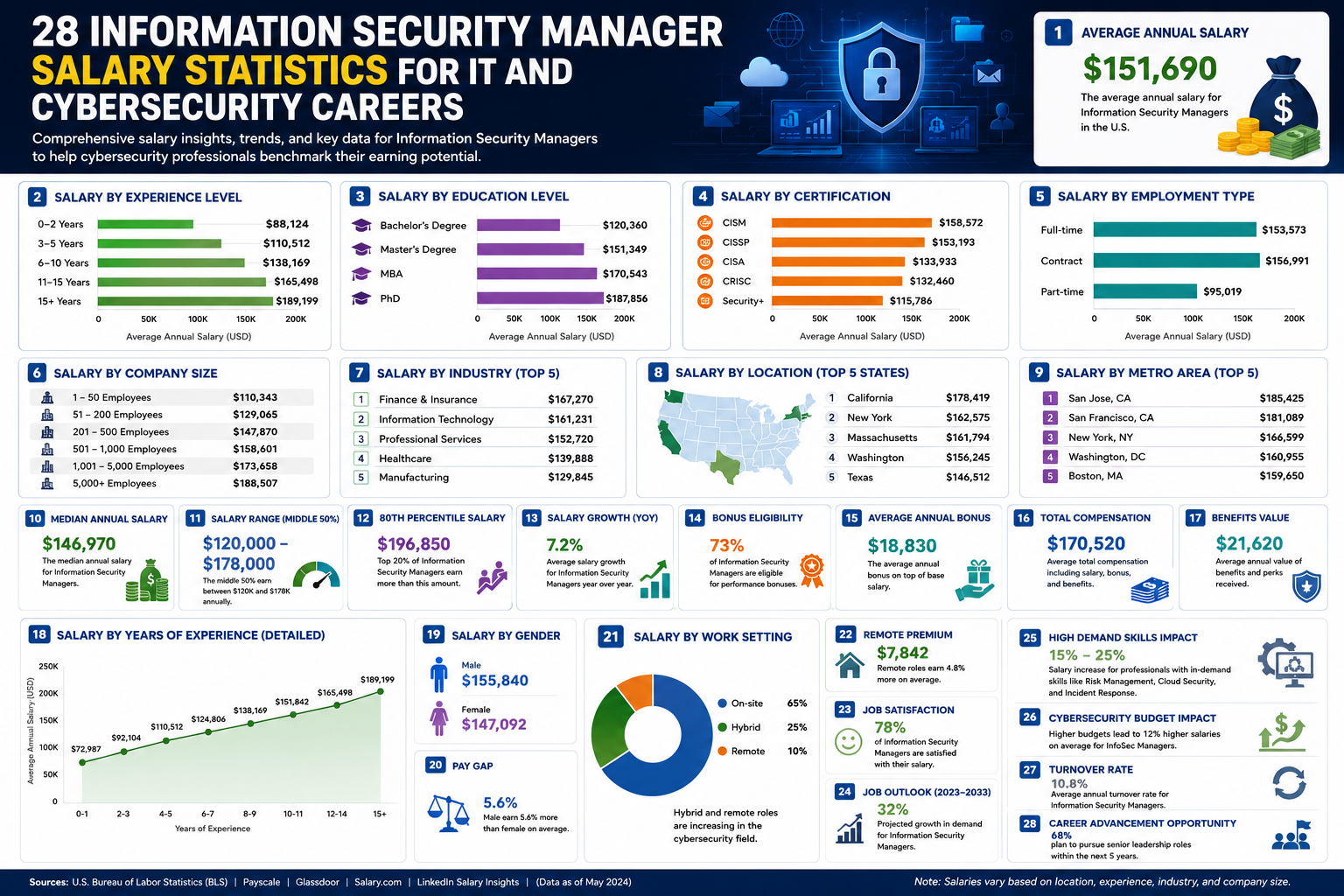
Because security breaches can cost millions of dollars and severely damage an organization’s reputation, companies are investing heavily in cybersecurity leadership. As a result, information security managers are among the highest-paid professionals in the technology sector. Their salaries reflect both the complexity of the role and the growing shortage of qualified cybersecurity talent.
Understanding what information security managers actually do, why their salaries vary so widely, and what skills employers value most can help aspiring professionals make smarter career decisions. Whether someone is transitioning from a technical cybersecurity role or planning a long-term leadership path, the position offers substantial opportunities for career growth and financial advancement.
Why Cybersecurity Leadership Matters More Than Ever
Modern businesses depend on technology for nearly every part of their operations. Financial transactions, cloud storage, remote work systems, supply chains, healthcare records, and communication platforms all rely on secure digital infrastructure. Unfortunately, attackers understand this dependence and increasingly target organizations through ransomware, phishing campaigns, cloud vulnerabilities, insider threats, and software exploits.
A single security incident can disrupt business operations for weeks. Beyond direct financial losses, companies may face lawsuits, regulatory fines, damaged customer trust, and long-term reputational harm. In heavily regulated industries such as finance, healthcare, and government contracting, the stakes are even higher because organizations must comply with strict security and privacy requirements.
This environment has transformed cybersecurity from a technical support function into a business-critical discipline. Executives and boards of directors now recognize that cybersecurity affects operational stability, customer confidence, and long-term profitability. Information security managers sit at the center of this shift because they help organizations reduce risk while enabling business growth.
Instead of simply blocking threats, modern security managers create balanced security strategies that allow organizations to innovate safely. They help leadership teams understand risk, prioritize investments, and implement technologies that improve security without slowing productivity. Their role increasingly involves business decision-making rather than just technical administration.
As cyber threats evolve, organizations need leaders who can think strategically, coordinate teams effectively, and respond quickly during crises. This growing demand explains why salaries for experienced information security managers continue to rise across nearly every industry.
The Core Responsibilities of an Information Security Manager
The responsibilities of an information security manager can vary depending on the size and structure of the organization. In smaller companies, one person may oversee nearly all security operations. In larger enterprises, responsibilities are often divided among specialized teams. Even so, several core duties remain consistent across most environments.
One of the most important responsibilities involves developing security policies and procedures. Organizations need clear rules governing how employees handle sensitive information, access systems, and respond to threats. Information security managers design these policies to reduce risk while ensuring compliance with industry regulations and internal standards.
Another major responsibility is overseeing daily security operations. This includes monitoring systems for suspicious activity, coordinating incident response efforts, managing vulnerability assessments, and ensuring security tools function properly. Managers must maintain visibility across the organization’s infrastructure to identify and address potential weaknesses before attackers exploit them.
Risk management also plays a central role. Information security managers regularly assess potential threats, analyze vulnerabilities, and evaluate how different risks could affect business operations. They then develop mitigation strategies designed to reduce exposure and improve resilience.
Compliance oversight has become increasingly important as governments and industries introduce stricter security regulations. Many organizations must comply with frameworks such as HIPAA, PCI-DSS, SOC 2, GDPR, or FedRAMP. Information security managers help ensure policies, technologies, and operational procedures align with these requirements.
Leadership responsibilities extend beyond technology. Information security managers often supervise analysts, engineers, consultants, and external vendors. They coordinate projects, conduct performance evaluations, support professional development, and ensure teams work efficiently together.
Communication is another essential part of the role. Security managers frequently explain technical issues to executives, department leaders, legal teams, and non-technical employees. Strong communication skills are necessary because cybersecurity decisions often affect the entire organization.
During security incidents, information security managers coordinate response activities, manage internal communications, and help leadership make critical decisions quickly. Their ability to stay calm under pressure can significantly influence how successfully an organization handles a cyber crisis.
The Growing Financial Value of Security Leadership
Organizations increasingly view cybersecurity leadership as a strategic investment rather than an operational expense. This shift has dramatically influenced compensation levels for information security managers.
Several factors contribute to rising salaries. First, there is a global shortage of experienced cybersecurity professionals. Many organizations struggle to find qualified candidates with both technical expertise and leadership capabilities. Because the talent pool remains limited, companies often compete aggressively for skilled managers.
Second, the financial consequences of cyberattacks continue to increase. Data breaches can cost organizations millions of dollars through downtime, legal costs, recovery efforts, and lost customer trust. Companies recognize that hiring experienced security leaders may prevent far greater losses in the future.
Third, regulatory pressure continues to expand. Businesses operating in healthcare, finance, defense, and critical infrastructure face growing compliance obligations. Organizations need security leaders who understand complex regulatory frameworks and can guide audit preparation and risk management efforts effectively.
Cloud computing has also increased demand for advanced cybersecurity leadership. Many organizations are transitioning from traditional infrastructure to hybrid and cloud-based environments. Managing security across these platforms requires specialized expertise in cloud architecture, identity management, and zero-trust security models.
As organizations expand remote work capabilities, information security managers must also address challenges involving endpoint security, secure access, employee training, and distributed environments. These evolving responsibilities further increase the value of experienced security leadership.
Because cybersecurity affects nearly every aspect of modern business operations, information security managers often work closely with executive leadership teams. Their ability to align security priorities with organizational objectives directly influences long-term business success.
Understanding Salary Variations Across Different Regions
Information security manager salaries can differ dramatically depending on geographic location. Several factors contribute to these regional differences, including local demand for cybersecurity talent, cost of living, industry concentration, and competition among employers.
Major technology hubs typically offer the highest salaries. Cities with strong technology sectors, financial institutions, government agencies, or defense contractors often compete intensely for experienced cybersecurity professionals. In these markets, organizations are willing to pay premium salaries to attract qualified leaders.
For example, regions with large concentrations of cloud computing companies, financial firms, or government contractors often provide significantly higher compensation packages than smaller markets. Salaries in major metropolitan areas may exceed two hundred thousand dollars for senior-level positions with extensive leadership responsibilities.
However, higher salaries do not always translate directly into greater purchasing power. Cities with extremely high living costs may reduce the practical financial advantage of larger compensation packages. Housing, transportation, taxes, and general living expenses can consume a substantial portion of earnings in major urban centers.
Mid-sized technology markets have become increasingly attractive for cybersecurity professionals because they offer competitive salaries combined with lower living costs. Cities experiencing rapid technology growth often provide strong compensation opportunities while maintaining a more affordable lifestyle.
Remote work has also started influencing salary structures across the cybersecurity industry. Some organizations now hire security managers remotely, allowing professionals to access high-paying opportunities without relocating to expensive metropolitan areas. However, many companies still adjust compensation based on geographic location.
Regional demand also depends heavily on industry presence. Areas with strong healthcare, financial services, manufacturing, or government sectors often maintain consistent demand for experienced security managers because these industries face significant cybersecurity and compliance requirements.
Understanding regional salary trends can help professionals make informed decisions about relocation, remote work opportunities, and long-term career planning.
How Industry Choice Impacts Compensation
Not all industries pay information security managers equally. Compensation often reflects the level of risk associated with a particular sector and the financial impact of potential breaches.
Financial institutions typically offer some of the highest salaries because they manage extremely sensitive customer data and financial transactions. Banks, investment firms, insurance companies, and payment processors face constant cyber threats and strict regulatory oversight. Security managers in these environments often oversee complex infrastructures and sophisticated threat detection systems.
Healthcare organizations also provide strong compensation opportunities. Hospitals, healthcare networks, pharmaceutical companies, and medical research organizations store highly sensitive patient information and must comply with extensive privacy regulations. Protecting healthcare systems has become increasingly difficult due to ransomware attacks targeting medical facilities.
Government agencies and defense contractors represent another major source of high-paying cybersecurity roles. These organizations often handle classified information, critical infrastructure systems, and national security projects. Security managers working in these sectors may require specialized clearances and deep expertise in compliance frameworks.
Technology companies frequently pay premium salaries as well, particularly those operating cloud services, software platforms, or large-scale digital infrastructures. These organizations prioritize innovation and security simultaneously, creating a strong demand for experienced security leadership.
Retail and e-commerce companies increasingly invest in cybersecurity leadership because they process massive amounts of customer payment information. Breaches affecting consumer trust can severely damage brand reputation and financial performance.
Manufacturing organizations are also expanding cybersecurity investments as industrial systems become more connected through automation and smart technologies. Protecting operational technology environments introduces additional security challenges beyond traditional IT systems.
Energy providers, telecommunications companies, and critical infrastructure operators similarly require advanced cybersecurity leadership because disruptions in these sectors can affect entire regions or industries.
Industry specialization can significantly increase earning potential because employers often value managers with deep experience in sector-specific regulations, technologies, and threat landscapes.
Technical Skills That Increase Earning Potential
Although leadership and communication skills are essential, technical expertise remains highly valuable for information security managers. Employers often prefer leaders who understand the technologies their teams use daily.
Cloud security expertise currently ranks among the most valuable technical skill sets. Organizations increasingly rely on platforms such as Amazon Web Services, Microsoft Azure, and Google Cloud. Security managers who understand cloud architecture, cloud-native security tools, and hybrid infrastructure protection often command higher salaries.
Identity and access management expertise is also highly sought after. Managing authentication systems, privileged access controls, and identity governance has become increasingly important as organizations adopt remote work and cloud-based services.
Knowledge of zero-trust security principles can significantly enhance earning potential. Zero trust frameworks assume no user or device should be trusted automatically, requiring continuous verification across systems and networks. Organizations implementing these architectures need leaders who understand both technical and operational considerations.
Security operations expertise remains highly valuable as well. Information security managers who understand threat detection, incident response workflows, and security monitoring technologies can better oversee operational teams during critical situations.
Experience with governance, risk, and compliance tools also increases market value. Organizations rely heavily on structured risk management processes, audit preparation, and compliance reporting to meet regulatory obligations.
Data protection and encryption expertise continue to grow in importance because organizations handle increasing amounts of sensitive information across cloud and hybrid environments.
Managers who combine technical depth with strategic leadership capabilities are especially valuable because they can communicate effectively with both technical teams and executive leadership.
The Importance of Soft Skills in Cybersecurity Leadership
Technical expertise alone is rarely enough to succeed as an information security manager. Soft skills often determine whether a professional can advance into higher-paying leadership positions.
Communication skills are among the most important. Security managers frequently explain complex technical risks to executives, legal teams, regulators, employees, and business stakeholders who may not have technical backgrounds. The ability to translate technical concepts into clear business language is essential.
Leadership abilities also heavily influence career growth. Security managers must motivate teams, coordinate projects, resolve conflicts, and guide organizations through stressful incidents. Strong leadership creates operational stability and improves team performance.
Decision-making under pressure is another critical skill. During security incidents, managers often need to make rapid choices with incomplete information. Their ability to evaluate risks calmly and coordinate response efforts can significantly affect organizational outcomes.
Problem-solving skills are essential because cybersecurity challenges constantly evolve. Attackers continuously develop new tactics, requiring security leaders to adapt strategies and technologies quickly.
Relationship-building abilities matter as well because cybersecurity affects multiple departments across an organization. Security managers often collaborate with legal teams, compliance officers, human resources, finance departments, and executive leadership.
Strategic thinking separates senior leaders from purely operational managers. Organizations increasingly want security leaders who understand business priorities and can align cybersecurity investments with long-term organizational objectives.
Professionals who develop both technical expertise and strong interpersonal abilities often advance more quickly into senior leadership positions with significantly higher compensation.
Career Progression in Information Security Management
Most professionals do not begin their careers as information security managers. The position typically represents the result of years of technical and leadership development across multiple cybersecurity disciplines.
Many security managers start in operational roles such as security analyst, systems administrator, network engineer, or incident responder. These positions provide foundational technical experience and exposure to real-world security challenges.
As professionals gain experience, they often move into specialized areas such as penetration testing, security architecture, compliance management, cloud security, or vulnerability management. These roles help build deeper expertise in critical security domains.
Leadership opportunities usually emerge gradually. Professionals may begin by leading small projects, mentoring junior staff, or managing operational initiatives. Over time, these experiences help prepare them for broader management responsibilities.
Mid-level management roles often involve supervising teams, overseeing security operations, managing vendor relationships, and coordinating compliance efforts. At this stage, professionals typically begin interacting more frequently with executive leadership.
Senior information security managers may oversee enterprise-wide programs, manage global operations, and participate directly in strategic business planning. Their responsibilities often extend beyond technical security into governance, budgeting, and organizational risk management.
Some professionals eventually advance into executive positions such as director of cybersecurity, vice president of information security, or chief information security officer. These roles focus heavily on enterprise strategy, regulatory oversight, and board-level communication.
Career progression often depends on a combination of technical expertise, leadership ability, industry specialization, and continuous professional development.
Why Certifications Continue to Matter
Professional certifications remain an important factor in cybersecurity hiring and salary decisions. While certifications alone cannot replace practical experience, they demonstrate knowledge, commitment, and professional credibility.
Management-focused certifications are particularly valuable for information security managers because they emphasize governance, risk management, compliance, and strategic leadership rather than purely technical skills.
Certifications focused on enterprise security management help professionals develop a broader understanding of organizational risk and business alignment. Employers often view these credentials as indicators of leadership readiness.
Advanced security certifications covering architecture, operations, risk management, and governance can also support career advancement into higher-paying positions. Many organizations specifically require certain certifications for senior leadership roles.
Cloud security certifications have become increasingly valuable as organizations continue migrating infrastructure and applications into cloud environments. Security managers who understand cloud governance and architecture often stand out in competitive hiring markets.
Compliance-related certifications can also increase earning potential in heavily regulated industries. Organizations value professionals who understand audit preparation, privacy regulations, and risk assessment methodologies.
However, certifications provide the greatest value when combined with practical experience and leadership capabilities. Employers generally prioritize professionals who can demonstrate real-world problem-solving and operational success rather than relying solely on credentials.
Continuous learning remains essential because cybersecurity changes rapidly. Security managers must stay informed about emerging threats, evolving regulations, and new technologies throughout their careers.
The Future Outlook for Information Security Managers
The long-term outlook for information security managers remains exceptionally strong. Cybersecurity demand continues growing faster than the supply of qualified professionals, and organizations across every industry increasingly recognize the importance of experienced security leadership.
Emerging technologies such as artificial intelligence, Internet of Things devices, automation platforms, and advanced cloud infrastructures introduce new security challenges that require specialized expertise. Organizations need leaders capable of adapting security strategies to protect increasingly complex digital environments.
Regulatory pressure is also expected to increase worldwide. Governments continue introducing stricter data privacy laws, cybersecurity reporting requirements, and infrastructure protection standards. Organizations will need experienced security managers to navigate these evolving obligations.
Remote and hybrid work models will likely remain common across many industries, creating ongoing demand for leaders who understand distributed security architectures and secure access management.
Cyberattacks are also becoming more sophisticated. Ransomware groups, nation-state actors, and organized cybercriminal organizations continue developing advanced attack techniques. Businesses need experienced managers who can coordinate effective defenses and incident response strategies.
Artificial intelligence will likely influence cybersecurity operations significantly in the coming years. Security managers will need to understand how AI-driven tools affect both defensive capabilities and emerging threats.
Because cybersecurity now affects nearly every industry and organizational function, information security managers are positioned to remain among the most valuable professionals in the technology workforce.
How Information Security Managers Build Enterprise Security Programs
An effective cybersecurity program does not happen by accident. Behind every mature security environment is usually a team of professionals led by an information security manager who understands how to align security operations with organizational goals. One of the most important responsibilities of these managers is building structured, scalable security programs capable of protecting the organization as it grows.
Security programs begin with risk assessment. Information security managers must identify the systems, applications, databases, and business processes most critical to operations. They evaluate how attackers might target these assets and estimate the potential impact of different types of incidents. This process helps organizations prioritize security investments instead of trying to protect every asset equally.
Once risks are identified, managers create policies and procedures designed to reduce exposure. These policies govern areas such as password management, acceptable use, remote access, cloud security, data handling, and employee responsibilities. Strong policies provide a consistent framework for decision-making across departments.
Building a successful security program also requires selecting appropriate technologies. Information security managers work closely with IT teams to deploy firewalls, endpoint protection systems, security monitoring tools, identity management platforms, and encryption technologies. They must balance security effectiveness with usability because overly restrictive systems can reduce productivity and encourage employees to bypass controls.
Training and awareness are another major part of program development. Employees remain one of the biggest cybersecurity risks because phishing attacks, social engineering tactics, and human mistakes continue causing many breaches. Security managers often oversee awareness programs that teach staff how to recognize suspicious activity and follow secure practices.
Program maturity increases over time as organizations strengthen monitoring capabilities, improve incident response procedures, and integrate security into business planning. Experienced managers understand that cybersecurity is not a one-time project but an ongoing process requiring constant evaluation and adaptation.
Organizations with mature security programs tend to recover more quickly from incidents, maintain stronger compliance positions, and reduce operational disruptions caused by cyber threats. This is one reason employers highly value experienced information security managers who can lead long-term security transformation initiatives.
The Role of Incident Response in Security Management
Cybersecurity incidents are inevitable. Even organizations with strong defenses may eventually experience phishing attacks, malware infections, insider threats, or attempted breaches. Information security managers play a critical role in preparing organizations to respond effectively when incidents occur.
Incident response begins long before an attack happens. Security managers develop response plans that define how teams should identify, contain, investigate, and recover from security events. These plans help organizations react quickly during stressful situations instead of improvising under pressure.
Preparation includes assigning responsibilities to different teams and stakeholders. Security personnel, legal departments, communications teams, human resources, and executive leadership may all play important roles during a major incident. Information security managers ensure these groups understand their responsibilities ahead of time.
Security managers also coordinate incident response testing through tabletop exercises and simulated attack scenarios. These exercises reveal weaknesses in communication, decision-making, and operational procedures before real incidents occur. Organizations that practice response planning generally handle actual crises more effectively.
When an incident occurs, information security managers often serve as coordinators. They help technical teams investigate suspicious activity, determine the scope of the breach, and implement containment measures. Their leadership becomes especially important during large-scale attacks that affect business operations.
Communication management is another major responsibility during incidents. Executives, employees, customers, regulators, and sometimes the public may require updates about the situation. Security managers help ensure information is communicated accurately without creating unnecessary confusion or panic.
After the incident is resolved, managers lead post-incident reviews designed to identify lessons learned and improve future defenses. This process often includes updating policies, strengthening controls, improving monitoring systems, and addressing operational weaknesses revealed during the incident.
Organizations increasingly value leaders with strong incident response experience because rapid, organized reactions can significantly reduce the financial and reputational impact of cyberattacks.
Why Cloud Security Expertise Has Become Essential
Cloud computing has transformed the way organizations operate. Businesses now rely heavily on cloud services for data storage, application hosting, collaboration, analytics, and infrastructure management. While cloud technology offers flexibility and scalability, it also introduces new cybersecurity challenges that information security managers must understand thoroughly.
Traditional security approaches focused primarily on protecting on-premises infrastructure located inside company facilities. Cloud environments are different because systems, applications, and data may exist across multiple providers and geographic regions. This complexity requires new security strategies.
Information security managers overseeing cloud environments must understand shared responsibility models. Cloud providers secure the underlying infrastructure, but organizations remain responsible for protecting their applications, user accounts, and sensitive data. Misunderstanding these responsibilities can create dangerous security gaps.
Identity and access management become especially important in cloud environments. Security managers must ensure users only access the systems and data necessary for their roles. Weak authentication controls remain one of the most common causes of cloud-related breaches.
Configuration management is another critical area. Many cloud security incidents occur because organizations misconfigure storage systems, permissions, or networking settings. Information security managers work with cloud engineers to establish secure configuration standards and continuous monitoring processes.
Cloud environments also require updated monitoring and incident detection strategies. Traditional network boundaries are less defined in cloud-based infrastructures, making visibility more complex. Security managers rely on advanced monitoring tools capable of analyzing activity across distributed systems and services.
Compliance considerations add further complexity because organizations may store sensitive data across multiple cloud platforms. Security managers must ensure cloud deployments meet privacy regulations and industry standards while maintaining operational efficiency.
Organizations increasingly seek managers with cloud security expertise because digital transformation continues to accelerate across industries. Professionals who understand both cloud technologies and cybersecurity strategy often command significantly higher salaries due to the specialized nature of these skills.
Managing Security Teams in High-Pressure Environments
Leading a cybersecurity team requires far more than technical knowledge. Information security managers must create environments where analysts, engineers, and specialists can perform effectively despite constant pressure and rapidly evolving threats.
Cybersecurity work can be mentally exhausting. Security teams often monitor systems around the clock, investigate alerts, respond to incidents, and manage urgent operational tasks. Burnout has become a major issue throughout the industry, particularly in organizations facing staffing shortages or high attack volumes.
Effective managers recognize the importance of maintaining team morale and operational sustainability. They distribute responsibilities carefully, encourage collaboration, and help employees prioritize workloads during busy periods. Strong leadership reduces stress and improves long-term performance.
Professional development is also essential. Cybersecurity changes constantly, requiring teams to stay updated on new attack methods, technologies, and regulations. Information security managers often support training initiatives, certification programs, and mentoring opportunities to help employees grow professionally.
Building trust within teams is another critical leadership skill. Security professionals must feel comfortable reporting mistakes, discussing concerns, and sharing ideas openly. Managers who encourage transparency create stronger operational environments and reduce the risk of overlooked vulnerabilities.
Communication between technical and non-technical departments also depends heavily on leadership quality. Information security managers often act as intermediaries between security teams and executives, ensuring business leaders understand operational risks without overwhelming them with unnecessary technical details.
Diversity of experience and thought can significantly improve cybersecurity operations as well. Teams composed of individuals with different technical backgrounds, perspectives, and problem-solving approaches often identify risks more effectively than highly uniform groups.
Managers must also balance defensive priorities with business needs. Security controls that excessively restrict employees or slow operations may create tension between departments. Skilled leaders find practical solutions that protect the organization while supporting productivity and innovation.
Strong management capabilities often separate average security leaders from highly compensated executives. Organizations value professionals who can build resilient teams capable of handling complex operational challenges consistently.
The Connection Between Compliance and Cybersecurity Leadership
Compliance has become one of the defining responsibilities of modern information security managers. Organizations operating in regulated industries must follow strict requirements governing how they collect, store, process, and protect sensitive information.
Healthcare organizations must protect patient information under privacy regulations. Financial institutions face extensive cybersecurity and reporting obligations. Government contractors often follow rigorous security frameworks designed to protect sensitive systems and national security data. Retail businesses processing payment information must maintain secure transaction environments.
Information security managers help organizations navigate these complex requirements by developing policies, implementing controls, and coordinating audit preparation efforts. Their work ensures organizations meet legal obligations while reducing operational risk.
Compliance is often misunderstood as simply completing paperwork or passing audits. In reality, effective compliance programs require strong operational security practices. Regulations frequently mandate controls involving access management, encryption, incident response, vulnerability management, employee training, and system monitoring.
Managers must understand both the technical and legal aspects of compliance frameworks. They work closely with auditors, legal departments, risk officers, and executive leadership to ensure security programs align with regulatory expectations.
Documentation is another important aspect of compliance leadership. Organizations must demonstrate that security policies are consistently enforced and monitored. Information security managers oversee reporting processes, evidence collection, and internal assessments designed to support audits and regulatory reviews.
Compliance failures can have severe consequences. Organizations may face fines, lawsuits, reputational damage, or operational restrictions if they fail to meet regulatory standards. This risk explains why companies often pay premium salaries for experienced managers capable of overseeing complex compliance environments.
As privacy laws and cybersecurity regulations continue expanding globally, compliance expertise is becoming even more valuable within the cybersecurity industry. Managers who understand multiple frameworks and regulatory environments often enjoy stronger career opportunities and higher earning potential.
Why Executive Communication Skills Matter So Much
Technical expertise alone is not enough for success in cybersecurity leadership. Information security managers frequently interact with executives and business leaders who may not have deep technical knowledge. Their ability to communicate effectively can strongly influence organizational support for cybersecurity initiatives.
Executives typically focus on business outcomes rather than technical details. They want to understand how cyber risks affect finances, operations, customer trust, legal exposure, and strategic objectives. Information security managers must translate technical threats into language that leadership teams can understand clearly.
For example, instead of describing a vulnerability using highly technical terminology, an effective manager might explain the operational and financial risks associated with that weakness. This business-focused communication style helps executives make informed decisions about security investments and priorities.
Board-level communication has become increasingly important as cybersecurity risks receive greater public attention. Many boards now expect regular security updates from senior cybersecurity leaders. Information security managers may participate in these discussions directly or support executive reporting processes.
Strong communication skills also improve collaboration across departments. Security initiatives often require cooperation from IT teams, human resources, legal departments, operations staff, and finance teams. Managers who communicate clearly can build stronger relationships and reduce resistance to security changes.
During crises, communication becomes even more critical. Poor messaging during a breach can create confusion, damage public trust, and complicate recovery efforts. Information security managers help coordinate accurate, timely communication across internal and external audiences.
Persuasion is another valuable leadership skill. Security managers often advocate for additional resources, technology investments, or operational changes. Their ability to present compelling business cases can directly influence organizational decision-making.
Professionals who combine technical depth with strong executive communication capabilities frequently advance into higher-paying leadership positions because organizations increasingly view cybersecurity as a strategic business function rather than purely a technical discipline.
How Economic Trends Affect Information Security Salaries
Information security manager salaries are influenced not only by technical demand but also by broader economic and workforce trends. Even during periods of economic uncertainty, cybersecurity often remains a priority because organizations cannot afford major security failures.
Digital transformation continues driving long-term demand for cybersecurity leadership. Businesses increasingly rely on cloud computing, automation, remote work systems, artificial intelligence, and connected devices. These technologies create new attack surfaces that require advanced security oversight.
Cybersecurity talent shortages also continue to affect compensation levels. Many organizations struggle to fill leadership positions because experienced professionals with both technical and management expertise remain relatively rare. Competition for qualified candidates pushes salaries upward.
Remote work has changed hiring patterns across the industry as well. Organizations now recruit cybersecurity professionals from broader geographic regions, creating new opportunities for candidates outside traditional technology hubs. Some professionals can now access higher-paying roles without relocating.
Inflation and rising living costs have also influenced salary negotiations in many markets. Employers increasingly offer flexible benefits, bonuses, remote work options, and retention incentives to attract experienced security leaders.
Industry-specific threats can further affect compensation trends. For example, sectors experiencing increased ransomware activity or regulatory pressure may raise salaries to strengthen security programs quickly.
Government initiatives and national cybersecurity strategies also contribute to workforce demand. Many countries are expanding investments in cybersecurity infrastructure, critical system protection, and digital resilience, creating additional opportunities for experienced security managers.
Long-term salary growth within cybersecurity leadership remains strong because organizations continue recognizing that effective security programs are essential for operational stability and business continuity.
Emerging Cybersecurity Threats and Their Impact on Leadership Demands
The cybersecurity landscape is constantly shifting, and information security managers are expected to adapt just as quickly as the threats they defend against. Modern cyberattacks are no longer limited to simple malware or opportunistic phishing emails. Instead, they have evolved into highly coordinated, financially motivated, and sometimes politically driven operations targeting organizations of every size.
One of the most significant emerging threats is ransomware. Attackers now focus on encrypting critical business data and demanding payment in exchange for restoration. These attacks often disrupt entire organizations, including hospitals, financial institutions, and manufacturing facilities. Information security managers must design defenses that include secure backups, network segmentation, and rapid incident response capabilities to reduce downtime and financial damage.
Phishing attacks have also become more sophisticated. Instead of poorly written emails, attackers now use personalized messages crafted from social media data, leaked credentials, and behavioral analysis. These targeted attacks, often called spear phishing, are difficult for employees to detect without proper training. Security managers are responsible for implementing awareness programs and deploying email security systems that can identify suspicious communication patterns.
Supply chain attacks present another growing concern. Instead of attacking an organization directly, cybercriminals target third-party vendors, software providers, or service partners to gain indirect access to larger systems. This approach makes it essential for information security managers to evaluate vendor security practices, enforce contractual security requirements, and continuously monitor external risks.
Advanced persistent threats (APTs) also require ongoing attention. These are long-term, stealthy attacks often carried out by organized groups or nation-state actors. APTs can remain undetected for months while extracting sensitive data or monitoring internal systems. Security managers must ensure that continuous monitoring tools, threat intelligence systems, and anomaly detection technologies are properly implemented.
Artificial intelligence has added another layer of complexity to cybersecurity. Attackers are now using AI to automate phishing campaigns, generate realistic fake identities, and identify system vulnerabilities faster than ever before. In response, security leaders must also adopt AI-driven defense tools capable of analyzing massive datasets and detecting abnormal behavior in real time.
These evolving threats increase the demand for experienced information security managers who can anticipate risks rather than simply react to them. Organizations are no longer satisfied with reactive security strategies. They expect leaders who can proactively design resilient systems capable of withstanding advanced attacks.
The Shift Toward Risk-Based Security Decision Making
Modern cybersecurity leadership is increasingly focused on risk-based decision-making. Instead of trying to eliminate all threats—which is impossible—information security managers prioritize risks based on their potential impact and likelihood.
This approach allows organizations to allocate resources more efficiently. Not all systems require the same level of protection, and not all vulnerabilities pose equal danger. Security managers evaluate business-critical assets, assess potential consequences of breaches, and develop strategies that balance protection with operational efficiency.
Risk-based frameworks help organizations avoid unnecessary spending on low-impact issues while focusing attention on high-priority threats. For example, protecting customer payment systems may take priority over internal administrative tools, depending on business objectives and regulatory requirements.
Information security managers also collaborate with executive leadership during risk assessments. They help translate technical vulnerabilities into business terms such as financial exposure, operational disruption, and reputational damage. This communication ensures that leadership teams understand the real-world implications of cybersecurity decisions.
Risk management is not a one-time process. It requires continuous monitoring as new systems, applications, and threats emerge. Security managers regularly update risk assessments to reflect changes in infrastructure, business operations, and external threat environments.
Organizations that adopt strong risk-based strategies tend to be more resilient during cyber incidents because they have already prioritized critical assets and established appropriate defensive measures.
The Increasing Role of Automation in Security Operations
Automation has become an essential component of modern cybersecurity programs. As organizations generate massive amounts of security data, manual monitoring alone is no longer sufficient. Information security managers are increasingly responsible for integrating automation tools into security operations to improve efficiency and response times.
Security automation helps organizations detect threats faster by analyzing logs, network activity, and system behavior in real time. Automated systems can identify unusual patterns, flag suspicious activity, and even initiate response actions without human intervention.
This capability is especially important in large organizations where security teams may be overwhelmed by thousands of alerts each day. Without automation, critical threats could be overlooked due to alert fatigue or resource limitations.
Information security managers must carefully design automation strategies to ensure accuracy and reliability. Over-automation can lead to false positives or unintended disruptions, while under-automation may slow down response times.
Automation is commonly used in areas such as threat detection, incident response, vulnerability scanning, and compliance reporting. These systems allow security teams to focus on higher-level strategic tasks instead of repetitive manual processes.
Despite the advantages of automation, human oversight remains essential. Security managers must validate automated decisions, interpret complex security events, and adjust systems based on evolving threats. The goal is not to replace human analysts but to enhance their effectiveness.
Organizations that successfully combine automation with skilled security leadership often achieve stronger protection and faster incident response capabilities.
Conclusion
Information security managers have become essential leaders in today’s digital-first business environment. As organizations continue to rely on complex networks, cloud systems, and data-driven operations, the responsibility of protecting these environments has grown significantly. This role is no longer limited to technical oversight; it now sits at the intersection of technology, business strategy, and risk management.
Salaries for information security managers reflect this elevated importance. Compensation levels are shaped by a combination of factors, including experience, industry, certifications, leadership ability, and geographic location. Professionals working in high-demand industries such as finance, healthcare, and technology often see the strongest earning potential, especially when they bring advanced expertise in cloud security, compliance, and enterprise risk management.
Beyond financial rewards, the role offers strong career stability and long-term growth opportunities. The continued rise in cyber threats, increasing regulatory pressure, and global digital transformation ensure that demand for skilled security leaders will remain strong for years to come. Organizations are not only seeking technical defenders but also strategic thinkers who can align security with business goals and guide teams through evolving challenges.
For professionals in the field, continuous learning remains critical. Cybersecurity evolves rapidly, and staying updated with new technologies, threat landscapes, and security frameworks is essential for maintaining relevance and advancing into higher leadership positions.
Ultimately, the information security manager role represents a powerful blend of responsibility, influence, and opportunity. Those who develop both technical depth and leadership capability can build highly rewarding careers while playing a crucial role in protecting the digital foundations of modern organizations.