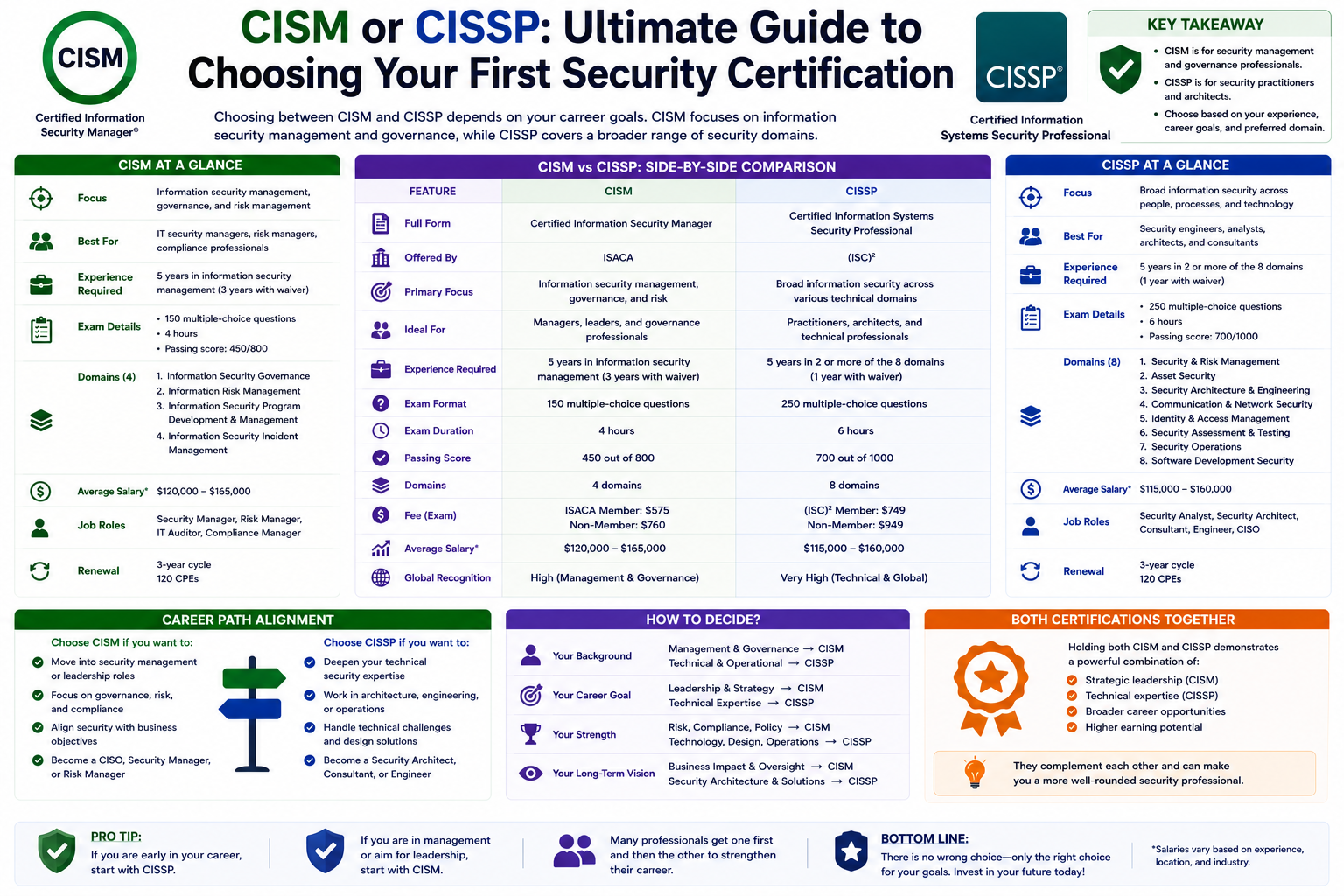
Cybersecurity has evolved into one of the most critical pillars of modern digital infrastructure. As organizations expand their reliance on cloud systems, remote operations, and interconnected networks, the demand for skilled professionals who can protect sensitive data has grown rapidly. In response, industry-recognized certifications have become an important way for professionals to demonstrate their expertise and credibility.
Among the many certifications available, two stand out at the advanced level: CISSP and CISM. These are not entry-level credentials. Instead, they are designed for individuals who already have substantial experience in information security and are looking to move into higher responsibility roles.
What makes these certifications especially significant is the way they reflect two different dimensions of cybersecurity work. One leans toward technical architecture and system-wide security design, while the other focuses more on leadership, governance, and aligning security with organizational objectives. Because of this, professionals often find themselves comparing the two when planning long-term career growth.
Before exploring which one might be more suitable, it is important to understand what each certification represents, what kind of mindset it develops, and how it fits into the broader cybersecurity ecosystem.
CISSP: A Broad and Technical Security Framework
The Certified Information Systems Security Professional certification is widely regarded as one of the most comprehensive credentials in the cybersecurity field. It is designed for professionals who are involved in designing, building, and managing security systems at an enterprise level.
Rather than focusing on a single specialization, CISSP spans a wide range of security domains. It covers foundational concepts such as risk management and security governance, while also extending into more technical areas like network protection, identity management, cryptography principles, and secure software development practices.
This wide scope is intentional. CISSP is meant to prepare professionals for roles where they must understand how different parts of a security ecosystem interact. Instead of working on one isolated component, CISSP-certified individuals are expected to view security holistically.
One of the defining characteristics of this certification is its balance between technical depth and strategic oversight. While it does not go as deep into hands-on configuration as some specialized technical certifications, it requires a strong understanding of how security technologies are designed, deployed, and maintained across large environments.
Professionals who pursue CISSP often aim for positions where they influence or directly manage security architecture. These roles may involve defining security policies, evaluating system vulnerabilities, coordinating incident response strategies, and ensuring compliance with regulatory frameworks.
Another important aspect of CISSP is its emphasis on consistency and structure. The knowledge areas are organized in a way that encourages professionals to think systematically. This helps them build security solutions that are not only effective in isolation but also sustainable and scalable across complex infrastructures.
In many organizations, CISSP holders are viewed as individuals who can bridge the gap between technical teams and executive decision-making. They are expected to understand both how systems work and how security decisions impact the organization as a whole.
CISM: A Security Certification Focused on Leadership and Governance
While CISSP takes a broad technical and architectural approach, the Certified Information Security Manager certification focuses more on the management side of cybersecurity. It is designed for professionals who are responsible for overseeing security programs rather than implementing them at a technical level.
CISM places strong emphasis on governance structures, risk alignment, and organizational strategy. Instead of asking how a system is secured in technical detail, it focuses on why certain security decisions are made and how they support business objectives.
This certification is particularly relevant in environments where security is not just a technical concern but a core business function. Professionals who earn CISM are often involved in shaping policies, defining security roadmaps, managing risk frameworks, and ensuring that security initiatives align with organizational goals.
A key aspect of CISM is its focus on communication and leadership. Security managers must frequently interact with executives, auditors, compliance teams, and technical staff. As a result, CISM emphasizes the ability to translate technical risks into business language that decision-makers can understand and act upon.
The certification also addresses incident management from a leadership perspective. Rather than focusing on the technical containment of threats, it emphasizes coordination, response planning, and organizational readiness. This includes ensuring that teams know how to react during security breaches and that proper recovery procedures are in place.
Another important area within CISM is risk management. Professionals are trained to evaluate potential threats not just from a technical standpoint but also in terms of business impact. This helps organizations prioritize security investments and allocate resources effectively.
CISM-certified professionals are typically found in roles where they oversee security programs, manage teams, and guide strategic direction. These positions require a strong understanding of both cybersecurity principles and organizational behavior.
Fundamental Differences in Purpose and Perspective
Although CISSP and CISM are often discussed together, they are built on different philosophies. The most important distinction lies in their primary focus.
CISSP is centered on the design and implementation of security systems. It encourages professionals to think about how to build secure environments, how to protect infrastructure, and how to manage technical security challenges across multiple domains.
CISM, on the other hand, focuses on managing and governing those systems. It emphasizes decision-making, policy creation, risk evaluation, and alignment with business objectives.
This difference creates two distinct perspectives within the cybersecurity field. One is more technical and architectural, while the other is more strategic and organizational.
Another way to understand the distinction is to consider the type of questions each certification prepares you to answer. CISSP-trained professionals often ask questions such as how to secure a network, how to design authentication systems, or how to implement encryption strategies. In contrast, CISM-trained professionals focus on questions like why a certain security policy is needed, how risk should be prioritized, or how security initiatives support business goals.
Neither approach is superior. Instead, they complement each other. Organizations need both strong technical foundations and effective governance structures to maintain a secure environment.
Skills and Mindset Developed by Each Certification
The CISSP certification develops a mindset that is analytical, detail-oriented, and systems-focused. Professionals trained under this framework learn to evaluate security challenges from multiple angles and understand how different components of an IT environment interact.
They develop skills in identifying vulnerabilities, designing secure architectures, and implementing layered defense strategies. This requires both technical understanding and the ability to think strategically about long-term security design.
CISM, on the other hand, cultivates leadership-oriented thinking. It trains professionals to evaluate risk at an organizational level and make decisions that balance security with business priorities.
Those who follow the CISM path develop strong skills in governance, communication, and program management. They learn how to build security policies, manage teams, and ensure that security efforts are aligned with broader organizational strategies.
In practice, CISSP professionals often act as builders and architects of security systems, while CISM professionals act as planners and decision-makers who guide how those systems are used and maintained.
Both skill sets are essential, and many organizations benefit from individuals who understand both perspectives, even if they specialize in one.
Real-World Career Paths and Professional Applications
The difference between CISSP and CISM becomes clearer when looking at real-world job roles.
CISSP is commonly associated with positions that involve technical leadership and security architecture. Professionals with this certification often work as security engineers, system architects, network security specialists, or consultants who design and evaluate enterprise security solutions.
These roles require a strong understanding of how systems are built and how threats can be mitigated at various layers of infrastructure. CISSP holders are often responsible for ensuring that security is integrated into system design from the ground up.
CISM aligns more closely with managerial and strategic positions. Individuals with this certification often work as security managers, risk officers, compliance leaders, or information security directors.
In these roles, the focus shifts from building systems to managing them. Responsibilities may include developing security policies, overseeing compliance audits, managing incident response teams, and communicating risk to senior leadership.
As professionals progress in their careers, many find that their responsibilities gradually shift from technical execution toward management and strategy. This is one reason why both certifications are often considered at different stages of a career rather than competing choices.
Why CISSP and CISM Are Frequently Compared
Despite their differences, CISSP and CISM are often compared because they both represent advanced levels of cybersecurity expertise. They are recognized globally and are frequently listed as preferred qualifications for senior security roles.
Another reason for comparison is that both certifications require significant professional experience. They are not entry points into cybersecurity but rather validations of established careers.
Additionally, both certifications cover overlapping themes such as risk management, security governance, and incident handling. However, the way they approach these topics differs significantly. CISSP focuses more on technical implementation, while CISM focuses more on organizational oversight.
This overlap can sometimes create confusion for professionals deciding which path to pursue. However, understanding the intent behind each certification helps clarify that they are designed for different types of responsibilities.
Early Career Perspective and Strategic Direction
For professionals early in their cybersecurity journey, CISSP and CISM may initially seem distant goals. Both require several years of experience, which means they are typically pursued after building a strong foundation in IT or security roles.
However, understanding the differences between them early can help shape career decisions. For example, someone interested in hands-on technical work might gravitate toward roles that build experience aligned with CISSP domains. This could include system administration, network security, or security engineering.
On the other hand, individuals who are more interested in organizational strategy, risk management, or leadership may focus on roles that align with CISM-oriented skills, such as compliance, audit, or security coordination.
Even at early stages, exposure to both technical and managerial aspects of cybersecurity can be valuable. Many professionals begin in technical roles and gradually transition into leadership positions as they gain experience and broader organizational understanding.
This progression is natural in cybersecurity careers, where technical expertise often forms the foundation for later strategic responsibilities.
Understanding this pathway helps professionals make more intentional choices about their development, ensuring that their experience aligns with their long-term goals rather than focusing solely on immediate job requirements.
Deep Dive Into Exam Structure and Assessment Style
One of the most important differences between CISSP and CISM becomes visible when you examine how each certification evaluates knowledge. While both are advanced-level certifications designed for experienced professionals, the way candidates are tested reflects the philosophy behind each credential.
The CISSP exam is known for its breadth and adaptive questioning style. It does not simply test memorization of facts. Instead, it evaluates how well a candidate can apply security principles across different scenarios. The questions often present complex situations where multiple answers may appear correct at first glance. The challenge lies in selecting the most appropriate solution based on established security frameworks and best practices.
This approach reflects the reality of enterprise security work, where professionals rarely deal with isolated problems. Instead, they must consider multiple layers of infrastructure, organizational constraints, and risk implications before making decisions. The CISSP exam is structured to mirror this complexity, requiring candidates to think like security architects rather than technicians.
CISM, on the other hand, takes a different approach to evaluation. Its exam structure is more focused on managerial reasoning and decision-making. Rather than emphasizing technical depth, it presents scenarios that test how well a candidate can manage security programs, allocate resources, and align decisions with business objectives.
The questions in CISM often revolve around prioritization and governance. For example, a candidate may be asked to determine the most appropriate response to a security risk from a management perspective. The emphasis is not on how to technically solve the issue, but on how to handle it strategically within an organization.
This difference in exam style highlights a broader philosophical divide. CISSP challenges technical judgment under complex system conditions, while CISM evaluates leadership judgment under organizational constraints.
Both exams are timed and structured to test endurance as well as understanding. Candidates must maintain focus across a large set of questions, many of which are designed to assess subtle differences in reasoning rather than obvious factual recall.
Experience Requirements and Professional Maturity Expectations
Another key distinction between these certifications lies in the type of professional experience they require. While both demand several years of background in information security, the nature of that experience differs significantly.
CISSP expects candidates to have experience across multiple domains of cybersecurity. This includes exposure to areas such as network security, identity management, risk analysis, and security architecture. The requirement is intentionally broad, reflecting the certification’s goal of producing professionals who understand how different components of security systems interact.
The emphasis is not just on technical exposure but on diversity of experience. A candidate is expected to have worked in at least two domains, which ensures they have a well-rounded understanding of enterprise security environments. This breadth of exposure helps professionals think across systems rather than within isolated technical silos.
CISM, in contrast, places a stronger emphasis on managerial experience. While it still requires a foundation in information security, it specifically expects candidates to have experience in leadership or governance-related roles. This includes responsibilities such as managing security programs, overseeing risk frameworks, and guiding teams or initiatives.
The key requirement is not just involvement in security tasks, but active participation in decision-making processes that affect organizational security posture. This reflects the certification’s focus on strategic oversight rather than technical execution.
In practice, this means that CISSP candidates often come from technical backgrounds such as system administration, engineering, or security analysis. CISM candidates are more likely to have experience in roles involving policy development, audit coordination, or security program management.
These differences in experience expectations reinforce the idea that each certification is designed for a distinct professional trajectory.
Domain Philosophy and Knowledge Orientation
Although both certifications cover multiple domains, the way these domains are structured reveals their underlying intent.
CISSP domains are built around the concept of a secure enterprise environment. They cover a wide spectrum of technical and operational areas, including asset protection, communication security, security architecture, and software development security practices.
The structure encourages professionals to understand how security controls function across different layers of an organization. It is not enough to know individual concepts in isolation; candidates must understand how they interact within a broader system.
For example, identity management is not treated as a standalone topic. Instead, it is connected to network access, encryption, and risk management. This interconnected approach reflects real-world security environments where no domain operates independently.
CISM domains are structured differently. They revolve around the lifecycle of security management within an organization. This includes governance, risk management, program development, and incident response coordination.
Each domain is designed to reflect a stage in how organizations plan, implement, and maintain security programs. Rather than focusing on technical mechanisms, CISM emphasizes process maturity and organizational alignment.
For instance, governance is not just about policies, but about how those policies are integrated into business operations. Risk management is not just about identifying threats, but about prioritizing them in a way that supports business objectives.
This difference in domain philosophy highlights a key distinction: CISSP is system-oriented, while CISM is process-oriented.
Cognitive Approach and Decision-Making Frameworks
Beyond content and structure, the two certifications also shape different cognitive approaches to problem-solving.
CISSP encourages analytical thinking at a systems level. Professionals trained under this framework learn to evaluate multiple variables simultaneously. They consider how changes in one part of a system may affect other components. This requires a strong understanding of dependencies, vulnerabilities, and security trade-offs.
Decision-making in CISSP contexts often involves selecting the most secure or most appropriate technical solution based on established principles. The focus is on correctness within a technical framework.
CISM, however, encourages strategic thinking at an organizational level. Decision-making is less about technical precision and more about alignment with business priorities. Professionals must weigh risk against operational impact, cost, compliance requirements, and organizational goals.
This means that in CISM-style scenarios, the “best” answer is often the one that supports long-term business stability rather than immediate technical resolution.
These differences reflect two distinct ways of thinking about cybersecurity. One is rooted in system optimization, while the other is rooted in organizational balance.
Positioning Within Organizational Hierarchies
The roles associated with CISSP and CISM also tend to differ in terms of organizational hierarchy.
CISSP professionals are often positioned in roles that directly influence technical infrastructure. They may operate as senior engineers, architects, or consultants who provide guidance on security implementation. While these roles can involve leadership responsibilities, they are often closer to the technical core of an organization.
These professionals are typically involved in designing security frameworks, evaluating system vulnerabilities, and ensuring that technical controls meet security standards.
CISM professionals, on the other hand, are often positioned closer to executive or managerial layers. Their responsibilities include overseeing security programs, managing budgets, and coordinating with other departments to ensure security alignment.
They are more likely to participate in strategic planning discussions and contribute to organizational decision-making at a higher level.
This hierarchical distinction is not rigid, but it reflects the general direction in which each certification leads. CISSP tends to anchor professionals in technical leadership, while CISM often serves as a stepping stone toward executive security roles.
Real-World Application in Organizational Environments
In practical environments, the differences between CISSP and CISM become especially noticeable during security operations and decision-making processes.
A CISSP-oriented professional might be responsible for designing a secure network architecture for a global enterprise. This would involve selecting appropriate encryption methods, configuring access controls, and ensuring that systems are resilient against cyber threats.
Their focus would be on ensuring that the technical implementation is robust, scalable, and aligned with security best practices.
A CISM-oriented professional, however, might be responsible for evaluating whether that same network architecture aligns with the organization’s risk tolerance and business strategy. They would consider whether the investment in security controls is justified by the level of risk, and how it fits into the organization’s broader objectives.
In incident response scenarios, CISSP professionals might focus on identifying the source of a breach and implementing technical containment measures. CISM professionals would focus on coordinating response teams, communicating with stakeholders, and ensuring that business operations are restored efficiently.
This division of responsibilities demonstrates how both certifications contribute to different but complementary aspects of cybersecurity operations.
Career Transition Dynamics Between Technical and Managerial Paths
Many cybersecurity professionals do not remain strictly within either technical or managerial tracks throughout their careers. Instead, they often transition between roles as their experience grows.
A common progression begins with technical roles that align closely with CISSP domains. Professionals gain hands-on experience in system security, network defense, and infrastructure management. Over time, as they develop broader organizational awareness, they may transition into leadership positions where CISM-related skills become more relevant.
In some cases, professionals pursue CISSP first to establish technical credibility, then move toward CISM as they take on managerial responsibilities. However, the reverse can also occur in organizations where individuals begin in governance or compliance roles and later deepen their technical understanding.
These transitions reflect the evolving nature of cybersecurity careers. As professionals advance, their responsibilities often expand from execution to strategy, requiring a broader skill set that spans both certifications.
Understanding this fluidity is important for long-term career planning, as it allows individuals to develop skills that remain relevant across multiple stages of professional growth.
Common Cognitive and Strategic Challenges for Candidates
Although CISSP and CISM are both designed for experienced professionals, candidates often face challenges that go beyond technical knowledge.
For CISSP, one of the main challenges is adapting to its breadth. Because it covers so many domains, candidates may find it difficult to maintain depth across all areas. The exam requires not only familiarity with concepts but also the ability to apply them in complex scenarios.
Another challenge lies in shifting from technical thinking to architectural thinking. Many professionals are used to solving specific technical problems, but CISSP requires them to think in terms of systems and long-term security design.
For CISM, the challenge is often conceptual rather than technical. Candidates must learn to think in terms of governance, risk prioritization, and business alignment. This requires a shift away from technical problem-solving toward strategic decision-making.
Many professionals initially struggle with the idea that the “best” answer is not always the most technically secure solution, but the one that best supports organizational goals.
Both certifications, therefore, require not just knowledge acquisition, but cognitive adaptation to different ways of thinking about cybersecurity.
Industry Relevance and Organizational Demand Patterns
In modern organizations, both CISSP and CISM continue to be highly valued, but they are often applied in different contexts.
CISSP is frequently associated with roles that require deep technical expertise and system-wide security oversight. Organizations rely on CISSP professionals to ensure that their technical infrastructure is secure, resilient, and compliant with industry standards.
CISM is more commonly associated with roles that require governance, risk management, and strategic oversight. Organizations depend on CISM professionals to ensure that security programs are aligned with business objectives and regulatory requirements.
As cybersecurity becomes more integrated into business operations, the demand for professionals who understand both perspectives continues to grow. Many organizations now seek individuals who can bridge the gap between technical implementation and strategic governance.
This trend reflects the increasing complexity of cybersecurity environments, where technical and managerial functions are deeply interconnected.
Long-Term Career Pathways in Cybersecurity Leadership
As cybersecurity careers mature, professionals often discover that growth is less about collecting technical knowledge and more about shifting perspectives. Early roles tend to focus on execution—configuring systems, monitoring alerts, and responding to incidents. Over time, however, responsibilities expand into planning, coordination, and strategic oversight.
At this stage, certifications like CISSP and CISM begin to influence not just job eligibility but career direction itself. They act as signals that shape how employers position professionals within organizational hierarchies and how individuals perceive their own career identity.
The CISSP pathway generally aligns with professionals who remain closely connected to technical ecosystems even as they advance. These individuals often move into roles where they are responsible for designing enterprise security architectures, evaluating system resilience, and guiding technical teams.
The progression is typically gradual. A professional might begin as a security analyst, move into a senior engineering role, and eventually transition into architecture or security design leadership. Even at higher levels, the focus remains tied to systems, infrastructure, and technical decision-making.
CISM, in contrast, is strongly associated with progression into management-focused roles. Professionals following this trajectory often begin in operational or compliance-related positions and gradually move into program management, governance oversight, or executive security leadership.
Instead of focusing on system design, their responsibilities evolve toward organizational alignment. They may oversee security teams, define enterprise-wide policies, manage risk frameworks, or contribute to board-level discussions about cybersecurity strategy.
The distinction between these pathways is not absolute, but it reflects how organizations typically structure cybersecurity leadership. One path emphasizes technical authority, while the other emphasizes organizational governance.
How Organizations Position CISSP and CISM Professionals Differently
In many enterprises, CISSP and CISM-certified professionals are placed in complementary roles that support different layers of the security function.
CISSP-oriented professionals are often embedded within technical teams or security operations divisions. Their work involves ensuring that security architecture is properly designed and implemented across networks, applications, and infrastructure.
They are frequently consulted during system design phases, cloud migrations, or infrastructure upgrades. Their input helps ensure that security is built into systems from the beginning rather than added as an afterthought.
CISM-oriented professionals are more likely to be positioned within governance, risk, or compliance departments. Their responsibilities focus on ensuring that security initiatives align with organizational goals and regulatory requirements.
They often act as intermediaries between technical teams and executive leadership. When technical teams present security solutions, CISM professionals evaluate whether those solutions align with business priorities, risk appetite, and budget constraints.
This separation of responsibilities allows organizations to maintain a balance between technical depth and strategic oversight. CISSP professionals ensure that systems are secure at a technical level, while CISM professionals ensure that security efforts are aligned with organizational direction.
Salary Trajectories and Compensation Progression Over Time
While salary is often one of the most visible differences between CISSP and CISM, the reality is more nuanced than simple averages.
In early senior-level positions, CISSP-certified professionals may see stronger compensation growth due to the high demand for technical expertise in security architecture, cloud security, and infrastructure protection. Organizations are often willing to pay a premium for individuals who can directly influence system security design.
As professionals move into leadership roles, CISM-certified individuals often experience stronger long-term earning potential. This is because managerial and executive positions tend to come with broader organizational responsibilities, including budget control, team leadership, and strategic planning authority.
Over time, compensation differences are less about the certification itself and more about the roles it enables access to. CISSP tends to open doors to high-paying technical leadership positions, while CISM leads toward executive-level compensation structures.
At the highest levels of cybersecurity leadership, such as Chief Information Security Officer roles, both certifications are valued. In many cases, professionals who hold both credentials are seen as particularly strong candidates because they demonstrate both technical understanding and strategic leadership capability.
However, it is important to recognize that salary progression is influenced by multiple factors beyond certification. Industry sector, geographic region, organizational size, and individual performance all play significant roles.
Industry-Specific Demand and Role Distribution
Different industries tend to favor CISSP and CISM differently based on their operational priorities and regulatory environments.
Highly technical industries such as cloud computing, software development, telecommunications, and infrastructure services often prioritize CISSP-oriented skills. These environments require deep technical expertise to secure complex, distributed systems.
In these sectors, security architecture, encryption systems, and network defense mechanisms are critical. Professionals who can design and implement these systems are highly valued.
Industries with strong regulatory and compliance requirements, such as finance, healthcare, government, and insurance, often place greater emphasis on CISM-oriented capabilities. These organizations must manage risk at scale, ensure compliance with strict regulations, and maintain detailed governance structures.
In these environments, the ability to translate security risks into business impact is essential. Leaders must ensure that security programs align with legal requirements, audit standards, and organizational policies.
Large enterprises with mature cybersecurity programs often require both skill sets. Technical teams handle implementation and defense, while governance teams ensure alignment and accountability. In such environments, CISSP and CISM professionals work closely together rather than in isolation.
Hybrid Skill Development and Overlapping Competencies
Although CISSP and CISM are distinct certifications, modern cybersecurity environments increasingly require professionals who can operate across both domains.
For example, cloud security architecture often requires both technical understanding and governance awareness. A professional designing a cloud environment must understand encryption, identity management, and network segmentation, while also considering compliance requirements, risk exposure, and business impact.
Similarly, incident response now involves both technical containment and strategic communication. Technical teams may focus on identifying and isolating threats, while leadership teams manage communication, regulatory reporting, and business continuity planning.
This overlap has led to the rise of hybrid cybersecurity roles that require familiarity with both CISSP and CISM concepts. Professionals in these roles must be able to switch between technical reasoning and managerial thinking depending on the situation.
As a result, many experienced professionals eventually develop competencies that span both certifications, even if they only formally hold one.
Decision-Making Frameworks Used in Real Security Environments
In practice, cybersecurity decisions are rarely made in isolation. They involve multiple stakeholders, competing priorities, and varying levels of risk tolerance.
CISSP-trained professionals typically rely on structured technical frameworks when making decisions. These frameworks help evaluate system vulnerabilities, prioritize mitigation strategies, and ensure that technical controls are properly implemented.
Their decision-making process is often grounded in principles such as least privilege, defense in depth, and secure design architecture. These principles guide how systems are built and maintained.
CISM-trained professionals use broader organizational frameworks. Their decisions are influenced by risk appetite, business impact analysis, compliance requirements, and resource allocation considerations.
Instead of focusing on how to technically solve a problem, they focus on how the solution affects the organization as a whole. This includes evaluating cost implications, operational disruption, and long-term strategic alignment.
In real-world environments, these two decision-making styles often intersect. A technical solution may be feasible from a CISSP perspective but may not be practical from a CISM perspective due to cost or organizational constraints.
Conversely, a governance-driven decision may align with business strategy but require technical refinement to be effectively implemented.
Common Misconceptions About Both Certifications
One of the most common misconceptions is that CISSP is purely technical and CISM is purely managerial. While there is truth in their general orientation, both certifications require a blend of technical understanding and strategic thinking.
CISSP does not ignore management principles. It includes domains related to risk management, security governance, and operational planning. Similarly, CISM does not ignore technical concepts. It requires an understanding of security technologies and how they support organizational objectives.
Another misconception is that CISSP is always more difficult than CISM or vice versa. In reality, difficulty depends on a candidate’s background. Individuals with technical experience may find CISSP more intuitive, while those with management experience may find CISM more accessible.
There is also a misconception that one certification is inherently superior. In practice, their value depends entirely on career goals and organizational context. Neither certification replaces the other, and both serve different but equally important purposes.
Strategic Fit Based on Personality and Work Style
Career satisfaction in cybersecurity often depends not just on skill but on work style and personality alignment.
Professionals who enjoy solving technical problems, analyzing system behavior, and working closely with infrastructure tend to gravitate toward CISSP-aligned roles. These individuals often prefer structured problem-solving and enjoy working at the system level.
They are typically comfortable dealing with complexity in technical environments and are motivated by building secure, resilient systems.
Professionals who prefer coordination, planning, and organizational strategy tend to align more with CISM-oriented roles. These individuals are often skilled communicators who enjoy working with teams, managing priorities, and shaping long-term security direction.
They are motivated by influence at the organizational level rather than direct technical implementation.
Understanding these differences can help professionals choose a path that aligns not only with career goals but also with personal strengths and working preferences.
Evolution of Cybersecurity Roles in Cloud and Hybrid Environments
The rise of cloud computing and hybrid infrastructure has significantly changed how CISSP and CISM skills are applied in practice.
Cloud environments require a strong architectural understanding of distributed systems, identity management, and network segmentation. These areas align closely with CISSP competencies.
At the same time, cloud adoption introduces complex governance challenges, including shared responsibility models, compliance across jurisdictions, and dynamic risk management. These areas align closely with CISM competencies.
As a result, modern cybersecurity roles increasingly require collaboration between technical architects and governance leaders. Security decisions must account for both system design and organizational policy.
This evolution has made the distinction between CISSP and CISM less about separation and more about integration. Organizations now expect both perspectives to be present in decision-making processes.
Career Risk Factors and Common Misalignment Scenarios
One of the challenges professionals face is choosing a certification path that does not align with their actual career direction.
For example, a technically oriented professional may pursue CISM without transitioning into management roles. In such cases, the certification may not immediately enhance job responsibilities or career progression.
Similarly, a management-oriented professional may pursue CISSP without engaging in technical roles, resulting in limited practical application of the knowledge.
Misalignment often occurs when certifications are pursued based on perceived prestige rather than career fit. While both CISSP and CISM are highly respected, their value is maximized only when aligned with appropriate roles.
Another common issue is delayed specialization. Professionals sometimes delay choosing between technical and managerial paths for too long, resulting in slower career progression due to a lack of focused experience.
Organizational Value of Dual Certification Awareness
Although most professionals begin with one certification path, awareness of both CISSP and CISM concepts can significantly enhance effectiveness in cybersecurity roles.
Technical professionals benefit from understanding governance and risk management, as it helps them design solutions that align with organizational priorities.
Similarly, managerial professionals benefit from understanding technical constraints, as it enables more realistic decision-making and better communication with technical teams.
Organizations often value professionals who can bridge this gap, even informally. Such individuals contribute to smoother collaboration between departments and more effective security planning.
Over time, this hybrid understanding becomes increasingly important as cybersecurity continues to integrate with business operations at all levels.
Impact of Emerging Cyber Threats on Certification Relevance
The rapid evolution of cyber threats is continuously reshaping what cybersecurity professionals are expected to know and how they apply their expertise in real environments. Attack techniques are no longer limited to traditional malware or perimeter breaches; instead, they now include cloud misconfigurations, supply chain vulnerabilities, identity-based attacks, and AI-assisted exploitation methods. This shift is influencing how both CISSP and CISM knowledge frameworks are applied in practice.
For CISSP-oriented professionals, emerging threats increase the importance of architectural resilience. Security design must now account for dynamic infrastructures, zero-trust models, and constantly changing attack surfaces. The focus is shifting toward building adaptable systems that can respond to threats that were not anticipated during initial design phases. This requires continuous reassessment of technical controls and deeper integration of automation in defense mechanisms.
For CISM-oriented professionals, evolving threats highlight the growing importance of governance agility. Security leadership must ensure that policies and risk frameworks can adapt quickly to new threat landscapes. Decision-makers are increasingly required to evaluate risks in near real-time and adjust organizational priorities without disrupting business continuity.
As threats become more complex and interconnected, the boundaries between technical execution and strategic governance continue to blur, making both perspectives increasingly interdependent in modern cybersecurity environments.
Conclusion
The comparison between CISSP and CISM ultimately reflects the broader reality of cybersecurity as a discipline that operates on two tightly connected levels: technical execution and strategic governance. Neither certification exists in isolation, and neither can fully replace the other because they are designed to address different, but equally essential, dimensions of security practice.
CISSP represents the structural backbone of cybersecurity knowledge. It focuses on how systems are designed, how security controls are implemented, and how complex infrastructures are protected across multiple layers. Professionals who follow this path are typically those who enjoy working close to the technical core of systems, analyzing architectures, and ensuring that security is embedded into every component of an organization’s digital environment. The certification develops a mindset centered on precision, system thinking, and technical resilience.
CISM, on the other hand, represents the decision-making and leadership layer of cybersecurity. It is less concerned with how individual technical solutions are built and more focused on why certain security decisions are made and how they support broader organizational objectives. It emphasizes governance, risk alignment, resource management, and the ability to translate security challenges into business language. Professionals aligned with this path often take on responsibilities that influence policy direction, organizational strategy, and executive-level risk discussions.
When viewed together, these certifications illustrate how cybersecurity success depends on both strong technical foundations and effective leadership structures. Organizations cannot operate securely without the other. Technical defenses without governance can become fragmented and misaligned, while governance without technical depth can lead to impractical or ineffective policies.
For professionals, the choice between CISSP and CISM should not be treated as a simple decision of which is “better,” but rather as a reflection of long-term career direction. Those who are drawn to system design, technical problem-solving, and architecture-driven thinking may find greater alignment with CISSP. Those who are more interested in leadership, organizational influence, and strategic decision-making may find CISM more suitable.
However, modern cybersecurity roles increasingly demand awareness of both perspectives. As organizations adopt cloud infrastructures, distributed systems, and advanced threat models, the separation between technical and managerial responsibilities continues to blur. Professionals who understand both domains—even if they specialize in one—are often better positioned to contribute meaningfully to security outcomes.
Ultimately, CISSP and CISM should be seen not as competing paths, but as complementary frameworks that together define the full spectrum of cybersecurity expertise. Choosing either path is less about limitation and more about direction, and both can lead to highly rewarding and impactful careers in a field that continues to evolve rapidly.