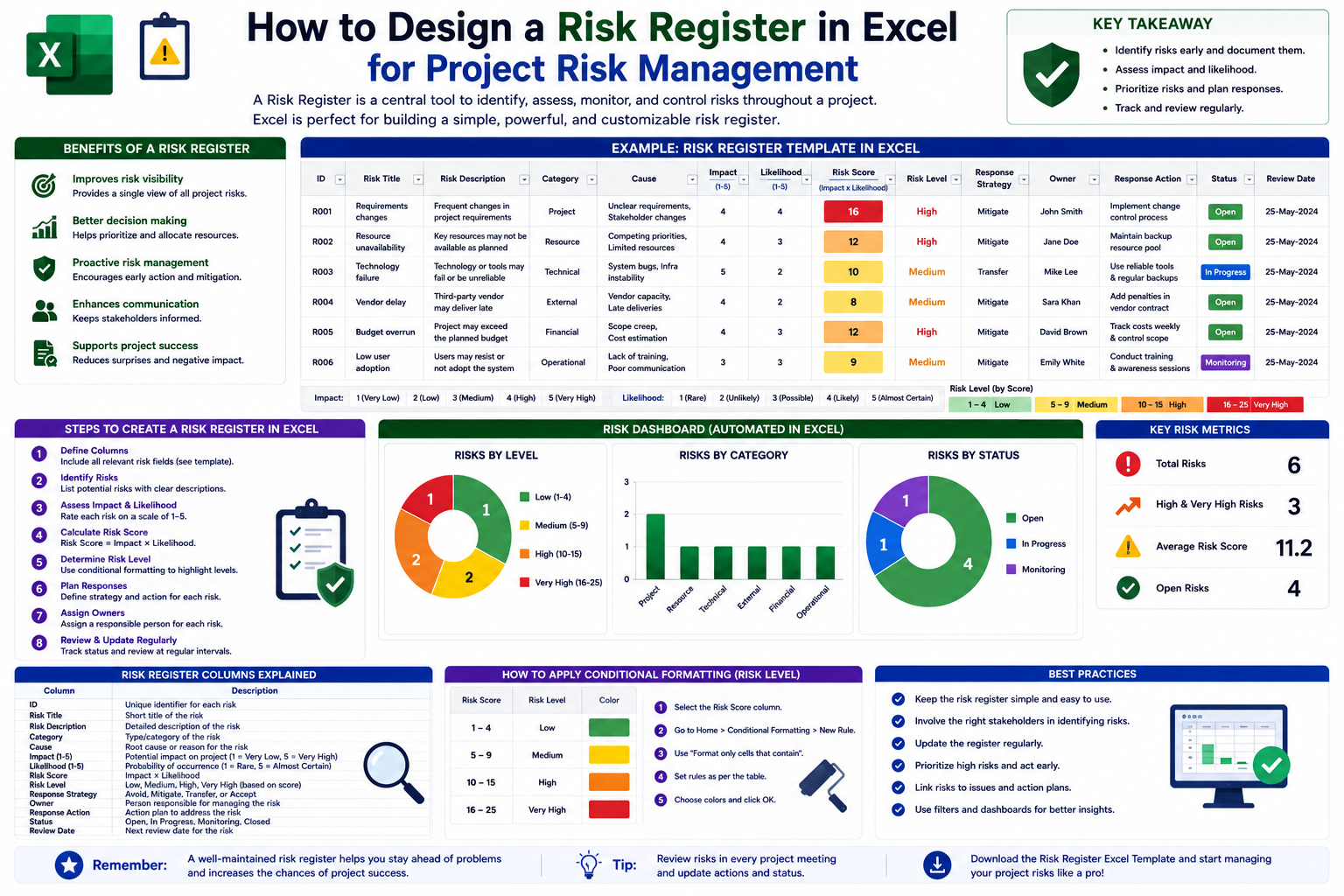
Every project, whether in IT, construction, product development, or business operations, exists in an environment of uncertainty. Even the most carefully planned initiatives are influenced by factors that cannot always be predicted with complete accuracy. Requirements may change midway, resources may become limited, dependencies may fail, and external conditions, such as market shifts or technical disruptions, can alter outcomes in unexpected ways.
Risk in this context does not mean failure is inevitable. Instead, it refers to the possibility that something may occur that affects project objectives. This effect can be negative, such as delays or increased costs, or occasionally positive, such as discovering an opportunity that improves efficiency or performance. The key challenge for any project team is not eliminating risk, which is impossible, but managing it in a way that reduces harm and improves decision-making.
A structured approach to risk allows teams to move from reactive problem-solving to proactive planning. Instead of responding to issues after they occur, teams can anticipate what might go wrong and prepare responses in advance. This shift in mindset is one of the most important developments in modern project management practices, especially in technology-driven environments where complexity is high and timelines are tight.
The Role of a Risk Register in Project Control
A risk register is essentially the central system where all identified risks are collected, documented, and managed throughout a project’s lifecycle. It acts as a living document that evolves as the project progresses. Unlike informal notes or scattered communication, a risk register provides a unified structure that ensures consistency and clarity.
At its core, the risk register serves as a decision-support tool. It helps project teams evaluate which risks deserve immediate attention and which ones can be monitored over time. By organizing risks in a structured format, it becomes easier to compare them, prioritize actions, and assign responsibility.
One of the most important aspects of a risk register is that it creates visibility. In many projects, risks exist in conversations, emails, or individual awareness but are never formally documented. This leads to gaps in communication and increases the likelihood that important issues will be overlooked. A risk register eliminates this problem by ensuring that every known risk is recorded in a single, accessible location.
It also supports accountability. When each risk is assigned to a specific owner, there is clarity about who is responsible for monitoring and responding to it. This reduces ambiguity and ensures that risk management is not treated as a general responsibility but as a defined part of project execution.
How Risk Shapes Decision-Making in Projects
Decision-making in projects is rarely straightforward. Managers often need to balance competing priorities such as time, cost, quality, and scope. Risk plays a significant role in this balancing act because it directly influences the probability of success or failure.
When risks are clearly documented, decision-makers can evaluate trade-offs more effectively. For example, if a particular technical approach carries a high risk of failure, the team might choose a slightly more expensive but more stable alternative. Without structured risk information, such decisions would be based on intuition rather than evidence.
Risk also helps in resource allocation. Not all risks require the same level of attention. Some may have minimal impact even if they occur, while others could significantly disrupt the project. A structured risk approach allows teams to allocate time, budget, and effort where it matters most, rather than spreading resources too thinly across all potential issues.
In addition, risk awareness improves communication between stakeholders. When risks are clearly outlined and prioritized, stakeholders gain a more realistic understanding of project challenges. This reduces misunderstandings and helps set appropriate expectations from the beginning.
The Structure Behind Effective Risk Tracking
Although risk registers can vary depending on organizational needs, they generally follow a logical structure that supports clarity and consistency. The structure is designed to capture both qualitative and quantitative aspects of risk, ensuring that each issue is understood in terms of both description and impact.
At a basic level, each risk needs an identifier, which allows it to be tracked easily over time. This is followed by a clear description that explains what the risk actually is. A well-written risk description avoids ambiguity and focuses on the cause and potential effect rather than vague statements.
Another essential aspect is categorization. Risks can originate from different areas such as technical systems, financial constraints, human resources, external dependencies, or operational challenges. Grouping risks into categories helps teams analyze patterns and identify areas where risks are most concentrated.
Two of the most critical dimensions of risk evaluation are likelihood and impact. Likelihood refers to the probability of the risk occurring, while impact refers to the severity of its consequences. When combined, these two factors provide a more complete understanding of overall risk significance.
Risk scoring is often used to translate these dimensions into a single value. This makes it easier to compare risks objectively. A higher score typically indicates a higher priority, allowing teams to focus their attention on the most critical issues first.
Understanding the Lifecycle of a Risk
Risks are not static; they evolve. A risk that appears highly significant at the beginning of a project may become less relevant later, while new risks may emerge as the project progresses. Because of this dynamic nature, risk management must be continuous rather than a one-time activity.
The lifecycle of a risk typically begins with identification. At this stage, the risk is recognized and documented. This is followed by an assessment, where the likelihood and impact are analyzed. Once evaluated, the risk is prioritized so that the team understands its relative importance compared to other risks.
After prioritization, planning begins. This involves defining what actions should be taken to reduce the likelihood of the risk occurring or to minimize its impact if it does occur. These actions are known as mitigation strategies.
Once the project is underway, risks must be monitored regularly. Monitoring involves reviewing the status of each risk, updating its likelihood or impact if necessary, and checking whether mitigation strategies are working as expected. If a risk materializes, it moves into a response phase where the planned actions are executed.
Finally, some risks are eventually closed. This can happen when the risk is no longer relevant, has been fully mitigated, or has already occurred and been addressed.
Why Structured Risk Documentation Improves Project Stability
Without structured documentation, risk management becomes inconsistent and fragmented. Different team members may have different perceptions of the same risk, leading to confusion and misaligned responses. Structured documentation solves this by creating a single source of truth.
It also improves traceability. When risks are documented properly, it becomes possible to track how they were identified, how they evolved, and how they were addressed. This historical record is valuable not only for the current project but also for future projects, as it provides insights into recurring issues and patterns.
Another important advantage is that structured risk documentation improves transparency. Stakeholders can review the risk register at any time to understand the current state of the project. This transparency builds trust and supports better governance practices.
In environments where compliance or auditing is important, structured documentation is particularly valuable. It demonstrates that risks were actively managed rather than ignored, which can be critical for regulatory or organizational requirements.
The Importance of Early Risk Identification
One of the most effective ways to reduce project uncertainty is to identify risks as early as possible. Early identification allows teams to take preventive action rather than corrective action, which is usually more costly and less efficient.
However, early risk identification is often challenging because not all risks are immediately visible. Some risks only become apparent after certain project phases begin. This is why continuous evaluation is necessary throughout the project lifecycle.
Teams that prioritize early risk identification tend to have more stable outcomes. They are better prepared for challenges and less likely to be surprised by unexpected issues. This does not eliminate risk, but it significantly reduces its disruptive potential.
Introduction to Using Excel for Risk Management
Among the various tools available for managing risks, spreadsheet software remains one of the most widely used, especially in smaller and medium-sized projects. Its popularity comes from its simplicity, accessibility, and flexibility.
Excel allows teams to quickly create structured tables where risks can be recorded, categorized, and analyzed. It does not require specialized software knowledge, making it accessible to a wide range of users. This makes it particularly useful for teams that are just beginning to adopt formal risk management practices.
Another advantage of using Excel is customization. Users can design the structure of their risk register based on the specific needs of their project. Columns can be added, removed, or modified as necessary. This flexibility ensures that the tool can adapt to different types of projects without requiring major changes.
Excel also supports basic automation through formulas, which can help calculate risk scores or prioritize risks automatically. While it may not offer the advanced features of dedicated project management systems, it provides enough functionality for effective risk tracking in many scenarios.
Challenges in Identifying and Recording Risks
Despite its importance, risk identification is often one of the most difficult parts of risk management. One common challenge is incomplete awareness. Team members may focus only on risks within their immediate area of responsibility, overlooking broader project risks.
Another challenge is underestimating the likelihood or impact of certain risks. Cognitive bias can lead individuals to assume that unlikely events will not occur, even when historical data suggests otherwise. This can result in insufficient preparation.
There is also the issue of vague risk descriptions. If risks are not clearly defined, they become difficult to analyze or address effectively. A poorly described risk may lead to confusion or inconsistent responses across the team.
Finally, there is the challenge of keeping the risk register updated. In fast-moving projects, teams may focus on execution and neglect documentation. Over time, this can lead to outdated risk information that no longer reflects the current state of the project.
Maintaining accuracy and consistency requires discipline and regular review, ensuring that the risk register remains a reliable tool rather than a static document.
Building a Practical Risk Identification Process in Real Projects
Before a risk register in Excel becomes useful, the quality of its input matters far more than the tool itself. A spreadsheet filled with poorly identified risks offers little value, while a well-structured register built from strong risk identification practices becomes a powerful decision-making asset.
Risk identification is not a single step but an ongoing thinking process that runs throughout a project. It requires teams to constantly ask what could go wrong, what dependencies exist, and where uncertainty might arise. In practice, this often involves reviewing project plans, breaking down deliverables, and examining each phase for potential disruptions.
One effective approach is to analyze risks from different perspectives rather than relying on a single viewpoint. Technical teams may focus on system failures or integration issues, while business stakeholders may focus on budget constraints or changing requirements. When these perspectives are combined, the resulting risk list becomes more complete and realistic.
Another important aspect of identification is learning from previous projects. Many risks repeat across different initiatives, especially in IT environments. Common examples include resource shortages, vendor delays, unclear requirements, or system compatibility problems. Capturing these recurring risks early ensures they are not overlooked in future planning.
Risk identification also benefits from structured discussion rather than informal observation. Teams that actively engage in guided discussions tend to uncover more risks than those relying on individual awareness alone. This is because group analysis often reveals blind spots that individuals may miss.
Translating Real-World Risks into Structured Excel Entries
Once risks are identified, the next challenge is converting them into structured entries that can be effectively managed in Excel. This step is critical because the way risks are written determines how usable the register becomes.
A well-written risk entry focuses on clarity and cause-and-effect relationships. Instead of vague statements, it describes what might happen and why it matters. For example, rather than writing a general statement like “system issues,” a structured entry would describe a specific scenario such as “server downtime due to unexpected hardware failure affecting application availability.”
This level of detail ensures that everyone reviewing the risk understands its context. It also makes it easier to assign appropriate mitigation actions later.
When entering risks into Excel, consistency becomes important. If each team member writes risks differently, the register becomes difficult to interpret. Establishing a standard format for risk descriptions helps maintain uniformity across the document.
Another important practice is ensuring that each risk is independent. Sometimes multiple risks are combined into a single entry, which reduces clarity. Breaking them down into separate risks allows for more accurate scoring and tracking.
Designing an Effective Scoring System for Risk Prioritization
One of the most powerful features of a risk register in Excel is the ability to assign numerical values to risks and automatically prioritize them. This transforms subjective assessments into structured decision-making inputs.
A typical scoring system uses two key dimensions: likelihood and impact. Likelihood measures how probable a risk is, while impact measures how severe the consequences would be if it occurred. By combining these two values, a single risk score is generated.
This scoring approach is simple but highly effective because it allows different types of risks to be compared on a common scale. A high-probability low-impact risk can be compared directly with a low-probability high-impact risk.
However, scoring is not just about multiplication or formulas. It requires careful definition of what each scale value represents. Without clear definitions, one person’s “high likelihood” may be another’s “medium likelihood,” leading to inconsistency.
To improve accuracy, teams often define behavioral descriptions for each scale level. For example, a “1” in likelihood might represent a risk that is highly unlikely to occur, while a “5” might represent an almost certain risk. Similar definitions are applied to impact levels.
This structured interpretation ensures that scoring remains consistent across different users and project phases.
Enhancing Excel with Conditional Logic for Smarter Risk Classification
Once risk scores are calculated, Excel can be used to automatically classify risks such as high, medium, or low priority. This is achieved through conditional logic that evaluates the risk score and assigns a corresponding label.
This automation reduces manual effort and ensures consistency in prioritization. Instead of relying on individuals to decide whether a risk is critical, the system applies predefined rules.
For example, risks above a certain threshold can automatically be marked as high priority. Medium-level risks fall within a defined range, while low-level risks remain below a specific cutoff. This creates a clear hierarchy of attention.
The advantage of this approach is that it allows teams to focus on what matters most without spending unnecessary time debating classification. It also ensures that priority levels remain consistent even as new risks are added.
However, it is important to periodically review these thresholds. As projects evolve, what was considered a high-risk threshold at the beginning may no longer be appropriate later. Adjusting these values ensures that prioritization remains aligned with project reality.
Structuring Risk Categories for Better Visibility
Categorization is often underestimated in risk management, yet it plays a crucial role in how effectively risks can be analyzed. Without categories, a risk register becomes a long list of unrelated items that are difficult to interpret.
By grouping risks into categories, patterns begin to emerge. For example, a project might reveal that most risks are related to external dependencies, indicating a potential weakness in vendor management. Alternatively, a high number of technical risks might suggest architectural instability.
Common categories include technical risks, operational risks, financial risks, schedule-related risks, and external risks. Each category provides a different lens through which the project can be evaluated.
In Excel, categories can be implemented using simple dropdown selections. This ensures consistency and prevents variations in naming conventions. It also makes filtering and analysis easier, allowing teams to focus on specific risk types when needed.
Categorization also improves reporting. Instead of reviewing all risks at once, stakeholders can view risks by category, which makes discussions more focused and relevant.
Building a Dynamic Risk Ownership Structure
Assigning ownership is a critical but often overlooked part of risk management. Without clear ownership, risks tend to be documented but not actively monitored.
A risk owner is responsible for tracking the status of a specific risk, updating its information, and ensuring that mitigation actions are executed when necessary. This does not necessarily mean they resolve the risk themselves, but they are accountable for managing it.
In a structured Excel risk register, ownership is typically assigned as a column where each risk is linked to a specific individual or role. This creates accountability and ensures that no risk is left unattended.
Ownership also improves communication. When a risk changes in severity or status, the responsible person is clearly identified, making it easier to coordinate responses.
However, assigning ownership requires careful consideration. It is not simply about assigning tasks to available team members. The assigned owner should have sufficient knowledge and authority to monitor and respond to the risk effectively.
Tracking Risk Status Across the Project Lifecycle
Risk status tracking ensures that the risk register remains a living document rather than a static record. As projects progress, risks change in nature, priority, and relevance.
A typical risk lifecycle includes states such as identified, active, mitigated, or closed. Each state reflects a different stage in how the risk is being managed.
Tracking status in Excel allows teams to quickly understand which risks require attention and which have already been addressed. It also helps identify bottlenecks, such as risks that remain active for extended periods without resolution.
Regular updates to risk status are essential. Without updates, the risk register loses accuracy and becomes less useful for decision-making. Establishing a routine review cycle ensures that information remains current.
Status tracking also supports communication with stakeholders. Instead of discussing every risk in detail, teams can focus on changes since the last review, making meetings more efficient.
Using Excel for Visual Risk Interpretation
While Excel is often seen as a numerical tool, it also offers visual capabilities that enhance risk interpretation. Visual cues make it easier to understand complex information at a glance.
Conditional formatting is one of the most effective ways to achieve this. By assigning colors to different risk levels, users can instantly identify critical issues without reading every detail.
For example, high-priority risks can be highlighted in one color, medium risks in another, and low risks in a third. This creates a visual hierarchy that improves readability.
Charts and simple visual summaries can also be created to show risk distribution across categories or priority levels. This helps teams understand where the majority of risks are concentrated.
Visual representation is especially useful in stakeholder communication. Not all stakeholders want to review detailed tables, but most can quickly interpret visual summaries.
Strengthening Risk Mitigation Planning in Structured Systems
Risk mitigation is the process of reducing either the likelihood or impact of a risk. In a structured risk register, mitigation planning becomes a key component of each entry.
A strong mitigation plan is specific and actionable. It clearly defines what steps will be taken, who will perform them, and how success will be measured. Vague statements such as “monitor closely” are not sufficient for effective risk management.
Mitigation strategies can take different forms depending on the nature of the risk. Some risks may require preventive actions, while others may require contingency planning in case the risk occurs.
In Excel, mitigation plans are typically documented in a dedicated column. This ensures that each risk is linked directly to its response strategy.
The effectiveness of mitigation planning depends on how realistic and practical the actions are. Plans that are too abstract or overly optimistic often fail when tested in real situations.
Maintaining Accuracy and Relevance in the Risk Register
One of the biggest challenges in risk management is ensuring that the risk register remains accurate over time. Projects evolve, and so do risks. Without regular maintenance, the register quickly becomes outdated.
Accuracy involves ensuring that risk descriptions, scores, and statuses reflect current reality. Relevance involves ensuring that only active and meaningful risks are included.
Over time, some risks become obsolete. These should be closed or archived rather than left active indefinitely. Keeping outdated risks in the register can distort reporting and reduce clarity.
Regular reviews are essential for maintaining both accuracy and relevance. These reviews allow teams to update risk information, adjust scores, and refine mitigation plans based on new developments.
A well-maintained risk register becomes increasingly valuable over time because it reflects not only current risks but also historical insights that can inform future projects.
Evolving the Risk Register from Static List to Active Management Tool
A risk register only becomes truly valuable when it moves beyond being a static record and becomes an active management system that influences daily project decisions. In many organizations, risk registers start as well-structured spreadsheets but gradually lose relevance because they are not consistently updated or integrated into project workflows.
To prevent this, the risk register must be treated as a dynamic document. This means it should evolve continuously as new information becomes available, project conditions change, and risks either increase or decrease in significance. A static register quickly becomes outdated, while a dynamic register reflects the real-time state of the project environment.
The shift from static to active usage requires discipline and process integration. Risk updates should not be treated as an occasional task but as part of regular project routines. Whenever project meetings occur, milestones are reached, or major decisions are made, the risk register should also be reviewed and updated accordingly.
When teams adopt this mindset, the risk register becomes more than documentation. It becomes a decision-making reference point that actively shapes project direction.
Embedding Risk Thinking into Daily Project Activities
One of the most effective ways to improve risk management maturity is to embed risk thinking into everyday project activities rather than treating it as a separate function. This ensures that risks are continuously considered during planning, execution, and review stages.
For example, during task planning, teams can ask what risks are associated with each deliverable. During development or implementation, they can evaluate whether any new risks have emerged due to technical or environmental changes. During testing or review phases, they can assess whether previously identified risks are still valid or have changed in severity.
When risk awareness becomes part of daily thinking, the likelihood of surprises decreases significantly. Teams begin to naturally anticipate potential problems rather than reacting to them after they occur.
This approach also improves communication. Instead of discussing risks only during formal risk meetings, conversations about risk become part of regular project discussions. This leads to more informed decisions and a more proactive project culture.
Strengthening Collaboration Through Shared Risk Visibility
A well-designed risk register improves collaboration by ensuring that all stakeholders have access to the same information. When risks are visible to everyone involved in the project, it reduces misunderstandings and improves alignment.
Shared visibility allows team members to understand not only their own responsibilities but also how their work affects other areas of the project. For example, a delay in one task may introduce new risks in another area. When these connections are visible, teams can coordinate more effectively.
In collaborative environments, the risk register becomes a communication bridge. It ensures that technical teams, management, and stakeholders are all working from the same set of assumptions. This reduces confusion and prevents conflicting interpretations of project status.
However, shared visibility also requires clarity. If the risk register is overly complex or poorly structured, it can become difficult for non-technical stakeholders to interpret. This is why simplicity and consistency in formatting are essential.
Improving Decision Speed with Structured Risk Data
One of the often-overlooked benefits of a well-maintained risk register is its impact on decision speed. When risk data is structured and easily accessible, decision-makers can evaluate situations more quickly and confidently.
Without a structured system, decisions often rely on fragmented information or subjective judgment. This can slow down processes and increase the likelihood of inconsistent decisions. A risk register helps eliminate this uncertainty by providing a centralized source of truth.
For example, if a new project change is proposed, decision-makers can quickly review existing risks to understand how the change might affect the project. They can assess whether it introduces new risks or increases the severity of existing ones.
This ability to quickly evaluate risk impact allows organizations to remain agile. Instead of delaying decisions due to uncertainty, they can move forward with greater confidence, knowing that risks have been properly assessed.
Structured risk data also supports prioritization. When multiple issues arise simultaneously, the risk register helps determine which ones require immediate attention and which can be addressed later.
Enhancing Risk Communication with Clear Documentation Practices
Effective risk communication depends heavily on how clearly risks are documented. Even the most accurate risk analysis loses value if it cannot be understood by others.
Clear documentation begins with language. Risk descriptions should be written in simple, direct terms that avoid unnecessary complexity. The goal is not to impress with technical language but to ensure understanding across all stakeholders.
Another important aspect is consistency. When risks are described in different styles or formats, it becomes harder to compare and analyze them. Standardized wording improves readability and ensures that all entries follow a similar structure.
In addition to clarity, documentation should also include context. A risk is more meaningful when its background is understood. For example, knowing why a risk exists or what conditions contribute to it helps teams evaluate its importance more effectively.
Good documentation also avoids duplication. Sometimes similar risks are recorded multiple times under slightly different descriptions. This creates confusion and inflates the perceived number of risks. Consolidating similar entries ensures accuracy and reduces redundancy.
Integrating Risk Registers with Project Workflow Systems
In more mature project environments, risk registers are not isolated tools but are integrated into broader project workflows. This integration ensures that risk management is aligned with planning, execution, and reporting processes.
When integrated properly, updates to project tasks can automatically trigger risk reviews. Similarly, changes in risk status can influence project schedules or resource allocation decisions. This creates a feedback loop where risks and project execution are continuously aligned.
Even in spreadsheet-based systems, this integration can be partially achieved through structured processes. For example, linking risk reviews to weekly project meetings ensures that updates are consistently captured.
The goal of integration is to eliminate the gap between risk management and project execution. When these two areas operate independently, risks are often identified but not acted upon effectively. Integration ensures that risk information directly influences project behavior.
Managing Risk Escalation Effectively
Not all risks remain at the same level of severity throughout a project. Some risks escalate over time, increasing in likelihood or impact. Effective risk management requires a clear process for handling such escalation.
Escalation occurs when a risk exceeds predefined thresholds or when mitigation efforts are no longer sufficient. At this point, the risk may need to be reviewed by higher-level decision-makers or escalated to senior management.
A structured risk register supports this process by clearly identifying high-priority risks through scoring and classification. This makes it easier to determine when escalation is necessary.
Without structured escalation, critical risks may remain at lower levels of attention, increasing the likelihood of negative outcomes. Proper escalation ensures that serious risks receive appropriate focus and resources.
Escalation is not just about raising awareness; it is about enabling action. When a risk is escalated, it often leads to changes in planning, resource allocation, or project direction.
Tracking Risk Dependencies Across Project Elements
In complex projects, risks rarely exist in isolation. Many risks are connected through dependencies that influence how they behave and evolve.
A dependency occurs when one risk affects or is influenced by another element in the project. For example, a delay in a supplier delivery may create multiple downstream risks affecting development, testing, and deployment.
Understanding these relationships is important because addressing one risk may help reduce several others. Conversely, ignoring dependencies can lead to unexpected cascading effects.
While Excel does not automatically map dependencies, structured documentation can still capture these relationships. By noting related risks within entries, teams can build awareness of how risks are interconnected.
Recognizing dependencies improves strategic planning. Instead of treating each risk individually, teams can focus on addressing root causes that influence multiple risks simultaneously.
Refining Risk Probability and Impact Over Time
Risk assessment is not a one-time activity. As projects evolve, both probability and impact values may change based on new information or progress.
A risk that initially seemed highly likely may become less relevant as conditions improve. Similarly, a low-impact risk may become more serious if project scope changes or new dependencies are introduced.
Regular reassessment ensures that the risk register remains accurate and aligned with current conditions. This is particularly important in long-term projects where circumstances can shift significantly over time.
Updating probability and impact values also helps maintain the accuracy of risk scoring. Without updates, the prioritization system becomes less reliable, potentially leading teams to focus on outdated concerns.
Building a Culture of Continuous Risk Awareness
The effectiveness of any risk register ultimately depends on the culture of the team using it. Even the most well-designed system will fail if it is not actively supported by consistent behavior and awareness.
A strong risk-aware culture encourages team members to identify and report risks early, without fear of criticism. It promotes open discussion and values transparency over perfection.
In such environments, risks are not seen as failures but as natural aspects of project execution. This mindset shift is essential for effective risk management.
Continuous awareness also means that risk discussions are not limited to formal meetings. Instead, they become part of everyday communication, ensuring that risks are always considered in decision-making.
When this culture is established, the risk register becomes a natural extension of how the team works rather than an external requirement.
Maintaining Long-Term Value of the Risk Register
As projects progress and eventually conclude, the risk register continues to hold value beyond the immediate lifecycle of the project. It becomes a historical record that can be used for future planning and analysis.
By reviewing past risks, teams can identify patterns that repeat across multiple projects. This helps improve future risk identification and reduces the likelihood of recurring issues.
The long-term value of a risk register lies in its ability to capture organizational learning. Each project contributes new insights that strengthen future performance.
Over time, this accumulated knowledge becomes one of the most valuable assets in improving project delivery and reducing uncertainty in future initiatives.
Strengthening Data Quality in the Risk Register
A risk register is only as reliable as the quality of the information it contains. If the data entered into the register is inconsistent, incomplete, or outdated, the entire purpose of risk management becomes weakened. Strong data quality practices ensure that the register reflects reality rather than assumptions or fragmented inputs.
One of the most important aspects of maintaining data quality is ensuring accuracy at the point of entry. Each risk must be recorded with precise wording that clearly defines the situation without ambiguity. When descriptions are vague, they create room for misinterpretation, which can lead to incorrect prioritization or ineffective responses.
Consistency is another key factor. When different team members contribute to the risk register, variations in language and structure can quickly appear. Over time, this leads to a disorganized dataset that is difficult to analyze. Establishing a consistent writing style and standardized terminology helps maintain clarity across all entries.
Timeliness also plays a major role in data quality. A risk that was relevant several weeks ago may no longer reflect the current project environment. If updates are not made regularly, the register becomes outdated and loses its decision-making value. Ensuring that risks are reviewed and refreshed at defined intervals keeps the information aligned with real project conditions.
Finally, completeness ensures that no critical detail is missing. A risk entry without sufficient context, ownership, or status information becomes less actionable. High-quality risk data is not just about identifying risks but fully describing them in a way that supports effective response planning.
Enhancing Strategic Visibility Through Risk Aggregation
As projects grow in size and complexity, individual risk entries alone are not enough to provide a complete picture. Strategic visibility requires aggregating risk information in a way that highlights broader patterns and trends across the project.
Risk aggregation involves grouping risks based on shared characteristics such as category, severity, or source. This allows teams to see beyond individual issues and understand where the majority of risk exposure is concentrated.
For example, if multiple risks originate from external vendors, this may indicate a structural dependency issue that requires higher-level attention. Similarly, a concentration of technical risks might suggest architectural weaknesses that need review.
Aggregation also helps in identifying systemic issues. Instead of treating each risk independently, teams can analyze clusters of related risks to identify root causes. This approach is more effective than addressing individual symptoms without understanding the underlying problem.
In Excel, aggregation can be supported through filtering, sorting, and structured grouping techniques. While not as advanced as dedicated analytics tools, it still provides enough capability to uncover meaningful insights when used consistently.
Applying Trend Observation to Risk Evolution
Risks do not remain static over time, and observing how they change can provide valuable insights into project stability. Trend observation focuses on how risk levels, categories, or frequencies evolve throughout the project lifecycle.
By reviewing historical updates, teams can identify whether risk exposure is increasing, decreasing, or stabilizing. An upward trend in high-severity risks may indicate growing instability, while a downward trend may suggest effective mitigation efforts.
Trend observation also helps in evaluating the effectiveness of risk management strategies. If mitigation actions are working properly, risk scores should gradually decrease over time. If they remain unchanged or increase, it may indicate that existing strategies are not effective.
This type of analysis also supports forecasting. By understanding how risks behave over time, teams can anticipate future challenges and prepare accordingly. This proactive approach is far more effective than reacting to issues after they escalate.
Even in spreadsheet environments, trend analysis can be achieved through version comparisons or periodic snapshots of the risk register. These snapshots provide a historical record that can be reviewed to understand how the project’s risk landscape has evolved.
Conclusion
A risk register is far more than a simple spreadsheet or documentation exercise; it is a practical framework that supports disciplined thinking in environments where uncertainty is unavoidable. In project-driven work, especially within IT and business operations, risks are not exceptions but constant variables that influence every stage of execution. The ability to recognize, structure, and respond to these uncertainties often determines whether a project succeeds smoothly or struggles through avoidable setbacks.
Using Excel as a foundation for building a risk register makes this process accessible to almost any team, regardless of size or technical maturity. Its flexibility allows organizations to start with a simple structure and gradually refine it as their needs become more advanced. Over time, what begins as a basic tracking sheet can evolve into a central decision-support system that reflects the real health of a project.
The true strength of a well-maintained risk register lies in its ability to bring clarity. It transforms scattered concerns into organized, measurable, and actionable information. By assigning likelihood, impact, ownership, and mitigation strategies, teams move from vague awareness of problems to a structured approach for managing them. This shift reduces uncertainty and improves confidence in decision-making.
Equally important is the cultural impact of consistent risk management. When teams actively engage with risk tracking, they develop stronger anticipation skills and become more proactive in identifying potential issues early. This creates an environment where risks are discussed openly rather than ignored, leading to better collaboration and stronger accountability.
However, the effectiveness of a risk register depends entirely on how consistently it is updated and used. Without regular review and refinement, even the most well-designed system can lose relevance. Continuous attention ensures that the register remains aligned with real project conditions and continues to provide meaningful insights.
Ultimately, a risk register in Excel is not just a tool for recording problems; it is a structured approach to thinking ahead, preparing for uncertainty, and strengthening overall project control.