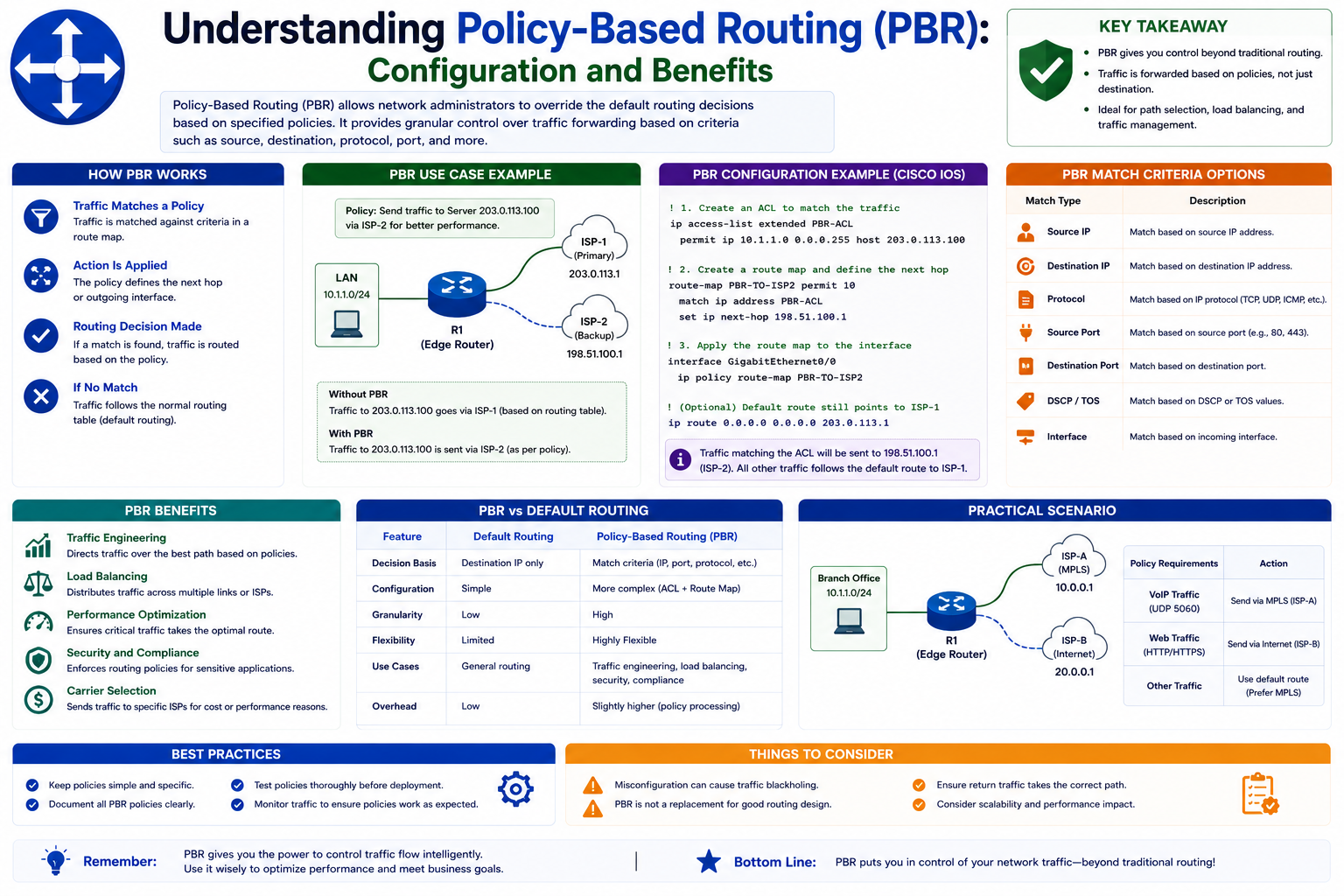
Modern computer networks are no longer simple paths where data just flows from one point to another in a predictable straight line. Instead, they are complex ecosystems with multiple possible routes, varying levels of performance, and different priorities for different types of traffic. In such an environment, relying only on traditional routing decisions can sometimes lead to inefficient use of resources.
Policy-Based Routing, commonly known as PBR, introduces a more intelligent and flexible approach. Instead of strictly following the shortest or most cost-effective path determined by routing protocols, PBR allows network administrators to influence how traffic is forwarded based on specific rules or “policies.” These policies can be designed around characteristics such as the source of the traffic, its destination, the type of application generating it, or even the priority level assigned to it.
To understand PBR in a practical sense, imagine a transportation system in a large city. Normally, vehicles follow predefined roads guided by traffic signs and general navigation systems. But in certain situations, special vehicles like emergency ambulances or delivery trucks carrying sensitive goods are given alternative routes that help them reach their destination faster or more safely. PBR works in a similar way inside a network by allowing certain types of data to take a different path than the default routing logic would normally choose.
This added control makes PBR a powerful technique in environments where performance optimization, security enforcement, and traffic segregation are important.
Understanding the Core Idea Behind Policy-Based Routing
At its core, Policy-Based Routing is about making forwarding decisions based on policies rather than purely on routing tables. Traditional routing systems primarily rely on destination-based logic. That means when a packet arrives at a router, the router looks at the destination IP address and consults its routing table to decide where the packet should go next.
While this method is efficient and scalable, it does not consider the nature of the traffic itself. All packets destined for the same location are treated equally, even if they serve very different purposes. For example, a video call, a database query, and a software update might all be heading to the same destination network, but their performance requirements are completely different.
Policy-Based Routing introduces a different mindset. Instead of only looking at where the packet is going, the router also looks at what the packet is, where it came from, and what rules apply to it. Based on this additional information, the router can override the default routing decision and send the traffic through a more appropriate path.
This ability to “bend” the normal routing behavior is what makes PBR unique. It does not replace traditional routing protocols; rather, it works alongside them, adding a layer of intelligent control on top of existing infrastructure.
Why Traditional Routing Alone Is Not Always Enough
In many network environments, traditional routing protocols such as OSPF, EIGRP, or BGP do an excellent job of finding the best available path between two points. These protocols calculate routes based on metrics like hop count, bandwidth, delay, and administrative distance. The result is usually an optimized path that ensures connectivity and efficiency.
However, the concept of “best path” in traditional routing is purely technical and does not take business requirements into account. A path that is technically optimal may not always be the most desirable from an organizational perspective.
For instance, consider a company with two internet connections: one high-speed but expensive link and another slower but more cost-effective link. Traditional routing might consistently choose the faster link for all traffic because it appears to be the best route. But from a business standpoint, it may be more efficient to reserve the expensive link for critical applications while sending less important traffic through the cheaper connection.
This is where Policy-Based Routing becomes valuable. It allows administrators to define rules that decide which traffic should use which path, regardless of what the routing protocol considers optimal.
Another limitation of traditional routing is its lack of application awareness. It cannot distinguish between types of traffic in a meaningful way. PBR helps overcome this limitation by introducing classification-based forwarding decisions.
How Policy-Based Routing Changes Traffic Flow Behavior
When Policy-Based Routing is implemented, the router no longer makes forwarding decisions based solely on destination information. Instead, it evaluates incoming packets against a set of predefined policies.
These policies act like filters that inspect packet characteristics. Once a packet matches a particular policy condition, a specific action is applied to it. This action often involves changing the next-hop decision, effectively redirecting the packet through a different route than it would normally take.
This process introduces a level of flexibility that is not possible with standard routing mechanisms. It allows network administrators to create highly customized traffic flows that align with organizational needs.
For example, traffic from a specific department might be routed through a secure inspection system before reaching its destination. Similarly, voice or video traffic might be prioritized and sent through a low-latency path to ensure better performance.
The key idea is that routing decisions become dynamic and context-aware rather than static and destination-only.
Traffic Classification: The Foundation of Policy-Based Routing
Before a router can apply any policy, it must first identify the traffic that the policy applies to. This process is known as traffic classification.
Traffic classification is essentially the act of sorting packets based on specific attributes. These attributes can include source address, destination address, protocol type, or even port numbers associated with particular applications.
Once traffic is classified, it can be grouped into categories that represent different types of network behavior. Each category can then be treated differently according to the policies defined by the network administrator.
This classification process is crucial because it determines the effectiveness of Policy-Based Routing. If traffic is not accurately identified, the wrong routing decisions may be applied, leading to inefficiencies or even connectivity issues.
In practical terms, classification allows the network to “understand” what kind of data is flowing through it, rather than treating all data equally.
The Role of Policies in Routing Decisions
Policies are the decision-making rules that drive Policy-Based Routing. They define what should happen when certain types of traffic are detected.
A policy typically consists of conditions and actions. The conditions describe the characteristics that traffic must match, while the actions define how that traffic should be handled.
For example, a policy might state that any traffic originating from a specific department should be routed through a secure gateway. Another policy might direct streaming traffic through a high-bandwidth connection.
These policies are evaluated in sequence, and once a match is found, the corresponding action is applied.
What makes policies powerful is their flexibility. They can be as simple or as complex as needed, allowing network designers to create highly specific traffic handling rules.
How Routers Apply Policy-Based Routing Internally
When a packet arrives at a router that has Policy-Based Routing enabled, the router does not immediately forward the packet based on its destination. Instead, it first checks whether any policies apply to the packet.
If a policy exists, the router compares the packet against the conditions defined in that policy. If the packet matches, the router overrides its normal routing logic and applies the action specified by the policy.
This process happens before the standard routing decision is made, which is why PBR is often described as a method for overriding default routing behavior.
If no policy matches the packet, the router simply forwards it using the regular routing table as usual.
This dual decision-making system ensures that Policy-Based Routing does not disrupt normal network operation but instead enhances it selectively.
Common Use Cases for Policy-Based Routing in Modern Networks
Policy-Based Routing is widely used in enterprise and service provider environments where traffic control and optimization are important.
One common use case is traffic engineering across multiple internet connections. Organizations often have more than one WAN link for redundancy or load distribution. PBR allows them to decide which type of traffic should use which link, improving both cost efficiency and performance.
Another important use case is application prioritization. Real-time applications such as voice calls or video conferencing require low latency and consistent performance. PBR can ensure that this type of traffic takes the most reliable and fastest path available.
Security is another major area where PBR is applied. Sensitive traffic can be routed through inspection systems or secure tunnels before reaching its destination, adding an extra layer of protection.
In large organizations, PBR is also used to separate departmental traffic. For example, finance data might be routed differently from general employee traffic to ensure compliance and monitoring requirements are met.
Advantages of Policy-Based Routing
One of the biggest advantages of Policy-Based Routing is control. It gives network administrators the ability to shape traffic flow in a way that aligns with business needs rather than relying solely on automatic routing decisions.
Another advantage is flexibility. PBR can be applied selectively, meaning it does not need to affect all traffic. This allows for highly targeted optimizations.
PBR also improves resource utilization. Distributing traffic intelligently across available links, it helps prevent congestion and ensures that network capacity is used more effectively.
In addition, PBR supports better service quality for critical applications by allowing them to bypass congested or less efficient paths.
Challenges and Limitations of Policy-Based Routing
Despite its benefits, Policy-Based Routing is not without challenges. One of the main concerns is complexity. As policies increase in number and sophistication, managing them becomes more difficult.
Another issue is troubleshooting. Because traffic may not follow the expected path based on traditional routing logic, diagnosing network problems can become more complicated.
Performance overhead is also a consideration. Each packet must be evaluated against policies, which can introduce additional processing load on network devices.
If not carefully designed, PBR can also lead to unintended routing loops or inconsistent traffic behavior.
Design Considerations for Effective Use of PBR
To use Policy-Based Routing effectively, careful planning is essential. Policies should be clearly defined and aligned with specific objectives rather than applied randomly.
It is also important to ensure that policies do not conflict with each other. Overlapping rules can create unpredictable results and make troubleshooting more difficult.
Network administrators should also consider scalability. As networks grow, the number of policies may increase, so maintaining simplicity wherever possible is beneficial.
Finally, monitoring and testing are crucial. Before applying policies in a production environment, it is important to verify their behavior in a controlled setting to avoid disruptions.
Real-World Perspective on Traffic Control with PBR
In a real-world network, Policy-Based Routing acts as a strategic tool rather than a basic configuration feature. It allows organizations to align network behavior with operational priorities.
Instead of relying entirely on automated decisions made by routing protocols, administrators gain the ability to influence traffic flow based on real business requirements. This shift from reactive routing to intentional routing design represents a significant step in modern network management.
By understanding how traffic behaves and applying intelligent policies, networks become more adaptable, efficient, and aligned with organizational goals.
Policy-Based Routing is not just about changing paths; it is about redefining how decisions are made inside a network environment.
Policy-Based Routing in Multi-Path Network Environments
In modern enterprise networks, it is extremely common to have more than one possible path between two points. These paths may differ in speed, cost, reliability, or geographical route. While traditional routing protocols automatically choose a “best path” based on technical metrics, real-world network design often requires something more nuanced than a single best route.
Policy-Based Routing becomes especially powerful in multi-path environments because it allows decision-making that is not strictly tied to routing metrics. Instead of letting the network always decide based on distance or cost, administrators can decide based on intent.
In a multi-path scenario, different links might serve different purposes. One link might be optimized for performance-sensitive traffic, while another is reserved for backup or non-critical data. Without Policy-Based Routing, all traffic might unintentionally concentrate on a single path simply because the routing protocol considers it optimal.
With PBR, traffic can be distributed intelligently based on rules that reflect business priorities rather than just network topology. This enables a more human-centered approach to traffic engineering, where decisions are based on what the data represents rather than only where it is going.
This capability is particularly important in hybrid infrastructures where organizations combine private networks, cloud connections, and internet-based links. Each of these paths may have different characteristics, and PBR allows traffic to be matched to the most appropriate route dynamically.
Packet Evaluation Process Inside Policy-Based Routing
To understand how Policy-Based Routing functions internally, it is important to look at how a router evaluates each packet when PBR is enabled.
When a packet enters an interface configured with PBR, the router does not immediately consult the routing table. Instead, it first enters a decision phase where policies are checked in a structured order.
The packet is examined based on predefined matching criteria. These criteria may include attributes such as the source address, destination address, protocol type, or transport layer ports. Each packet is compared against these rules one by one until a match is found.
If the packet matches a defined condition, the router applies a corresponding action. This action typically involves altering the next-hop decision, but it may also involve marking or prioritizing traffic depending on the configuration goals.
If no match is found, the packet is processed using normal routing logic. This ensures that Policy-Based Routing does not interfere with general traffic flow unless explicitly instructed to do so.
This layered decision-making process is what makes PBR both powerful and flexible. It introduces a filtering stage before routing, effectively allowing routers to “pre-process” traffic based on policy logic.
The Relationship Between PBR and Routing Protocols
Policy-Based Routing does not replace traditional routing protocols. Instead, it works alongside them. This is an important distinction because routing protocols such as OSPF, EIGRP, and BGP remain responsible for building and maintaining the routing table.
PBR operates at a higher decision level. While routing protocols decide where routes exist and how they are learned, PBR decides whether those routes should be used for specific traffic flows.
This layered architecture creates a separation of responsibilities. Routing protocols ensure connectivity and network stability, while PBR introduces customization and traffic steering.
However, this relationship also requires careful coordination. If PBR decisions conflict with routing protocol decisions, unexpected behavior can occur. For example, a routing protocol might prefer one path, while PBR forces traffic through another. This does not break the network, but it can lead to asymmetric routing, where traffic flows in one direction differ from return paths.
Understanding this interaction is essential for designing stable networks that use PBR effectively.
Traffic Selection Logic and Matching Criteria
One of the most important aspects of Policy-Based Routing is the logic used to select traffic. This is where the concept of matching criteria becomes central.
Matching criteria define the conditions under which traffic is considered relevant for a specific policy. These conditions can be simple or highly detailed, depending on the network requirements.
At a basic level, traffic can be matched based on source or destination IP addresses. This allows administrators to control traffic based on where it originates or where it is going.
At a more advanced level, traffic can be matched based on application-level characteristics such as protocol types or port numbers. This allows for differentiation between services like web browsing, file transfers, or voice communication.
The more detailed the matching criteria, the more precise the policy becomes. However, increasing complexity also increases administrative overhead and potential for misconfiguration.
Because of this, effective Policy-Based Routing design often involves balancing precision with simplicity. Overly complex matching rules may become difficult to manage over time.
Next-Hop Manipulation and Traffic Redirection Behavior
Once traffic has been matched to a policy, the most common action applied is next-hop manipulation. This means changing the forwarding decision so that the packet is sent to a different router than it normally would be.
In traditional routing, the next hop is determined solely by the routing table. With PBR, this decision can be overridden.
This override does not permanently change the routing table itself. Instead, it temporarily modifies how a specific packet is handled at the moment it is processed.
This distinction is important because it means PBR is not altering the underlying network topology. It only influences forwarding behavior on a per-packet or per-flow basis.
Next-hop manipulation allows administrators to create traffic flows that are independent of routing protocol decisions. This is particularly useful when certain paths need to be preferred for specific types of traffic, regardless of general network preferences.
For example, even if a routing protocol prefers a high-bandwidth link for all traffic, PBR can redirect latency-sensitive applications through a lower-latency path instead.
Load Distribution Strategies Using Policy-Based Routing
One of the more advanced applications of Policy-Based Routing is traffic load distribution. While traditional routing protocols can distribute traffic based on equal-cost multipath routing, PBR allows for more controlled and intentional distribution.
Instead of simply balancing traffic evenly, PBR enables distribution based on traffic type, user group, or application priority.
This means that different categories of traffic can be assigned to different network paths. For instance, bulk data transfers might be directed through a lower-cost link, while interactive applications are sent through a higher-performance link.
This approach improves overall network efficiency by ensuring that each type of traffic uses the most appropriate resource.
However, load distribution using PBR must be carefully designed. If policies are not balanced correctly, some links may become overused while others remain underutilized. This requires continuous monitoring and adjustment.
PBR in Enterprise Network Segmentation
Network segmentation is the practice of dividing a network into smaller, controlled sections for security, performance, or organizational reasons. Policy-Based Routing plays a key role in supporting segmentation strategies.
By using PBR, different segments of traffic can be directed through different security zones or processing paths. This allows organizations to enforce separation between departments, services, or user groups.
For example, financial data might be routed through a secure inspection system, while general user traffic bypasses that system to reduce latency.
This selective routing enables organizations to apply different security or performance policies without redesigning the entire network architecture.
PBR effectively acts as a dynamic traffic controller that enforces segmentation rules at the routing level rather than at the physical or VLAN level alone.
Interaction Between PBR and Network Security Systems
Policy-Based Routing is often integrated with security infrastructure to ensure that certain types of traffic are inspected or filtered before reaching their destination.
For example, traffic that is considered sensitive or potentially risky can be routed through firewalls, intrusion detection systems, or monitoring devices.
This ensures that security policies are enforced consistently across the network, even when multiple routing paths exist.
Without PBR, some traffic might bypass security devices simply because the routing protocol selects a different path. With PBR, administrators can ensure that all relevant traffic passes through required security checkpoints.
However, this also introduces the need for careful design. Routing traffic through additional security layers can increase latency, so policies must be balanced between security and performance requirements.
Asymmetric Routing and Its Impact on Network Behavior
One of the side effects that can occur when using Policy-Based Routing is asymmetric routing. This happens when traffic takes one path in one direction and a different path on the return journey.
Asymmetry is not inherently a problem, but it can create complications in certain network environments, especially those involving stateful devices like firewalls.
Stateful devices track connections based on both inbound and outbound traffic flows. If traffic returns through a different path that bypasses the stateful device, it may be incorrectly classified or even dropped.
This makes it important to carefully design PBR policies to ensure consistency in bidirectional traffic flows where necessary.
In some cases, asymmetric routing is intentional and beneficial, especially in load-balanced environments. However, it must always be considered during design to avoid unintended disruptions.
Performance Considerations in Policy-Based Routing Deployment
While Policy-Based Routing offers significant flexibility, it also introduces additional processing requirements for network devices.
Each packet must be evaluated against policy rules before being forwarded. This adds a layer of decision-making that is not present in standard routing.
On high-traffic networks, this additional processing can contribute to increased CPU utilization on routers or switches.
Because of this, PBR is often applied selectively rather than globally. Instead of applying policies to all traffic, it is typically used only for specific traffic types that require special handling.
Efficient PBR design minimizes performance impact by keeping policies simple and focused.
Another important consideration is scalability. As the number of policies increases, the evaluation process becomes more complex. This can impact both performance and manageability if not properly controlled.
Policy Hierarchies and Decision Prioritization
In environments where multiple policies exist, the order in which they are evaluated becomes important.
Policy-Based Routing typically follows a top-down evaluation model. This means that the first matching policy is applied, and subsequent policies are not evaluated for that packet.
This structure creates a hierarchy of decision-making where higher-priority policies must be placed earlier in the evaluation order.
If policies are not structured correctly, lower-priority rules may unintentionally override more important ones.
This makes policy design a critical aspect of PBR implementation. Logical ordering ensures that traffic is handled consistently and predictably.
Proper prioritization allows administrators to create layered traffic control strategies where different rules apply to different categories of traffic in a controlled sequence.
Practical Interpretation of PBR Behavior in Live Networks
In a live network environment, Policy-Based Routing operates continuously and silently in the background. Users are generally unaware that traffic is being redirected unless they analyze the network paths.
From a user perspective, the goal of PBR is transparency. Applications should function normally, even though their traffic may be taking different paths than expected.
From a network perspective, PBR provides a powerful mechanism for shaping traffic behavior in real time.
This dual nature—being invisible to users but highly influential in network behavior—is what makes Policy-Based Routing a valuable tool in advanced network design.
It allows administrators to optimize performance, enforce policies, and manage resources without requiring changes to end-user systems or applications.
Advanced Policy-Based Routing Design in Large-Scale Networks
As networks grow in size and complexity, Policy-Based Routing becomes less about simple traffic redirection and more about strategic traffic engineering. In large-scale environments such as enterprises, service provider infrastructures, or hybrid cloud systems, traffic patterns are highly dynamic and often unpredictable.
At this level, PBR is no longer just a tool for overriding a routing decision. It becomes a mechanism for shaping how entire categories of data behave across multiple network domains. Designing PBR in such environments requires a deeper understanding of scalability, consistency, and long-term maintainability.
Large networks typically contain multiple routing domains, redundant links, distributed data centers, and geographically separated sites. Each of these components introduces variability in latency, bandwidth, and reliability. Without a controlled traffic policy, data may take inefficient or inconsistent routes depending on routing protocol behavior.
Policy-Based Routing allows engineers to impose structure on this complexity. Instead of relying solely on dynamic routing convergence, administrators can define intentional traffic flows that align with organizational objectives.
This approach transforms routing from a reactive system into a proactive design framework where traffic behavior is planned rather than discovered.
Hierarchical Traffic Control and Policy Layers
In complex networks, a single flat set of routing rules is rarely sufficient. Instead, traffic control is often implemented in layers, where different policies apply at different levels of decision-making.
At the highest level, broad policies may determine how traffic enters or exits major network segments. These policies often reflect business-level priorities, such as separating internal traffic from external traffic or distinguishing between critical and non-critical applications.
At a lower level, more specific policies refine these decisions. For example, within a particular department or site, additional rules might determine how traffic is distributed across internal links or which services are prioritized.
This layered structure creates a hierarchy of control where each level adds more precision to traffic handling.
Policy-Based Routing fits naturally into this hierarchy because it operates at the interface level, allowing localized control that complements higher-level routing decisions.
When properly designed, these layers work together to create a consistent and predictable traffic model across the entire network.
However, if poorly structured, overlapping policies can lead to conflicts, inconsistent routing behavior, or unintended traffic paths. This makes careful planning essential when designing multi-layer PBR systems.
Traffic Engineering with Policy-Based Routing
Traffic engineering is the practice of optimizing the flow of data across a network to improve performance, efficiency, and reliability. Policy-Based Routing plays a significant role in traffic engineering because it allows explicit control over how data moves through the network.
Traditional traffic engineering relies heavily on routing protocol metrics and path selection algorithms. While effective, this approach is limited to what the protocol considers optimal.
PBR introduces a different dimension by allowing human-defined policies to influence traffic paths. This means that routing decisions can be aligned with business priorities rather than purely technical metrics.
For example, during peak hours, certain types of non-critical traffic might be redirected to less congested paths to preserve performance for high-priority applications.
Similarly, traffic between specific geographic regions can be optimized by selecting paths based on latency rather than shortest hop count.
This level of control allows networks to adapt dynamically to changing conditions while still maintaining predictable behavior.
Traffic engineering with PBR is particularly valuable in environments where multiple WAN links or hybrid cloud connections exist. In such cases, different paths may have varying performance characteristics that must be carefully managed.
Role of PBR in Hybrid and Cloud-Connected Networks
Modern networks increasingly extend beyond traditional on-premises infrastructure into cloud environments. This creates hybrid architectures where traffic flows between data centers, branch offices, and cloud platforms.
In these environments, routing complexity increases significantly. Different segments of the network may be managed by different providers or systems, each with its own routing logic.
Policy-Based Routing provides a way to unify traffic behavior across these diverse environments. By applying consistent policies at key network points, administrators can control how traffic enters and exits the cloud or hybrid infrastructure.
For example, traffic destined for cloud-based applications might be routed through optimized internet gateways, while internal application traffic remains within private network paths.
This separation ensures that each type of traffic uses the most appropriate infrastructure based on its requirements.
In hybrid environments, PBR also helps manage cost efficiency. Cloud connectivity often involves variable pricing models, where certain paths are more expensive than others. PBR can be used to ensure that high-cost links are used only when necessary.
This ability to balance performance and cost makes Policy-Based Routing an important component of modern hybrid network design.
Policy Consistency Across Distributed Networks
In distributed network environments, maintaining consistency in routing policies is a major challenge. Different sites may have different configurations, hardware capabilities, or routing behaviors.
If Policy-Based Routing is not applied consistently across these locations, traffic behavior may vary unpredictably depending on where it enters the network.
To address this, organizations often design standardized policy frameworks that can be applied across multiple network nodes.
These frameworks define common rules for traffic classification, routing decisions, and priority handling. While the underlying infrastructure may differ between sites, the policy logic remains consistent.
This consistency ensures that users experience predictable network behavior regardless of their location.
However, achieving this consistency requires careful coordination. Each network device must interpret and apply policies in the same way, which often involves standardized configuration practices and centralized design models.
Without this alignment, Policy-Based Routing can lead to fragmented traffic behavior across the network.
Interaction Between PBR and Redundant Network Paths
Redundancy is a fundamental principle in network design. Multiple paths are often configured between network nodes to ensure availability in case of failure.
Policy-Based Routing must be carefully integrated into redundant architectures to avoid unintended side effects.
In a redundant environment, routing protocols typically handle failover automatically by redirecting traffic when a primary path becomes unavailable.
However, when PBR is introduced, traffic may be forced onto specific paths regardless of routing protocol preferences. This can complicate failover behavior if not properly designed.
For example, if a policy explicitly directs traffic through a primary link, and that link fails, the network must still have a fallback mechanism to ensure connectivity.
This requires careful coordination between PBR rules and routing protocol behavior.
In well-designed systems, PBR is implemented in a way that complements redundancy rather than overrides it completely. This ensures that traffic continues to flow even when preferred paths become unavailable.
Load Sensitivity and Adaptive Routing Behavior
Although Policy-Based Routing is typically static in nature, it can be combined with dynamic network monitoring to create adaptive routing behavior.
In such designs, policies are influenced by real-time network conditions such as link utilization, latency, or congestion levels.
For example, if a particular link becomes heavily congested, policies can be adjusted to redirect traffic to alternative paths.
This creates a more responsive network environment where routing decisions evolve based on current conditions rather than fixed rules alone.
While traditional PBR does not inherently include real-time adaptation, it can be integrated with monitoring systems to achieve similar effects.
This hybrid approach combines the stability of predefined policies with the flexibility of dynamic adjustments.
Adaptive routing behavior is particularly useful in environments with fluctuating traffic loads, such as content delivery networks or large enterprise WANs.
Security Implications of Policy-Based Routing
Policy-Based Routing has significant implications for network security. Because it controls the path that traffic takes through the network, it can be used to enforce security boundaries and inspection points.
For example, sensitive traffic can be routed through secure inspection systems where it is analyzed for threats before reaching its destination.
This ensures that security policies are consistently applied even when multiple routing paths exist.
PBR can also be used to isolate different types of traffic from each other. For instance, guest network traffic can be separated from internal corporate traffic by routing it through different network segments.
However, the same flexibility that makes PBR powerful can also introduce risks if misconfigured. Incorrect policies may bypass security systems unintentionally or expose sensitive traffic to less secure paths.
Because of this, security-aware design is essential when implementing Policy-Based Routing.
Proper validation and testing ensure that all traffic follows the intended security path without exceptions.
Performance Optimization and Resource Allocation
One of the key motivations for using Policy-Based Routing is performance optimization. By directing traffic based on its characteristics, network resources can be used more efficiently.
High-performance links can be reserved for latency-sensitive applications, while lower-cost or lower-performance links handle bulk data transfers.
This selective allocation ensures that critical applications receive the resources they need without being impacted by less important traffic.
In large networks, this type of optimization can significantly improve overall performance.
However, achieving optimal resource allocation requires continuous analysis of traffic patterns. As usage changes over time, policies may need to be adjusted to reflect new conditions.
Without ongoing optimization, even well-designed PBR systems can become inefficient.
Operational Challenges in Maintaining PBR Environments
While Policy-Based Routing provides powerful control, it also introduces operational complexity.
One of the main challenges is visibility. Because traffic may not follow traditional routing paths, understanding its behavior requires specialized monitoring.
Troubleshooting can also become more complex. When issues arise, administrators must consider not only routing protocols but also active policy rules that may be influencing traffic flow.
Another challenge is scalability. As networks grow, the number of policies may increase significantly, making management more difficult.
To address this, organizations often implement structured policy frameworks and documentation practices to ensure that PBR configurations remain manageable over time.
Regular audits and reviews are also important to ensure that policies remain aligned with current network requirements.
Long-Term Strategic Value of Policy-Based Routing
Despite its complexity, Policy-Based Routing offers significant long-term strategic value for modern networks.
It enables organizations to move beyond rigid routing behavior and adopt a more flexible, intent-driven approach to traffic management.
Instead of relying solely on automated routing decisions, administrators gain the ability to shape how data flows based on evolving business needs.
This makes networks more adaptable to change, whether that change comes from increased traffic demand, new applications, or shifting infrastructure models.
In essence, Policy-Based Routing transforms the network from a passive transport system into an actively managed environment where traffic behavior is intentionally designed rather than automatically determined.
Fine-Grained Traffic Control and Policy Precision in Modern Networks
As networks continue to evolve, one of the most valuable aspects of Policy-Based Routing is its ability to support increasingly fine-grained traffic control. Instead of applying broad rules that affect large groups of traffic, modern PBR designs often focus on highly specific conditions that target very precise communication flows.
This level of precision allows network engineers to distinguish between traffic that would normally appear identical to traditional routing systems. For example, two sessions may both be using the same destination IP address, yet serve entirely different functions within an application ecosystem. One might be a user request for real-time interaction, while the other could be a background synchronization process. With Policy-Based Routing, these subtle differences can be identified and handled separately.
Fine-grained control becomes especially important in environments where user experience depends heavily on network responsiveness. Even small delays in selecting an optimal path can impact application performance, particularly in real-time systems such as collaboration tools, financial trading platforms, or distributed analytics services.
Another key advantage of precise policy design is improved predictability. When traffic behavior is tightly defined, it becomes easier to forecast how the network will respond under different conditions. This helps reduce uncertainty during peak usage periods or infrastructure changes.
However, achieving this level of precision requires careful planning. Overly detailed policies can become difficult to manage and may introduce unintended complexity. The most effective designs strike a balance between specificity and maintainability, ensuring that policies remain both powerful and manageable over time.
Conclusion
Policy-Based Routing represents a significant shift in how networks are designed, managed, and optimized. Instead of relying entirely on automated routing decisions driven by protocols and metrics, PBR introduces a layer of intentional control that allows traffic behavior to be shaped according to real-world needs. This transformation is particularly important in today’s networking environments, where data flows are no longer uniform and predictable but instead vary widely in importance, sensitivity, and performance requirements.
One of the most important takeaways from understanding PBR is that it bridges the gap between technical routing logic and organizational intent. Traditional routing systems are excellent at ensuring connectivity and selecting efficient paths based on network conditions. However, they do not inherently understand business priorities. Policy-Based Routing fills this gap by allowing administrators to define how specific types of traffic should behave, ensuring that critical applications receive the appropriate level of service while less important traffic is managed more efficiently.
Throughout its use, PBR proves especially valuable in complex environments such as multi-path networks, hybrid infrastructures, and distributed enterprise systems. In these scenarios, multiple routes may exist between the same endpoints, each with different performance characteristics. Without policy control, traffic may not always take the most appropriate path from a business perspective. PBR resolves this by enabling selective routing decisions based on traffic attributes such as source, destination, or application type.
At the same time, Policy-Based Routing is not without its challenges. Its flexibility introduces additional complexity in design, implementation, and troubleshooting. Misconfigured policies can lead to unexpected routing behavior, asymmetry, or performance inefficiencies. Therefore, successful implementation requires careful planning, clear policy definitions, and ongoing monitoring to ensure that intended outcomes are consistently achieved.
Despite these challenges, the long-term value of PBR is substantial. It enhances network efficiency, improves application performance, supports security enforcement, and enables more intelligent use of available infrastructure. In essence, it transforms the network from a static transport system into a dynamic, policy-driven environment capable of adapting to evolving demands.
As networks continue to grow in scale and complexity, the importance of intelligent traffic control mechanisms will only increase. Policy-Based Routing stands as a foundational technique in this evolution, offering the ability to align network behavior with organizational goals in a precise and controlled manner.
Ultimately, PBR is not just a configuration feature—it is a strategic design philosophy that empowers networks to operate with greater awareness, flexibility, and purpose.