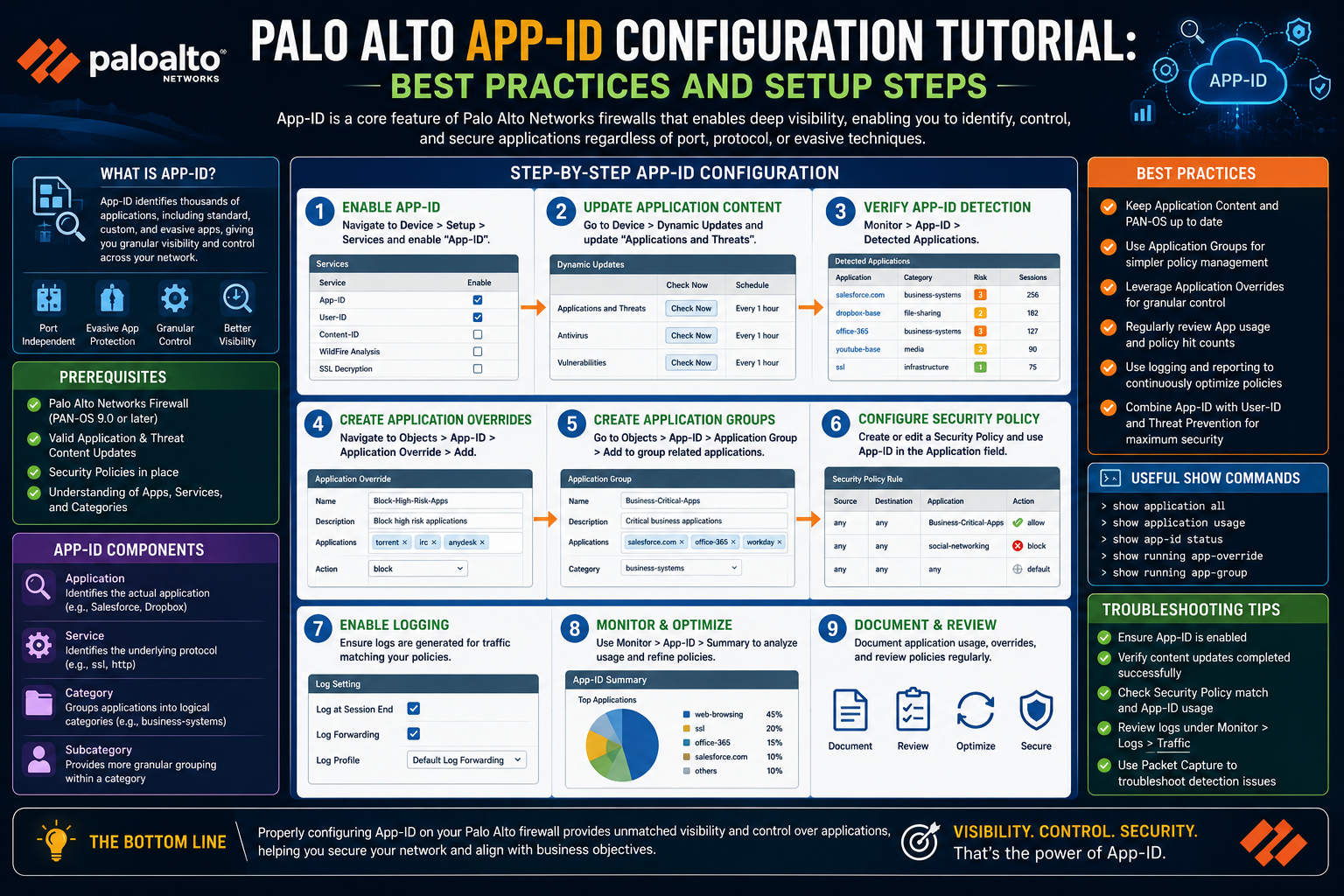
In modern network security environments, visibility and control over application traffic have become more important than simply blocking or allowing ports. Traditional firewalls were primarily designed to filter traffic based on port numbers and IP addresses. However, as applications evolved and began using dynamic ports, encrypted channels, and complex communication patterns, port-based filtering became insufficient for accurate traffic control. This challenge led to the development of more intelligent inspection mechanisms, and one of the most advanced among them is Application Identification, widely known as App-ID in Palo Alto Networks firewalls.
App-ID is a core technology embedded within Palo Alto Networks’ next-generation firewalls that enables precise identification of applications traversing the network. Instead of relying solely on ports or protocols, App-ID examines multiple characteristics of network traffic, including application signatures, behavioral patterns, and contextual information. This allows it to correctly identify applications even when they attempt to disguise themselves by using non-standard ports or encrypted channels.
Unlike traditional inspection methods, App-ID operates at the application layer, which is Layer 7 of the OSI model. This means it can distinguish between different applications that might use the same port, such as web browsing, file sharing, or messaging services. It also ensures that administrators have full visibility into what is happening across the network, enabling them to create more precise and effective security policies.
The significance of App-ID lies in its ability to move beyond assumptions based on network ports and instead analyze actual application behavior. This allows organizations to enforce security policies that are aligned with business needs rather than the technical limitations of legacy firewall architectures.
Evolution of Application-Based Traffic Inspection
Before the introduction of application-aware firewalls, network security relied heavily on stateless and stateful inspection methods. Stateless firewalls filtered traffic based on static rules, while stateful firewalls added the ability to track active connections. However, both approaches primarily depended on ports and protocols for decision-making.
As the internet evolved, applications began using dynamic port allocation, tunneling techniques, and encryption. For example, many applications started using HTTP or HTTPS ports to bypass firewall restrictions. This made it difficult for traditional firewalls to distinguish between legitimate web traffic and unauthorized application usage.
App-ID emerged as a solution to this limitation by introducing a multi-layered identification approach. Instead of relying on a single attribute such as port number, App-ID evaluates traffic using several detection techniques simultaneously. This includes signature-based detection, protocol decoding, and heuristic analysis. These methods work together to provide a highly accurate classification of applications.
This evolution marked a shift from network-centric security to application-centric security. Organizations were no longer limited to blocking or allowing traffic based on broad rules. Instead, they could now make decisions based on specific applications, user behavior, and contextual information.
Core Principles Behind App-ID Technology
App-ID operates based on a combination of detection techniques that work together to identify applications with high accuracy. These techniques are designed to complement each other, ensuring that even if one method fails to detect an application, another method can still identify it.
One of the primary principles is signature-based identification. This involves analyzing packet payloads and comparing them against a database of known application signatures. Each application has unique characteristics, such as specific byte patterns or communication behaviors, which can be used for identification.
Another important principle is protocol decoding. App-ID is capable of understanding how different protocols function at a deeper level. For example, it can inspect HTTP or SSL traffic and determine whether it is being used for legitimate browsing or for a hidden application.
Behavioral analysis is also a key component. Instead of relying solely on known signatures, App-ID observes how traffic behaves over time. If an application exhibits certain patterns, such as consistent data transfer intervals or unusual session behavior, it can be classified accordingly.
These principles collectively ensure that App-ID does not rely on a single point of failure. Instead, it builds a layered understanding of traffic, which significantly improves accuracy and reliability.
Role of Layer 7 Visibility in Network Security
Layer 7, also known as the application layer, represents the highest level of the OSI model. It is where user-facing applications operate, such as web browsers, email clients, and file-sharing tools. Traditional firewalls often lacked visibility at this layer, which limited their ability to enforce granular security policies.
App-ID enhances Layer 7 visibility by analyzing traffic beyond its surface-level attributes. This means it can identify not just the type of traffic, but the specific application generating it. For example, it can differentiate between standard web browsing and social media usage even if both are using HTTPS on port 443.
This level of visibility is crucial for modern organizations. It allows security teams to understand how applications are being used within the network, detect unauthorized application usage, and enforce policies that align with organizational goals.
Layer 7 visibility also plays a critical role in threat prevention. Many advanced cyber threats disguise themselves as legitimate application traffic. Without deep inspection, these threats can go unnoticed. App-ID helps mitigate this risk by analyzing traffic at a deeper level and identifying anomalies that may indicate malicious activity.
Components That Support App-ID Functionality
App-ID does not operate as a standalone feature. It relies on several internal components within the Palo Alto Networks firewall architecture. These components work together to ensure accurate application identification and classification.
One of the most important components is the application signature database. This database contains predefined signatures for thousands of applications. Each signature represents a unique pattern that can be used to identify a specific application.
Another key component is the protocol decoder engine. This engine is responsible for interpreting network protocols and extracting meaningful information from traffic streams. It allows the firewall to understand how different applications communicate over the network.
Heuristic analysis is another supporting component. This method is used when signature-based detection is not sufficient. It evaluates traffic behavior and compares it against known patterns to make an informed classification.
Contextual analysis also plays a role in App-ID functionality. This involves examining the context in which traffic occurs, such as user identity, session state, and network environment. By combining context with other detection methods, App-ID improves its accuracy significantly.
These components are tightly integrated within the PAN-OS operating system, ensuring seamless communication and efficient processing of network traffic.
How App-ID Identifies Applications in Real Time
App-ID performs real-time inspection of network traffic as it passes through the firewall. When a packet enters the system, it is immediately subjected to a series of inspection stages.
The first stage involves initial packet classification. At this stage, the firewall examines basic attributes such as source and destination IP addresses, ports, and protocol types. While this information alone is not sufficient for full identification, it helps narrow down potential application types.
The next stage involves signature matching. The packet payload is compared against known application signatures. If a match is found, the application is immediately identified.
If signature matching is inconclusive, protocol decoding is used. The firewall analyzes the structure of the communication protocol to determine the nature of the application.
In cases where both signature and protocol analysis are insufficient, behavioral heuristics are applied. The system evaluates traffic patterns over time and makes a classification based on observed behavior.
Throughout this process, App-ID continuously updates its classification as more information becomes available. This dynamic approach ensures that applications are accurately identified even if they attempt to change behavior mid-session.
Importance of Security Policies in App-ID Operation
Security policies play a crucial role in how App-ID functions within a firewall environment. These policies define how identified applications should be handled once they are detected.
When configuring security rules, administrators can specify actions based on application identity rather than port numbers. This allows for more granular control over network traffic.
For example, a policy can be created to allow web browsing while blocking file-sharing applications, even if both use the same underlying protocol. This level of precision is only possible because of App-ID’s ability to distinguish between applications.
Security policies also determine whether traffic should be allowed, blocked, or inspected further. Once App-ID identifies an application, the firewall checks the corresponding policy rule to decide how to handle the traffic.
In addition, security policies can incorporate user identity and device information. This means that access decisions can be based not only on the application but also on who is using it and from which device.
This integration of application awareness with policy enforcement is one of the key strengths of Palo Alto Networks firewalls.
Application Signatures and Their Role in Identification
Application signatures are one of the foundational elements of App-ID technology. Each signature is a unique pattern that represents a specific application. These patterns are derived from characteristics such as packet structure, communication sequences, and data content.
When traffic passes through the firewall, the App-ID engine compares it against these signatures. If a match is found, the application is identified with a high degree of confidence.
Signature updates are continuously maintained by Palo Alto Networks to ensure that new applications and updates to existing applications are accurately recognized. This ensures that the system remains effective even as the application landscape evolves.
However, signatures alone are not always sufficient. Some applications are designed to mimic other traffic types or use encryption to hide their identity. In such cases, additional detection methods are required.
This is why App-ID combines signatures with protocol decoding and behavioral analysis. Together, these methods provide a comprehensive identification framework.
Challenges in Application Identification
Despite its advanced capabilities, application identification is not without challenges. One of the primary challenges is encryption. As more applications adopt SSL and TLS encryption, visibility into packet contents becomes more difficult.
Another challenge is application tunneling, where one application is encapsulated within another. This makes it harder to distinguish between primary and secondary applications.
Additionally, applications frequently change their behavior through updates. This requires continuous updates to signature databases and detection mechanisms.
Performance is also a consideration. Deep packet inspection requires significant processing power, especially in high-traffic environments.
App-ID addresses these challenges through a combination of optimized processing techniques, continuous updates, and adaptive inspection methods.
Building the Foundation for App-ID Deployment in a Firewall Environment
Before App-ID can effectively identify and control applications in a network, a structured firewall environment must be established. Application visibility and control depend heavily on how the underlying infrastructure is designed. In Palo Alto Networks firewalls, App-ID does not function in isolation; instead, it operates as part of a broader security architecture that includes zones, interfaces, routing, and policy layers.
A properly designed foundation ensures that traffic flows are logically separated and easily identifiable. This separation allows the firewall to apply application-level inspection with greater accuracy. Without a well-structured foundation, even advanced features like App-ID can produce inconsistent or incomplete results.
In enterprise environments, traffic is rarely uniform. Users access internal systems, external web services, cloud platforms, and remote applications simultaneously. Each of these traffic types must be classified in a way that allows App-ID to analyze them efficiently. This is why the initial design phase is critical for long-term application control success.
A strong foundation also ensures scalability. As networks grow, new applications and services are introduced. A properly structured firewall environment ensures that App-ID can continue to function without requiring constant redesign of policies or rules.
Designing Zones and Traffic Segmentation for Application Control
Zones are one of the most important structural elements in a Palo Alto Networks firewall. They represent logical groupings of interfaces and are used to define trust boundaries within the network. App-ID relies heavily on zone-based segmentation to determine how traffic should be inspected and controlled.
Each zone represents a specific security level or functional area of the network. For example, internal users may be placed in a trusted zone, while external traffic is placed in an untrusted zone. A separate zone may be created for servers, cloud environments, or partner networks.
When traffic flows between zones, it triggers security policies that include App-ID inspection. This allows the firewall to apply application-based rules only when necessary, reducing unnecessary processing overhead.
Zone design also influences how granular application control can be. A poorly designed zone structure can lead to overly broad policies that fail to distinguish between different types of traffic. On the other hand, a well-designed zone architecture enables precise control over application flows.
Segmentation also enhances security by limiting lateral movement within the network. Even if an attacker gains access to one zone, App-ID can help restrict unauthorized applications from communicating across zones.
Understanding Tags and Contextual Labeling in Policy Design
Tags are used in Palo Alto Networks environments to add contextual meaning to network objects. While App-ID focuses on identifying applications, tags help classify and organize security policies and network elements.
Tags provide an additional layer of clarity by allowing administrators to label objects such as zones, addresses, and services. These labels make it easier to manage large-scale environments where multiple policies may exist.
In application control environments, tags help differentiate between different types of traffic policies. For example, policies related to internal applications can be tagged differently from those related to external services.
This labeling system also improves policy readability. Instead of relying solely on IP addresses or technical identifiers, administrators can use meaningful labels that reflect business functions or security requirements.
Tags do not directly influence App-ID detection, but they significantly improve the manageability of application-based policies. They ensure that as the number of applications and rules increases, the environment remains organized and maintainable.
Constructing Security Policies with Application Awareness
Security policies are the core mechanism through which App-ID enforces application control. These policies define how identified applications should be handled once they are detected by the firewall.
Unlike traditional firewall rules that rely on ports and protocols, App-ID-based policies operate at the application level. This allows administrators to define rules such as allowing specific applications while blocking others, regardless of their underlying network behavior.
When constructing these policies, multiple elements must be considered, including source zone, destination zone, user identity, and application type. App-ID evaluates traffic against these criteria before making a decision.
Policies can be configured to allow, deny, or log application traffic. The flexibility of these options enables organizations to tailor security enforcement based on business requirements.
One of the most important aspects of application-aware policies is specificity. Instead of allowing all traffic on a port, policies can be designed to allow only specific applications that are verified and approved.
This approach significantly reduces the attack surface and minimizes the risk of unauthorized application usage within the network.
Working with Application Objects in Policy Definition
Application objects represent predefined or custom-defined applications within the firewall system. These objects are used by App-ID to classify traffic and enforce policies.
Each application object contains detailed information about how the application behaves, including its protocol usage, port requirements, and communication patterns. This information is used during the identification process.
Administrators can use these application objects directly in security policies. Instead of specifying ports, they can define rules based on application names.
Application objects also include metadata that describes dependencies and relationships with other applications. This is important because some applications cannot function independently and require supporting services.
By using application objects in policies, organizations gain more precise control over traffic. This ensures that only intended applications are allowed to operate within the network environment.
Application Dependencies and Their Impact on Policy Enforcement
Many modern applications are not standalone systems. They rely on multiple underlying services to function properly. These relationships are known as application dependencies.
App-ID is capable of identifying these dependencies and ensuring that they are accounted for in security policies. If a dependent application is not included in a policy, the primary application may not function correctly.
For example, a messaging application may rely on a web-based service for authentication or data transfer. If only the primary application is allowed, but its dependency is blocked, the application may fail.
Understanding these relationships is essential for designing effective security policies. Administrators must ensure that all required dependencies are included when defining application rules.
App-ID simplifies this process by automatically identifying dependency relationships and suggesting related applications during policy configuration. This reduces configuration errors and improves application availability.
Application Groups for Scalable Policy Management
As networks grow, managing individual application rules becomes increasingly complex. Application groups provide a scalable solution for organizing multiple applications under a single policy object.
An application group is a collection of related applications that share similar security requirements or functional purposes. Instead of creating separate rules for each application, administrators can manage them collectively.
This approach simplifies policy management and reduces administrative overhead. It also ensures consistency across similar applications.
Application groups are particularly useful in environments where multiple applications serve similar business functions. For example, all collaboration tools or all web-based services can be grouped.
While application groups improve efficiency, they must be carefully managed. Since they are static in nature, any changes in application requirements require manual updates to the group configuration.
Despite this limitation, application groups remain a powerful tool for simplifying large-scale application control environments.
Traffic Decryption and Its Relationship with App-ID
Encryption is one of the biggest challenges in modern network security. Many applications use SSL or TLS encryption to protect data in transit. While this enhances privacy, it also limits visibility for security systems.
App-ID relies on traffic visibility to accurately identify applications. When traffic is encrypted, the firewall cannot inspect payload contents unless decryption is applied.
Traffic decryption enables App-ID to analyze encrypted sessions by temporarily decrypting traffic for inspection purposes. This allows the firewall to apply the same identification techniques used for unencrypted traffic.
Once inspection is complete, the traffic is re-encrypted and forwarded to its destination. This ensures that security is maintained without compromising data integrity.
Decryption policies must be carefully designed to balance security and privacy. Not all traffic needs to be decrypted, and selective decryption is often used to optimize performance and compliance.
When properly implemented, decryption significantly enhances App-ID accuracy and improves visibility into encrypted application traffic.
Logging, Monitoring, and Visibility of Application Traffic
Visibility is one of the most valuable outcomes of App-ID implementation. Through detailed logging and monitoring, administrators can gain insights into how applications are being used across the network.
Every application identified by App-ID generates log entries that include details such as application name, source, destination, and action taken. These logs provide a comprehensive view of network activity.
Monitoring tools allow administrators to track application usage trends over time. This helps identify unusual behavior, such as unexpected spikes in traffic or unauthorized application usage.
Logs also play a critical role in security investigations. If a security incident occurs, application logs can be used to trace activity and identify the source of the issue.
The combination of real-time monitoring and historical logging provides a complete picture of application behavior within the network.
Rule Processing Order and Policy Evaluation Behavior
The order in which security rules are processed is critical in App-ID environments. Firewalls evaluate rules sequentially from top to bottom, applying the first matching rule to traffic.
This means that rule placement directly impacts how applications are handled. A misconfigured rule order can result in unintended application access or blocking.
App-ID evaluation occurs during the policy matching process. Once an application is identified, the firewall checks it against the security policy rules in sequence.
If a match is found, the corresponding action is applied immediately. If no match is found, default deny rules may block the traffic.
Understanding rule processing behavior is essential for ensuring that application control policies function as intended.
Common Configuration Mistakes in App-ID Environments
One common mistake in App-ID deployments is relying too heavily on port-based rules. While App-ID is designed to move beyond port dependency, some configurations still use traditional methods, reducing effectiveness.
Another frequent issue is incomplete application dependency configuration. When dependent applications are not included in policies, legitimate traffic may be blocked.
Overly broad application groups can also lead to security gaps. While grouping simplifies management, it can reduce precision if not properly structured.
Misconfigured decryption policies can also impact App-ID accuracy. If encrypted traffic is not properly handled, application identification may be incomplete.
Avoiding these mistakes requires careful planning and regular policy review.
Optimization Techniques for High-Traffic Networks
In high-traffic environments, performance optimization becomes critical. App-ID inspection requires processing resources, so efficiency must be carefully managed.
One optimization technique involves limiting application inspection to relevant traffic flows. Not all traffic requires deep inspection, and selective enforcement can improve performance.
Another technique involves optimizing rule order to ensure that frequently used applications are processed more efficiently.
Hardware acceleration features available in Palo Alto firewalls can also improve App-ID performance in large-scale environments.
Efficient policy design and regular cleanup of unused rules further contribute to system optimization.
Real-World Application Control Scenarios in Enterprise Networks
In enterprise environments, App-ID is used to enforce a wide range of security policies. One common scenario involves controlling access to social media applications while allowing business-critical communication tools.
Another scenario involves restricting file-sharing applications that may pose security risks while permitting approved cloud storage services.
Organizations also use App-ID to monitor bandwidth usage across different applications, ensuring that critical services receive priority.
In cloud-integrated environments, App-ID helps differentiate between legitimate cloud services and unauthorized shadow IT applications.
These real-world applications demonstrate the flexibility and importance of App-ID in modern network security architectures.
Troubleshooting Application Identification Issues
When application identification issues occur, they are often related to misconfiguration or incomplete visibility. One common issue is unidentified traffic, where App-ID cannot classify the application.
This may occur due to encryption, unsupported applications, or missing signatures. In such cases, further inspection or policy adjustment may be required.
Another issue is incorrect application classification. This can happen when traffic patterns closely resemble multiple applications.
Troubleshooting typically involves reviewing logs, analyzing traffic behavior, and verifying policy configurations.
Proper monitoring and regular system updates help minimize these issues and ensure accurate application identification.
Advanced App-ID Inspection Techniques in Modern Networks
As networks become more complex and application-driven, basic application identification is no longer enough to maintain strong security control. Organizations now rely on advanced inspection techniques that allow Palo Alto Networks firewalls to not only recognize applications but also understand their behavior in deeper and more contextual ways. App-ID, as part of the PAN-OS ecosystem, evolves continuously to handle modern challenges such as encrypted traffic, evasive applications, cloud-based services, and hybrid network environments.
At this stage of deployment maturity, App-ID is no longer viewed as a simple identification engine. Instead, it functions as a layered intelligence system that combines multiple analytical methods to achieve high-precision classification. These methods include protocol decoding, heuristic behavior analysis, contextual correlation, and dynamic signature matching.
Advanced inspection begins where basic identification ends. Once a traffic flow is initially classified, App-ID continues analyzing it throughout the session lifecycle. This ensures that if an application changes behavior mid-session or attempts to mask itself, the firewall can re-evaluate and adjust its classification in real time.
In enterprise environments, this capability is essential because modern applications are rarely static. Many cloud services continuously update their communication methods, while malicious actors intentionally modify traffic patterns to evade detection. App-ID’s adaptive inspection model ensures that security policies remain effective even in such dynamic conditions.
Deep Packet Inspection and Layered Analysis Mechanisms
Deep Packet Inspection (DPI) is a core foundation of App-ID functionality. Unlike traditional inspection methods that only examine packet headers, DPI analyzes both headers and payload data to understand the true nature of network traffic.
Within App-ID, DPI is not a single process but a layered system. The firewall first inspects metadata such as IP addresses, ports, and protocols. It then moves deeper into the packet payload to identify application-specific patterns. Finally, it evaluates session behavior over time to confirm classification accuracy.
This layered approach ensures that applications cannot easily bypass detection by changing ports or disguising traffic. Even if an application uses encrypted channels, DPI combined with SSL decryption policies allows App-ID to regain visibility into traffic content.
One of the most important advantages of DPI is its ability to identify unknown or emerging applications. When a packet does not match known signatures, App-ID uses behavioral analysis to make an educated classification based on observed characteristics.
This makes DPI a critical component in environments where new applications are frequently introduced, such as cloud-native infrastructures or agile development ecosystems.
Behavioral Analysis and Heuristic-Based Identification
Behavioral analysis is one of the most powerful aspects of App-ID’s advanced inspection model. Instead of relying solely on predefined signatures, the firewall observes how traffic behaves over time and compares it against known behavioral patterns.
Heuristic analysis allows App-ID to identify applications based on characteristics such as session duration, packet frequency, data transfer direction, and communication consistency. These behavioral traits are often unique to specific application types.
For example, streaming applications typically exhibit continuous data flow with high bandwidth consumption, while messaging applications tend to generate short, burst-like traffic patterns. App-ID uses these distinctions to classify applications even when traditional identification methods fail.
Heuristic-based identification is especially useful for detecting unknown or custom applications. Many organizations develop internal tools that are not included in public signature databases. In such cases, App-ID can still infer the application type based on behavior.
This capability significantly improves security coverage by reducing blind spots in application visibility. It ensures that even unfamiliar traffic can be categorized and controlled effectively.
Handling Encrypted Traffic with Advanced Inspection Models
Encryption has become one of the most significant challenges in network security. A large percentage of modern traffic is encrypted using SSL or TLS protocols, which prevents traditional inspection tools from analyzing payload content.
App-ID addresses this challenge through integration with decryption policies. When enabled, the firewall can decrypt traffic temporarily, inspect it using App-ID mechanisms, and then re-encrypt it before forwarding it to its destination.
This process restores visibility into encrypted sessions, allowing App-ID to apply the same identification techniques used for unencrypted traffic. It ensures that applications hiding behind encryption are still subject to security policies.
However, decryption is not applied universally. Organizations must carefully define which traffic should be decrypted based on security requirements, privacy concerns, and compliance regulations.
Selective decryption is commonly used in enterprise environments. For example, traffic to financial institutions or sensitive personal services may remain encrypted, while general web traffic is inspected for application control.
When properly configured, encrypted traffic inspection significantly enhances App-ID effectiveness without compromising user privacy or system performance.
Cloud Applications and Dynamic Traffic Challenges
The rise of cloud computing has fundamentally changed how applications behave. Unlike traditional applications that run on fixed infrastructure, cloud-based applications operate across distributed environments with constantly changing endpoints.
This dynamic nature presents unique challenges for App-ID. Cloud applications often use shared infrastructure, dynamic scaling, and multiple service layers, making it difficult to rely on static identification methods.
App-ID addresses this challenge by continuously updating its signature database and incorporating cloud-aware identification techniques. It recognizes not only individual cloud applications but also their underlying service components.
For example, a single cloud platform may include storage services, authentication systems, and communication APIs. App-ID can identify each component separately and apply appropriate policies.
This level of granularity is essential for modern enterprises that rely heavily on cloud ecosystems. It ensures that organizations maintain control over cloud usage while still benefiting from scalability and flexibility.
Application Dependency Mapping in Complex Environments
In advanced network environments, applications rarely operate independently. Instead, they rely on multiple supporting services, APIs, and backend systems. App-ID incorporates dependency mapping to ensure that all related components are properly identified and accounted for.
Dependency mapping allows the firewall to understand relationships between primary applications and their supporting services. This ensures that policies do not unintentionally block essential communication paths.
For example, a collaboration platform may depend on authentication services, file storage systems, and messaging APIs. If only the main application is allowed, but dependencies are blocked, the application will fail to function properly.
App-ID simplifies this complexity by automatically identifying and suggesting related applications during policy creation. This reduces configuration errors and ensures seamless application functionality.
Dependency awareness is especially important in large-scale enterprise environments where applications are interconnected across multiple systems and networks.
Real-Time Traffic Classification and Adaptive Learning
One of the most powerful features of App-ID is its ability to perform real-time traffic classification. Unlike static inspection systems, App-ID continuously evaluates traffic as it flows through the firewall.
This means that application classification is not a one-time process. Instead, it evolves dynamically based on new information gathered during the session.
If App-ID initially misclassifies traffic, it can correct itself as more data becomes available. This adaptive learning capability ensures higher accuracy over time.
Real-time classification is particularly useful for detecting applications that attempt to evade detection by changing behavior mid-session. It also helps identify multi-stage applications that use different protocols during different phases of communication.
This continuous evaluation model ensures that security policies remain accurate and effective even in highly dynamic network environments.
Policy Enforcement Based on Application Intelligence
App-ID fundamentally transforms how security policies are enforced. Instead of relying on static network parameters, policies are based on intelligent application classification.
This allows administrators to define rules that align directly with business requirements. For example, organizations can allow productivity applications while blocking entertainment or high-risk applications.
Policy enforcement occurs immediately after App-ID identifies an application. The firewall evaluates the traffic against configured rules and determines whether to allow, block, or inspect further.
This application-centric approach significantly improves security precision. It eliminates ambiguity caused by port-based rules and ensures that only authorized applications are permitted.
Policies can also incorporate additional context such as user identity, device type, and location. This multi-dimensional approach provides a comprehensive security framework.
Visibility and Analytics for Application Behavior
App-ID provides extensive visibility into network traffic, enabling organizations to analyze application usage patterns in detail. This visibility is critical for both security and operational efficiency.
Through continuous monitoring, administrators can identify which applications consume the most bandwidth, which users access specific applications, and how application usage changes over time.
This data is invaluable for optimizing network performance and identifying potential security risks. For example, unexpected spikes in application usage may indicate compromised accounts or unauthorized activity.
Application analytics also support capacity planning. Organizations can use historical data to predict future bandwidth requirements and infrastructure needs.
The combination of real-time monitoring and historical analysis provides a complete view of application behavior across the network.
Handling Unknown and Custom Applications
Not all applications are known or documented in signature databases. Many organizations develop custom applications tailored to specific business needs. These applications may not have predefined signatures, making them difficult to identify using traditional methods.
App-ID addresses this challenge through unknown traffic classification and behavioral inference. When an application cannot be identified, App-ID categorizes it based on observed characteristics.
Administrators can then analyze this traffic further and decide whether to create custom application signatures or adjust policies accordingly.
This capability ensures that even non-standard or proprietary applications remain visible within the network environment.
Custom application support is particularly important in industries such as software development, research, and manufacturing, where internal tools are frequently used.
Performance Optimization in High-Throughput Environments
As App-ID performs deep inspection, it requires significant processing resources. In high-throughput environments, performance optimization becomes essential to maintain network efficiency.
One optimization technique involves prioritizing critical applications for inspection while reducing inspection depth for low-risk traffic.
Another approach involves leveraging hardware acceleration features available in modern Palo Alto Networks appliances. These features offload processing tasks and improve throughput.
Efficient rule design also plays a key role in performance optimization. Well-structured policies reduce unnecessary processing and ensure faster decision-making.
Regular maintenance, including signature updates and policy cleanup, further enhances system performance.
Integration of App-ID with Threat Prevention Systems
App-ID does not operate independently from other security features. It is closely integrated with threat prevention systems that detect malware, intrusions, and advanced persistent threats.
Once App-ID identifies an application, threat prevention mechanisms analyze its behavior for malicious activity. This includes inspecting payloads for known attack signatures and monitoring for suspicious behavior patterns.
This integration ensures that application identification is directly linked to threat detection. It allows organizations to block malicious applications while permitting legitimate ones.
By combining App-ID with threat prevention, firewalls provide a unified security framework that addresses both application control and cybersecurity protection.
Operational Challenges in Large-Scale Deployments
Deploying App-ID in large-scale environments introduces several operational challenges. These include policy complexity, performance management, and continuous updates.
As the number of applications increases, managing policies becomes more difficult. Without proper structure, policies can become inconsistent or overly complex.
Performance challenges arise when high volumes of traffic require real-time inspection. This necessitates careful resource management and optimization.
Continuous updates are also required to maintain accurate application signatures. Without regular updates, identification accuracy may decline over time.
Addressing these challenges requires a combination of best practices, automation, and structured policy design.
Role of App-ID in Zero Trust Security Models
Modern security frameworks increasingly rely on Zero Trust principles, which assume that no traffic should be trusted by default. App-ID plays a central role in enabling this model by providing application-level visibility and control.
In a Zero Trust architecture, every application request is inspected and validated before access is granted. App-ID ensures that only authorized applications can communicate across the network.
This approach eliminates implicit trust based on network location. Instead, access decisions are based on application identity, user context, and security policies.
App-ID, therefore, acts as a foundational component in implementing Zero Trust environments, ensuring that security is enforced consistently across all network segments.
Continuous Evolution of Application Identification Technologies
Application environments continue to evolve rapidly, driven by cloud adoption, mobile applications, and distributed systems. As a result, App-ID must also evolve to remain effective.
Ongoing development focuses on improving detection accuracy, expanding signature databases, and enhancing behavioral analysis capabilities.
Future advancements are likely to include deeper integration with artificial intelligence and machine learning to further improve classification accuracy and predictive analysis.
This continuous evolution ensures that App-ID remains a critical component of modern network security architectures.
Conclusion
App-ID represents a fundamental shift in how modern firewalls understand and control network traffic. Instead of relying on outdated methods such as port numbers or protocol assumptions, it introduces a far more intelligent and context-aware approach to application identification. By analyzing traffic behavior, decoding protocols, and using signature-based detection, App-ID gives organizations the ability to see exactly what is happening inside their networks at the application level.
This level of visibility is especially important in today’s digital environments, where applications no longer behave in predictable ways. Cloud services, encrypted communication, mobile apps, and hybrid infrastructures have made traditional firewall techniques insufficient. App-ID addresses these challenges by continuously inspecting traffic in real time and adapting to changes in application behavior.
One of the most valuable outcomes of App-ID is precise policy enforcement. Security teams are no longer forced to create broad rules based on ports or IP addresses. Instead, they can define policies that directly target specific applications, user groups, or business functions. This not only improves security but also reduces unnecessary restrictions that can impact productivity.
Another important benefit is improved threat visibility. Because App-ID operates at the application layer, it helps detect unauthorized or risky application usage that might otherwise go unnoticed. When combined with decryption capabilities and threat prevention systems, it becomes a powerful tool for identifying hidden risks within encrypted or complex traffic flows.
App-ID also supports scalability in large and evolving network environments. Whether dealing with on-premises infrastructure, cloud platforms, or remote users, it provides consistent application-level intelligence that helps maintain control and visibility across all segments of the network.
Ultimately, App-ID is not just a feature but a core foundation of next-generation firewall technology. It enables organizations to move beyond basic traffic filtering and adopt a more intelligent, adaptive, and security-focused approach to network management. As applications continue to evolve, technologies like App-ID will remain essential for maintaining strong, flexible, and effective cybersecurity defenses.