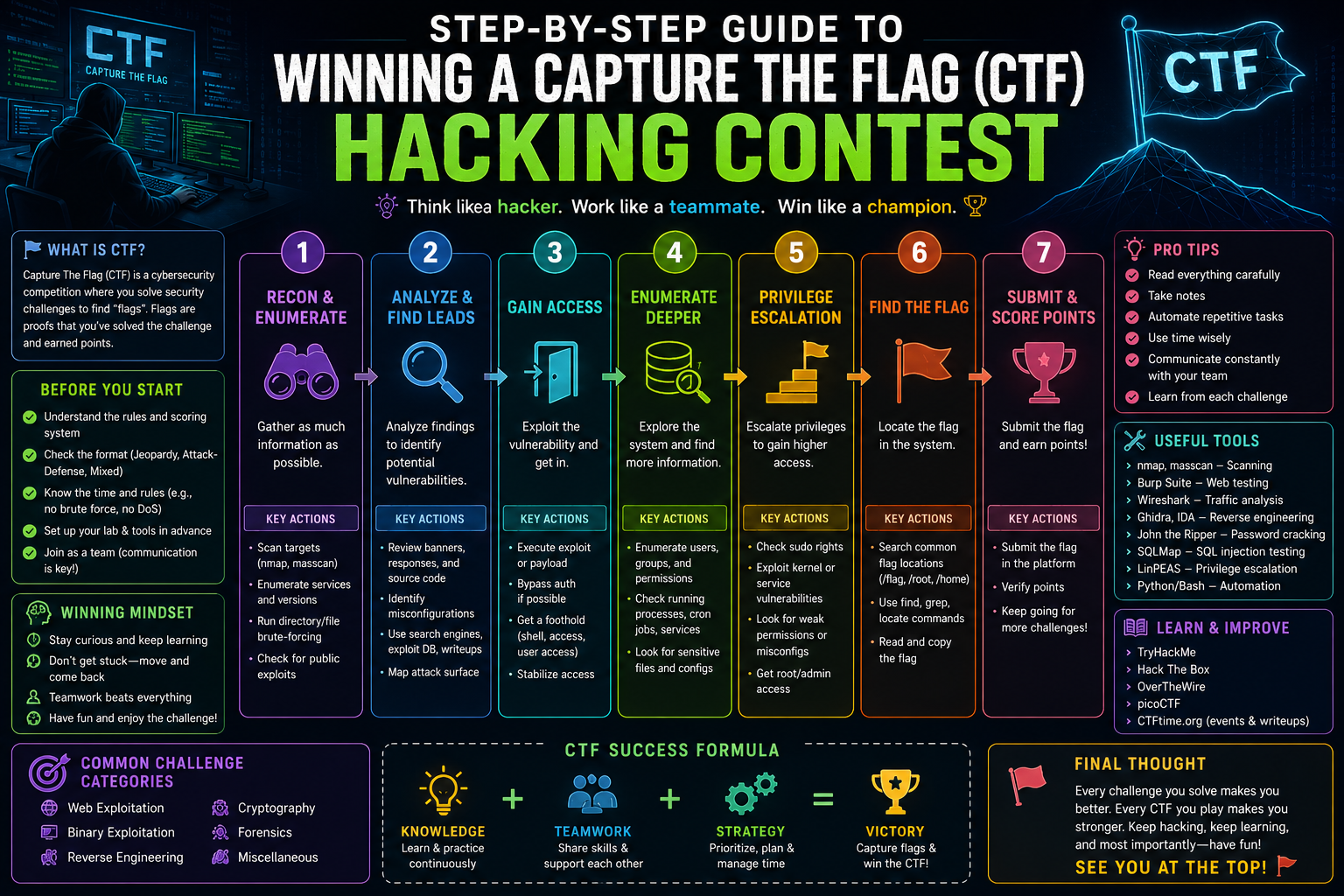
Capture the Flag (CTF) competitions are among the most practical and engaging ways to develop real cybersecurity skills. Unlike theoretical learning, these challenges place participants directly into problem-solving environments where they must analyze systems, uncover weaknesses, and apply technical knowledge to achieve specific objectives.
Despite the name, there is no physical flag involved. Instead, the “flag” is a digital token—often a string of text—that confirms a successful solution to a challenge. This structure turns cybersecurity learning into a game-like experience, where each solved problem represents progress.
CTF competitions are widely used by students, aspiring ethical hackers, and experienced security professionals. They help bridge the gap between academic knowledge and real-world application, which is often difficult to achieve through traditional learning methods alone.
At their core, these competitions simulate real security scenarios in a controlled environment. Participants are not attacking real-world systems without permission; instead, they work within intentionally vulnerable systems designed for learning. This makes CTFs one of the safest and most effective training grounds for cybersecurity development.
The Purpose and Value of CTF Challenges in Modern Security
Cybersecurity is not just about knowing tools or memorizing techniques. It requires analytical thinking, creativity, and persistence. CTF challenges are designed to build exactly these qualities.
One of the most important aspects of CTF competitions is that they encourage hands-on learning. Instead of reading about vulnerabilities, participants actually exploit them in controlled environments. This active engagement significantly improves understanding and retention.
Another major benefit is exposure to real-world attack techniques. Many challenges are modeled after actual security vulnerabilities found in web applications, operating systems, cryptographic systems, and network infrastructure. This makes CTF practice highly relevant to professional cybersecurity roles.
CTF competitions also help develop problem-solving skills under pressure. While some challenges are relaxed and self-paced, others are timed events that require quick thinking and efficient decision-making. This mimics real cybersecurity incident response situations where time is critical.
Additionally, CTFs encourage continuous learning. The field of cybersecurity evolves rapidly, and new vulnerabilities appear regularly. CTF platforms frequently update challenges, ensuring participants are always exposed to new concepts and techniques.
For professionals, these competitions act as skill assessments. They help identify strengths and weaknesses, allowing individuals to focus on specific areas of improvement. For beginners, they provide structured learning paths that gradually build confidence and competence.
How Capture the Flag Competitions Are Structured
CTF competitions can vary widely in format, but most follow a structured approach that organizes challenges into categories and assigns points based on difficulty. Participants or teams aim to solve as many challenges as possible within a set time frame or an ongoing environment.
There are generally three major formats used in CTF competitions, each offering a different style of gameplay and learning experience.
Jeopardy-Style Challenges
Jeopardy-style CTFs are the most common and beginner-friendly format. In this setup, participants are given a list of independent challenges categorized by topic and difficulty. Each solved challenge reveals a flag, which is submitted to earn points.
These challenges often include topics such as cryptography, web security, reverse engineering, and digital forensics. Each category contains multiple problems, ranging from simple introductory tasks to highly complex scenarios.
The structure is similar to solving a puzzle collection. Participants can choose which problems to attempt, allowing them to focus on areas where they feel most confident or want to improve.
This format is particularly popular in online competitions because it does not require direct interaction between teams. Individuals can participate alone or collaborate remotely.
Attack-Defense Style Challenges
Attack-defense CTFs are more dynamic and closely resemble real-world cybersecurity operations. In this format, each team is given a system or server that contains vulnerabilities. Teams must secure their own systems while simultaneously attempting to exploit vulnerabilities in other teams’ systems.
This creates a highly competitive environment where both offensive and defensive skills are tested at the same time. Participants must quickly identify weaknesses, patch them, and develop strategies to defend against incoming attacks.
At the same time, they must analyze other systems for vulnerabilities and attempt to gain unauthorized access or control. Points are awarded for successful defenses and successful attacks.
This format requires strong teamwork, communication, and coordination. Unlike Jeopardy-style competitions, success depends heavily on real-time collaboration and strategic planning.
Mixed-Format Competitions
Mixed-format CTFs combine elements of both Jeopardy and Attack-Defense styles. Participants may be required to solve traditional puzzles while also engaging in real-time system defense or attack scenarios.
These competitions are often more complex and are typically designed for advanced participants. They test a broad range of skills, including theoretical knowledge, practical hacking abilities, and teamwork under pressure.
Mixed formats provide a more complete simulation of real-world cybersecurity environments, where professionals must handle multiple types of threats simultaneously.
Key Differences Between CTF Competitions and Hackathons
At first glance, CTF competitions and hackathons may seem similar because both involve teamwork, problem-solving, and time constraints. However, they serve very different purposes.
CTF competitions are focused on cybersecurity challenges. Participants attempt to exploit vulnerabilities, decode encrypted data, or analyze system behavior to retrieve flags. The primary goal is to identify and understand security weaknesses.
Hackathons, on the other hand, focus on creation rather than exploitation. Participants build software applications, tools, or systems from scratch within a limited timeframe. The emphasis is on innovation, functionality, and design.
In CTFs, success comes from breaking systems and understanding how they fail. In hackathons, success comes from building something new and functional.
Another key difference is mindset. CTF participants think like attackers and defenders, analyzing how systems can be broken or protected. Hackathon participants think like developers, focusing on solving user problems through new applications or services.
While both experiences are valuable, CTF competitions are more closely aligned with ethical hacking, penetration testing, and cybersecurity careers.
Core Skill Areas Tested in CTF Competitions
CTF challenges are designed to test a wide range of cybersecurity skills. While no participant is expected to master every area immediately, familiarity with each category is essential for success.
Binary Exploitation Skills
Binary exploitation involves manipulating compiled programs to behave in unintended ways. This often requires understanding how software interacts with memory and system resources.
Participants may encounter vulnerabilities such as buffer overflows or memory corruption issues. By exploiting these weaknesses, they can alter program behavior or gain unauthorized access to restricted data.
This category is considered one of the more advanced areas in CTF competitions and requires strong programming and system-level knowledge.
Reverse Engineering Skills
Reverse engineering focuses on analyzing compiled applications to understand their internal logic. Participants are often given executable files and must determine how they function without access to source code.
This process involves breaking down programs, studying their behavior, and identifying hidden logic or embedded data. It is commonly used to uncover hidden flags or bypass security mechanisms.
Reverse engineering requires patience and strong analytical skills, as well as familiarity with debugging tools and system architecture.
Web Exploitation Skills
Web exploitation challenges focus on vulnerabilities found in websites and web applications. These may include issues such as insecure authentication, input validation errors, or misconfigured servers.
Participants often interact with web pages, analyze network requests, and identify weaknesses that allow unauthorized actions. This category is highly relevant to real-world cybersecurity, as web applications are common targets for attackers.
Cryptography Skills
Cryptography challenges involve encoding, decoding, and analyzing encrypted data. Participants may need to break simple encryption methods or identify patterns in complex ciphertexts.
These challenges often test logical thinking and familiarity with mathematical concepts. They also emphasize pattern recognition and problem-solving under uncertainty.
Digital Forensics Skills
Forensics challenges involve analyzing files, images, or system data to uncover hidden information. This may include extracting metadata, recovering deleted data, or identifying concealed messages.
Participants often work with various file formats and must carefully examine data structures to find hidden flags.
Mental Approach and Thinking Style Required for CTF Success
Success in CTF competitions depends less on memorization and more on mindset. Participants must develop curiosity, patience, and persistence.
One of the most important mental habits is analytical thinking. Instead of jumping directly to solutions, participants must carefully examine each problem, break it into smaller parts, and understand how different components interact.
Another key skill is adaptability. CTF challenges often require switching between different domains such as networking, programming, and cryptography. Being flexible in approach is essential.
Persistence is equally important. Many challenges are designed to be difficult and may require multiple attempts before finding the correct solution. Failure is part of the learning process, not a setback.
Attention to detail also plays a major role. Small clues hidden in code, network traffic, or file metadata can often be the key to solving a challenge.
Finally, curiosity drives success. The best participants are those who enjoy exploring systems deeply and asking how and why things work the way they do.
Building a Practical Learning Environment for CTF Practice
Preparing for Capture the Flag competitions begins long before entering any event. The most important step is creating a controlled environment where experimentation is safe, repeatable, and unrestricted. Unlike a theoretical study, CTF preparation depends heavily on practice, and that practice requires a flexible technical setup.
A strong learning environment typically includes a system capable of running multiple isolated environments. This allows learners to experiment with vulnerabilities, test exploit ideas, and break systems without affecting their primary operating system. Many participants prefer using virtualized environments because they can simulate different machines, networks, and operating conditions.
The value of such an environment lies in freedom. In real cybersecurity work, mistakes can have serious consequences. In CTF preparation, mistakes are part of learning. Breaking systems, misconfiguring services, and experimenting with incorrect assumptions all contribute to a deeper understanding.
Another important aspect is replicating real-world scenarios. Many CTF challenges mimic real systems, so familiarity with system behavior is essential. Setting up web servers, experimenting with network communication, and observing how applications behave under different conditions builds intuition that becomes extremely useful during competitions.
Over time, this environment becomes a personal cybersecurity laboratory. Participants return to it repeatedly, refining techniques, testing new ideas, and strengthening weak areas. This continuous practice loop is one of the most effective ways to improve performance in CTF competitions.
Developing Core Technical Foundations for CTF Success
Before diving into advanced challenges, it is important to develop strong foundational knowledge in several key areas. These fundamentals form the backbone of nearly every CTF challenge, regardless of category.
Operating systems knowledge is essential. Most challenges are based on Linux environments, so understanding file structures, permissions, process management, and command behavior is crucial. Without this foundation, even simple tasks can become confusing.
Networking knowledge is equally important. Understanding how data travels between systems, how protocols communicate, and how requests are structured allows participants to identify weaknesses in communication systems. Many web and network-based challenges rely on this understanding.
Programming familiarity also plays a major role. While deep software development skills are not always required, the ability to read and understand scripts is critical. Many challenges provide partial code or require participants to modify existing scripts to solve problems.
Another important foundation is logical reasoning. CTF problems often require connecting unrelated clues. A strong logical mindset helps break complex challenges into manageable steps.
These core skills do not need to be mastered before starting CTF practice. Instead, they should be developed alongside hands-on experience. The combination of theory and practice accelerates learning significantly.
Understanding CTF Problem-Solving Methodology
One of the most important aspects of CTF preparation is learning how to approach problems systematically. Unlike random experimentation, successful participants follow structured thinking patterns.
The first step is observation. Before attempting any solution, it is important to carefully examine the challenge environment. This includes analyzing inputs, outputs, file structures, and system behavior. Many beginners rush this step and miss critical clues.
The next step is hypothesis formation. Based on observations, participants form ideas about what might be happening behind the scenes. This could involve guessing how a system processes data or how a vulnerability might be triggered.
After forming a hypothesis, testing begins. This involves trying different inputs, modifying behavior, or analyzing system responses. Each test provides feedback that helps refine understanding.
If a hypothesis fails, it is not a setback but a learning opportunity. Each failure narrows down possibilities and brings participants closer to the solution.
Once enough information is gathered, pattern recognition becomes important. Many CTF challenges follow predictable structures. Recognizing these patterns helps speed up problem-solving significantly.
Finally, documentation plays an important role. Keeping track of attempts, findings, and observations ensures that progress is not lost and allows participants to revisit their reasoning if needed.
Tools and Workflows Used in CTF Preparation
CTF competitions often require familiarity with a wide range of tools. These tools are not used randomly but are part of a structured workflow that helps participants analyze and solve challenges efficiently.
One of the most important categories of tools includes system analysis utilities. These help examine files, inspect system behavior, and monitor processes. They are commonly used in reverse engineering and forensic challenges.
Network analysis tools are also widely used. These allow participants to observe network traffic, identify patterns, and detect hidden communication. Many web-based challenges rely heavily on understanding how requests and responses are structured.
Another category includes debugging tools. These are essential for reverse engineering tasks where participants need to analyze program execution step by step. By observing how a program behaves internally, hidden logic can be uncovered.
Scripting tools are also important. Many repetitive tasks in CTF challenges can be automated using simple scripts. This saves time and reduces manual effort during competitions.
A structured workflow typically involves gathering data first, analyzing it next, forming hypotheses, testing solutions, and refining results. This cycle repeats until the challenge is solved.
Over time, participants develop personal workflows that suit their thinking style. Some prefer visual analysis, while others rely on step-by-step logical breakdowns. Flexibility in workflow is important because no two challenges are identical.
Mastering Web Exploitation Thinking Patterns
Web exploitation challenges are among the most common in CTF competitions because they reflect real-world security issues found in online applications.
To succeed in this category, participants must understand how web systems process user input. Many vulnerabilities arise when systems fail to properly validate or sanitize input data.
A key thinking pattern in web challenges is identifying trust boundaries. Systems often assume certain inputs are safe, and attackers exploit this assumption. Recognizing where trust is placed helps uncover vulnerabilities.
Another important pattern is request manipulation. By modifying how data is sent to a server, participants can observe changes in behavior that reveal hidden logic or weaknesses.
Understanding session behavior is also important. Many web applications use sessions to track users, and improper handling of session data can lead to security flaws.
Web challenges also require attention to structure. Small details in URLs, parameters, or headers can often contain hidden clues.
The ability to think like both a user and a system is crucial. Participants must consider how a system processes data internally while also thinking about how an attacker might manipulate it externally.
Approaching Cryptography Challenges Strategically
Cryptography challenges require a different mindset compared to other CTF categories. Instead of exploiting systems, participants focus on analyzing patterns in encoded or encrypted data.
The first step is identifying the type of encoding or encryption used. Many challenges involve standard encoding formats, while others use custom or layered encryption techniques.
Once the format is identified, pattern recognition becomes important. Even complex encrypted data often contains subtle structures or repetitions that can provide clues.
Mathematical reasoning also plays a role in cryptography challenges. Understanding how data transformations work helps in reversing or decoding messages.
Another key strategy is testing assumptions. Participants often try different decoding methods until one produces meaningful output.
Cryptography challenges also require patience. Unlike web or binary exploitation tasks, progress may be slow and incremental. Small discoveries eventually lead to complete solutions.
Over time, participants develop intuition for recognizing encryption types quickly, which significantly speeds up problem-solving.
Building Reverse Engineering Skills Step by Step
Reverse engineering is one of the more advanced areas in CTF competitions, but it can be learned gradually with consistent practice.
The process begins with understanding how compiled programs behave. Unlike readable source code, compiled applications require interpretation through analysis tools.
Participants typically start by observing program behavior. Running a program and interacting with it provides initial clues about its structure and functionality.
Next comes deeper inspection. By examining how the program processes inputs, participants begin to understand its internal logic.
Control flow analysis is an important concept here. Programs often contain conditional paths, loops, and hidden branches that determine their behavior.
Another key aspect is identifying hidden data. Some programs contain embedded strings or logic that reveal flags when triggered correctly.
Reverse engineering also involves breaking down complex systems into smaller parts. Instead of analyzing everything at once, participants focus on individual components and gradually build a complete understanding.
With practice, reverse engineering becomes less about guessing and more about systematic breakdown and analysis.
Strengthening Digital Forensics Techniques
Digital forensics challenges focus on extracting hidden or deleted information from files and data sources. These challenges simulate real-world investigations where evidence must be carefully uncovered.
Participants often begin by examining file metadata. Files may contain hidden details about their origin, modification history, or embedded data structures.
Another common technique is analyzing file formats. Many files can contain hidden layers of information that are not visible in standard viewing methods.
Data carving is also an important concept. This involves extracting usable information from corrupted or partially hidden data.
Forensics challenges often require attention to detail. Small inconsistencies in data structures can lead to important discoveries.
Over time, participants develop an investigative mindset. Instead of viewing files as static objects, they see them as layered structures that may contain hidden information waiting to be uncovered.
Working Effectively in Teams During CTF Events
Although many CTF challenges can be solved individually, team-based competitions introduce additional complexity. Effective teamwork becomes a major factor in success.
One of the most important aspects of teamwork is role distribution. Different participants may specialize in different categories, such as web exploitation, cryptography, or reverse engineering.
Communication is also essential. Sharing findings quickly ensures that team members do not duplicate efforts or miss important clues.
Another key factor is coordination under pressure. During timed competitions, teams must make decisions quickly and efficiently.
Trust within the team plays an important role. Each member relies on others to handle their respective responsibilities effectively.
Over time, teams develop internal workflows that allow them to operate smoothly during competitions.
Time Management and Strategy in Competitions
Time management is a critical skill in CTF competitions. Since challenges are often time-bound, participants must decide how to allocate their efforts effectively.
One important strategy is prioritization. Easier challenges are often solved first to secure initial points before moving on to more difficult tasks.
Another approach is parallel problem-solving in teams. Different members work on different challenges simultaneously to maximize efficiency.
It is also important to recognize when to move on. Spending too much time on a single challenge can reduce overall performance.
Strategic thinking also includes balancing risk and reward. High-difficulty challenges offer more points but require more time and effort.
Successful participants constantly adjust their strategy based on progress and remaining time.
Common Mistakes Beginners Make in CTF Competitions
Beginners often make several common mistakes that slow their progress in CTF competitions.
One frequent mistake is rushing into solutions without proper analysis. This often leads to confusion and wasted effort.
Another mistake is ignoring small details. Many challenges contain subtle clues that are easy to overlook.
Beginners also tend to focus too narrowly on one approach. Flexibility is important because initial assumptions may be incorrect.
Another issue is a lack of documentation. Without tracking progress, it becomes difficult to learn from mistakes.
Finally, many beginners underestimate the importance of practice. CTF skills develop gradually through repeated exposure to different challenges.
Avoiding these mistakes significantly improves learning efficiency and performance over time.
Advancing from Beginner to Competitive CTF Mindset
Once the basics of Capture the Flag competitions become familiar, the next stage of growth involves shifting from learning individual techniques to building a structured competitive mindset. At this level, success is no longer about solving isolated puzzles but about understanding how different categories of problems connect, evolve, and escalate in difficulty during real events.
Advanced participants begin to recognize that CTF competitions are not random collections of challenges. Instead, they are carefully designed systems that test layered thinking. Each challenge often contains multiple hidden steps, requiring participants to move through stages of analysis rather than jumping directly to solutions.
This stage of development focuses heavily on thinking efficiency. Instead of exploring every possible direction, experienced participants quickly eliminate unlikely paths and focus only on high-probability leads. This ability comes from repeated exposure and pattern recognition built over time.
Another major shift is learning to operate under uncertainty. Beginners often expect clear instructions or obvious starting points. In advanced competitions, ambiguity is intentional. Participants must interpret incomplete information, infer missing logic, and make decisions based on partial evidence.
This mindset is similar to real-world cybersecurity work, where attackers rarely leave clear instructions behind. Instead, defenders must reconstruct events from fragments of data, logs, or system behavior. CTF competitions mirror this environment closely at higher difficulty levels.
Developing Specialized Skill Paths in CTF Learning
As participants gain experience, they naturally begin to gravitate toward certain types of challenges. This specialization is not accidental—it reflects individual strengths in reasoning, technical background, and problem-solving style.
Some individuals prefer logic-heavy challenges that involve cryptography and mathematical reasoning. Others are drawn to system-level tasks such as binary analysis or reverse engineering. Some focus heavily on web systems, while others excel in forensic investigation.
Specialization is important because mastery in CTF competitions is rarely about being average in everything. Instead, high-performing participants develop deep expertise in one or two categories while maintaining basic competence in others.
Specialists often become the backbone of competitive teams. In a team environment, each member contributes a unique strength, and the combination leads to faster and more effective problem-solving.
However, specialization should not lead to isolation. Even highly focused participants benefit from understanding adjacent domains. For example, a web security specialist benefits from basic knowledge of cryptography, since modern applications often combine multiple layers of security.
Over time, specialization evolves naturally. It is not something forced at the beginning, but something discovered through repeated practice and exposure to different challenge types.
Building a Long-Term CTF Training Routine
Improvement in CTF competitions does not happen through occasional practice. It requires a consistent and structured training routine that gradually builds skill over time.
A strong training routine typically includes exposure to new challenges, review of past mistakes, and deliberate practice of weak areas. This cycle ensures continuous improvement rather than repetitive stagnation.
One important aspect of training is consistency. Short but regular practice sessions are far more effective than long, irregular bursts of effort. Consistency helps reinforce memory and improves problem-solving speed.
Another key element is challenge diversity. Practicing only one category limits growth. Exposure to different types of problems ensures adaptability during competitions.
Reviewing past attempts is equally important. Every failed challenge contains valuable learning opportunities. By analyzing mistakes, participants refine their approach and avoid repeating errors in future scenarios.
Over time, training becomes more structured and intentional. Instead of randomly selecting problems, participants begin targeting specific skills they want to improve, such as speed, accuracy, or analytical depth.
This gradual refinement transforms casual learners into competitive participants capable of handling complex CTF environments.
Developing Analytical Depth in Problem Interpretation
One of the defining characteristics of advanced CTF participants is their ability to analyze problems deeply rather than superficially. This skill is often the difference between solving a challenge quickly and becoming stuck for long periods.
Deep analysis begins with understanding the intent behind a challenge. Every CTF problem is designed with a specific learning objective. Recognizing this objective helps narrow down possible solution paths.
Instead of treating a problem as a single task, advanced participants break it into layers. Each layer represents a different aspect of the challenge, such as input handling, system behavior, or hidden logic.
This layered thinking allows participants to isolate issues more effectively. Rather than being overwhelmed by complexity, they focus on one layer at a time.
Another important aspect is questioning assumptions. Many challenges are designed to mislead participants into following incorrect paths. By constantly questioning initial assumptions, advanced players avoid wasting time on misleading directions.
Pattern recognition also plays a role in analytical depth. Over time, participants begin to notice recurring structures across different challenges. These patterns help accelerate understanding and reduce cognitive load during competitions.
Handling Unknown Systems and Black-Box Scenarios
A significant portion of advanced CTF challenges involves systems that are completely unknown to the participant at the start. These are often referred to as black-box scenarios, where internal workings are hidden and must be discovered through interaction.
In such situations, the first step is controlled experimentation. Instead of making large assumptions, participants carefully test small inputs and observe outputs.
This process gradually reveals system behavior. Even without internal visibility, patterns emerge based on how the system responds.
Another important strategy is incremental exploration. Instead of attempting to solve the entire system at once, participants explore small sections and gradually expand their understanding.
Documentation plays a critical role here. Keeping track of inputs and responses helps build a mental model of the system over time.
Advanced participants also learn to identify boundaries within unknown systems. These boundaries represent transitions in behavior, often indicating different internal modules or logic paths.
By mapping these boundaries, participants can reconstruct the structure of the system without direct access to its internals.
Building Efficiency and Speed in Competitive Environments
Speed is an important factor in CTF competitions, especially in timed events where multiple teams are competing simultaneously. However, speed alone is not enough. It must be combined with accuracy and strategic thinking.
Efficiency comes from reducing unnecessary steps. Experienced participants avoid redundant testing and focus only on meaningful actions that provide useful information.
Another aspect of efficiency is familiarity with tools and workflows. The less time spent figuring out how to perform a task, the more time available for actual problem-solving.
Mental organization also contributes to speed. Keeping track of ongoing tasks, hypotheses, and partial solutions prevents confusion and repetition.
In team environments, efficiency is amplified through delegation. When tasks are distributed effectively, multiple challenges can be solved simultaneously.
However, speed must always be balanced with accuracy. Rushed decisions often lead to mistakes that cost more time in the long run. The most successful participants maintain a steady, controlled pace rather than rushing through challenges.
Understanding Multi-Step Attack Chains in CTF Challenges
Advanced CTF challenges often require multi-step solutions, where one action leads to another in a chain of dependencies. These are known as attack chains.
An attack chain begins with an initial entry point, often a small vulnerability or clue. This entry point then leads to deeper system access or additional information.
Each step in the chain must be carefully executed. Missing one step can prevent access to the next stage entirely.
Understanding dependency relationships is crucial in these scenarios. Some actions only become possible after specific conditions are met.
Participants must also think several steps ahead. Instead of focusing only on the current action, they must anticipate future stages of the challenge.
Attack chains teach participants how real-world security breaches often occur. In professional environments, attackers rarely succeed through a single vulnerability. Instead, they combine multiple weaknesses to achieve their goal.
Improving Debugging and Investigation Thinking
Debugging is not limited to programming. In CTF competitions, debugging refers to the process of understanding why something behaves in a certain way, whether it is a program, system, or network response.
Advanced participants approach debugging as an investigative process. Instead of guessing solutions, they systematically eliminate possibilities.
One key strategy is isolating variables. By changing one factor at a time, participants can identify which element affects system behavior.
Another important technique is reproducing behavior consistently. If a result can be repeated reliably, it becomes easier to analyze and understand.
Advanced debugging also involves reconstructing events. Instead of only looking at current behavior, participants try to understand what sequence of actions led to the current state.
This investigative mindset is extremely valuable in cybersecurity careers, where incident analysis often requires reconstructing attack paths from incomplete data.
Strengthening Research Skills for Unknown Techniques
CTF competitions frequently introduce unfamiliar concepts. Instead of relying solely on existing knowledge, participants must develop strong research skills to quickly learn new techniques.
Effective research begins with understanding terminology. Identifying key concepts helps narrow down relevant information.
Another important aspect is selective learning. Not all information is equally useful. Advanced participants focus only on what directly contributes to solving the challenge.
Cross-referencing multiple sources of understanding also improves accuracy. When different explanations align, confidence in a solution increases.
Over time, participants develop a mental library of concepts that allows them to recognize new techniques faster. This significantly reduces learning time during competitions.
Research skills also help participants adapt to evolving challenge styles. CTF organizers frequently introduce new formats and variations, making continuous learning essential.
Managing Cognitive Load During Long Competitions
CTF competitions can last several hours or even days. Managing mental energy becomes just as important as technical skill.
Cognitive load refers to the amount of mental effort required to process information. When overloaded, participants make mistakes or miss important details.
One strategy to manage cognitive load is task rotation. Switching between different types of challenges prevents mental fatigue in a single category.
Another important technique is structured thinking. Breaking problems into smaller parts reduces mental strain and improves clarity.
Rest periods also play a role in maintaining performance. Short breaks help reset focus and improve long-term productivity.
Experienced participants learn to recognize when their thinking becomes inefficient. At that point, stepping back briefly can significantly improve performance upon return.
Evolving from Practice to Competitive Performance
The transition from practice to competitive performance is gradual. It involves applying learned skills under real-time pressure and adapting to unpredictable scenarios.
In practice environments, participants often have unlimited time. In competitions, time is limited, and decisions must be made quickly.
This shift requires confidence in decision-making. Instead of overanalyzing every possibility, advanced participants rely on experience and intuition.
Competitive performance also requires adaptability. Unexpected challenge types may appear, requiring quick adjustment of strategy.
Team coordination becomes more important in live environments. Clear communication and fast information sharing directly impact success.
Over time, repeated exposure to competition environments builds resilience. Participants become more comfortable with uncertainty and pressure, improving overall performance.
Integrating CTF Skills into Broader Cybersecurity Thinking
Although CTF competitions are gamified environments, the skills developed through them extend far beyond the competition itself. They directly contribute to real-world cybersecurity understanding.
Participants learn how systems fail, how vulnerabilities are discovered, and how attackers think. This knowledge is highly relevant in security analysis, penetration testing, and system defense roles.
CTF experience also builds structured thinking habits that apply to many technical fields. The ability to break down complex systems, analyze behavior, and identify weaknesses is widely valuable.
As experience grows, participants begin to see connections between different challenge types and real-world security incidents. This reinforces learning and deepens technical understanding.
Over time, CTF practice becomes not just preparation for competitions but a continuous learning process that strengthens overall cybersecurity capability.
Post-Competition Analysis and Continuous Improvement Loop
One of the most overlooked but highly impactful habits among strong CTF participants is what happens after a competition ends. While most beginners immediately move on to the next event or stop practicing altogether, advanced participants treat every competition as a structured learning dataset. The real improvement often comes not during the competition itself, but in how effectively the experience is analyzed afterward.
After a CTF event, reviewing solved and unsolved challenges helps uncover patterns in performance. Successful solutions can be broken down to understand why a particular approach worked efficiently. This includes identifying the initial clue that led to the correct direction, the reasoning steps used, and the tools or methods that made the process faster. By documenting these elements, participants gradually build a personal knowledge base of effective strategies that can be reused in future events.
Equally important is analyzing unsolved challenges. These represent the most valuable learning opportunities. Instead of treating them as failures, experienced participants revisit them to understand where their reasoning diverged from the intended solution path. Often, the gap is not technical knowledge but a misinterpretation of the problem structure or overlooking a subtle hint. Identifying these gaps helps refine future decision-making and reduces repeated mistakes.
Another key aspect of post-competition analysis is comparing alternative approaches. In many CTF events, multiple solutions exist for a single challenge, and other participants may solve the same problem using completely different techniques. Reviewing these alternative methods exposes participants to new ways of thinking and often introduces more efficient or elegant solutions that were not initially considered.
Over time, this reflective process creates a continuous improvement loop. Each competition feeds into the next, gradually increasing both speed and accuracy. Participants begin to recognize recurring patterns across different events, which significantly reduces the time needed to interpret new challenges. This long-term accumulation of experience is what separates casual learners from consistently high-performing competitors.
Ultimately, the ability to critically evaluate one’s own performance is what transforms CTF participation from a recreational activity into a structured skill-building system. Instead of relying solely on exposure to new challenges, participants actively refine their thinking process, making each competition a stepping stone toward deeper technical mastery.
Conclusion
Capture the Flag competitions offer something that traditional cybersecurity learning methods often struggle to provide—direct, hands-on exposure to how systems behave when they are tested, broken, and analyzed under pressure. Instead of focusing only on theory, CTF environments place learners into realistic problem-solving situations where progress depends on observation, reasoning, and experimentation. This shift from passive learning to active engagement is what makes CTFs such a powerful training method.
Across different formats such as Jeopardy-style puzzles, attack-defense simulations, and mixed events, participants are exposed to a wide range of cybersecurity concepts. Each category strengthens a different dimension of thinking, whether it is analyzing encrypted data, understanding system behavior, or identifying weaknesses in web applications. Over time, this exposure builds a more complete understanding of how digital systems operate and how they can be evaluated from a security perspective.
One of the most important outcomes of CTF participation is the development of structured thinking. Participants gradually learn how to break down complex problems into smaller, manageable parts. Instead of relying on guesswork, they begin to follow logical processes—observe, hypothesize, test, and refine. This approach not only improves performance in competitions but also mirrors the analytical mindset required in real-world cybersecurity roles.
Equally important is the development of adaptability. No two CTF challenges are the same, and new techniques are constantly introduced. This forces participants to remain flexible and continuously expand their knowledge base. Over time, this adaptability becomes a core strength, allowing individuals to approach unfamiliar problems with confidence rather than hesitation.
CTF competitions also encourage persistence. Many challenges are intentionally designed to be difficult, requiring multiple attempts and repeated analysis before a solution emerges. This environment teaches resilience and reinforces the idea that failure is part of the learning process rather than an endpoint. Each unsuccessful attempt contributes valuable insight that brings participants closer to the solution.
Beyond technical skill, CTF practice fosters curiosity. Participants begin to question how systems work at a deeper level, exploring not just how to solve a problem but why a system behaves in a certain way. This curiosity often becomes the driving force behind long-term growth in cybersecurity learning.
Ultimately, Capture the Flag competitions are more than just games. They are structured environments for developing real-world cybersecurity thinking. Whether for beginners building foundational skills or professionals sharpening their expertise, CTFs provide a continuous cycle of learning, practice, and improvement. Over time, consistent participation transforms abstract knowledge into practical ability, shaping individuals who can confidently analyze, understand, and respond to complex security challenges in real environments.