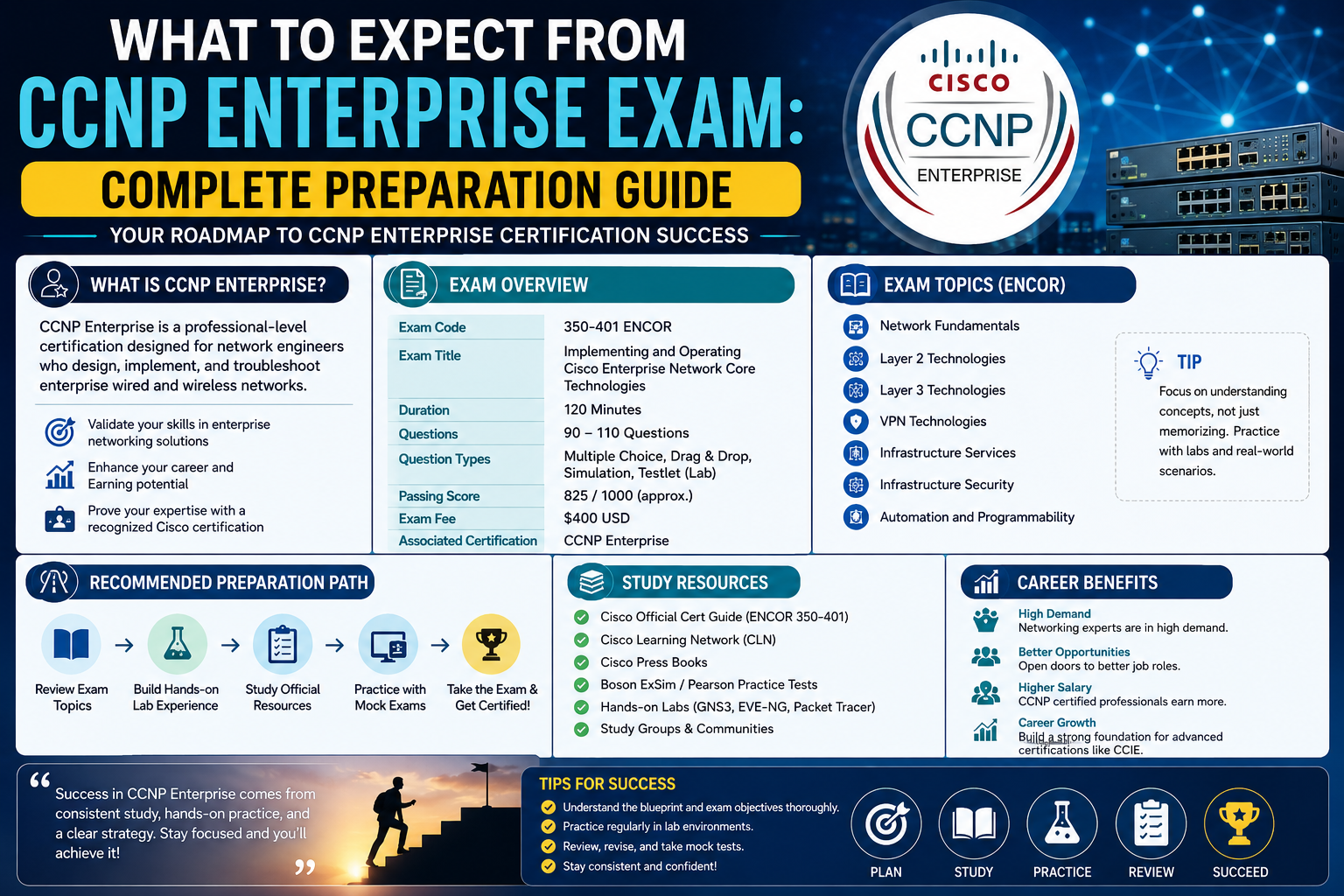
The CCNP Enterprise certification sits at the center of Cisco’s professional-level networking track and represents one of the most recognized credentials for network engineers working in enterprise environments. It is designed for professionals who already understand core networking principles and are now looking to deepen their expertise in complex infrastructure, automation, security integration, and large-scale network design.
In today’s technology landscape, enterprise networks are no longer limited to traditional on-premises routers and switches. They now extend across cloud environments, software-defined architectures, remote workforce connectivity, and automated orchestration systems. This shift has made modern networking far more dynamic, requiring engineers to understand not only how networks operate, but also how they evolve and adapt in real time.
The CCNP Enterprise certification reflects this transformation. It is structured to validate both foundational and advanced competencies, ensuring that certified professionals can manage modern infrastructures that rely heavily on scalability, performance optimization, and intelligent network behavior.
To understand its significance, it is important to recognize that enterprise networking is no longer just about keeping systems online. It now involves ensuring seamless application delivery, maintaining secure access across distributed environments, and integrating cloud-based services without compromising performance. As organizations grow more dependent on digital ecosystems, the demand for engineers with advanced Cisco knowledge continues to increase.
Cisco Systems has played a major role in shaping global networking standards for decades, and its certification framework is widely respected across industries. Cisco Systems. The CCNP Enterprise path reflects Cisco’s attempt to align professional certifications with the realities of modern network operations, where automation, programmability, and hybrid infrastructure are becoming essential components of everyday work.
The Evolution of Cisco Certifications and the Shift in 2020
The structure of Cisco certifications has undergone a significant transformation over the years, but one of the most notable shifts occurred around 2019 and 2020. This period marked a major redesign of the entire certification ecosystem, often described informally as a turning point in Cisco’s training philosophy.
Before this change, Cisco certifications followed a more fragmented approach. There were multiple entry-level certifications, several overlapping associate-level paths, and a variety of professional certifications that sometimes covered similar topics with slight variations. While this structure worked in earlier networking eras, it became increasingly complex as technology evolved.
The modernization effort introduced a more streamlined certification hierarchy. One of the most significant changes was the consolidation of entry-level certifications into a single unified associate-level certification. This replaced older, more specialized entry paths and simplified the starting point for new learners entering the networking field.
Another important shift was the introduction of new technology-focused certifications that reflected emerging trends. Automation, software-defined networking, and cloud integration were no longer optional skills; they were becoming essential parts of enterprise environments. Cisco adjusted its certification structure to reflect these realities by embedding these topics more deeply into professional-level exams.
The restructuring also affected professional certifications such as CCNP. Instead of multiple exams leading to different variations of the same certification, the new model introduced a core-plus-concentration structure. This meant that candidates would first demonstrate broad knowledge through a core exam and then specialize in a focused area aligned with their career goals.
This change was not simply administrative. It represented a shift in how networking expertise is defined. Instead of focusing solely on device configuration and routing protocols, Cisco began emphasizing a more holistic understanding of enterprise systems. Engineers were now expected to understand automation tools, security frameworks, and infrastructure analytics as part of their core skill set.
This evolution also addressed a growing industry concern: the gap between traditional networking education and real-world enterprise demands. Modern networks are highly integrated systems that require engineers to understand multiple disciplines simultaneously. The updated certification structure reflects this multidisciplinary reality.
Why CCNP Enterprise Became a Central Certification Path
Among all professional-level Cisco certifications, CCNP Enterprise stands out as one of the most widely pursued and strategically important paths. This is largely due to the nature of enterprise networks themselves, which form the backbone of most corporate IT infrastructures.
Enterprise networks are responsible for connecting users, applications, data centers, and cloud services across distributed environments. They must be designed for resilience, scalability, and security while also supporting increasing demands for automation and real-time analytics. This complexity makes enterprise networking one of the most challenging and rewarding areas in IT.
The CCNP Enterprise certification was designed to reflect this complexity. It is not limited to a single niche such as routing or switching. Instead, it covers a broad range of technologies that collectively define modern enterprise environments. This includes infrastructure design, advanced routing, network assurance, security integration, virtualization, and automation.
One reason this certification has become so central is its alignment with real job roles. Many network engineers, infrastructure architects, and systems specialists work in environments where they must manage large-scale networks that span multiple sites and cloud platforms. CCNP Enterprise validates the skills required for these responsibilities in a structured and measurable way.
Another factor contributing to its importance is its flexibility. The certification allows professionals to choose a specialization that aligns with their career direction. Whether someone is interested in wireless networking, advanced routing, network design, or automation, the CCNP Enterprise framework provides a pathway to develop those skills in depth.
This flexibility is particularly important in a field where job roles are increasingly specialized. Organizations no longer look for general networking knowledge alone; they require professionals who can solve specific challenges related to cloud integration, network performance optimization, or secure infrastructure design.
CCNP Enterprise also serves as a bridge between associate-level knowledge and expert-level certifications. It provides the foundational depth required to pursue advanced certifications while also delivering practical skills that can be applied directly in enterprise environments.
The certification’s relevance is further strengthened by the increasing adoption of software-defined networking. Traditional manual configuration methods are being replaced by automated systems that rely on controllers, APIs, and orchestration platforms. Engineers who understand both traditional and modern approaches are better positioned to manage these transitions effectively.
Structure of CCNP Enterprise Certification Journey
The CCNP Enterprise certification follows a structured two-exam model designed to assess both broad and specialized knowledge. This structure ensures that candidates not only understand core enterprise networking principles but also develop expertise in a specific area of interest.
The journey begins with a core exam that focuses on essential enterprise networking technologies. This exam is designed to test a candidate’s understanding of foundational concepts that apply across all enterprise environments. It serves as the baseline requirement for the certification and ensures that every certified professional has a consistent level of knowledge.
After completing the core exam, candidates must choose a concentration exam. This second exam allows them to specialize in a particular domain, such as advanced routing, network design, wireless technologies, automation, or cloud connectivity. The combination of these two exams defines the final certification.
This structure reflects a broader trend in IT certification design. Instead of assessing knowledge through a single comprehensive test, modern certifications now emphasize layered learning. Candidates are first evaluated on general principles and then tested on specialized skills relevant to their chosen career path.
The core-plus-specialization model also provides long-term flexibility. As technology evolves, concentration exams can be updated independently without altering the foundational core. This ensures that certifications remain relevant even as networking technologies continue to change.
Another important aspect of this structure is its alignment with real-world job progression. Many network professionals begin their careers working on general infrastructure tasks before moving into specialized roles such as network design or automation engineering. The CCNP Enterprise structure mirrors this progression, making it a natural fit for career development.
The certification journey also encourages continuous learning. Since concentration exams can be selected based on interest or career goals, professionals can expand their expertise in multiple directions over time. This makes CCNP Enterprise not just a certification, but a long-term development framework.
Understanding the Core Exam ENCOR 350-401 in Depth
The ENCOR 350-401 exam forms the foundation of the CCNP Enterprise certification. It is designed to assess a candidate’s understanding of enterprise infrastructure technologies and their ability to integrate and manage complex networking environments.
This exam covers a wide range of topics that reflect the diverse responsibilities of modern network engineers. Rather than focusing on a single technology, it evaluates knowledge across multiple domains that are essential for enterprise operations.
One of the key areas covered in the core exam is enterprise architecture. This includes understanding how different components of a network interact, how systems are designed for scalability, and how redundancy and resilience are implemented in large environments. Candidates are expected to understand both traditional hierarchical designs and modern software-defined architectures.
Another major component of the exam focuses on infrastructure technologies. This includes routing protocols, switching concepts, and advanced network services. The goal is to ensure that candidates can configure, troubleshoot, and optimize complex network infrastructures that support business-critical applications.
Virtualization is also an important part of the exam. Modern enterprise environments increasingly rely on virtualized infrastructure, including virtual routers, switches, and network functions. Understanding how these components operate and integrate with physical infrastructure is essential for managing hybrid environments.
Network assurance is another critical domain. This involves monitoring network performance, identifying issues, and ensuring optimal operation. Engineers must be able to analyze network behavior and use diagnostic tools to maintain service quality and reliability.
Security is deeply integrated into the core exam as well. Rather than treating security as a separate discipline, it is embedded within networking concepts. This reflects the modern reality that network and security operations are closely interconnected. Engineers must understand how to implement secure configurations, protect infrastructure components, and mitigate threats at the network level.
Automation and programmability have become increasingly important in recent years, and the core exam reflects this shift. Candidates are expected to have a basic understanding of automation tools, scripting concepts, and API interactions. This ensures that they can work effectively in environments where network operations are increasingly automated.
The ENCOR exam is designed not only to test theoretical knowledge but also to evaluate practical understanding. It requires candidates to think critically about how different technologies interact and how to apply concepts in real-world scenarios.
This makes the exam both challenging and comprehensive. It serves as a foundation for specialization while ensuring that all CCNP Enterprise certified professionals share a consistent understanding of modern enterprise networking principles.
As enterprise environments continue to evolve, the importance of this core knowledge becomes even more significant. It provides the base upon which advanced skills are built and ensures that professionals are prepared to adapt to new technologies and methodologies as they emerge.
CCNP Enterprise Concentration Exams and Specialization Paths
After completing the ENCOR core exam, the CCNP Enterprise certification journey moves into its most flexible and career-defining stage: the concentration exams. This is where professionals shift from general enterprise networking knowledge into focused expertise that aligns with specific job roles, technologies, and industry demands.
The concentration layer is designed to reflect how modern IT teams operate. Instead of expecting every engineer to master everything equally, Cisco has structured the certification so that professionals can build deep expertise in one domain while maintaining a strong foundational understanding from the core exam. This mirrors real enterprise environments where teams are divided into specialized roles such as routing engineers, wireless specialists, automation developers, and network architects.
Each concentration exam represents a different direction within enterprise networking. These paths are not isolated silos; rather, they are interconnected areas that collectively define how modern networks function. Whether an organization is deploying cloud-connected branches, optimizing wireless performance, or automating network operations, each specialization plays a critical role.
The flexibility of this structure is one of the reasons the CCNP Enterprise certification remains highly relevant. It allows professionals to tailor their learning journey according to industry demand, personal interest, or long-term career goals. This adaptability is especially important in a field where technology evolves rapidly, and job roles continuously shift.
Advanced Routing and Infrastructure Specialization
One of the most widely chosen concentration paths focuses on advanced routing and infrastructure services. This specialization is designed for professionals who want to deepen their understanding of complex routing environments, service integration, and large-scale network troubleshooting.
In modern enterprise networks, routing is no longer limited to simple path selection between networks. It involves dynamic environments where multiple routing protocols coexist, traffic must be optimized across hybrid infrastructures, and redundancy must be carefully engineered to ensure continuous availability.
Professionals pursuing this specialization are expected to understand advanced routing concepts such as policy-based routing, route redistribution, and complex path manipulation. These concepts are critical in enterprise environments where multiple networks must be interconnected without compromising performance or stability.
Another important aspect of this specialization is infrastructure services. These include technologies that support core network operations such as DHCP, DNS integration, network time synchronization, and advanced switching mechanisms. While these services may appear foundational, they become significantly more complex in large-scale environments where redundancy, segmentation, and performance optimization are required.
Troubleshooting is also a major focus in this path. Enterprise networks are highly dynamic, and issues can arise from configuration errors, protocol mismatches, or infrastructure failures. Engineers must be able to diagnose problems quickly and restore services with minimal disruption.
This specialization is particularly valuable for professionals working in large data center environments, service provider networks, or organizations with geographically distributed infrastructure. It builds the expertise required to maintain stability in environments where even small configuration errors can have a significant impact.
SD-WAN and Modern Network Transformation
Another major concentration area focuses on software-defined wide area networking, commonly known as SD-WAN. This technology represents one of the most significant shifts in enterprise networking over the past decade.
Traditional WAN architectures relied heavily on fixed routing paths, dedicated hardware, and manual configuration. While effective in earlier network designs, these approaches struggle to meet the demands of modern cloud-driven environments where flexibility, scalability, and centralized control are essential.
SD-WAN introduces a software-driven approach to WAN management. It allows organizations to dynamically control traffic flows across multiple connection types, including broadband, MPLS, and cellular networks. This flexibility enables better application performance, improved cost efficiency, and enhanced reliability.
Professionals specializing in SD-WAN are expected to understand how centralized controllers manage distributed network devices. They must also be familiar with policy-based traffic routing, application-aware networking, and automated failover mechanisms.
Security is deeply integrated into SD-WAN architectures. Unlike traditional networks, where security is often added as a separate layer, SD-WAN environments embed security policies directly into the network fabric. This includes encryption, segmentation, and secure connectivity to cloud environments.
This specialization is particularly relevant for organizations undergoing digital transformation. As businesses increasingly move applications to cloud platforms and adopt hybrid work models, SD-WAN provides the flexibility needed to maintain performance and security across distributed environments.
The SD-WAN concentration path also reflects the broader industry shift toward automation and centralized network control. Engineers in this domain must be comfortable working with controllers, orchestration systems, and policy-driven configurations rather than manual device-level management.
Enterprise Wireless Networking Expertise
Wireless networking has become a critical component of modern enterprise environments. With the rise of mobile devices, remote work, and IoT systems, wireless infrastructure now plays a central role in business operations.
The CCNP Enterprise wireless concentration path focuses on both the design and implementation of enterprise-grade wireless networks. This includes understanding how wireless signals propagate, how access points are deployed across large environments, and how to ensure consistent coverage and performance.
One of the key challenges in wireless networking is managing variability. Unlike wired networks, wireless connections are affected by physical obstacles, interference, and environmental conditions. Engineers must design networks that can adapt to these challenges while maintaining performance and reliability.
Wireless site surveys are an important part of this specialization. These surveys help determine optimal access point placement, identify potential interference sources, and ensure coverage across all required areas. Proper planning is essential for avoiding performance issues after deployment.
Mobility management is another critical topic. In enterprise environments, users frequently move between access points while maintaining active connections. Ensuring seamless handoff between access points is essential for maintaining uninterrupted service.
Security also plays a significant role in wireless networks. Since wireless signals are broadcast over the air, they are inherently more vulnerable than wired connections. Engineers must implement strong authentication mechanisms, encryption protocols, and access control policies to protect network resources.
Wireless high availability is another important concept. Enterprise environments cannot afford downtime in wireless connectivity, especially in industries such as healthcare, education, and logistics. Designing redundant systems and failover mechanisms ensures continuous connectivity even in the event of hardware or configuration failures.
This specialization is particularly valuable for professionals working in campus networks, large corporate environments, and public sector organizations where wireless connectivity is a primary access method.
Network Automation and Programmability
One of the most transformative areas in modern networking is automation. As networks grow in size and complexity, manual configuration becomes inefficient and error-prone. Automation addresses this challenge by enabling programmable network management and reducing reliance on manual intervention.
The automation concentration path within CCNP Enterprise focuses on teaching engineers how to interact with networks programmatically. This includes understanding APIs, scripting concepts, and automation frameworks that allow networks to be controlled through software rather than manual configuration.
Python is often used as a foundational language in this area due to its simplicity and versatility. Engineers learn how to write scripts that interact with network devices, retrieve configuration data, and automate repetitive tasks.
APIs play a central role in modern network automation. They allow different systems to communicate with each other, enabling centralized control and orchestration. Engineers must understand how to use APIs to configure devices, monitor network performance, and integrate with external systems.
Controllers are another important component of automation. These centralized systems manage network behavior across multiple devices, allowing for consistent policy enforcement and simplified management. Instead of configuring each device individually, engineers can define policies at a higher level and let the controller handle implementation.
Automation also improves network reliability. By reducing manual configuration, the likelihood of human error decreases significantly. Automated systems can also respond to network events in real time, improving resilience and performance.
This specialization is particularly important in organizations adopting DevOps practices or transitioning toward infrastructure-as-code models. In these environments, networking is treated as part of a larger software ecosystem rather than a standalone discipline.
Network Design and Enterprise Architecture Focus
Network design is another key specialization within the CCNP Enterprise certification. This path focuses on the strategic planning and architectural design of enterprise networks rather than day-to-day configuration tasks.
Designing a network requires a deep understanding of business requirements, scalability considerations, and long-term infrastructure planning. Engineers must be able to translate organizational needs into technical designs that are both efficient and sustainable.
Enterprise network design includes considerations such as hierarchical architecture, redundancy planning, traffic segmentation, and scalability modeling. Each of these elements contributes to the overall performance and reliability of the network.
One of the primary challenges in network design is balancing performance with cost. While high-performance infrastructure is desirable, it must also be economically viable. Engineers must make decisions that optimize both technical and financial factors.
Security is also an integral part of network design. Modern enterprise architectures must incorporate security principles from the beginning rather than treating them as an afterthought. This includes segmentation strategies, access control models, and secure communication pathways.
Cloud integration is another important aspect of modern network design. As organizations increasingly adopt hybrid environments, networks must be designed to seamlessly connect on-premises infrastructure with cloud platforms.
This specialization is particularly suited for professionals who want to move into architecture roles or strategic planning positions within IT organizations.
Preparing for CCNP Enterprise Through Practical Experience
While theoretical knowledge is essential for passing CCNP Enterprise exams, practical experience plays an equally important role in mastering the required skills. Enterprise networking is a hands-on discipline where real-world problem-solving is critical.
Working with physical or simulated network environments helps reinforce theoretical concepts and provides insight into how systems behave under real conditions. This includes configuring routing protocols, troubleshooting connectivity issues, and testing redundancy mechanisms.
Lab environments are particularly valuable for understanding complex scenarios that cannot be fully captured through theory alone. They allow engineers to experiment with different configurations, observe system behavior, and develop troubleshooting skills.
Exposure to real enterprise environments is even more valuable. Working in production networks provides experience with performance constraints, operational challenges, and system dependencies that are difficult to replicate in lab settings.
Another important aspect of preparation is understanding how different technologies interact. Enterprise networks are highly interconnected systems where changes in one area can impact multiple components. Engineers must develop a systems-level understanding rather than focusing on isolated technologies.
This holistic understanding is one of the key goals of the CCNP Enterprise certification. It ensures that certified professionals are not only technically skilled but also capable of thinking strategically about network behavior and design.
Real-World Skills Validated by CCNP Enterprise
The CCNP Enterprise certification is not designed as a theoretical exercise. It is structured to reflect the real responsibilities of network engineers working in modern enterprise environments. This makes it especially valuable for professionals who want to move beyond basic configuration tasks and into roles that involve decision-making, system design, and operational ownership.
In real enterprise networks, engineers are expected to manage systems that support critical business functions. These networks must remain operational under heavy load, adapt to changing traffic patterns, and integrate with cloud-based services without interruption. The CCNP Enterprise certification validates the ability to operate in exactly these kinds of environments.
One of the most important real-world skills validated by this certification is infrastructure troubleshooting. Enterprise networks are complex systems with many interconnected components. When something goes wrong, the issue is rarely isolated to a single device. Instead, it often involves multiple layers such as routing, switching, security policies, or service dependencies.
Professionals certified at the CCNP Enterprise level are expected to systematically diagnose these problems. This involves analyzing logs, understanding protocol behavior, and isolating faults across different network layers. The ability to think logically under pressure is one of the most valuable skills in enterprise networking.
Another critical skill is network optimization. In large organizations, networks are constantly evolving as new applications are introduced, users are added, and cloud services are integrated. Engineers must ensure that performance remains stable even as complexity increases.
This often involves tuning routing protocols, optimizing traffic flows, and adjusting network policies to ensure efficient resource utilization. It also includes monitoring network behavior to identify potential bottlenecks before they impact users.
Security integration is another key real-world skill validated by CCNP Enterprise. Modern enterprise networks cannot treat security as a separate function. Instead, it must be integrated into every layer of the infrastructure.
Engineers must understand how to implement secure routing, configure access control policies, and ensure encrypted communication across different network segments. They must also be able to respond to security incidents that originate at the network level.
Automation skills are increasingly important in real-world environments. Many organizations now use automation tools to manage large-scale networks more efficiently. Engineers are expected to understand how to use scripts, APIs, and controllers to perform tasks that would otherwise require manual configuration.
This includes tasks such as deploying configurations across multiple devices, monitoring network health, and responding to system alerts automatically. Automation not only improves efficiency but also reduces the risk of human error.
The Role of CCNP Enterprise in Career Development
One of the most significant benefits of the CCNP Enterprise certification is its impact on career progression. It is widely recognized in the IT industry as a professional-level credential that demonstrates both technical competence and practical experience.
For many network engineers, CCNP Enterprise serves as a turning point in their careers. It often marks the transition from junior or associate-level roles into more advanced positions with greater responsibility. These roles may include network engineer, senior infrastructure engineer, or network operations specialist.
The certification also plays an important role in helping professionals specialize. Because the CCNP Enterprise path includes multiple concentration options, it allows individuals to align their certification with specific job roles. This specialization can significantly improve career opportunities in targeted areas.
For example, professionals who choose a wireless networking concentration may move into roles focused on campus network design and deployment. Those who specialize in automation may transition into DevOps or network programming roles. Similarly, those focused on SD-WAN or cloud connectivity may work in organizations undergoing digital transformation.
Another important aspect of career development is salary progression. While compensation varies by region and experience, professionals with CCNP-level certifications generally earn higher salaries than those with only entry-level certifications. This is because the certification demonstrates the ability to handle complex systems and solve advanced technical problems.
Beyond salary, CCNP Enterprise also enhances job mobility. Because Cisco technologies are widely used across industries, certified professionals can work in a variety of sectors, including finance, healthcare, telecommunications, education, and government.
The certification also serves as a stepping stone toward expert-level credentials. Many professionals use CCNP Enterprise as preparation for more advanced certifications that focus on enterprise infrastructure and wireless technologies at the expert level.
Industry Relevance and Demand for Enterprise Networking Skills
Enterprise networking remains one of the most in-demand areas within the IT industry. As organizations continue to expand their digital infrastructure, the need for skilled network engineers has grown significantly.
Modern businesses rely heavily on stable and secure network connectivity. Applications such as cloud services, video conferencing, data analytics platforms, and remote collaboration tools all depend on underlying network infrastructure. Any disruption in network performance can have immediate and significant business impact.
This dependency has elevated the importance of network engineers who can design, implement, and maintain reliable systems. The CCNP Enterprise certification directly aligns with these industry requirements by validating the skills needed to manage complex environments.
One of the key drivers of demand is digital transformation. Organizations across all sectors are migrating toward cloud-based systems, hybrid infrastructures, and software-defined networking models. These transitions require engineers who understand both traditional networking and modern cloud-integrated architectures.
Another factor increasing demand is cybersecurity. As networks become more complex and interconnected, the risk of security breaches also increases. Enterprise networks must be designed with strong security principles, and engineers must be able to implement and maintain these protections.
The rise of remote work has also contributed to the importance of enterprise networking skills. With employees accessing corporate resources from multiple locations, networks must support secure and reliable remote connectivity. This has increased the need for technologies such as VPNs, SD-WAN, and cloud-based access systems.
Automation is another major trend shaping the industry. As networks scale, manual management becomes unsustainable. Organizations are increasingly adopting automated systems to manage configuration, monitoring, and troubleshooting tasks. Engineers with automation skills are, therefore, in high demand.
CCNP Enterprise certification reflects all of these industry trends. It prepares professionals to work in environments that are dynamic, automated, and highly dependent on secure connectivity.
Challenges in CCNP Enterprise Certification Journey
While CCNP Enterprise is highly valuable, it is also considered a challenging certification. This difficulty is intentional, as the certification is designed to validate advanced professional-level skills.
One of the main challenges candidates face is the breadth of topics covered in the core exam. The ENCOR exam includes multiple domains such as routing, switching, security, automation, and network assurance. This requires candidates to develop a broad understanding of enterprise networking rather than focusing on a single area.
Another challenge is the depth of knowledge required. It is not enough to understand concepts at a surface level. Candidates must be able to apply knowledge in complex scenarios, troubleshoot issues, and understand how different technologies interact.
The integration of automation and programmability also presents a challenge for many candidates. Traditional networking professionals may have limited experience with scripting, APIs, or software-driven network management. Adapting to this new paradigm requires additional learning and practice.
Time management is another common difficulty. The exam requires candidates to analyze scenarios, interpret technical information, and make decisions under time constraints. This can be challenging without sufficient hands-on experience.
Another factor that increases difficulty is the evolving nature of networking technologies. As the industry changes, exam content is updated to reflect new trends such as SD-WAN, cloud integration, and AI-driven network analytics. Candidates must stay current with these developments.
Despite these challenges, the certification is considered achievable with proper preparation. Success typically depends on a combination of theoretical study, practical lab experience, and consistent practice.
Importance of Hands-On Experience in Enterprise Networking
Hands-on experience plays a critical role in mastering the skills required for CCNP Enterprise certification. Networking is inherently practical, and many concepts cannot be fully understood through theory alone.
Working in lab environments allows candidates to experiment with configurations, observe system behavior, and understand how different technologies interact. This type of experience is essential for developing troubleshooting skills and operational confidence.
Real-world exposure is even more valuable. Working in production environments provides insight into performance constraints, unexpected system behavior, and operational challenges that cannot be replicated in labs.
For example, in a lab, a routing protocol may function perfectly under ideal conditions. However, in a real enterprise environment, factors such as network congestion, hardware limitations, and configuration conflicts can significantly impact behavior.
Hands-on experience also helps candidates develop intuition. Over time, engineers learn to recognize patterns, predict issues, and identify root causes more efficiently. This intuitive understanding is one of the key differences between theoretical knowledge and professional expertise.
Another benefit of practical experience is familiarity with tools and technologies used in enterprise environments. This includes network monitoring systems, configuration management tools, and diagnostic utilities.
Engineers who have worked extensively with these tools are better prepared to handle real-world challenges and adapt to new technologies as they emerge.
How CCNP Enterprise Reflects Modern Networking Trends
The structure and content of the CCNP Enterprise certification closely reflect current trends in the networking industry. This alignment ensures that certified professionals remain relevant in rapidly evolving environments.
One of the most significant trends reflected in the certification is the shift toward software-defined networking. Traditional hardware-based configurations are being replaced by centralized control systems that manage network behavior through software.
Another major trend is cloud integration. Modern enterprise networks must support seamless connectivity between on-premises infrastructure and cloud platforms. This requires knowledge of hybrid architectures, secure cloud access, and distributed networking models.
Automation is another key trend. Networks are becoming increasingly programmable, with many tasks now handled through scripts, APIs, and orchestration systems. This reduces manual workload and improves operational efficiency.
Security integration is also a major focus. Rather than being treated as a separate layer, security is now embedded throughout the network infrastructure. This includes secure routing, encrypted communication, and identity-based access control.
Finally, network analytics and assurance are becoming increasingly important. Organizations now rely on data-driven insights to monitor performance, detect anomalies, and optimize network behavior. This shift toward intelligent networking is reflected in the certification’s emphasis on network assurance concepts.
These trends highlight the importance of continuous learning in the field of networking. CCNP Enterprise is not just a static certification; it is designed to evolve alongside industry changes, ensuring long-term relevance for professionals who hold it.
Rise of Intent-Based Networking and Network Observability
One of the most important shifts shaping modern enterprise environments is the move toward intent-based networking and deep network observability. Unlike traditional networking approaches, where engineers manually configure devices and verify behavior afterward, intent-based systems focus on defining desired outcomes and letting the network determine how to achieve them.
In practical terms, this means network engineers are increasingly responsible for defining policies such as application priority, security requirements, and performance expectations, rather than configuring individual interfaces or routing rules. The system then translates these high-level intents into actual network behavior.
This evolution is closely tied to the growing importance of telemetry and real-time data analysis. Modern enterprise networks generate massive amounts of operational data, including traffic flows, device performance metrics, and application behavior insights. Instead of relying solely on manual troubleshooting, engineers now use observability platforms to understand what is happening across the network at any given moment.
Tools like network assurance platforms and analytics engines allow teams to detect anomalies before they escalate into outages. This represents a major shift from reactive troubleshooting to proactive network management. Engineers are no longer just fixing problems—they are predicting and preventing them.
The CCNP Enterprise framework indirectly prepares professionals for this shift by emphasizing network assurance concepts and automation awareness. While it does not turn engineers into data scientists, it builds the foundational understanding needed to work effectively in environments where data-driven decision-making is central.
As enterprise environments continue to evolve, observability is becoming as important as connectivity itself. Networks are no longer judged only by uptime but also by application performance, user experience, and service consistency.
Changing Structure of Enterprise Networking Roles
Another significant transformation taking place in the industry is the restructuring of traditional networking roles. In earlier IT environments, network engineers were primarily responsible for configuring routers, switches, and basic connectivity services. However, modern enterprise networks are far more complex, requiring specialized roles that go beyond traditional boundaries.
Today, many organizations divide networking responsibilities into distinct functional areas. For example, some engineers focus entirely on automation and scripting, while others specialize in wireless design, security integration, or cloud connectivity. This specialization allows teams to manage increasingly complex infrastructures more efficiently.
The CCNP Enterprise certification aligns well with this shift by offering multiple concentration paths. Instead of training every professional in the same skill set, it encourages focused expertise in specific domains. This reflects how enterprise teams actually operate in real-world environments.
Another important change is the integration of networking with broader IT disciplines. Network engineers now frequently collaborate with software developers, cybersecurity analysts, and cloud architects. This cross-functional collaboration requires a deeper understanding of how networking interacts with applications and services at a system level.
In many organizations, networking is no longer viewed as a standalone function. It is now part of a larger digital ecosystem that includes infrastructure automation, application delivery, and security operations. This has led to the emergence of hybrid roles such as network automation engineer or infrastructure reliability engineer.
These evolving roles require professionals to think beyond traditional configuration tasks. They must understand how networks support business applications, how automation impacts operational workflows, and how performance data can be used to improve service delivery.
As a result, modern network engineers are expected to combine technical depth with strategic awareness. They must not only understand how networks operate but also how they contribute to overall business outcomes.
Conclusion
The CCNP Enterprise certification represents far more than a technical milestone; it reflects the direction in which enterprise networking as a whole is moving. As organizations continue to expand across hybrid cloud environments, remote infrastructures, and software-driven architectures, the role of the network engineer has evolved into something far more dynamic, analytical, and strategic than in previous decades.
What makes CCNP Enterprise particularly relevant today is its balance between foundational knowledge and modern specialization. The core exam ensures that professionals understand the essential principles that underpin enterprise networks, while the concentration paths allow them to develop focused expertise in areas that are shaping the future of IT. Whether it is advanced routing, SD-WAN transformation, wireless networking, automation, cloud connectivity, or network assurance, each specialization aligns with real industry demands.
Another important aspect of this certification is how it reflects the shift from manual network management to intelligent, automated systems. Traditional networking relied heavily on device-by-device configuration and reactive troubleshooting. In contrast, modern enterprise environments demand proactive monitoring, policy-driven automation, and data-informed decision-making. CCNP Enterprise prepares professionals to operate confidently within this new paradigm.
Equally significant is the certification’s role in career development. It acts as a bridge between foundational networking knowledge and expert-level design and architecture roles. Professionals who pursue this certification often find themselves better equipped to handle complex infrastructures, collaborate across technical teams, and contribute to large-scale digital transformation initiatives.
As networking continues to converge with cloud computing, cybersecurity, and software development, the importance of multidisciplinary understanding will only increase. CCNP Enterprise helps build that bridge by combining traditional networking expertise with modern technologies such as automation, programmability, and network analytics.
Ultimately, the certification is not just about passing exams—it is about developing a mindset capable of adapting to continuous technological change. In a field where systems evolve rapidly and expectations grow constantly, the ability to learn, adapt, and apply knowledge effectively becomes the most valuable skill of all. CCNP Enterprise remains a strong foundation for anyone aiming to build a long-term, future-ready career in enterprise networking.