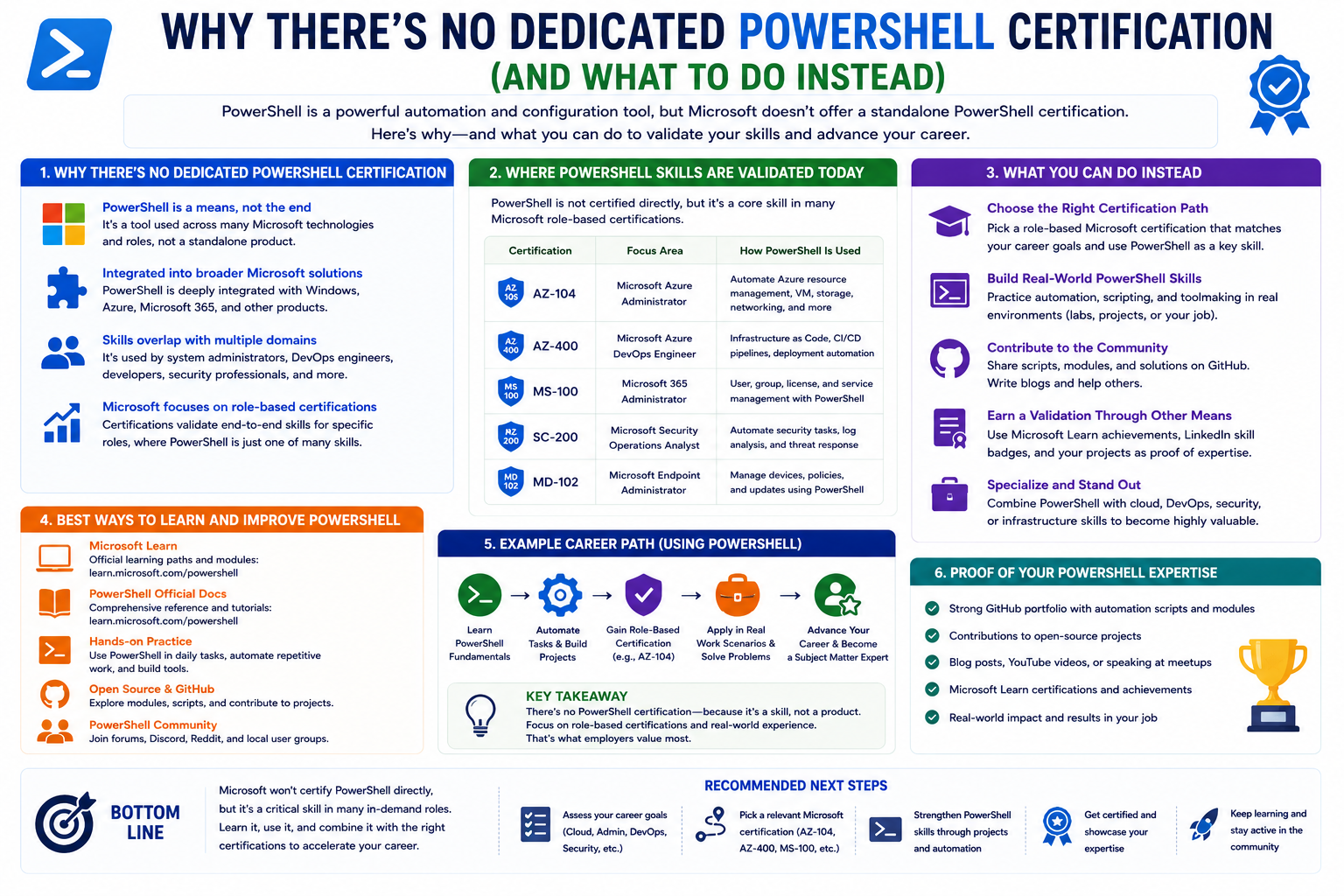
PowerShell has become one of the most influential tools in modern IT operations, yet it stands apart from many other technologies in one notable way: there is no single, widely recognized certification dedicated entirely to it. This absence often surprises professionals, especially considering how deeply PowerShell is embedded in system administration, cloud management, and automation workflows. To understand why this gap exists, it is necessary to explore the nature of PowerShell itself, how certification ecosystems evolve, and how the industry evaluates skills.
Understanding the Unique Nature of PowerShell
PowerShell is not just a scripting language in the traditional sense. It is a comprehensive automation framework that combines a command-line shell, a scripting environment, and a configuration management tool. This layered identity makes it incredibly flexible, but it also complicates the idea of standardizing knowledge into a single certification.
Unlike standalone programming languages that follow a more predictable structure, PowerShell adapts to the environment in which it is used. It integrates deeply with operating systems, cloud services, and enterprise tools. As a result, the skill set required to “know PowerShell” can vary significantly depending on the role. A help desk technician might use simple commands to manage users, while a systems engineer could be writing advanced scripts that automate entire infrastructures.
This variability makes it difficult to define a universal benchmark for certification. What should be tested? Basic command usage, scripting logic, or enterprise automation design? Each of these areas represents a different level of expertise, and combining them into a single certification risks either oversimplifying or overcomplicating the evaluation.
Past Attempts and Their Limitations
There have been efforts to introduce structured validation for PowerShell skills. One of the most notable attempts came from a well-known PowerShell-focused community that launched an assessment program designed to validate practical knowledge. Instead of relying on multiple-choice questions, it required candidates to complete real-world tasks and submit their work.
While the concept was promising, it did not gain widespread adoption. One reason was the challenge of scaling such an evaluation model. Practical assessments require time, expert review, and consistent standards, all of which are difficult to maintain across a large number of candidates. Additionally, without backing from a major vendor or certification authority, it struggled to achieve industry-wide recognition.
This highlights a key issue: certification is not just about testing knowledge. It is also about credibility, standardization, and acceptance by employers. Without these elements, even well-designed programs can fade away.
Comparison with Traditional Programming Certifications
When comparing PowerShell to more traditional programming languages, the differences become clearer. Languages like Python or Java are often taught in academic settings and have well-defined learning paths. Certification programs for these languages typically focus on syntax, algorithms, and general programming principles.
PowerShell, however, is tightly connected to specific ecosystems. Its value lies in how it interacts with systems, services, and administrative tasks. This makes it less about abstract programming knowledge and more about practical application within a given environment.
Because of this, PowerShell skills are often assessed indirectly. Instead of earning a standalone certification, professionals demonstrate their knowledge through certifications tied to broader platforms. These might include cloud administration, system management, or infrastructure automation credentials where PowerShell plays a supporting role.
Integration into Broader Certification Paths
One of the strongest reasons for the absence of a dedicated PowerShell certification is that its skills are already embedded within other certification tracks. Many widely recognized credentials require candidates to use PowerShell as part of their skill set.
For example, administrative certifications often include tasks that involve scripting, automation, and command-line operations. Candidates are expected to understand how to use PowerShell to manage resources, configure systems, and automate repetitive processes. In this way, PowerShell becomes a foundational skill rather than a standalone subject.
This integrated approach has advantages. It ensures that PowerShell knowledge is applied in real-world scenarios rather than being tested in isolation. However, it also means that there is no single certification that explicitly highlights PowerShell expertise.
Challenges in Defining Certification Standards
Creating a certification requires clear objectives, measurable outcomes, and a consistent testing methodology. For PowerShell, defining these elements is particularly challenging.
First, the scope is vast. PowerShell can be used for simple tasks or highly complex automation workflows. Deciding what constitutes beginner, intermediate, or advanced knowledge is not straightforward.
Second, the tool evolves continuously. New modules, commands, and integrations are introduced regularly. A certification would need to keep pace with these changes, requiring frequent updates to remain relevant.
Third, practical skills are difficult to assess through traditional exams. Multiple-choice questions may test theoretical understanding, but they cannot fully capture a candidate’s ability to write efficient scripts or solve real-world problems.
These challenges make it difficult to design a certification that is both comprehensive and practical.
The Role of Industry Demand
Certification programs are often driven by demand from employers and professionals. If organizations consistently require a specific credential, it becomes valuable, and certification bodies invest in creating and maintaining it.
In the case of PowerShell, the demand is somewhat indirect. Employers typically look for broader skill sets, such as system administration, cloud management, or DevOps capabilities. PowerShell is expected to be part of these roles, but it is rarely the sole focus.
Because of this, there has not been enough pressure to create a dedicated certification. Employers are more interested in what candidates can accomplish rather than whether they hold a specific PowerShell credential.
Potential Benefits of a Dedicated Certification
Despite the challenges, there are clear advantages to having a recognized PowerShell certification. For job seekers, it would provide a tangible way to demonstrate their skills. This could be particularly valuable for those who lack extensive work experience but have invested time in learning automation and scripting.
For employers, a certification could serve as a reliable indicator of competence. It would reduce uncertainty during the hiring process and help identify candidates who can contribute effectively from day one.
Additionally, a structured certification path could encourage more professionals to learn PowerShell in a systematic way. This could lead to higher overall skill levels within the industry.
Imagining a Structured Certification Path
If a PowerShell certification were to be developed, it would likely follow a tiered approach. Different levels could represent varying degrees of expertise, from basic command usage to advanced automation and scripting.
At the foundational level, candidates might be tested on core concepts such as command syntax, object handling, and basic scripting. Intermediate levels could focus on automation techniques, error handling, and integration with other tools. Advanced levels might require candidates to design and implement complex workflows, demonstrating both technical skill and strategic thinking.
The assessment format would also need careful consideration. A combination of theoretical questions and practical tasks would likely be necessary to ensure a comprehensive evaluation.
Impact on the Professional Community
The PowerShell community is known for its collaborative and supportive nature. Knowledge sharing is a key aspect of this ecosystem, with professionals regularly contributing scripts, tutorials, and solutions.
Introducing a certification could influence this dynamic in several ways. On one hand, it could attract more individuals to the community, increasing participation and knowledge exchange. On the other hand, it could introduce a more competitive element, as individuals strive to achieve recognized credentials.
Overall, the impact would likely be positive, as long as the certification complements rather than replaces the existing culture of collaboration.
Balancing Certification and Practical Experience
One of the ongoing debates in the IT industry is the value of certifications versus hands-on experience. This discussion would certainly apply to PowerShell as well.
A certification can validate knowledge, but it cannot fully replace real-world experience. The most effective professionals are those who can apply their skills in practical situations, adapt to new challenges, and continuously learn.
For this reason, even if a PowerShell certification were introduced, it would be most valuable when combined with practical experience. Employers would still look for evidence of real-world application, such as projects, scripts, or contributions to automation initiatives.
The Future of PowerShell Skill Recognition
As technology continues to evolve, the way skills are evaluated may also change. Traditional certifications may be supplemented or replaced by alternative methods, such as project-based assessments, portfolios, or continuous learning platforms.
For PowerShell, this could mean that formal certification is not the only path to recognition. Professionals might demonstrate their expertise through practical work, community contributions, or performance in real-world scenarios.
At the same time, the growing importance of automation and scripting could increase the demand for more structured validation methods. This might eventually lead to the development of a recognized certification, especially if industry needs shift in that direction.
Conclusion
The absence of a dedicated PowerShell certification is not due to a lack of importance or relevance. Instead, it reflects the unique nature of the tool, the challenges of standardizing its diverse applications, and the way the industry currently evaluates skills. PowerShell is deeply integrated into broader technical roles, and its value is often demonstrated through practical use rather than formal credentials.
While there are clear benefits to having a recognized certification, the complexities involved in creating and maintaining one have so far prevented it from becoming a reality. For now, professionals continue to prove their PowerShell expertise through experience, broader certifications, and real-world achievements.
Whether or not a dedicated certification emerges in the future, one thing remains certain: PowerShell will continue to be a critical skill for IT professionals. Those who invest time in mastering it will find that their efforts pay off, regardless of whether a formal credential exists to validate their knowledge.