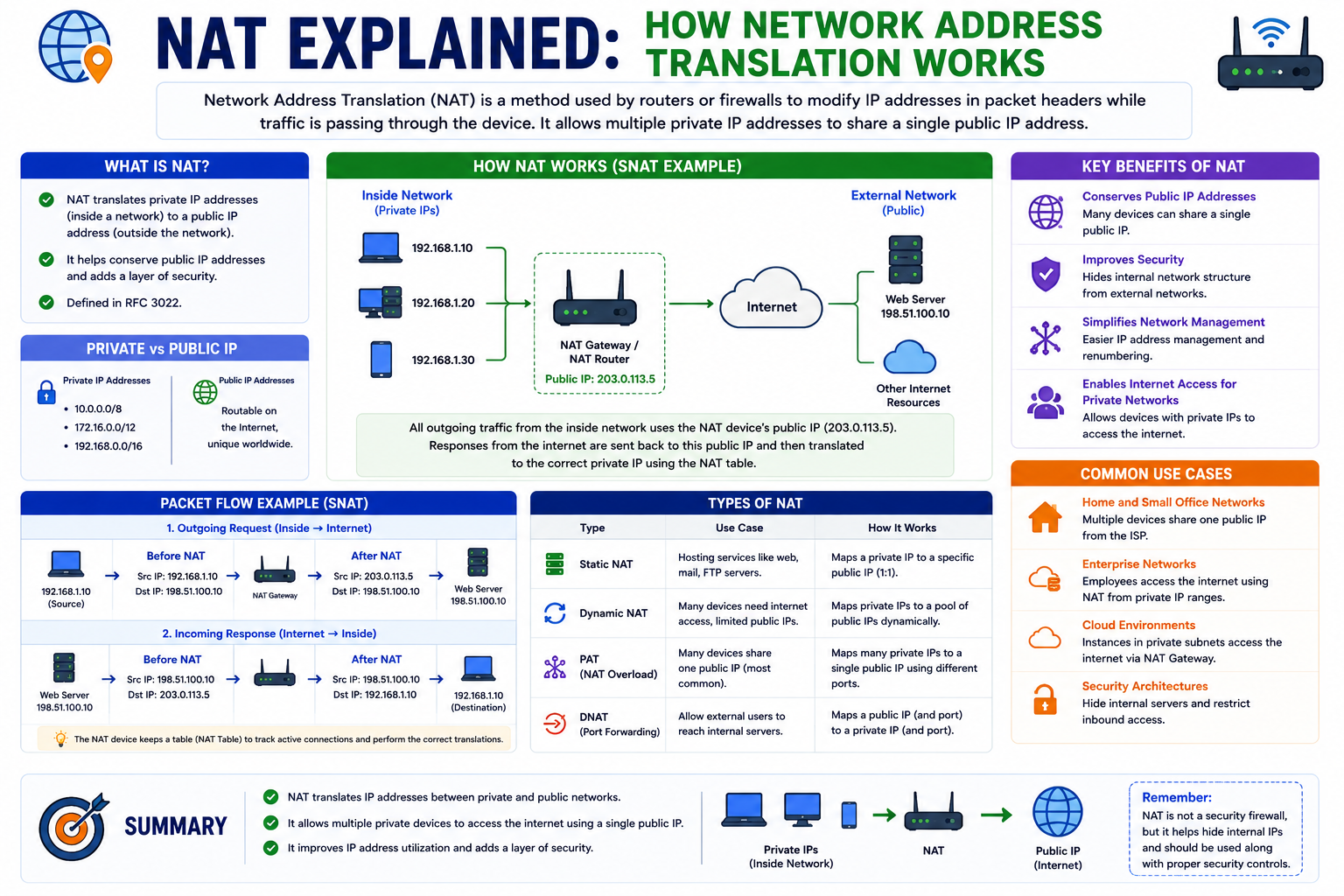
Network Address Translation, commonly known as NAT, is a fundamental networking process that allows multiple devices within a private network to share a single public, globally routable IP address. In practical terms, NAT acts as a translator between internal devices and the wider internet, masking private IP addresses and replacing them with a public one when traffic leaves the network. This mechanism not only conserves IP address space but also adds a layer of abstraction between internal systems and external networks.
The Concept of Private IP Addresses
Every device connected to a network must have an IP address to communicate effectively. However, not every device requires a globally unique identity on the internet. This is where private IP addresses come into play. Private IP ranges are reserved specifically for internal use and cannot be routed over the public internet. These ranges include 10.0.0.0 to 10.255.255.255, 172.16.0.0 to 172.31.255.255, and 192.168.0.0 to 192.168.255.255.
Among these, the 10.0.0.0 range offers the largest pool of addresses, making it ideal for large-scale enterprise environments that require extensive internal addressing. On the other hand, the 192.168.0.0 range is smaller but widely recognized, especially in home networks where addresses like 192.168.1.1 are commonly used as default gateway addresses for routers. These private addresses can be reused across different networks without conflict because they are not visible or reachable on the internet.
Why Private IP Addresses Cannot Access the Internet Directly
The internet operates on globally unique IP addresses to ensure proper routing of data between devices. Private IP addresses are intentionally excluded from this global system, meaning they cannot be used for direct communication across the internet. If private addresses were allowed on the internet, it would lead to conflicts and routing confusion, as many networks reuse the same private address ranges. NAT resolves this limitation by acting as an intermediary that translates private addresses into globally valid ones.
The Role of Public or Global IP Addresses
Global IP addresses are unique identifiers assigned to devices that need to communicate over the internet. These addresses are distributed by global authorities and managed through service providers to ensure uniqueness and proper allocation. Unlike private IPs, global addresses can be routed across the internet, allowing devices to send and receive data from anywhere in the world. NAT bridges the gap between private and global addressing by enabling internal devices to communicate externally without exposing their actual IP identities.
The Need to Hide Internal Network Addresses
Hiding internal IP addresses is not just a matter of necessity due to address limitations; it also enhances network structure and organization. When internal addresses remain concealed, external systems interact only with the router’s public IP address rather than individual devices. This separation simplifies communication and reduces complexity in managing network traffic. It also allows organizations to design their internal networks freely without worrying about global address conflicts.
How a Device Initiates Communication with the Internet
When a device inside a private network attempts to access an external resource, it follows a structured process. Suppose a computer with a private IP address wants to access a website. The first step involves resolving the website’s domain name into an IP address using a Domain Name System server. Once the IP address of the destination server is known, the computer prepares to send the request.
The device recognizes that the destination is outside its local network because the IP address does not fall within its private range. As a result, it forwards the request to its default gateway, typically a router. However, since the device uses a private IP address, it cannot directly communicate with the external server. This is where NAT becomes essential.
How NAT Handles Outgoing Traffic
When the request reaches the router, NAT examines the packet and determines that it needs to translate the source IP address before forwarding it to the internet. The router replaces the private source IP address with its own public IP address. At the same time, it creates an entry in a translation table, often referred to as the NAT table. This entry keeps track of the original private IP address and the corresponding public IP address used for the communication.
Once the translation is complete, the router sends the modified packet to the destination server on the internet. From the perspective of the external server, the request appears to originate from the router’s public IP address rather than the internal device. This abstraction is what enables multiple devices to share a single public identity online.
How Incoming Traffic Is Routed Back
When the external server responds, the response is sent to the public IP address of the router. Upon receiving the response, the router consults its NAT table to determine which internal device initiated the request. Using the stored mapping, it translates the destination IP address back to the original private IP address and forwards the packet to the correct device within the network. This process ensures that communication remains seamless despite the use of private addressing internally.
Understanding One-to-One NAT
One form of NAT involves a direct mapping between a private IP address and a public IP address. In this setup, each internal device is assigned a unique public IP address for communication with external networks. While this method is straightforward, it requires a large number of public IP addresses, making it less practical for most environments where address conservation is important.
Introduction to Port Address Translation
A more efficient approach is Port Address Translation, often referred to as NAT overload. Instead of assigning a unique public IP address to each device, this method allows multiple devices to share a single public IP address by differentiating their traffic using port numbers. Each outgoing connection is assigned a unique combination of source port and destination details, enabling the router to track multiple sessions simultaneously.
This technique significantly increases the number of possible connections, supporting thousands of simultaneous sessions using a single public IP address. It is widely used in home and enterprise networks due to its efficiency and scalability.
How NAT Tracks Multiple Connections
In environments where many devices access the internet at the same time, NAT relies on its translation table to maintain accurate mappings between internal and external communications. Each entry in the table includes details such as source IP address, destination IP address, source port, and destination port. This information ensures that responses from external servers are delivered to the correct internal device, even when multiple devices are communicating with the same destination.
By leveraging port numbers, NAT can distinguish between different sessions originating from the same public IP address. This capability allows networks to function efficiently without requiring a large pool of public IP addresses.
The Relationship Between NAT and Network Scalability
One of the most significant advantages of NAT is its contribution to network scalability. By enabling multiple devices to share a single public IP address, NAT reduces the demand for globally unique addresses. This is especially important given the limited availability of IPv4 addresses. Organizations can expand their internal networks without needing additional public IP allocations, making NAT an essential component of modern networking.
NAT and Efficient Use of Address Space
The conservation of IP address space is one of the primary reasons NAT was developed. With the rapid growth of internet-connected devices, the available pool of IPv4 addresses became insufficient to meet global demand. NAT addresses this challenge by allowing private networks to operate independently of global address constraints while still maintaining connectivity to the internet.
The Role of Routers in NAT Implementation
Routers play a central role in implementing NAT. They act as the boundary between private networks and the internet, performing address translation for all outgoing and incoming traffic. By maintaining translation tables and applying rules for packet modification, routers ensure that communication flows smoothly between internal devices and external servers.
How NAT Supports Everyday Internet Usage
In everyday scenarios, NAT operates transparently in the background. Whether users are browsing websites, streaming content, or accessing cloud services, NAT ensures that their private IP addresses remain hidden while enabling seamless communication with external systems. This process occurs automatically without requiring user intervention, making it a foundational element of modern networking.
NAT and Interaction with Other Network Technologies
NAT works alongside other networking technologies to enable full internet functionality. For example, routing protocols manage how packets travel across networks, while DNS resolves domain names into IP addresses. Together, these technologies create a cohesive system that allows devices to communicate efficiently across the globe. NAT fits into this ecosystem by handling address translation, ensuring compatibility between private networks and the public internet.
Extending NAT Concepts to Large-Scale Networks
In large-scale environments, NAT can be implemented in various forms to meet different requirements. Enterprises may use combinations of static and dynamic translation methods to manage traffic effectively. Service providers also rely on advanced NAT techniques to support large numbers of customers while conserving public IP address space. These implementations highlight the flexibility and adaptability of NAT in diverse networking scenarios.
How Global Communication Is Enabled
While NAT handles local translation, global communication across the internet relies on routing protocols that exchange information between networks. One of the key protocols responsible for this is Border Gateway Protocol, which enables different networks to share routing information and determine the best paths for data transmission. This collaboration between NAT and global routing mechanisms ensures that data can travel efficiently from private networks to destinations anywhere in the world.
Conclusion
Network Address Translation stands as a critical mechanism that enables modern networks to function efficiently despite the limitations of available IP address space. By allowing multiple devices within a private network to share a single public IP address, NAT not only conserves valuable addressing resources but also simplifies internal network design. It creates a clear boundary between private and public communication, ensuring that internal systems can operate independently while still accessing global services.
Beyond address conservation, NAT plays an essential role in maintaining organized and manageable network communication. Through the use of translation tables and port-based tracking, it ensures that data is accurately routed between internal devices and external servers, even when thousands of connections are active simultaneously. This ability to handle large volumes of traffic with minimal complexity makes NAT indispensable in both home and enterprise environments.
As networks continue to grow and the demand for connectivity increases, NAT remains a foundational technology that bridges the gap between private infrastructure and the public internet. Its integration with routing protocols and other networking processes ensures seamless communication across vast and diverse systems. Understanding NAT provides a deeper insight into how everyday internet access works behind the scenes, highlighting its importance in sustaining reliable and scalable digital communication.