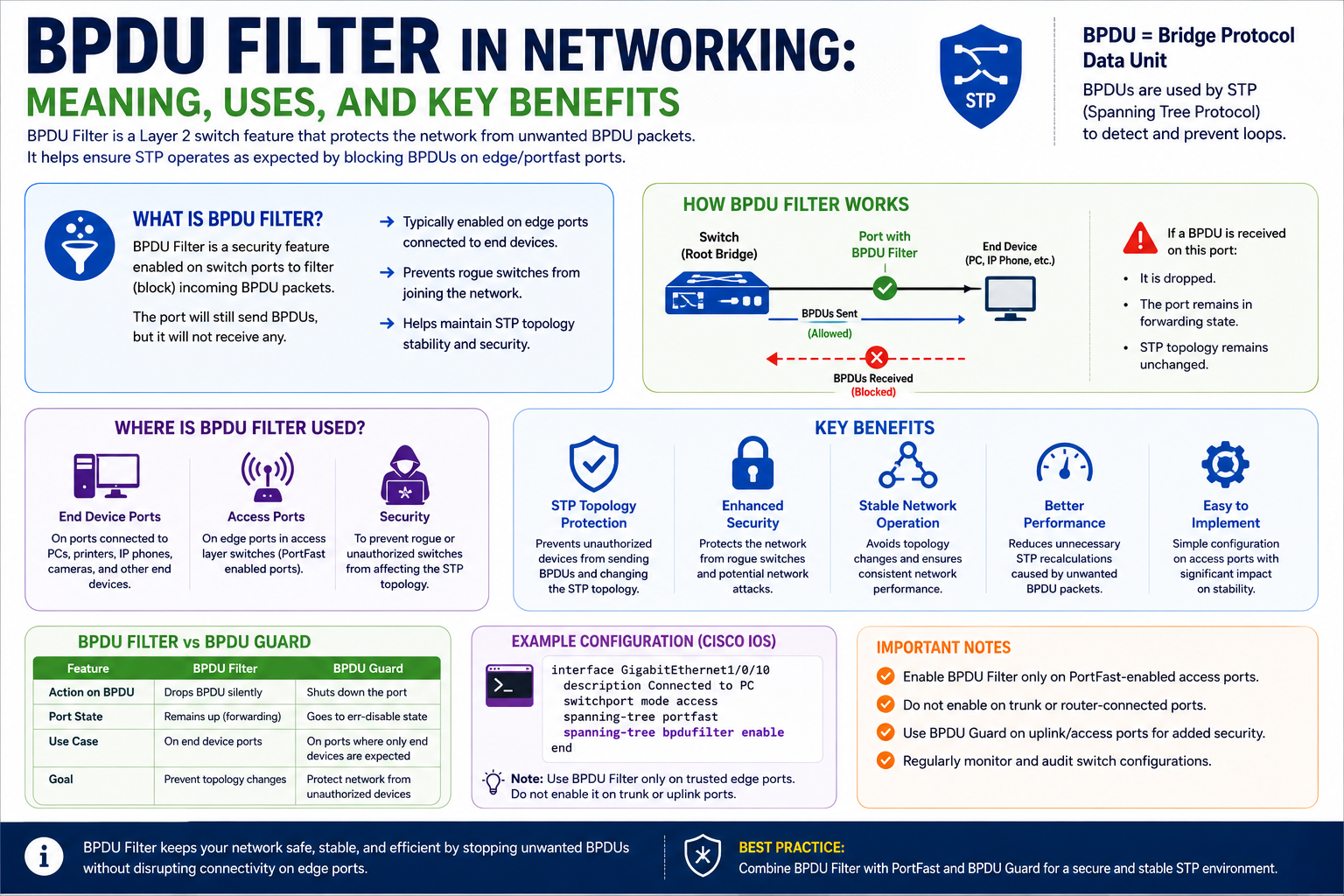
BPDU Filter controls a protocol signal, not the physical loop risk
A Bridge Protocol Data Unit, or BPDU, is a control message used by Spanning Tree Protocol to communicate information about the switching topology. Ethernet networks with redundant physical connections need loop-prevention behavior; otherwise a frame can circulate through a layer-two loop, multiplying broadcast traffic and disrupting forwarding. BPDU Filter changes whether those control messages are sent or received on an interface under particular configurations. It is a specialized edge-port feature, not a general-purpose performance boost or a safe substitute for STP.
The most consequential distinction is between Cisco-style global PortFast BPDU filtering and an explicit per-interface BPDU filter. Those modes can behave differently when a BPDU arrives, depending on the platform and release. Any configuration advice must therefore state its device family, software version and operating mode. A shortcut such as ‘BPDU Filter blocks switching loops’ is factually unsafe: filtering the very messages that expose a loop can make an accidental loop harder to prevent.
What normal STP and PortFast are trying to accomplish
A switch can have two physical paths to the same part of a network. STP exchanges BPDUs to elect a root bridge and determine which links forward and which links are blocked in order to prevent an active layer-two loop. If a previously redundant connection becomes necessary, the topology may reconverge. The control-plane exchange provides information that ordinary data traffic alone does not supply.
PortFast is an edge-port mechanism intended for interfaces connected to end stations where a switch-to-switch layer-two loop is not expected. It lets supported ports transition more promptly toward forwarding behavior; it does not transform an unsafe connection into a safe one. Connecting an unmanaged switch, bridge, or another network device to an edge-designated port can change the risk. The legitimate design assumption is about the endpoint and topology, not the apparent absence of BPDUs during a quiet period.
Before selecting an edge policy, draw a diagram with both physical links and expected STP boundaries. For each interface, record whether it connects to a host, an access point acting as a bridge, a hypervisor with virtual switching, or another physical switch. The interface description should reflect observed wiring, not merely what a deployment spreadsheet hoped would be installed.
Global PortFast BPDU filtering versus interface BPDU filtering
Cisco’s documented global command spanning-tree portfast bpdufilter default applies filtering to ports in an operational PortFast state on supported platforms. Cisco’s command reference says a port can transmit a few BPDUs at linkup, and receiving a BPDU on an edge port causes it to lose operational PortFast status and disables that global BPDU filter on the port. This allows STP behavior to reassert itself when the assumed edge condition no longer holds. The exact syntax and behavior must be confirmed against the switch and IOS or IOS XE version in use.
The per-interface spanning-tree bpdufilter enable mode is different. The Cisco documentation for affected platforms warns that a locally configured filter can prevent both sending and receiving BPDUs on the specified port. If another switch or bridging device is attached, suppressing the control exchange can prevent STP from recognizing the loop. A per-interface filter is therefore not a generally safe way to make a port quiet or to accelerate host connectivity.
A good operating standard records which mode is allowed on which interface type, the exact reason, and the review required before a link is repurposed. Do not copy a configuration fragment from one Cisco product family to another and assume the global/interface semantics are identical. Documentation, release notes and a lab test are more reliable than a generic certification tutorial.
BPDU Guard solves a different problem
BPDU Guard is often confused with BPDU Filter because both are discussed around PortFast and edge ports. The objective of BPDU Guard is to react to an unexpected BPDU on an edge interface, commonly by disabling or error-disabling the affected port on supported configurations. That makes the unexpected network connection visible as a policy violation. The objective of BPDU Filter is to suppress BPDU traffic under defined conditions; its reaction to an incoming BPDU depends on the mode just described. They are not interchangeable protections.
Imagine an office desktop port into which someone plugs a small switch and creates a second connection back to the same access network. With guard configured as intended for the platform, receipt of an unexpected BPDU can cause the port to shut down rather than permit the risky topology. With an unconditional interface filter, the switch might not observe the control message that would reveal the second bridge. The business consequence can include widespread broadcast storms rather than a single disconnected workstation.
The correct choice depends on whether the network can safely tolerate a port being shut down, whether the endpoint can legitimately transmit BPDUs, and how operators investigate and restore service. In particular, do not apply a disruptive guard policy blindly to links where bridge devices are expected; review the actual edge classification first.
A controlled lab that demonstrates the failure mode
Use a lab with two managed switches and one end station, isolated from production. Begin with a simple topology in which the switches have one active inter-switch link and an access port is designated for the end station. Confirm the baseline STP root and interface roles, and record the output of the supported STP status commands for the device. Add a second potential path only under a controlled, supervised test; do not build an unintended layer-two loop on an operational network to observe what happens.
First, test the global PortFast BPDU filter configuration on a supported model. Record which interface is operationally edge, whether BPDUs are sent shortly after linkup, and how the state changes when the port receives a legitimate BPDU from the lab switch. The intended observation is not merely that a command was accepted. Capture what the interface did and whether normal STP control participation returned when the edge assumption was invalidated.
Separately, inspect or emulate the per-interface filtering behavior on a disconnected test segment. Verify its BPDU send/receive state using the correct platform documentation and packet capture where appropriate. Then reset the port to a known-good baseline. A production change plan should never rely on a loop demonstration that could bring down customer traffic. The lab’s purpose is to understand a hazardous configuration before it is seen in the field.
Finish by testing BPDU Guard on a designated edge port and observing the platform’s documented violation state. Record how the port is diagnosed, how an operator verifies the root cause, and what recovery process is authorized. An automatic port reenablement timer without investigation could recreate the same hazard if the unauthorized bridge remains connected.
Troubleshooting a suspected BPDU filtering problem
When connectivity fails after a topology change, collect the device model, software release, interface configuration and operational STP state. Confirm the actual cabling and what kind of device is on the far end. Look for an unexpected error-disabled interface, rapidly changing MAC address learning, unusual broadcast or multicast volume, and changes in root-bridge election or port role. Do not assume that no received BPDUs means the connection is a valid edge; filtering itself can remove the evidence.
Separate three hypotheses. First, a guard policy intentionally disabled the interface because an unexpected BPDU arrived. Second, a global filter stopped applying when a legitimate BPDU changed the operational PortFast state. Third, a manual interface filter suppressed STP information so the switch did not detect the unsafe topology. The corrective action differs for each. Taking every interface out of STP filtering at once can turn a contained outage into a wider network failure.
If a switch experiences an apparent broadcast storm, prioritize containment using the organization’s approved network incident process, preserve relevant status and event logs, and do not reconnect suspected links until the topology has been checked. Confirm the approved design, then remove or adjust the unsafe configuration with rollback available. The source of truth is the observed control-plane and forwarding behavior, not the intention behind a command name.
When BPDU Filter may be appropriate
Some designs seek to limit control traffic on genuine endpoint connections or avoid exposing an STP control plane to devices that should not participate. That requirement must be weighed against the possibility that a so-called endpoint is actually a bridge or will later be repurposed. A global edge-aware policy can be safer than unconditional interface filtering in supported Cisco implementations, but it is not a blanket substitute for an approved edge-port standard and topology review.
Ask five questions before applying the feature: Is this interface genuinely an edge? Which mode is supported by this software version? What happens if a BPDU arrives? How would a loop be detected and isolated? How will the configuration be tested and rolled back? Record those answers with the change ticket. If the design cannot explain the failure state, the filter should not be approved on the strength of a generic ‘best practice’ claim.
BPDU filtering is ultimately a control-plane decision. The responsible operator must know what information STP is losing and how the system responds when the assumed topology changes. That understanding is more important than memorizing one switch command, and it keeps an edge-port optimization from becoming a network-wide availability incident.