Firewalls act as a critical control point in any network environment, serving as a gatekeeper that determines which traffic is permitted to pass and which must be blocked. Much like a highly trained security team at a restricted facility, a firewall continuously inspects incoming and outgoing data to ensure that only authorized communication is allowed. This process is not random but governed by a structured set of rules carefully defined by network administrators. These rules dictate how traffic is handled, ensuring that malicious or unauthorized access attempts are stopped before they can cause harm.
At the core of firewall functionality lies the concept of rule-based decision-making. Every piece of data that travels across a network is broken into packets, and each packet is evaluated against a predefined list of conditions. These conditions are designed to identify whether the packet is safe, suspicious, or outright malicious. Based on this evaluation, the firewall either allows the packet to pass, blocks it entirely, or silently drops it without notifying the sender. This layered decision-making process ensures both security and operational efficiency within the network.
How Firewall Rules Evaluate Network Traffic
Firewall rules function as logical instructions, often structured in an if-then format, that determine how traffic should be treated. Each rule includes specific parameters that define the characteristics of acceptable or unacceptable traffic. When a packet arrives, the firewall compares it against these parameters sequentially, starting from the top of the ruleset. As soon as a matching rule is found, the corresponding action is executed, and no further rules are evaluated for that packet.
These rules rely on multiple attributes to accurately identify and categorize traffic. One of the most important factors is the source and destination IP address, which indicates where the traffic is coming from and where it is headed. This allows administrators to block or allow communication between specific systems or networks. Another key attribute is the port number and protocol, which define the type of service being requested, such as web browsing, file transfer, or remote access. By controlling access to certain ports and protocols, firewalls can prevent the use of insecure or unauthorized services.
Direction also plays a significant role in rule evaluation. Traffic can either be inbound, meaning it is entering the network, or outbound, meaning it is leaving the network. Different rules can be applied depending on the direction, allowing for more precise control over how data flows. For example, a network may allow users to access external websites while blocking unsolicited inbound connections from unknown sources. This directional filtering helps maintain a balance between accessibility and security.
Allow Rules and Their Importance in Controlled Access
Allow rules are designed to permit traffic that meets specific criteria defined by the network administrator. These rules ensure that legitimate communication is not disrupted while maintaining strict security boundaries. Without allow rules, even trusted traffic would be blocked, making the network unusable. Therefore, they form the foundation of normal network operations by defining what is considered acceptable behavior.
In most environments, allow rules are carefully crafted to enable only necessary services. For instance, secure protocols are often prioritized to ensure that sensitive data is transmitted safely. By explicitly allowing only trusted services and sources, administrators can significantly reduce the risk of exposure to threats. This selective approach ensures that the network remains functional while minimizing vulnerabilities.
The effectiveness of allow rules depends on their precision. Overly broad rules can inadvertently permit unwanted traffic, creating potential security gaps. On the other hand, overly restrictive rules can disrupt legitimate operations, leading to inefficiencies and user frustration. Achieving the right balance requires a deep understanding of network requirements and potential risks. This is why allow rules are typically implemented alongside deny mechanisms to create a comprehensive security framework.
Deny Rules as a Defensive Mechanism in Network Security
Deny rules are equally important, as they explicitly block traffic that is deemed unsafe or unnecessary. These rules act as a protective barrier, preventing unauthorized access attempts and mitigating potential threats. By identifying and blocking suspicious activity, deny rules help maintain the integrity and confidentiality of network resources.
There are several reasons why traffic may be denied. One common scenario involves communication originating from untrusted or unknown sources. Another involves the use of insecure protocols that could expose sensitive data to interception or manipulation. By blocking such traffic, firewalls reduce the likelihood of successful attacks and unauthorized data access.
Deny rules also simplify network management by narrowing the scope of traffic that needs to be monitored. Instead of analyzing every possible interaction, administrators can focus on a defined set of allowed activities. This streamlined approach improves both security and efficiency, making it easier to detect anomalies and respond to potential threats.
In practice, deny rules serve as a critical component of a layered defense strategy. They work in conjunction with allow rules to create a controlled environment where only approved communication is permitted. This combination ensures that the network remains both secure and functional, even in the face of evolving threats.
The Strategic Purpose of Deny Mechanisms in Modern Networks
The primary goal of deny mechanisms is to protect the network from unauthorized, malicious, or suspicious traffic. In an increasingly complex digital landscape, threats can originate from a wide range of sources, including external attackers, compromised devices, and even internal users. Deny rules provide a proactive means of addressing these risks by blocking potentially harmful activity before it can cause damage.
One of the key advantages of deny mechanisms is their ability to enforce strict security policies. By clearly defining what is not allowed, organizations can ensure that all network activity aligns with their security objectives. This is particularly important in environments that handle sensitive data, where even a minor breach can have significant consequences.
Deny rules also play a crucial role in reducing the attack surface. By limiting the number of accessible services and entry points, they make it more difficult for attackers to find vulnerabilities. This reduction in exposure is a fundamental principle of effective cybersecurity, as it minimizes the opportunities for exploitation.
Another important aspect of deny mechanisms is their role in maintaining compliance with regulatory requirements. Many industries are subject to strict security standards that mandate the implementation of robust access controls. Deny rules help organizations meet these requirements by ensuring that unauthorized access is consistently prevented.
Overall, deny mechanisms are an essential part of any comprehensive security strategy. They provide a clear and enforceable framework for controlling network access, helping to safeguard critical resources and maintain operational stability.
Explicit Deny Firewall Rules and Their Targeted Blocking Approach
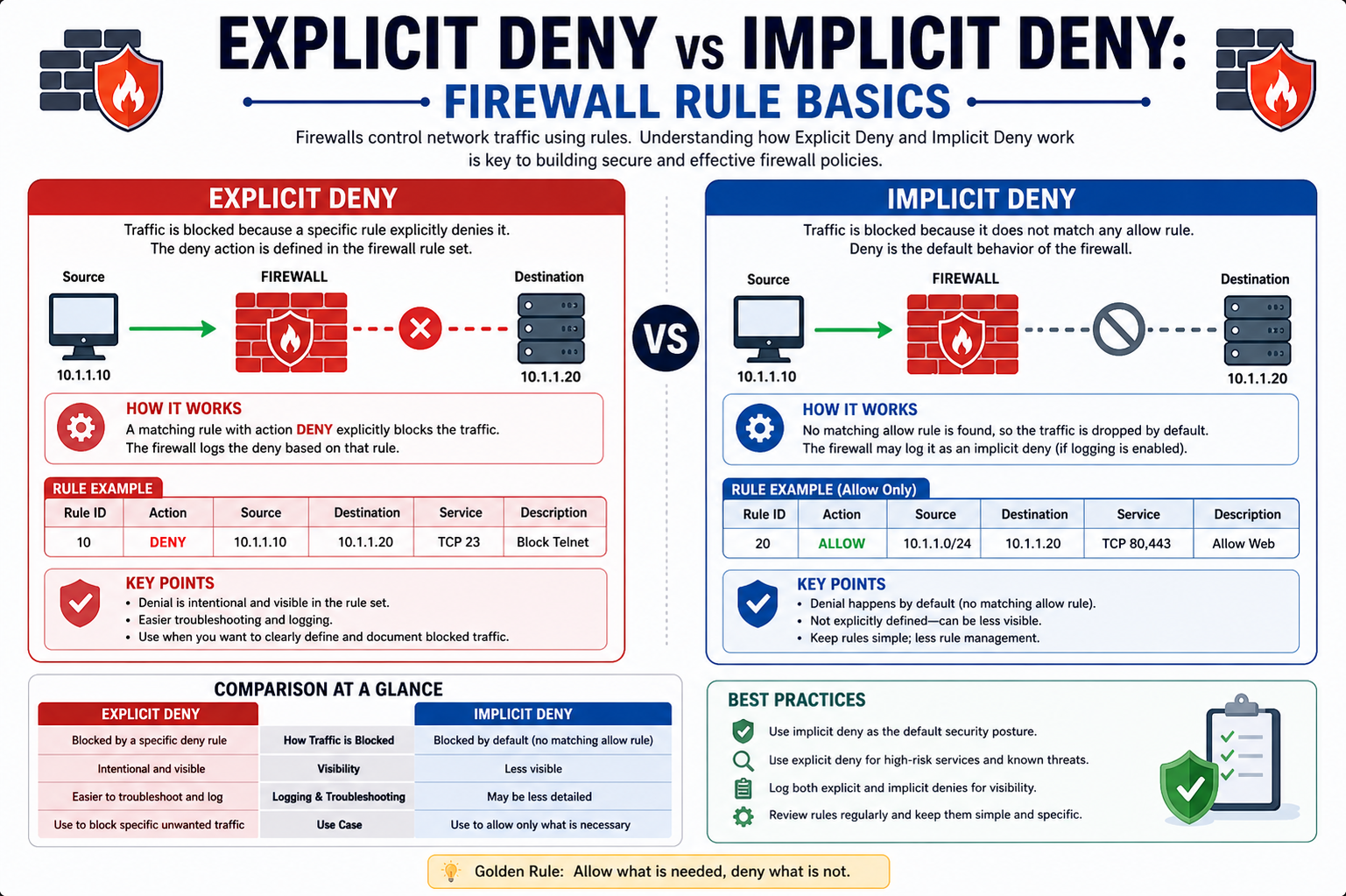
Explicit deny rules are a deliberate and highly controlled method of blocking network traffic based on clearly defined criteria. Unlike general blocking mechanisms, these rules are created with a specific purpose in mind, allowing administrators to identify and stop particular types of traffic that are known to be harmful or non-compliant with organizational policies. This precision makes explicit deny rules an essential tool in maintaining a secure and predictable network environment.
When an explicit deny rule is configured, it is placed within the firewall ruleset alongside other rules that allow or manage traffic. As traffic flows through the firewall, each packet is evaluated against these rules in sequence. If a packet matches the conditions specified in an explicit deny rule, it is immediately blocked, preventing it from reaching its intended destination. This process ensures that known threats are stopped at the earliest possible stage, reducing the risk of compromise.
The effectiveness of explicit deny rules lies in their specificity. Administrators can define conditions based on a wide range of attributes, including IP addresses, ports, protocols, and even application-level characteristics. This allows for a highly customized approach to security, where only clearly identified threats are blocked without affecting legitimate traffic. Such precision is particularly valuable in complex network environments where maintaining availability is just as important as ensuring security.
Practical Implementation of Explicit Deny in Network Hardening
In real-world scenarios, explicit deny rules are often used as part of a broader network hardening strategy. Network hardening involves strengthening the overall security posture by reducing vulnerabilities and limiting potential attack vectors. Explicit deny rules contribute to this process by targeting known risks and eliminating them from the network environment.
One common use case involves blocking traffic from known malicious IP addresses. These addresses may be associated with previous attacks, suspicious activity, or threat intelligence feeds. By explicitly denying traffic from these sources, organizations can prevent repeat attacks and reduce the likelihood of successful intrusions. This proactive approach ensures that threats are addressed before they can cause damage.
Another important application of explicit deny rules is in enforcing network segmentation. Modern networks are often divided into multiple segments to isolate sensitive systems and limit the spread of potential threats. Explicit deny rules can be used to control communication between these segments, ensuring that only authorized interactions are permitted. This segmentation not only enhances security but also improves overall network performance by reducing unnecessary traffic.
Explicit deny rules are also valuable in meeting regulatory and compliance requirements. Many security standards require organizations to implement strict access controls and demonstrate that unauthorized traffic is effectively blocked. By clearly defining and documenting explicit deny rules, organizations can provide evidence of their security measures and ensure compliance with relevant regulations.
Advantages of Explicit Deny Rules in Traffic Management
One of the most significant benefits of explicit deny rules is the level of control they provide over network traffic. By specifying exactly what should be blocked, administrators can create a finely tuned security policy that aligns with organizational needs. This granular control allows for precise management of traffic, reducing the risk of both overblocking and underblocking.
Another advantage is the ability of explicit deny rules to act as a safeguard against overly permissive configurations. In some cases, allow rules may be broader than intended, potentially permitting traffic that should not be allowed. An explicit deny rule can override these situations by ensuring that specific unwanted traffic is always blocked, regardless of other rules. This layered approach adds an extra level of protection and helps prevent configuration errors from leading to security breaches.
Explicit deny rules also play a crucial role in defending against known threats. Many types of malicious activity can be identified by specific patterns, such as unusual port usage or communication with known command-and-control servers. By blocking these patterns, explicit deny rules can effectively neutralize threats before they have a chance to execute their intended actions. This proactive defense mechanism is essential in maintaining a secure network environment.
In addition to security benefits, explicit deny rules can improve network performance by reducing unnecessary traffic. By blocking unwanted data at the firewall level, they prevent it from consuming bandwidth and processing resources within the network. This optimization ensures that legitimate traffic receives the resources it needs, contributing to a more efficient and reliable system.
Limitations and Considerations When Using Explicit Deny Rules
While explicit deny rules offer many advantages, they also require careful planning and management to be effective. One of the primary challenges is the need for accurate and up-to-date information about potential threats. Since these rules are based on known criteria, they may not be effective against new or unknown threats that do not match existing conditions. This limitation highlights the importance of combining explicit deny rules with other security measures.
Another consideration is the complexity of managing a large number of rules. In extensive network environments, the ruleset can become quite large, making it difficult to maintain and optimize. Poorly organized rules can lead to inefficiencies, increased processing time, and even unintended behavior. To address this issue, administrators must regularly review and update their rules to ensure they remain relevant and effective.
There is also the risk of inadvertently blocking legitimate traffic. If a rule is too broad or incorrectly configured, it may prevent authorized users from accessing necessary resources. This can lead to disruptions in operations and negatively impact user experience. To minimize this risk, explicit deny rules should be thoroughly tested before being implemented in a production environment.
Despite these challenges, explicit deny rules remain a vital component of network security. When used correctly, they provide a powerful means of controlling traffic and protecting against known threats. Their effectiveness is greatly enhanced when combined with other strategies, such as implicit deny rules and comprehensive monitoring systems.
Role of Explicit Deny in Strengthening Security Posture
Explicit deny rules contribute significantly to the overall security posture of an organization by providing a targeted and proactive defense mechanism. They enable administrators to address specific risks directly, ensuring that known threats are consistently blocked. This targeted approach complements broader security strategies, creating a more robust and resilient network environment.
In many cases, explicit deny rules are used to enforce organizational policies and best practices. For example, they can be used to block access to unauthorized services or restrict communication with external networks that are not considered trustworthy. By enforcing these policies at the firewall level, organizations can ensure consistent compliance across all users and systems.
Another important role of explicit deny rules is in incident response. When a new threat is identified, administrators can quickly create a rule to block the associated traffic, preventing further impact. This rapid response capability is essential in minimizing the damage caused by security incidents and maintaining business continuity.
Ultimately, explicit deny rules provide a level of precision and control that is essential for modern network security. They allow organizations to address specific threats while maintaining the flexibility needed to support legitimate operations. When integrated into a comprehensive security framework, they play a crucial role in protecting network resources and ensuring long-term stability.
Implicit Deny Firewall Rules and the Principle of Default Rejection
Implicit deny rules represent a foundational concept in firewall design, built on the idea that any traffic not explicitly permitted should automatically be rejected. This approach ensures that networks operate under a strict security posture where trust is never assumed. Instead of attempting to identify and block every possible threat, implicit deny rules take a more cautious stance by allowing only what is clearly defined as safe and blocking everything else by default.
Within a firewall ruleset, implicit deny is not always visible as a written rule, yet it is always present as the final action. Firewall systems process rules in a sequential order, and if a packet does not match any defined allow or explicit deny condition, it reaches the end of the ruleset. At that point, the implicit deny rule is applied, and the traffic is dropped. This silent enforcement mechanism ensures that no undefined or unexpected traffic is allowed to pass through the network.
This concept aligns closely with modern security philosophies that prioritize minimizing trust and maximizing verification. By rejecting all unspecified traffic, implicit deny rules create a controlled environment where every permitted interaction must be intentionally configured. This eliminates ambiguity and significantly reduces the chances of accidental exposure to threats.
Operational Behavior of Implicit Deny in Firewall Processing
The behavior of implicit deny rules is closely tied to how firewalls evaluate and process traffic. Each packet entering or leaving the network is inspected against the ruleset in a top-down manner. The firewall checks each rule in sequence until it finds a match. If no match is found, the packet is not given the benefit of the doubt. Instead, it is automatically rejected due to the implicit deny condition.
This method of operation ensures consistency and predictability in traffic handling. Administrators can be confident that only explicitly defined traffic flows are allowed, while everything else is systematically blocked. This reduces the likelihood of configuration errors leading to unintended access.
Implicit deny rules also operate without requiring additional configuration or processing overhead. Since they are inherently part of the firewall’s logic, they do not consume extra resources or complicate the ruleset. This makes them an efficient and reliable mechanism for enforcing security policies without adding unnecessary complexity.
Another important aspect of implicit deny behavior is its silent nature. In many cases, blocked traffic is simply dropped without sending a response back to the source. This lack of feedback can be beneficial from a security standpoint, as it provides no information to potential attackers about the network’s structure or defenses. By avoiding unnecessary communication, the firewall minimizes the risk of revealing sensitive details.
Implementation of Implicit Deny in Network Hardening Strategies
Implicit deny rules play a central role in network hardening by enforcing a strict default-deny posture. This approach ensures that all network activity is carefully controlled and monitored. Instead of relying on a reactive strategy that blocks threats as they are discovered, implicit deny creates a proactive environment where only approved traffic is allowed from the outset.
In practice, this means that administrators must define explicit allow rules for every type of legitimate traffic. While this may require more initial effort, it results in a highly secure configuration where all permitted interactions are intentional and well understood. This level of control is particularly valuable in environments that handle sensitive data or require high levels of security assurance.
Implicit deny rules also support the segmentation of networks by ensuring that communication between different segments is restricted unless explicitly allowed. This prevents unauthorized lateral movement within the network, which is a common tactic used by attackers to expand their access after an initial breach. By limiting communication pathways, implicit deny rules help contain potential threats and reduce their impact.
Furthermore, implicit deny rules are essential in environments that adopt a zero-trust model. In such models, no user or device is automatically trusted, regardless of its location within the network. Every request must be verified and authorized before it is allowed. Implicit deny rules enforce this principle by ensuring that any unverified or undefined traffic is immediately rejected.
Key Benefits of Implicit Deny Rules in Security Architecture
One of the most significant advantages of implicit deny rules is the establishment of a default deny stance. This ensures that the network remains secure even in the absence of comprehensive threat intelligence. Instead of trying to anticipate every possible attack, the firewall simply blocks anything that has not been explicitly approved. This approach provides a strong baseline level of security that is difficult for attackers to bypass.
Another important benefit is the reduction of the network’s attack surface. By limiting access to only necessary services and resources, implicit deny rules minimize the number of potential entry points available to attackers. This makes it more challenging for malicious actors to find vulnerabilities and exploit them.
Implicit deny rules also provide effective protection against unknown or emerging threats. Since these threats may not match any existing deny criteria, they could potentially bypass explicit deny rules. However, because implicit deny blocks all unspecified traffic, it prevents these threats from establishing connections in the first place. This makes it a valuable defense mechanism against new and evolving attack techniques.
In addition to security advantages, implicit deny rules contribute to improved visibility and control. By requiring all allowed traffic to be explicitly defined, administrators gain a clear understanding of network activity. This transparency makes it easier to monitor behavior, identify anomalies, and respond to potential incidents.
Finally, implicit deny rules support compliance with security best practices and regulatory requirements. Many standards emphasize the importance of least privilege and controlled access. By enforcing a default deny posture, organizations can demonstrate that they are taking appropriate measures to protect their systems and data.
Challenges and Practical Considerations of Implicit Deny Usage
Despite their strengths, implicit deny rules also present certain challenges that must be carefully managed. One of the primary difficulties is the need to define comprehensive allow rules. Since all traffic is blocked by default, any legitimate activity that is not explicitly permitted will be denied. This can lead to disruptions if the ruleset is incomplete or not properly configured.
Another challenge is the potential impact on usability and user experience. In highly restrictive environments, users may encounter difficulties accessing necessary resources, especially during the initial deployment phase. To address this, administrators must thoroughly analyze network requirements and ensure that all essential services are accounted for in the allow rules.
Implicit deny rules can also make troubleshooting more complex. When traffic is blocked without a clear indication of why, it can be difficult to determine which rule is responsible or whether a required rule is missing. Effective logging and monitoring tools are essential to overcome this challenge and provide visibility into firewall activity.
Additionally, maintaining a default deny posture requires ongoing effort. As network requirements evolve, new services and applications may need to be added to the allow list. Administrators must regularly review and update their rules to ensure that they remain aligned with organizational needs. This continuous maintenance is necessary to balance security with functionality.
Even with these challenges, implicit deny rules remain a cornerstone of modern network security. Their ability to enforce strict access control and protect against unknown threats makes them indispensable in any comprehensive security strategy. When combined with explicit deny rules and well-defined allow policies, they create a robust framework that effectively safeguards network environments.
Key Differences Between Explicit Deny and Implicit Deny in Firewall Design
Understanding the distinction between explicit deny and implicit deny rules is essential for building an effective firewall strategy. While both mechanisms are designed to block traffic, they operate in fundamentally different ways and serve distinct purposes within a network security framework. Explicit deny rules are intentional and highly specific, targeting clearly defined traffic patterns that are known to be undesirable. In contrast, implicit deny rules function as a universal safeguard, blocking any traffic that does not match an existing rule.
This difference becomes particularly important when designing a layered security approach. Explicit deny rules allow administrators to focus on known risks by directly blocking them, while implicit deny ensures that no undefined or unexpected traffic is accidentally permitted. Together, these mechanisms create a comprehensive defense model that balances precision with broad protection. By combining targeted blocking with default rejection, organizations can significantly reduce the likelihood of unauthorized access.
Another important distinction lies in how these rules are perceived within the firewall configuration. Explicit deny rules are visible and configurable, making them easy to identify and manage. Implicit deny rules, on the other hand, are often built into the firewall’s logic and may not appear as a defined entry in the ruleset. Despite their invisibility, they play a critical role in enforcing security policies and ensuring that all traffic is properly evaluated.
Control Granularity and Scope of Traffic Enforcement
One of the most notable differences between explicit and implicit deny rules is the level of control they provide. Explicit deny rules offer granular control, allowing administrators to define precise conditions under which traffic should be blocked. This specificity enables organizations to tailor their security policies to address particular threats or operational requirements. For example, a rule can be created to block traffic from a specific IP address or to prevent the use of a certain protocol.
Implicit deny rules, by contrast, operate at a much broader level. They do not target specific traffic but instead apply to everything that has not been explicitly allowed. This universal scope ensures that no gaps are left in the firewall’s protection. However, it also means that implicit deny rules do not provide the same level of customization as explicit deny rules. Their strength lies in their simplicity and comprehensiveness rather than precision.
The combination of these two approaches allows organizations to achieve both detailed control and complete coverage. Explicit deny rules handle known threats with precision, while implicit deny rules ensure that any unknown or unaccounted-for traffic is automatically blocked. This dual-layer approach is a cornerstone of effective network security design.
Default Behavior and Rule Processing Logic
The default behavior of a firewall is heavily influenced by the presence of implicit deny rules. In a properly configured system, the firewall operates under a default deny posture, meaning that all traffic is blocked unless it is explicitly permitted. This behavior is enforced by the implicit deny rule, which acts as the final checkpoint in the rule evaluation process.
Explicit deny rules, on the other hand, are not part of the default behavior but are instead added to address specific scenarios. They are evaluated alongside allow rules as the firewall processes traffic from top to bottom. When a packet matches an explicit deny rule, it is immediately blocked, regardless of any subsequent rules. This immediate action ensures that targeted threats are stopped without delay.
The interaction between these rules highlights the importance of rule order and structure. Since firewalls process rules sequentially, the placement of explicit deny and allow rules can significantly impact how traffic is handled. Administrators must carefully design their rulesets to ensure that the intended behavior is achieved. Misordered rules can lead to unintended consequences, such as allowing traffic that should be blocked or blocking traffic that should be allowed.
Impact on Network Performance and Resource Utilization
Firewall performance is an important consideration in any network environment, and the use of explicit and implicit deny rules can influence how efficiently the system operates. Explicit deny rules require the firewall to evaluate specific conditions for each packet, which can consume processing resources, especially in large and complex rulesets. As the number of rules increases, the time required to evaluate each packet may also increase, potentially affecting overall performance.
Implicit deny rules, however, do not introduce additional overhead in the same way. Since they are part of the firewall’s inherent logic, they simply act as the final action when no other rule matches. This makes them an efficient mechanism for ensuring security without adding complexity to the ruleset. Their simplicity contributes to consistent performance, even in high-traffic environments.
Despite these differences, the overall impact on performance can be managed through careful rule design and optimization. By organizing rules effectively and minimizing unnecessary complexity, administrators can ensure that the firewall operates efficiently while still providing robust security. Regular reviews and updates to the ruleset can help maintain optimal performance over time.
Use Cases and Strategic Application of Deny Rules
Explicit and implicit deny rules are best used together as part of a comprehensive security strategy. Each type of rule serves a unique purpose, and their combined use provides a balanced approach to traffic management. Explicit deny rules are particularly useful in scenarios where specific threats have been identified. For instance, they can be used to block traffic from known malicious sources, restrict access to certain services, or enforce organizational policies.
Implicit deny rules, on the other hand, are essential for establishing a secure baseline. They ensure that any traffic not explicitly permitted is automatically blocked, reducing the risk of accidental exposure. This makes them especially valuable in environments where security is a top priority and where the consequences of unauthorized access are significant.
In practice, organizations often begin by defining a set of allow rules that specify which traffic is necessary for normal operations. Explicit deny rules are then added to address known risks and refine the security policy. Finally, the implicit deny rule ensures that any remaining traffic is blocked. This layered approach provides both flexibility and security, allowing organizations to adapt to changing requirements while maintaining a strong defense against threats.
Best Practices for Designing Effective Deny Rule Strategies
To maximize the effectiveness of both explicit and implicit deny rules, it is essential to follow structured best practices when designing and maintaining firewall policies. A well-organized ruleset should begin with clearly defined allow rules for legitimate traffic, followed by carefully placed explicit deny rules to block known threats and enforce restrictions. This layered structure ensures that critical services remain accessible while unwanted traffic is filtered out efficiently. Regular auditing of firewall rules is equally important, as outdated or redundant entries can introduce inefficiencies and potential security gaps. Administrators should also prioritize proper documentation, making it easier to understand the purpose of each rule and reducing the likelihood of misconfigurations. Logging and monitoring should be enabled to track denied traffic, providing valuable insights into potential attack patterns and helping refine security policies over time. By continuously reviewing and optimizing deny rule strategies, organizations can maintain a strong security posture while ensuring that network performance and usability are not compromised.
Common Mistakes to Avoid When Implementing Deny Rules
While deny rules are essential for securing a network, improper implementation can lead to unintended consequences that weaken security or disrupt normal operations. One common mistake is creating overly broad deny rules that block more traffic than intended, potentially preventing legitimate users or services from functioning correctly. Another frequent issue is neglecting rule order, which can result in allow rules taking precedence over deny rules or vice versa, leading to unpredictable behavior. Failing to regularly review and update rules is also a significant concern, as outdated entries may no longer reflect current network requirements or threat landscapes. Additionally, insufficient logging and monitoring can make it difficult to identify why certain traffic is being blocked, complicating troubleshooting efforts. Overreliance on explicit deny rules without a strong implicit deny foundation can also leave gaps in security, allowing unaccounted traffic to pass through. Avoiding these mistakes requires careful planning, consistent maintenance, and a thorough understanding of how firewall rules interact within the overall security architecture.
Final Thoughts
A well-designed firewall strategy relies on the effective use of both explicit and implicit deny rules. These mechanisms are not mutually exclusive but are instead complementary components of a unified security framework. Explicit deny rules provide the precision needed to address known threats, while implicit deny rules deliver the comprehensive coverage required to protect against unknown risks.
By understanding how these rules function and how they interact, administrators can create a ruleset that is both secure and efficient. This involves careful planning, regular maintenance, and a clear understanding of network requirements. When implemented correctly, the combination of explicit and implicit deny rules forms a powerful defense system that safeguards network resources and ensures reliable operation.
Ultimately, the goal of any firewall configuration is to strike a balance between accessibility and security. Too much restriction can hinder productivity, while too little can expose the network to significant risks. By leveraging the strengths of both explicit and implicit deny rules, organizations can achieve this balance and maintain a resilient and secure network environment.