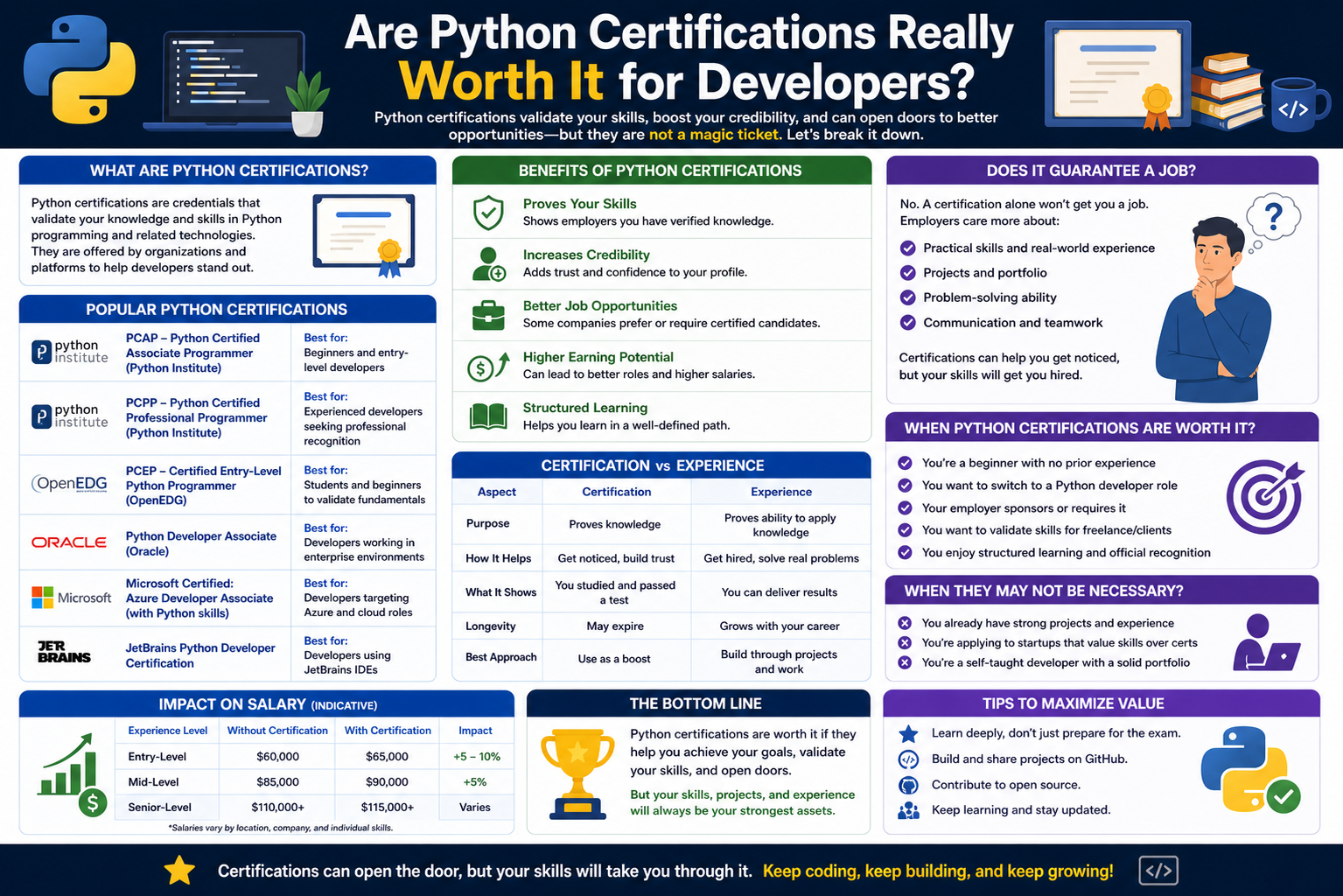
Python certifications often raise a common question among learners and professionals: do they actually hold real value in today’s technology-driven job market, or are they just another formal credential with limited impact? When someone begins exploring Python, they quickly notice that the language itself is widely used across web development, data science, automation, artificial intelligence, and cybersecurity. Yet, unlike some other IT domains, Python does not have a single dominant certification path that everyone follows. This creates confusion about whether investing time and money into certification is truly beneficial or simply optional.
The Reality Behind Python Certifications
Python certifications exist, but they are not as universally required or standardized as certifications in networking, cloud computing, or cybersecurity. Instead, they function more as structured learning milestones rather than strict job requirements. Many learners discover Python through self-study, online projects, or academic courses without ever pursuing formal certification. Because of this flexibility, the Python ecosystem has developed a reputation where practical skill often matters more than formal credentials.
However, certifications still provide a structured pathway for those who prefer guided learning. Instead of wondering what to study next, a certification syllabus clearly outlines topics, expectations, and skill progression. This is especially helpful for beginners who feel overwhelmed by the wide range of Python applications. A certification can act as a roadmap, guiding learners from basic syntax to more advanced programming concepts in a logical order.
At the same time, the value of certification depends heavily on how it is used. If someone treats it as a learning tool rather than a standalone achievement, it can significantly strengthen their understanding of Python. On the other hand, if someone expects the certificate alone to guarantee a job, it may not deliver the expected results. Employers typically prioritize hands-on experience, problem-solving ability, and real-world project work over certificates alone.
Why Developers Debate Certifications
The debate around Python certifications is mainly rooted in how programming skills are evaluated. Unlike traditional IT roles where standardized certifications clearly demonstrate technical competency, programming is more practical and project-based. Developers are often judged by their ability to build applications, solve problems, and contribute to real systems rather than by passing exams.
One argument against certifications is that coding skills cannot be fully measured through multiple-choice questions or theoretical assessments. Real development work requires creativity, debugging ability, and experience handling unpredictable challenges. These qualities are difficult to test in a controlled exam environment. As a result, some professionals believe certifications only measure theoretical knowledge rather than real-world capability.
On the other hand, certifications are not entirely without value. They provide structured validation that a learner has engaged seriously with the language. For beginners especially, this structured validation can help build confidence and provide a sense of direction. It also shows employers that the candidate has taken initiative to learn Python in a disciplined manner instead of casually experimenting with it.
Another important point in the debate is accessibility. Not everyone has access to internships, mentors, or real-world development environments. For such learners, certifications can serve as an entry point into the tech industry. They may not replace experience, but they can help bridge the gap when experience is limited.
What Employers Actually Look For
In most hiring situations, employers are more interested in what a candidate can do rather than what certificates they hold. A strong portfolio of Python projects often carries more weight than multiple certifications. Projects demonstrate practical ability, problem-solving skills, and familiarity with real-world development challenges.
However, certifications are not ignored completely. In some cases, especially for entry-level positions, certifications can help a candidate stand out when competing with others who have similar educational backgrounds. They act as supporting evidence of commitment and structured learning. In large organizations, where recruiters filter hundreds of applications, certifications can sometimes help an application pass initial screening stages.
For technical roles related to data analysis, automation, or testing, certifications may also help demonstrate familiarity with specific tools and workflows. Even if they are not mandatory, they can strengthen a resume by showing that the candidate has followed a recognized learning path.
Ultimately, employers look for a combination of skills: coding ability, understanding of software concepts, and practical experience. Certifications may contribute to this profile, but they are rarely the sole deciding factor in hiring decisions.
Overview of Python Certification Paths
Python certifications are generally structured in levels, starting from beginner-friendly credentials and progressing toward advanced professional qualifications. These certifications are designed to match different stages of a learner’s journey. Some focus on general programming skills, while others are specialized toward data analytics, software testing, or advanced system design.
The certification structure is intended to provide gradual progression. Beginners start with foundational concepts, intermediate learners move into object-oriented programming and application development, and advanced professionals focus on architecture, performance optimization, and enterprise-level systems. This tiered structure helps learners choose a path that aligns with their current skill level and career goals.
Although multiple organizations offer Python-related training and assessments, the most structured and widely recognized pathway comes from a dedicated certification framework that organizes exams based on skill progression. These certifications typically include entry-level, associate-level, professional-level, and expert-level stages.
Each stage builds upon the previous one, ensuring that learners develop a strong foundation before moving into advanced topics. This layered approach is particularly useful for self-learners who may not have formal computer science education but still want to build a strong programming career.
PCEP – Entry Level Python Programmer
The entry-level certification is designed for individuals who are just beginning their journey in programming. It focuses on fundamental Python concepts and basic programming logic. This stage does not require prior coding experience, making it accessible to complete beginners who are learning programming for the first time.
At this level, learners are introduced to core programming concepts such as variables, data types, control flow, loops, and basic data structures. The goal is to ensure that candidates understand how Python executes code and how basic programs are structured. This includes working with simple input and output operations, understanding conditions, and writing small scripts that perform straightforward tasks.
Another important aspect of this level is learning how to think logically like a programmer. Instead of just memorizing syntax, learners begin to understand how problems can be broken down into smaller steps and solved using code. This shift in thinking is one of the most important foundations in programming.
The certification also covers lists, tuples, and dictionaries, which are essential data structures in Python. These concepts allow learners to store, organize, and manipulate data efficiently. Functions are also introduced, helping learners understand how to write reusable and modular code.
For many beginners, this stage serves as a confidence-building step. It validates that they can write basic Python programs and understand essential programming logic. While it may not be sufficient for advanced job roles, it lays the groundwork for further learning and specialization.
PCED – Data Analytics Foundation with Python
As Python has become increasingly important in the field of data analysis, specialized certifications have emerged to address this growing demand. One such certification focuses on entry-level data analytics using Python. This path is designed for individuals who are interested in working with data rather than full-scale software development.
At this stage, learners begin to explore how Python can be used to collect, clean, and analyze data. The focus shifts from general programming concepts to practical data handling techniques. This includes working with datasets, identifying patterns, and preparing data for analysis.
A key part of this certification involves data acquisition and preprocessing. Learners are introduced to methods for gathering data from different sources and preparing it for meaningful analysis. This includes handling missing values, correcting inconsistencies, and organizing data in a structured format.
Another important area is data validation and integrity. This ensures that the data being analyzed is accurate, reliable, and suitable for decision-making. Without proper validation, analysis results can be misleading or incorrect.
Data cleaning is also a major focus. Real-world data is often messy, incomplete, or inconsistent, so learners must understand how to refine and prepare it for analysis. This step is essential in any data-related role, as clean data forms the foundation of accurate insights.
Basic statistical analysis is introduced at this level as well. Learners begin to understand how to interpret data using simple statistical methods. This helps in identifying trends, relationships, and patterns within datasets.
Finally, data visualization plays an important role. Presenting data in charts, graphs, and visual formats helps make insights more understandable. This skill is widely used in business intelligence and reporting roles, where clear communication of data insights is essential.
This certification is particularly useful for individuals aiming to enter fields like data analysis, business intelligence, or reporting. It provides a structured introduction to how Python is used in real-world data-driven environments while building a strong foundation for more advanced analytical skills later on.
PCAP – Certified Associate in Python Programming
The associate-level certification is designed for learners who already understand basic programming concepts and are ready to move into more structured and professional Python development. At this stage, the focus shifts from simple scripts and foundational logic toward more organized programming practices, including object-oriented programming and modular design.
This certification is often considered a major step up from entry-level learning because it introduces concepts that are widely used in real-world software development. Unlike beginner-level material that focuses on understanding how Python works, this stage emphasizes how to build scalable and maintainable programs. Learners are expected to write cleaner code, structure programs into reusable components, and handle more complex logic.
A key area of focus is control flow and program evaluation. At this level, learners are expected to understand how programs make decisions, how loops behave in different scenarios, and how different conditions affect program execution. This understanding becomes critical when building applications that require dynamic behavior rather than static outputs.
Another important topic is data aggregates. This includes working more deeply with lists, dictionaries, tuples, and sets. Instead of just using these structures, learners begin to understand how to manipulate them efficiently, optimize their usage, and apply them in real problem-solving scenarios. This forms the backbone of many Python applications, especially those involving data processing or automation.
Functions and modules are also a major focus. At this stage, learners are expected to design reusable functions that can be integrated into larger systems. They also begin to understand how Python modules work, allowing them to organize code across multiple files. This is an essential skill for working in team environments where large codebases need to be maintained and expanded over time.
Object-oriented programming is one of the most significant introductions at this level. Learners begin to work with classes, objects, inheritance, and encapsulation. This shift allows them to move beyond simple procedural programming and start thinking in terms of real-world models and systems. Object-oriented programming is widely used in modern software development, making this a crucial milestone for anyone pursuing a Python career.
Exception handling is also introduced to help learners write more robust and error-resistant programs. Instead of allowing programs to crash when unexpected inputs occur, developers learn how to handle errors gracefully and maintain program stability. This is especially important in production environments where reliability is essential.
This certification represents a turning point in a learner’s Python journey. It bridges the gap between beginner understanding and professional-level programming skills. It also prepares learners for more specialized certifications and real-world development roles where structured coding practices are expected.
Transitioning from Associate to Specialized Python Paths
Once learners reach the associate level, they often begin to explore different directions based on their career interests. Python is a highly flexible language, and it supports multiple career paths including software development, data analysis, automation, testing, artificial intelligence, and DevOps. At this stage, certification paths start to diverge into specialized areas rather than following a single linear progression.
Some learners choose to focus on data-driven roles, where Python is used for analysis, visualization, and statistical modeling. Others prefer software engineering paths, where Python is used to build applications, APIs, and backend systems. There are also learners who move toward quality assurance and testing, where Python plays a key role in automation frameworks.
This flexibility is one of the strongest advantages of Python as a programming language. However, it also means that learners must carefully choose their direction. Certifications at this stage help guide that decision by offering structured learning paths tailored to specific career goals.
Instead of continuing with general programming concepts, learners begin to focus on practical applications. This includes solving domain-specific problems, working with industry-relevant tools, and understanding how Python integrates into larger systems. The goal is no longer just to learn Python, but to apply it effectively in a chosen field.
PCAD – Associate Level Data Analytics with Python
The data analytics associate certification is designed for learners who want to deepen their expertise in working with data using Python. At this stage, the focus moves beyond basic data handling and into more advanced analytical techniques that are commonly used in business intelligence and data science roles.
One of the main areas of focus is data acquisition and cleaning at a more advanced level. Learners are expected to work with larger datasets, often containing inconsistencies, missing values, or unstructured formats. The ability to clean and prepare data efficiently becomes a critical skill, as real-world datasets rarely come in a ready-to-use format.
Data modeling and analysis are also key components of this certification. Learners begin to explore how to structure data for meaningful analysis, identify relationships between variables, and apply logical reasoning to interpret results. This stage introduces a more analytical mindset, where coding is used as a tool for extracting insights rather than just processing information.
Data visualization becomes more advanced as well. Instead of simple charts, learners work with more complex visual representations that help communicate insights clearly to stakeholders. This includes understanding how to choose the right type of visualization for different kinds of data and how to present findings in a meaningful way.
Statistical methods are introduced in greater depth at this stage. Learners begin to work with concepts such as averages, distributions, correlations, and basic predictive analysis. These skills are essential for anyone working in data-related roles, as they allow for more accurate interpretation of datasets.
Data governance and ethics also become important topics. As data usage becomes more widespread, understanding how to handle data responsibly is essential. This includes ensuring privacy, maintaining accuracy, and following ethical guidelines when working with sensitive information.
This certification is ideal for individuals aiming to build careers in data analysis, reporting, or business intelligence. It provides a strong intermediate foundation that prepares learners for more advanced data science roles in the future.
PCAT – Python Certification for Testing and Automation
The testing and automation certification focuses on using Python for software quality assurance and automated testing. This is a highly practical area where Python is widely used in real-world software development environments. Instead of building applications, learners focus on ensuring that applications work correctly and efficiently.
At this level, learners are introduced to software testing fundamentals. This includes understanding different types of testing such as unit testing, integration testing, and system testing. The goal is to ensure that software behaves as expected under various conditions.
Testing frameworks and tools play a major role in this certification. Learners gain experience with tools that allow them to automate test cases, execute them efficiently, and analyze results. Automation is a key aspect of modern software testing, as it significantly reduces manual effort and improves accuracy.
A major focus is test automation using Python. Learners write scripts that simulate user interactions, validate outputs, and check system behavior automatically. This is especially useful in large-scale applications where manual testing would be time-consuming and inefficient.
Debugging and troubleshooting are also essential skills at this stage. Learners must be able to identify issues in code, understand error messages, and fix problems systematically. This requires a strong understanding of how software behaves internally.
Continuous integration and deployment concepts are introduced as well. Learners begin to understand how automated testing fits into modern development workflows, where code is continuously tested and deployed to production environments. This ensures that software remains stable even as new features are added.
This certification is particularly valuable for those interested in DevOps, quality assurance, or software testing careers. It demonstrates the ability to apply Python in practical, production-level environments where reliability and efficiency are critical.
PCPP-32-1 – Professional Python Programming Foundation
The professional-level certification marks a significant shift toward advanced software development. At this stage, learners are expected to have strong Python fundamentals and practical programming experience. The focus is no longer on basic coding concepts but on building complex applications and understanding advanced programming principles.
One of the key areas covered is file processing and working with external environments. Learners gain the ability to read from and write to files, interact with system resources, and manage data persistence. This is essential for applications that need to store and retrieve information efficiently.
Mathematical, scientific, and engineering tools are also introduced. This allows Python to be used in specialized fields such as scientific computing, simulations, and technical analysis. These tools expand Python’s usability beyond traditional software development.
Graphical user interface programming is another important topic. Learners begin building applications with visual interfaces, allowing users to interact with software more intuitively. This moves Python development closer to real-world application design.
Advanced object-oriented programming concepts are explored in depth. This includes deeper understanding of class design, inheritance structures, and object behavior. Learners are expected to design complex systems using object-oriented principles.
Python enhancement proposals are also discussed, helping learners understand how the language evolves and how new features are introduced. This provides insight into the long-term development of Python as a programming language.
This certification represents a major milestone in the transition from intermediate to advanced programming. It prepares learners for high-level software development roles where system design, architecture, and advanced programming concepts are required.
PCPP-32-2 – Certified Professional in Python Programming 2
The second professional-level Python certification represents a significant step into advanced software engineering practices, where the focus moves beyond writing functional code and shifts toward designing, structuring, and deploying large-scale systems. At this stage, learners are expected to already have strong programming experience and a deep understanding of object-oriented programming, modular design, and software architecture principles.
Unlike earlier certifications that focus on learning Python syntax and core programming logic, this level emphasizes real-world application development in complex environments. The goal is to prepare developers for roles where they are responsible for building systems that are scalable, maintainable, and efficient across enterprise-level requirements.
One of the most important areas covered is package creation and distribution. Learners are trained to structure Python applications in a way that allows them to be reused, shared, and deployed across different environments. This includes understanding how to organize code into libraries, manage dependencies, and ensure compatibility across systems. These skills are essential for developers working in collaborative teams or contributing to large software ecosystems.
Another critical focus is design patterns. At this stage, learners are introduced to proven architectural solutions that help solve common software design problems. Instead of writing ad-hoc code, developers learn how to apply structured patterns that improve code readability, scalability, and maintainability. This includes understanding how different components of a system interact and how to design systems that are flexible and easy to extend.
Interprocess communication is also a key topic. This involves understanding how different processes within a system communicate with each other. In real-world applications, especially in enterprise systems, multiple processes often run simultaneously and need to exchange data efficiently. Learning how to manage this communication helps developers build more robust and responsive applications.
Python network programming is another advanced area covered in this certification. Learners explore how Python can be used to build network-based applications that communicate over the internet or internal networks. This includes working with sockets, managing connections, and handling data transmission. These skills are essential for backend development, cloud-based applications, and distributed systems.
Database access using Python, particularly with relational databases, is also an important component. Developers learn how to connect Python applications to databases, execute queries, and manage data transactions. This is crucial for applications that rely on persistent data storage, such as web applications, enterprise systems, and data-driven platforms.
At this level, Python is no longer viewed as just a programming language but as a tool for building complete software solutions. Learners are expected to think like software architects, considering not just how to write code, but how that code fits into larger systems and interacts with other components.
The Role of Advanced Certifications in Career Development
As learners progress into professional-level certifications, the value of these credentials becomes more strategic rather than foundational. At earlier stages, certifications help validate basic knowledge and provide structured learning paths. At advanced stages, they serve as indicators of specialization and technical depth.
For developers aiming to move into senior roles, certifications like this can help demonstrate readiness for more complex responsibilities. These roles often involve designing system architectures, optimizing performance, and ensuring that applications meet enterprise standards. While practical experience remains the most important factor, advanced certifications can reinforce a candidate’s technical credibility.
However, it is important to understand that at this level, certifications alone are rarely enough. Employers expect a combination of hands-on experience, project portfolios, and problem-solving ability. The certification acts as supporting evidence rather than the primary qualification.
Developers who pursue this level of certification often already have experience working in software teams or contributing to large projects. For them, the certification becomes a way to formalize their knowledge and gain recognition for skills they may already be using in practice.
CEPP – Expert Level Python Programming Credential
The expert-level Python certification represents the highest level of structured recognition within the certification pathway. Unlike previous certifications, this one is not achieved through a single exam. Instead, it is awarded after successfully completing multiple advanced-level certifications, demonstrating mastery across different areas of Python programming.
This level is intended for individuals who have reached a high degree of proficiency in Python and are capable of working in senior technical roles. It represents not just knowledge of the language, but the ability to apply it across multiple domains, including software development, system design, automation, and data processing.
At this stage, professionals are expected to understand Python at a deep architectural level. This includes designing large-scale applications, optimizing performance, managing system resources efficiently, and integrating Python with other technologies and platforms.
Expert-level developers are often involved in leadership roles within technical teams. They may be responsible for guiding development practices, reviewing code architecture, and making high-level decisions about system design. Their role extends beyond coding into mentoring, planning, and technical strategy.
While this certification represents a significant achievement, it is important to note that it is not always necessary for career success. Many senior Python developers reach high-level positions based on experience alone, without formal expert certification. However, for those who pursue it, it serves as a formal recognition of advanced expertise.
How Employers View Advanced Python Certifications
At advanced stages of certification, employer perception becomes more nuanced. While entry-level certifications can help candidates get noticed, professional and expert-level certifications are viewed differently. They are often seen as supplementary evidence of specialization rather than primary qualifications.
Employers hiring for senior roles are typically more interested in real-world accomplishments, such as large-scale projects, system design experience, and leadership in development teams. However, advanced certifications can still add value by demonstrating structured learning and commitment to continuous improvement.
In some cases, certifications can help differentiate candidates who have similar levels of experience. For example, when two developers have comparable project backgrounds, a certification may provide an additional point of credibility. This is especially true in large organizations where formal qualifications are part of the hiring evaluation process.
However, it is also common for highly skilled developers to succeed without any certifications at all. In the software industry, practical ability often outweighs formal credentials. This means that certifications should be viewed as one part of a broader skill set rather than a defining factor.
Choosing Between Certification and Practical Experience
One of the most important decisions for any Python learner is whether to focus on certifications, practical experience, or a combination of both. Each approach has its advantages, and the best choice often depends on individual goals and learning style.
Certifications provide structure, discipline, and a clear learning path. They are especially useful for beginners who need guidance on what to study and in what order. They also help build confidence by providing measurable milestones.
Practical experience, on the other hand, is essential for real-world success. Building projects, contributing to open-source software, and solving real problems provide hands-on skills that cannot be fully replicated through exams. This experience is often what employers value most.
The most effective approach is usually a combination of both. Certifications can guide learning and validate knowledge, while practical experience reinforces and expands that knowledge in real-world scenarios. Together, they create a stronger and more complete skill profile.
Balancing Learning Paths in Python Careers
Python offers one of the most flexible career paths in technology, but this flexibility also means learners must make strategic choices about how they develop their skills. Some individuals focus heavily on certifications, while others rely entirely on practical experience.
A balanced approach tends to produce the best long-term results. Certifications help structure learning and provide credibility, while hands-on projects build confidence and real-world competence. Over time, this combination helps learners transition from beginners to professional developers more effectively.
As learners move through intermediate and advanced levels, the importance of specialization becomes more significant. Whether the focus is on software development, data science, automation, or testing, having a clear direction helps guide both certification choices and practical learning efforts.
At the professional stage, the goal is no longer just to learn Python but to apply it effectively in solving complex problems. This shift marks the transition from learning a programming language to becoming a software engineer capable of building and maintaining real systems.
Python Certifications for Job-Seekers
For individuals actively looking for employment, Python certifications can play a supportive role in strengthening a resume, but they should not be viewed as the only deciding factor in getting hired. In the technology job market, employers usually prioritize practical ability, problem-solving skills, and hands-on experience over formal certifications. However, certifications can still add structure and credibility, especially for those who are early in their careers or transitioning from a non-technical background.
When someone is new to Python and does not yet have a strong portfolio of projects, certifications can help demonstrate commitment and a structured approach to learning. They show that the candidate has invested time in understanding core programming concepts rather than only experimenting casually. This can be particularly useful when competing for entry-level positions where many applicants may have similar educational backgrounds but varying levels of practical exposure.
Certifications also help bridge the gap for individuals who may not have access to internships, mentorships, or real-world development environments. In such cases, a certification provides a formal learning path that can partially substitute for professional experience. While it does not replace real-world coding practice, it helps establish a baseline of knowledge that employers can recognize.
For job-seekers with prior programming experience, certifications may serve a different purpose. Instead of proving basic understanding, they can highlight specialization in Python or validate knowledge in areas such as data analysis, automation, or software testing. This can help candidates shift into Python-focused roles from other programming languages or IT domains.
However, it is important to maintain realistic expectations. A certification alone rarely guarantees employment. Employers typically look for a combination of skills, including coding ability, familiarity with tools, understanding of software development practices, and the ability to work on real projects. Certifications may help get an interview, but performance during technical assessments and interviews ultimately determines hiring outcomes.
Python Certifications for Working Professionals
For individuals already employed in technical or IT-related roles, Python certifications can serve a different purpose compared to job-seekers. In professional environments, learning often becomes more specialized, and certifications can help expand skill sets beyond daily job responsibilities.
Many professionals work in roles that focus on a specific area, such as system administration, testing, or data management. Over time, this can lead to skill narrowing, where exposure to other aspects of programming becomes limited. Python certifications can help address this by introducing broader concepts and encouraging learning outside of daily tasks.
For example, a system administrator might primarily use Python for automation scripts but may not have exposure to advanced programming techniques such as object-oriented design or database integration. Pursuing certification can help broaden their technical capabilities and open opportunities for more advanced roles within their organization.
Similarly, professionals working in data-related roles may already use Python for basic analysis but may not have formal training in statistical methods or advanced visualization techniques. Certifications provide a structured way to deepen this knowledge and improve analytical capabilities.
One important benefit for working professionals is motivation. Without clear learning goals, it can be difficult to stay consistent with skill development. Certifications provide structured milestones, making it easier to track progress and maintain focus over time.
However, the value of certification for professionals is often situational. In some organizations, practical experience and internal performance matter far more than external certifications. In such cases, certification may not significantly impact promotions or salary growth. Instead, it becomes more of a personal development tool rather than a formal requirement.
Experience vs Certification in Python Careers
One of the most debated topics in programming careers is the comparison between real-world experience and formal certification. While both have value, they serve different purposes and are often used together rather than as replacements for each other.
Experience refers to hands-on work with actual projects, whether through employment, freelancing, or open-source contributions. It demonstrates the ability to solve real problems, work with complex systems, and adapt to unexpected challenges. This type of learning is often unpredictable and highly practical, making it extremely valuable in software development roles.
Certifications, on the other hand, provide structured validation of knowledge. They ensure that learners have been exposed to specific topics and have understood foundational or advanced concepts in a systematic way. However, they do not always reflect the ability to apply those concepts in real-world situations.
Employers generally place more weight on experience because it directly reflects job performance. A developer who has built real applications, debugged production issues, and collaborated in teams is often preferred over someone who only holds certifications but lacks practical exposure.
That said, certifications can still complement experience effectively. For example, a developer with project experience in Python may use certifications to formalize their knowledge or demonstrate expertise in a new specialization such as data science or automation. In this way, certifications act as reinforcement rather than replacement.
For beginners, the balance often leans more toward certification because experience is still limited. As careers progress, the importance of real-world experience increases significantly, while certifications become secondary supporting credentials.
Long-Term Value of Python Certifications
The long-term value of Python certifications depends largely on how they are used throughout a career. If treated as a one-time achievement, their impact may be limited. However, if used as part of continuous learning and skill development, they can contribute meaningfully to career growth.
In fast-changing technology environments, continuous learning is essential. Python itself evolves over time, and the tools and frameworks built around it change even faster. Certifications can help professionals stay updated with structured learning paths that reflect current industry practices.
Another long-term benefit is career flexibility. Python is used in multiple domains, including web development, data science, artificial intelligence, automation, and cybersecurity. Certifications can help professionals transition between these fields by providing foundational knowledge in new areas.
For example, someone working in basic scripting can gradually move into automation engineering or data analysis by following structured certification paths. This flexibility makes Python one of the most versatile programming languages in the job market.
However, long-term success still depends more on adaptability, problem-solving ability, and continuous project experience. Certifications alone do not guarantee career progression, but they can support it when combined with practical skills.
Final Thoughts
Python certifications offer value, but their importance depends heavily on individual goals, experience level, and career direction. For beginners, they provide structure, guidance, and confidence. For job-seekers, they can help strengthen resumes and improve visibility. For working professionals, they can support skill expansion and career development.
At the same time, certifications should not be viewed as a replacement for practical experience. In programming careers, real-world problem-solving ability remains the most important factor. Employers consistently prioritize what candidates can build and how effectively they can solve technical challenges.
The most effective approach is a balanced one. Certifications can guide learning and validate understanding, while hands-on experience builds true competence. Together, they create a strong foundation for a successful Python career.
Ultimately, Python certifications are worth it when used as part of a broader learning strategy. They are not a shortcut to success, but they can be a valuable tool for growth, structure, and professional development when combined with consistent practice and real-world application.