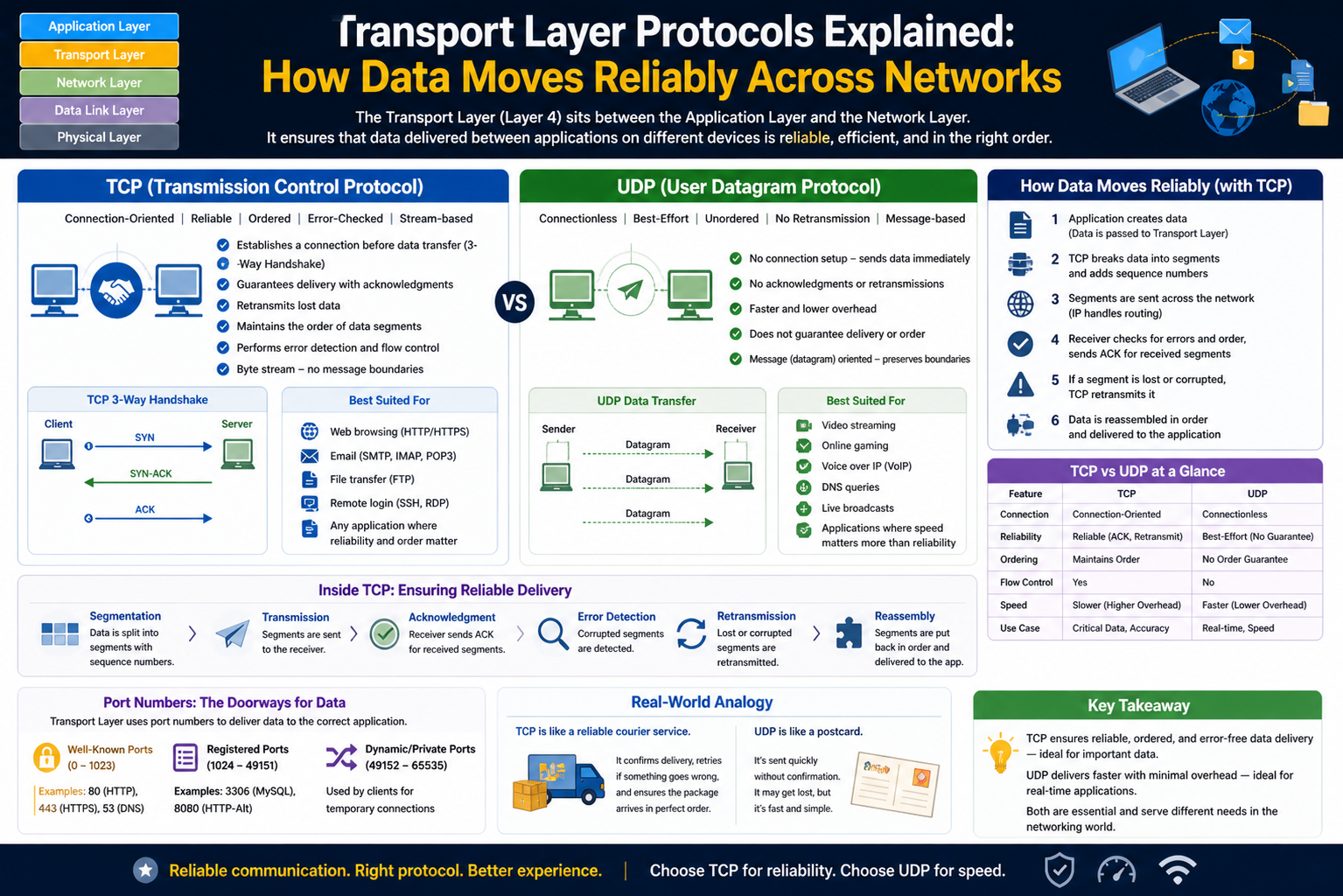
Transport layer protocols form the backbone of reliable and efficient communication across modern computer networks. They operate within the transport layer of the OSI model and are responsible for enabling end-to-end data transmission between devices. This layer acts as a bridge between application-level processes and lower-level network operations, ensuring that data generated by applications reaches its intended destination correctly or as efficiently as possible, depending on the protocol used. Two primary protocols dominate this layer: Transmission Control Protocol and User Datagram Protocol. Each serves a distinct purpose, balancing reliability, speed, and overhead based on the requirements of different types of communication.
The importance of transport layer protocols cannot be overstated because virtually every digital interaction depends on them. Whether someone is browsing websites, sending emails, streaming media, or playing online games, these protocols ensure that data flows between devices in a structured and manageable way. Without them, communication across networks would lack coordination, leading to data loss, duplication, or misdelivery. They provide mechanisms for segmentation, reassembly, error handling, and flow control, all of which contribute to seamless communication between systems.
Core Purpose of Transport Layer Communication
At its core, the transport layer is designed to provide logical communication between application processes running on different hosts. Unlike lower layers that deal with hardware addressing or routing, the transport layer focuses on delivering data from one process to another. This is achieved using port numbers, which act as identifiers for specific applications or services running on a device. For example, a web browser and an email client on the same computer can simultaneously communicate over the network because transport protocols distinguish their data streams using ports.
Another essential function of this layer is segmentation. Large chunks of data generated by applications are broken down into smaller units called segments or datagrams before being transmitted. This makes it easier to manage data transfer, especially across complex networks where packets may take different paths to reach the destination. Once the data arrives, the transport layer is responsible for reassembling these segments into their original form so the receiving application can process them correctly.
Error detection and recovery are also handled at this layer, particularly in protocols designed for reliability. Some protocols ensure that every segment is delivered accurately and in the correct order, while others prioritize speed and accept occasional data loss. This flexibility allows transport layer protocols to support a wide range of use cases, from critical financial transactions to real-time video streaming.
Transmission Control Protocol and Its Role
Transmission Control Protocol is widely recognized for its reliability and structured communication approach. It is a connection-oriented protocol, meaning that a connection must be established between the sender and receiver before any data is transmitted. This connection ensures that both parties are ready for communication and capable of handling the data exchange.
One of the defining characteristics of this protocol is its ability to guarantee data delivery. It achieves this through several mechanisms, including sequence numbering, acknowledgments, retransmissions, and flow control. Every segment sent across the network is assigned a unique sequence number, allowing the receiver to identify missing or out-of-order segments. When a segment is successfully received, the receiver sends an acknowledgment back to the sender. If the sender does not receive this acknowledgment within a specified timeframe, it retransmits the missing data.
This process ensures that no data is lost during transmission, making it ideal for applications where accuracy is critical. For instance, when accessing a website or sending an email, even a small amount of missing data could result in incomplete or corrupted information. By enforcing strict delivery rules, this protocol ensures that communication remains consistent and dependable.
Another key feature is flow control, which prevents the sender from overwhelming the receiver with too much data at once. The receiving system communicates its capacity to handle incoming data, allowing the sender to adjust its transmission rate accordingly. This dynamic adjustment helps maintain efficient communication without causing congestion or data loss.
Connection Establishment Through Handshake Mechanism
Before any data transmission begins, a connection must be established using a structured process known as the three-way handshake. This mechanism ensures that both the sender and receiver are synchronized and ready to exchange data. It involves three distinct steps that confirm the readiness of both parties.
The process begins when the sender transmits a synchronization request to the receiver. This initial message indicates the sender’s intention to establish a connection and includes essential information such as initial sequence numbers. Upon receiving this request, the receiver responds with a combined acknowledgment and synchronization message, confirming that it is ready to proceed. Finally, the sender sends a final acknowledgment, completing the connection setup.
Once this handshake is complete, both systems can begin transmitting data with confidence that the connection is stable. This process is fundamental to ensuring reliable communication, as it establishes the parameters for data exchange and confirms that both sides are prepared to participate in the session.
Reliability Versus Performance Trade-Off
While reliability is a major strength, it also introduces certain limitations. The mechanisms that ensure accurate delivery, such as acknowledgments and retransmissions, add overhead to the communication process. This overhead can result in increased latency, making the protocol less suitable for applications that require real-time responsiveness.
For example, in scenarios like live video streaming or online gaming, delays caused by retransmissions can negatively impact the user experience. In such cases, it may be more beneficial to prioritize speed over absolute accuracy. This is where alternative transport protocols come into play, offering different trade-offs based on application requirements.
Despite these limitations, the reliability offered by this protocol makes it indispensable for many critical applications. It is widely used in web browsing, file transfers, and email communication, where data integrity is more important than speed.
User Datagram Protocol and Its Lightweight Design
User Datagram Protocol represents a fundamentally different approach to data transmission. Unlike its counterpart, it is connectionless, meaning that data is sent without establishing a prior connection between sender and receiver. This eliminates the need for handshake processes and reduces the overall communication overhead.
The primary goal of this protocol is speed and efficiency. It sends data packets, known as datagrams, directly to the destination without verifying whether they arrive successfully. There are no acknowledgments, retransmissions, or sequencing mechanisms involved. As a result, it offers significantly lower latency compared to connection-oriented protocols.
This approach is often described as best-effort delivery. The protocol makes no guarantees about the delivery, order, or duplication of packets. While this may seem like a disadvantage, it is actually beneficial for certain types of applications where speed is more important than accuracy.
For instance, in real-time communication scenarios such as voice or video streaming, minor data loss is often unnoticeable to users. It is more important for the data to arrive quickly than to ensure that every single packet is delivered perfectly. By eliminating the overhead associated with reliability mechanisms, this protocol enables faster and more efficient communication.
Use Cases That Benefit from Fast Transmission
Applications that rely on real-time data exchange often prefer lightweight transport protocols due to their speed advantages. Voice communication systems, for example, prioritize continuous data flow over perfect accuracy. Small interruptions or missing packets may result in minor glitches, but the overall conversation remains understandable.
Online gaming is another area where fast transmission is crucial. Player movements, actions, and environmental updates must be delivered quickly to maintain a responsive gaming experience. While some critical operations may still use reliable protocols, many real-time updates rely on faster, connectionless communication to minimize delays.
Domain name resolution also benefits from this approach. When a user enters a website address, the system must quickly translate it into an IP address. This process requires rapid communication between servers, and the occasional loss of a packet can be easily handled by retrying the request. The speed advantage makes connectionless protocols ideal for such tasks.
Balancing Protocol Selection Based on Requirements
Choosing the appropriate transport layer protocol depends on the specific needs of an application. If data accuracy and reliability are critical, a connection-oriented protocol is the preferred choice. It ensures that all information is delivered correctly, even if it takes more time. On the other hand, if speed and low latency are more important, a connectionless protocol provides a better solution.
Developers and network engineers must carefully evaluate factors such as data sensitivity, network conditions, and application behavior when selecting a protocol. In many cases, systems use a combination of both protocols, leveraging their strengths to achieve optimal performance.
For example, a multimedia application might use a reliable protocol for authentication and control messages while relying on a faster protocol for streaming audio or video. This hybrid approach allows applications to maintain both reliability and performance where needed.
Foundation for Advanced Networking Concepts
Understanding transport layer protocols is essential for anyone working with networks or preparing for technical certifications. These protocols form the basis for many advanced concepts, including network security, performance optimization, and troubleshooting. By mastering how data is transmitted and managed at this layer, it becomes easier to analyze network behavior and identify potential issues.
They also play a critical role in diagnosing connectivity problems. Issues such as slow performance, dropped connections, or incomplete data transfers often originate at the transport layer. By examining how protocols handle data, engineers can pinpoint the root cause of these problems and implement effective solutions.
As networking continues to evolve, the principles behind transport layer protocols remain fundamental. They provide the structure and reliability needed to support an ever-growing range of applications and services, ensuring that communication across networks remains efficient and dependable.
Deep Dive into Transmission Control Protocol Mechanics
Transmission Control Protocol operates with a level of precision that makes it one of the most dependable communication methods in networking. Its internal mechanisms are carefully designed to ensure that data not only reaches its destination but does so in the correct order and without duplication. This level of control is achieved through a combination of sequencing, acknowledgment systems, retransmission strategies, and congestion management techniques. Each of these components plays a critical role in maintaining data integrity across even the most complex and unstable network environments.
When data is transmitted using this protocol, it is divided into segments, each carrying a sequence number. These sequence numbers allow the receiving system to reconstruct the original data stream accurately. If segments arrive out of order, they are rearranged based on their sequence numbers before being passed to the application layer. This ensures that the receiving application experiences a continuous and organized stream of data, regardless of how the underlying network delivers the segments.
Acknowledgment mechanisms further enhance reliability by confirming the successful receipt of data. Instead of acknowledging each segment individually, the protocol often uses cumulative acknowledgments, which confirm the receipt of all segments up to a certain point. This reduces overhead while still maintaining a reliable communication channel. If an acknowledgment is not received within a specified timeframe, the sender assumes that the segment was lost and retransmits it, ensuring that no data is permanently lost.
Error Detection and Data Integrity Assurance
Error detection is another cornerstone of reliable communication. Each segment includes a checksum value, which is calculated based on the segment’s contents. When the segment arrives at its destination, the receiving system recalculates the checksum and compares it with the original value. If the values do not match, it indicates that the data has been corrupted during transmission. In such cases, the corrupted segment is discarded, and the sender is prompted to retransmit the data.
This method ensures that only accurate and uncorrupted data is delivered to the application layer. It is particularly important in environments where data integrity is critical, such as financial transactions, database synchronization, and secure communications. By detecting and correcting errors at the transport layer, the protocol prevents faulty data from propagating through higher layers of the network stack.
In addition to checksum validation, the protocol also employs mechanisms to handle duplicate segments. Occasionally, network conditions may cause the same segment to be delivered more than once. The receiving system uses sequence numbers to identify and discard duplicate segments, ensuring that the final data stream remains consistent and free from redundancy.
Flow Control and Efficient Data Transmission
Flow control is essential for maintaining a balanced communication process between sender and receiver. Without it, a fast sender could overwhelm a slower receiver, leading to data loss and reduced performance. To address this, the protocol uses a sliding window mechanism that regulates the amount of data that can be sent before receiving an acknowledgment.
The receiver advertises a window size, which represents the amount of data it can handle at any given time. The sender adjusts its transmission rate based on this window size, ensuring that it does not exceed the receiver’s capacity. As acknowledgments are received, the window slides forward, allowing more data to be transmitted. This dynamic adjustment enables efficient use of network resources while preventing congestion at the receiving end.
This mechanism also contributes to overall network stability by adapting to changing conditions. If the receiver becomes temporarily overwhelmed, it can reduce the window size, signaling the sender to slow down. Conversely, if the receiver has more capacity, it can increase the window size, allowing for faster data transmission. This adaptability is crucial for maintaining performance across diverse network environments.
Congestion Control and Network Stability
Beyond managing communication between two endpoints, the protocol also addresses congestion within the network itself. Congestion occurs when network resources become overloaded, leading to packet loss and increased latency. To mitigate this, the protocol implements several congestion control algorithms that adjust the rate of data transmission based on network conditions.
One common approach involves gradually increasing the transmission rate until signs of congestion are detected, such as packet loss or delayed acknowledgments. When congestion is detected, the protocol reduces the transmission rate to alleviate pressure on the network. This process, often referred to as congestion avoidance, helps maintain a balance between maximizing throughput and preventing network overload.
Another technique involves slow start, where the transmission rate begins at a low level and increases exponentially until a threshold is reached. This cautious approach ensures that the network is not overwhelmed during the initial stages of communication. By combining these strategies, the protocol maintains efficient data flow while minimizing the risk of congestion-related issues.
These congestion control mechanisms are vital for the overall health of the internet. They ensure that no single connection monopolizes network resources, allowing multiple users and applications to share bandwidth fairly. Without such controls, network performance would degrade significantly under heavy load conditions.
Advanced Features Supporting Reliable Communication
In addition to its core mechanisms, the protocol includes several advanced features that enhance its functionality. One such feature is selective acknowledgment, which allows the receiver to inform the sender about specific segments that were successfully received. This enables the sender to retransmit only the missing segments rather than the entire sequence, improving efficiency and reducing unnecessary data transfer.
Another important feature is the use of timers to manage retransmissions. The protocol dynamically adjusts these timers based on network conditions, ensuring that retransmissions occur promptly without causing excessive duplication. This adaptive behavior allows the protocol to perform effectively across a wide range of network scenarios, from high-speed local networks to slower, more unpredictable connections.
The protocol also supports full-duplex communication, allowing data to be transmitted simultaneously in both directions. This capability enhances efficiency by enabling continuous data exchange without waiting for one direction to complete before starting the other. It is particularly useful in applications that require bidirectional communication, such as interactive web sessions and file transfers.
Limitations and Performance Considerations
Despite its many strengths, the protocol is not without limitations. The overhead associated with its reliability mechanisms can lead to increased latency and reduced throughput in certain scenarios. Each segment requires additional information, such as headers and sequence numbers, which consume bandwidth. Furthermore, the need for acknowledgments and retransmissions can introduce delays, especially in high-latency networks.
These limitations make the protocol less suitable for applications that require real-time responsiveness. In such cases, the delay caused by retransmissions and congestion control can negatively impact performance. For example, in live video streaming or online gaming, even small delays can disrupt the user experience.
Another consideration is the complexity of the protocol. Its numerous mechanisms and algorithms require more processing power compared to simpler protocols. While modern systems are generally capable of handling this complexity, it can still be a factor in resource-constrained environments.
Practical Applications of Reliable Transport
The reliability and robustness of this protocol make it the preferred choice for a wide range of applications. Web browsing relies on it to ensure that pages load correctly and completely. File transfer systems use it to guarantee that files are delivered without corruption. Email services depend on it to ensure that messages are transmitted accurately and in full.
In enterprise environments, it is commonly used for database communication, remote access, and secure transactions. These applications require a high level of data integrity, making reliability a top priority. By providing a dependable communication channel, the protocol supports critical business operations and ensures that sensitive information is handled securely.
Even in scenarios where speed is important, this protocol often plays a supporting role. For example, while streaming media may use faster protocols for data delivery, control messages and session management often rely on reliable communication. This combination allows applications to achieve both performance and stability.
Transition Toward Lightweight Communication Approaches
As networking demands continue to evolve, there is an increasing need for faster and more efficient communication methods. While reliable protocols remain essential for many applications, their limitations have led to the development and adoption of alternative approaches that prioritize speed and low latency.
These lightweight protocols sacrifice certain reliability features in exchange for improved performance. They are particularly well-suited for real-time applications where timely delivery is more important than perfect accuracy. By understanding the strengths and weaknesses of each approach, network professionals can make informed decisions about which protocol to use in different scenarios.
The contrast between reliable and lightweight communication methods highlights the importance of flexibility in network design. No single protocol can meet all requirements, and the ability to choose the right tool for the job is a key aspect of effective network management.
User Datagram Protocol in Greater Detail
User Datagram Protocol operates with a fundamentally different philosophy compared to reliability-focused transport mechanisms. Instead of establishing a connection and maintaining strict delivery guarantees, it embraces a minimalist design that prioritizes speed and efficiency. This protocol transmits data in discrete units known as datagrams, which are sent independently across the network without prior coordination between sender and receiver. Each datagram carries the necessary addressing information, allowing it to reach its destination without relying on an established session.
Because there is no connection setup, communication begins immediately as soon as data is ready to be sent. This eliminates delays associated with handshake procedures and significantly reduces overhead. The protocol does not track the state of communication, meaning it does not maintain information about previously sent packets or expect confirmations from the receiving side. As a result, it operates with remarkable simplicity, making it highly efficient in environments where rapid data delivery is essential.
This stateless nature also means that each datagram is treated independently. Packets may take different routes through the network and arrive out of order, or not arrive at all. The protocol does not attempt to correct these issues, leaving any necessary handling to the application layer. While this might appear to be a limitation, it is actually a deliberate design choice that enables high-performance communication in scenarios where strict reliability is unnecessary.
Header Structure and Lightweight Operation
One of the reasons this protocol is so fast is its extremely small header size. Unlike more complex transport protocols that include numerous fields for sequencing, acknowledgment, and control, this protocol uses a compact header containing only essential information. Typically, it includes source and destination port numbers, the length of the datagram, and a checksum for basic error detection.
The reduced header size means that more of each packet is dedicated to actual data rather than control information. This efficiency allows for faster transmission and lower bandwidth consumption. In high-throughput environments, even small reductions in overhead can lead to significant performance improvements, especially when dealing with large volumes of data.
The checksum field provides a minimal level of data integrity verification. While it can detect corrupted packets, it does not trigger retransmission. Instead, corrupted datagrams are simply discarded. Any recovery or correction must be handled by the application if needed. This approach keeps the protocol lightweight while still offering a basic safeguard against data corruption.
Best-Effort Delivery Model Explained
The concept of best-effort delivery is central to understanding how this protocol functions. Rather than guaranteeing that every packet reaches its destination, it focuses on delivering as many packets as possible within the shortest time. There are no assurances regarding delivery, order, or duplication. Packets may be lost, arrive out of sequence, or even be duplicated under certain network conditions.
This model is particularly effective in real-time applications where timeliness is more critical than completeness. For example, in live audio communication, missing a small portion of data may result in a brief distortion, but the conversation can continue without significant disruption. Attempting to retransmit lost packets would introduce delays that could degrade the overall experience.
By avoiding retransmissions and acknowledgments, the protocol minimizes latency and maximizes throughput. This makes it an ideal choice for applications that require continuous data flow and can tolerate occasional imperfections. The trade-off between accuracy and speed is a defining characteristic of this communication method.
Real-Time Communication and Streaming Applications
Real-time applications are among the most prominent users of this protocol. Voice over IP systems rely on fast and consistent data delivery to maintain clear communication between participants. Even slight delays can disrupt the natural flow of conversation, making low-latency transmission a top priority. The protocol’s ability to send data without waiting for acknowledgments ensures that audio packets are delivered as quickly as possible.
Video streaming also benefits from this approach. In live broadcasts or interactive video sessions, maintaining a steady stream of data is more important than ensuring that every frame is perfect. Minor data loss may result in temporary visual artifacts, but the overall viewing experience remains intact. The protocol’s efficiency allows for smooth playback even under varying network conditions.
Online gaming environments similarly depend on rapid data exchange. Player actions, movements, and environmental updates must be transmitted in near real time to maintain synchronization between participants. While critical operations may still use reliable communication methods, many in-game updates rely on faster protocols to ensure responsiveness. This combination allows games to deliver both accuracy and speed where needed.
Domain Name Resolution and Network Services
Another important application of this protocol is domain name resolution. When a user enters a website address, the system must quickly translate it into a numerical network address. This process involves sending a query to a domain name server and receiving a response with the corresponding address. Because these queries are typically small and require immediate responses, a lightweight communication method is ideal.
The protocol’s speed ensures that domain resolution occurs almost instantaneously, allowing users to access websites without noticeable delays. If a query fails or a response is lost, the system can simply resend the request. This retry mechanism at the application level compensates for the lack of built-in reliability, maintaining overall efficiency while ensuring successful resolution.
Other network services, such as simple file transfers and network management operations, also make use of this protocol. Its simplicity and low overhead make it suitable for tasks that require quick communication without the complexity of connection management.
Challenges and Limitations of Connectionless Communication
While the protocol offers significant advantages in terms of speed and efficiency, it also presents certain challenges. The lack of reliability mechanisms means that applications must handle issues such as packet loss, duplication, and reordering. This can increase the complexity of application design, as developers must implement their own error-handling and recovery strategies.
Another limitation is the absence of congestion control. Unlike more sophisticated protocols that adjust their transmission rate based on network conditions, this protocol does not inherently respond to congestion. As a result, excessive use in congested networks can lead to increased packet loss and degraded performance. Applications that rely heavily on this protocol must incorporate their own mechanisms to manage traffic and avoid overwhelming the network.
Security considerations also come into play. Because the protocol does not establish a connection or verify the identity of the sender, it is more susceptible to certain types of attacks, such as spoofing. Additional security measures, such as encryption and authentication at higher layers, are often required to mitigate these risks.
Comparative Perspective on Transport Protocol Design
The contrast between connection-oriented and connectionless communication highlights the diversity of transport layer design. One approach emphasizes reliability, ensuring that data is delivered accurately and completely, while the other prioritizes speed and efficiency, accepting some level of data loss as a trade-off. Both approaches are essential for supporting the wide range of applications that exist in modern networks.
Understanding these differences allows network professionals to select the most appropriate protocol for a given scenario. In many cases, systems use both approaches simultaneously, leveraging their respective strengths to achieve optimal performance. For example, a streaming platform might use a fast protocol for delivering media content while relying on a reliable protocol for user authentication and control messages.
This complementary relationship demonstrates that transport protocols are not competing solutions but rather tools designed for different purposes. By combining them effectively, it is possible to create systems that are both efficient and dependable.
Role in Modern Network Architecture
As network technologies continue to evolve, the role of lightweight communication protocols remains critical. The increasing demand for real-time applications, cloud services, and interactive platforms has driven the need for faster and more efficient data transmission methods. Connectionless protocols provide the foundation for these advancements, enabling seamless communication across diverse environments.
At the same time, ongoing developments aim to address some of the limitations associated with this approach. Enhanced protocols and hybrid models are being designed to offer improved reliability without sacrificing performance. These innovations reflect the continuous effort to balance speed, efficiency, and accuracy in network communication.
The adaptability of transport layer protocols ensures that they remain relevant in an ever-changing technological landscape. By understanding their principles and applications, it becomes possible to design and manage networks that meet the demands of modern digital communication.
Choosing Between Transport Protocols in Real-World Scenarios
Selecting the appropriate transport protocol is not a theoretical exercise but a practical decision that directly impacts application performance, reliability, and user experience. Different applications have unique requirements, and understanding how each protocol behaves under various conditions is essential for making informed choices. The decision often revolves around a balance between reliability, latency, overhead, and complexity. No single protocol is universally superior; instead, each excels in specific scenarios depending on the priorities of the system.
When absolute data accuracy is required, a reliability-focused protocol becomes the natural choice. Applications such as financial systems, file transfers, and secure communications cannot tolerate data loss or corruption. In these cases, mechanisms like acknowledgments, retransmissions, and ordered delivery ensure that every piece of information arrives intact. On the other hand, applications that prioritize speed and responsiveness, such as live streaming or real-time gaming, benefit from lightweight communication methods that minimize delay even if some data is lost in transit.
In many modern systems, the decision is not strictly one or the other. Hybrid approaches are commonly used, where different aspects of an application rely on different transport protocols. For example, control signals, authentication processes, and configuration updates may use a reliable protocol, while real-time data streams use a faster, connectionless alternative. This layered strategy allows applications to optimize both performance and dependability.
Understanding Network Port Scanning and Its Importance
Transport layer protocols are closely tied to the concept of network ports, which act as communication endpoints for applications. Each service running on a device listens on a specific port, and these ports can be scanned to determine which services are active. Port scanning is a fundamental technique used by network engineers, system administrators, and security professionals to assess the state of a network and identify potential vulnerabilities.
A port scanner works by sending requests to a range of ports on a target system and analyzing the responses. Based on these responses, the scanner can determine whether a port is open, closed, or filtered. Open ports indicate that a service is actively listening and accepting connections, while closed ports are not in use but still reachable. Filtered ports, on the other hand, do not respond at all, often due to firewall rules or other security measures.
Understanding which ports are open is critical for maintaining a secure network environment. Unnecessary open ports can serve as entry points for attackers, allowing unauthorized access to systems and data. By regularly scanning and monitoring ports, organizations can identify and close potential vulnerabilities before they are exploited.
Tools Commonly Used for Port Scanning
A variety of tools are available to perform port scanning and network analysis, each offering different features and levels of complexity. Some tools are command-line based, providing flexibility and control for advanced users, while others offer graphical interfaces for ease of use. Regardless of the interface, these tools rely on transport layer protocols to probe and analyze network services.
One widely used tool is Nmap, known for its versatility and powerful scanning capabilities. It can perform a range of scans, including those based on reliable and connectionless protocols, allowing users to gather detailed information about network hosts and services. Nmap supports advanced features such as service detection, operating system identification, and script-based analysis, making it a comprehensive solution for network exploration and security assessment.
Another popular tool is Netcat, which is often described as a multi-purpose networking utility. It can establish connections, transfer data, and perform basic port scanning. Its simplicity and flexibility make it a valuable tool for testing and troubleshooting network services. By issuing simple commands, users can quickly check whether specific ports are open and responsive.
For those who prefer a graphical interface, Zenmap provides a user-friendly way to utilize the capabilities of Nmap. It offers visual representations of scan results, making it easier to interpret complex data. Users can save scan profiles, compare results over time, and customize scanning parameters through an intuitive interface.
Techniques for Scanning Ports and Assessing Services
Different scanning techniques are used to gather information about network ports, each with its own advantages and trade-offs. One common method is the full connection scan, which completes the entire connection establishment process. This approach is reliable and accurate but can be relatively slow because it fully engages with each port being tested.
A more efficient alternative is the SYN scan, often referred to as a half-open scan. Instead of completing the full connection process, it sends an initial request and analyzes the response. If the target responds positively, the scanner identifies the port as open without finalizing the connection. This method is faster and less resource-intensive but may be detected by intrusion detection systems due to its probing nature.
Scanning based on connectionless communication presents additional challenges. Since there is no guaranteed response, determining whether a port is open requires interpreting indirect signals, such as error messages or the absence of a reply. This makes the process less deterministic but still valuable for identifying services that rely on lightweight communication protocols.
Advanced scanning configurations allow users to customize their approach based on specific needs. Parameters can be adjusted to control scan speed, target port ranges, and the level of detail in the results. By fine-tuning these settings, network professionals can perform thorough assessments while minimizing the impact on network performance.
Interpreting Port Scan Results for Security Analysis
Analyzing the results of a port scan requires a clear understanding of what each state represents. Open ports indicate active services, which may be legitimate or potentially risky depending on their purpose. Closed ports are generally not a concern, as they do not accept incoming connections. Filtered ports suggest that access is being restricted, often by security devices such as firewalls.
The presence of unexpected open ports can signal potential security issues. For example, if a service is running on a port without proper authorization or documentation, it may indicate misconfiguration or unauthorized activity. Identifying such anomalies is a key step in maintaining a secure network environment.
In addition to identifying open ports, it is important to determine which services are associated with them. This information helps assess the potential impact of a vulnerability. For instance, an open port linked to a remote access service may pose a greater risk than one used for a non-critical application. By correlating port data with service information, security professionals can prioritize their response and implement appropriate safeguards.
Regular monitoring and analysis of port activity contribute to a proactive security strategy. Instead of reacting to incidents after they occur, organizations can identify and address weaknesses before they are exploited. This approach enhances overall network resilience and reduces the likelihood of successful attacks.
Security Implications of Transport Layer Behavior
Transport layer protocols play a significant role in network security, influencing how data is transmitted and how systems respond to external interactions. Reliable protocols provide built-in mechanisms for verifying data integrity and maintaining structured communication, which can help prevent certain types of attacks. However, their predictable behavior can also be exploited if not properly secured.
Connectionless protocols, while efficient, introduce different security considerations. Their lack of connection establishment and verification makes them more susceptible to spoofing and amplification attacks. Attackers can exploit these characteristics to send malicious traffic or overwhelm target systems. To mitigate these risks, additional security measures such as filtering, rate limiting, and authentication must be implemented at other layers.
Firewalls and intrusion detection systems rely heavily on transport layer information to monitor and control network traffic. By analyzing port numbers, protocol types, and connection patterns, these systems can identify suspicious activity and enforce security policies. Understanding how transport protocols operate is therefore essential for configuring and maintaining effective security controls.
Encryption and secure communication protocols also build upon the transport layer, adding another layer of protection for sensitive data. By combining reliable transmission with strong security measures, it is possible to create communication channels that are both efficient and secure.
Conclusion
Transport layer protocols serve as the foundation for modern network communication, enabling data to move between systems in a structured and efficient manner. From ensuring reliable delivery to enabling real-time interaction, they support a wide range of applications that define the digital experience. Their influence extends beyond basic communication, shaping how networks are designed, secured, and optimized.
Understanding the differences between reliability-focused and speed-oriented approaches allows for better decision-making when designing systems. By leveraging the strengths of each protocol, it is possible to create solutions that meet diverse requirements without compromising performance or integrity. This balance is at the heart of effective network architecture.
The tools and techniques used to analyze transport layer behavior further enhance our ability to manage and secure networks. Through port scanning, traffic analysis, and continuous monitoring, network professionals can maintain visibility into system activity and respond to potential threats with confidence.
Ultimately, mastery of transport layer protocols provides a deeper insight into how digital communication functions at its core. It equips individuals with the knowledge needed to build, troubleshoot, and secure networks in an increasingly connected world, ensuring that data continues to flow reliably and efficiently across every corner of the internet.