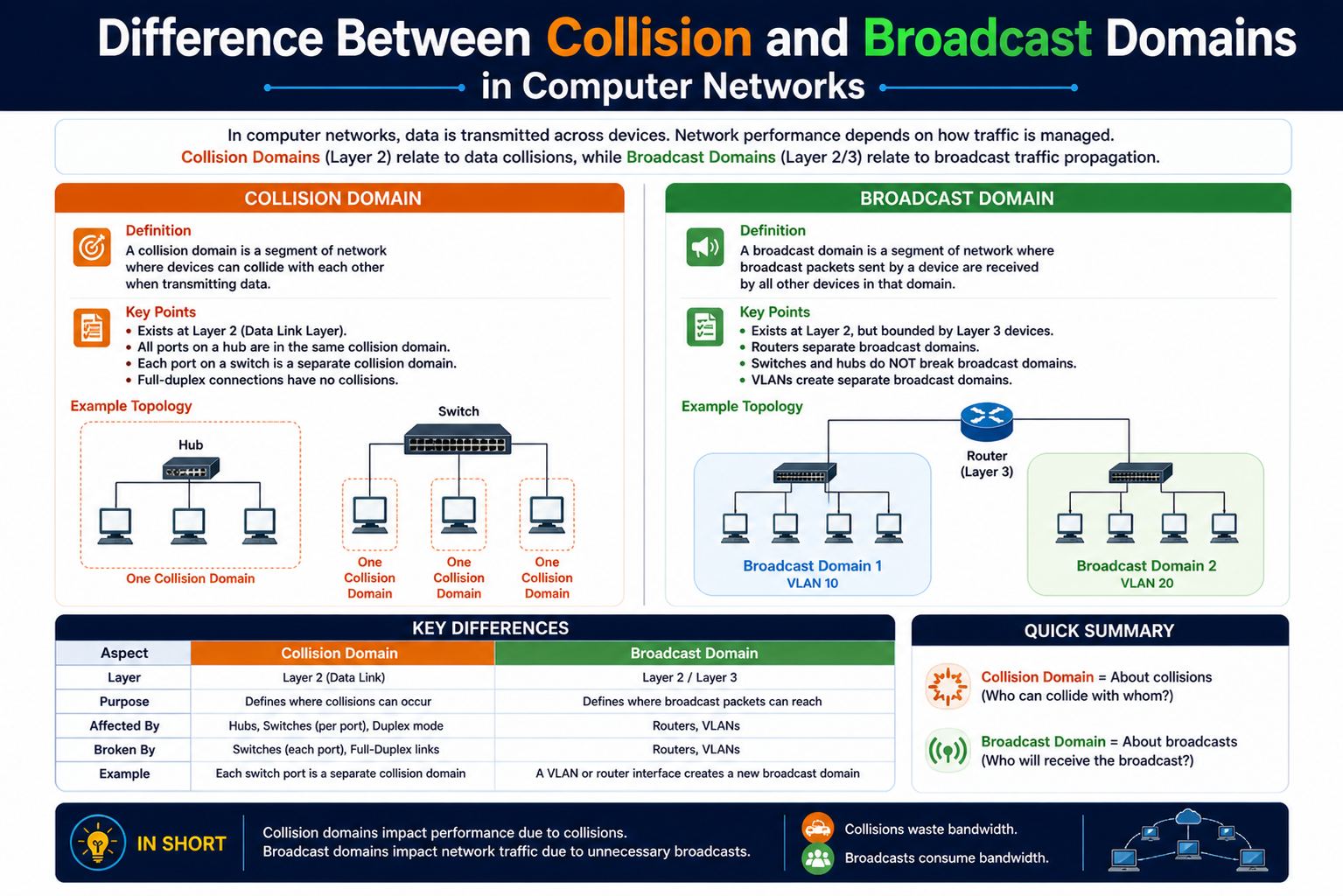
In computer networking, communication efficiency depends heavily on how data flows between devices and how that traffic is managed within a network structure. Two important concepts that define this behavior are collision domains and broadcast domains. Both play a critical role in determining how data is transmitted, how congestion is controlled, and how efficiently a network performs under load. While they were once closely related in early network designs, modern networking has clearly separated their functions, making them distinct but equally important areas of study for understanding how networks operate today.
Collision domains are primarily concerned with data transmission conflicts that occur when multiple devices attempt to send data at the same time over a shared medium. Broadcast domains, on the other hand, deal with how broadcast traffic is distributed across a network segment and which devices receive it. To build efficient and scalable networks, it is essential to understand both concepts in depth, starting with how collisions occur and how they impact network communication.
What is a Collision in Networking
A collision in networking occurs when two or more devices attempt to transmit data simultaneously over the same communication channel in a half-duplex environment. When this happens, the signals interfere with each other, causing data corruption. As a result, the transmitted information becomes unreadable and must be resent.
This situation is most common in older or shared network environments where multiple devices rely on the same physical medium for communication. Since only one device can successfully transmit at a time in such setups, simultaneous transmissions lead to signal overlap. When a collision is detected, the devices involved stop transmitting and wait for a random backoff time before attempting to resend the data. This random delay helps reduce the likelihood of repeated collisions occurring at the same time.
Although collisions were once a major performance issue in traditional Ethernet networks, modern infrastructure has significantly reduced their occurrence. This is mainly due to advancements in switching technology and full-duplex communication methods.
Understanding a Collision Domain
A collision domain refers to a specific area within a network where data packets can collide with one another when being transmitted. In simpler terms, it is a section of the network where devices share the same communication medium and therefore have the potential to interfere with each other’s transmissions.
If multiple devices exist within the same collision domain, they must compete for access to the network channel. This increases the chances of collisions, especially when network traffic is high. Conversely, if the collision domain is segmented into smaller parts, fewer devices share the same communication path, reducing the probability of transmission conflicts.
In modern network design, switches play a crucial role in reducing collision domains by isolating each connected device into its own dedicated communication segment. This ensures that devices do not directly compete with each other for bandwidth on the same channel.
Impact of Collisions on Network Performance
Collisions have a direct negative impact on network efficiency. When a collision occurs, the affected data must be retransmitted, which consumes additional bandwidth and increases network delay. As the number of devices in a collision domain increases, the probability of collisions also rises, leading to congestion and reduced overall performance.
This retransmission process introduces latency, especially in busy networks where multiple devices are frequently sending data. The repeated need to resend information also reduces the effective throughput of the network, meaning that less useful data is successfully transmitted within a given time frame.
In high-traffic environments, excessive collisions can severely degrade performance, making communication slow and unreliable. This is why modern network architectures aim to eliminate or minimize collision domains wherever possible.
Half Duplex vs Full Duplex Communication
The occurrence of collisions is closely tied to whether a network operates in half-duplex or full-duplex mode. In half-duplex communication, data transmission can only occur in one direction at a time. This means that a device must either send or receive data, but not both simultaneously. In such environments, collisions are more likely because multiple devices may attempt to transmit at the same time.
Full-duplex communication, on the other hand, allows devices to send and receive data simultaneously without interference. This eliminates the possibility of collisions entirely, as each direction of communication has its own dedicated channel.
Modern Ethernet networks primarily use full-duplex communication, especially when connected through switches. This advancement has significantly reduced the relevance of collision domains in everyday networking scenarios.
Core Mechanisms for Handling Collisions
To manage collisions in traditional networks, specific protocols were developed to detect and reduce their occurrence. One of the most widely known mechanisms is carrier sensing, where a device first checks whether the communication channel is free before transmitting data. If the channel is busy, the device waits before attempting again.
In some cases, collision detection methods were also used to identify when a collision had already occurred during transmission. Once detected, devices would stop sending data immediately and initiate a retransmission process after a random delay.
These mechanisms helped maintain basic network functionality in shared environments, but they also introduced inefficiencies due to repeated retransmissions and delays.
Role of Switches in Reducing Collision Domains
Switching technology revolutionized how collision domains are managed. Unlike older network hubs, which broadcast data to all connected devices, switches create dedicated communication paths between individual devices. This means that each port on a switch effectively represents its own collision domain.
As a result, devices connected to a switch do not compete with each other for bandwidth, and collisions are virtually eliminated in full-duplex configurations. This isolation greatly improves network efficiency and allows for higher performance even when many devices are connected.
Switches also intelligently forward data only to the intended recipient device rather than broadcasting it to all nodes, further reducing unnecessary traffic and improving overall communication flow.
Role of Routers in Segmentation of Collision Domains
Routers also contribute to network segmentation, although their primary function is to manage communication between different networks rather than individual devices. In earlier network designs, routers were sometimes used to divide large shared networks into smaller segments, indirectly reducing collision domains.
By separating traffic between different network paths, routers helped limit the number of devices competing for the same communication channel. However, with the rise of switching technology, the role of routers in managing collision domains has become less significant in local network environments.
Practical Methods to Avoid Collisions in Networks
One of the most effective ways to avoid collisions is by using switches instead of hubs. Switches ensure that each device operates on a dedicated communication path, eliminating shared transmission issues.
Another important method is enabling full-duplex communication wherever possible. When devices are configured to support full-duplex mode, they can send and receive data simultaneously without risk of interference.
Proper network configuration also plays a role in reducing collisions. Faulty cables, incorrect duplex settings, or mismatched network speeds can force devices into half-duplex mode, increasing the likelihood of collisions. Ensuring that hardware and configurations are properly aligned helps maintain smooth communication.
Collision Considerations in Wireless Environments
In wireless networks, collisions behave differently due to the shared nature of radio frequency channels. Since multiple devices communicate over the same air medium, the potential for interference is always present.
To manage this, wireless systems use techniques designed to reduce collision probability by controlling when devices transmit data. However, because the medium is inherently shared, wireless networks are more susceptible to congestion compared to wired full-duplex environments.
Proper channel planning and access point distribution help reduce interference and improve overall wireless performance by minimizing overlapping transmissions.
Early View of Collision Behavior in Networks
In early networking environments, collision domains were a major limiting factor in performance. Because all devices shared a single communication medium, network congestion was common, and performance degraded quickly as more devices were added.
This led to the development of more intelligent network devices that could isolate traffic and reduce unnecessary collisions. Over time, these improvements transformed how networks are designed, shifting from shared communication models to segmented and switched architectures.
Transition Toward Modern Network Efficiency
As networking technology evolved, the focus shifted from simply enabling communication to optimizing it. Collision domains, once a major concern, have now become largely managed through hardware design and full-duplex communication.
Despite this, understanding collision domains remains important because it explains how network efficiency is achieved and why modern switching systems are so effective. It also provides a foundation for understanding more advanced networking concepts related to traffic management and data flow optimization.
How Collision Domains Shape Network Architecture
Collision domains play a foundational role in how early and modern networks are structured. In a shared communication environment, every device competes for the same transmission medium, which means the architecture of the network directly influences how often collisions occur. When designing networks, engineers aim to reduce the size of collision domains to improve efficiency and reduce retransmission overhead.
In practical terms, a smaller collision domain means fewer devices are sharing the same communication channel. This significantly lowers the probability of simultaneous transmissions. In contrast, larger collision domains increase contention, making network performance less predictable under heavy traffic. This is why modern Ethernet networks rely heavily on switching infrastructure, which naturally segments collision domains into smaller, manageable units.
Evolution from Shared Media to Switched Networks
In early networking systems, hubs were commonly used to connect multiple devices. These hubs operated by broadcasting incoming signals to all connected ports, meaning every device effectively shared the same collision domain. As a result, even a single transmission could affect the entire network segment.
As networking technology advanced, switches replaced hubs and fundamentally changed this behavior. Instead of broadcasting data to all devices, switches learn the location of connected devices and forward data only to the intended recipient. This creates isolated communication paths, drastically reducing the size and impact of collision domains.
This evolution marked a major shift in networking efficiency, allowing more devices to communicate simultaneously without interfering with each other. It also laid the foundation for full-duplex communication, which further eliminates collisions entirely.
Role of Ethernet in Collision Domain Behavior
Ethernet technology originally relied heavily on shared communication principles. Devices connected on the same Ethernet segment had to follow strict rules to avoid transmission conflicts. One of the core mechanisms used was carrier sensing, where a device listens to the network before transmitting data.
If the network was detected as busy, the device would delay transmission. However, even with these precautions, simultaneous transmission attempts could still occur, leading to collisions. This is why Ethernet initially incorporated collision detection mechanisms to handle such events.
Modern Ethernet, however, has evolved significantly. With the introduction of switched Ethernet and full-duplex modes, collision detection has become largely unnecessary in most environments. Devices now communicate over dedicated paths, removing the shared medium limitation that caused collisions in the first place.
Switch Port Isolation and Its Impact on Collision Domains
One of the most important innovations in modern networking is switch port isolation. Each port on a switch represents a separate collision domain, meaning devices connected to different ports do not interfere with each other’s transmissions.
This isolation allows multiple devices to communicate simultaneously without competing for the same bandwidth. For example, if ten devices are connected to a switch, each device effectively has its own dedicated communication channel. This dramatically reduces congestion and improves overall throughput.
Switches also support full-duplex communication, which further enhances this isolation by allowing simultaneous send and receive operations without interference. As a result, collision domains become virtually irrelevant in well-designed switched networks.
Full Duplex Communication and Its Role in Eliminating Collisions
Full-duplex communication is one of the most important advancements in modern networking. In a full-duplex system, data can be transmitted and received at the same time without conflict. This is achieved through separate communication channels for sending and receiving data.
Because of this separation, devices no longer need to compete for access to the network medium. This completely eliminates the possibility of collisions in full-duplex environments. It also improves network efficiency by allowing continuous data flow in both directions.
Full-duplex is now the standard mode of operation for most Ethernet networks, especially those operating at higher speeds. Half-duplex communication is largely considered outdated and is rarely used in modern infrastructure.
Understanding Broadcast Domains in Network Communication
While collision domains focus on transmission conflicts, broadcast domains deal with how broadcast traffic is distributed across a network. A broadcast domain is a logical division of a network in which any broadcast sent by a device is received by all other devices within the same segment.
Broadcasts are used when a device needs to communicate with all nodes on a network without knowing their specific addresses. This makes them useful for discovery processes and network services that require general communication.
However, unlike collisions, broadcasts are intentional and often necessary for proper network operation. They help devices locate services, obtain configuration information, and communicate in situations where direct addressing is not possible.
How Broadcast Traffic Operates in a Network
When a device sends a broadcast message, it is delivered to every device within the same broadcast domain. This ensures that all relevant devices receive the information, even if the sender does not know their exact location.
Common examples include service discovery and network configuration processes. For instance, when a device first connects to a network and does not yet have an IP address, it may send a broadcast request to locate a configuration server.
While this mechanism is essential for network initialization and service discovery, it can also create unnecessary traffic if overused. In large networks with many devices, excessive broadcast traffic can consume bandwidth and reduce efficiency.
Broadcast Domain Boundaries and Their Importance
Unlike collision domains, broadcast domains are not automatically segmented by switches. Instead, routers and virtual segmentation techniques are used to define their boundaries. A broadcast sent within one broadcast domain does not cross into another unless explicitly routed.
This boundary control is critical for maintaining network performance. Without proper segmentation, broadcast traffic could spread across an entire network, leading to congestion and reduced efficiency.
By limiting the size of broadcast domains, network designers can ensure that broadcast traffic remains localized and manageable. This improves scalability and prevents unnecessary load on network devices.
Relationship Between IP Subnets and Broadcast Domains
Broadcast domains are closely related to IP subnetting. In most network designs, each IP subnet corresponds to a separate broadcast domain. This means that devices within the same subnet can communicate using broadcasts, while devices in different subnets cannot.
This relationship allows network administrators to control broadcast traffic by designing subnet structures carefully. Smaller subnets result in smaller broadcast domains, which reduces unnecessary traffic and improves performance.
Subnetting also helps organize network traffic logically, making it easier to manage and troubleshoot communication flows across large environments.
Why Broadcast Traffic Becomes a Performance Concern
Although broadcasts are useful, they can become problematic in large-scale networks. Every broadcast message is processed by every device in the broadcast domain, regardless of whether it is relevant to them.
In environments with hundreds or thousands of devices, this can create significant processing overhead. Each device must inspect broadcast traffic to determine whether it is relevant, which consumes CPU resources and network bandwidth.
Over time, excessive broadcast traffic can lead to network congestion, slower response times, and reduced overall efficiency. This is why broadcast domain control is a key aspect of network design.
Difference Between Collision and Broadcast Behavior
Collision domains and broadcast domains differ fundamentally in how they affect network traffic. Collision domains are concerned with transmission conflicts at the physical layer, while broadcast domains deal with logical message distribution.
Collisions are undesirable and always represent a failure in communication that must be corrected through retransmission. Broadcasts, however, are intentional and often necessary for network services to function correctly.
Understanding this difference is essential for designing efficient networks, as each requires a different strategy for optimization and control.
Early Networking Challenges with Broadcast and Collision Overlap
In early network designs, collision and broadcast domains often overlapped significantly because all devices shared the same communication medium. This created environments where both collisions and broadcast storms could occur frequently.
As networks grew larger, this design became inefficient, leading to slow performance and high levels of congestion. These limitations drove the development of switching and routing technologies that separated these domains and improved scalability.
Transition Toward Segmented Network Design
Modern network design focuses heavily on segmentation to improve performance. By separating collision domains using switches and broadcast domains using routers and VLANs, networks can handle significantly more traffic without degradation.
This segmentation ensures that collisions are minimized and broadcasts are controlled, allowing networks to scale efficiently while maintaining high performance levels across all connected devices.
Why Broadcast Control Becomes Critical in Scalable Networks
As networks expand in size, broadcast traffic becomes a major design concern. Every device in a broadcast domain must process broadcast frames, even if the data is not relevant to it. This creates unnecessary processing overhead and can significantly reduce network efficiency when the number of devices increases.
In small networks, this overhead is usually negligible. However, in medium to large-scale environments, uncontrolled broadcasts can lead to what is often called “broadcast noise,” where a significant portion of network traffic consists of broadcast messages. This reduces the available bandwidth for actual data transmission and increases latency across the system.
To address this, modern network design focuses heavily on limiting the size of broadcast domains and controlling how broadcast traffic is generated and distributed.
Role of Layered Network Design in Broadcast Management
Modern networks are built using layered architecture principles, where different devices are responsible for different tasks. This separation of responsibilities plays a key role in controlling broadcast domains.
At the access layer, devices connect end users and generate most of the broadcast traffic. At the distribution layer, traffic is organized and filtered. At the core layer, high-speed forwarding occurs with minimal processing overhead.
This layered approach ensures that broadcast traffic does not propagate unnecessarily throughout the entire network. Instead, it is contained within smaller segments where it is actually needed.
By carefully structuring networks into layers, administrators can significantly reduce broadcast impact and improve overall efficiency.
How VLANs Reduce Broadcast Domain Size
Virtual LANs (VLANs) are one of the most effective tools for controlling broadcast domains. A VLAN allows a physical network to be logically divided into multiple independent network segments.
Each VLAN operates as its own broadcast domain, meaning broadcast traffic generated within one VLAN is not forwarded to another VLAN unless explicitly routed. This separation greatly reduces unnecessary broadcast propagation.
For example, devices in a corporate environment such as printers, employees, and servers can each be placed into separate VLANs. This ensures that broadcast traffic is limited to relevant devices only, improving performance and reducing network congestion.
VLANs also enhance security by isolating network traffic, preventing unnecessary exposure between different device groups.
Router Function in Broadcast Domain Segmentation
Routers play a critical role in separating broadcast domains. Unlike switches, which forward broadcast traffic within a VLAN, routers do not forward broadcast packets between different networks by default.
Each router interface typically represents a separate broadcast domain. This means that any broadcast generated in one network segment will not reach another segment unless specifically configured to do so.
This behavior is essential for maintaining control over large networks. By using routers to segment broadcast domains, network administrators can prevent broadcast traffic from spreading uncontrollably across the entire infrastructure.
DHCP Broadcast Behavior and Network Efficiency
One of the most common uses of broadcast traffic in networking is DHCP communication. When a device first connects to a network, it does not have an IP address and therefore does not know how to communicate directly with a DHCP server.
To solve this, the device sends a broadcast request asking for network configuration details. The DHCP server responds, allowing the device to obtain an IP address and join the network properly.
While this process is essential, it can generate significant broadcast traffic in large environments. To optimize this, DHCP relay agents or helpers are used. These mechanisms forward DHCP requests directly to the appropriate server without flooding the entire broadcast domain.
This improves efficiency and reduces unnecessary network load.
DHCP Relay and Its Role in Reducing Broadcast Noise
DHCP relay functionality allows routers or switches to intercept broadcast DHCP requests and convert them into unicast messages directed to a specific DHCP server.
Instead of allowing the broadcast to reach every device in the network, the relay ensures that only the intended server receives the request. The server’s response is then forwarded back to the client.
This significantly reduces broadcast traffic across large networks, especially in environments with multiple subnets. It also improves response time and reduces unnecessary processing on network devices.
Multicast as an Alternative to Broadcast Communication
Multicast communication provides a more efficient alternative to broadcast in many scenarios. Instead of sending data to all devices in a network segment, multicast allows data to be sent only to devices that have expressed interest in receiving it.
Devices must join a multicast group to receive traffic, which ensures that only relevant recipients process the data. This reduces unnecessary load on the network and improves bandwidth efficiency.
Multicast is commonly used in applications such as video streaming, online conferencing, and real-time data distribution where multiple recipients need the same information simultaneously.
How Multicast Improves Network Efficiency
Unlike broadcast traffic, which is delivered to every device in a domain, multicast traffic is selectively distributed. This reduces the number of devices that must process each packet.
By limiting data delivery to subscribed devices, multicast reduces CPU usage, network congestion, and unnecessary bandwidth consumption. It also improves scalability, as adding more recipients does not significantly increase network load.
However, multicast requires proper configuration to function effectively. Without correct setup, it may behave similarly to broadcast, reducing its efficiency benefits.
Challenges in Multicast Implementation
Although multicast offers significant advantages, it is more complex to implement than broadcast communication. It requires proper group management, routing configuration, and network support to function correctly.
If multicast is not properly configured, it can fall back to broadcast behavior, which negates its benefits and increases network load. This makes careful planning essential when deploying multicast in large environments.
Despite its complexity, multicast remains a powerful tool for optimizing network communication in scenarios involving multiple recipients.
Broadcast Suppression Techniques in Network Hardware
Broadcast suppression is a technique used in modern network devices to limit excessive broadcast traffic. It works by setting a threshold for broadcast traffic levels on a port or interface.
When traffic exceeds this threshold, the device may block or drop additional broadcast packets to prevent network overload. This helps protect the network from broadcast storms, which can occur when excessive broadcast traffic floods the system.
While this method can improve stability, it must be used carefully. Overly aggressive suppression can lead to legitimate broadcast traffic being dropped, potentially disrupting network services.
Risks Associated with Broadcast Suppression
Although broadcast suppression helps protect networks from overload, it can also introduce risks if not properly configured. Critical services that rely on broadcast communication may be affected if suppression thresholds are too strict.
This can result in failed device discovery, disrupted network configuration processes, or incomplete service communication. Therefore, administrators must carefully balance suppression settings to ensure both stability and functionality.
Broadcast Storms and Their Impact on Networks
A broadcast storm occurs when excessive broadcast traffic overwhelms a network segment. This can happen due to misconfigurations, faulty devices, or loops in the network topology.
During a broadcast storm, devices become overwhelmed with traffic processing, leading to severe performance degradation or even network failure. Bandwidth becomes saturated, and legitimate data cannot be transmitted effectively.
To prevent this, network protocols such as spanning tree and storm control mechanisms are used to detect and mitigate excessive broadcast activity.
Spanning Tree Protocol and Broadcast Control
Spanning Tree Protocol plays an important role in preventing loops in network topology, which are a common cause of broadcast storms. By ensuring that only one active path exists between network segments, it eliminates redundant loops that could amplify broadcast traffic.
This helps maintain stable network operation and prevents uncontrolled broadcast propagation across interconnected devices.
Balancing Broadcast Efficiency and Network Functionality
While reducing broadcast traffic improves efficiency, it is important not to eliminate it entirely. Many network protocols rely on broadcasts for essential functions such as device discovery, configuration, and service advertisement.
The goal of modern network design is therefore not to remove broadcasts completely but to control and optimize their usage. This balance ensures that networks remain both efficient and functional.
Balancing Collision and Broadcast Domains in Network Design
Modern network design is centered around achieving a balance between minimizing collisions and controlling broadcast traffic. While both are different in nature, they directly influence overall network performance and scalability. A well-optimized network reduces collision domains to near zero using switching and full-duplex communication, while carefully managing broadcast domains through segmentation and intelligent routing.
The challenge in real-world network architecture is not simply eliminating these domains but designing a structure where both operate efficiently without interfering with normal communication. Too many devices in a single segment can lead to broadcast congestion, while poorly configured connections can still introduce unnecessary collisions. Effective design ensures both are kept within controlled limits.
How Enterprise Networks Eliminate Collision Domains
In enterprise environments, collision domains are effectively eliminated through the widespread use of Ethernet switches. Each switch port creates a dedicated communication path for connected devices, meaning no two devices on separate ports compete for the same transmission medium.
This structure ensures that collisions do not occur because each device has its own isolated channel. Additionally, full-duplex communication allows simultaneous sending and receiving of data, further removing any chance of transmission conflict.
As a result, collision domains in modern enterprise networks are mostly theoretical rather than practical concerns. Engineers now focus more on traffic optimization and segmentation rather than collision prevention.
Designing Efficient Broadcast Domain Boundaries
Unlike collision domains, broadcast domains require careful planning even in modern networks. Poorly designed broadcast domains can lead to excessive traffic, slowing down devices and consuming unnecessary bandwidth.
The key to efficiency lies in defining clear boundaries using VLANs and routers. Each broadcast domain should contain only logically related devices that need to communicate frequently. This minimizes unnecessary broadcast propagation and ensures that traffic remains relevant to its destination.
By limiting the size of broadcast domains, networks become more predictable, scalable, and easier to manage.
Hierarchical Network Segmentation for Scalability
Large-scale networks rely heavily on hierarchical segmentation to manage both collision and broadcast behavior. This structure typically consists of access, distribution, and core layers, each serving a specific role in traffic handling.
At the access layer, devices connect and generate most of the traffic, including broadcasts. The distribution layer filters and manages this traffic, applying policies and segmentation rules. The core layer ensures fast and efficient forwarding across the network backbone.
This hierarchy prevents unnecessary broadcast spread and ensures that collision domains remain isolated at the edge of the network.
Role of Switching Intelligence in Modern Networks
Modern switches are highly intelligent devices capable of learning network behavior and optimizing traffic flow. They maintain MAC address tables to track connected devices and forward traffic only where needed.
This intelligence ensures that unicast traffic is delivered directly to its destination, while broadcast traffic is confined within its designated domain. It also reduces unnecessary load on network devices by preventing redundant forwarding.
Advanced switches can also implement features such as storm control, VLAN tagging, and dynamic segmentation to further improve efficiency.
Impact of Network Speed on Collision Behavior
Network speed plays a significant role in collision behavior. In older networks operating at lower speeds, collisions were more frequent due to slower transmission times and shared media access.
As speeds increased, especially with the introduction of gigabit Ethernet and beyond, full-duplex communication became standard. At these speeds, half-duplex operation is generally unsupported, effectively eliminating collision possibilities.
Higher speeds combined with switching technology ensure that modern networks operate with minimal transmission delays and no collision-related inefficiencies.
Wireless Networks and Collision Management Challenges
Unlike wired networks, wireless environments inherently operate in a shared medium, making collision management more complex. Devices communicate over radio frequencies, which are shared across all connected clients within range.
To manage this, wireless networks use collision avoidance techniques rather than collision detection. These mechanisms attempt to reduce the likelihood of simultaneous transmissions rather than reacting after collisions occur.
Channel planning, access point distribution, and frequency selection are essential strategies for minimizing interference and maintaining performance in wireless environments.
Broadcast Efficiency in Wireless Systems
Wireless networks are also affected by broadcast traffic, which can become more noticeable due to shared spectrum usage. Excessive broadcasts can reduce available airtime for actual data transmission.
To mitigate this, wireless systems often use features such as client isolation, airtime fairness, and optimized roaming strategies. These techniques help ensure that broadcast traffic does not overwhelm wireless channels.
Proper design of wireless infrastructure is critical to maintaining stable performance, especially in high-density environments.
Importance of Network Protocols in Domain Control
Network protocols play a key role in managing both collision and broadcast domains. Protocols such as DHCP, ARP, and spanning tree rely on controlled broadcast behavior to function correctly.
At the same time, routing protocols ensure that broadcast traffic does not cross unnecessary boundaries, maintaining separation between network segments.
Without these protocols, networks would struggle to maintain structure and efficiency, especially as they scale in size and complexity.
Traffic Optimization Through Intelligent Routing
Routing is one of the most powerful tools for controlling broadcast domains. By directing traffic between different network segments, routers ensure that broadcast packets remain confined to their appropriate subnet.
This prevents unnecessary flooding of broadcast traffic across the entire network. Instead, only relevant segments receive the communication they need.
Intelligent routing decisions also improve overall performance by selecting the most efficient paths for data transmission.
Reducing Network Overhead Through Segmentation
Segmentation is a core principle in reducing both collision and broadcast overhead. By dividing a network into smaller logical or physical segments, traffic is distributed more efficiently.
Each segment operates independently, reducing contention and limiting the spread of broadcast traffic. This improves performance, enhances security, and simplifies network management.
Segmentation is especially important in large organizations where thousands of devices must communicate efficiently without overwhelming the infrastructure.
Best Practices for Designing Efficient Networks
A well-designed network follows several key principles to optimize performance. First, collision domains should be minimized using switches and full-duplex communication. Second, broadcast domains should be carefully controlled using VLANs and routing.
Third, unnecessary broadcast traffic should be reduced through intelligent configuration of services like DHCP and multicast. Finally, network devices should be monitored and tuned regularly to prevent congestion and inefficiencies.
Following these practices ensures that networks remain stable, scalable, and capable of handling increasing traffic demands.
The Role of Monitoring in Domain Optimization
Continuous monitoring is essential for maintaining efficient collision and broadcast domain behavior. Network monitoring tools help identify traffic patterns, detect anomalies, and highlight potential bottlenecks.
By analyzing this data, administrators can adjust configurations to improve performance and prevent issues such as broadcast storms or unexpected congestion.
Monitoring also helps ensure that network segmentation strategies remain effective as the environment evolves.
Final Conclusion
Collision domains and broadcast domains represent two fundamental aspects of network communication control. Collision domains deal with transmission conflicts at the physical level, while broadcast domains manage how broadcast traffic is distributed across logical network segments.
Modern networking has largely eliminated collisions through switching and full-duplex communication, while broadcast domains remain an important design consideration for scalability and efficiency. Proper segmentation, routing, and protocol management ensure that both are optimized for performance.
At the end of the day, efficient networks are not built by eliminating these concepts entirely but by controlling them intelligently to achieve fast, reliable, and scalable communication.