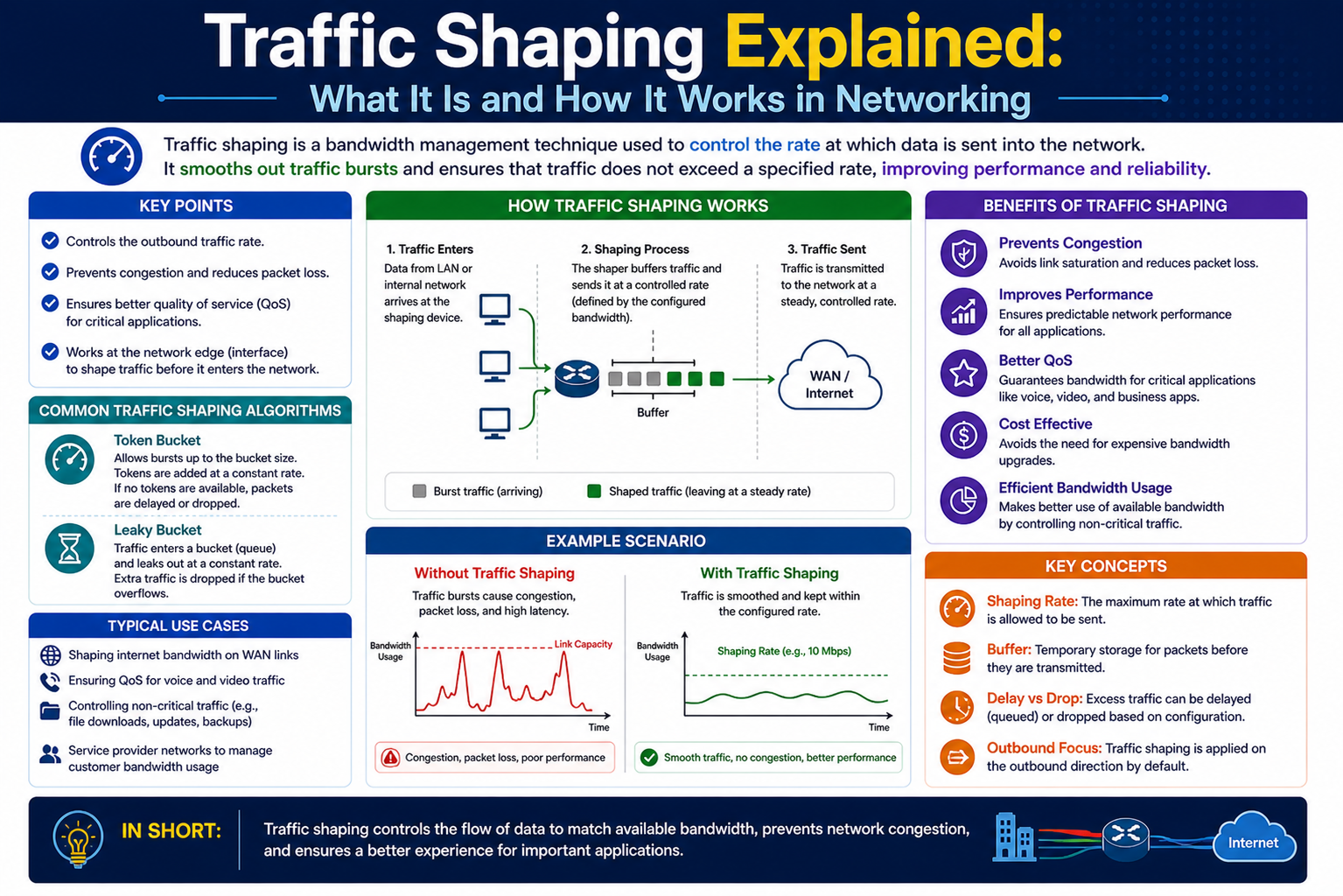
Traffic shaping is a network management technique used to regulate the flow of data across a network by controlling how packets are transmitted, delayed, or prioritized. It ensures that important data traffic receives the necessary bandwidth while less critical traffic is delayed or restricted. This process helps maintain stable network performance, prevents congestion, and ensures that essential services continue to operate smoothly even during heavy usage periods. Traffic shaping is widely used in enterprise environments where multiple applications compete for limited bandwidth resources, making it a key component of modern network optimization strategies.
Core Concept of Traffic Shaping in Networking
At its core, traffic shaping is about controlling data movement in a structured and intelligent way. Instead of allowing all network traffic to flow freely at full speed, it introduces rules that decide how quickly different types of data should travel. This helps avoid sudden spikes in traffic that can overwhelm network devices or reduce performance. By smoothing out data transmission, traffic shaping creates a more predictable and balanced flow of information. It also ensures that network resources are distributed fairly according to predefined priorities, allowing organizations to maintain efficiency across all connected systems and services.
Importance of Traffic Shaping in Modern Networks
Modern digital environments rely heavily on stable and consistent network performance, especially as organizations run multiple applications simultaneously. Traffic shaping plays a critical role in ensuring that bandwidth is used efficiently and that network congestion is minimized. Without it, networks can become overloaded, leading to delays, packet loss, and poor user experiences. By managing data flow intelligently, traffic shaping helps organizations maintain service quality even during peak usage times. It also allows businesses to prioritize mission-critical applications, ensuring that essential operations remain uninterrupted regardless of network demand.
Role of Network Administrators in Traffic Management
Network administrators are responsible for designing and maintaining efficient communication systems within an organization, and traffic shaping is one of their key tools. Their role involves analyzing network usage patterns, identifying high-priority applications, and implementing rules that control how data flows across the network. They must ensure that critical services receive sufficient bandwidth while preventing non-essential traffic from consuming excessive resources. This requires a deep understanding of network behavior, performance requirements, and organizational needs. Through careful configuration and monitoring, administrators ensure that traffic shaping policies continue to deliver optimal performance.
Understanding Network Traffic Flow and Congestion
Network traffic consists of continuous streams of data packets moving between devices, applications, and servers. When too many packets attempt to travel through the same network path at the same time, congestion occurs. This can slow down communication, increase delays, and reduce overall system efficiency. Traffic shaping addresses this issue by controlling the rate at which packets are sent, ensuring that data flows in a controlled and manageable manner. By smoothing out bursts of traffic, it prevents bottlenecks and maintains a steady flow of information across the network infrastructure.
Relationship Between Traffic Shaping and Quality of Service
Quality of Service is a framework used to prioritize different types of network traffic based on their importance. Traffic shaping works closely with this concept by enforcing QoS policies and ensuring that high-priority traffic receives preferential treatment. For example, applications that require real-time communication or fast response times are given priority over less critical data transfers. This ensures that essential services maintain consistent performance even when the network is under heavy load. Traffic shaping therefore acts as a practical mechanism for implementing QoS policies effectively within a network environment.
How Bandwidth Management Works in Traffic Shaping
Bandwidth management is a key function of traffic shaping that involves allocating available network capacity among different applications and users. Instead of allowing all traffic to consume bandwidth freely, the system distributes it based on predefined rules and priorities. High-priority traffic is allowed to use more bandwidth, while lower-priority traffic may be limited or delayed. This controlled distribution ensures that critical applications always have the resources they need to function properly. It also prevents network overload by balancing usage across all active connections and services.
Priority-Based Handling of Network Traffic
Traffic shaping relies heavily on the concept of prioritization, where different types of data are assigned different levels of importance. For example, business-critical applications such as communication tools or customer-facing systems may be given higher priority than background processes or internal updates. When the network becomes busy, high-priority traffic is transmitted first, while lower-priority traffic is queued or slowed down. This ensures that essential operations continue without interruption, even during periods of high network demand, improving both performance and reliability across the system.
Application Categorization in Traffic Control Systems
In traffic shaping systems, applications are categorized based on their function, importance, and performance requirements. Each category is assigned specific rules that determine how its data should be handled. For example, real-time applications may require immediate transmission, while file downloads can tolerate delays. This categorization allows network administrators to apply precise control over traffic behavior. By grouping applications into different classes, organizations can ensure that network resources are used efficiently and that critical services always receive the necessary level of support.
Enterprise Usage of Traffic Shaping in Real Environments
In enterprise networks, traffic shaping is used to balance the demands of multiple applications running simultaneously. Customer-facing systems often receive higher priority because they directly impact user experience and business performance. Internal tools and background processes may be assigned lower priority to ensure they do not interfere with critical operations. This structured approach allows organizations to maintain smooth performance across all departments. It also ensures that important services remain responsive, even when the network is handling a large volume of simultaneous requests.
Traffic Shaping for Real-Time Communication Applications
Real-time communication tools such as voice and video applications require consistent and uninterrupted data flow to function properly. Any delay or packet loss can result in poor call quality or disrupted video streams. Traffic shaping helps prevent these issues by giving priority to real-time traffic and ensuring it receives sufficient bandwidth. This allows communication to remain clear and stable, even when the network is experiencing heavy usage. By reducing delays and managing congestion, traffic shaping significantly improves the performance of time-sensitive applications.
Use of Traffic Shaping in Cloud and Service Providers
Cloud service providers and internet service providers often use traffic shaping to manage large-scale data flow across their networks. Since they serve multiple users simultaneously, it is essential to control how bandwidth is distributed among them. Traffic shaping allows these providers to offer different service levels based on user requirements or subscription plans. It also helps maintain overall network stability by preventing any single user or application from consuming excessive resources. This ensures fair usage and consistent performance for all customers connected to the network.
Security Role of Traffic Shaping in Network Protection
Beyond performance optimization, traffic shaping also contributes to network security by helping mitigate certain types of cyberattacks. For example, during large-scale traffic floods designed to overwhelm systems, traffic shaping can reduce the impact by limiting or deprioritizing suspicious data flows. This prevents malicious traffic from consuming all available bandwidth and allows legitimate applications to continue functioning. By controlling abnormal traffic patterns, it adds an additional layer of defense that helps protect network infrastructure from disruption and overload situations.
Traffic Shaping and Network Congestion Control
Traffic shaping plays a vital role in controlling network congestion by regulating how data packets are transmitted across a network. Instead of allowing all traffic to pass through instantly, it smooths out bursts of data and ensures a steady flow. When too many users or applications try to send data at the same time, congestion occurs, which leads to delays and reduced performance. Traffic shaping prevents this by temporarily holding back lower-priority traffic and releasing it gradually. This controlled flow reduces bottlenecks, improves response times, and ensures that the network remains stable even during peak usage periods.
How Traffic Shaping Prioritizes Critical Applications
One of the most important functions of traffic shaping is prioritizing critical applications over less important ones. In a typical network, not all data has the same level of importance. Some applications require instant delivery, while others can tolerate delays. Traffic shaping identifies these differences and assigns priority levels accordingly. High-priority applications such as communication tools, business systems, or real-time services are given faster access to bandwidth. Meanwhile, less urgent traffic is delayed or queued. This prioritization ensures that essential services always perform reliably, even when network resources are limited.
Bandwidth Allocation and Efficient Resource Usage
Efficient bandwidth usage is a major benefit of traffic shaping. Since network resources are often limited, organizations must ensure that bandwidth is distributed in a controlled and efficient manner. Traffic shaping helps achieve this by allocating bandwidth based on predefined rules. High-priority traffic receives a larger share of available bandwidth, while lower-priority traffic is restricted to prevent overuse. This prevents wasteful consumption of resources and ensures that critical applications always have enough capacity to function properly. As a result, organizations can maximize performance without requiring immediate infrastructure upgrades.
Traffic Queuing and Packet Delay Mechanisms
Traffic shaping uses queuing techniques to manage how packets are processed when the network is busy. When data exceeds the allowed transmission rate, it is placed into a queue or buffer. Instead of being dropped, the packets wait their turn for transmission. This controlled delay ensures that the network does not become overloaded. Different queues may be created for different types of traffic, depending on their priority level. High-priority queues are processed faster, while low-priority queues experience more delay. This structured approach ensures fair and efficient handling of all network traffic.
Understanding Rate Limiting in Traffic Shaping
Rate limiting is a key mechanism used in traffic shaping to control the speed at which data is transmitted. It sets a maximum limit on how much data can be sent within a specific time frame. When traffic exceeds this limit, it is either delayed or temporarily held back. This prevents sudden spikes in network usage that can cause congestion or system instability. Rate limiting is especially useful for managing non-critical applications that do not require immediate transmission. By controlling data flow at a steady rate, it helps maintain overall network performance and reliability.
Bandwidth Throttling and Its Role in Traffic Control
Bandwidth throttling is another important concept closely related to traffic shaping. It involves intentionally slowing down certain types of traffic to prevent them from consuming too many resources. This technique is often used for non-priority applications or services that generate heavy data loads. By reducing their transmission speed, the network can allocate more resources to critical applications. Bandwidth throttling ensures that no single application dominates the network, allowing for balanced and fair usage across all connected systems.
Controlled Information Rate and Network Stability
Controlled information rate refers to the predefined speed at which data is allowed to flow through the network. Traffic shaping uses this concept to maintain stability and prevent overload conditions. By setting specific limits on data transmission rates, network administrators can ensure that traffic flows in a predictable and manageable way. This reduces sudden spikes in usage that could disrupt services. Controlled information rate policies also help maintain consistent performance across different applications, ensuring that users experience smooth and uninterrupted connectivity.
Traffic Shaping for Real-Time vs Non-Real-Time Data
Not all network traffic behaves the same way, especially when comparing real-time and non-real-time data. Real-time data, such as voice calls or video conferencing, requires immediate transmission with minimal delay. Non-real-time data, such as file downloads or updates, can tolerate delays without affecting functionality. Traffic shaping differentiates between these two types and assigns appropriate handling rules. Real-time traffic is prioritized for fast delivery, while non-real-time traffic is queued or slowed down. This separation ensures optimal performance for all types of applications.
Impact of Traffic Shaping on User Experience
User experience is significantly improved when traffic shaping is properly implemented. Without it, users may experience slow loading times, interrupted services, or inconsistent performance. By managing data flow efficiently, traffic shaping ensures that critical applications remain responsive and stable. Users benefit from smoother communication, faster application performance, and reduced downtime. Even during periods of high network demand, traffic shaping maintains a balanced flow of data, ensuring that users experience consistent and reliable connectivity across all services.
Traffic Classification Methods in Network Systems
Traffic classification is the process of identifying and categorizing different types of network data. This is a fundamental step in traffic shaping because it determines how each type of traffic should be handled. Classification can be based on application type, protocol, source, or destination. Once classified, each traffic type is assigned a priority level and handling rule. This allows the network to treat different data streams differently based on their importance. Proper classification ensures that traffic shaping policies are applied accurately and effectively across the entire network.
Application-Based Traffic Identification Techniques
In application-based traffic shaping, network systems identify traffic based on the specific applications generating it. This is often done using deep packet inspection or similar techniques that analyze data packets. Once the application is identified, it is assigned a specific policy that controls its transmission behavior. For example, business-critical applications may receive high priority, while background applications are restricted. This method provides precise control over network traffic and ensures that important applications always receive the necessary resources for optimal performance.
Route-Based Traffic Shaping in Encrypted Environments
When traffic is encrypted, it becomes difficult to identify the application generating it. In such cases, route-based traffic shaping is used instead. This method focuses on the source and destination of the data rather than the application itself. By analyzing traffic paths, the system can still apply appropriate shaping rules. For example, traffic coming from trusted sources may be prioritized, while unknown or external traffic may be restricted. This approach ensures that traffic shaping remains effective even when application-level details are not accessible.
Role of Packet Flow Direction in Traffic Management
Packet flow direction is an important factor in traffic shaping because it determines how data moves across the network. Inbound and outbound traffic may be handled differently depending on network policies. Outbound traffic is often easier to control and shape, while inbound traffic requires careful management at entry points. By analyzing the direction of data flow, network systems can apply appropriate shaping rules. This ensures that both incoming and outgoing traffic are managed efficiently, maintaining overall network stability and performance.
Traffic Prioritization for Business-Critical Systems
Business-critical systems require consistent and reliable network performance to function effectively. Traffic shaping ensures that these systems receive the highest level of priority in the network. This means their data is transmitted first and allocated sufficient bandwidth. By protecting these systems from congestion and delays, organizations can ensure uninterrupted business operations. Whether it is customer service platforms, financial systems, or internal management tools, traffic shaping guarantees that essential services remain fully operational under all network conditions.
Traffic Shaping and Network Policy Enforcement
Traffic shaping is deeply connected with network policy enforcement because it applies predefined rules that control how data is handled across the network. These policies are designed by network administrators to ensure that every type of traffic follows specific behavior patterns. Once these rules are in place, traffic shaping enforces them automatically by controlling packet flow, prioritization, and transmission rates. This ensures that network usage remains consistent with organizational goals. Without proper policy enforcement, networks can become unpredictable, leading to congestion, poor performance, and inefficient use of resources.
Class-Based Traffic Management Structure
Class-based traffic management is a structured approach where network traffic is divided into different categories or classes based on importance and function. Each class is assigned specific rules that determine how its traffic should be treated. High-priority classes are given more bandwidth and faster transmission, while lower classes are restricted or delayed. This structured hierarchy allows administrators to manage complex network environments more effectively. It also ensures that critical applications are always prioritized, while less important traffic does not interfere with essential operations.
Role of Buffers in Traffic Shaping Systems
Buffers play a crucial role in traffic shaping by temporarily storing data packets when the network is congested. Instead of dropping excess packets, the system places them in a buffer where they wait until they can be transmitted. This prevents data loss and ensures smoother traffic flow. Buffers help absorb sudden spikes in network usage, allowing traffic to be released gradually rather than all at once. However, excessive buffering can lead to delays, so careful configuration is necessary to maintain a balance between performance and responsiveness.
Understanding Packet Scheduling in Traffic Control
Packet scheduling is the process of deciding the order in which data packets are transmitted across the network. Traffic shaping relies heavily on scheduling mechanisms to ensure that high-priority packets are sent first. Different scheduling algorithms may be used depending on network requirements, such as fairness, priority, or weighted distribution. By controlling the sequence of packet transmission, traffic shaping ensures that important data is delivered quickly while less critical traffic is handled in a controlled manner. This improves both efficiency and predictability in network performance.
Impact of Traffic Shaping on Network Latency
Latency refers to the time it takes for data to travel from one point in a network to another. Traffic shaping directly influences latency by controlling how and when packets are transmitted. High-priority traffic experiences lower latency because it is processed immediately, while lower-priority traffic may experience delays due to queuing. Although this introduces some delay for non-essential data, it significantly improves the performance of critical applications. Overall, traffic shaping helps maintain balanced latency levels across the network, ensuring smooth communication and responsiveness.
Traffic Shaping in Enterprise Communication Systems
Enterprise communication systems rely heavily on stable and predictable network performance. Traffic shaping ensures that communication tools such as messaging platforms, voice services, and collaboration applications function without interruption. By prioritizing communication-related traffic, organizations can maintain effective internal and external communication channels. This is especially important in environments where real-time interaction is essential. Traffic shaping helps prevent disruptions caused by heavy data usage from other applications, ensuring that communication systems remain reliable and efficient.
Handling Background Applications with Traffic Control
Background applications often run without direct user interaction but still consume network resources. These applications may include system updates, backups, or synchronization processes. Traffic shaping ensures that such background activities do not interfere with critical operations. By assigning lower priority or limiting bandwidth, the network can prevent background processes from overwhelming available resources. This allows essential applications to function smoothly while background tasks continue in a controlled and efficient manner without disrupting overall performance.
Traffic Shaping in Multi-User Network Environments
In environments where multiple users share the same network, traffic shaping becomes essential for maintaining fairness and efficiency. Without control, some users or applications could consume excessive bandwidth, leading to poor performance for others. Traffic shaping distributes resources evenly based on predefined policies, ensuring that no single user dominates the network. It also allows administrators to prioritize specific users or departments when necessary. This balanced approach ensures smooth and fair network usage across all connected users.
Dynamic Adjustment of Traffic Policies
Network conditions are not always constant, which means traffic shaping policies must sometimes be adjusted dynamically. Administrators may modify rules based on changing usage patterns, business needs, or performance requirements. Dynamic adjustment allows the network to respond to real-time conditions, ensuring optimal performance at all times. For example, during peak hours, stricter controls may be applied, while during low usage periods, restrictions may be relaxed. This flexibility ensures that traffic shaping remains effective under varying network loads.
Traffic Shaping for Data Consistency and Reliability
Data consistency and reliability are essential in any network environment. Traffic shaping helps achieve this by ensuring that data is transmitted in an organized and predictable manner. By controlling packet flow, it reduces the chances of data loss, duplication, or corruption caused by congestion. Reliable data transmission is especially important for business applications where accuracy and stability are critical. Traffic shaping ensures that information reaches its destination correctly and in a timely manner, maintaining overall system integrity.
Integration of Traffic Shaping with QoS Frameworks
Traffic shaping is closely integrated with Quality of Service frameworks, which define how different types of traffic should be handled. QoS policies set the rules, while traffic shaping enforces them in real time. This integration ensures that network performance aligns with organizational priorities. For example, if QoS defines a certain application as high priority, traffic shaping ensures that its data is transmitted first and allocated sufficient resources. This combination provides a powerful mechanism for managing complex network environments effectively.
Traffic Flow Optimization Techniques
Traffic flow optimization focuses on improving the efficiency of data transmission across the network. Traffic shaping contributes to this by reducing congestion, balancing load, and prioritizing important traffic. Optimization techniques may include adjusting bandwidth limits, refining classification rules, or improving scheduling mechanisms. The goal is to ensure that data flows smoothly without unnecessary delays or interruptions. By optimizing traffic flow, organizations can achieve better performance, reduced latency, and more efficient use of network resources.
Challenges in Implementing Traffic Shaping Systems
Although traffic shaping offers many benefits, implementing it effectively can be challenging. One of the main difficulties is accurately classifying traffic and assigning appropriate priorities. Incorrect classification can lead to poor performance or unfair resource distribution. Another challenge is maintaining balance between restriction and performance, as overly strict policies may slow down important applications. Continuous monitoring and adjustment are required to ensure that the system remains effective. Despite these challenges, proper configuration leads to significant improvements in network performance.
Monitoring and Analysis of Network Traffic Patterns
Monitoring network traffic is essential for understanding how data flows across the system. Traffic shaping relies on continuous analysis of traffic patterns to ensure that policies are working correctly. By observing usage trends, administrators can identify congestion points, performance issues, or inefficient resource allocation. This information is used to refine traffic shaping rules and improve overall efficiency. Regular monitoring ensures that the network remains stable, responsive, and aligned with organizational needs over time.
Traffic Shaping in High-Demand Network Scenarios
During high-demand scenarios, such as peak usage periods or large data transfers, traffic shaping becomes even more important. It helps prevent network overload by controlling how traffic is distributed. High-priority applications continue to function normally, while lower-priority traffic is slowed down or queued. This ensures that critical operations are not affected by sudden increases in network activity. By managing heavy traffic loads effectively, traffic shaping maintains stability and prevents system failure under stress conditions.
Scalability of Traffic Shaping Mechanisms
Scalability refers to the ability of traffic shaping systems to handle increasing network size and complexity. As organizations grow, their network demands also increase, requiring more advanced traffic management techniques. Scalable traffic shaping systems can adapt to higher traffic volumes without losing efficiency. They allow administrators to add new rules, adjust priorities, and manage additional users without disrupting existing performance. This ensures that the network remains efficient and reliable even as it expands.
Traffic Shaping for Service Level Management
Service level management involves maintaining agreed performance standards for different services within a network. Traffic shaping plays a key role in achieving these standards by controlling how resources are allocated. By prioritizing critical services and managing bandwidth distribution, it ensures that performance targets are consistently met. This is especially important in business environments where service quality directly impacts customer satisfaction and operational efficiency. Traffic shaping helps maintain these standards by providing predictable and controlled network behavior.
Traffic Shaping in Internet Service Providers (ISP) Networks
Internet Service Providers rely heavily on traffic shaping to manage large volumes of user data flowing through their infrastructure. Since multiple customers share the same network resources, it becomes necessary to control how bandwidth is distributed among them. Traffic shaping allows ISPs to regulate usage, prevent congestion, and maintain consistent performance for all users. By applying different rules for different service tiers, providers can ensure fair usage while still delivering reliable connectivity. This helps maintain overall network stability even during peak demand periods when traffic loads are extremely high.
Tiered Service Models and Traffic Control
Many service providers use tiered service models where customers receive different levels of network performance based on their subscription plans. Traffic shaping is the mechanism that makes these models possible. Higher-tier users are given priority access to bandwidth, while lower-tier users may experience controlled speeds during heavy network usage. This structured approach allows providers to balance network load while offering flexible pricing models. It also ensures that premium users receive consistent performance, while basic users still maintain acceptable connectivity levels without overwhelming the system.
Traffic Shaping in Video Streaming and Media Delivery
Video streaming platforms require stable and consistent bandwidth to deliver smooth playback experiences. Traffic shaping helps manage data flow so that video content is delivered without buffering or interruptions. By prioritizing streaming traffic and ensuring steady bandwidth allocation, the system reduces playback delays and improves viewing quality. It also helps balance network usage when multiple users are streaming content simultaneously. Without traffic shaping, sudden spikes in demand could cause congestion, leading to reduced video quality and poor user experience.
Impact on Cloud Computing Environments
Cloud computing environments depend on efficient network performance to deliver services such as storage, processing, and application hosting. Traffic shaping ensures that data flowing between users and cloud servers is managed efficiently. By prioritizing critical cloud operations and controlling non-essential traffic, it helps maintain smooth performance across distributed systems. This is especially important in multi-tenant environments where multiple users share the same infrastructure. Traffic shaping ensures fair resource distribution while maintaining reliability and responsiveness for all cloud-based services.
Traffic Shaping and Data Center Efficiency
Data centers handle massive amounts of network traffic every second, making traffic shaping essential for operational efficiency. It helps regulate internal and external data flows, ensuring that servers are not overwhelmed by excessive requests. By controlling bandwidth usage and prioritizing critical system communications, traffic shaping improves overall data center performance. It also reduces the risk of bottlenecks that could slow down processing or cause service interruptions. This structured traffic control helps maintain high availability and reliability in large-scale computing environments.
Role in Preventing Network Overutilization
Network overutilization occurs when too much data is transmitted at once, leading to congestion and reduced performance. Traffic shaping prevents this by controlling the rate at which data is sent across the network. Instead of allowing unlimited data flow, it enforces limits that ensure stable and predictable usage patterns. This prevents sudden spikes in traffic from disrupting system performance. By maintaining controlled usage levels, traffic shaping helps ensure that all users and applications receive fair access to network resources.
Traffic Shaping and Fair Usage Policies
Fair usage policies are designed to prevent individual users from consuming excessive network resources at the expense of others. Traffic shaping is the technical mechanism that enforces these policies. It ensures that no single user or application dominates bandwidth usage, especially in shared environments. By limiting excessive consumption and distributing resources evenly, traffic shaping maintains fairness across the network. This is particularly important in public networks, enterprise systems, and service provider infrastructures where balanced usage is essential.
Adaptive Traffic Management Techniques
Adaptive traffic management refers to the ability of a network to adjust its traffic shaping rules based on real-time conditions. Instead of using fixed rules, adaptive systems respond dynamically to changes in network demand. For example, during high traffic periods, stricter controls may be applied, while during low usage periods, restrictions may be relaxed. This flexibility allows the network to maintain optimal performance at all times. Adaptive traffic shaping ensures that resources are always used efficiently, regardless of changing conditions.
Traffic Shaping in Hybrid Network Architectures
Hybrid networks combine different types of infrastructure, such as on-premises systems and cloud-based services. Traffic shaping plays an important role in managing data flow between these environments. It ensures that communication between different network segments remains efficient and stable. By prioritizing critical cross-network traffic and controlling unnecessary data transfers, it helps maintain consistent performance. This is especially important in organizations that rely on both local and cloud-based systems for daily operations.
Handling Burst Traffic Conditions
Burst traffic refers to sudden spikes in data transmission that occur over a short period of time. These bursts can overload network systems if not properly managed. Traffic shaping handles this by temporarily buffering excess data and releasing it gradually. This prevents congestion and ensures that the network remains stable during sudden increases in demand. By smoothing out burst traffic, it helps maintain consistent performance and prevents disruptions caused by unpredictable data flows.
Traffic Shaping for Enterprise Security Enhancement
Traffic shaping also contributes to network security by controlling unusual or suspicious traffic patterns. In cases where abnormal data flows are detected, such as during attack attempts or unauthorized access, traffic shaping can reduce their impact by limiting their transmission rate. This helps protect critical systems from being overwhelmed. By managing traffic behavior, it adds an additional layer of defense that supports overall cybersecurity strategies and improves network resilience against potential threats.
Balancing Performance and Network Cost Efficiency
One of the major advantages of traffic shaping is its ability to improve performance without requiring expensive infrastructure upgrades. Instead of increasing bandwidth capacity, organizations can optimize existing resources more effectively. By controlling how traffic is distributed, traffic shaping reduces congestion and improves efficiency. This helps organizations achieve better performance while keeping operational costs under control. It provides a cost-effective solution for maintaining high-quality network performance without constant hardware expansion.
Traffic Shaping in Remote Work Environments
With the rise of remote work, networks must support employees accessing systems from various locations. Traffic shaping ensures that remote connections remain stable and reliable. It prioritizes business-critical applications such as communication tools, file sharing, and virtual desktops. By managing bandwidth usage across distributed users, it helps maintain consistent performance regardless of location. This ensures that remote employees experience smooth connectivity, enabling them to perform tasks efficiently without network interruptions.
Future Trends in Traffic Shaping Technology
As networks continue to evolve, traffic shaping is becoming more intelligent and automated. Future systems are expected to use advanced analytics and machine learning techniques to predict traffic patterns and adjust policies in real time. This will allow networks to respond proactively to congestion before it occurs. Additionally, integration with cloud-native environments will make traffic shaping more flexible and scalable. These advancements will further improve network efficiency, reliability, and adaptability in increasingly complex digital ecosystems.
Final Conclusion
Traffic shaping is a fundamental network management technique that controls how data flows across systems to ensure stability, efficiency, and fairness. It prioritizes important applications, manages bandwidth usage, and prevents congestion through structured policies. By regulating traffic flow, it improves performance for critical services while maintaining balanced resource distribution across all users. Its applications span enterprise networks, cloud environments, service providers, and security systems. Overall, traffic shaping remains an essential tool for maintaining modern network reliability and performance.