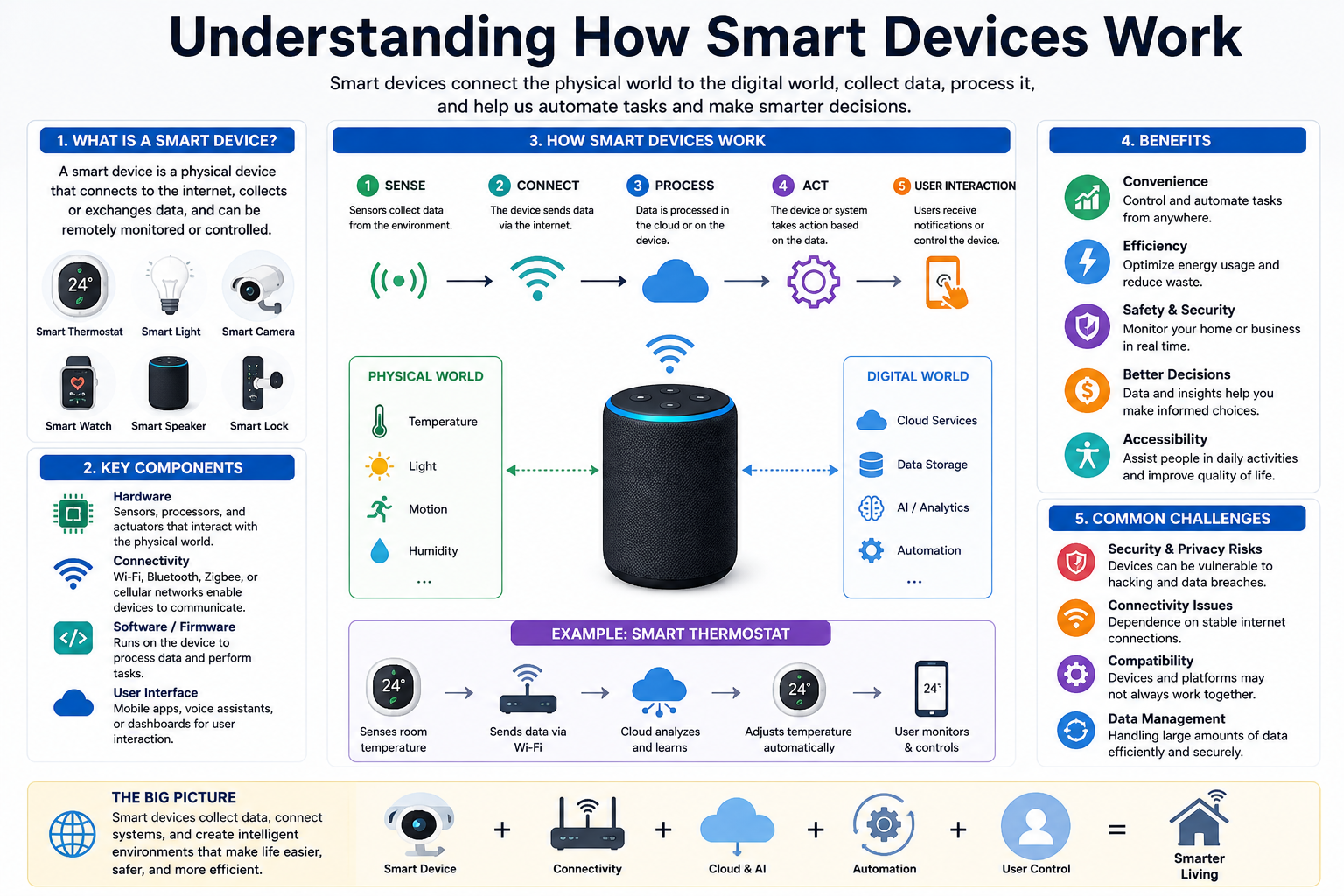
Smart devices are modern electronic systems designed to perform tasks intelligently by combining hardware components, software processing, and internet connectivity. Unlike traditional electronic devices that require constant manual input, smart devices can respond to their environment, user behavior, and remote instructions. They are built to make daily life easier by automating tasks, improving efficiency, and offering real-time control over different systems. These devices are now widely used in homes, offices, industries, and healthcare environments, making them a core part of modern digital life.
Basic Idea Behind Smart Devices
The fundamental idea behind smart devices is integration. A smart device is not just a machine performing a single function; it is a combination of sensors, processors, communication modules, and software that work together. This combination allows the device to observe its surroundings, analyze information, and take action based on predefined rules or learned behavior. For example, a smart device can detect motion, analyze temperature changes, or respond to voice commands without requiring continuous human control.
Key Characteristics That Define Smart Devices
Smart devices are typically defined by three core characteristics: sensing ability, processing capability, and connectivity. The sensing ability allows the device to collect data from its environment. Processing capability enables the device to interpret that data and make decisions. Connectivity allows it to communicate with other devices or systems over a network. When these three elements work together, the device becomes capable of automation and remote operation, which distinguishes it from traditional electronics.
Common Examples of Smart Devices in Daily Life
Smart devices come in many forms and serve different purposes. In households, smart refrigerators can track food items and suggest recipes based on available ingredients. Smart speakers respond to voice commands and can control other connected devices. Smart thermostats automatically adjust temperature settings based on user preferences and behavior patterns. Smart doorbells provide video monitoring and communication features, allowing users to see and speak to visitors remotely. Each of these devices demonstrates how intelligence is embedded into everyday objects.
How Smart Devices Operate in Simple Terms
At a basic level, smart devices follow a cycle of input, processing, and output. First, they collect data using sensors or user input methods such as voice commands or touch interfaces. Next, this data is processed either locally within the device or through cloud-based systems. Finally, the device performs an action based on the processed information. This action could be sending a notification, adjusting a setting, or triggering another connected device. This continuous cycle allows smart devices to function dynamically in real time.
Role of Embedded Systems in Smart Devices
Embedded systems are the core computing units inside smart devices. These systems are specially designed computers built into devices to perform dedicated functions. They are optimized for efficiency, meaning they use low power while delivering enough processing capability to handle specific tasks. Embedded systems allow devices like smart thermostats or fitness trackers to operate continuously without requiring large hardware components. They act as the “brain” of smart devices, controlling how data is processed and actions are executed.
Importance of Sensors in Smart Technology
Sensors play a crucial role in enabling intelligence in devices. They act as the input mechanism that allows smart devices to understand their environment. Different types of sensors measure different conditions such as temperature, humidity, motion, light intensity, sound, and pressure. When these sensors detect changes, they send signals to the device’s processor. This allows the system to react appropriately, such as turning on lights when motion is detected or adjusting cooling systems when temperature rises.
Actuators and Their Function in Smart Systems
Actuators are components responsible for carrying out physical actions in smart devices. While sensors collect information, actuators perform tasks based on processed decisions. For example, in a smart thermostat, an actuator may increase or decrease heating levels. In smart locks, actuators physically lock or unlock doors. These components bridge the gap between digital instructions and real-world actions, making automation possible in smart environments.
Processing Units Inside Smart Devices
The processing unit inside a smart device acts as its decision-making center. It analyzes data received from sensors and determines what action should be taken. Some smart devices use simple microcontrollers, which are small computing chips designed for basic operations. Others use more advanced processors similar to those found in smartphones, allowing them to handle complex tasks such as video analysis or voice recognition. The strength of the processor determines how intelligent and responsive a device can be.
Connectivity as the Foundation of Smart Systems
Connectivity is what allows smart devices to communicate with each other and with external systems. Without connectivity, a device would only function locally without remote control or data sharing. Smart devices use different communication methods such as wireless networks or short-range communication technologies. This connectivity enables users to control devices remotely using smartphones or computers, and also allows devices to exchange information with cloud platforms for advanced processing.
Understanding Network Communication in Smart Devices
Smart devices rely heavily on network communication to function effectively. They connect to home or business networks to send and receive data. Once connected, they can interact with servers, applications, and other devices. This communication allows smart systems to work together as a unified ecosystem. For example, a smart home system can connect lighting, security cameras, and thermostats so they operate in coordination based on user preferences or environmental conditions.
Introduction to Wireless Communication Methods
Different smart devices use different wireless communication methods depending on their purpose and energy requirements. Some devices use high-speed connections for large data transfers, while others use low-energy protocols for simple commands. These communication methods ensure that devices remain efficient while maintaining reliable connectivity. The choice of communication method affects performance, range, and battery life of the smart device.
Role of Wi-Fi in Smart Device Connectivity
Wi-Fi is one of the most widely used communication methods in smart devices. It allows devices to connect to local networks and access the internet. Through Wi-Fi, smart devices can communicate with cloud services, receive updates, and be controlled remotely from anywhere with internet access. Wi-Fi is especially useful for devices that require high data transfer rates, such as smart cameras and streaming devices.
Bluetooth in Short-Range Device Communication
Bluetooth is commonly used for short-range communication between smart devices. It allows devices to connect directly without needing a central network. This makes it ideal for connecting smartphones to wearable devices or speakers. Bluetooth consumes less power compared to Wi-Fi, making it suitable for battery-powered devices. However, its limited range means it is only effective when devices are close to each other.
Introduction to IoT in Smart Device Ecosystems
The Internet of Things plays a major role in connecting smart devices into a unified system. IoT refers to a network of interconnected devices that communicate and share data over the internet. This allows smart devices to work together intelligently, rather than operating independently. Through IoT platforms, devices can be monitored, controlled, and automated from centralized applications, improving efficiency and user convenience.
Cloud Computing in Smart Device Operations
Cloud computing enhances smart device capabilities by providing remote processing and storage. Instead of relying solely on internal hardware, smart devices can send data to cloud servers for analysis. This allows for more advanced processing, such as machine learning and data analytics. Cloud systems also enable users to access their devices from anywhere and store large amounts of data without local storage limitations.
Communication Protocols Used in Smart Systems
Smart devices use specific communication protocols to exchange data efficiently. These protocols define how information is structured and transmitted between devices and systems. They ensure that devices from different manufacturers can still communicate effectively if they follow the same standards. This structured communication is essential for maintaining stability and reliability in smart ecosystems.
Basic Understanding of Smart Device Automation
Automation is one of the most important features of smart devices. It allows devices to perform tasks without human intervention. Automation is achieved through predefined rules, sensors, and intelligent processing systems. For example, a smart lighting system can automatically turn lights on or off based on time or motion detection. This reduces manual effort and improves efficiency in daily tasks.
How Smart Devices Connect to Digital Networks
Smart devices depend on network connectivity to function beyond their basic standalone capabilities. Once connected to a network, they become part of a larger digital ecosystem where they can send, receive, and process information. This connectivity allows them to interact with mobile applications, cloud platforms, and even other smart devices. The network acts as the communication bridge that transforms isolated electronics into intelligent, responsive systems capable of real-time coordination and automation.
Role of Home and Business Networks in Smart Systems
Most smart devices operate within local networks found in homes or workplaces. These networks are typically built using routers and wireless access points that distribute internet connectivity to multiple devices. Within such environments, smart devices can communicate with each other without constantly relying on external servers. This local communication improves speed, reduces latency, and ensures that essential functions can still operate even when internet connectivity is unstable or temporarily unavailable.
Understanding Device Pairing and Initial Setup
Before a smart device can function properly, it must go through a setup and pairing process. This process usually involves connecting the device to a mobile application or web interface. During setup, the device joins a network, registers itself with a system, and receives configuration settings. This step is crucial because it establishes trust between the user and the device while also allowing secure communication channels to be formed for future interactions.
Importance of Smart Hubs in Device Management
In many smart environments, especially smart homes, a central hub is used to manage multiple devices. A smart hub acts as a controller that coordinates communication between devices that may use different protocols. Instead of each device communicating individually with a cloud server, the hub allows local coordination. This improves efficiency, reduces network congestion, and simplifies user control by providing a single point of management for all connected devices.
Device Interoperability in Smart Ecosystems
Interoperability refers to the ability of different smart devices to work together regardless of brand or manufacturer. This is one of the biggest challenges in smart technology. Devices often use different communication standards and software systems, which can create compatibility issues. To solve this, manufacturers and developers rely on shared protocols and integration platforms that allow devices to exchange data and perform coordinated actions within the same ecosystem.
Communication Between Devices and Cloud Platforms
Cloud platforms play a central role in modern smart device operations. When a smart device collects data, it often sends that data to cloud servers for storage and analysis. The cloud then processes the information and may send instructions back to the device. This two-way communication allows for advanced features such as remote monitoring, predictive automation, and data-driven decision-making. Cloud integration also enables users to control devices from anywhere in the world.
Data Flow in Smart Device Systems
The flow of data in a smart device system follows a structured path. First, data is collected by sensors embedded within the device. This data is then transmitted to a local processor or hub for initial interpretation. If necessary, it is forwarded to cloud servers for deeper analysis. After processing, commands or responses are sent back to the device to trigger an action. This continuous loop of data exchange is what enables real-time intelligence in smart systems.
Edge Computing in Smart Device Technology
Edge computing is an important advancement in smart device architecture. Instead of sending all data to the cloud for processing, edge computing allows data to be processed directly on or near the device. This reduces delay and improves response times. For example, a smart security camera using edge computing can detect motion and trigger alerts instantly without waiting for cloud confirmation. This makes systems faster, more efficient, and less dependent on internet stability.
Differences Between Cloud Processing and Edge Processing
Cloud processing and edge processing serve different purposes in smart systems. Cloud processing is powerful and capable of handling large-scale data analysis, making it suitable for tasks that require heavy computation. Edge processing, on the other hand, focuses on speed and real-time response by handling data locally. Many modern smart devices combine both approaches to balance performance, efficiency, and reliability.
Firmware and Software in Smart Devices
Smart devices rely on firmware and software to function correctly. Firmware is low-level software embedded into the hardware that controls basic operations of the device. It acts as the foundation upon which all other functions are built. Software, on the other hand, includes applications and interfaces that allow users to interact with the device. Both firmware and software must work together seamlessly to ensure smooth operation and feature updates.
Importance of Firmware Updates
Firmware updates are essential for maintaining smart device performance and security. Manufacturers regularly release updates to fix bugs, improve features, and patch security vulnerabilities. Without updates, devices may become outdated or exposed to cyber threats. These updates are usually delivered over the internet and installed automatically or manually through a user interface. Keeping devices updated ensures long-term reliability and improved functionality.
Role of APIs in Smart Device Integration
Application Programming Interfaces, commonly known as APIs, allow smart devices and software systems to communicate with each other. APIs define rules and methods for exchanging data between different applications. In smart ecosystems, APIs enable third-party apps to control devices or retrieve information from them. This makes it possible to integrate smart devices into larger systems such as automation platforms or enterprise management tools.
Security Architecture in Connected Devices
Security is a fundamental aspect of smart device design. Since these devices are connected to networks and often handle sensitive data, they must include strong protection mechanisms. Security architecture typically includes encryption, authentication, and access control systems. Encryption ensures that data transmitted between devices and servers cannot be easily intercepted. Authentication verifies the identity of users and devices before allowing access.
Authentication Methods in Smart Systems
Authentication is used to ensure that only authorized users can access and control smart devices. This can involve passwords, PIN codes, biometric recognition, or multi-factor authentication systems. Strong authentication methods are essential for preventing unauthorized access, especially in devices like security cameras, smart locks, and home monitoring systems. Proper authentication safeguards both privacy and system integrity.
Encryption in Data Transmission
Encryption transforms readable data into a coded format that can only be decoded by authorized systems. In smart devices, encryption is used to protect data as it travels across networks. This prevents attackers from intercepting and understanding sensitive information. Secure communication protocols ensure that both device-to-device and device-to-cloud interactions remain protected against potential threats.
Device Lifecycle in Smart Technology Systems
Smart devices go through a lifecycle that includes installation, configuration, operation, maintenance, and eventual replacement. During installation, devices are physically set up and connected to networks. Configuration involves adjusting settings to match user preferences. During operation, devices perform their intended functions while continuously collecting and processing data. Maintenance includes updates and troubleshooting, while replacement occurs when devices become outdated or no longer supported.
Scalability in Smart Device Environments
Scalability refers to the ability of a smart system to expand and support additional devices without losing performance. In modern smart environments, users often add multiple devices over time. A scalable system ensures that new devices can be integrated smoothly without requiring major changes to the existing infrastructure. This is particularly important in large environments such as smart homes, offices, and industrial systems.
Real-Time Communication in Smart Systems
Real-time communication is essential for smart devices that need to respond instantly to environmental changes or user commands. This type of communication ensures that data is processed and acted upon without delay. Real-time systems are especially important in security systems, healthcare monitoring, and industrial automation, where even small delays can affect performance or safety.
Device Synchronization Across Platforms
Synchronization allows smart devices to maintain consistent data across multiple platforms and systems. For example, a change made on a mobile app can instantly reflect on the physical device and cloud dashboard. This ensures consistency and prevents conflicts between different control points. Synchronization also improves user experience by keeping all systems updated in real time.
Role of Automation Rules in Smart Systems
Automation rules define how smart devices should behave under specific conditions. These rules are created by users or system designers to automate repetitive tasks. For example, a rule may instruct lights to turn on at sunset or a thermostat to adjust temperature when no one is home. Automation reduces manual effort and increases system efficiency by allowing devices to operate independently based on predefined logic.
Artificial Intelligence in Smart Devices
Artificial intelligence is one of the most important technologies driving modern smart devices. It allows devices to go beyond simple programmed responses and instead learn from patterns, behavior, and environmental data. With AI integration, smart devices can make decisions that improve over time. For example, a smart thermostat can study daily routines and adjust temperature settings automatically based on when users are usually home or away, creating a more personalized experience.
Machine Learning and Adaptive Behavior
Machine learning is a subset of artificial intelligence that enables smart devices to improve their performance without being explicitly reprogrammed. It works by analyzing large amounts of data and identifying patterns that help predict future actions. In smart systems, machine learning allows devices to adapt to user preferences. Over time, devices become more accurate in their responses, reducing the need for manual adjustments and increasing automation efficiency.
Voice Recognition and Natural Interaction
Voice recognition technology is widely used in smart devices to create a more natural interaction between humans and machines. Instead of relying on buttons or screens, users can simply speak commands. Smart speakers and virtual assistants process spoken language, convert it into digital signals, and interpret the meaning using AI systems. This enables hands-free control of multiple devices and services, improving accessibility and convenience in everyday life.
Data Collection and Behavioral Analysis
Smart devices continuously collect data from their surroundings and user interactions. This data is used to analyze behavior patterns, preferences, and usage habits. By understanding how users interact with devices, systems can optimize performance and provide more relevant responses. However, this constant data collection also raises important questions about how information is stored, processed, and protected.
Privacy Concerns in Smart Technology
Privacy is one of the most significant concerns in smart device ecosystems. Since these devices collect large amounts of personal and environmental data, there is always a risk of sensitive information being exposed or misused. Data such as location, voice recordings, and usage patterns must be carefully managed. Without proper safeguards, unauthorized access to this information can lead to serious privacy violations.
Cybersecurity Threats in Connected Devices
Smart devices are often targeted by cyberattacks because they are connected to networks and sometimes lack strong security protections. Attackers may attempt to gain unauthorized access, intercept data, or install malicious software. Once compromised, a smart device can become a gateway into larger networks, putting other connected systems at risk. This makes cybersecurity a critical aspect of smart device design and usage.
Common Vulnerabilities in Smart Systems
Many smart devices suffer from vulnerabilities such as weak passwords, outdated firmware, or unsecured network connections. These weaknesses can be exploited by attackers to gain control of devices or steal information. Poorly configured devices are especially at risk. Manufacturers must continuously improve security measures, while users must also take responsibility for proper setup and maintenance.
Importance of Secure Network Configuration
Proper network configuration plays a major role in securing smart devices. Devices should be placed on secure networks with strong encryption and limited access. Separating smart devices from primary networks reduces the risk of widespread compromise if one device is attacked. Network segmentation ensures that even if a device is breached, the damage remains contained within a limited area.
Role of Encryption in Data Protection
Encryption is a critical security mechanism that protects data as it moves between devices and networks. It ensures that even if data is intercepted, it cannot be read without the correct decryption key. Smart devices use encryption to secure communication with cloud servers, mobile applications, and other connected devices. This adds an essential layer of protection for sensitive information.
Authentication and Access Control Systems
Authentication systems verify the identity of users before granting access to smart devices. This can include passwords, biometric verification, or multi-factor authentication methods. Access control systems determine what level of control each user has over a device. Together, these systems ensure that only authorized individuals can interact with smart devices and modify their settings.
Firmware Security and Update Mechanisms
Firmware is the core software that runs inside smart devices, and it must be kept secure to prevent vulnerabilities. Manufacturers regularly release firmware updates to fix security issues and improve performance. These updates are often delivered automatically over the internet. Keeping firmware updated is essential for protecting devices from newly discovered threats and ensuring long-term stability.
Challenges of Device Compatibility
One of the major challenges in smart device ecosystems is compatibility between different brands and technologies. Not all devices are designed to work together, especially when they use different communication protocols or software platforms. This can create difficulties when trying to build a unified smart system. Users often need to carefully select devices that support common standards or use integration platforms to bridge compatibility gaps.
Fragmentation in Smart Technology Ecosystems
The smart device market is highly fragmented, meaning there are many competing standards and systems. This fragmentation can make it difficult for users to combine devices from different manufacturers. As a result, some ecosystems become closed, limiting flexibility. Efforts are being made to standardize communication protocols, but full compatibility across all devices is still an ongoing challenge.
Energy Efficiency in Smart Devices
Energy efficiency is an important factor in smart device design. Many devices are designed to operate continuously, which requires careful management of power consumption. Low-energy processors, efficient sensors, and optimized software help reduce energy usage. This is especially important for battery-powered devices, where long operating time is essential for practical use.
Battery Technology Improvements
Advancements in battery technology have significantly improved the performance of portable smart devices. Modern batteries offer longer life, faster charging, and better energy storage capacity. This has made devices such as smart wearables, wireless sensors, and portable monitors more practical and reliable. Continued improvements in battery efficiency will further expand the capabilities of smart technology.
Energy Management in Smart Homes
Smart homes often include multiple devices that require coordinated energy management. Systems can automatically adjust lighting, heating, and appliance usage to reduce energy consumption. By analyzing usage patterns, smart systems can optimize energy efficiency without sacrificing comfort. This not only reduces electricity costs but also contributes to environmental sustainability.
Industrial Applications of Smart Devices
In industrial environments, smart devices are used to monitor machines, track production processes, and improve operational efficiency. Sensors collect real-time data from equipment, allowing systems to detect issues before they become serious problems. This predictive capability helps reduce downtime and improve productivity. Smart industrial systems are a key part of modern manufacturing and automation.
Healthcare Monitoring Using Smart Systems
Smart devices are increasingly used in healthcare to monitor patient health in real time. Wearable devices can track vital signs such as heart rate, oxygen levels, and physical activity. This data can be shared with healthcare professionals for continuous monitoring. In some cases, smart systems can detect early signs of medical conditions, enabling faster intervention and improved patient outcomes.
Smart Devices in Transportation Systems
Transportation systems also benefit from smart technology. Vehicles equipped with sensors and connectivity features can monitor performance, optimize fuel usage, and improve safety. Smart traffic systems use connected devices to manage traffic flow and reduce congestion. These technologies contribute to safer and more efficient transportation networks.
Standardization and Industry Regulations
As smart devices become more widespread, standardization and regulation are becoming increasingly important. Industry standards ensure that devices meet minimum requirements for safety, security, and performance. Regulations help protect users from poorly designed or insecure products. Compliance with these standards is essential for maintaining trust in smart technology systems.
Future Role of Autonomous Smart Systems
Autonomous smart systems represent the next stage of smart device evolution. These systems can operate independently with minimal human intervention. By combining artificial intelligence, machine learning, and advanced sensors, future devices will be capable of making complex decisions in real time. This will expand the role of smart systems in homes, industries, and public infrastructure.
Human Interaction with Intelligent Systems
As smart devices become more advanced, the way humans interact with technology is also changing. Instead of directly controlling every function, users increasingly rely on automated systems that make decisions on their behalf. This shift requires trust in technology and a better understanding of how systems operate. The goal is to create seamless interaction where technology supports human needs without requiring constant supervision.
Evolution of Smart Devices Over Time
Smart devices have evolved significantly from simple automated gadgets to highly intelligent systems capable of learning and adapting. In earlier stages, devices only followed fixed instructions with limited flexibility. Over time, advancements in computing power, connectivity, and artificial intelligence have transformed them into responsive systems that can analyze data and make decisions. This evolution continues as technology becomes more advanced, leading to smarter, faster, and more efficient devices.
Expansion of Smart Technology in Daily Life
Smart technology is no longer limited to specialized environments; it has become a part of everyday life. From homes and workplaces to public infrastructure, smart systems are integrated into many aspects of modern living. Lighting systems adjust automatically, appliances respond to user behavior, and security systems operate continuously in the background. This widespread adoption shows how deeply smart devices are embedded into daily routines.
Integration of Smart Devices in Smart Cities
Smart cities represent one of the most advanced applications of smart technology. In these environments, connected systems manage traffic flow, monitor air quality, control energy distribution, and enhance public safety. Smart devices installed throughout the city collect and analyze data to improve urban planning and resource management. This integration creates more efficient, sustainable, and responsive urban environments.
Role of Automation in Future Systems
Automation will continue to be a defining feature of smart devices in the future. As systems become more intelligent, they will require less human intervention to perform complex tasks. Automation will extend beyond simple actions to include decision-making processes based on real-time data analysis. This will increase efficiency and reduce the need for manual control in both personal and industrial environments.
Artificial Intelligence Driving Future Innovation
Artificial intelligence will play a central role in the next generation of smart devices. With improved algorithms and processing capabilities, AI will enable devices to understand context, predict needs, and make independent decisions. This will lead to more personalized experiences, where devices adapt automatically to individual users and environments without requiring constant input.
Impact of Machine Learning on Device Intelligence
Machine learning will continue to enhance the intelligence of smart devices by allowing them to learn from experience. Instead of relying on pre-programmed instructions, devices will analyze patterns and adjust behavior accordingly. This continuous learning process will improve accuracy, efficiency, and responsiveness, making devices more useful and intuitive over time.
Advancements in Sensor Technology
Sensor technology is expected to become more advanced, compact, and efficient. Future sensors will be capable of detecting more detailed environmental changes with higher precision. This will improve the ability of smart devices to respond accurately to real-world conditions. Enhanced sensors will also contribute to better health monitoring, environmental tracking, and industrial automation.
Improvement in Connectivity Standards
Connectivity standards will continue to evolve to support faster and more reliable communication between devices. New technologies will reduce latency and increase bandwidth, allowing smart systems to process and share information more efficiently. Improved connectivity will strengthen the integration of devices across different platforms and environments.
Growth of Edge and Cloud Hybrid Systems
The combination of edge computing and cloud computing will become more common in smart device systems. Edge computing will handle immediate processing tasks locally, while cloud systems will manage large-scale data analysis and storage. This hybrid approach will provide a balance between speed, efficiency, and computational power, making smart systems more effective and responsive.
Energy Efficiency and Sustainable Technology
Energy efficiency will remain a key focus in the development of smart devices. Future systems will be designed to consume less power while delivering higher performance. Renewable energy sources and improved battery technologies will support sustainable operation. This will reduce environmental impact and make smart devices more practical for long-term use.
Role of Smart Devices in Education and Learning
Smart devices are increasingly being used in education to enhance learning experiences. Interactive tools, digital classrooms, and intelligent learning platforms help students access information more efficiently. These systems can adapt to individual learning styles and provide personalized educational content, improving overall understanding and engagement.
Smart Devices in Business and Industry
In business environments, smart devices improve productivity, efficiency, and decision-making. They are used for monitoring operations, managing resources, and analyzing performance data. Businesses rely on smart systems to automate repetitive tasks and improve workflow management. This leads to better resource utilization and reduced operational costs.
Healthcare Transformation Through Smart Technology
Healthcare systems are being transformed through the use of smart devices. Continuous monitoring systems, wearable health trackers, and remote diagnostic tools allow for better patient care. These technologies enable early detection of health issues and improve communication between patients and healthcare providers. Smart healthcare systems are becoming essential in modern medical practices.
Security Enhancements in Future Smart Systems
Security will continue to be a critical area of focus as smart devices become more advanced. Future systems will include stronger encryption methods, improved authentication techniques, and advanced threat detection mechanisms. These improvements will help protect user data and prevent unauthorized access to connected systems.
Challenges in Future Smart Device Development
Despite advancements, several challenges will remain in smart device development. Compatibility between different systems, data privacy concerns, and cybersecurity threats will continue to require attention. Additionally, ensuring affordability and accessibility will be important to make smart technology widely available across different regions and populations.
Ethical Considerations in Smart Technology
As smart devices become more intelligent, ethical considerations will become increasingly important. Issues such as data privacy, surveillance, and decision-making transparency must be addressed. Developers and policymakers will need to ensure that smart systems are designed and used responsibly, respecting user rights and privacy.
Human Dependence on Smart Systems
With increasing automation, human dependence on smart systems is expected to grow. While this improves convenience and efficiency, it also raises concerns about over-reliance on technology. It will be important to maintain a balance where humans remain in control while benefiting from automated support systems.
Understanding of Smart Devices
Smart devices operate through a combination of sensors, processors, connectivity systems, and intelligent software that work together to create automated and responsive behavior. They collect data, process information, and perform actions based on real-time analysis. This integration of multiple technologies allows them to function as intelligent systems rather than simple electronic tools.
Conclusion
Smart devices represent a major advancement in modern technology by combining automation, connectivity, and intelligence into everyday tools. They rely on complex systems involving sensors, processors, communication networks, and artificial intelligence to function effectively. As technology continues to evolve, smart devices will become even more capable, efficient, and integrated into daily life. Their applications will expand across homes, industries, healthcare, transportation, and cities, making them an essential part of the future digital world.