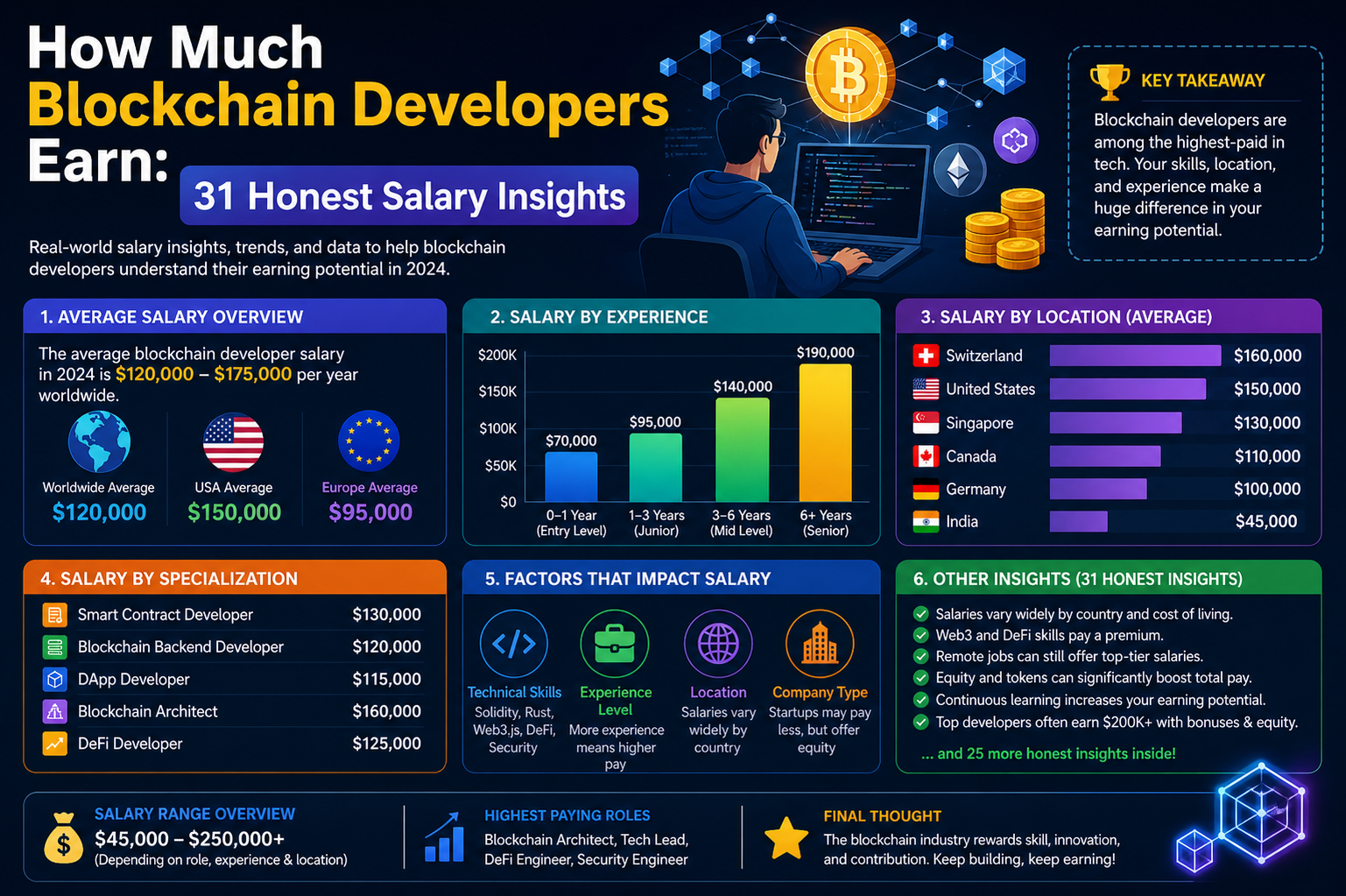
Blockchain development has moved far beyond its early association with cryptocurrency trading and speculative markets. Today, it represents a foundational layer of modern digital infrastructure that supports decentralized finance systems, tokenized assets, gaming ecosystems, digital identity platforms, enterprise supply chains, and cross-border payment networks. As organizations continue to explore decentralized technologies, the demand for skilled blockchain developers has expanded rapidly across both startup environments and large-scale enterprises.
Unlike traditional software engineering roles, blockchain development sits at the intersection of cryptography, distributed systems, and financial technology. This combination makes it highly specialized and technically demanding. As a result, compensation in this field often reflects not only general programming ability but also deep expertise in security, consensus mechanisms, and decentralized architecture design.
However, salary expectations in blockchain development are not uniform. They vary significantly depending on experience level, geographic location, technology stack, and specialization. A developer working on Ethereum-based smart contracts may have a very different earning profile compared to someone building private enterprise blockchain systems or Layer 2 scaling solutions. Understanding these differences is essential for evaluating career growth and market value in this space.
What is a Blockchain Developer
A blockchain developer is a software engineer who designs, builds, tests, and maintains applications and systems that run on decentralized blockchain networks. These professionals are responsible for creating applications that do not rely on a central authority, instead operating on distributed ledgers maintained by network participants.
In practice, blockchain developers work across multiple layers of the technology stack. Some focus on building smart contracts, which are self-executing pieces of code deployed on blockchain networks. Others develop decentralized applications, often referred to as dApps, which provide user interfaces that interact with blockchain-based backend systems. There are also developers who specialize in protocol-level engineering, contributing directly to the core infrastructure of blockchain networks themselves.
Job titles in this field vary depending on specialization. Common designations include blockchain developer, smart contract engineer, Web3 developer, Solidity engineer, blockchain protocol engineer, and DeFi developer. Each of these roles may involve different responsibilities, but they all share a common foundation in decentralized system design and blockchain-based logic execution.
The scope of work for a blockchain developer depends heavily on the organization. In early-stage startups, developers are often responsible for rapid prototyping, smart contract deployment, and integration with frontend interfaces. In contrast, enterprise-level developers may focus on building permissioned blockchain networks, ensuring regulatory compliance, and optimizing performance and security at scale.
Despite these differences, most blockchain developers engage in a shared set of core activities. These include writing and deploying smart contracts, building decentralized applications, ensuring system security, integrating blockchain systems with external services, and continuously testing for vulnerabilities or inefficiencies in contract logic.
Core Responsibilities in Blockchain Development
Blockchain developers are responsible for building systems that must operate reliably in decentralized and often adversarial environments. Unlike traditional applications where a central server controls data flow, blockchain systems rely on distributed consensus, meaning every line of code must be designed with security and transparency in mind.
One of the primary responsibilities is smart contract development. Smart contracts are automated programs stored on blockchain networks that execute when predefined conditions are met. Developers must write these contracts carefully, ensuring they are free from vulnerabilities, as deployed contracts are often immutable and cannot be easily modified once live.
Another major responsibility involves decentralized application development. These applications provide user-facing interfaces that allow individuals to interact with blockchain networks. This requires integrating frontend technologies with blockchain backends, often through specialized libraries and APIs that facilitate communication with smart contracts.
Security auditing is also a critical part of the job. Blockchain developers must regularly review code for vulnerabilities such as reentrancy attacks, integer overflows, and logic flaws that could be exploited by malicious actors. Given the financial value often locked in blockchain systems, even minor errors can lead to significant losses.
Additionally, blockchain developers contribute to system architecture design. This includes selecting appropriate blockchain platforms, designing token economies, optimizing transaction efficiency, and ensuring scalability as user demand grows. In enterprise environments, they may also be responsible for integrating blockchain solutions with existing cloud infrastructure or legacy systems.
Essential Skills and Tools in Blockchain Engineering
Blockchain development requires a combination of traditional software engineering skills and specialized knowledge of decentralized systems. A strong foundation in programming is essential, particularly in languages used for smart contract development and backend integration.
Solidity is the most widely used language for Ethereum-based smart contracts, while Rust is increasingly important for newer blockchain platforms such as Solana. Some systems also use Vyper, which emphasizes simplicity and security in contract design. Developers often need to become proficient in multiple languages depending on the blockchain ecosystem they work in.
In addition to programming languages, blockchain developers rely heavily on development frameworks and testing environments. Tools such as Hardhat, Truffle, and Foundry are commonly used to compile, test, and deploy smart contracts in controlled environments before they are released to live networks. These tools help simulate blockchain behavior and identify potential issues early in the development cycle.
Frontend and integration work often involves libraries such as Web3.js and Ethers.js. These libraries allow decentralized applications to communicate with blockchain networks, enabling functions like wallet connections, transaction signing, and smart contract interaction directly from user interfaces.
Security and monitoring tools also play a critical role. Developers use tools designed to detect vulnerabilities in smart contracts and analyze deployed applications for suspicious behavior. In high-value decentralized finance applications, these tools are essential for maintaining trust and preventing exploitation.
Blockchain infrastructure tools such as node providers and deployment services are also widely used. These services help developers connect to blockchain networks without running full nodes themselves, enabling faster development and easier scaling of decentralized applications.
How Blockchain Developer Compensation Works
Compensation in blockchain development is influenced by a combination of technical expertise, industry demand, and geographic or remote work arrangements. Unlike more traditional software roles, blockchain salaries tend to be more volatile due to the rapidly evolving nature of the industry and the varying maturity of blockchain projects.
One of the most significant factors affecting salary is specialization. Developers who focus on high-demand areas such as smart contract security, decentralized finance protocols, or Layer 2 scaling solutions typically earn more than general-purpose developers. This is because these areas require deeper technical understanding and carry higher financial risk if implemented incorrectly.
Another important factor is the type of organization. Startups in the blockchain space may offer lower base salaries but compensate with equity or token-based incentives. These incentives can be highly valuable if the project succeeds, but they also carry higher risk. On the other hand, established enterprises and fintech companies often provide more stable and predictable compensation packages with higher base salaries.
Remote work has also reshaped salary structures in this field. Many blockchain companies operate as remote-first organizations, allowing developers to earn competitive salaries regardless of location. This has helped reduce traditional geographic salary disparities, although major tech hubs still tend to offer higher compensation due to concentration of funding and talent.
Experience level remains a key determinant of salary progression. Entry-level developers typically focus on learning frameworks, writing simple contracts, and contributing to existing codebases. Mid-level developers begin to take ownership of full features, optimize smart contracts, and participate in architectural decisions. Senior developers often lead entire protocol designs, oversee security audits, and guide technical direction for projects.
As developers gain more experience, their ability to handle complex systems, prevent security vulnerabilities, and design scalable architectures becomes the primary driver of increased compensation rather than years of experience alone.
Salary Landscape Overview Across Regions
Blockchain developer salaries vary widely across different regions, reflecting differences in local tech ecosystems, cost of living, and access to venture capital funding. However, even in lower-cost regions, blockchain development tends to offer above-average compensation compared to many traditional software roles.
In major technology hubs such as San Francisco, New York, and Seattle, blockchain developers typically earn some of the highest salaries in the industry. These locations are home to a large number of venture-backed startups, cryptocurrency exchanges, and protocol development teams, all of which compete aggressively for technical talent. Senior developers in these areas often reach the upper range of compensation due to high demand and specialized skill requirements.
Remote roles based in the United States also offer strong compensation levels, often comparable to major cities. This reflects the increasing normalization of distributed teams within blockchain companies. Developers working remotely can often access high-paying roles without relocating, although compensation may still vary slightly based on employer policy and candidate experience.
Mid-tier cities such as Chicago, Austin, Denver, and Atlanta offer slightly lower but still competitive salaries. These regions often provide a balance between cost of living and earning potential, making them attractive to developers who want strong compensation without the expenses of major coastal cities.
Smaller cities and emerging tech regions show a wider range of salaries, often starting at lower entry-level figures but still reaching significant levels for experienced developers. This variation reflects the growing but still uneven adoption of blockchain technology across different parts of the economy.
Overall, the salary landscape demonstrates that blockchain development remains one of the most financially rewarding areas within software engineering. However, the true earning potential depends less on location alone and more on specialization, technical depth, and ability to work on high-impact decentralized systems.
Blockchain Developer Salary Market Evolution
The blockchain development salary landscape has changed rapidly over the past few years as the industry has matured from experimental projects into a more structured segment of the technology sector. Early blockchain roles were often informal, with compensation heavily tied to startup funding cycles and token incentives rather than stable salaries. Over time, as institutional adoption increased, compensation models became more standardized and closely aligned with traditional software engineering benchmarks.
Today, blockchain developer salaries are influenced by a blend of tech industry standards and crypto-native compensation structures. While base salaries in established companies now resemble those of other high-demand engineering roles, additional incentives such as tokens, equity, and performance bonuses still play a major role in total compensation. This hybrid structure makes blockchain compensation unique compared to conventional software development roles.
Market evolution has also been shaped by cycles of rapid expansion and contraction in the crypto economy. During periods of high market activity, demand for developers surges, pushing salaries upward as companies compete for limited talent. In slower market conditions, hiring may stabilize, but experienced developers in high-value niches such as DeFi, security, and infrastructure continue to command strong compensation due to persistent technical demand.
Key Drivers Behind Blockchain Developer Compensation
Several core factors determine how much a blockchain developer earns, and these go far beyond simple job titles or years of experience. One of the most significant drivers is technical specialization. Developers who work on smart contract security, decentralized finance protocols, or Layer 2 scaling solutions are consistently paid more because their expertise directly impacts financial risk and system reliability.
Another major factor is the complexity of the blockchain environment being worked on. Public blockchains like Ethereum require deep understanding of gas optimization, consensus mechanics, and decentralized execution constraints. Private or enterprise blockchains, on the other hand, emphasize permissioned access control, compliance, and integration with traditional systems. Developers who can operate across both environments often see higher compensation due to their versatility.
The maturity of the project also influences pay structures. Early-stage projects often offer lower base salaries but compensate with token allocations or equity stakes, which may become highly valuable if the project succeeds. More established organizations tend to offer higher base salaries with lower risk, appealing to developers who prioritize stability over speculative upside.
Finally, the scarcity of talent plays a crucial role. Blockchain remains a highly specialized field with a relatively small pool of experienced developers. This scarcity drives up salaries, especially for individuals who have demonstrated real-world deployment experience, contributed to open-source protocols, or successfully handled high-value smart contract systems.
Impact of Experience on Blockchain Salary Growth
Experience in blockchain development does not simply refer to time spent in the industry, but rather to the depth and complexity of systems a developer has worked on. Early-stage developers typically focus on learning frameworks, writing basic smart contracts, and supporting existing decentralized applications. Their compensation reflects their learning phase but still tends to be higher than many entry-level software roles due to the technical barrier to entry.
As developers progress into mid-level roles, they begin to take ownership of production-level systems. This includes designing smart contracts with financial logic, optimizing gas efficiency, participating in code audits, and contributing to decentralized governance systems. At this stage, developers become significantly more valuable because they are trusted to handle real user funds and mission-critical infrastructure.
Senior developers operate at a different level entirely. They are responsible for designing entire blockchain architectures, leading protocol development, and overseeing security frameworks that protect millions or even billions in digital assets. Their compensation reflects not only technical expertise but also leadership ability and decision-making responsibility in high-risk environments.
In many cases, senior blockchain developers also contribute to strategic decisions such as tokenomics design, cross-chain integration planning, and long-term scalability solutions. These responsibilities elevate their role beyond engineering into technical leadership, which significantly increases earning potential.
Geographic and Remote Work Salary Dynamics
Geography continues to influence blockchain salaries, although its impact has been reduced by the rise of remote-first organizations. Traditionally, major technology hubs have offered the highest compensation due to proximity to venture capital, high-growth startups, and established tech companies. These environments create intense competition for skilled developers, pushing salaries higher.
However, the blockchain industry has been one of the earliest adopters of global remote work structures. Many companies operate fully distributed teams, allowing developers to work from virtually anywhere while earning competitive salaries aligned with global benchmarks. This shift has created opportunities for developers in lower-cost regions to access high-paying roles without relocating.
Despite this shift, regional differences still exist. Developers in major metropolitan areas often receive higher compensation packages, especially when working for companies headquartered in those regions. This is partly due to historical salary benchmarks and partly due to the concentration of high-value blockchain projects in those ecosystems.
In contrast, developers in emerging markets may experience wider salary ranges. While entry-level compensation may be lower, experienced developers who build strong portfolios and contribute to global open-source ecosystems can still access competitive international roles. This creates a more merit-driven compensation structure compared to many traditional industries.
Role of Specialization in Salary Differentiation
Specialization is one of the strongest determinants of salary variation in blockchain development. Developers who focus on general-purpose smart contract writing may earn solid incomes, but those who specialize in high-impact areas tend to command significantly higher compensation.
Smart contract security is one of the most valuable specializations. Developers with expertise in identifying vulnerabilities, conducting audits, and preventing exploits are in extremely high demand due to the financial risks associated with blockchain applications. Even small vulnerabilities can lead to major losses, making security experts highly valuable.
Another high-paying specialization is decentralized finance development. DeFi protocols involve complex financial logic, including lending systems, liquidity pools, staking mechanisms, and automated market makers. Developers working in this space must understand both programming and financial engineering concepts, which increases their market value.
Layer 2 scaling and cross-chain development are also emerging as highly lucrative areas. These technologies aim to improve blockchain scalability and interoperability, which are critical challenges in the industry. Developers who can design efficient scaling solutions or bridge different blockchain networks are often rewarded with premium compensation packages.
Protocol-level engineering represents the highest tier of specialization. These developers work directly on the core infrastructure of blockchain networks, influencing consensus mechanisms, transaction validation, and network performance. Due to the complexity and responsibility involved, this specialization typically commands top-tier salaries.
Token-Based Compensation and Equity Structures
One of the most distinctive aspects of blockchain developer compensation is the use of token-based incentives. Unlike traditional software roles, many blockchain companies offer tokens as part of their compensation packages, especially in early-stage projects. These tokens may represent governance rights, utility within a platform, or speculative value tied to the success of the ecosystem.
Token compensation introduces both opportunity and risk. In successful projects, token value can increase significantly, potentially exceeding base salary earnings. However, in unsuccessful or poorly adopted projects, token value may remain low or become illiquid. This creates a compensation structure that is partially performance-based and tied to market adoption.
Equity is also common in blockchain startups, particularly those that operate at the intersection of Web3 and traditional venture capital funding. Equity stakes align developers with long-term company growth, rewarding those who contribute to successful scaling and adoption.
This hybrid compensation model reflects the experimental nature of the blockchain industry. Unlike traditional sectors with predictable revenue models, blockchain projects often rely on network effects, community participation, and ecosystem growth, making incentive alignment a critical part of compensation design.
Market Demand Cycles and Salary Fluctuations
Blockchain developer salaries are influenced by broader market cycles within the cryptocurrency and Web3 ecosystem. During periods of rapid market expansion, demand for developers increases sharply as new projects launch, funding rounds expand, and user adoption accelerates. This often leads to aggressive hiring and rising salary offers across the industry.
During slower market periods, hiring may become more selective, but demand for experienced developers remains relatively stable. Core infrastructure projects, security-focused roles, and established protocols continue to require ongoing development regardless of market conditions. This creates a baseline level of demand that supports long-term salary stability.
Market cycles also influence compensation structures. In bullish environments, token-based compensation becomes more attractive due to rising asset values. In contrast, during bearish conditions, developers may prioritize base salary and stable employment over speculative incentives.
Despite these fluctuations, the overall long-term trend in blockchain development compensation has remained upward. As technology adoption increases across industries, demand for skilled developers continues to grow, reinforcing strong earning potential over time.
Advanced Blockchain Career Paths and Salary Progression
Blockchain development is not a single linear career path. Instead, it branches into multiple specialized directions that significantly affect both responsibilities and earning potential. As developers gain experience, they often move away from general coding tasks and into more strategic or infrastructure-heavy roles that command higher compensation.
At the core level, most developers begin as general blockchain engineers working on smart contracts and decentralized applications. Over time, many transition into specialized roles such as protocol engineers, security auditors, DeFi architects, or Layer 2 scaling engineers. Each of these roles represents a deeper level of technical complexity and often comes with a noticeable increase in salary.
Protocol engineers typically sit at the highest tier of blockchain development. They work directly on blockchain networks themselves rather than applications built on top. Their responsibilities may include improving consensus mechanisms, optimizing transaction throughput, and ensuring network stability. Because these systems often support billions in value, protocol engineers are among the highest-paid professionals in the blockchain space.
Security-focused roles are another high-paying career path. These developers specialize in identifying vulnerabilities in smart contracts, auditing decentralized protocols, and designing systems that resist attacks. Given the irreversible nature of blockchain transactions, security expertise is considered one of the most valuable skill sets in the industry, often leading to premium compensation packages.
DeFi Development and Financial Engineering Influence
Decentralized finance has become one of the most financially significant sectors within blockchain, and it has a direct impact on developer salaries. DeFi developers are responsible for building systems that replicate traditional financial services such as lending, borrowing, trading, and yield generation without centralized intermediaries.
This type of development requires a strong understanding of both software engineering and financial logic. Developers must design smart contracts that handle large volumes of value while ensuring accuracy, transparency, and security. Even minor errors in DeFi protocols can result in substantial financial losses, which is why developers in this space are often highly compensated.
DeFi developers also work on complex systems such as automated market makers, liquidity pools, staking mechanisms, and synthetic asset platforms. These systems require careful mathematical modeling and optimization, which further increases the technical barrier to entry.
Because DeFi protocols are often funded by venture capital and generate revenue through transaction fees, successful projects can afford to pay significantly higher salaries. This creates a competitive environment where experienced DeFi developers are heavily sought after and often receive multiple job offers simultaneously.
Cross-Chain Development and Interoperability Roles
As blockchain ecosystems expand, the need for interoperability between different networks has become increasingly important. Cross-chain development focuses on enabling communication and asset transfer between separate blockchain systems such as Ethereum, Solana, and Layer 2 networks.
Developers in this area work on bridging protocols, messaging systems, and interoperability frameworks that allow decentralized applications to function across multiple chains. This is a technically complex field because each blockchain has its own architecture, consensus model, and transaction structure.
Cross-chain engineers are typically compensated at higher levels due to the complexity and importance of their work. As the blockchain industry moves toward a multi-chain future rather than a single dominant network, these roles are expected to grow in demand.
Layer 2 scaling development is closely related to cross-chain work. Developers in this space focus on improving blockchain performance by reducing congestion on main networks. They build solutions such as rollups and sidechains that help increase transaction speed and reduce costs. Because scalability is one of the biggest challenges in blockchain adoption, these engineers are highly valued.
Enterprise Blockchain Development and Institutional Demand
While public blockchains dominate much of the conversation, enterprise blockchain development remains a significant and stable segment of the industry. Large organizations use blockchain technology for supply chain tracking, identity management, financial settlement systems, and internal data integrity solutions.
Enterprise blockchain developers often work with permissioned networks where access is restricted to approved participants. These systems prioritize privacy, compliance, and performance over full decentralization. Platforms such as Hyperledger are commonly used in this environment.
Salaries in enterprise blockchain development tend to be stable and competitive, often aligning closely with senior software engineering roles in traditional tech companies. While they may not always reach the speculative highs of DeFi or protocol engineering, they offer consistency and long-term career stability.
Enterprise roles also involve integration with existing systems, including cloud infrastructure, databases, and legacy software. This makes hybrid skill sets particularly valuable, as developers must bridge the gap between traditional IT systems and blockchain-based solutions.
Smart Contract Auditing as a High-Income Specialization
Smart contract auditing has emerged as one of the most lucrative specializations in blockchain development. Auditors are responsible for reviewing code before deployment to identify vulnerabilities, inefficiencies, or logic errors that could lead to financial loss.
This role requires a deep understanding of attack vectors such as reentrancy exploits, flash loan attacks, overflow issues, and permission misconfigurations. Auditors must think like attackers in order to anticipate potential vulnerabilities in decentralized systems.
Because blockchain systems often manage large amounts of financial value, auditing services are highly in demand. Projects are willing to pay premium rates to ensure their contracts are secure before launch. Experienced auditors often work independently or as part of specialized security firms, charging high fees per audit engagement.
This specialization is also closely tied to reputation. Auditors who have successfully identified critical vulnerabilities in major protocols can command significantly higher compensation due to their proven track record of preventing losses.
Impact of Open Source Contributions on Salary Growth
Open source participation plays a major role in blockchain career development. Unlike traditional software roles where internal projects dominate, blockchain development thrives on open ecosystems where protocols and tools are publicly accessible.
Developers who actively contribute to open source blockchain projects often gain visibility within the community. This visibility can lead to job offers, consulting opportunities, and invitations to join high-value projects early in their development lifecycle.
Contributions to major protocols or widely used developer tools carry significant weight in hiring decisions. Employers in the blockchain space often evaluate GitHub activity and real-world contributions more heavily than formal education or certifications.
In many cases, developers who have contributed to well-known decentralized protocols or infrastructure projects are able to negotiate higher salaries due to their demonstrated experience and community recognition.
Hybrid Skill Sets and Their Effect on Compensation
Blockchain development increasingly rewards developers who combine multiple skill sets. Pure smart contract development is valuable, but hybrid expertise often leads to higher compensation due to increased versatility.
One common hybrid combination is blockchain development with full-stack engineering. Developers who can build both backend smart contracts and frontend user interfaces are highly valuable in decentralized application teams.
Another powerful combination is blockchain and cloud infrastructure expertise. Developers who understand AWS, distributed systems, and backend scalability can design more efficient decentralized systems that integrate with traditional infrastructure.
Some of the highest-paid developers also combine blockchain expertise with cryptography or cybersecurity knowledge. These individuals are capable of designing secure systems from the ground up and are often involved in protocol design and security architecture.
Leadership Roles and Architectural Responsibility
As blockchain developers progress in their careers, many transition into leadership roles where they are responsible for designing entire systems rather than writing individual components. These roles include blockchain architects, lead protocol engineers, and technical leads for decentralized platforms.
Architectural roles require a deep understanding of system design, scalability challenges, and long-term protocol evolution. Developers in these positions make decisions that affect entire ecosystems, including how transactions are processed, how governance is structured, and how security is maintained.
Compensation for these roles is significantly higher due to the level of responsibility involved. In many cases, senior architects also receive equity or token-based incentives in addition to base salary, further increasing total earnings.
Leadership positions also involve mentoring junior developers, reviewing code at scale, and coordinating across multiple engineering teams. This combination of technical and managerial responsibility places these roles at the top end of blockchain compensation structures.
Regional Salary Differences in Blockchain Development
Blockchain developer salaries vary widely across different regions, but the gap is becoming less rigid due to the rise of remote-first work culture. Still, geography continues to influence compensation, especially when companies align salaries with local market standards or cost of living adjustments.
In major global tech hubs such as San Francisco, New York, and Seattle, blockchain developers consistently earn some of the highest salaries in the industry. These cities are home to venture capital firms, crypto exchanges, and early-stage blockchain startups that compete aggressively for talent. Developers in these regions often receive premium compensation packages that reflect both high living costs and intense demand for specialized skills.
European tech hubs such as Berlin, Zurich, and London also offer competitive blockchain salaries, particularly in fintech-focused roles and enterprise blockchain development. These regions often emphasize regulatory compliance and financial infrastructure integration, which creates demand for experienced engineers who understand both blockchain systems and traditional financial frameworks.
In contrast, emerging tech regions in Asia, Latin America, and Eastern Europe often show lower average salaries, but this is balanced by lower living costs and increasing access to global remote opportunities. Developers in these regions who build strong portfolios and contribute to international projects can still earn salaries comparable to Western markets through remote employment.
Remote work has become one of the most influential factors in reducing geographic salary barriers. Many blockchain companies now hire globally and offer standardized compensation based on role and experience rather than location alone. This shift has significantly expanded opportunities for developers in smaller cities and developing markets.
Remote Work and Global Blockchain Employment Trends
The blockchain industry has been one of the earliest adopters of fully remote and distributed work models. Many decentralized projects are built by global teams that never meet in person, relying entirely on online collaboration tools and open-source workflows.
This remote-first structure has reshaped salary expectations. Developers are no longer restricted to local job markets and can apply for positions with international blockchain companies regardless of where they live. As a result, skilled developers in lower-cost regions can access high-paying roles previously limited to major tech hubs.
Remote blockchain roles often come with flexible compensation models. Some companies offer location-adjusted salaries, while others provide flat global pay scales to maintain fairness across teams. This flexibility has created a more competitive hiring environment where skills matter more than geography.
However, remote work also increases competition. Developers are no longer competing only with local talent but with a global pool of engineers. This means that standing out requires strong technical expertise, proven project experience, and active contributions to blockchain ecosystems.
Future Salary Trends in Blockchain Development
The future of blockchain developer salaries is closely tied to the continued adoption of decentralized technologies across industries. As blockchain moves beyond cryptocurrency into mainstream applications such as banking, logistics, healthcare, and digital identity, demand for skilled developers is expected to remain strong.
One of the most likely trends is continued salary growth for specialized roles. Areas such as smart contract security, cross-chain interoperability, and Layer 2 scaling are expected to see sustained demand due to their importance in solving current blockchain limitations.
Another expected trend is increased standardization of compensation models. As the industry matures, more companies are likely to shift toward structured salary bands similar to traditional software engineering roles, while still maintaining token-based incentives for early-stage projects.
Institutional adoption of blockchain technology is also expected to influence salaries. As banks, governments, and large corporations integrate blockchain systems, demand for enterprise blockchain developers will increase, potentially stabilizing salaries at higher long-term levels.
At the same time, automation and improved development tools may reduce the time required for basic blockchain tasks. This could shift salary growth toward higher-level roles involving architecture, security, and system design rather than routine smart contract coding.
Comparing Blockchain Salaries with Traditional Software Engineering
Blockchain development salaries are generally higher than those in traditional software engineering, especially at the mid and senior levels. This is primarily due to the specialized nature of the skill set and the relatively small pool of experienced developers.
Unlike conventional backend or frontend development roles, blockchain engineers must understand cryptographic principles, decentralized system design, and financial logic. This combination of skills is rare, which increases their market value.
In early career stages, blockchain salaries may appear similar to standard software engineering roles. However, as developers gain experience and specialize, compensation growth tends to accelerate more quickly due to high demand in niche areas.
Senior blockchain developers often earn significantly more than their traditional counterparts, particularly in roles related to DeFi, protocol development, and security auditing. Additional token-based compensation can further widen this gap depending on project success.
Career Stability and Risk Factors in Blockchain Development
While blockchain development offers high earning potential, it also comes with certain risks due to the volatility and rapid evolution of the industry. Projects can rise and fall quickly, and market cycles can influence hiring trends and compensation structures.
Startups in the blockchain space may offer high upside through token incentives, but they also carry higher risk compared to established tech companies. Developers working in these environments must be comfortable with uncertainty and fast-changing priorities.
On the other hand, enterprise blockchain roles provide greater stability, with more predictable salary structures and long-term project lifecycles. These positions are often preferred by developers seeking consistent income and lower exposure to market volatility.
Another risk factor is technological change. Blockchain frameworks, tools, and best practices evolve quickly, requiring developers to continuously learn and adapt. Those who fail to keep up may find their skills becoming less relevant over time.
Long-Term Earning Potential in Blockchain Development
Despite its risks, blockchain development offers strong long-term earning potential for skilled professionals. As the technology becomes more integrated into global financial systems and enterprise infrastructure, demand for experienced developers is expected to grow steadily.
Developers who invest in high-value skills such as smart contract security, protocol design, and cross-chain architecture are likely to see sustained salary growth over time. These areas are difficult to automate and require deep expertise, making them highly resistant to downward wage pressure.
Additionally, early contributors to successful blockchain ecosystems may benefit from long-term token appreciation or equity growth, creating wealth-building opportunities beyond traditional salary income.
The combination of technical specialization, global demand, and evolving technology ensures that blockchain development remains one of the most financially rewarding areas in software engineering.
Final Thoughts
Blockchain development stands out as one of the most dynamic and high-paying fields in modern technology. Salaries are influenced by a combination of technical expertise, specialization, experience, and global demand rather than simple geographic location alone.
While compensation varies widely across roles and regions, the overall trend shows strong earning potential for developers who continuously upgrade their skills and adapt to new blockchain ecosystems. The most successful professionals in this field are those who combine deep technical ability with real-world project experience and a strong understanding of decentralized systems.
As blockchain technology continues to evolve and expand into mainstream industries, developers who position themselves in high-demand areas are likely to benefit from both financial growth and long-term career stability.