Wireless communication has evolved steadily to meet increasing demands for speed, reliability, and efficiency. At its core, wireless technology relies on electromagnetic waves traveling through the air, carrying data between devices. While the fundamental nature of these waves has not changed, the methods used to optimize their transmission have advanced significantly. One of the most impactful innovations in this area is Multiple Input, Multiple Output, commonly known as MIMO. This technology represents a shift in how wireless systems handle data transmission by leveraging multiple antennas instead of relying on a single pathway.
Traditional wireless systems used a single antenna at both the transmitting and receiving ends, a setup known as Single Input, Single Output. While effective in earlier stages of wireless development, this approach has limitations in terms of bandwidth, reliability, and scalability. As more devices began to rely on wireless connectivity, these limitations became increasingly apparent. The need for a more efficient way to utilize available spectrum led to the development of MIMO, which uses multiple antennas to send and receive signals simultaneously.
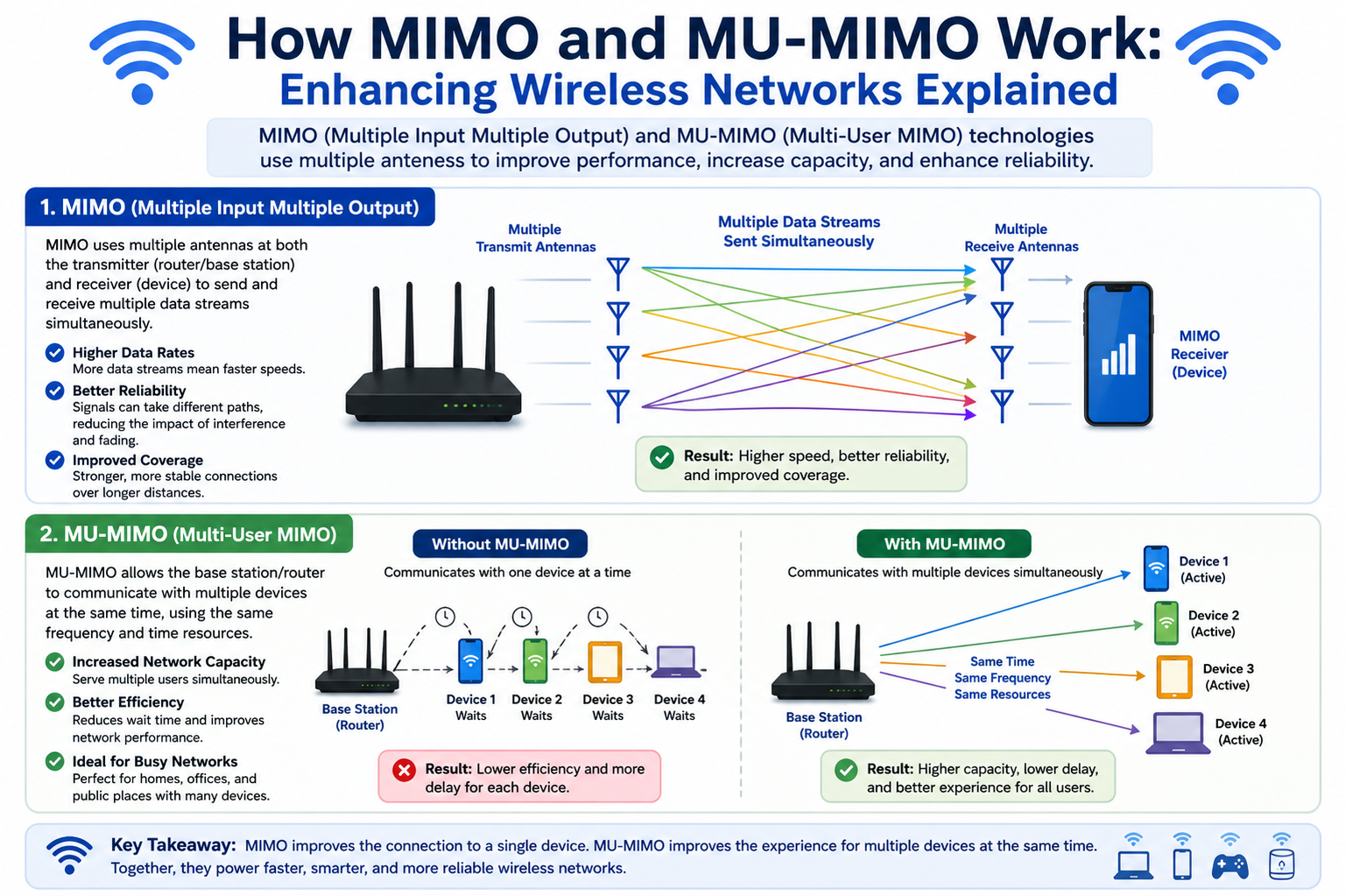
MIMO operates by transmitting multiple data streams across the same frequency band. Instead of assigning different frequencies to each stream, which would quickly exhaust available spectrum, MIMO takes advantage of spatial diversity. This means that signals are transmitted in such a way that they travel different paths through the environment. When these signals reach the receiver, the multiple antennas can distinguish between them based on slight differences in timing, phase, and path characteristics. This ability to separate overlapping signals is what allows MIMO to increase data throughput without requiring additional spectrum.
The concept can be compared to adding more lanes to a highway rather than trying to make cars travel faster. Each lane represents an independent data stream, and the total capacity increases as more lanes are added. In practical terms, this means that a system with two antennas on both the transmitter and receiver can potentially double the data rate compared to a single-antenna system. Configurations are typically described using a notation such as 2×2 or 4×4, indicating the number of antennas on each side of the communication link.
Another key aspect of MIMO is its ability to improve signal reliability. In a typical wireless environment, signals can be affected by obstacles, reflections, and interference. These factors can cause signal fading or loss, leading to reduced performance. MIMO addresses this challenge by using multiple transmission paths. Even if one path experiences interference or degradation, others may remain unaffected, allowing the system to maintain a stable connection. This technique, known as diversity gain, enhances overall signal robustness.
Beamforming is another important feature often associated with MIMO systems. Instead of broadcasting signals equally in all directions, beamforming allows the transmitter to focus energy toward a specific receiver. By adjusting the phase and amplitude of signals from each antenna, the system can create constructive interference in the desired direction and destructive interference elsewhere. This results in stronger signals for the intended device and reduced interference for others, improving both efficiency and performance.
The implementation of MIMO has become a cornerstone of modern wireless standards. As devices such as smartphones, laptops, and smart home equipment continue to proliferate, the demand for higher data rates and more reliable connections continues to grow. MIMO provides a scalable solution that can adapt to these demands by simply increasing the number of antennas and optimizing signal processing techniques. This flexibility makes it a critical component in the ongoing evolution of wireless communication systems.
How MIMO Enhances Wireless Performance
The introduction of multiple antennas into wireless communication systems has fundamentally changed how performance is measured and achieved. One of the most immediate benefits of MIMO is the increase in bandwidth. By transmitting multiple data streams simultaneously, the system can deliver significantly higher data rates compared to traditional single-stream setups. This improvement is especially noticeable in environments where large amounts of data need to be transmitted quickly, such as video streaming, online gaming, and cloud-based applications.
In ideal conditions, the performance gain from MIMO can be directly proportional to the number of antennas used. For example, a 2×2 configuration can theoretically double the throughput, while a 4×4 setup can quadruple it. Although real-world conditions rarely allow for perfect scaling due to interference and environmental factors, the improvement is still substantial. This makes MIMO an attractive solution for both residential and enterprise networks seeking to maximize efficiency without requiring additional spectrum.
Signal quality is another area where MIMO excels. Wireless signals often encounter obstacles such as walls, furniture, and other physical barriers that can weaken or distort them. Additionally, signals may reflect off surfaces, creating multiple paths that can interfere with each other. While these multipath effects were once considered a problem, MIMO turns them into an advantage. By using multiple antennas, the system can capture and process these different signal paths, effectively reconstructing the original data with greater accuracy.
This capability is closely related to the concept of spatial multiplexing, where independent data streams are transmitted over different spatial paths. The receiver uses advanced algorithms to separate and decode these streams, even when they overlap in time and frequency. This process requires sophisticated signal processing but results in a more efficient use of the available spectrum. It also allows the system to maintain high performance even in challenging environments with significant interference.
Coverage is another critical factor improved by MIMO technology. A stronger and more reliable signal translates into a wider coverage area, reducing dead zones and ensuring consistent connectivity. This is particularly important in large buildings, campuses, and urban environments where maintaining uniform coverage can be challenging. By combining beamforming and diversity techniques, MIMO systems can extend their reach and provide a better user experience across a broader area.
Capacity is equally important, especially in environments with many connected devices. Traditional systems often struggle to handle multiple users simultaneously, leading to congestion and reduced performance. MIMO addresses this issue by increasing the overall efficiency of data transmission. With more data streams available, the system can serve more devices without compromising speed or reliability. This makes it well-suited for high-density environments such as offices, schools, and public venues.
Another advantage of MIMO is its adaptability. Modern systems can dynamically adjust the number of active data streams based on current conditions. For instance, if the signal quality is high, the system may use multiple streams to maximize throughput. If conditions deteriorate, it may switch to fewer streams with stronger redundancy to maintain a stable connection. This flexibility ensures optimal performance under a wide range of scenarios.
Despite its many benefits, implementing MIMO is not without challenges. The increased complexity of hardware and signal processing can lead to higher costs and power consumption. Designing systems that can effectively manage multiple antennas and process complex signals requires advanced engineering and careful optimization. However, the performance gains often justify these challenges, making MIMO a key technology in modern wireless communication.
Transition from Single-User to Multi-User Communication
As wireless networks continued to evolve, the need to support multiple users simultaneously became increasingly important. Early implementations of MIMO focused on improving the connection between a single transmitter and a single receiver, a configuration known as Single-User MIMO. While this approach significantly enhanced performance for individual devices, it did not fully address the challenges of multi-device environments where many users compete for limited resources.
In Single-User MIMO systems, the transmitter communicates with one device at a time, even if multiple devices are connected. The available time is divided among users, with each device receiving data in sequence. This method, known as time division, can lead to delays as the number of connected devices increases. Each device must wait its turn, which can result in reduced efficiency and a less responsive user experience.
To overcome these limitations, Multi-User MIMO was introduced. This advanced form of MIMO allows a transmitter to communicate with multiple devices simultaneously rather than sequentially. By assigning different data streams to different users, the system can serve several devices at once, significantly improving overall network performance. This approach eliminates the bottleneck created by time division and enables more efficient use of available resources.
The key to Multi-User MIMO lies in its ability to separate signals intended for different users. This is achieved through advanced beamforming techniques that direct each data stream toward its intended recipient. By carefully controlling the transmission pattern, the system minimizes interference between users and ensures that each device receives its data with minimal disruption. This requires precise coordination and sophisticated signal processing but results in a much more efficient communication system.
One of the most significant benefits of Multi-User MIMO is increased network capacity. By serving multiple devices simultaneously, the system can handle higher levels of traffic without degradation in performance. This is particularly valuable in environments with many connected devices, such as offices, schools, and public spaces. Users experience faster speeds and lower latency, even during peak usage times.
Another advantage is improved user experience. With reduced waiting times and more consistent data delivery, applications that require real-time communication, such as video conferencing and online gaming, perform more reliably. This leads to smoother interactions and greater overall satisfaction for users. The ability to maintain high performance in crowded environments is one of the defining features of Multi-User MIMO.
Efficiency is also enhanced through better utilization of available spectrum. Instead of dedicating the entire channel to a single user at a time, the system can divide it among multiple users simultaneously. This maximizes the value of limited frequency resources and allows networks to support more devices without requiring additional bandwidth. As spectrum becomes increasingly scarce, this efficiency becomes even more critical.
However, Multi-User MIMO introduces additional complexity compared to Single-User MIMO. The system must accurately track the অবস্থ and characteristics of each connected device to ensure proper signal separation. This requires continuous feedback and sophisticated algorithms to adapt to changing conditions. Environmental factors such as interference and physical obstacles can also impact performance, making careful planning and optimization essential.
Key Elements Influencing MIMO Deployment
Successfully implementing MIMO technology requires careful consideration of several factors that can influence performance. One of the most important aspects is antenna placement. The positioning of antennas plays a critical role in determining how effectively signals are transmitted and received. Proper placement ensures that signals can travel along multiple paths without excessive interference, maximizing the benefits of spatial diversity.
In many cases, antennas should be positioned to provide clear lines of sight to the areas where devices are most commonly used. While MIMO can handle reflections and indirect paths, minimizing obstructions can still improve overall performance. The orientation and spacing of antennas also matter, as they affect how signals propagate and interact with each other. Achieving the right balance requires careful planning and, in some cases, empirical testing.
Channel conditions are another crucial factor. Wireless signals operate within specific frequency bands, and these bands are often shared by multiple devices and networks. Interference from other transmitters can degrade performance, regardless of whether MIMO is used. Selecting appropriate channels and managing interference is essential to maintaining a stable and efficient network. This may involve using advanced features such as dynamic channel selection and interference mitigation techniques.
Hardware compatibility is equally important. Both the transmitter and receiver must support MIMO for the technology to function effectively. While many modern devices come equipped with MIMO capabilities, older devices may not be compatible. Ensuring that all components of the network can support the desired configuration is a key step in the deployment process. Upgrading hardware may be necessary to fully realize the benefits of MIMO.
Before deploying a MIMO system, conducting a thorough site survey is highly recommended. This process involves analyzing the physical environment, identifying potential sources of interference, and determining the optimal placement of equipment. A site survey can reveal issues such as overlapping channels, signal dead zones, and capacity requirements. Addressing these issues in advance can prevent problems and ensure a smoother deployment.
Once the planning phase is complete, the installation process can begin. This involves mounting the الأجهزة, connecting them to the network, and ապահովing power. Proper installation ensures that the system operates as intended and that all components are securely in place. Attention to detail during this مرحله can prevent future issues and simplify maintenance.
Configuration is the next critical step. This includes setting parameters such as channel selection, transmission power, and quality of service settings. Beamforming features should be adjusted to match the physical environment, and firmware updates should be applied to ensure optimal performance. Many modern systems offer centralized management tools that simplify this process and provide real-time monitoring امکانات.
Testing and optimization are ongoing processes. After deployment, it is important to evaluate the system’s performance and מאַכן adjustments as needed. This may involve conducting walkthrough tests to identify coverage gaps or الأداء issues. Regular monitoring helps ensure that the network continues to perform well as conditions change, such as when new devices are added or nearby networks become active.
Deep Dive into Spatial Multiplexing and Signal Processing
One of the most powerful mechanisms behind MIMO technology is spatial multiplexing, a technique that allows multiple independent data streams to be transmitted simultaneously over the same frequency channel. This approach transforms the way wireless communication systems utilize the available spectrum. Instead of relying solely on time or frequency division, spatial multiplexing introduces an additional dimension—space. By doing so, it significantly increases data throughput without requiring extra bandwidth.
At the transmitter side, data is divided into separate streams, each assigned to a different antenna. These streams are transmitted at the same time and over the same frequency. As they propagate through the environment, they encounter various obstacles such as walls, furniture, and other objects. These interactions cause the signals to scatter, reflect, and take different paths before reaching the receiver. While this might seem like a disadvantage, MIMO systems are specifically designed to take advantage of these multipath effects.
At the receiver, multiple antennas capture the incoming signals. Because each signal has traveled a slightly different path, it arrives with unique characteristics, such as variations in phase, amplitude, and delay. Advanced signal processing algorithms analyze these differences to separate the combined signals back into their original data streams. This process is highly complex and requires precise mathematical modeling, but it enables the system to recover multiple streams from what appears to be a single overlapping transmission.
The effectiveness of spatial multiplexing depends on the richness of the environment. In settings with many reflective surfaces, such as indoor environments, multipath propagation is more pronounced, which can enhance the performance of MIMO systems. In contrast, open outdoor areas with fewer obstacles may provide fewer distinct paths, potentially limiting the benefits. However, even in such scenarios, other MIMO techniques can be used to maintain performance.
Signal processing plays a crucial role in enabling MIMO functionality. Techniques such as channel estimation, matrix decomposition, and error correction are used to ensure accurate data recovery. Channel estimation involves analyzing the transmission environment to understand how signals are affected as they travel from transmitter to receiver. This information is then used to optimize the transmission strategy and improve decoding accuracy.
Matrix operations are at the heart of MIMO signal processing. The relationship between transmitted and received signals can be represented as a mathematical matrix, where each element describes the effect of a specific transmission path. By solving this matrix, the receiver can isolate individual data streams. Methods such as singular value decomposition and zero-forcing are commonly used to achieve this separation.
Error correction mechanisms further enhance reliability. Even with advanced processing, some errors may occur due to noise and interference. Techniques such as forward error correction allow the receiver to detect and correct these errors without requiring retransmission. This improves overall efficiency and ensures a more stable connection.
The combination of spatial multiplexing and advanced signal processing is what enables MIMO systems to deliver high data rates and robust performance. These techniques work together to maximize the use of available resources, making MIMO a cornerstone of modern wireless communication.
Understanding Diversity Techniques in MIMO Systems
While spatial multiplexing focuses on increasing data rates, diversity techniques are designed to improve reliability and signal quality. In wireless communication, signals are often subject to fading, which occurs when the signal strength varies due to environmental factors. This can lead to dropped connections and reduced performance. Diversity techniques address this issue by providing multiple independent paths for signal transmission, increasing the likelihood that at least one path will remain strong.
One common form of diversity is spatial diversity, which uses multiple antennas to transmit the same signal. Each antenna sends a slightly different version of the signal, and the receiver combines these versions to reconstruct the original data. If one signal is weakened or distorted, others may still be clear, allowing the system to maintain a reliable connection.
Another approach is transmit diversity, where the transmitter uses multiple antennas to send redundant copies of the signal. Techniques such as space-time coding are used to encode the data in a way that maximizes the benefits of multiple transmission paths. This ensures that even in challenging conditions, the receiver can recover the information accurately.
Receive diversity, on the other hand, focuses on the receiver side. Multiple antennas capture the incoming signals, and the system selects the best version or combines them to improve quality. Methods such as maximal ratio combining weigh each signal based on its strength and quality, resulting in a more accurate representation of the original transmission.
Frequency diversity is another technique that can be used in conjunction with MIMO. By transmitting the same data over different frequency channels, the system reduces the impact of frequency-specific interference. Although this approach requires additional bandwidth, it can significantly improve reliability in certain scenarios.
Time diversity involves transmitting the same data at different times. If interference or fading affects one transmission, subsequent transmissions may be received more clearly. This technique is often used in combination with other diversity methods to enhance overall performance.
Diversity techniques are particularly valuable in environments with high levels of interference or physical obstructions. By providing multiple opportunities for successful transmission, they reduce the likelihood of data loss and improve user experience. In MIMO systems, diversity and spatial multiplexing can be used together, allowing the system to balance between speed and reliability based on current conditions.
Adaptive algorithms play a key role in managing this balance. Depending on the quality of the communication channel, the system may prioritize higher data rates or increased reliability. For example, in a stable environment with strong signals, spatial multiplexing may be emphasized. In more challenging conditions, diversity techniques may take precedence to ensure consistent performance.
The integration of diversity techniques into MIMO systems highlights the flexibility and robustness of this technology. By combining multiple strategies, MIMO can adapt to a wide range of environments and deliver reliable communication even under less-than-ideal conditions.
Advanced Beamforming and Its Role in MU-MIMO
Beamforming is a critical component of both MIMO and Multi-User MIMO systems, enabling more efficient and targeted signal transmission. Unlike traditional broadcasting methods that send signals in all directions, beamforming focuses the transmission toward specific devices. This targeted approach not only improves signal strength but also reduces interference with other devices.
The principle behind beamforming involves adjusting the phase and amplitude of signals transmitted from multiple antennas. By carefully controlling these parameters, the system can create constructive interference in the მიმართულ of the intended receiver and destructive interference elsewhere. This results in a concentrated beam of energy that enhances communication with the target device.
In Single-User MIMO systems, beamforming is used to improve the connection between the transmitter and a single receiver. By focusing the signal, the system can achieve higher data rates and better reliability. However, the true potential of beamforming is realized in Multi-User MIMO systems, where multiple devices are served simultaneously.
In MU-MIMO, beamforming is used to create separate beams for different users. Each beam carries a unique data stream ուղղված to a specific device. This requires precise coordination and real-time adjustments to ensure that the beams do not interfere with each other. The system must continuously track the position and characteristics of each device to maintain optimal الأداء.
Channel state information is essential for effective beamforming. This information describes how signals propagate between the transmitter and each receiver. Devices provide feedback to the transmitter, allowing it to adjust its transmission strategy accordingly. Accurate and timely channel state information is crucial for maintaining the quality of beamformed signals.
Digital beamforming is commonly used in modern systems, where signal processing is performed in the digital domain. This allows for greater flexibility and precision مقارنة with analog methods. Hybrid approaches that combine digital and analog techniques are also used to balance performance and complexity.
One of the challenges of beamforming in MU-MIMO is managing interference between users. Since multiple beams are transmitted simultaneously, there is a risk that signals may overlap and cause degradation. Advanced algorithms are used to minimize this interference, ensuring that each user receives a clear and distinct signal.
Beamforming also contributes to improved energy efficiency. By directing energy only where it is needed, the system reduces unnecessary power consumption. This is particularly important in large-scale deployments where energy efficiency can have a significant impact on operational costs.
The role of beamforming in MU-MIMO cannot be overstated. It is the key enabler that allows multiple users to be served simultaneously without compromising performance. As wireless networks continue to evolve, beamforming techniques are becoming increasingly sophisticated, further enhancing the capabilities of MIMO systems.
Challenges and Limitations in Real-World MIMO Deployments
Despite its many advantages, MIMO technology faces several challenges when implemented in real-world environments. One of the primary issues is the complexity of the system. Managing multiple antennas, processing overlapping signals, and maintaining accurate channel information require advanced hardware and software. This complexity can increase costs and make deployment more challenging.
Interference is another significant concern. In densely populated areas, multiple wireless networks may operate on the same frequency bands, leading to congestion and الأداء degradation. While MIMO can mitigate some of these effects, it cannot eliminate interference entirely. Careful planning and channel management are आवश्यक to minimize these issues.
Physical environment also plays a crucial role in determining performance. Obstacles such as walls, floors, and furniture can affect signal propagation, जिससे variations in signal strength and quality. While MIMO can take advantage of multipath propagation, excessive बाधाएं may still limit performance. Understanding the characteristics of the deployment environment is essential for optimizing system design.
Device compatibility is another تحدي. Not all devices support advanced MIMO features, particularly older الأجهزة. In such cases, the system may need to fall back to simpler modes of operation, reducing overall efficiency. Ensuring that both transmitters and receivers support the desired مستوى of MIMO is important for achieving optimal results.
Power consumption is also a factor to consider. Operating multiple antennas and performing complex signal processing requires more energy compared to traditional systems. This can impact battery life in mobile devices and increase operational costs in large deployments. ენერგyefficient designs and optimization techniques are needed to address this challenge.
Latency can be affected by the additional processing required in MIMO systems. While MU-MIMO reduces delays caused by time division, the complexity of signal processing and coordination may introduce new sources of latency. Balancing performance and responsiveness is a key consideration in system design.
Scalability is another important aspect. As the number of users and devices continues to grow, maintaining consistent performance becomes more challenging. MU-MIMO helps address this issue by enabling simultaneous communication, but it also requires more sophisticated management and संसाधन allocation.
Security considerations should not be overlooked. The complexity of MIMO systems կարող introduce new vulnerabilities if not properly managed. Ensuring secure communication requires robust encryption and authentication mechanisms, as well as नियमित updates to address potential threats.
Finally, ongoing maintenance and optimization are ضروری for sustaining performance. Wireless environments are dynamic, with conditions constantly changing due to new devices, ساختمان modifications, and other factors. Regular monitoring and adjustments are needed to ensure that the system continues to operate efficiently.
These challenges highlight the importance of careful planning, advanced technology, and ongoing management in MIMO deployments. While the benefits are substantial, achieving them requires a comprehensive approach that addresses both technical and environmental factors.
MU-MIMO Scheduling and Resource Allocation Strategies
As Multi-User MIMO systems enable simultaneous communication with multiple devices, efficient scheduling and resource allocation become essential for maintaining optimal performance. Unlike simpler wireless systems where devices take turns accessing the medium, MU-MIMO must decide how to distribute spatial streams, power, and time among several users at once. This requires intelligent coordination to ensure fairness, efficiency, and stability across the network.
Scheduling in MU-MIMO determines which devices are served at any given moment and how many spatial streams are assigned to each. The system evaluates factors such as signal quality, device capability, traffic demand, and channel conditions. Devices with better channel conditions may be prioritized because they can transmit data more efficiently, maximizing overall throughput. However, fairness must also be considered to prevent weaker devices from being starved of resources.
Resource allocation extends beyond simply assigning streams. It includes managing transmission power, selecting modulation and coding schemes, and determining how to group users for simultaneous transmission. Grouping is particularly important in MU-MIMO because users sharing the same transmission must have sufficiently distinct channel characteristics. If their channels are too similar, interference may increase, reducing the effectiveness of spatial separation.
Dynamic scheduling algorithms are often used to adapt to changing conditions. Wireless environments are highly variable, with signal quality fluctuating بسبب movement, interference, and other factors. Adaptive algorithms continuously monitor these changes and adjust scheduling decisions in real time. This ensures that the network remains efficient even as conditions evolve.
Another important concept is proportional fairness. This approach balances the need for high throughput with the requirement to provide reasonable service to all users. Instead of always favoring the strongest devices, the system allocates resources in a way that maximizes overall efficiency while still giving weaker devices opportunities to transmit data. This balance is critical in environments with diverse device capabilities.
Buffer status also plays a role in scheduling decisions. Devices with large amounts of pending data may be prioritized to prevent congestion and delays. Similarly, latency-sensitive applications such as voice and video communication may receive higher priority to ensure smooth الأداء. By considering both channel conditions and application requirements, MU-MIMO systems can deliver a more consistent user experience.
The complexity of scheduling and resource allocation increases with the number of کاربران. As more devices connect to the network, the system must evaluate a larger set of possible combinations and make decisions بسرعة. Efficient algorithms and hardware acceleration are often required to handle this complexity without introducing excessive latency.
Overall, effective scheduling and resource allocation are fundamental to the success of MU-MIMO systems. They ensure that the available spatial and spectral resources are used efficiently, enabling the network to support a large number of users while maintaining high performance.
Channel State Information and Feedback Mechanisms
Accurate knowledge of the communication channel is essential for both MIMO and MU-MIMO systems. This information, known as channel state information, describes how signals propagate between the transmitter and receiver. It includes details such as signal strength, phase shifts, interference levels, and spatial characteristics. Without this information, the system cannot effectively separate data streams or perform beamforming.
Channel state information can be obtained through various methods. One common approach is explicit feedback, where the receiver measures the channel and sends this information back to the transmitter. This allows the transmitter to adjust its transmission strategy based on current conditions. While this method provides accurate information, it also introduces overhead, as additional data must be transmitted صرف for feedback purposes.
Implicit feedback is another approach, where the transmitter estimates the channel based on received signals. This method reduces overhead but may be less accurate, especially in rapidly changing environments. The choice between explicit and implicit feedback depends on the specific requirements of the system and the trade-offs between accuracy and efficiency.
Timing is a critical factor in channel state information. Wireless channels can change quickly due to movement of devices, تغيرات in the environment, and interference from other networks. If the channel information becomes outdated, the effectiveness of beamforming and spatial multiplexing decreases. لذلك, systems must update channel state information frequently to maintain performance.
Quantization and compression techniques are often used to reduce the amount of data required for feedback. Instead of sending detailed channel measurements, the receiver may send a simplified representation that captures the most important characteristics. This reduces overhead while still providing sufficient information for effective transmission.
In MU-MIMO systems, channel state information becomes even more important. The transmitter must have accurate information for each connected device to create separate beams and avoid interference. This requires efficient coordination and timely updates to ensure that all users receive optimal الخدمة.
Feedback mechanisms must also be designed to minimize latency. Delays in feedback can lead to outdated information and reduced performance. Efficient protocols and fast processing are essential to ensure that channel updates are delivered and applied quickly.
Error handling is another consideration. Feedback data may be corrupted or lost during transmission, leading to inaccuracies in channel estimation. Robust error detection and correction techniques are needed to ensure that the system can recover from such issues and maintain reliable operation.
The management of channel state information is a complex but critical aspect of MIMO and MU-MIMO systems. It enables advanced features such as beamforming and spatial multiplexing, allowing the network to deliver high performance even in challenging conditions.
Impact of Device Capabilities on MU-MIMO Performance
The performance of MU-MIMO systems is heavily influenced by the capabilities of the connected devices. Each device may support a different number of antennas, processing قدرت, and communication standards. These differences affect how effectively the system can allocate resources and deliver data streams.
Devices with multiple antennas can take full advantage of MIMO features, receiving multiple data streams simultaneously. In contrast, devices with a single antenna are limited to simpler transmission modes. When such devices are present in a MU-MIMO network, the system must adapt its strategy to accommodate their limitations.
Processing capability is another important factor. Advanced signal processing is required to decode multiple data streams and handle complex modulation schemes. Devices with limited processing power may struggle to keep up with high البيانات rates, leading to reduced performance. This is particularly relevant for older devices or low-cost تجهیزات.
Support for specific wireless standards also plays a role. Newer standards incorporate advanced MIMO and MU-MIMO features, بينما older standards may not. Ensuring compatibility across devices is essential for maintaining a consistent user experience. In some cases, the network may need to operate in a mixed mode, supporting both advanced and legacy devices.
The number of spatial streams supported by a device determines how much data it can receive simultaneously. Devices that support more streams can achieve higher throughput, making them ideal candidates for MU-MIMO transmission. The system may prioritize such devices when allocating resources to maximize overall efficiency.
Power constraints are also important, especially for mobile devices. Operating multiple antennas and processing complex signals can consume significant energy. Devices may limit their MIMO capabilities to conserve battery life, which can تاثیر performance. Balancing performance and power consumption is a key consideration in device design.
Mobility adds another layer of complexity. Devices that move frequently, such as smartphones, experience rapidly changing channel conditions. This can make it more difficult for the system to maintain accurate channel state information and stable connections. MU-MIMO systems must adapt quickly to these changes to ensure consistent الأداء.
Interoperability between devices from different manufacturers is another challenge. Variations in implementation and feature support can affect how well devices მუშაობ together in a MU-MIMO environment. استانداردization efforts help address these issues, but differences may still exist.
Ultimately, the effectiveness of MU-MIMO depends not only on the network infrastructure but also on the capabilities of the connected devices. A well-designed system takes these variations into account, optimizing performance for a diverse range of devices while maintaining overall efficiency.
Optimization Techniques for High-Density Wireless Environments
High-density environments, such as offices, المدارس, stadiums, and public venues, present unique challenges for wireless communication. In these settings, a large number of devices compete for limited resources, leading to congestion, interference, and reduced performance. MIMO and MU-MIMO technologies play a crucial role in addressing these challenges, but additional optimization techniques are often required لتحقيق the best results.
One important strategy is user grouping. In MU-MIMO systems, devices are grouped based on their channel characteristics to minimize interference and maximize spatial separation. Effective grouping ensures that multiple users can be served simultaneously without degrading each other’s signals. This requires continuous analysis of channel conditions and dynamic adjustment of group assignments.
Load balancing is another key technique. By distributing devices across multiple access points or frequency bands, the system can prevent congestion and ensure more even resource utilization. This may involve steering devices to less crowded channels or adjusting transmission power to influence device association.
Interference management is critical in high-density environments. Techniques such as dynamic frequency selection and transmit power control help reduce interference between الأجهزة. Coordinating channel usage across multiple access points can further تحسين performance, especially in large deployments.
Advanced modulation and coding schemes are used to maximize data rates under varying conditions. By adapting these schemes based on signal quality, the system can achieve higher efficiency while maintaining reliability. This adaptability is essential in environments where conditions can change rapidly.
Quality of service mechanisms are used to prioritize different types of traffic. Applications that require low latency, such as voice and video, can be given higher priority to ensure smooth الأداء. This helps maintain a consistent user experience even when the network is تحت heavy load.
Another important consideration is backhaul capacity. The connection between access points and the core network must be able to handle the increased traffic generated by MIMO and MU-MIMO systems. Insufficient backhaul capacity can create bottlenecks, limiting the benefits of advanced wireless technologies.
Monitoring and analytics tools are essential for ongoing optimization. By جمع data on network performance, administrators can identify issues and make informed adjustments. This may include تغییرات to configuration settings, repositioning of equipment, or upgrades to hardware.
Environmental factors must also be taken into account. Physical layout, building materials, and user distribution can all impact performance. Careful planning and नियमित تقييمات help ensure that the network remains efficient and reliable.
Optimization in high-density environments is an ongoing process that requires a combination of advanced technology and strategic planning. By leveraging MIMO and MU-MIMO along with complementary techniques, networks can deliver high الأداء even under challenging conditions.
Future Evolution of MIMO and MU-MIMO Technologies
Wireless communication continues to evolve rapidly, and MIMO along with MU-MIMO remains at the center of this transformation. As the demand for higher speeds, lower latency, and more reliable connectivity increases, these technologies are being refined and expanded to meet future requirements. One of the most notable directions in this evolution is the move toward systems with even larger numbers of antennas, often referred to as massive MIMO. This approach significantly extends the principles of traditional MIMO by scaling up the number of antennas at the transmitter, enabling the simultaneous handling of many more data streams and users.
Massive MIMO introduces new possibilities for improving spectral efficiency. By increasing the number of antennas, the system can focus energy more precisely and serve a larger number of devices concurrently. This is particularly beneficial in dense urban environments where network congestion is a постоян challenge. The ability to direct highly focused beams to individual users reduces interference and enhances overall network capacity.
Another key development is the integration of MIMO with advanced wireless standards. As newer generations of wireless communication emerge, they incorporate increasingly sophisticated MIMO capabilities. These enhancements include improved beamforming techniques, better channel estimation methods, and more efficient resource allocation strategies. Together, these advancements enable networks to deliver higher performance while maintaining compatibility with a wide range of devices.
Artificial intelligence and machine learning are also playing a growing role in optimizing MIMO systems. These technologies can analyze vast amounts of network data to identify patterns and predict changes in channel conditions. By leveraging this insight, systems can make more informed decisions about scheduling, beamforming, and resource allocation. This leads to more efficient operation and बेहतर adaptability in dynamic environments.
Energy efficiency is another focus area for future development. As networks expand and the number of connected devices increases, managing power consumption becomes increasingly important. New techniques are being developed to reduce energy usage without compromising performance. These include more efficient hardware designs, intelligent power control algorithms, and adaptive التشغيل modes that adjust system behavior based on current demand.
The evolution of MIMO is also closely linked to the growth of the Internet of Things. With billions of devices المتوقع to be connected, networks must be capable of handling massive مستويات of traffic. MIMO and MU-MIMO provide the क्षमता to support this growth by enabling efficient communication with multiple devices simultaneously. This makes them essential components of المستقبل wireless ecosystem.
As these technologies continue to advance, they will play a critical role in shaping the آینده of communication. Their ability to adapt, scale, and deliver high performance ensures that they will remain relevant as new challenges and opportunities arise.
Integration with Next-Generation Wireless Systems
The integration of MIMO and MU-MIMO into next-generation wireless systems represents a significant خطوة forward in communication technology. These systems are designed to support a wide range of applications, from high-speed internet access to real-time data exchange in critical systems. MIMO technologies are fundamental to achieving the الأداء levels required for these applications.
One of the defining features of next-generation systems is their ability to operate across multiple frequency bands. This includes both traditional sub-6 GHz frequencies and higher frequency ranges such as millimeter wave. MIMO techniques are adapted to work effectively across these bands, رغم the unique challenges each presents. For example, higher frequencies may experience greater signal attenuation, but they also allow for more compact antenna arrays and higher ظرفیت.
Beamforming becomes even more important in these advanced systems. At higher frequencies, signals are more directional, making precise beam control essential. MIMO systems use sophisticated beamforming algorithms to ensure that signals reach their intended destinations with minimal loss. This improves both coverage and efficiency, especially in challenging environments.
Network architecture is also evolving to support MIMO capabilities. Concepts such as distributed antenna systems and coordinated multipoint transmission allow multiple transmitters to work together, enhancing coverage and reducing interference. These approaches تعتمد on accurate synchronization and coordination, which are enabled by advanced MIMO techniques.
Latency reduction is another critical هدف. Many emerging applications, such as autonomous systems and augmented reality, require near-instantaneous communication. MIMO contributes to this by enabling faster data transmission and reducing the need for retransmissions. Combined with other تکنologies, it helps achieve the low latency required for these use cases.
Security is an increasingly important consideration in next-generation systems. MIMO can contribute to enhanced security through techniques such as spatial filtering, which limits signal exposure to unintended recipients. By focusing transmissions more precisely, the risk of interception is reduced, adding an extra layer of protection.
The integration of MIMO into advanced wireless systems highlights its versatility and اهمیت. It serves as a foundation for delivering the high الأداء, flexibility, and reliability needed in modern communication networks.
Practical Deployment Strategies and Long-Term Maintenance
Deploying MIMO and MU-MIMO systems in real-world environments requires careful planning and execution. The process begins with a thorough understanding of the محیط in which the system will operate. عوامل such as building layout, user density, and potential sources of interference must be considered to طراحی an effective network.
A well-conducted site survey is essential for identifying optimal locations for equipment. This includes determining where to place access points and how to position antennas for maximum coverage. The survey should also assess existing wireless activity to avoid channel conflicts and minimize interference.
During installation, attention to detail is crucial. Equipment must be securely mounted and properly connected to both power and network infrastructure. Adequate spacing and orientation of antennas help ensure that MIMO features function as intended. Even small errors in placement can have a noticeable impact on الأداء.
Configuration is a critical مرحله that determines how the system operates. This includes setting parameters such as channel selection, transmission power, and quality of service policies. Advanced features like beamforming and MU-MIMO must be carefully tuned to match the specific characteristics of the environment. Centralized management tools can simplify this process by providing a unified interface for controlling multiple devices.
Testing and validation follow installation and configuration. This involves measuring signal strength, throughput, and latency across different areas of the deployment. Walkthrough tests help identify coverage gaps and performance issues that may not be apparent from initial planning. Adjustments can then be made to optimize the system.
Long-term maintenance is ضروری for sustaining performance. Wireless environments are dynamic, with conditions changing over time due to new devices, structural modifications, and external interference. Regular monitoring يساعد identify emerging issues and ensures that the network continues to operate efficiently.
Firmware updates are an important aspect of maintenance. Manufacturers frequently release updates that improve performance, add features, and address security vulnerabilities. Keeping equipment up to date ensures that the system benefits from the latest advancements and remains protected against potential threats.
Capacity planning is another ongoing consideration. As user demand grows, the network may need to be expanded or upgraded. This could involve adding more access points, increasing backhaul capacity, or upgrading to الأجهزة with higher MIMO capabilities. Proactive planning helps prevent performance degradation and ensures a smooth user experience.
Effective deployment and maintenance strategies are key to realizing the full potential of MIMO and MU-MIMO technologies. By combining careful planning with continuous optimization, organizations can build wireless networks that deliver reliable and high-performance connectivity over the long term.
Conclusion
MIMO and MU-MIMO technologies represent a fundamental تحول in wireless communication, enabling networks to achieve higher efficiency, greater capacity, and improved reliability. By utilizing multiple antennas and advanced signal processing techniques, these systems make better use of the available spectrum and overcome many of the limitations of traditional approaches.
The journey from single-antenna systems to advanced multi-user configurations highlights the importance of innovation in meeting growing connectivity demands. MIMO introduced the concept of spatial multiplexing and diversity, allowing multiple data streams to be transmitted simultaneously. MU-MIMO built upon this foundation by enabling concurrent communication with multiple users, significantly enhancing network performance in dense environments.
Throughout their development, these technologies have addressed key challenges such as interference, signal degradation, and limited bandwidth. Techniques مثل beamforming, channel estimation, and adaptive resource allocation have played a crucial role in overcoming these obstacles. At the same time, ongoing advancements continue to refine and expand their capabilities.
The impact of MIMO and MU-MIMO extends across a wide range of applications. From everyday الإنترنت access to complex industrial systems, these technologies فراہم the الأداء needed to support modern دیجیتال الحياة. Their ability to scale and adapt ensures that they remain relevant as new requirements emerge.
Looking ahead, the continued evolution of these technologies will play a vital role in shaping the مستقبل of wireless communication. Innovations such as massive MIMO, intelligent الشبكات, and integration with emerging standards will further enhance their capabilities. As networks become more complex and interconnected, the principles underlying MIMO and MU-MIMO will remain essential.
In conclusion, MIMO and MU-MIMO are not just incremental improvements but transformative technologies that redefine how wireless communication systems operate. Their adoption enables more efficient use of resources, بہتر user experiences, and the ability to meet the ever-increasing demands of a connected world.