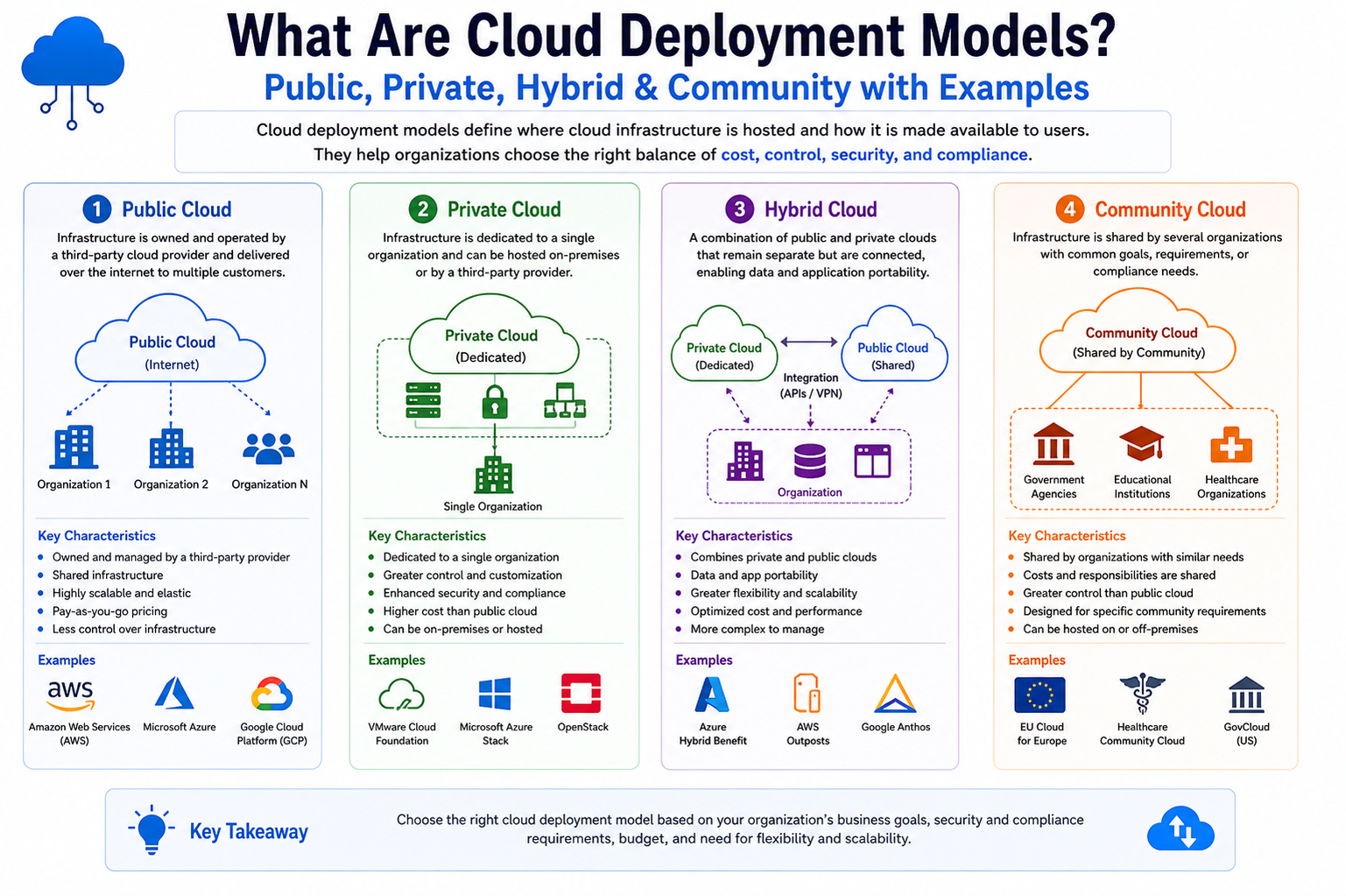
Cloud computing has transformed how organizations design, deploy, and manage their digital infrastructure. Instead of relying solely on physical servers located within office premises, businesses can now access computing resources over the internet with remarkable flexibility and efficiency. This shift has led to the development of various cloud deployment models, each designed to meet different operational, security, and performance needs. Choosing the right model is not simply a technical decision; it is a strategic one that influences cost, scalability, security, and long-term growth.
At its core, cloud deployment refers to how cloud services are made available to users. It defines where the infrastructure resides, who controls it, and how resources are distributed. Whether a business is running applications, storing data, or developing software, the chosen deployment model determines how these activities are executed and managed. Organizations must evaluate their requirements carefully, considering factors such as regulatory compliance, workload sensitivity, and budget constraints.
Cloud services are commonly delivered in forms such as Software as a Service, Platform as a Service, and Infrastructure as a Service. These service models operate across different deployment environments, enabling businesses to tailor solutions according to their needs. However, understanding deployment models is equally important because it directly affects how these services are accessed and secured.
The four most widely used cloud deployment models are public cloud, private cloud, community cloud, and hybrid cloud. Each model has its own strengths and limitations, making it suitable for specific use cases. A clear understanding of these models helps organizations avoid costly mistakes and build efficient systems that align with their operational goals.
Before diving into specific models, it is important to understand that no single approach fits all scenarios. Businesses often evolve over time, and their infrastructure needs change accordingly. A startup may initially rely on a cost-effective and scalable solution, while a large enterprise might prioritize control and security. Therefore, selecting a deployment model requires a balance between flexibility, performance, and governance.
Another important factor to consider is resource availability. Cloud computing relies heavily on internet connectivity, processing power, and storage capabilities. Organizations must evaluate whether they have the necessary bandwidth and technical expertise to manage their chosen environment effectively. Without proper planning, even the most advanced cloud solution can fail to deliver expected results.
What is Cloud Deployment
Cloud deployment can be understood as the process of configuring and delivering cloud-based resources to users through a network, typically the internet. It involves setting up hardware, software, storage, and networking components in a way that allows seamless access and operation. These deployments are hosted on specialized platforms designed to ensure high availability, scalability, and performance.
In a cloud environment, users do not need to worry about the physical location of servers or the complexities of maintaining hardware. Instead, they interact with virtual resources that can be provisioned and managed remotely. This abstraction allows businesses to focus more on their core activities rather than spending time on infrastructure maintenance.
One of the key advantages of cloud deployment is its ability to scale resources on demand. For example, a business experiencing increased traffic can quickly allocate additional computing power without investing in new hardware. Similarly, resources can be reduced when demand decreases, ensuring cost efficiency. This flexibility is one of the main reasons why cloud computing has become so popular across industries.
Cloud deployment also enhances collaboration and accessibility. Employees can access applications and data from anywhere, provided they have an internet connection. This is particularly beneficial for remote work environments and global teams that need to collaborate in real time.
Security, however, remains a critical consideration. Different deployment models offer varying levels of control and protection. While some models provide robust built-in security features, others require organizations to implement their own measures. Understanding these differences is essential for safeguarding sensitive information and maintaining compliance with industry regulations.
Another aspect of cloud deployment is automation. Many cloud platforms offer tools that automate tasks such as resource provisioning, monitoring, and scaling. This reduces the burden on IT teams and minimizes the risk of human error. Automation also improves efficiency by ensuring that resources are used optimally at all times.
Organizations must also consider integration when choosing a deployment model. Modern businesses often rely on multiple systems and applications that need to work together seamlessly. A well-designed cloud deployment should support integration with existing tools and workflows, enabling smooth operations and improved productivity.
Public Cloud Deployments
Public cloud deployment is one of the most widely used models due to its accessibility and cost-effectiveness. In this model, cloud services are delivered over the internet by a third-party provider. The infrastructure, including servers, storage, and networking components, is owned and managed by the provider. Users access these resources on a shared basis, typically through a subscription or pay-as-you-go pricing model.
This approach eliminates the need for organizations to invest in expensive hardware and infrastructure. Instead, they can leverage the provider’s resources to run applications, store data, and perform various computing tasks. Public cloud platforms are designed to handle large volumes of users, making them highly scalable and efficient.
One of the biggest advantages of public cloud deployment is its ease of use. Setting up services is usually straightforward, and users can quickly deploy applications without extensive technical knowledge. This makes it an attractive option for startups and small businesses that need to get up and running بسرعة without significant upfront investment.
Cost efficiency is another major benefit. Since resources are shared among multiple users, the overall cost is distributed, making it more affordable. Organizations only pay for the resources they use, which helps in managing budgets effectively. This flexibility is particularly useful for businesses with fluctuating workloads.
Public cloud providers also offer high levels of reliability and performance. Their data centers are equipped with advanced technologies and redundancy measures to ensure minimal downtime. This means that businesses can rely on consistent service availability, which is crucial for maintaining operations and customer satisfaction.
However, public cloud deployment is not without its challenges. One of the primary concerns is the lack of control. Since the infrastructure is managed by a third party, organizations have limited influence over how resources are configured and maintained. This can be a disadvantage for businesses with specific customization requirements.
Security and privacy are also important considerations. Although providers implement strong security measures, the shared nature of public cloud environments raises concerns about data isolation. Organizations must ensure that their data is properly protected and complies with relevant regulations.
Another factor to consider is internet dependency. Accessing public cloud services requires a stable and high-speed internet connection. Any disruption in connectivity can impact performance and accessibility. Therefore, businesses must evaluate their network capabilities before adopting this model.
Despite these challenges, public cloud deployment remains a popular choice for many organizations due to its scalability, affordability, and ease of implementation. It is particularly well-suited for applications that do not require strict control over infrastructure or sensitive data.
As businesses continue to embrace digital transformation, the role of public cloud deployment is expected to grow even further. Its ability to support innovation, reduce costs, and improve efficiency makes it a valuable component of modern IT strategies.
Private Cloud Deployments
Private cloud deployment represents a more controlled and exclusive approach to cloud computing. Unlike public cloud environments where resources are shared among multiple users, a private cloud is dedicated to a single organization. This exclusivity allows businesses to maintain greater control over their infrastructure, data, and security policies. The underlying technologies used in private clouds are often similar to those found in public clouds, but the key difference lies in ownership and access restrictions.
Organizations can choose to host their private cloud on-premises within their own data centers or outsource it to a third-party provider while still maintaining exclusive access. In both cases, the infrastructure is not shared with other users, ensuring a higher level of privacy and customization. This makes private cloud deployment particularly suitable for industries that handle sensitive data, such as finance, healthcare, and government sectors.
One of the most significant advantages of private cloud deployment is control. Organizations have full authority over how their systems are configured, managed, and secured. This level of control enables businesses to tailor their infrastructure to meet specific requirements, whether it involves custom applications, unique workflows, or specialized security measures. It also allows IT teams to implement policies that align closely with organizational goals and regulatory standards.
Customization is another key strength of private clouds. Businesses are not limited by predefined configurations or standardized services. Instead, they can design and deploy solutions that address their unique challenges. This flexibility is particularly valuable for companies with complex operations or those that require high-performance computing environments.
Security is often cited as one of the main reasons for choosing a private cloud. Since access is restricted to authorized users בלבד, the risk of unauthorized access is significantly reduced. Organizations can implement advanced security measures such as multi-factor authentication, encryption, and intrusion detection systems. Additionally, they have complete visibility into their infrastructure, enabling them to monitor and respond to potential threats more effectively.
Despite these advantages, private cloud deployment comes with its own set of challenges. One of the most notable is cost. Building and maintaining a private cloud requires significant investment in hardware, software, and skilled personnel. Unlike public cloud models যেখানে costs are distributed among multiple users, private cloud expenses are borne entirely by the organization. This can make it less accessible for small and medium-sized businesses with limited budgets.
Another challenge is the need for technical expertise. Managing a private cloud requires a team of skilled professionals, including system administrators, network engineers, and security specialists. These experts are responsible for maintaining the infrastructure, ensuring uptime, and addressing any issues that arise. Without the right talent, organizations may struggle to fully utilize the capabilities of their private cloud.
Scalability can also be a concern. While private clouds can be scaled, the process is not as seamless as in public cloud environments. Adding new resources often involves purchasing additional hardware and configuring it manually, which can be time-consuming and costly. This limitation may hinder organizations that experience rapid growth or fluctuating demand.
Maintenance is another factor to consider. Unlike public cloud providers that handle updates and system maintenance, organizations using private clouds must manage these tasks themselves. This includes patching software, upgrading hardware, and ensuring system reliability. While this provides greater control, it also increases the workload for IT teams.
Integration capabilities, however, are a strong point of private cloud deployment. Organizations can seamlessly connect their cloud environment with existing systems and applications. This allows for a unified infrastructure that supports both legacy systems and modern technologies. Such integration is essential for businesses that rely on a combination of traditional and cloud-based solutions.
Private cloud deployment also supports compliance with regulatory requirements. Many industries have strict guidelines بشأن data handling and security. By maintaining full control over their infrastructure, organizations can ensure that they meet these standards and avoid potential penalties. This makes private clouds an attractive option for businesses operating in highly regulated environments.
In terms of performance, private clouds offer consistent and predictable results. Since resources are not shared, there is no risk of performance degradation بسبب other users. This reliability is crucial for applications that require high availability and low latency. Businesses can optimize their infrastructure to deliver the best possible performance for their specific workloads.
Another advantage is data sovereignty. Organizations can choose where their data is stored and processed, ensuring compliance with local laws and regulations. This is particularly important for companies operating in multiple regions with different legal requirements. By controlling data location, businesses can avoid complications related to cross-border data transfer.
However, it is important to recognize that private cloud deployment is not a one-size-fits-all solution. While it offers numerous benefits, it may not be the most cost-effective or scalable option for every organization. Businesses must carefully evaluate their needs and resources before committing to this model.
Community Cloud Deployments
Community cloud deployment offers a collaborative approach to cloud computing by bringing together multiple organizations with shared goals, requirements, or regulatory concerns. In this model, the infrastructure is shared among a specific group of users rather than being open to the general public. These users typically belong to the same industry or sector, such as healthcare institutions, educational organizations, or government agencies.
The primary idea behind community cloud deployment is to create a shared environment that addresses common challenges while maintaining a level of privacy and security. By pooling resources, organizations can reduce costs and improve efficiency. At the same time, they can implement standardized policies and practices that benefit all participants.
One of the most significant advantages of community clouds is cost sharing. Since the infrastructure is used collectively, expenses المتعلقة hardware, maintenance, and management are distributed among the participating organizations. This makes it more affordable than building individual private clouds while still offering many of the same benefits.
Collaboration is another key benefit. Community cloud environments are designed to facilitate cooperation among members. Organizations can share data, applications, and resources more easily, مما enhances productivity and innovation. This is particularly valuable for projects that require joint efforts, such as research initiatives or public service programs.
Security in community cloud deployment is typically मजबूत, provided that all participants adhere to agreed-upon standards. Since the users share similar requirements, it is easier to implement consistent security measures across the environment. This uniformity helps in maintaining data integrity and protecting sensitive information.
However, achieving this level of security requires strong coordination. All participating organizations must agree on policies, protocols, and governance structures. This can be challenging, especially when dealing with multiple stakeholders with different priorities. Effective communication and collaboration are essential for ensuring the success of a community cloud.
Data isolation is another important consideration. যদিও resources are shared, each organization’s data must remain separate and secure. Implementing proper segmentation techniques is crucial to prevent unauthorized access and ensure compliance with regulations. This adds complexity to the management of community cloud environments.
Technical requirements can also pose challenges. Each participating organization must have the necessary infrastructure and expertise to integrate with the community cloud. This includes ensuring compatibility with shared systems and adhering to established standards. Without proper alignment, the effectiveness of the cloud environment may be compromised.
Another limitation is the relative rarity of community cloud deployments. Compared to public and private clouds, this model is less commonly used, which means there are fewer established frameworks and best practices available. Organizations may need to invest additional time and effort in designing and implementing their solutions.
Despite these challenges, community cloud deployment offers a unique balance between cost efficiency, security, and collaboration. It is particularly well-suited for organizations that share common objectives and are willing to work together لتحقيق mutual benefits. By leveraging shared resources, businesses can achieve outcomes that might not be possible individually.
Community clouds also promote standardization. By adopting common practices, organizations can streamline operations and reduce inconsistencies. This leads to improved efficiency and easier management of resources. Standardization also simplifies compliance with regulatory requirements, as all participants follow the same guidelines.
In terms of scalability, community clouds offer moderate flexibility. While they can be expanded to accommodate additional members or resources, the process requires coordination among all participants. This can slow down decision-making and limit the سرعة of scaling compared to public cloud environments.
Governance plays a critical role in community cloud deployment. Clear policies and structures must be established to define responsibilities, access controls, and usage guidelines. Without proper governance, conflicts may arise, and the effectiveness of the cloud environment may be diminished.
Overall, community cloud deployment provides a collaborative and cost-effective solution for organizations with shared needs. It combines elements of both public and private clouds, offering a balance between accessibility and control. While it may not be suitable for every scenario, it presents a valuable option for specific use cases where cooperation and shared resources are essential.
Hybrid Cloud Deployments
Hybrid cloud deployment represents a strategic combination of multiple cloud environments, typically integrating public, private, and sometimes community cloud elements into a unified system. Instead of relying on a single deployment model, organizations can distribute their workloads across different environments based on specific needs. This approach allows businesses to take advantage of the strengths of each model while minimizing their individual limitations.
At its foundation, a hybrid cloud is built on the idea of flexibility. Organizations are no longer restricted to one infrastructure type. They can run sensitive applications in a private cloud while using a public cloud for less critical operations. This separation ensures that each workload is placed in the most suitable environment, improving both performance and security.
One of the most common implementations of hybrid cloud deployment involves storing sensitive data in a private cloud while running customer-facing applications in a public cloud. This ensures that critical information remains protected while still benefiting from the scalability and accessibility of public cloud services. Similarly, businesses may use a community cloud for collaborative projects with partners while maintaining core operations in a private environment.
Flexibility is one of the defining characteristics of hybrid cloud deployment. Organizations can adapt their infrastructure as their needs evolve. For example, during periods of high demand, additional resources can be temporarily sourced from a public cloud. Once the demand decreases, those resources can be scaled back, ensuring cost efficiency. This dynamic allocation of resources is particularly valuable for businesses with fluctuating workloads.
Scalability is another major advantage. Hybrid cloud environments allow organizations to expand their capabilities without being limited by the constraints of a single platform. This means that businesses can grow seamlessly, adding new services and applications as needed. The ability to scale across multiple environments ensures that performance remains consistent even during peak usage.
Cost management, however, requires careful planning in hybrid cloud deployments. While the model itself is not inherently expensive, improper configuration can lead to increased खर्च. Organizations must monitor their resource usage closely and ensure that they are using the most cost-effective options for each workload. Without proper oversight, the complexity of managing multiple environments can result in unnecessary expenses.
Security in a hybrid cloud is both an advantage and a challenge. On one hand, sensitive data can be isolated in a secure private environment. On the other hand, managing security across multiple platforms requires a comprehensive strategy. Organizations must implement consistent policies, encryption standards, and access controls across all environments to ensure data protection.
Data management is another critical aspect. In a hybrid cloud, data is often distributed across different environments. Ensuring that this data is properly synchronized and accessible can be complex. Organizations must implement robust data integration and management solutions to avoid issues such as duplication, inconsistency, or loss of information.
Interoperability plays a crucial role in the success of hybrid cloud deployment. The different environments must be able to communicate and work together seamlessly. This requires compatible technologies, standardized protocols, and efficient integration tools. Without proper interoperability, the benefits of a hybrid cloud may be diminished.
Another important consideration is governance. Managing a hybrid cloud involves overseeing multiple systems, each with its own configurations and policies. Organizations must establish clear governance frameworks to ensure consistency and compliance. This includes defining roles, responsibilities, and procedures for managing resources across all environments.
Performance optimization is also a key factor. By distributing workloads strategically, organizations can ensure that each application runs in the most suitable environment. For example, high-performance applications can be hosted in a private cloud with dedicated resources, while less demanding tasks can be handled by a public cloud. This approach maximizes efficiency and ensures optimal performance.
Hybrid cloud deployment also supports innovation. By combining different environments, organizations can experiment with new technologies and approaches without disrupting their existing operations. This enables businesses to stay competitive and adapt to changing market conditions.
However, the complexity of managing a hybrid cloud should not be underestimated. Organizations must invest in skilled personnel, advanced tools, and effective strategies to ensure smooth operation. Without proper management, the benefits of hybrid cloud deployment may be overshadowed by its challenges.
Despite these complexities, hybrid cloud deployment remains a powerful solution for organizations seeking a balance between flexibility, control, and scalability. It provides the ability to tailor infrastructure to specific needs while maintaining the القدرة to adapt to changing requirements.
Key Considerations When Choosing a Cloud Deployment Model
Selecting the right cloud deployment model is a critical decision that can significantly impact an organization’s performance, security, and cost structure. With multiple options available, businesses must carefully evaluate their requirements and priorities before making a choice. This process involves analyzing various factors that influence how effectively a cloud environment will support operations.
One of the first considerations is business objectives. Organizations must clearly define what they aim to achieve with their cloud strategy. Whether the goal is to reduce costs, improve scalability, enhance security, or support innovation, the chosen deployment model should align with these objectives. Without a clear understanding of goals, it becomes difficult to select the most appropriate solution.
Workload characteristics also play a crucial role. Different applications have different requirements in terms of performance, security, and scalability. For example, mission-critical applications may require a highly secure and controlled environment, making private cloud deployment more suitable. On the other hand, applications with variable demand may benefit from the scalability of public cloud environments.
Security and compliance requirements are among the most important factors to consider. Organizations that handle sensitive data must ensure that their cloud environment meets all regulatory standards. This includes implementing strong security measures, maintaining data privacy, and ensuring proper access controls. In some cases, these requirements may limit the choice of deployment models.
Cost is another significant factor. While cloud computing is often associated with cost savings, different deployment models ունեն different cost structures. Public clouds typically offer lower upfront costs but may incur higher operational expenses over time. Private clouds require significant initial investment but provide greater control. Hybrid models offer flexibility but require careful management to avoid overspending.
Scalability and flexibility are essential for businesses that expect growth or fluctuating demand. Organizations must choose a deployment model that can adapt to changing requirements without compromising performance. Public and hybrid clouds are generally more scalable, while private clouds may require additional resources to expand.
Technical expertise is also a key consideration. Managing a cloud environment requires skilled professionals who can handle configuration, maintenance, and troubleshooting. Organizations must assess whether they have the necessary expertise in-house or need to rely on external support. This can influence the choice of deployment model significantly.
Integration capabilities should not be overlooked. Businesses often rely on multiple systems and applications that need to work together seamlessly. The chosen cloud deployment model must support integration with existing infrastructure to ensure smooth operations. This includes compatibility with software, databases, and networking systems.
Performance requirements are another critical aspect. Applications that require low latency and high reliability must be hosted in environments that can meet these demands. Organizations should evaluate the performance characteristics of each deployment model and choose the one that best suits their needs.
Vendor support and reliability also play a role in decision-making. Organizations must consider the reputation and capabilities of cloud providers, including their ability to deliver consistent performance and respond to issues بسرعة. Reliable support ensures that any समस्याएं can be addressed promptly, minimizing disruptions.
Finally, long-term strategy should guide the selection process. Cloud deployment is not just a short-term समाधान but a foundation for future growth. Organizations must consider how their needs may evolve and choose a model that can accommodate future changes. This forward-thinking approach ensures that the chosen solution remains effective over time.
By carefully evaluating these factors, businesses can make informed decisions and select a cloud deployment model that aligns with their goals. The right choice not only enhances efficiency and performance but also provides a मजबूत foundation for innovation and growth in an increasingly digital world.
Comparing Cloud Deployment Models in Real-World Scenarios
Understanding cloud deployment models becomes more meaningful when they are viewed through practical, real-world scenarios. Each model—public, private, community, and hybrid—serves a unique purpose depending on how an organization operates, what kind of data it handles, and how much control it requires over its infrastructure. Instead of treating these models as isolated concepts, businesses often evaluate them side by side to determine which one aligns best with their operational strategy.
In real-world environments, public cloud deployments are commonly used by startups, digital platforms, and businesses that prioritize speed and scalability. These organizations often need to launch applications quickly without investing heavily in infrastructure. For example, an e-commerce platform experiencing seasonal spikes in traffic can benefit from the ability to scale resources up and down بسهولة. This ensures smooth performance during peak times while avoiding unnecessary costs during slower periods.
Private cloud deployments, on the other hand, are often chosen by organizations that deal with highly sensitive data or strict regulatory requirements. Financial institutions, healthcare providers, and government agencies typically prefer this model because it offers greater control and security. In such environments, the ability to customize infrastructure and enforce strict access controls is essential. These organizations are willing to invest more in exchange for enhanced protection and compliance.
Community cloud deployments are less common but highly effective in specific contexts. For instance, multiple research institutions working on a مشترکہ project may use a shared cloud environment to collaborate efficiently. By pooling resources, they can reduce costs while maintaining a secure and standardized infrastructure. This approach is particularly useful when organizations share similar goals, policies, and compliance requirements.
Hybrid cloud deployments are increasingly popular because they offer a balanced approach. Large enterprises often adopt hybrid strategies to combine the benefits of different models. For example, a company might store sensitive customer data in a private cloud while running its web applications on a public cloud. At the same time, it may collaborate with partners using a community cloud. This layered approach מאפשר businesses to optimize performance, security, and cost simultaneously.
When comparing these models, it becomes clear that there is no universally “best” option. Each model excels in certain areas while presenting challenges in others. Public clouds offer unmatched scalability but limited control. Private clouds provide security and customization but require significant investment. Community clouds enable collaboration but depend on strong coordination. Hybrid clouds deliver flexibility but demand careful management.
Organizations must also consider how their needs evolve over time. A company that starts with a public cloud may later transition to a hybrid model as it grows and requires more control over its data. Similarly, an enterprise using a private cloud may integrate public cloud services to improve scalability. This dynamic nature of cloud adoption highlights the importance of choosing a model that supports long-term growth.
Performance is another key factor in real-world comparisons. Applications that require high سرعة and low latency may perform better in private or hybrid environments where resources are dedicated. Meanwhile, applications with variable demand can benefit from the elasticity of public clouds. By aligning workloads with the appropriate environment, businesses can achieve optimal performance.
Cost considerations also vary depending on the model. Public clouds generally offer lower upfront costs but can become expensive if not managed properly. Private clouds require significant initial investment but may provide cost stability over time. Community clouds distribute costs among participants, while hybrid clouds require careful planning to avoid unnecessary expenses. Understanding these cost dynamics is essential for making informed decisions.
Security remains a central concern across all deployment models. While private clouds offer the highest level of control, public clouds provide advanced security features managed by experienced providers. Community clouds rely on shared policies, and hybrid clouds require consistent security measures across multiple environments. Organizations must evaluate their risk tolerance and implement appropriate safeguards regardless of the chosen model.
Ultimately, comparing cloud deployment models in real-world scenarios helps organizations move beyond theory and make practical decisions. By analyzing how each model performs in different situations, businesses can identify the approach that best supports their اهداف and operational requirements.
Final Thoughts
Choosing the right cloud deployment model is a complex but essential step in building a successful digital infrastructure. Each model—public, private, community, and hybrid—offers distinct advantages and challenges, making it important for organizations to carefully evaluate their needs before making a decision. The effectiveness of any cloud strategy depends not only on the technology itself but also on how well it aligns with business goals and operational requirements.
Public cloud deployment stands out for its accessibility, scalability, and cost efficiency. It enables organizations to quickly deploy applications and scale resources as needed without significant upfront investment. However, it may not be suitable for businesses that require strict control over their infrastructure or handle highly sensitive data.
Private cloud deployment provides a high level of control, customization, and security. It is ideal for organizations with specific requirements or regulatory obligations. While it offers العديد of benefits, it also demands significant investment in terms of cost and technical expertise. Businesses must ensure that they have the necessary resources to manage and maintain a private cloud effectively.
Community cloud deployment offers a collaborative approach that allows organizations with shared goals to work together on a مشترکہ platform. This model promotes cost sharing, standardization, and التعاون, making it a valuable option for specific industries and projects. თუმცა, it requires strong coordination and governance to ensure نجاح.
Hybrid cloud deployment combines the strengths of multiple models, providing flexibility and scalability. It allows organizations to distribute workloads অনুযায়ী their requirements, ensuring optimal performance and security. While it offers significant advantages, it also introduces complexity that must be managed carefully.
As technology continues to evolve, cloud deployment models are likely to become even more sophisticated. Organizations will have access to more advanced tools and सेवाएं that enhance efficiency, security, and performance. This evolution will further expand the possibilities of cloud computing, enabling businesses to innovate and adapt to changing market conditions.
One of the most important aspects of cloud adoption is continuous evaluation. Businesses should regularly assess their cloud strategy to ensure that it remains aligned with their goals. As requirements change, organizations may need to adjust their deployment model or adopt a combination of approaches. This flexibility is key to maintaining a competitive edge.
Another critical factor is investment in skills and knowledge. Cloud computing is a rapidly evolving field, and organizations must stay updated with the latest trends and best practices. تدريب and development of technical teams play a crucial role in ensuring that cloud environments are managed effectively and securely.
Risk management should also be a priority. მიუხედავად the benefits of cloud computing, there are potential risks related to security, compliance, and operational continuity. Organizations must implement robust strategies to mitigate these risks and ensure that their systems remain reliable and secure.
In the end, the choice of a cloud deployment model is not just about technology—it is about strategy. It requires a deep understanding of business needs, technical capabilities, and future goals. By carefully analyzing these factors, organizations can build a cloud infrastructure that supports growth, innovation, and long-term success.
Cloud computing has opened up new opportunities for businesses of all sizes. With the right deployment model, organizations can achieve greater efficiency, improve performance, and deliver better experiences to their users. The key lies in making informed decisions and continuously adapting to the evolving digital landscape.