Modern organizations rely heavily on projects to introduce change, improve operations, launch products, and deploy technology. Whether a company is implementing a new software platform, constructing a building, redesigning a customer service process, or expanding into new markets, every initiative depends on a carefully planned sequence of tasks. Without structure and coordination, even the most promising project can quickly become chaotic.
Project management exists to bring order to complexity. It provides the framework needed to organize work, assign responsibilities, monitor progress, and ensure that goals are achieved within defined constraints. Among the many techniques used in project management, one of the most fundamental is understanding activity relationships.
Activity relationships define how tasks interact with one another. Some tasks cannot begin until another task has ended. Other tasks can happen simultaneously. Certain activities may overlap partially, while some must finish together to maintain consistency and quality. These relationships shape the entire project schedule and influence how efficiently resources are used.
When project managers create timelines, they do far more than list activities in order. They analyze dependencies between tasks to determine what must happen first, what can occur in parallel, and where delays could create serious problems. This process forms the foundation of effective scheduling and helps teams understand how their work contributes to the broader project.
In every industry, activity relationships affect outcomes. In construction projects, the foundation must be completed before walls are erected. In software development, testing cannot begin until enough code has been written. In marketing campaigns, promotional content must often be finalized before advertisements are launched. In manufacturing, raw materials must arrive before assembly can begin.
Understanding these dependencies is essential because projects rarely involve isolated activities. Most tasks are connected in some way, and the success of one activity often depends on the progress of another. If these relationships are not identified properly, schedules become unrealistic, teams experience confusion, and deadlines are missed.
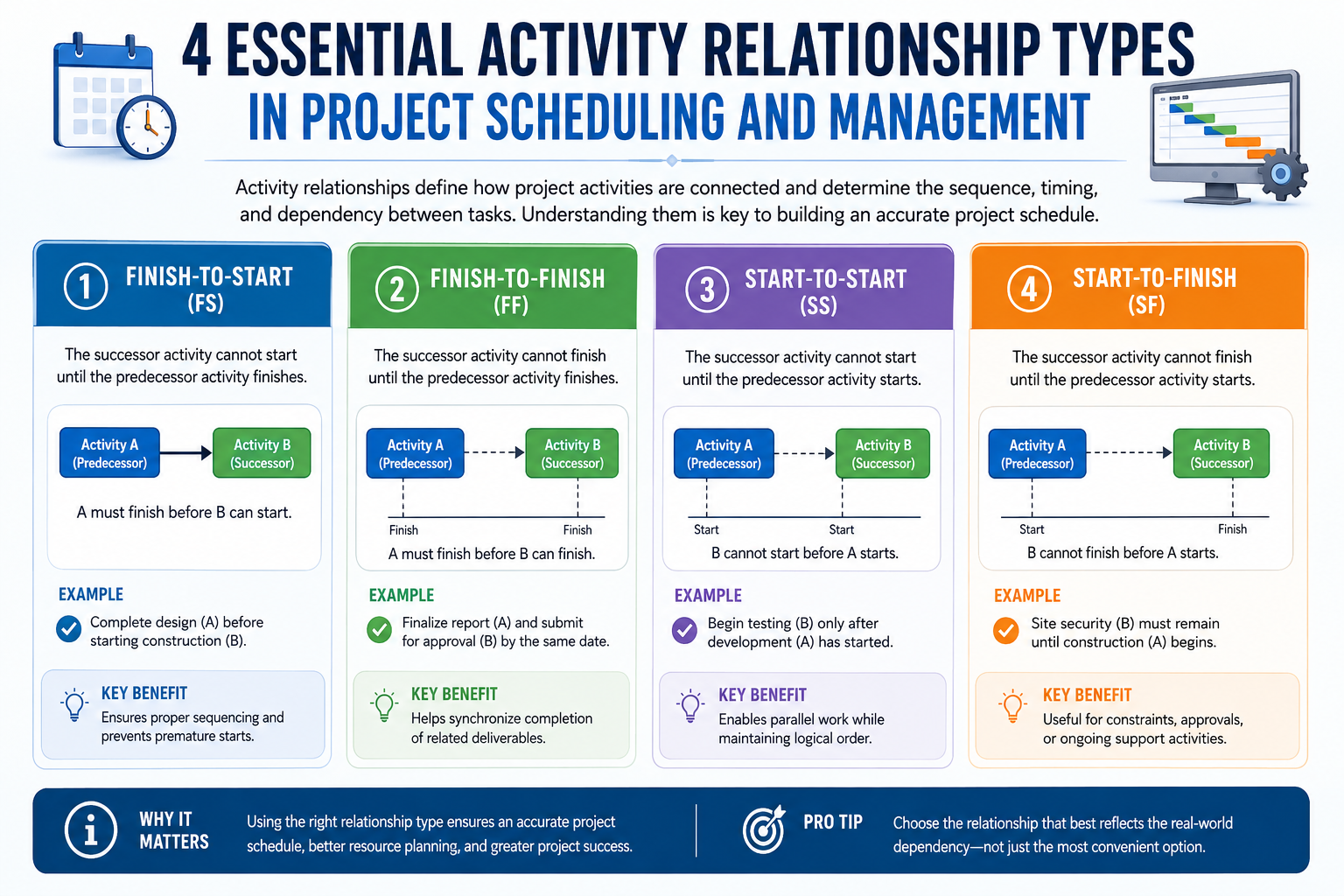
Project managers use four primary activity relationships to define these connections. These relationships are recognized across industries and are widely used in scheduling methodologies and planning tools. They include Finish-to-Start, Start-to-Start, Finish-to-Finish, and Start-to-Finish relationships.
Each relationship describes a different way in which activities can depend on one another. Some are very common and appear in almost every project, while others are less frequently used but still important in certain situations. Together, these relationships help project managers build logical, realistic schedules that reflect how work actually happens in the real world.
The ability to identify and manage activity relationships is especially important in today’s environment, where projects are becoming increasingly complex. Organizations often operate across multiple locations, use distributed teams, and rely on advanced technologies. Projects may involve hundreds or even thousands of interconnected tasks. A single scheduling mistake can affect budgets, delivery timelines, customer satisfaction, and operational stability.
Because of this complexity, project managers must think carefully about sequencing activities. They need to understand not only what work must be completed, but also how tasks interact over time. This requires communication with technical experts, stakeholders, and operational teams to accurately capture dependencies and constraints.
Activity relationships also play a major role in risk management. Certain tasks represent critical points in a project schedule. If one of these activities is delayed, multiple downstream activities may also be affected. By identifying relationships early, project managers can predict where bottlenecks may occur and create contingency plans to reduce disruption.
Another important benefit of understanding activity relationships is improved resource coordination. Projects often involve shared personnel, equipment, facilities, and budgets. When schedules are structured logically, resources can be allocated more efficiently, and teams can avoid conflicts or idle time.
In addition, clear activity relationships help improve communication among project participants. Team members gain a better understanding of how their tasks affect others, which encourages accountability and collaboration. Stakeholders can also see how progress in one area influences the overall project timeline.
Although activity relationships are technical concepts, they are deeply connected to everyday business operations. They affect how quickly products are delivered, how smoothly services are implemented, and how effectively organizations respond to change. Even individuals outside formal project management roles often deal with these relationships without realizing it.
For example, event planners coordinate venue preparation, catering setup, guest arrivals, and entertainment schedules. Healthcare organizations manage patient admissions, diagnostics, treatment procedures, and discharge planning. Educational institutions organize course development, registration systems, faculty assignments, and examination schedules. In each case, activities must occur in a logical sequence to achieve successful outcomes.
The growing importance of project-based work has also increased demand for professionals who understand scheduling and dependency management. Organizations value individuals who can coordinate complex initiatives and ensure that teams remain aligned. Strong scheduling skills are now considered essential across many leadership and operational roles.
As projects become more dynamic, activity relationships are evolving as well. Agile methodologies, hybrid project approaches, and digital collaboration tools have introduced new ways of organizing work. Even so, the core principles of task dependencies remain highly relevant. Whether a team follows traditional scheduling methods or adaptive project frameworks, activities still influence one another in predictable ways.
Understanding these relationships is therefore not only important for professional project managers but also for anyone involved in planning, operations, or organizational change. The ability to think logically about task sequencing improves decision-making, efficiency, and overall project performance.
Why Activity Relationships Matter in Modern Projects
Many projects fail not because the team lacks talent or technical knowledge, but because the work is not coordinated properly. Deadlines slip, resources become overloaded, communication breaks down, and tasks are completed out of sequence. In many cases, these problems can be traced back to poorly defined activity relationships.
A project schedule is much more than a calendar filled with dates. It represents a logical model of how work will progress from initiation to completion. Every task included in the schedule must connect to other tasks in a meaningful way. If these connections are inaccurate or incomplete, the entire schedule becomes unreliable.
Activity relationships help create realism in project planning. They acknowledge that some tasks simply cannot happen until certain conditions are met. For instance, an engineering team cannot begin testing hardware before components are assembled. A publishing company cannot print books before content editing is complete. A hospital cannot move patients into a newly built wing before safety inspections are finalized.
Without clearly defined dependencies, teams may attempt to perform work prematurely, resulting in wasted effort, quality problems, or rework. Alternatively, resources may sit idle because people are unsure when they can begin their tasks.
Properly identifying activity relationships also improves forecasting. Project managers can estimate timelines more accurately because they understand how delays in one area will affect other activities. This visibility is crucial when communicating expectations to stakeholders, executives, and customers.
In large projects, even small scheduling errors can create cascading consequences. Imagine a technology deployment involving hardware installation, software configuration, cybersecurity testing, employee training, and operational handover. If one activity is delayed unexpectedly, multiple downstream tasks may also shift. Without a structured understanding of dependencies, it becomes difficult to manage these changes effectively.
Activity relationships are particularly important in industries where timing is critical. Construction projects often involve weather constraints, inspection requirements, and equipment scheduling. Manufacturing operations rely on synchronized production processes. Software development teams coordinate coding, integration, testing, and deployment activities. Logistics organizations manage transportation schedules, inventory movement, and delivery commitments.
Another reason activity relationships matter is that they support better prioritization. Not every task has equal importance at every stage of the project. Some activities lie on the critical path, meaning any delay directly impacts the project completion date. Understanding dependencies helps managers identify which tasks require the most attention and monitoring.
This visibility also strengthens decision-making during project disruptions. When unexpected events occur, managers can quickly assess which activities are affected and determine the best response. They may decide to resequence work, allocate additional resources, or adjust timelines to minimize impact.
Activity relationships also encourage collaboration between departments and functional teams. Many projects involve people with different expertise and responsibilities. Marketing teams may depend on design teams, engineering teams may depend on procurement teams, and operational teams may depend on training specialists. Clearly defined dependencies help everyone understand how their work connects to broader project objectives.
Communication improves significantly when dependencies are visible. Instead of working in isolation, teams recognize how delays or changes in their activities may affect others. This creates greater accountability and encourages proactive problem-solving.
Another important aspect of activity relationships is their influence on resource management. Organizations rarely have unlimited personnel, equipment, or budgets. Effective scheduling ensures that resources are used efficiently without unnecessary overlap or downtime.
For example, a company implementing a new data center may need electricians, network engineers, cybersecurity specialists, and testing personnel at different stages of the project. By sequencing activities logically, project managers can coordinate these specialists effectively and reduce scheduling conflicts.
In highly competitive industries, efficient project execution can create major strategic advantages. Faster product launches, quicker system deployments, and smoother operational transitions help organizations respond to market opportunities more effectively. Strong dependency management contributes directly to these outcomes.
Activity relationships also support quality assurance. Some tasks must occur in a specific order to maintain standards and compliance requirements. In regulated industries such as healthcare, aviation, and finance, improper sequencing can lead to safety risks or legal issues.
For instance, medical equipment installations may require calibration before operational testing. Financial systems may require security validation before user access is enabled. Manufacturing facilities may require environmental inspections before production begins. These relationships ensure that important safeguards are not overlooked.
Digital transformation projects have further increased the importance of dependency management. Organizations are now integrating cloud services, automation tools, artificial intelligence systems, and remote collaboration platforms into daily operations. These initiatives often involve complex technical dependencies that require careful coordination.
Remote and hybrid work environments also create new scheduling challenges. Distributed teams may operate across different time zones, cultures, and communication styles. Clearly defined activity relationships help maintain alignment and reduce confusion in these environments.
Project management software has made it easier to visualize and manage dependencies. Modern scheduling tools allow managers to map relationships, track progress, and simulate the effects of delays. However, software alone cannot replace thoughtful planning. Effective dependency management still requires critical thinking, communication, and operational understanding.
The process of defining activity relationships begins during project planning. Managers work with stakeholders and subject matter experts to identify how tasks interact. This often involves workshops, planning sessions, and timeline analysis. The goal is to create a schedule that reflects real-world operational requirements rather than theoretical assumptions.
As projects progress, relationships may change. New risks emerge, priorities shift, and external conditions evolve. Skilled project managers continuously monitor dependencies and adjust schedules as needed to maintain progress.
This flexibility is especially important in modern business environments, where change occurs rapidly. Organizations must adapt to evolving customer expectations, technological innovations, regulatory requirements, and competitive pressures. Strong dependency management helps projects remain resilient despite uncertainty.
Another valuable benefit of activity relationships is improved transparency for stakeholders. Executives and sponsors often want visibility into project progress and potential risks. Dependency-based schedules provide a clearer picture of how work is interconnected and where attention is needed.
Stakeholder confidence increases when project timelines appear logical and well-structured. Conversely, unrealistic schedules with poorly defined relationships often create skepticism and frustration.
Learning how to identify and manage activity relationships is, therefore, a critical skill for anyone involved in project planning or execution. It combines analytical thinking, communication, operational awareness, and strategic planning.
As organizations continue to rely on projects to drive innovation and growth, the importance of dependency management will only increase. Teams that understand how activities connect are better positioned to deliver successful outcomes, manage uncertainty, and achieve long-term operational goals.
The Foundations of Logical Task Sequencing
At the heart of every successful project lies logical sequencing. This concept refers to arranging activities in an order that reflects how work must realistically occur. Logical sequencing ensures that tasks are performed efficiently, safely, and in alignment with project objectives.
Without logical sequencing, project schedules become little more than random lists of activities. Teams may begin work prematurely, overlook important prerequisites, or encounter preventable delays. Proper sequencing transforms individual tasks into a coordinated workflow that guides the project toward completion.
The foundation of logical sequencing begins with understanding dependencies. A dependency exists whenever one activity relies on another activity in some way. Dependencies may involve timing, resources, approvals, technical requirements, or operational constraints.
Some dependencies are mandatory. These are relationships that cannot realistically be changed. For example, a building foundation must be completed before structural walls can be installed. A software application must be developed before it can be tested.
Other dependencies are discretionary. These relationships are based on preferred practices or organizational decisions rather than absolute requirements. For instance, a company may choose to complete all employee training before launching a new system, even though partial training could theoretically occur earlier.
There are also external dependencies, which involve factors outside the direct control of the project team. These may include regulatory approvals, vendor deliveries, customer decisions, or environmental conditions.
Project managers must evaluate all these factors when sequencing tasks. The goal is not simply to create order, but to create the most effective order possible.
One common mistake in project planning is assuming that tasks occur in isolation. In reality, activities influence one another continuously. A delay in one area may create ripple effects throughout the project schedule. Understanding these interactions is essential for accurate planning.
Logical sequencing also requires balancing efficiency with risk management. While overlapping activities can accelerate timelines, doing so may introduce uncertainty or coordination challenges. Project managers must determine where overlap is beneficial and where strict sequencing is necessary.
Technology projects provide excellent examples of sequencing complexity. Consider a company implementing a new enterprise resource planning system. Activities may include infrastructure preparation, software customization, data migration, security configuration, testing, training, and deployment.
Some of these tasks can occur simultaneously, while others depend on earlier work. Data migration may require completed database structures. Testing may depend on successful configuration. Employee training may require finalized workflows. Each relationship influences the project timeline.
Construction projects demonstrate similar challenges. Excavation must occur before foundation work. Electrical wiring often depends on framing completion. Interior finishing may require inspections to be passed first. Poor sequencing can create costly delays and safety risks.
Manufacturing environments also rely heavily on logical sequencing. Production lines require synchronized workflows to maintain efficiency. Raw materials must arrive before assembly begins. Quality inspections may occur at multiple stages. Packaging and distribution depend on completed production activities.
Healthcare projects involve particularly sensitive sequencing considerations. Hospital expansions, system implementations, and patient care improvements often require careful coordination to avoid disruptions to essential services.
Logical sequencing is equally important in creative industries. Film production schedules coordinate script development, casting, location preparation, filming, editing, sound design, and marketing. Publishing projects manage writing, editing, layout design, printing, and distribution activities.
Despite differences across industries, the underlying principle remains the same: tasks must occur in a sequence that supports successful project delivery.
Project managers often use scheduling diagrams and dependency mapping techniques to visualize relationships between activities. These tools help teams understand how work flows through the project and where critical dependencies exist.
Critical path analysis is one important technique related to logical sequencing. The critical path represents the sequence of activities that directly determines the project completion date. Delays in critical path activities immediately affect the overall schedule.
Understanding the critical path helps managers prioritize monitoring and resource allocation. It also highlights which dependencies carry the greatest scheduling risk.
Another important aspect of sequencing is recognizing lead and lag time. Lead time allows successor activities to begin before predecessor activities are fully complete. Lag time introduces intentional delays between activities.
These timing adjustments provide flexibility in scheduling and can improve efficiency when managed carefully. However, they also require close coordination to avoid confusion or quality issues.
Human factors also influence logical sequencing. Teams need clear communication, realistic expectations, and coordinated workflows to execute schedules effectively. Even the best-designed schedule can fail if participants do not understand their responsibilities or timing requirements.
Leadership plays a major role here. Effective project managers communicate dependencies clearly and ensure that team members understand how their work connects to the broader project timeline.
Organizational culture can also affect sequencing decisions. Some companies prioritize speed and innovation, encouraging overlapping activities and rapid iteration. Others emphasize risk reduction and compliance, favoring more structured sequencing approaches.
Modern project environments increasingly require adaptive sequencing strategies. Agile methodologies, iterative development, and continuous delivery models have introduced more flexible approaches to task coordination. Even so, dependencies still exist and must be managed carefully.
In agile software development, for example, teams may work in short iterative cycles, but activities such as coding, testing, integration, and deployment still require coordination. Dependencies remain important even when schedules are more dynamic.
Hybrid project models combine traditional scheduling with adaptive practices. These approaches require managers to balance structure with flexibility, ensuring that dependencies are managed without limiting responsiveness.
Effective sequencing also supports organizational learning. By analyzing completed projects, teams can identify where dependency management succeeded or failed. These insights improve future planning and strengthen operational maturity.
As projects become more interconnected and technology-driven, logical sequencing will continue to grow in importance. Organizations depend on coordinated execution to maintain competitiveness, deliver innovation, and manage change effectively.
Understanding activity relationships is, therefore, not just a technical project management skill. It is a strategic capability that supports efficiency, collaboration, risk management, and long-term organizational success.
Finish-to-Start Relationships and Their Role in Project Scheduling
Among all activity relationships used in project management, the Finish-to-Start relationship is the most common and easiest to understand. In this type of dependency, one task must be fully completed before another task can begin. The completion of the first activity acts as the trigger for the start of the next activity.
This relationship reflects how work naturally progresses in many real-world situations. Certain activities simply cannot move forward until prerequisite tasks are finished. Because of this, Finish-to-Start relationships form the structural backbone of most project schedules.
In construction, for example, workers cannot install a roof until the walls and structural framework are complete. In software development, user testing cannot begin until a functional version of the application exists. In manufacturing, products cannot be packaged before assembly is finished. These examples illustrate how one activity creates the conditions necessary for the next activity to start.
Project managers rely heavily on Finish-to-Start relationships because they help create logical order. Without them, projects would quickly become disorganized and unrealistic. Teams might attempt to begin tasks prematurely, resulting in wasted effort, confusion, or poor quality outcomes.
This type of relationship also helps clarify accountability. Teams understand exactly what must happen before they can begin their work. This clarity improves communication and reduces uncertainty throughout the project lifecycle.
Although Finish-to-Start relationships may appear simple, managing them effectively can become challenging in large or fast-moving projects. Delays in predecessor activities often create chain reactions that affect multiple downstream tasks. A single missed deadline can ripple through the schedule and threaten the project completion date.
For this reason, project managers monitor these dependencies closely. They identify which activities are critical to maintaining progress and develop contingency plans for tasks that carry high risk.
One of the key advantages of Finish-to-Start sequencing is predictability. Since tasks occur in a clearly defined order, managers can estimate timelines with greater confidence. Teams also gain a better understanding of project milestones and progress expectations.
However, strict sequencing can sometimes reduce flexibility. If every task waits for the full completion of the previous activity, projects may move more slowly than necessary. Skilled project managers, therefore, evaluate whether some activities can overlap safely without introducing excessive risk.
The decision to maintain strict Finish-to-Start sequencing or allow overlap depends on factors such as complexity, quality requirements, resource availability, and operational risk.
In highly regulated industries, strict sequencing is often essential. Pharmaceutical manufacturing, aviation maintenance, healthcare operations, and infrastructure development all require careful adherence to approved procedures. Activities must occur in a controlled order to ensure safety and compliance.
Technology projects provide particularly interesting examples of Finish-to-Start relationships. Consider a company deploying a new cloud-based business system. The infrastructure environment must first be configured before application deployment can begin. Once deployment is complete, security testing may start. After successful testing, user training can proceed. Finally, production rollout occurs after training and approval activities are finished.
Each stage depends on the successful completion of earlier work. Attempting to bypass these dependencies could create operational failures or security vulnerabilities.
Finish-to-Start relationships also play a central role in product development. A company designing a new consumer device might first complete market research, followed by product design, prototype development, manufacturing preparation, testing, and commercial launch activities. Each stage builds upon the outputs of previous tasks.
Marketing campaigns often rely on similar sequencing. Content creation must be completed before advertising materials are finalized. Approval processes typically occur before publication or launch activities begin. Event planning also depends heavily on ordered workflows involving venue booking, vendor coordination, logistics preparation, and promotional activities.
Another important characteristic of Finish-to-Start relationships is their impact on risk visibility. Because tasks occur sequentially, delays become easier to identify and track. Project managers can quickly determine which predecessor activities threaten future work.
This visibility supports better decision-making. Managers may allocate additional resources, adjust priorities, or revise schedules to protect critical activities from disruption.
Resource planning also benefits from Finish-to-Start sequencing. Teams and equipment can be assigned in stages rather than simultaneously, reducing overlap and improving utilization. This approach is particularly valuable when organizations operate with limited personnel or specialized expertise.
For example, a company implementing a new cybersecurity platform may rely on a small group of highly skilled engineers. Finish-to-Start sequencing allows those specialists to complete one stage before moving to the next, reducing conflicts and ensuring focused attention.
Communication improves as well. Team members know exactly when their involvement begins and ends. This reduces uncertainty and encourages smoother collaboration between departments.
Despite these advantages, project managers must remain cautious about excessive dependency chains. When schedules contain too many tightly connected Finish-to-Start relationships, even small delays can create major disruptions.
Imagine a project with twenty sequential activities where each task depends entirely on the previous one. A delay in the first activity may affect every remaining task. Such schedules can become fragile and difficult to manage.
To reduce this risk, managers often explore opportunities for parallel work where appropriate. This leads to another important activity relationship: Start-to-Start dependencies.
Start-to-Start Relationships and Concurrent Workflows
Unlike Finish-to-Start relationships, Start-to-Start dependencies allow activities to progress simultaneously once the predecessor task has begun. In this relationship, the successor activity cannot start until the predecessor activity starts, but both tasks may continue independently afterward.
Start-to-Start relationships are especially valuable in projects where speed and efficiency are priorities. They allow teams to overlap work rather than waiting for complete task completion before moving forward.
Modern organizations frequently use concurrent workflows to accelerate project delivery. Competitive pressures, customer expectations, and rapid technological change often demand faster execution timelines. Start-to-Start relationships help organizations meet these demands by reducing unnecessary waiting periods.
A common example appears in software development. Once programmers begin writing code, quality assurance teams may start preparing test environments and drafting testing procedures. They do not need to wait for the entire application to be completed before beginning their work.
Construction projects also rely heavily on concurrent activities. Once framing work begins on one section of a building, electricians and plumbers may start preparing installations in completed sections. This overlap shortens project timelines significantly.
Manufacturing operations provide another strong example. As soon as assembly begins on initial product batches, packaging teams may start preparing materials for completed units. Logistics teams may simultaneously organize distribution schedules.
Start-to-Start relationships create opportunities for improved efficiency because teams do not remain idle waiting for full task completion. Instead, work progresses in coordinated stages.
However, managing concurrent workflows requires strong communication and coordination. Since multiple activities occur simultaneously, changes in one task may affect other ongoing work. Teams must remain aligned to avoid confusion or rework.
For instance, if software requirements change after testing activities have already started, testing procedures may need revision. In construction projects, design modifications during ongoing installation work can create delays or quality issues.
Because of these risks, project managers carefully evaluate which activities are suitable for overlapping execution. Tasks involving stable requirements and predictable outputs are generally easier to coordinate concurrently.
Start-to-Start relationships are especially common in agile and iterative project environments. Agile methodologies emphasize incremental progress, collaboration, and continuous feedback. Teams frequently begin related activities as soon as initial work starts rather than waiting for complete task completion.
For example, product designers, developers, and testing specialists may collaborate throughout the development process rather than working in isolated phases. This approach increases responsiveness and accelerates delivery.
Marketing campaigns often use Start-to-Start sequencing as well. Once campaign planning begins, graphic designers, content writers, and social media specialists may start working simultaneously. Parallel workflows help organizations launch campaigns more quickly and adapt to changing market conditions.
Healthcare operations also benefit from concurrent scheduling. During hospital system upgrades, technical teams may begin configuring systems while training specialists simultaneously prepare educational materials for staff. Operational planning and technical implementation often progress together.
One of the major benefits of Start-to-Start relationships is improved schedule compression. Projects can often be completed significantly faster when appropriate overlap exists between tasks.
This acceleration can create important business advantages. Faster product launches may increase market competitiveness. Quicker infrastructure deployments may improve operational efficiency sooner. Reduced project durations may lower costs and improve stakeholder satisfaction.
However, concurrency also introduces management complexity. Coordinating overlapping activities requires strong leadership, clear communication channels, and effective monitoring systems.
Project managers must ensure that teams understand dependency conditions and timing expectations. Misalignment between concurrent activities can create operational conflicts.
Resource allocation becomes more challenging as well. Multiple teams may require access to shared tools, facilities, or expertise at the same time. Careful planning is necessary to avoid bottlenecks.
Risk management is another critical consideration. When activities overlap, problems can spread more quickly across the project. A delay or defect in one task may immediately affect multiple ongoing activities.
To address these risks, managers often establish checkpoints and coordination meetings. These mechanisms allow teams to share updates, identify issues early, and adjust workflows as needed.
Technology has greatly improved the ability to manage concurrent workflows. Modern collaboration platforms, project management software, and communication tools help distributed teams coordinate activities in real time.
Organizations increasingly rely on digital dashboards and dependency tracking systems to monitor overlapping tasks. These tools provide visibility into progress, resource usage, and potential conflicts.
Despite technological support, human collaboration remains essential. Successful concurrent workflows depend on trust, communication, and shared understanding among team members.
Organizational culture also influences how effectively Start-to-Start relationships are managed. Companies that encourage collaboration and adaptability often perform better in concurrent project environments than organizations with rigid communication structures.
Leadership style matters as well. Managers overseeing overlapping workflows must balance structure with flexibility. They need to coordinate activities carefully while allowing teams enough autonomy to respond quickly to changing conditions.
In global organizations, Start-to-Start relationships can create additional complexity due to time zone differences and cultural variations. Distributed teams must coordinate carefully to maintain synchronization across activities.
Despite these challenges, concurrent workflows are becoming increasingly important in modern project management. Organizations seeking agility and speed rely heavily on Start-to-Start sequencing to remain competitive.
Understanding how to manage these relationships effectively is, therefore, a critical skill for project leaders operating in fast-paced environments.
Finish-to-Finish Relationships and Coordinated Completion
While some activities depend on when tasks begin, others depend on when tasks finish. Finish-to-Finish relationships occur when one activity cannot be considered complete until another related activity is also completed.
In this dependency type, activities may start independently and progress at different speeds, but their completion points are linked. The successor activity cannot finish before the predecessor activity finishes.
Finish-to-Finish relationships are especially important in projects where synchronization and coordinated delivery matter more than simultaneous starting times.
A practical example can be found in publishing. Writers and editors may begin work independently, but the editing process cannot officially finish until the writing is complete. Similarly, layout formatting may continue throughout content development, but final formatting completion depends on finalized content.
Technology deployments often involve Finish-to-Finish relationships as well. A cybersecurity review may begin while software development is still ongoing, but the security assessment cannot be finalized until the software configuration is complete.
Construction projects frequently require coordinated completion activities. Interior finishing work and final inspections may progress simultaneously, but inspection approval cannot be concluded until all finishing tasks are completed.
These relationships help ensure consistency and quality by aligning completion milestones across related activities.
One of the main benefits of Finish-to-Finish sequencing is improved coordination between interconnected tasks. Teams remain aware that their work must align with other ongoing activities before completion can occur.
This dependency type is especially useful when activities involve iterative collaboration. Multiple teams may work independently but still require synchronized outcomes.
For example, in product development, hardware engineering and software integration may progress separately for much of the project. However, final system validation cannot finish until both components are fully completed and tested together.
Healthcare projects also demonstrate the importance of coordinated completion. During hospital facility upgrades, infrastructure modernization, and regulatory compliance reviews may occur simultaneously. Final operational approval depends on completion of both workstreams.
Finish-to-Finish relationships also help support quality assurance processes. Activities requiring validation, review, or certification often depend on related tasks reaching completion before formal closure can occur.
This structure encourages accountability and prevents premature sign-offs. Teams cannot declare activities complete until all necessary supporting work has been finalized.
Project managers use Finish-to-Finish dependencies to manage synchronization risks. When multiple activities must conclude together, delays in one area may threaten coordinated delivery.
Careful monitoring is therefore essential. Managers track progress across related tasks to ensure that completion timelines remain aligned.
Communication plays a particularly important role here. Teams must share updates frequently to coordinate their remaining work and avoid last-minute surprises.
Resource management can also become complex in Finish-to-Finish relationships. If related activities approach completion simultaneously, organizations may experience temporary spikes in workload or resource demand.
Testing, approval, documentation, and operational transition activities often converge near project completion stages. Managers must prepare accordingly to avoid bottlenecks.
Modern digital collaboration tools support coordinated completion by providing shared visibility into project progress. Teams can monitor dependencies, track milestones, and identify completion risks more effectively.
Agile and hybrid project environments increasingly rely on Finish-to-Finish coordination as well. Cross-functional teams often work iteratively while aligning toward shared delivery milestones.
In these environments, synchronization matters greatly. Teams may adapt continuously during execution, but coordinated completion remains essential for successful deployment or release activities.
Organizations undergoing digital transformation frequently encounter Finish-to-Finish dependencies across technical, operational, and organizational workstreams. System deployment, employee training, compliance validation, and operational readiness may all need to conclude together before launch.
Managing these relationships successfully requires both technical planning and strong leadership. Teams must remain focused not only on their individual tasks but also on collective project outcomes.
Start-to-Finish Relationships and Rare Scheduling Scenarios
Among the four primary activity relationships, Start-to-Finish is the least common and often the most difficult to understand. In this relationship, a successor activity cannot finish until a predecessor activity has started.
Unlike other dependency types, Start-to-Finish relationships reverse the more intuitive flow of scheduling logic. The beginning of one task triggers the completion of another task.
Although relatively rare, these relationships do appear in specific operational and transition scenarios.
One of the clearest examples involves system replacements or operational handovers. Imagine an organization replacing an outdated network infrastructure with a modern system. The old system cannot be fully decommissioned until the new system has started operating successfully.
In this case, the start of the new system enables the finish of the old system’s operation.
Healthcare environments provide another example. During nursing shift changes, outgoing staff cannot fully conclude their responsibilities until incoming staff begin their shifts. The start of the incoming shift allows the previous shift to finish safely.
Manufacturing operations may use Start-to-Finish relationships during production line transitions. Existing processes continue running until replacement systems or equipment become operational.
These dependencies are particularly important in environments where continuity is critical. Organizations cannot simply stop existing operations before replacement activities begin successfully.
Start-to-Finish relationships help manage risk during transitions by ensuring overlap between outgoing and incoming activities.
Because these scenarios often involve operational continuity, they require careful planning and monitoring. Failure to coordinate properly can create service interruptions, safety risks, or operational instability.
Project managers rarely use Start-to-Finish relationships in routine scheduling because most project activities follow more conventional sequencing patterns. However, understanding this dependency remains important for handling specialized operational scenarios.
One challenge with Start-to-Finish relationships is communication clarity. Team members unfamiliar with this dependency type may misunderstand scheduling logic or interpret timelines incorrectly.
Managers must therefore explain these relationships carefully and ensure that stakeholders understand transition conditions.
Technology migrations frequently involve Start-to-Finish coordination. Data centers, cloud platforms, telecommunications systems, and enterprise applications often require phased cutovers to maintain service availability.
For example, an organization migrating email systems cannot fully shut down the legacy environment until the new platform becomes operational and accessible to users.
Infrastructure modernization projects also rely on this relationship. Utility providers upgrading power systems or transportation networks may maintain old services until replacement systems begin functioning properly.
These transitions often require contingency planning as well. Organizations may prepare rollback procedures in case new systems experience unexpected problems during startup.
Risk management becomes especially important in Start-to-Finish scenarios because operational continuity is usually at stake. Managers must coordinate testing, approvals, communication, and fallback strategies carefully.
Human factors also influence these transitions. Employees may require training and support as operational responsibility shifts from old systems to new ones.
Change management practices, therefore, play a critical role in successful Start-to-Finish coordination. Organizations must prepare users, communicate expectations, and manage resistance to change effectively.
Despite their rarity, Start-to-Finish relationships highlight an important principle in project management: not all dependencies follow simple linear logic. Real-world operations often involve complex transitions that require nuanced scheduling approaches.
Understanding all four activity relationships allows project managers to create schedules that reflect operational reality rather than simplistic assumptions.
As organizations continue evolving through digital transformation, automation, and large-scale operational change, the ability to manage specialized dependency relationships will remain increasingly valuable.
Project management is ultimately about coordination, timing, and alignment. Activity relationships provide the framework that makes this coordination possible, enabling organizations to manage complexity and deliver successful outcomes in an increasingly interconnected world.
Conclusion
Activity relationships are one of the most important foundations of effective project management. They help transform a collection of independent tasks into a structured, logical workflow that guides projects from initiation to completion. Whether a project involves technology deployment, construction, manufacturing, healthcare operations, or business transformation, understanding how activities connect is essential for maintaining order, efficiency, and progress.
The four primary activity relationships — Finish-to-Start, Start-to-Start, Finish-to-Finish, and Start-to-Finish — each serve a unique purpose in scheduling and coordination. Some relationships ensure that work occurs in the correct sequence, while others allow overlapping activities that improve speed and flexibility. Together, they help project managers build realistic schedules that reflect the practical demands of real-world operations.
Strong dependency management also improves communication, resource planning, risk control, and decision-making. Teams gain a clearer understanding of how their work affects others, while project leaders can identify bottlenecks and respond to delays more effectively. In increasingly complex business environments, these capabilities are critical for delivering successful outcomes.
As organizations continue to rely on projects to drive innovation and operational change, the ability to manage activity relationships will remain a highly valuable skill. Projects succeed not only because tasks are completed, but because they are completed in the right order, at the right time, and in coordination with the broader goals of the organization.