Mobile applications have quietly reshaped the way people live, work, and communicate. From the moment we wake up and check notifications to the time we unwind with entertainment apps at night, mobile software has become deeply embedded in daily routines. Tasks that once required physical effort or desktop computers can now be completed instantly from a handheld device. Ordering food, booking transport, managing finances, learning new skills, tracking health, and even controlling smart home devices are all handled through mobile apps.
This shift didn’t happen overnight. It is the result of years of technological evolution, faster internet speeds, more powerful smartphones, and a growing demand for convenience. As mobile devices became more affordable and accessible, developers gained a massive platform to build solutions for global users. Today, billions of people rely on mobile apps daily, and this dependence continues to grow across industries.
As mobile usage increases, so does the demand for professionals who can design and build these applications. Businesses now prioritize mobile-first strategies, meaning they design digital experiences for smartphones before considering desktops. This transformation has made mobile development one of the most important areas in modern software engineering, shaping both technology trends and career opportunities worldwide.
What is a Mobile Developer
A mobile developer is a software professional responsible for creating applications that run on mobile devices such as smartphones, tablets, and wearable technology. Their primary goal is to design apps that are functional, user-friendly, and optimized for performance across different devices and operating systems.
Mobile developers typically specialize in one of two major ecosystems: iOS, which powers Apple devices, or Android, which runs on a wide variety of smartphones and tablets. Some developers focus exclusively on one platform, while others work with cross-platform technologies that allow apps to function on both systems using a shared codebase.
Beyond writing code, mobile developers play a critical role in shaping how users interact with digital products. They translate ideas into fully functional applications that meet business needs and user expectations. This requires a strong balance of technical knowledge and creative problem-solving.
The role is not limited to building apps from scratch. Mobile developers are also responsible for maintaining existing applications, improving performance, fixing bugs, and adapting software to new operating system updates. Since mobile technology evolves rapidly, developers must continuously update their skills to remain relevant and effective.
In many organizations, mobile developers work closely with designers, product managers, backend engineers, and quality assurance teams. This collaboration ensures that applications are not only technically sound but also visually appealing and aligned with user needs.
Core Responsibilities of Mobile Developers
The responsibilities of a mobile developer can vary depending on the organization, project size, and stage of development. However, several core duties define the role across most environments.
One of the primary responsibilities is designing and building mobile applications based on business or client requirements. This involves turning concepts into functional software that performs specific tasks, whether it is a shopping app, fitness tracker, or productivity tool.
Mobile developers also spend significant time writing and maintaining code. This code must be efficient, scalable, and compatible with different devices and screen sizes. Performance optimization is especially important in mobile development, as users expect apps to run smoothly without delays or crashes.
Another key responsibility is collaborating with design teams. Mobile developers must ensure that user interfaces are not only visually appealing but also intuitive and easy to navigate. This often involves implementing design specifications while providing feedback on technical feasibility.
Integration with backend systems is another critical part of the job. Many mobile applications rely on external servers, databases, and APIs to function properly. Developers must ensure that data flows smoothly between the app and backend services, enabling features such as login systems, real-time updates, and cloud storage.
Testing and debugging are also essential responsibilities. Mobile developers must identify and fix issues before applications are released to users. This includes checking for performance problems, security vulnerabilities, and compatibility issues across different devices and operating systems.
Once an app is launched, the work does not end. Developers are responsible for maintaining applications, releasing updates, and ensuring compatibility with new versions of operating systems. This ongoing maintenance is crucial for keeping apps functional and relevant over time.
Essential Skills Required for Mobile Development
Mobile development requires a combination of technical and problem-solving skills. While specific requirements vary depending on specialization, there are several foundational skills that every mobile developer needs.
Programming knowledge is the most important requirement. Mobile developers must be comfortable working with languages such as Swift for iOS development, Kotlin or Java for Android development, and JavaScript or Dart for cross-platform frameworks. Each language has its own syntax and structure, but all require logical thinking and attention to detail.
Understanding mobile frameworks and development tools is equally important. These frameworks provide the structure needed to build applications efficiently. For iOS, developers often use Apple’s native frameworks, while Android developers rely on tools designed for the Android ecosystem. Cross-platform frameworks allow developers to write code once and deploy it across multiple platforms.
Problem-solving ability is another essential skill. Mobile developers frequently encounter technical challenges such as performance issues, compatibility errors, and unexpected bugs. The ability to analyze problems and find effective solutions is crucial for success in this field.
Attention to user experience is also important. Mobile applications must be intuitive, responsive, and visually consistent. Developers need to understand how users interact with apps and ensure that navigation feels natural and efficient.
Version control systems are widely used in mobile development to manage code changes and collaborate with other developers. These systems help track modifications, prevent conflicts, and maintain organized project histories.
Familiarity with application programming interfaces is also essential. APIs allow mobile apps to communicate with external services, enabling features such as online payments, social media integration, and data synchronization.
Finally, adaptability is a key skill in mobile development. Technology changes quickly, and developers must be willing to learn new tools, frameworks, and best practices to stay competitive in the industry.
Tools and Technologies Used in Mobile Development
Mobile developers rely on a wide range of tools and technologies to build, test, and deploy applications. These tools form the foundation of the development process and help ensure efficiency and quality.
Integrated development environments are central to mobile development. These environments provide everything a developer needs in one place, including code editing, debugging, and testing tools. They are tailored specifically for iOS and Android development, making it easier to build platform-specific applications.
Programming languages form the backbone of mobile applications. Swift is commonly used for Apple devices, while Kotlin has become the preferred language for Android development. These languages are designed to be modern, efficient, and safe, helping developers create high-quality applications.
Cross-platform development frameworks have become increasingly popular. These frameworks allow developers to build applications that work on multiple operating systems using a single codebase. This reduces development time and increases efficiency, especially for companies targeting both Android and iOS users.
Mobile developers also use tools for version control to manage code collaboration. These tools allow multiple developers to work on the same project simultaneously without overwriting each other’s changes.
Testing tools are essential for ensuring application quality. Developers use them to simulate different devices, screen sizes, and operating conditions. This helps identify bugs and performance issues before the app reaches users.
Backend services and cloud platforms are also widely used in mobile development. These services handle data storage, authentication, and server-side logic, allowing mobile apps to function smoothly without relying entirely on local device resources.
How the Mobile Development Ecosystem Works
The mobile development ecosystem is a complex network of tools, platforms, and processes that work together to bring applications to life. At its core, this ecosystem connects developers, users, and service providers through a structured workflow.
It begins with an idea or requirement, often generated by businesses or product teams. This idea is then translated into technical specifications that guide the development process. Mobile developers use these specifications to design and build the application.
Once development begins, developers write code using platform-specific languages or cross-platform frameworks. This code is tested continuously to ensure it functions correctly across different devices and operating systems.
Design plays a crucial role throughout the process. User interface designers create layouts and visual elements, while developers implement these designs into functional interfaces. The collaboration between design and development ensures that the final product is both visually appealing and easy to use.
Backend systems support the mobile application by handling data storage, user authentication, and server communication. These systems ensure that apps can perform complex tasks such as syncing data across devices or processing transactions.
After development and testing are complete, the application is prepared for release. It is submitted to digital distribution platforms where users can download and install it. Even after release, developers continue to monitor performance, release updates, and improve functionality based on user feedback.
This ecosystem is constantly evolving as new technologies emerge. Advances in artificial intelligence, cloud computing, and mobile hardware continue to expand what is possible in mobile development, making it a dynamic and fast-moving field.
How Mobile Developer Compensation is Structured
Mobile developer compensation is not based on a single fixed formula. Instead, it is built from multiple components that together define total earnings. The most visible part is the base salary, which is the fixed annual amount paid by an employer. However, in many organizations, this is only one part of the overall package.
Additional compensation often includes performance bonuses, stock options, profit-sharing arrangements, and project-based incentives. These extras can significantly increase total income, especially in larger technology companies or fast-growing startups. In some cases, bonuses are tied to individual performance, while in others they depend on company performance or successful product releases.
Equity is another important element, particularly in startups. Developers may receive ownership shares in the company, which can become highly valuable if the business grows or is acquired. While equity is not guaranteed income, it is often used as a long-term incentive to attract skilled professionals.
Benefits also play a role in overall compensation. These may include health coverage, retirement plans, paid leave, training budgets, and wellness programs. While not direct cash income, they contribute to the overall value of the employment package.
Understanding how compensation is structured helps mobile developers evaluate job offers more accurately. A lower base salary may be offset by strong equity or bonuses, while a higher salary might come with fewer long-term incentives. This layered structure makes it important for professionals to look beyond the headline number when comparing opportunities.
Entry-Level Earnings and Early Career Expectations
At the beginning of a mobile development career, earnings are generally modest compared to those of experienced professionals, but still competitive compared to many other industries. Entry-level developers are typically focused on learning, adapting to workflows, and gaining hands-on experience with real-world applications.
In the early stages, most developers work under the supervision of senior engineers. Their responsibilities often include writing simple features, fixing minor bugs, and assisting with testing. They may also spend time learning codebases, understanding architecture patterns, and becoming familiar with development tools.
Because of the learning curve, employers do not expect full independence from entry-level developers. Instead, they prioritize adaptability, willingness to learn, and foundational knowledge of programming concepts. Strong problem-solving ability and basic familiarity with mobile platforms can significantly improve early career opportunities.
Salary levels at this stage reflect both potential and training investment. Companies are essentially investing in future productivity. While compensation is lower than mid or senior levels, entry-level positions still offer strong financial stability compared to many non-technical roles.
One of the most important aspects of this stage is growth potential. Developers who actively build skills, contribute to real projects, and demonstrate initiative often progress quickly. Early experience lays the foundation for higher-paying roles later in the career path.
Mid-Career Growth and Skill Premiums
As mobile developers gain experience, their earning potential increases significantly. Mid-career professionals are no longer focused solely on learning; instead, they take ownership of features, contribute to architectural decisions, and collaborate more independently with cross-functional teams.
At this stage, developers are expected to handle full development cycles. This includes planning features, implementing functionality, optimizing performance, and ensuring that applications meet both technical and user requirements. Their role becomes more strategic as they begin to influence how applications are built rather than just executing tasks.
Skill premiums become more noticeable during this phase. Developers with expertise in performance optimization, advanced debugging, or complex UI development tend to earn more than generalists. Employers value professionals who can solve difficult technical challenges efficiently.
Mid-career developers often begin to specialize. Some focus on native iOS or Android development, while others explore cross-platform technologies or backend integration. Specialization allows them to position themselves as experts in specific areas, increasing their market value.
Communication skills also become more important. Mid-level developers frequently interact with product managers, designers, and stakeholders. The ability to explain technical concepts clearly can influence career progression and compensation.
Overall, this stage represents a turning point where experience begins to translate into significantly higher earnings and more responsibility within development teams.
Senior Roles and Leadership Compensation
Senior mobile developers operate at a strategic level within organizations. Their responsibilities go beyond coding and extend into system design, team leadership, and long-term technical planning.
At this stage, developers often mentor junior team members, guide architectural decisions, and ensure that applications are scalable, secure, and maintainable. They play a key role in defining development standards and best practices within their teams.
Leadership responsibilities may also include managing project timelines, coordinating with multiple departments, and making decisions that affect product direction. In many organizations, senior developers act as the bridge between technical teams and business leadership.
Compensation at this level reflects both technical expertise and leadership ability. Senior developers typically earn significantly more than mid-level professionals due to their ability to influence high-impact decisions and reduce technical risk.
In some cases, senior developers transition into specialized leadership roles such as mobile architecture specialists or engineering managers. These positions focus less on writing code and more on guiding teams, reviewing system design, and ensuring technical alignment across projects.
The combination of deep technical knowledge and leadership capability makes senior mobile developers highly valuable in the job market. Their expertise directly contributes to product success and organizational efficiency.
Geographic Influence on Mobile Developer Pay
Location plays a major role in determining mobile developer salaries. In regions with strong technology industries, salaries tend to be significantly higher due to increased demand for skilled professionals and higher living costs.
Major tech hubs often offer the highest compensation packages. These areas typically host large technology companies, startups, and innovation centers that compete for top talent. As a result, developers in these regions often benefit from higher base salaries and additional perks.
In contrast, regions with smaller tech ecosystems tend to offer lower salaries. However, this is often balanced by lower living expenses, reduced competition, and improved work-life balance. Developers in these areas may enjoy a more comfortable lifestyle despite earning less in absolute terms.
Remote work has started to change the importance of geography. Many companies now hire developers from different regions, sometimes offering location-adjusted salaries. This allows professionals to access higher-paying opportunities without relocating.
However, geographic differences still matter. Even in remote roles, companies may adjust compensation based on cost of living or regional salary benchmarks. This creates a complex global salary structure where location still influences earnings, but not as strongly as before.
Impact of Industry Type on Salary Differences
The industry a mobile developer works in can significantly affect their salary. Different sectors have varying levels of technical complexity, security requirements, and budget availability.
Industries such as finance, healthcare, and enterprise software often offer higher salaries due to strict security standards and the need for highly reliable systems. Mobile applications in these sectors must handle sensitive data and operate with minimal errors, increasing the value of experienced developers.
Entertainment and consumer app industries also employ large numbers of mobile developers, but salaries can vary widely depending on company size and revenue model. High-performing consumer apps may offer competitive pay, especially if they generate significant user engagement or revenue.
E-commerce and logistics industries rely heavily on mobile applications for customer interaction, tracking, and transactions. Developers in these sectors often work on high-traffic applications that require strong performance optimization skills.
Startups across all industries may offer lower base salaries but compensate with equity or growth opportunities. Developers in startups often gain broader experience due to smaller teams and faster development cycles.
Industry choice, therefore, plays a major role in shaping both salary levels and career development opportunities.
Native vs Cross-Platform and Its Effect on Earnings
One of the most important decisions in mobile development is whether to specialize in native development or cross-platform development. This choice can influence both career opportunities and earning potential.
Native developers focus on building applications specifically for one platform, such as iOS or Android. This specialization allows them to take full advantage of platform-specific features, resulting in highly optimized and polished applications. Native expertise is often valued in companies that prioritize performance and user experience.
Cross-platform developers use frameworks that allow applications to run on multiple platforms from a single codebase. This approach improves efficiency and reduces development time, making it attractive to startups and companies with limited resources.
In terms of compensation, both paths can be highly rewarding, but in different ways. Native developers may earn higher salaries in specialized roles, especially in large organizations with complex applications. Cross-platform developers may benefit from broader job opportunities and flexibility across multiple projects.
Employers often value developers who understand both approaches. This hybrid knowledge increases versatility and can lead to higher compensation due to expanded skill coverage.
Specializations That Increase Market Value
Within mobile development, certain specializations can significantly increase earning potential. Developers who go beyond general app development and focus on advanced technical areas often command higher salaries.
Performance optimization is one such specialization. Developers who can improve app speed, reduce battery consumption, and enhance responsiveness are highly valued, especially in large-scale applications.
Security-focused development is another high-value area. Mobile apps that handle financial transactions, personal data, or enterprise information require strong security practices. Developers with expertise in secure coding and encryption are in high demand.
Advanced user interface development is also a valuable specialization. Creating smooth animations, responsive layouts, and accessible designs requires deep knowledge of platform capabilities and user behavior.
Backend integration expertise can further increase value. Developers who understand server communication, APIs, and cloud services can build more complete and scalable applications.
These specializations not only improve salary potential but also open doors to more advanced roles and leadership opportunities.
Company Size and Startup vs Enterprise Pay Gap
The size and structure of a company can significantly influence mobile developer salaries. Large enterprises typically offer stable salaries, structured career progression, and comprehensive benefits. These companies often have established development teams and long-term projects.
Startups, on the other hand, may offer lower base salaries but compensate with equity and faster career growth opportunities. Developers in startups often gain exposure to multiple aspects of product development, which can accelerate skill growth.
Mid-sized companies usually fall somewhere in between. They offer competitive salaries while still providing opportunities for innovation and career advancement.
The choice between startups and enterprises often depends on personal priorities. Some developers prefer stability and structured environments, while others value flexibility and rapid learning experiences.
Each environment contributes differently to long-term earning potential and career development.
Freelancing and Contract-Based Income Potential
Freelancing offers mobile developers an alternative path to traditional employment. Instead of working for a single employer, freelancers take on multiple projects from different clients.
Income in freelancing can vary widely depending on skill level, reputation, and project complexity. Experienced freelancers often earn more than traditional employees, especially when working with international clients.
Freelancers must manage their own workload, client communication, and project timelines. While this provides flexibility, it also requires strong self-discipline and business management skills.
Contract-based work is another option. Many companies hire mobile developers on short-term contracts for specific projects. These roles often pay higher hourly rates but lack long-term job security.
Both freelancing and contract work offer opportunities for higher income, but they also come with variability and less stability compared to full-time employment.
Negotiation Strategies in Mobile Development Careers
Salary negotiation is an important skill for mobile developers. Many professionals underestimate the impact of negotiation on long-term earnings.
Effective negotiation begins with understanding market rates and personal skill value. Developers who can clearly demonstrate their impact on past projects are in a stronger position to negotiate higher compensation.
Timing is also important. Negotiations are typically most effective during job offers, performance reviews, or when taking on additional responsibilities.
Beyond salary, developers can negotiate benefits such as remote work flexibility, training opportunities, and performance bonuses. These additional elements can significantly improve overall compensation.
Confidence, preparation, and clear communication are key factors in successful negotiation outcomes.
Remote Work and Global Salary Competition
Remote work has transformed the mobile development job market. Developers are no longer limited to local opportunities and can now work for companies located anywhere in the world.
This has increased competition but also expanded access to higher-paying roles. Developers in lower-cost regions can now work for companies in higher-paying markets, sometimes earning significantly more than local averages.
However, global competition also means that employers have access to a larger talent pool. This can influence salary structures and create more competitive hiring environments.
Remote work also requires strong communication skills, self-management, and the ability to collaborate across time zones. Developers who excel in remote environments often have better long-term career opportunities.
Career Switching Into Mobile Development
Many professionals transition into mobile development from other technical or non-technical backgrounds. This career switch is increasingly common due to the high demand for mobile skills.
Individuals with experience in web development, software engineering, or IT support often find it easier to transition. However, even those from unrelated fields can successfully enter mobile development with structured learning and practice.
Career switchers typically start with foundational programming concepts before moving into platform-specific development. Building practical projects is essential for gaining real-world experience.
While the transition requires effort, mobile development offers strong long-term career stability and growth potential, making it an attractive option for career changers.
Emerging Trends Affecting Future Salaries
Mobile development continues to evolve rapidly, and several emerging trends are shaping future salary expectations. Advances in artificial intelligence are changing how applications are built, allowing developers to integrate smarter features such as predictive text, image recognition, and personalized experiences.
The growth of wearable technology and Internet-connected devices is expanding the scope of mobile development beyond smartphones. Developers are increasingly working on apps for smartwatches, health devices, and connected home systems.
Low-code and no-code platforms are also influencing the industry. While these tools simplify app creation, they increase demand for developers who can handle complex, high-performance applications that go beyond basic functionality.
Security and privacy concerns are becoming more important as mobile apps handle more sensitive data. This increases demand for developers with strong security expertise.
As these trends continue to evolve, mobile developers who adapt quickly and continuously expand their skills are likely to see stronger career growth and higher earning potential.
Global Salary Landscape for Mobile Developers
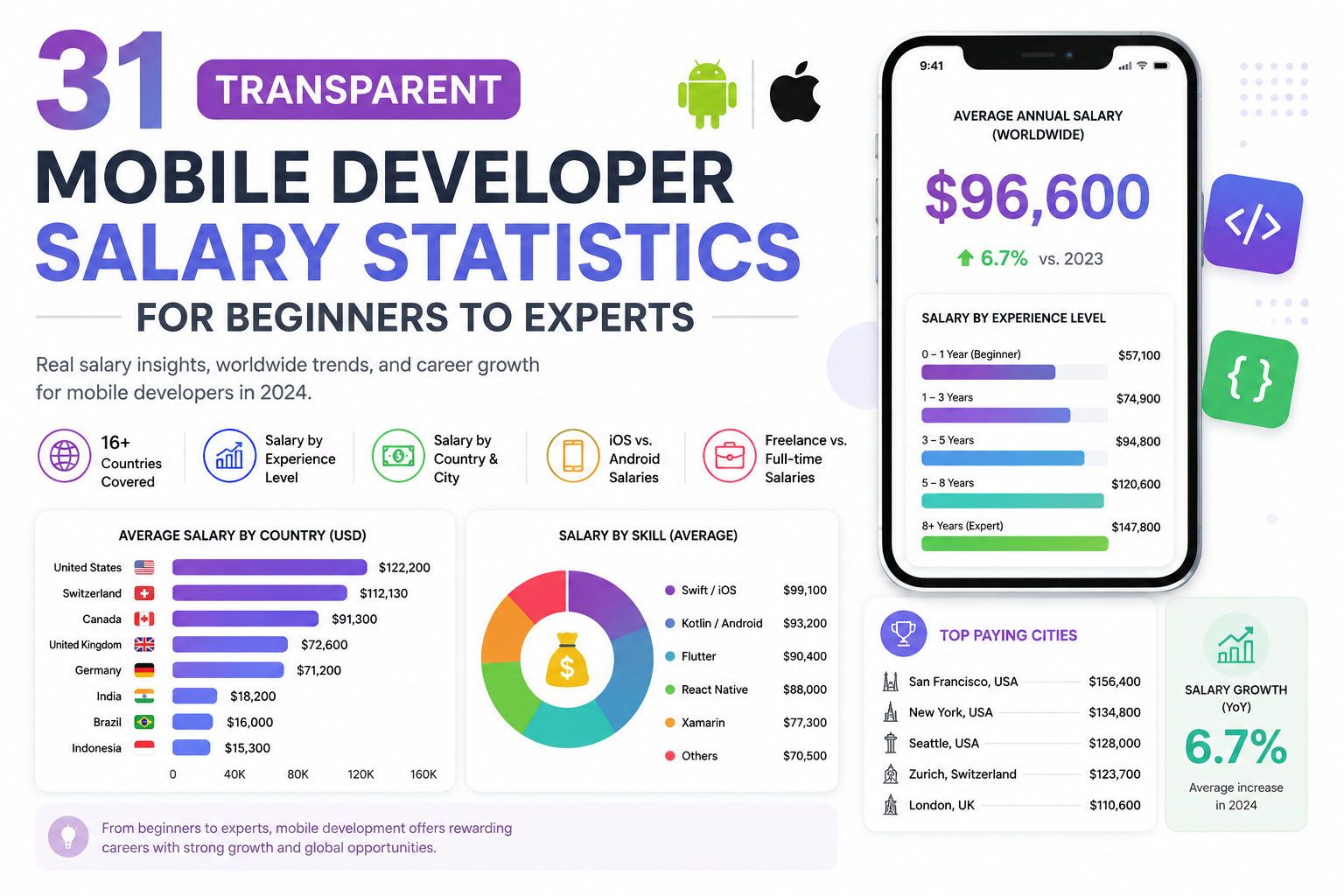
Mobile developer salaries are shaped not only by experience and job role but also by global economic differences. Around the world, compensation for the same technical skillset can vary dramatically depending on local demand, currency strength, industry maturity, and cost of living.
In highly developed technology markets, mobile developers tend to earn significantly higher base salaries. These regions usually have strong startup ecosystems, large multinational corporations, and intense competition for skilled engineers. As a result, companies offer higher compensation to attract and retain talent.
In contrast, emerging technology markets may offer lower absolute salaries, but this does not always reflect lower value. In many cases, developers in these regions enjoy strong purchasing power relative to local living costs. A salary that appears modest in global terms may still provide a comfortable lifestyle locally.
Remote work has blurred these boundaries. Many companies now hire globally, but compensation strategies differ. Some organizations adjust salaries based on the developer’s location, while others adopt a uniform pay structure regardless of geography. This creates a complex global salary ecosystem where identical skills can result in different compensation packages.
Another important factor is currency fluctuation. Developers paid in strong currencies often experience greater financial stability compared to those earning in weaker currencies, even when nominal salary figures appear similar.
Overall, the global landscape shows that mobile development is a universally in-demand skill, but financial rewards are heavily influenced by geography and economic conditions.
Cost of Living and Real Income Value
When evaluating mobile developer salaries, focusing only on gross income can be misleading. The real value of a salary is strongly affected by the cost of living in a specific region.
Housing is often the largest expense. In major urban tech centers, rent can consume a significant portion of monthly income. Developers may earn higher salaries in these regions, but elevated living costs can offset much of the financial advantage.
Transportation, food, healthcare, and taxes also contribute to overall expenses. In some regions, public infrastructure reduces personal costs, while in others, private services increase financial pressure.
Because of these differences, two developers earning similar salaries in different locations may experience very different standards of living. One may enjoy significant disposable income, while the other may face tight budgeting despite a higher nominal salary.
Remote work has introduced new flexibility in this area. Developers living in lower-cost regions while earning salaries tied to higher-cost markets often experience improved financial well-being. However, companies sometimes adjust compensation to reflect location-based pricing, reducing this advantage.
Understanding the cost of living is essential for making informed career decisions. A lower salary in a low-cost region may ultimately provide better financial balance than a higher salary in an expensive city.
Taxes and Net Salary Differences
Another important but often overlooked factor in mobile developer earnings is taxation. The difference between gross salary and take-home pay can vary widely depending on local tax systems.
In some regions, income tax rates are progressive, meaning higher earners pay a larger percentage of their income. In others, flat tax systems or lower overall tax rates result in higher net income retention.
Social security contributions, healthcare deductions, and other mandatory payments can also affect take-home pay. These deductions may provide long-term benefits such as pensions or public services, but they reduce immediate income availability.
Tax structures can significantly influence career decisions. A high-paying job in one region may result in similar or even lower net income compared to a lower-paying role in a region with lower taxes.
Mobile developers working internationally or remotely must also consider cross-border taxation rules. These can affect income reporting requirements and financial planning.
Understanding net income rather than just salary figures is essential for accurate financial assessment in mobile development careers.
Hiring Process for Mobile Developers
The hiring process for mobile developers is typically structured and multi-staged, reflecting the technical complexity of the role. Companies aim to evaluate both technical ability and problem-solving approach during recruitment.
The process usually begins with resume screening, where employers assess technical skills, project experience, and relevant background. Strong portfolios and demonstrable app experience often play a key role at this stage.
This is followed by technical assessments. These may include coding challenges, debugging tasks, or system design exercises. Employers use these assessments to evaluate logical thinking, coding proficiency, and familiarity with mobile frameworks.
Technical interviews often form the core of the hiring process. Candidates are asked to explain past projects, solve technical problems, and demonstrate understanding of mobile architecture. Interviewers may also explore topics such as performance optimization, API integration, and platform-specific behavior.
Behavioral interviews are equally important. These focus on communication skills, teamwork, adaptability, and problem-solving approach. Employers want to understand how candidates work in collaborative environments and handle challenges under pressure.
In some cases, candidates are asked to complete practical assignments or take-home projects. These simulate real-world tasks and allow employers to evaluate coding style, structure, and attention to detail.
The final stage often involves discussions with senior engineers or team leads. This stage focuses on cultural fit, long-term potential, and alignment with company goals.
Building a Strong Mobile Developer Portfolio
A well-structured portfolio is one of the most powerful tools for mobile developers. It serves as tangible proof of skills and experience, often carrying more weight than formal qualifications.
A strong portfolio typically includes real applications that demonstrate practical ability. These can be published apps, personal projects, or contributions to open-source work. The key is showcasing functional, working software rather than theoretical knowledge.
Each project in a portfolio should highlight different skills. For example, one app might demonstrate UI design capabilities, while another showcases backend integration or performance optimization.
Clear documentation is also important. Employers want to understand what the project does, what technologies were used, and what challenges were solved during development.
Quality is more important than quantity. A few well-built applications with strong functionality are more valuable than a large number of incomplete or simplistic projects.
Portfolios also help demonstrate growth over time. Showing progression from basic applications to more complex systems can strengthen a candidate’s credibility and appeal.
Common Interview Challenges and Evaluation Criteria
Mobile development interviews are designed to test both technical depth and practical thinking. One of the most common challenges candidates face is system design questions.
These questions assess how developers approach building scalable and efficient mobile applications. Candidates may be asked to design an app from scratch, explain architecture choices, or describe how they would handle performance issues.
Coding exercises are also common. These tasks evaluate logical thinking and coding efficiency. Interviewers focus not only on correct solutions but also on code structure, readability, and optimization.
Debugging exercises test problem-solving ability. Candidates are asked to identify and fix issues in existing code, simulating real-world development scenarios.
Another important area is platform knowledge. Candidates may be questioned on differences between operating systems, memory management, or lifecycle behavior of mobile applications.
Soft skills are evaluated through behavioral questions. Employers assess how candidates communicate, collaborate, and respond to feedback.
Success in interviews often depends on preparation, clarity of thinking, and the ability to explain technical decisions effectively.
Mobile App Architecture and Its Impact on Careers
Understanding application architecture is a key factor in advanced mobile development careers. Architecture defines how an application is structured, how components interact, and how data flows within the system.
Well-designed architecture improves scalability, maintainability, and performance. Developers who understand architectural principles are often entrusted with more complex and high-impact projects.
Common architectural approaches include layered structures that separate the user interface, business logic, and data management. This separation helps improve code organization and reduces complexity.
As applications grow in size, architecture becomes increasingly important. Poor structure can lead to performance issues, difficult maintenance, and increased development costs.
Mobile developers with strong architectural knowledge are often considered for senior roles, as they contribute to long-term system design decisions.
Team Structures and Agile Development Environment
Mobile developers rarely work in isolation. Most development takes place within structured teams using collaborative workflows.
Agile methodologies are widely used in mobile development environments. These methodologies emphasize iterative development, continuous feedback, and flexible planning.
Teams are typically divided into specialized roles. Mobile developers work alongside UI designers, backend engineers, product managers, and quality assurance specialists.
Work is often organized into short development cycles. Each cycle focuses on delivering specific features or improvements, allowing for regular updates and feedback.
Daily coordination meetings help teams stay aligned on progress and challenges. This structure promotes transparency and efficient problem-solving.
Understanding team dynamics is essential for mobile developers, as collaboration plays a major role in project success.
Quality Assurance and Mobile App Testing Depth
Testing is a critical phase in mobile application development. It ensures that apps function correctly across different devices, operating systems, and usage conditions.
Functional testing verifies that features work as intended. This includes checking user interactions, data processing, and navigation flows.
Performance testing evaluates how applications behave under different conditions, such as high traffic or limited device resources. Developers aim to ensure smooth performance even under stress.
Compatibility testing ensures that applications work across different screen sizes, hardware configurations, and operating system versions.
Security testing is increasingly important, especially for applications that handle sensitive data. Developers must identify vulnerabilities and ensure secure data handling practices.
User acceptance testing involves real users interacting with the application to provide feedback on usability and functionality.
Testing is not a one-time process but continues throughout the development lifecycle.
Mobile Release Cycles and Store Deployment Strategy
Releasing a mobile application involves a structured deployment process. Applications must meet platform guidelines before being published to digital distribution stores.
Each release typically goes through multiple stages, including internal testing, beta testing, and final deployment. This ensures that issues are identified and resolved before reaching a wider audience.
Version control is essential in managing updates. Developers must track changes carefully to ensure stability and compatibility across versions.
After release, monitoring user feedback and performance metrics is critical. Developers use this information to plan updates, fix bugs, and improve features.
Release cycles are often frequent, especially in competitive markets where continuous improvement is necessary to retain users.
Career Progression Paths Beyond Coding
Mobile development offers multiple career progression paths beyond traditional coding roles. As developers gain experience, they may choose to specialize or transition into leadership positions.
Technical leadership roles focus on guiding development teams, making architectural decisions, and ensuring technical quality across projects.
Some developers move into product-focused roles, where they help define features, user experience, and overall application strategy.
Others may specialize in advanced technical areas such as system optimization, mobile security, or cross-platform architecture.
There are also opportunities in consultancy, where experienced developers provide guidance to organizations on mobile strategy and implementation.
Each path offers different responsibilities and requires a combination of technical expertise and strategic thinking.
Common Career Mistakes and Growth Barriers
Many mobile developers face challenges that can slow career progression. One common issue is over-reliance on familiar tools without expanding skill sets.
Another barrier is a lack of focus on system-level thinking. Developers who focus only on writing code without understanding architecture may struggle to move into higher-level roles.
Poor communication skills can also limit career growth, especially in collaborative environments where a clear explanation of technical ideas is essential.
Ignoring new technologies is another mistake. Mobile development evolves rapidly, and staying updated is crucial for long-term success.
Burnout is also a real challenge due to fast release cycles and constant updates in the mobile ecosystem. Managing workload effectively is important for maintaining long-term productivity.
Developer Productivity and Performance Expectations
Productivity in mobile development is not only measured by speed but also by quality and efficiency. Employers value developers who can deliver reliable solutions without excessive rework.
Clean code practices, efficient debugging, and structured development approaches all contribute to higher productivity.
Time management is also important, especially when working on multiple features or projects simultaneously.
Performance expectations increase with experience. Senior developers are expected to handle complex tasks, mentor others, and contribute to strategic decisions.
Balancing speed with quality is a key challenge in mobile development environments, where user expectations are high and release cycles are frequent.
Conclusion
Mobile development has become one of the most influential and fast-growing career paths in the technology industry, shaped by the constant expansion of smartphone usage and digital services. As applications continue to integrate into nearly every aspect of daily life, the demand for skilled mobile developers remains consistently strong across global markets. Salaries in this field reflect a combination of experience, technical expertise, specialization, and geographic location, making it a dynamic and flexible career choice for many professionals.
Beyond financial rewards, mobile development offers continuous learning opportunities. The rapid evolution of tools, frameworks, and operating systems ensures that developers must constantly refine their skills to stay competitive. This ongoing growth not only enhances earning potential but also creates pathways into leadership, architecture, and product strategy roles.
While compensation varies widely, the long-term outlook for mobile developers remains highly positive. Those who invest in mastering both technical foundations and modern development trends are well-positioned to achieve strong career stability and advancement. Ultimately, mobile development is more than a technical profession—it is a field that combines creativity, problem-solving, and innovation, offering meaningful opportunities in an increasingly mobile-driven world.