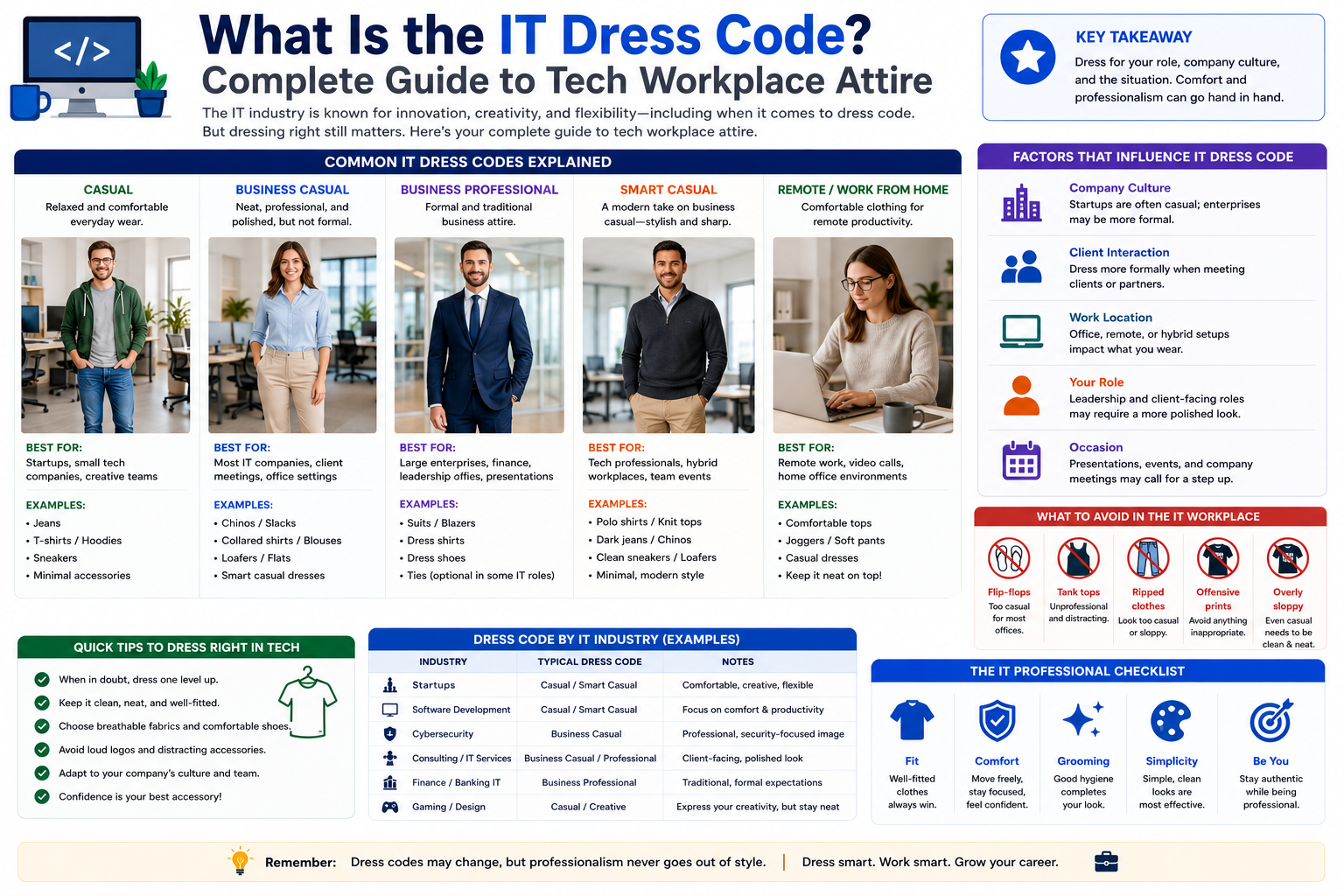
In the world of information technology, one of the most common yet confusing questions new employees face is what they should wear to work. Unlike more traditional industries such as banking, law, or hospitality, where dress codes are often strict and clearly defined, the IT sector tends to operate with far more flexibility. This flexibility can be both a relief and a source of uncertainty.
When someone joins a new IT company, they may hear mixed messages. One day, they might see colleagues wearing jeans and sneakers, and the next day, they might notice someone dressed in formal attire for a client meeting. This inconsistency often leads to confusion, especially for fresh graduates or professionals transitioning from more structured environments.
The IT industry is known for prioritizing skills, productivity, and innovation over appearance. Because of this, clothing choices are often considered secondary. However, that does not mean appearance is irrelevant. In fact, how someone dresses can still influence first impressions, workplace perception, and even career growth.
Most IT workplaces today fall somewhere between casual and business casual. This middle ground allows employees to feel comfortable while still maintaining a sense of professionalism. However, the interpretation of “casual” or “business casual” can vary significantly from one organization to another. What is acceptable in a startup environment may not be appropriate in a corporate IT firm handling international clients.
Another important factor influencing dress expectations is company culture. Some IT companies promote a relaxed and creative atmosphere where individuality is encouraged. Others prefer a more structured and professional environment where employees are expected to maintain a polished appearance. Understanding this cultural difference is the first step toward choosing the right outfit.
New employees often feel pressure to “fit in” without fully understanding the unspoken rules. Unlike formal dress codes that are written in employee handbooks, IT dress norms are often learned through observation. This makes it essential to pay attention during the first few days or weeks at a new workplace.
The Balance Between Comfort and Professionalism
One of the biggest challenges in choosing IT work attire is finding the right balance between comfort and professionalism. The IT industry often involves long working hours, extended screen time, and sometimes even late-night problem-solving sessions. Because of this, comfort naturally becomes a priority for many professionals.
Comfortable clothing, such as cotton shirts, simple t-shirts, jeans, and sneakers, is commonly seen in IT offices. These choices allow employees to move freely, sit for long hours, and stay focused on their tasks without distraction. However, comfort alone is not enough when it comes to workplace dressing.
Professionalism still plays a key role in shaping how individuals are perceived by colleagues, managers, and clients. Even in relaxed IT environments, there is usually an expectation that employees will look neat, clean, and presentable. Clothing that is too casual or inappropriate can sometimes send the wrong message, even if the work performance is excellent.
For example, wearing overly casual clothing such as gym wear or beach-style outfits can create an impression of a lack of seriousness. On the other hand, overly formal clothing, such as full suits, in a relaxed IT environment may make a person appear out of place or disconnected from the company culture.
The ideal approach is to aim for a middle ground that combines both comfort and professionalism. Many IT professionals prefer smart casual attire because it provides this balance. Smart casual typically includes items like polo shirts, button-down shirts, chinos, and clean sneakers or loafers. These choices are comfortable enough for daily work while still maintaining a polished appearance.
Another important consideration is adaptability. IT professionals often attend different types of meetings throughout the day. A morning might involve coding or technical work in a relaxed environment, while an afternoon might include a formal meeting with clients or senior management. Dressing in a way that allows easy transition between these situations is highly practical.
Layering is also a useful strategy. For instance, an employee might wear a simple t-shirt under a lightweight shirt or blazer. This allows them to adjust their appearance depending on the situation without needing a complete change of clothes.
Ultimately, the goal is not to choose between comfort and professionalism, but to combine both in a way that suits the work environment and responsibilities.
Understanding Different IT Workplace Dress Expectations
The IT industry is diverse, and dress expectations can vary widely depending on the type of company. Understanding these differences can help employees make better clothing choices and avoid unnecessary confusion.
In large corporate IT firms, especially those that work with international clients, dress codes tend to be more structured. Employees are often expected to maintain business casual attire. This may include collared shirts, formal trousers, closed shoes, and minimal casual wear. Even though full suits may not be required daily, professionalism is still emphasized.
In contrast, startups and smaller tech companies often adopt a more relaxed approach. In these environments, it is common to see employees wearing jeans, t-shirts, hoodies, and sneakers. The focus is usually on creativity, productivity, and innovation rather than formal appearance. However, even in such relaxed settings, cleanliness and neatness remain important.
Another category includes hybrid IT companies that combine both corporate and startup cultures. These workplaces may have flexible dress norms that change depending on the day or situation. For example, employees might dress casually during regular workdays but adopt formal attire during client presentations or important meetings.
Remote IT work has also changed the concept of dress codes significantly. Many professionals working from home prioritize comfort above all else. However, even in remote settings, appearance still matters during video calls or virtual meetings. Looking presentable helps maintain professionalism and ensures effective communication.
It is also important to note that different departments within the same IT company may have slightly different expectations. For example, client-facing roles such as project managers or business analysts may be expected to dress more formally compared to backend developers or technical engineers.
Understanding these variations helps employees avoid overdressingor underdressing. Observing colleagues, especially senior team members, is often the most effective way to understand what is appropriate.
Common Clothing Choices in IT Environments
While IT dress codes vary, certain clothing choices are commonly accepted across most workplaces in the industry. These options provide a reliable starting point for employees trying to build a suitable wardrobe.
T-shirts are widely accepted in many IT environments, especially when they are plain, simple, and free of bold or inappropriate graphics. Neutral colors such as white, black, navy, and grey are often preferred because they look clean and professional.
Polo shirts are another popular choice. They offer a slightly more polished appearance than t-shirts while still maintaining comfort. Many IT professionals consider polos a perfect middle ground for everyday office wear.
Button-down shirts are commonly used in both casual and business casual IT settings. They can be worn with or without a blazer, depending on the level of formality required. Light colors and simple patterns are generally preferred.
For lower wear, jeans are widely accepted in most IT workplaces, especially when they are clean, well-fitted, and free of excessive distressing. In more formal environments, chinos or formal trousers may be more appropriate.
Footwear also plays an important role in overall appearance. Sneakers are widely accepted in casual IT settings, while loafers or formal shoes may be preferred in more professional environments. Regardless of style, shoes should always be clean and well-maintained.
Accessories are generally kept to a minimum in IT workplaces. Simple watches, belts, and bags are common, while overly flashy or distracting accessories are usually avoided. The focus remains on simplicity and practicality.
It is also important to consider hygiene and grooming. Clean clothes, neat hair, and basic personal grooming contribute significantly to a professional appearance. Even the most appropriate outfit can lose its impact if it is not well-maintained.
Adapting to Workplace Culture and Unspoken Rules
One of the most important aspects of dressing in the IT industry is understanding that not all rules are written. Many expectations are unspoken and learned through observation over time.
When starting a new job, it is often helpful to spend the first few days observing how others dress. This includes colleagues at similar levels as well as senior employees and managers. Their choices can provide valuable insight into what is considered acceptable.
Another useful approach is to slightly elevate your initial outfit choices. Dressing slightly more formally than the average employee during the first few days is generally safer than being too casual. Once the workplace norms are understood, adjustments can be made accordingly.
Company culture also plays a significant role. Some organizations value individuality and self-expression, allowing employees to dress freely. Others emphasize uniformity and professionalism, expecting a consistent standard of appearance.
Workplace events, meetings, and client interactions may also require adjustments in clothing choices. Even in casual environments, employees are often expected to dress more formally when representing the company externally.
It is also important to avoid extreme fashion choices in either direction. Overly casual outfits, such as sleepwear-like clothing or beach-style attire, can appear unprofessional. Similarly, overly formal attire in a relaxed environment may create unnecessary distance from colleagues.
Dressing appropriately is not about strict rules but about understanding context. It reflects awareness of the workplace environment and respect for the people one works with.
Dressing for Client-Facing Roles in IT Environments
In the IT industry, not every employee works in the same context. While many professionals spend their days writing code, managing systems, or developing software internally, others frequently interact with clients, stakeholders, or external partners. These client-facing roles carry a different level of responsibility when it comes to appearance, and dress code expectations often become more structured as a result.
When an IT professional represents a company in front of a client, their clothing becomes part of the company’s identity. Even if the organization has a relaxed internal dress culture, client interactions often demand a more polished and formal appearance. This is because clients tend to associate professionalism with trust, reliability, and competence, and appearance plays a subtle but important role in shaping that perception.
Employees in roles such as project management, business analysis, consultancy, or sales engineering are usually expected to maintain a business casual or semi-formal wardrobe. This often includes well-fitted shirts, formal trousers, blazers, and polished shoes. The goal is not to appear overly rigid or corporate, but to strike a balance that reflects confidence and professionalism.
It is also common for IT professionals to adjust their outfits based on the nature of the meeting. For internal discussions, a relaxed outfit may be acceptable, while external presentations or client pitches may require a more formal look. This adaptability is an important skill in itself, as it demonstrates awareness of context and audience.
Another important factor is consistency. Clients often interact with the same team over a period of time, and maintaining a consistent level of professionalism in appearance helps build trust. Sudden shifts between overly casual and overly formal attire can sometimes create confusion or reduce the sense of stability.
In many organizations, employees in client-facing roles are subtly encouraged to “dress one level above” the internal office standard. This does not necessarily mean wearing suits every day, but it does mean choosing cleaner, sharper, and more structured outfits compared to purely internal teams.
Remote and Hybrid Work Appearance Standards
The rise of remote and hybrid work has significantly changed how IT professionals approach dressing for work. In traditional office environments, clothing choices were influenced by physical presence and direct observation. In remote settings, however, appearance is often limited to what appears on a screen during virtual meetings.
This shift has created a new kind of dress code—one that is more flexible but still guided by professionalism. Many remote IT workers tend to prioritize comfort since they are working from home, but they also need to maintain a presentable appearance during video calls, team meetings, and client interactions.
A common approach in remote IT environments is what many people refer to as “camera-ready dressing.” This means that while the lower half of the outfit may be relaxed or casual, the upper half is usually more presentable. A clean shirt, polo, or simple top is often enough to maintain professionalism on screen.
However, even in remote settings, dressing appropriately can have a psychological impact. Changing out of sleepwear into casual work attire helps signal the start of the workday and improves focus. This separation between personal and professional time becomes even more important when both occur in the same physical space.
Hybrid work environments add another layer of complexity. Employees may split their time between home and office, which means their wardrobe must be versatile enough to adapt to both situations. In such cases, many professionals prefer a “smart casual core wardrobe” that works in multiple settings without requiring major changes.
Another important consideration is unexpected situations. Even remote workers may be called into last-minute video meetings or hybrid office visits. Being prepared with a few presentable outfits ensures that they can respond without stress or delay.
The overall expectation in remote IT environments is not perfection, but readiness. Employees are not required to dress formally at all times, but they are expected to look presentable whenever professional interaction is involved.
The Psychology Behind Professional Appearance in IT
Clothing in the workplace is not just about external perception; it also has a strong psychological influence on the individual wearing it. In the IT industry, where much of the work involves concentration, problem-solving, and creativity, this psychological aspect can play a meaningful role in performance.
When a person dresses in a structured and neat manner, it can create a sense of discipline and focus. This is often referred to as “enclothed cognition,” where clothing influences mental state and behavior. For IT professionals, this means that even simple choices like wearing a clean shirt instead of casual loungewear can subtly affect productivity.
On the other hand, overly casual clothing may sometimes lead to a relaxed mindset that is not always ideal for structured work environments. While comfort is important, too much relaxation in appearance can reduce the mental separation between rest and work, especially in remote settings.
Professional appearance also affects how individuals perceive themselves. When someone feels well-dressed, they are more likely to feel confident during meetings, presentations, or collaborative discussions. This confidence can translate into clearer communication and better engagement with colleagues.
In team environments, appearance also influences group dynamics. When most team members maintain a similar level of professionalism in dressing, it creates a sense of unity and shared standards. This does not require uniformity, but rather a balanced approach where everyone respects the general expectations of the workplace.
Interestingly, even in highly technical environments where clothing has no direct impact on skill or output, appearance still plays a role in shaping first impressions. People often form judgments within seconds of meeting someone, and clothing contributes to that initial perception.
However, it is important to note that in the IT industry, appearance is never a substitute for skill. A well-dressed professional who lacks technical ability will not succeed in the long term, but a skilled professional who also maintains a presentable appearance often finds it easier to navigate workplace interactions.
Seasonal and Environmental Considerations in IT Dressing
Another practical aspect of IT dress codes is adapting to seasonal and environmental conditions. Since many IT professionals spend long hours indoors, factors like temperature, comfort, and climate control significantly influence clothing choices.
In warmer climates, lightweight and breathable fabrics become essential. Cotton shirts, loose-fitting tops, and comfortable trousers help maintain comfort throughout the day. Overly heavy or layered clothing can lead to discomfort and reduced concentration.
In contrast, colder environments or heavily air-conditioned offices require layering strategies. Light sweaters, blazers, or jackets can help maintain comfort without compromising professionalism. Layering also provides flexibility, allowing employees to adjust their clothing based on room temperature.
Footwear choices can also be influenced by seasonal conditions. In warmer months, breathable shoes or lighter materials are preferred, while in colder conditions, more covered footwear may be appropriate. Regardless of season, comfort remains a key consideration, especially in roles that involve long hours of sitting.
Environmental factors also extend to workplace infrastructure. Some IT offices maintain formal climate control systems, while others may have more variable conditions. Understanding the physical environment helps employees make better clothing decisions that support productivity.
Seasonal dressing in IT is less about fashion trends and more about practicality. The goal is to remain comfortable while maintaining a consistent level of professionalism regardless of external conditions.
Gender-Neutral and Inclusive Dressing in IT Workplaces
Modern IT workplaces are increasingly embracing diversity and inclusion, and this is reflected in evolving dress expectations. Gender-neutral dressing has become more common, allowing employees greater flexibility in choosing clothing that aligns with their comfort and identity while still maintaining professionalism.
Rather than enforcing rigid gender-based clothing expectations, many IT companies now focus on general standards such as neatness, appropriateness, and professionalism. This allows individuals to choose outfits that suit their personal style while still aligning with workplace norms.
For example, clothing items such as shirts, trousers, blazers, and shoes are often considered universal across genders. The emphasis is less on gender-specific fashion rules and more on overall presentation.
Inclusive dressing also recognizes cultural and personal diversity within IT teams. Employees from different backgrounds may have different interpretations of professional attire, and modern workplaces tend to accommodate this diversity as long as the core standards of professionalism are met.
Comfort and practicality remain central in these discussions. Employees are encouraged to choose clothing that allows them to perform their tasks effectively without unnecessary discomfort or restriction.
The shift toward inclusivity in IT dress codes reflects a broader cultural change in the industry—one that values skill, collaboration, and innovation over rigid appearance standards.
Common Dressing Mistakes in IT Work Environments
Despite the flexibility of IT dress codes, certain common mistakes can still negatively impact how professionals are perceived in the workplace. These mistakes are often unintentional but can influence impressions and interactions.
One of the most common mistakes is overdressing in environments that are otherwise casual. Wearing formal suits in a relaxed office may create unnecessary distance between colleagues and make the individual appear disconnected from the team culture.
On the opposite end, underdressing is also a frequent issue. Clothing that is too casual, such as gym wear or sleepwear-style outfits, can appear unprofessional even in relaxed environments. While comfort is important, maintaining a baseline level of neatness is essential.
Another common mistake is neglecting cleanliness and grooming. Even appropriate clothing can lose its impact if it is wrinkled, stained, or poorly maintained. Similarly, personal grooming plays a significant role in overall presentation.
Overly distracting clothing, such as loud patterns, offensive graphics, or excessive accessories, can also be problematic. In professional environments, simplicity is generally preferred over attention-seeking fashion choices.
Footwear is another area where mistakes often occur. Wearing overly casual or worn-out shoes can reduce the overall professional appearance of an outfit, even if the rest of the attire is appropriate.
Finally, inconsistency in dressing can also create confusion. Frequently switching between very different styles without understanding the workplace context may make it harder for colleagues to interpret professional intent.
Evolution of IT Dress Codes Over Time
The concept of what is appropriate to wear in the IT industry has not always been as flexible as it is today. In fact, workplace dressing in technology companies has gone through a noticeable transformation over the past few decades. Understanding this evolution helps explain why modern IT environments are so diverse in their expectations.
In the early stages of the tech industry, especially during the rise of corporate computing and enterprise systems, IT professionals were often part of large, structured organizations. These environments typically followed strict corporate norms similar to those in the banking or finance sectors. Employees were expected to wear formal business attire such as suits, ties, dress shirts, and polished shoes.
At that time, IT was seen as a support function within larger corporations rather than a creative or independent industry. Because of this perception, appearance standards were heavily influenced by traditional corporate culture. Dressing formally was not just about professionalism; it was also about fitting into the broader organizational identity.
As the technology sector began to grow rapidly, especially during the software boom and the rise of personal computing, new types of companies emerged. Startups and software firms started to challenge traditional corporate norms, including dress codes. These newer companies prioritized innovation, speed, and creativity over rigid formalities.
This shift marked the beginning of a more relaxed approach to workplace attire. Tech entrepreneurs and engineers began to adopt simpler, more comfortable clothing such as jeans, t-shirts, and casual shirts. The idea was that creativity and productivity should not be restricted by formal clothing expectations.
Over time, this casual culture became associated with innovation itself. In many IT environments, dressing casually began to symbolize technical expertise, independence, and modern thinking. However, this shift did not completely replace formal expectations—it created a dual system where both formal and casual styles coexist depending on context.
Today, the IT industry reflects this blended evolution. Some companies still maintain structured corporate dress codes, especially those dealing with government contracts, finance, or international clients. Others embrace a fully casual culture, particularly in software development, gaming, and startup ecosystems.
The result is a highly flexible environment where dress codes are no longer defined by the industry alone but by company culture, job role, and even individual teams.
The Influence of Company Size on IT Dress Expectations
One of the most important factors shaping dress code expectations in IT is company size. The size of an organization often influences its structure, culture, and communication style, which in turn affects how employees are expected to dress.
Large IT corporations tend to have more defined expectations, even if they are not strictly formal. In such organizations, employees often interact with multiple departments, international clients, and external stakeholders. Because of this, maintaining a consistent and professional appearance becomes important.
Even when large companies adopt business casual policies, there is usually an underlying expectation of neatness and uniformity. Employees are expected to look presentable, especially in meetings, presentations, and official events. While creativity in dressing is not discouraged, extreme casualness is often avoided.
Mid-sized companies typically adopt a more balanced approach. These organizations may have a mix of formal and informal teams, depending on the nature of work. Employees often have more flexibility, but still need to adjust their attire based on their responsibilities.
In contrast, small IT companies and startups often have the most relaxed dress environments. These workplaces prioritize speed, innovation, and collaboration, which often leads to a more informal culture. Employees may dress in whatever allows them to work comfortably, as long as it remains respectful and appropriate.
However, even in small companies, there is usually an unspoken understanding of professionalism. While formal dress codes may not exist, employees still tend to avoid clothing that could be considered inappropriate or distracting.
Company size also influences how dress expectations are communicated. Larger organizations are more likely to have written guidelines, while smaller companies rely heavily on observation and cultural norms.
The Role of Leadership in Setting Dress Standards
Leadership plays a significant role in shaping dress expectations within IT workplaces. Even in environments without formal dress codes, employees often look to managers, team leads, and executives to understand what is appropriate.
When leaders dress in a certain way, it sets a visible standard for the rest of the team. For example, if senior management consistently dresses in business casual attire, employees are likely to follow a similar approach. On the other hand, if leadership maintains a relaxed dress style, it reinforces a casual culture throughout the organization.
This phenomenon is not based on formal rules but on social behavior and workplace dynamics. Employees often interpret leadership behavior as an indicator of company values and expectations.
In many IT companies, leadership consciously adjusts its appearance depending on context. During internal technical discussions, leaders may dress casually to encourage openness and comfort. During client meetings or public events, they may adopt a more formal appearance to represent the company professionally.
This adaptability sends an important message: dress codes in IT are not fixed but context-dependent.
Leadership also influences how strictly dress norms are enforced. In some organizations, managers may gently correct overly casual attire or encourage more professional dressing during important events. In others, they may prioritize technical output over appearance entirely.
Ultimately, leadership behavior helps shape the unspoken rules that define workplace dressing culture.
Dress Code Differences Across IT Job Roles
Not all IT professionals have the same responsibilities, and this often leads to differences in dress expectations across job roles.
Software developers and engineers, for example, typically work in technical environments where comfort is prioritized. Their roles often involve long hours of focused work, problem-solving, and collaboration within teams. As a result, their clothing is usually casual and practical.
System administrators, network engineers, and backend specialists often follow similar patterns. Since their work is mostly internal and technical, appearance is less emphasized compared to functionality and comfort.
On the other hand, roles that involve communication, coordination, or client interaction tend to have higher dress expectations. Business analysts, project managers, consultants, and sales engineers often need to maintain a more polished appearance because they frequently represent the company externally.
Human resources professionals in IT companies also tend to follow slightly more formal dressing standards. Their role involves employee engagement, onboarding, and organizational communication, which often requires a professional presentation.
Even within the same team, dress expectations can vary depending on specific tasks. For example, a developer may dress casually during coding sessions but switch to more formal attire when presenting a project to stakeholders.
This flexibility highlights an important aspect of IT culture: dress codes are not rigid but role-based and situational.
Impact of Globalization on IT Dressing Culture
Globalization has had a significant impact on how IT professionals dress across different regions and companies. With IT becoming a global industry, teams often include members from diverse cultural and geographical backgrounds.
Different countries have different expectations when it comes to workplace attire. In some regions, formal dressing is still strongly associated with professionalism. In others, casual dressing is widely accepted even in corporate environments.
As international collaboration becomes more common, IT companies often adopt hybrid dress cultures that accommodate diverse expectations. This means that employees may need to adjust their dressing style depending on the region they are working in or the clients they are interacting with.
For example, a team working with international clients may adopt more formal attire during cross-border meetings, even if their internal culture is casual. This helps ensure cultural alignment and professional consistency.
Global IT companies also tend to establish flexible dress policies that allow regional offices to adapt based on local norms. This creates a balance between global brand identity and local cultural expectations.
As a result, IT professionals today are often more aware of cultural sensitivity in dressing. They understand that clothing choices can carry different meanings in different parts of the world.
The Role of Technology Workspaces in Shaping Dress Codes
The physical design of IT workplaces also influences how employees dress. Modern tech offices are often designed to encourage collaboration, creativity, and comfort. This architectural shift has directly impacted clothing norms.
Open office layouts, casual seating areas, and creative workspaces reduce the need for formal dressing. When employees are working in relaxed environments, casual clothing naturally becomes more practical and comfortable.
Many IT companies also incorporate recreational spaces such as game rooms, lounges, and relaxation zones. These spaces reinforce a casual and flexible atmosphere, further influencing clothing choices.
On the other hand, companies that maintain traditional office structures with formal meeting rooms and enclosed workspaces often have slightly more structured dress expectations.
Remote and hybrid workspaces have further blurred the boundaries of dress codes. When employees are no longer physically present in a shared office, traditional appearance norms become less relevant. Instead, functionality and comfort take priority.
However, even in modern workspaces, there is still an underlying expectation of professionalism. The environment may be relaxed, but the behavior and appearance of employees still reflect the company’s identity.
Social Perception and Workplace Confidence in IT Dressing
Clothing in IT workplaces not only influences external perception—it also affects how individuals are perceived socially within teams and how confident they feel in their roles.
Employees who dress appropriately for their environment often feel more integrated into the workplace culture. This sense of belonging can improve communication, collaboration, and overall job satisfaction.
Social perception also plays a subtle role in career progression. While technical skills remain the most important factor in IT, individuals who consistently present themselves professionally may be perceived as more reliable or leadership-ready.
Confidence is another important factor. When employees feel comfortable and appropriately dressed, they are more likely to participate actively in discussions, present ideas clearly, and engage in teamwork effectively.
In contrast, feeling overdressed or underdressed can sometimes lead to discomfort or self-consciousness, which may affect communication and confidence levels.
Because of this, understanding workplace dress expectations is not just about appearance—it is also about psychological comfort and social integration.
Personal Branding Through Dressing in IT Careers
In modern IT workplaces, clothing has gradually become part of a broader concept often referred to as personal branding. While technical skills, communication abilities, and problem-solving remain the core of professional identity, appearance contributes to how consistently and clearly that identity is perceived by others in the workplace.
Personal branding in IT is not about dressing extravagantly or following rigid fashion trends. Instead, it is about maintaining a consistent, intentional, and appropriate visual presence that aligns with one’s professional role. Even in highly technical environments, people naturally associate certain visual cues with reliability, discipline, and attention to detail.
For example, an IT professional who consistently dresses neatly—even in a casual environment—tends to be perceived as more organized and dependable. This does not mean formal clothing is required, but rather that clothing choices are deliberate rather than careless. Small details such as ironed shirts, clean footwear, and well-fitted attire contribute to this perception.
Over time, this consistency can subtly influence how colleagues and managers remember and evaluate an individual. In team environments where many professionals share similar technical skills, such non-technical factors can help individuals stand out positively and professionally.
Personal branding through dressing also plays a role in leadership development. Individuals who are considered for managerial or client-facing positions are often expected to demonstrate not only technical competence but also the ability to represent the organization professionally. Dressing appropriately in different contexts becomes part of that readiness.
It is also important to recognize that personal branding in IT is highly context-sensitive. What builds a strong professional image in a startup environment may differ from what is expected in a corporate or enterprise-level organization. Understanding these nuances helps professionals adapt without losing authenticity.
Ultimately, dressing as part of personal branding in IT is about alignment—aligning appearance with role, responsibility, and workplace culture in a way that supports long-term career growth.
Workplace Adaptability and Situational Dressing
Another important aspect of IT dress culture is adaptability. Unlike industries with rigid uniform standards, IT environments often require professionals to shift between different levels of formality throughout the same week or even the same day.
Situational dressing refers to the ability to adjust one’s appearance based on the specific context of a task or interaction. For example, an employee might wear casual attire while working on internal development tasks but switch to a more structured outfit when attending a stakeholder meeting.
This flexibility is particularly important in agile IT environments where priorities can change rapidly. A developer might be called into a client discussion unexpectedly, or a team meeting might shift into a formal presentation setting. Being prepared for such transitions reduces stress and improves professional responsiveness.
Adaptability also reflects awareness of workplace dynamics. Employees who can read situations and adjust accordingly are often seen as more mature and reliable. This does not require an extensive wardrobe but rather a thoughtful selection of versatile clothing pieces that can work across multiple scenarios.
Many IT professionals build their wardrobes around neutral, mix-and-match items that allow for quick adjustments. This practical approach ensures that they are never caught unprepared, regardless of how the workday evolves.
Situational dressing also extends beyond meetings and office interactions. Company events, training sessions, and external visits may each require slightly different levels of formality. Understanding these subtle shifts is part of developing professional maturity in the IT field.
In essence, adaptability in dressing is not about frequent change but about readiness. It ensures that professionals remain appropriate, confident, and comfortable across a variety of work situations.
The Subtle Influence of Peer Behavior on Dress Choices
In IT workplaces, peer behavior plays a powerful role in shaping individual dress choices. Even in companies without formal dress codes, employees tend to align their appearance with those around them over time.
This social alignment happens gradually and often unconsciously. When a new employee joins a team, they typically observe how colleagues dress and adjust their own choices to match the general environment. This helps them integrate more smoothly into the workplace culture.
Peer influence is especially strong in team-based IT environments where collaboration is frequent. When most team members follow a similar style of dressing, it creates a sense of cohesion and shared identity. This does not require uniformity but rather a general alignment in level of formality.
Interestingly, peer behavior also helps stabilize dress expectations in flexible environments. Even when no official rules exist, teams often develop their own informal standards that are understood without being explicitly stated.
For example, if most employees in a team prefer smart casual attire, new members are likely to adopt the same style to avoid feeling out of place. Over time, this creates a self-regulating system of workplace dressing norms.
However, peer influence can also vary depending on individual confidence and personal preference. Some professionals may choose to maintain a distinct style while still respecting the overall workplace culture. This balance between individuality and conformity is a natural part of modern IT environments.
Understanding peer influence helps employees make more informed decisions rather than relying solely on assumptions. It also highlights that workplace dressing is not only an individual choice but also a collective behavior shaped by social interaction.
Conclusion
The question of what to wear in the IT industry does not have a single fixed answer because the environment itself is flexible, diverse, and constantly evolving. Unlike traditional professions with strict uniform rules, IT workplaces are shaped by a mix of company culture, job roles, leadership style, and the nature of daily tasks. This makes dressing less about following rigid instructions and more about understanding context.
At its core, IT dressing is about balance. Professionals are expected to combine comfort with a sense of responsibility, ensuring that their appearance remains neat, appropriate, and aligned with workplace expectations. Whether the environment is highly casual or more structured, the underlying principle remains the same: present yourself in a way that supports both productivity and professionalism.
Another important takeaway is adaptability. IT professionals often move between different situations—coding sessions, team discussions, client meetings, and virtual interactions. Each of these contexts may require slight adjustments in appearance. Being able to adapt smoothly reflects awareness, maturity, and respect for the professional environment.
It is also clear that dressing in IT is not just about external appearance but also about internal confidence and workplace behavior. The way a person dresses can influence how they feel, how they communicate, and how they are perceived by others. While skills remain the most important factor in career growth, presentation can enhance opportunities and strengthen professional relationships.
Over time, most IT professionals naturally develop their own sense of style based on experience, observation, and workplace exposure. This evolution helps them build a personal approach that fits both their comfort and their career needs.
Ultimately, there is no perfect outfit for every IT workplace. Instead, there is a guiding principle: dress with awareness, keep it clean and appropriate, and adjust based on the environment. When professionals follow this mindset, they are better prepared to navigate different workplace cultures with confidence and ease.