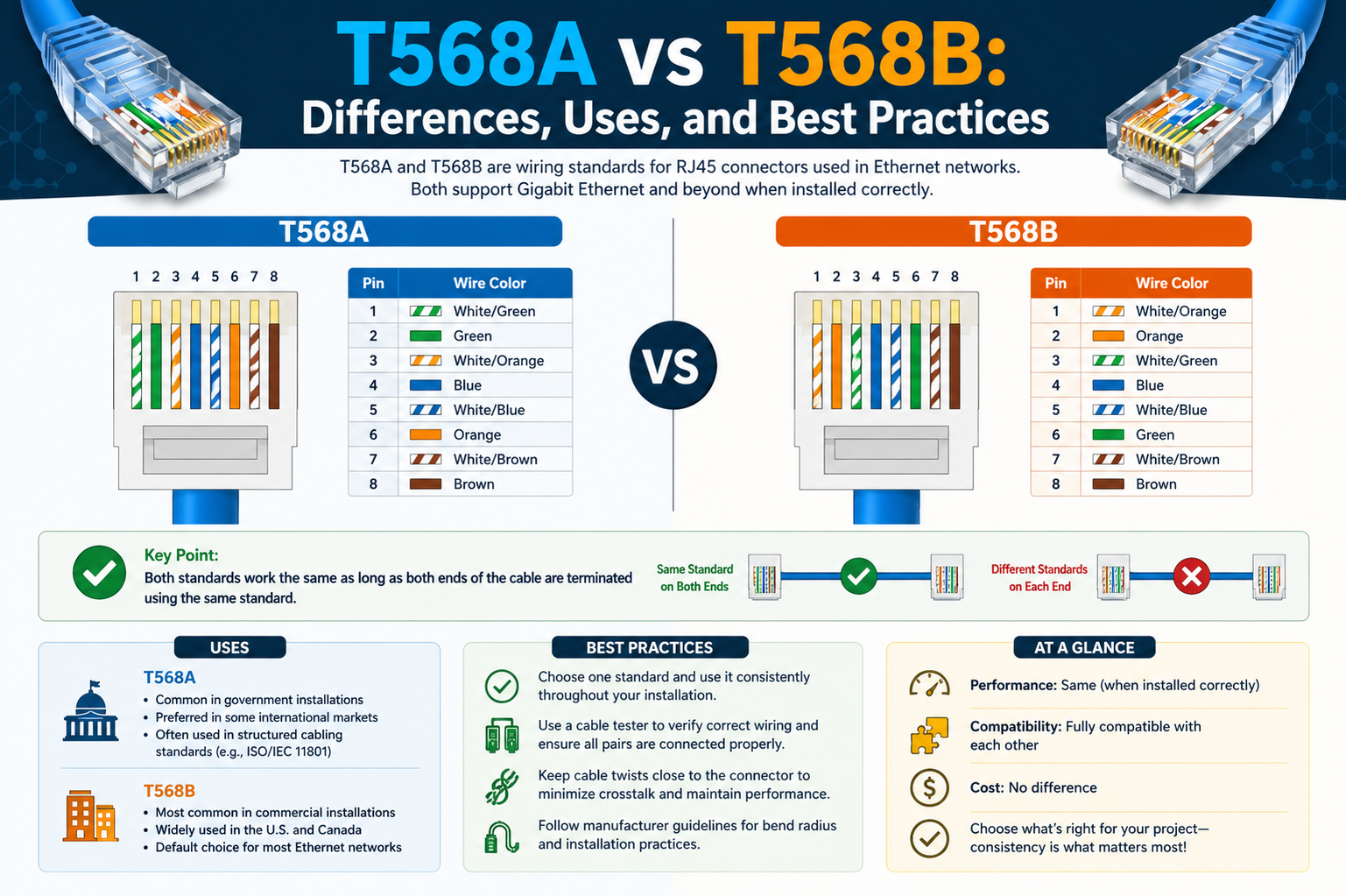
The primary difference between T568A and T568B lies in the positioning of the orange and green wire pairs inside an Ethernet cable. While both standards follow the same overall structure and use identical wire colors, they swap the placement of these two pairs, resulting in slightly different pin configurations. In practical terms, this difference does not impact performance when a single standard is used consistently across a network. However, inconsistency between the two can create communication issues. T568B is widely adopted in modern network installations, particularly in the United States, whereas T568A is often associated with older systems and certain regulated environments. Regardless of preference, maintaining uniformity across all cabling remains essential for stable and reliable connectivity.
Understanding the Importance of Consistency
Consistency is one of the most critical factors in structured cabling systems. At a glance, the difference between T568A and T568B may appear minor, but even small variations in wiring can cause major disruptions in network communication. Ethernet cables rely on precise alignment of pins and wire pairs to transmit data accurately between devices. When both ends of a cable follow the same standard, signals flow smoothly and efficiently. However, when different standards are mixed unintentionally, the cable effectively becomes a crossover, which can prevent proper communication in many setups.
In professional networking environments, this level of inconsistency can lead to troubleshooting challenges, downtime, and performance degradation. For this reason, network technicians and engineers emphasize strict adherence to a single wiring scheme throughout an entire local area network. This practice ensures compatibility, reduces errors, and simplifies maintenance over time. Even in smaller networks, maintaining a consistent approach can prevent avoidable issues and support long-term reliability.
What is an Ethernet Wiring Standard
An Ethernet wiring standard defines how the eight individual conductors inside a twisted-pair cable are arranged and terminated. These standards specify the exact order in which each colored wire connects to the pins of an RJ45 connector. By following a standardized arrangement, devices from different manufacturers can communicate seamlessly without requiring custom configurations.
Each Ethernet cable contains four twisted pairs, totaling eight wires. These pairs are color-coded to make identification easier during installation and troubleshooting. The arrangement of these wires is not random; it is carefully designed to minimize electromagnetic interference and maintain signal integrity. Proper termination according to a recognized standard ensures that data signals remain stable and accurate during transmission.
Without these standards, network installations would lack uniformity, leading to compatibility issues and unreliable performance. Standardization enables scalability, allowing networks to expand without requiring complete rewiring or complex adjustments. It also ensures that technicians across different regions and industries can follow the same guidelines, making collaboration and maintenance more efficient.
Organizations Behind the Standards
The development and maintenance of Ethernet wiring standards are overseen by several key industry organizations. These groups collaborate to ensure that networking technologies remain consistent, reliable, and adaptable to evolving demands. Their work involves defining specifications, testing compatibility, and updating standards as new technologies emerge.
The Telecommunications Industry Association and the Electronic Industries Alliance play a central role in establishing structured cabling guidelines. They provide detailed specifications that outline how cables should be installed, terminated, and tested. These standards are widely adopted across commercial, residential, and industrial environments.
In addition to these organizations, the Institute of Electrical and Electronics Engineers contributes to the broader framework of networking standards. While its focus extends beyond cabling, it plays a crucial role in defining how data is transmitted over Ethernet networks. Together, these organizations create a cohesive system that supports interoperability across a wide range of devices and infrastructures.
Their collaborative approach ensures that networking standards remain relevant and effective. By incorporating input from manufacturers, service providers, and technical experts, they create guidelines that address real-world challenges while supporting future innovation.
Introduction to T568A Wiring Standard
T568A is one of the two primary wiring standards used for terminating Ethernet cables. It was introduced as part of early structured cabling guidelines and has been widely implemented in various network installations. Although it is considered the older of the two standards, it continues to be used in specific environments where compatibility with legacy systems is important.
This standard defines a specific sequence for arranging the eight wires within a cable. By following this sequence, technicians can ensure that each wire connects to the correct pin on the RJ45 connector. The arrangement is designed to maintain proper pairing and reduce interference, which is essential for maintaining signal quality.
T568A is often associated with installations that require backward compatibility with older telephone systems. In such cases, its wiring arrangement aligns more closely with traditional telecommunication setups, making integration easier. Despite being less common in newer installations, it remains an important part of networking standards and continues to be relevant in many scenarios.
Color Coding and Wire Arrangement in T568A
Ethernet cables use a consistent color-coding system to identify each wire and its corresponding pair. The four pairs are typically green, blue, orange, and brown, with each pair consisting of one solid-colored wire and one white-striped wire. This color scheme simplifies the process of organizing and terminating cables.
In the T568A standard, the wire arrangement follows a specific order starting from pin 1 of the connector. The sequence begins with the green-striped wire, followed by the solid green wire. Next comes the orange-striped wire, then the blue pair, and finally the brown pair. This arrangement ensures that each pair remains properly aligned, which is essential for minimizing crosstalk and maintaining signal integrity.
Understanding this color coding is crucial for anyone working with network cabling. Even a small mistake in the order can disrupt connectivity and require re-termination. For this reason, many technicians rely on reference diagrams or memorization techniques to ensure accuracy during installation.
Compatibility of T568A
One of the defining features of T568A is its compatibility with a wide range of networking equipment. Devices such as routers, switches, and computers are designed to work with either wiring standard, provided that both ends of the cable follow the same configuration. This flexibility allows T568A to function effectively in modern networks despite its association with older systems.
A key advantage of T568A is its ability to support legacy telephone systems. In environments where voice and data services share the same infrastructure, this compatibility can simplify installation and reduce the need for additional adapters or converters. This makes it particularly useful in buildings with existing telecommunication wiring.
However, it is important to note that T568A and T568B are not directly compatible with each other when used on opposite ends of a standard patch cable. In such cases, the cable becomes a crossover cable, which is designed for specific networking scenarios but may not work in all setups. Maintaining consistency within a network eliminates this issue and ensures seamless communication between devices.
Practical Applications of T568A
T568A is commonly found in environments where adherence to established standards is required. This includes certain institutional and regulated settings where consistency across all installations is mandatory. In these cases, the use of T568A ensures uniformity and simplifies maintenance across large networks.
It is also frequently used in situations where existing infrastructure must be preserved. For example, older buildings with pre-installed cabling systems may already follow the T568A standard. Continuing with the same configuration when adding new connections helps maintain compatibility and avoids unnecessary rewiring.
In residential settings, T568A may be chosen for its alignment with traditional telephone wiring. This can be beneficial in homes where both voice and data services are integrated into a single cabling system. By using a standard that supports both, homeowners can achieve a more streamlined and efficient setup.
Why Understanding T568A Matters
Even though T568B is more commonly used in modern installations, understanding T568A remains important for anyone involved in networking. Many existing systems still rely on this standard, and the ability to identify and work with it is essential for troubleshooting and maintenance.
Knowledge of T568A also provides a deeper understanding of how Ethernet wiring standards evolved. By comparing it with T568B, technicians can gain insight into the design decisions that shaped modern networking practices. This understanding can be valuable when working on complex projects or integrating different systems.
In addition, familiarity with both standards allows for greater flexibility in network design. While it is generally recommended to use a single standard throughout a network, there are situations where crossover cables or mixed configurations may be necessary. In such cases, understanding the differences between T568A and T568B becomes critical.
Foundation for Comparing T568A and T568B
Before diving into a detailed comparison of T568A and T568B, it is important to establish a clear understanding of their individual characteristics. Both standards share the same fundamental structure, using identical cable types, connectors, and signaling methods. The only difference lies in the ترتيب of specific wire pairs, yet this small variation has significant implications for network configuration.
By examining T568A in detail, we gain a solid foundation for understanding how it compares to T568B. This knowledge will be essential as we explore the second standard, its unique characteristics, and how it fits into modern networking environments.
Introduction to T568B Wiring Standard
T568B is the second major Ethernet wiring standard and is widely regarded as the more commonly used option in modern network installations. Like T568A, it defines the precise order in which the eight wires inside an Ethernet cable are arranged and connected to an RJ45 connector. The structure, cable type, and overall design remain identical between the two standards, but the positioning of specific wire pairs differs.
Over time, T568B gained popularity due to its alignment with earlier commercial wiring practices and its widespread adoption in private sector networks. As new infrastructure projects expanded, many technicians and installers began using T568B as their default configuration. This momentum contributed to its dominance in many regions, particularly in environments where legacy telephone compatibility was not a primary concern.
Despite being considered more modern in usage, T568B is not technically superior to T568A in terms of performance. Both standards deliver identical speed and reliability when implemented correctly. The preference for T568B is largely based on convention, familiarity, and existing infrastructure rather than any inherent technical advantage.
Color Coding and Wire Arrangement in T568B
T568B uses the same set of four color-coded wire pairs found in all Ethernet cables: green, blue, orange, and brown. Each pair consists of one solid-colored wire and one white-striped wire, forming a total of eight conductors. This standardized color scheme ensures consistency across installations and simplifies the termination process.
The key difference in T568B lies in how the orange and green pairs are positioned. Starting from pin 1 of the connector, the sequence begins with the orange-striped wire followed by the solid orange wire. The green pair, which appears first in T568A, is shifted to a later position in the sequence. The blue and brown pairs remain unchanged between the two standards, maintaining consistency in the middle and end sections of the connector.
This rearrangement may seem minor, but it is critical to follow the correct order precisely. Even a single misplaced wire can disrupt signal transmission and lead to connectivity issues. For this reason, technicians often rely on clear visual references or labeling systems when terminating cables to ensure accuracy.
Compatibility of T568B
T568B is compatible with all standard Ethernet networking equipment, including switches, routers, computers, and patch panels. Like T568A, it functions seamlessly as long as both ends of the cable use the same wiring configuration. This compatibility makes it a flexible and reliable choice for a wide range of network environments.
However, just like T568A, T568B is not directly compatible with the alternate standard when used inconsistently. If one end of a cable is wired as T568A and the other as T568B, the result is a crossover cable. While crossover cables have specific use cases, they are not suitable for standard network connections in most modern setups.
Maintaining a consistent wiring standard across all cables and connectors is essential to avoid unintended crossover configurations. This consistency ensures that all devices can communicate effectively without requiring special adjustments or troubleshooting.
Why T568B Became Widely Adopted
The widespread adoption of T568B can be attributed to several practical factors. One of the main reasons is its alignment with earlier wiring conventions used in commercial networking environments. As businesses expanded their IT infrastructure, many chose to continue using the same configuration to maintain consistency with existing systems.
Another contributing factor is the influence of installers and technicians who became accustomed to T568B over time. As more professionals adopted this standard, it became the default choice in many training programs and installation guides. This created a cycle where new technicians learned and applied T568B, further reinforcing its dominance.
In addition, many organizations preferred T568B for its simplicity in certain deployment scenarios. While both standards are equally easy to implement, familiarity often plays a significant role in decision-making. When a standard becomes widely recognized, it naturally becomes the preferred option for new installations.
Practical Applications of T568B
T568B is commonly used in modern office environments, data centers, and residential networks. Its widespread adoption makes it the most likely standard to encounter in newly installed cabling systems. For organizations building networks from scratch, T568B is often chosen as the default due to its prevalence and ease of integration with existing equipment.
In commercial settings, using T568B helps ensure compatibility with pre-terminated cables and patch panels that are already configured according to this standard. This reduces the need for customization and simplifies the installation process. It also makes it easier to find replacement cables and components, as most manufacturers design their products with T568B in mind.
Residential users also benefit from the simplicity and availability of T568B wiring. Many pre-made Ethernet cables sold in the market follow this standard, making it convenient for home network setups. By using the same configuration for in-wall wiring and patch cables, users can achieve consistent performance without additional adjustments.
Comparing T568A and T568B Structurally
When comparing T568A and T568B, it becomes clear that their structural similarities far outweigh their differences. Both standards use the same cable types, connectors, and signaling methods. The only variation lies in the ترتیب of the orange and green wire pairs. This small change does not affect the electrical performance of the cable, but it does influence how connections are established.
Because of their similarities, both standards support the same network speeds and protocols. Whether a network uses T568A or T568B, the performance will remain identical as long as the installation is done correctly. This means that the choice between the two is largely a matter of preference and consistency rather than technical capability.
Understanding these structural similarities helps demystify the debate between T568A and T568B. Instead of viewing one as superior to the other, it is more accurate to see them as alternative approaches to achieving the same goal. Both provide reliable connectivity when used consistently within a network.
Key Differences Between T568A and T568B
The most significant difference between T568A and T568B is the ترتيب of the green and orange wire pairs. In T568A, the green pair appears first, while in T568B, the orange pair takes that position. This swap changes the pin assignments for these wires but does not alter the function of the cable as a whole.
This difference originated from the development of the standards at different times and by different groups. Each group established its own ترتیب based on existing practices and requirements. As a result, both standards were adopted in various contexts, leading to the coexistence of two valid configurations.
From a practical standpoint, this difference only becomes important when cables are terminated incorrectly or inconsistently. If both ends of a cable follow the same standard, the network will function normally. Problems arise only when the two standards are mixed without intention, highlighting the importance of careful installation practices.
Advantages of Using T568B
One of the main advantages of T568B is its widespread recognition and use in modern networking environments. Because it is so commonly used, it is often easier to find compatible components, pre-made cables, and installation guides that follow this standard. This accessibility makes it a convenient choice for both professionals and beginners.
Another advantage is the familiarity many technicians have with T568B. Training programs and certification courses often emphasize this standard, making it the default choice for many new installers. This familiarity reduces the likelihood of errors and simplifies the learning process for those entering the field.
While T568B does not offer technical performance benefits over T568A, its popularity and ease of use make it a practical option for most network installations. By choosing a widely adopted standard, organizations can ensure compatibility and streamline their operations.
Understanding the Role of Crossover Cables
Crossover cables are created when one end of an Ethernet cable is wired using T568A and the other end uses T568B. This configuration allows certain types of devices to communicate directly without the need for a switch or router. In the past, crossover cables were commonly used to connect similar devices, such as two computers or two switches.
In modern networks, however, the need for crossover cables has diminished significantly. Most devices now support automatic detection and adjustment of signal paths, making standard straight-through cables sufficient for nearly all connections. Despite this, understanding how crossover cables work remains important for troubleshooting and legacy systems.
The existence of crossover cables highlights the importance of proper wiring practices. While they serve a specific purpose, accidental creation of crossover cables due to inconsistent wiring can lead to confusion and connectivity issues. This reinforces the need to follow a single standard throughout a network.
Common Mistakes in Wiring and Installation
One of the most common mistakes in Ethernet cabling is mixing T568A and T568B unintentionally. This often occurs when different technicians work on the same network without clear documentation or when reference materials are not used during installation. The result is a cable that does not function as expected, leading to wasted time and effort in troubleshooting.
Another frequent issue is incorrect ترتیب of wires within the connector. Even when using the correct standard, misplacing a single wire can disrupt the entire connection. This highlights the importance of careful attention to detail and proper testing after termination.
Poor cable handling and inadequate tools can also contribute to wiring problems. Using high-quality connectors, proper crimping tools, and reliable testing equipment can significantly reduce the likelihood of errors. By following best practices, technicians can ensure that their installations meet the required standards and perform reliably.
Deeper Comparison Between T568A and T568B
When examining T568A and T568B more closely, it becomes clear that their differences are minimal in terms of structure but meaningful in practical application. Both standards are built on the same foundation, using identical cable types, twisted pair design, and RJ45 connectors. They are engineered to deliver the same data transmission speeds, support the same networking protocols, and maintain consistent signal integrity when installed correctly.
The only real distinction lies in the ترتيب of the green and orange wire pairs. While this may appear insignificant, it plays an important role in ensuring that each pin on one end of the cable connects correctly to the corresponding pin on the other end. This alignment is what allows devices to communicate effectively across a network.
From a performance perspective, there is no measurable difference between the two standards. Whether a network uses T568A or T568B, users can expect the same level of reliability, speed, and efficiency. This reinforces the idea that the choice between them is not about technical superiority but about maintaining consistency and meeting specific requirements.
Real World Networking Scenarios
In real-world environments, the choice between T568A and T568B often depends on existing infrastructure and organizational standards. For example, in a large office building with an established cabling system, the existing standard must be followed when adding new connections. Changing standards mid-network can lead to confusion, increased maintenance complexity, and potential connectivity problems.
In newly constructed networks, the decision is typically based on preference or industry practice. Many organizations choose T568B because it is more commonly used, making it easier to find compatible components and trained technicians. However, in environments where compatibility with older systems is important, T568A may be the preferred option.
Data centers, educational institutions, and corporate offices all rely on structured cabling systems that demand consistency. In these settings, documentation plays a crucial role. Clear labeling and records of which standard is being used help ensure that future modifications are carried out correctly. Without proper documentation, even a well-designed network can become difficult to manage over time.
Impact on Network Performance
A common misconception is that one wiring standard offers better performance than the other. In reality, both T568A and T568B are designed to meet the same technical specifications and deliver identical results. The سرعة of data transmission, resistance to interference, and overall reliability are determined by factors such as cable quality, installation practices, and environmental conditions rather than the wiring standard itself.
What truly impacts performance is the accuracy of the installation. Properly aligning the wire pairs, maintaining the twists as close as possible to the connector, and ensuring secure termination all contribute to optimal signal transmission. Even the best standard cannot compensate for poor workmanship.
Another important factor is cable management. Keeping cables organized, avoiding sharp bends, and minimizing exposure to electromagnetic interference can significantly improve network performance. These practices apply equally to both T568A and T568B, further emphasizing that the standard itself is only one part of a larger system.
Mixing T568A and T568B in a Network
Mixing T568A and T568B within the same network is one of the most common causes of connectivity issues. When cables are terminated using different standards on each end, the result is a crossover configuration. While this may work in certain specific scenarios, it is not suitable for standard network connections in most modern environments.
Unintentional mixing can lead to devices failing to communicate, intermittent connectivity, or reduced network efficiency. These issues can be difficult to diagnose, especially in large networks where multiple cables and connections are involved. Troubleshooting often requires testing each cable individually, which can be time-consuming and disruptive.
To avoid these problems, it is essential to establish a clear standard at the بداية of any network installation and ensure that all technicians follow it consistently. Regular testing and verification can also help identify mismatched cables before they cause significant issues.
Benefits of Maintaining a Single Standard
Using a single wiring standard across an entire network offers several important advantages. First, it simplifies installation and maintenance. Technicians can work more efficiently when they know exactly which ترتيب to follow, reducing the likelihood of errors.
Second, it improves reliability. When all cables are wired consistently, the chances of connectivity problems are significantly reduced. This leads to a more stable network that can handle increased traffic and support additional devices without complications.
Third, it enhances scalability. As networks grow, new connections can be added بسهولة without worrying about compatibility issues. This is particularly important in environments where expansion is expected, such as growing businesses or educational institutions.
Finally, consistency supports better documentation and troubleshooting. When a standard is clearly defined and followed, it becomes easier to identify and resolve issues quickly. This can save time, reduce costs, and improve overall network performance.
Choosing the Right Standard for Your Needs
Selecting between T568A and T568B depends on several factors, including existing infrastructure, regulatory requirements, and personal or organizational preference. In many cases, the decision is straightforward. If a network already uses one standard, it is best to continue with that same configuration to maintain consistency.
In new installations, T568B is often chosen بسبب its widespread use and familiarity among technicians. However, if there is a need to support legacy systems or meet specific guidelines, T568A may be the better option.
It is also important to consider المستقبل when making this decision. Choosing a standard that aligns with industry practices can make future upgrades and expansions easier. At the same time, ensuring that all team members are trained in the выбран standard can help maintain جودة and consistency over time.
Role of Standards in Network Certifications
Understanding T568A and T568B is an essential part of many networking certification programs. These standards are often included in exam objectives because they represent fundamental knowledge required for working with physical network infrastructure.
Certification exams test not only the ability to recognize the differences between the two standards but also the practical skills needed to apply them correctly. This includes identifying wire ترتيب, understanding compatibility issues, and troubleshooting common problems.
For students and professionals, mastering these concepts provides a strong foundation for more advanced topics. It also demonstrates a commitment to best practices, which is highly valued in the networking industry.
Troubleshooting Common Cabling Issues
When network problems arise, cabling is often one of the first areas to investigate. Issues such as slow connections, dropped signals, or complete communication failure can often be traced back to improper wiring.
One of the first steps in troubleshooting is to verify that the correct standard has been used consistently across all connections. This may involve inspecting connectors, checking color ترتيب, and using cable testing tools to confirm proper pin alignment.
If a mismatch is detected, the cable may need to be re-terminated باستخدام the correct standard. While this can be time-consuming, it is often necessary to restore proper functionality.
Other potential issues include damaged cables, poor جودة connectors, and interference from nearby الأجهزة. Addressing these problems requires a combination of technical knowledge, careful inspection, and the use of appropriate tools.
Future Relevance of T568A and T568B
As networking technology continues to evolve, the الأساسية principles behind T568A and T568B remain relevant. While new cable types and higher data speeds are being developed, the need for standardized wiring practices continues to be essential.
These standards provide a stable foundation that supports innovation while ensuring compatibility with existing systems. Even as wireless technologies become more advanced, wired networks remain critical for high-speed, reliable connections in many environments.
Understanding T568A and T568B is not just about working with current systems but also about preparing for future developments. By mastering these standards, technicians and engineers can adapt to new technologies while maintaining the reliability and consistency that modern networks demand.
Common Mistakes and How to Avoid Them
Even experienced technicians can make mistakes when working with Ethernet cabling, especially when dealing with T568A and T568B standards. One of the most frequent errors is failing to follow a single standard consistently across the entire network. This often happens when multiple people work on the same installation without clear guidelines or documentation. The result can be mismatched connections that lead to unreliable communication or complete network failure.
Another common issue is incorrect wire ترتيب during termination. Because the color codes are similar and closely spaced, it is easy to place a wire in the wrong position. This small mistake can disrupt signal transmission and require the connector to be redone. To avoid this, it is important to double-check the ترتيب before crimping and to use clear reference guides when needed.
Poor cable handling is another factor that can affect performance. Excessive bending, stretching, or الضغط on cables can damage the الداخلي conductors and reduce signal quality. Using proper tools and following best practices during installation helps prevent these problems and ensures a longer lifespan for the network infrastructure.
Best Practices for Reliable Cabling
Achieving a reliable network requires more than just choosing between T568A and T568B. It involves following a set of best practices that ensure consistent performance and reduce the risk of errors. One of the most important practices is maintaining the twist of each wire pair as close as possible to the connector. This helps minimize interference and preserves signal integrity.
Using high-quality materials is equally important. Cables, connectors, and tools should meet industry standards to ensure durability and performance. منخفض quality components may save money in the short term but can lead to frequent failures and higher maintenance costs over time.
Proper labeling and organization also play a key role in network management. Clearly marking cables and documenting the wiring standard used makes it easier to troubleshoot issues and expand the network in the future. A well-organized system not only improves efficiency but also reduces the likelihood of accidental errors during maintenance.
When to Use T568A
T568A is typically chosen in environments where compatibility with older systems is required. In buildings with existing تلفون wiring or legacy infrastructure, using T568A can simplify integration and reduce the need for additional modifications. This makes it a practical choice for renovations or upgrades where preserving the existing setup is important.
It is also used in certain regulated environments where a specific standard must be followed to maintain consistency. In such cases, the decision is not based on preference but on compliance with established guidelines. By adhering to these requirements, organizations can ensure uniformity across their entire network.
In residential settings, T568A may be preferred when combining voice and data services within the same cabling system. Its compatibility with older تلفون خطوط can make it easier to support multiple types of communication without additional المعدات.
When to Use T568B
T568B is the more commonly used standard in modern networks, making it the default choice for many new installations. Its widespread adoption means that most technicians are familiar with it, and many pre-made cables and components are designed with this configuration in mind. This makes installation faster and more convenient.
In commercial environments, T568B is often selected because it aligns with existing infrastructure and industry practices. Using a widely recognized standard simplifies training, reduces confusion, and ensures compatibility with commonly available equipment.
For home networks, T568B is also a practical option due to the availability of ready-made cables that follow this standard. By matching in-wall wiring with these cables, users can achieve consistent performance without additional adjustments or پیچیدہ configurations.
Understanding Long Term Network Planning
Choosing a wiring standard is not just a short-term decision; it has long-term implications for network growth and maintenance. Once a standard is established, it should be followed consistently to ensure compatibility as the network expands. Changing standards later can create confusion and require significant effort to correct.
Planning ahead involves considering factors such as future expansion, expected usage, and maintenance requirements. A well-designed cabling system should be flexible enough to accommodate new devices and technologies without requiring major تغييرات.
Documentation is a critical part of long-term planning. Keeping detailed records of the wiring standard, cable routes, and connection points makes it easier to manage the network over time. This information can be invaluable when troubleshooting issues or adding new connections.
How Professionals Maintain Network Standards
Professional network installers follow strict procedures to ensure that wiring standards are applied consistently. This includes using standardized tools, following detailed installation guidelines, and performing thorough testing after each connection is completed. These steps help identify and correct issues before they affect the overall network.
Testing is an essential part of the process. Cable testers can verify that each pin is connected correctly and that the cable meets performance requirements. This ensures that the network operates efficiently and reduces the likelihood of future problems.
Training and certification also play a role in maintaining high standards. Technicians who are properly trained in structured cabling practices are more likely to follow correct procedures and produce reliable results. This level of expertise is especially important in large or complex installations حيث even small errors can have significant consequences.
Why Precision Matters in Cabling
Precision is a fundamental aspect of network cabling. Each wire must be placed in the correct position, each connector must be properly secured, and each cable must be handled with care. Small mistakes can have a big impact on performance, leading to slow speeds, dropped connections, or complete failure.
Attention to detail is what separates a reliable network from one that is prone to مشاكل. By taking the time to follow standards accurately and verify each connection, technicians can ensure that the network performs as expected. This level of precision also makes future maintenance easier, as properly installed cables are less likely to develop issues over time.
In addition, precision supports scalability. A well-installed network can بسهولة accommodate new devices and increased traffic without requiring major changes. This makes it a valuable investment for both businesses and individuals.
Final Comparison and Practical Insight
At their core, T568A and T568B are nearly identical standards that serve the same purpose. They provide a structured approach to wiring Ethernet cables, ensuring that devices can communicate effectively. The difference in wire ترتيب is minor, but it highlights the importance of consistency and attention to detail.
From a practical standpoint, the choice between the two should be guided by existing infrastructure, requirements, and long-term goals. There is no الأداء advantage to choosing one over the other, but there is a significant benefit to using one standard consistently.
Understanding both standards allows for greater flexibility and confidence when working with network cabling. Whether installing a new system or maintaining an existing one, this knowledge helps ensure that connections are reliable and efficient.
Conclusion
T568A and T568B may seem like small details in the broader world of networking, but they play a crucial role in ensuring reliable communication. Their standardized approach to wire ترتيب provides the foundation for consistent and efficient data transmission across networks of all sizes.
The most important takeaway is the value of consistency. Choosing a standard and applying it uniformly across the network eliminates many potential problems and simplifies both installation and maintenance. Whether you select T568A or T568B, the key is to stick with that choice and follow best practices throughout the process.
By focusing on accuracy, using quality materials, and maintaining clear documentation, you can build a network that is not only functional but also prepared for future growth. These principles remain essential regardless of how technology evolves, making them a cornerstone of effective network design.