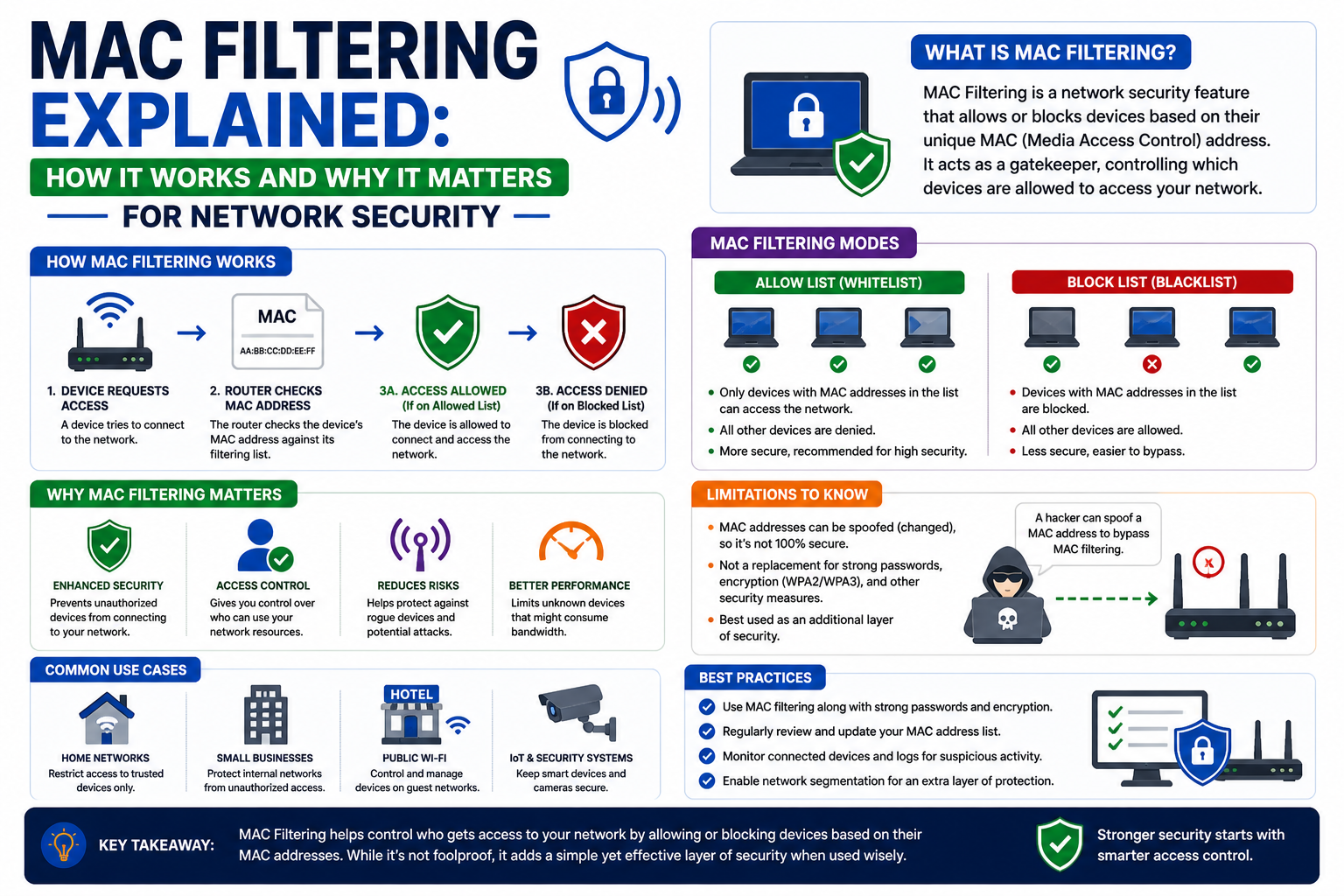
MAC filtering is a widely used network management technique that controls which devices can connect to a network by checking their unique identifiers, known as MAC addresses. Every network-enabled device carries a MAC address assigned to its network interface, and this identifier becomes the basis for filtering decisions. Network administrators rely on this method to either permit or deny access, making it a simple yet practical way to manage connectivity. Although it is not considered a strong standalone security solution, it plays an important role in organizing and controlling network environments, especially where ease of access and basic control are required.
The concept behind MAC filtering is straightforward. When a device attempts to connect to a network, the network infrastructure—such as a router, switch, or access point—checks the MAC address of that device against a predefined list. If the address is on the approved list, access is granted. If it appears on a blocked list or is not recognized, the connection is denied or restricted. This mechanism allows administrators to enforce policies without requiring users to manually configure settings on their devices, which is especially useful in environments with many transient users.
Breaking Down the Role of MAC Addresses
To fully understand MAC filtering, it is essential to grasp the role of MAC addresses themselves. A MAC address is a unique identifier assigned to a network interface card. It is typically represented as six pairs of hexadecimal numbers separated by colons. These identifiers are designed to be globally unique, ensuring that no two devices share the same address under normal circumstances. This uniqueness is what allows MAC filtering to function as a device-level control mechanism.
Each MAC address consists of two main components. The first portion is known as the Organizationally Unique Identifier (OUI), which identifies the manufacturer of the device. This part helps in recognizing the vendor and sometimes gives insight into the type of device. The second portion is specific to the individual device, making each address distinct. Together, these components create a system where devices can be uniquely identified across networks.
Despite their intended uniqueness, MAC addresses can be altered. Devices may use either a burned-in address, which is assigned by the manufacturer, or a locally administered address, which can be changed by the user or software. This flexibility introduces both advantages and limitations in the context of MAC filtering. While it allows customization and testing, it also reduces the reliability of MAC filtering as a strict security measure.
How MAC Filtering Works in Practice
MAC filtering operates by comparing incoming device addresses against a configured list. There are generally two approaches: allow lists and deny lists. An allow list contains only the MAC addresses permitted to connect, meaning any device not explicitly listed is blocked. A deny list, on the other hand, blocks specific addresses while allowing all others to connect. Each approach serves different purposes depending on the network environment and desired level of control.
When a device sends data to a network, its MAC address is included in the frame header. Network devices read this information and make decisions based on predefined rules. In a standard network operation, this process happens automatically for routing and switching purposes. However, MAC filtering introduces an additional layer of decision-making, where the address is evaluated not just for delivery but also for permission.
This method is often implemented at the access point level in wireless networks or at switches in wired environments. It can also be integrated into higher-level systems that apply policies such as bandwidth limits, access privileges, or authentication requirements. By linking MAC addresses to specific rules, administrators can tailor the network experience for different devices without requiring user intervention.
Applications of MAC Filtering in Real-World Scenarios
MAC filtering is commonly used in environments where controlling access quickly and efficiently is more important than enforcing strict security. For example, in guest networks, administrators may allow temporary access by registering a device’s MAC address. This approach simplifies onboarding and reduces the need for complex authentication processes.
In service provider environments, MAC filtering can be used to manage customer equipment. Internet service providers may identify customer devices by their MAC addresses and assign bandwidth limits or usage policies accordingly. This ensures that each user receives the appropriate level of service without requiring constant manual configuration.
Another practical use case is in controlled access environments such as offices or campuses. Known devices can be pre-approved, allowing employees to connect seamlessly, while unknown devices are either blocked or redirected to a limited-access network. This helps maintain a balance between convenience and control, ensuring that authorized users can work efficiently while reducing the risk of unauthorized access.
MAC filtering also appears in temporary or high-turnover settings where users frequently change. In such cases, the ability to quickly add or remove devices from a list becomes valuable. It allows administrators to maintain order without deploying complex authentication systems that may be unnecessary for short-term use.
Advantages of Using MAC Filtering
One of the main advantages of MAC filtering is its simplicity. It is easy to configure and does not require advanced technical knowledge to implement. This makes it accessible for small networks or situations where quick deployment is needed. Administrators can manage access with minimal overhead, making it an efficient solution for basic network control.
Another benefit is its transparency to users. Once a device is approved, the user typically does not need to take any additional steps to connect. This creates a seamless experience, which is particularly important in environments where user convenience is a priority. By reducing friction, MAC filtering helps ensure that users can access the network without unnecessary complications.
MAC filtering also provides a basic level of device identification. By associating MAC addresses with specific devices, administrators can monitor network activity and apply policies accordingly. This can be useful for tracking usage patterns, managing resources, and identifying devices that may require special handling.
Limitations and Considerations of MAC Filtering
While MAC filtering offers several advantages, it is important to recognize its limitations. One of the most significant challenges is the ease with which MAC addresses can be spoofed. Because devices can change their MAC addresses, an unauthorized user can potentially bypass filtering by imitating an approved address. This undermines the reliability of MAC filtering as a security measure.
Another limitation is scalability. In large networks with many devices, maintaining an accurate list of MAC addresses can become cumbersome. Adding, removing, and updating entries requires ongoing effort, which can lead to errors or outdated configurations. This makes MAC filtering less practical for environments with a high number of users or frequent changes.
Additionally, MAC filtering does not provide encryption or protection against eavesdropping. It only controls access based on device identity, leaving other aspects of network security unaddressed. For this reason, it should not be relied upon as the sole method of securing a network. Instead, it is best used as part of a broader strategy that includes stronger authentication and encryption mechanisms.
The Role of MAC Filtering in Network Policy Enforcement
Beyond basic access control, MAC filtering can be used to enforce network policies. By associating specific MAC addresses with particular rules, administrators can customize the behavior of the network for different devices. This might include assigning different levels of access, limiting bandwidth, or directing traffic through specific routes.
For example, a network may allow certain devices full access to internal resources while restricting others to internet-only access. By linking these policies to MAC addresses, administrators can ensure consistent enforcement without requiring users to manually configure their settings. This approach simplifies management and helps maintain a structured network environment.
MAC filtering can also be integrated with other systems to enhance its effectiveness. When combined with authentication protocols or monitoring tools, it becomes part of a layered approach to network management. This integration allows for more sophisticated control while still leveraging the simplicity of MAC-based identification.
Understanding the Balance Between Convenience and Security
MAC filtering represents a balance between convenience and control. It provides an easy way to manage access without introducing complexity, but it does not offer strong protection against determined attackers. This makes it suitable for environments where ease of use is more important than high-level security.
In practice, the effectiveness of MAC filtering depends on how it is used. When applied in low-risk scenarios, it can be a valuable tool for maintaining order and ensuring that only known devices connect to the network. However, in high-risk environments, it should be supplemented with more robust measures to address its inherent weaknesses.
The key is to understand the role MAC filtering plays within the broader context of network management. It is not a complete solution, but rather one component of a larger strategy. By using it appropriately, administrators can take advantage of its strengths while mitigating its limitations.
Expanding the Concept of MAC Filtering in Network Control
MAC filtering continues to play a role in shaping how devices interact with a network by acting as a checkpoint for incoming connections. Once the basic concept is understood, it becomes easier to see how this technique fits into broader network management practices. Rather than functioning as a standalone mechanism, MAC filtering often operates alongside other controls to help administrators maintain order and efficiency. It serves as a practical way to define which devices are recognized and how they should behave once connected.
In many environments, the presence of numerous devices makes it necessary to categorize and manage them efficiently. MAC filtering provides a simple method to achieve this by linking each device to a specific identity. This identity can then be used to determine not only whether access is granted but also what level of access is appropriate. By organizing devices in this way, administrators can ensure that resources are allocated properly and that the network operates smoothly without unnecessary disruptions.
Device Identification and Policy Assignment
One of the more advanced uses of MAC filtering lies in its ability to support policy-based management. Instead of merely allowing or blocking access, networks can assign roles and permissions based on the MAC address of a device. This means that each device can be treated differently depending on its purpose or ownership. For example, a personal device might receive limited access, while a company-issued device could be granted full privileges.
This approach allows for a more dynamic network environment where rules are automatically applied without requiring manual intervention from users. As devices connect, the network identifies them and enforces the appropriate policies. This can include bandwidth restrictions, access to certain applications, or prioritization of traffic. By automating these decisions, MAC filtering helps reduce administrative workload and ensures consistency across the network.
Another important aspect of device identification is the ability to track and monitor activity. By associating network traffic with specific MAC addresses, administrators can gain insights into usage patterns and identify potential issues. This level of visibility is valuable for troubleshooting and optimizing performance, as it allows for targeted analysis rather than broad assumptions.
MAC Filtering in Wireless Network Environments
Wireless networks are one of the most common places where MAC filtering is applied. In these environments, controlling access can be more challenging due to the open nature of wireless signals. MAC filtering provides a straightforward way to manage which devices are allowed to connect without requiring complex configurations on the user side.
When a device attempts to join a wireless network, the access point checks its MAC address against a predefined list. If the address is recognized, the connection proceeds. If not, the device may be denied access or redirected to a limited network. This process happens quickly and often goes unnoticed by users, making it an efficient solution for maintaining control.
In guest networks, MAC filtering can simplify the onboarding process. Instead of requiring users to go through detailed authentication steps, administrators can register devices in advance or allow temporary access based on their MAC addresses. This creates a balance between accessibility and oversight, ensuring that users can connect بسهولة while still maintaining a level of control.
Wireless environments also highlight some of the challenges associated with MAC filtering. Because signals can be intercepted, it is possible for attackers to observe MAC addresses and attempt to replicate them. This reinforces the need to use MAC filtering as part of a broader security strategy rather than relying on it alone.
MAC Filtering in Wired Network Infrastructure
Although often associated with wireless networks, MAC filtering is equally relevant in wired environments. Switches and routers can use MAC addresses to determine how devices should be treated within the network. This is particularly useful in organizations where different departments or user groups require varying levels of access.
In a wired setup, MAC filtering can control which devices are allowed to connect to specific ports. For example, a switch port might be configured to accept traffic only from a known MAC address. If a different device is connected, the port can be disabled or restricted. This helps prevent unauthorized devices from gaining access, even if they are physically connected to the network.
This level of control is especially valuable in environments where physical security cannot be guaranteed at all times. By tying access to both the physical port and the MAC address, administrators add an extra layer of protection. While not foolproof, this approach reduces the likelihood of unauthorized access and helps maintain network integrity.
Wired networks also benefit from the ability to integrate MAC filtering with other technologies. For instance, it can be combined with authentication systems to create a more comprehensive access control framework. This layered approach ensures that even if one mechanism is bypassed, others remain in place to protect the network.
Managing Guest Access and Temporary Connections
One of the most practical uses of MAC filtering is in managing guest access. In environments such as offices, educational institutions, or public spaces, there is often a need to provide temporary connectivity to visitors. MAC filtering offers a convenient way to handle this without compromising the main network.
Administrators can create separate lists for guest devices, allowing them to connect for a limited time or with restricted privileges. Once the access period expires, the device can be removed from the list, effectively revoking its connection. This process is straightforward and does not require complex user interaction, making it ideal for high-turnover scenarios.
Another advantage of this approach is the ability to maintain a record of connected devices. By keeping track of MAC addresses, administrators can review past connections and identify patterns or anomalies. This information can be useful for both operational and security purposes, providing a clearer picture of how the network is being used.
However, managing guest access through MAC filtering also requires careful attention. Lists must be updated regularly to ensure that outdated entries do not remain active. Failure to do so can lead to unintended access or cluttered configurations that are difficult to manage over time.
Challenges in Scaling MAC Filtering Solutions
As networks grow in size and complexity, the limitations of MAC filtering become more apparent. One of the primary challenges is scalability. Maintaining a list of MAC addresses for a large number of devices can quickly become overwhelming. Each new device must be added manually, and any changes require updates to the configuration.
This process can lead to inefficiencies, particularly in environments where devices frequently change. For example, in organizations with many employees or students, keeping track of all MAC addresses can be time-consuming. Errors in the list can result in devices being incorrectly blocked or allowed, causing disruptions to normal operations.
Automation can help address some of these challenges, but it also introduces additional complexity. Integrating MAC filtering with automated systems requires careful planning and maintenance to ensure that everything functions correctly. Without proper oversight, automation can lead to unintended consequences that are difficult to troubleshoot.
Another issue related to scalability is the management of multiple network segments. In larger environments, different areas of the network may require different filtering rules. Coordinating these rules across multiple devices and locations can be challenging, especially if there is no centralized management system in place.
Security Implications and Practical Limitations
While MAC filtering provides a level of control, it is important to recognize its limitations in terms of security. One of the most significant concerns is the ease with which MAC addresses can be spoofed. Because these addresses can be changed, an attacker can potentially mimic an authorized device and gain access to the network.
This vulnerability is particularly relevant in wireless environments, where network traffic can be observed more easily. By capturing data packets, an attacker can identify valid MAC addresses and attempt to replicate them. This highlights the importance of using additional security measures to complement MAC filtering.
Another limitation is the lack of encryption. MAC filtering does not protect the data being transmitted over the network. Without encryption, sensitive information can be intercepted and accessed by unauthorized parties. This makes it essential to combine MAC filtering with protocols that provide data protection.
Despite these limitations, MAC filtering remains a useful tool when applied appropriately. It is most effective in environments where the risk level is relatively low and the primary goal is to manage access rather than enforce strict security. By understanding its strengths and weaknesses, administrators can make informed decisions about how to incorporate it into their network strategy.
Integrating MAC Filtering with Advanced Network Controls
As networks evolve, MAC filtering is rarely used in isolation. Instead, it becomes part of a layered approach where multiple technologies work together to manage access and enforce policies. This integration allows administrators to extend the usefulness of MAC filtering beyond simple allow-or-deny decisions. By combining it with authentication systems, monitoring tools, and access control frameworks, networks can achieve a more refined and adaptive level of management.
In many environments, MAC filtering acts as an initial checkpoint. When a device attempts to connect, its MAC address is evaluated before any deeper authentication takes place. If the device passes this first stage, it may then be subject to additional verification methods such as credentials or certificates. This layered design ensures that even if one mechanism is bypassed, others remain in place to protect the network. It also allows administrators to create flexible policies that adapt to different types of users and devices.
This integration is particularly useful in environments where a mix of managed and unmanaged devices exists. Managed devices can be pre-registered and assigned specific policies, while unmanaged devices can be placed into restricted segments. MAC filtering helps distinguish between these categories quickly, enabling the network to respond appropriately without requiring manual intervention at every step.
Role of MAC Filtering in Network Segmentation
Network segmentation is a critical strategy for organizing and securing modern infrastructures, and MAC filtering can contribute to this process. By identifying devices based on their MAC addresses, networks can assign them to specific segments or virtual networks. This ensures that devices only interact with resources that are relevant to their role, reducing unnecessary exposure and improving overall efficiency.
For example, devices belonging to internal staff can be placed in a segment with full access to organizational resources, while guest devices are confined to a limited segment with restricted permissions. MAC filtering helps enforce these boundaries by ensuring that only recognized devices are allowed into each segment. This separation not only improves security but also enhances performance by reducing congestion and limiting broadcast traffic.
Segmentation also simplifies troubleshooting and monitoring. When devices are grouped logically, it becomes easier to identify issues and isolate problems. MAC filtering supports this by maintaining a clear mapping between devices and their assigned segments. This clarity is valuable in complex environments where visibility is essential for maintaining stability and performance.
Enhancing User Experience Through Automated Access
One of the less obvious benefits of MAC filtering is its ability to improve user experience. By automatically recognizing devices, networks can provide seamless connectivity without requiring repeated authentication. Once a device is approved, it can reconnect effortlessly whenever it is within range, creating a smooth and consistent experience for users.
This is particularly important in environments where users expect quick and reliable access. For instance, employees returning to the workplace or students moving between locations benefit from a system that remembers their devices. MAC filtering enables this continuity by linking each device to its corresponding permissions and settings. As a result, users can focus on their tasks without being interrupted by repeated login prompts or configuration steps.
Automation also reduces the burden on support teams. When devices are recognized automatically, there are fewer connectivity issues to resolve. This allows administrators to focus on more critical tasks rather than handling routine access requests. Over time, this efficiency contributes to a more stable and responsive network environment.
Monitoring and Auditing Network Activity
MAC filtering plays a role in monitoring and auditing by providing a consistent way to identify devices. Every interaction on the network can be associated with a specific MAC address, creating a detailed record of activity. This information is valuable for analyzing usage patterns, detecting anomalies, and ensuring compliance with policies.
By tracking MAC addresses, administrators can identify which devices are consuming the most resources or generating unusual traffic. This insight helps in optimizing performance and addressing potential issues before they escalate. It also supports accountability by linking actions to specific devices, making it easier to investigate incidents or enforce rules.
Auditing capabilities are especially important in environments where maintaining records is necessary for operational or regulatory reasons. MAC filtering contributes to this by providing a reliable identifier that remains consistent across sessions. Even if other aspects of the connection change, the MAC address serves as a stable reference point for tracking activity over time.
However, it is important to recognize that monitoring based solely on MAC addresses has limitations. If a device changes its address, the continuity of tracking may be disrupted. This reinforces the need to combine MAC filtering with other identification methods to ensure accurate and reliable monitoring.
Addressing the Weakness of MAC Address Spoofing
One of the most significant challenges associated with MAC filtering is the possibility of spoofing. Because MAC addresses can be modified, an attacker can impersonate a legitimate device by adopting its address. This undermines the reliability of MAC-based controls and highlights the need for additional safeguards.
To address this issue, networks often implement complementary measures that verify the authenticity of devices. These measures may include authentication protocols, encryption, and behavioral analysis. By combining these techniques with MAC filtering, administrators can create a more robust defense against unauthorized access.
Another approach is to monitor for inconsistencies in device behavior. If a MAC address suddenly appears in a different location or exhibits unusual activity, it may indicate spoofing. By analyzing these patterns, networks can detect potential threats and take appropriate action. This proactive approach helps mitigate the risks associated with MAC address manipulation.
Despite these challenges, MAC filtering remains useful when applied with an understanding of its limitations. It should not be relied upon as the sole line of defense but rather as one component of a comprehensive security strategy. When used in conjunction with stronger controls, it contributes to a more resilient network environment.
Balancing Administrative Effort and Network Efficiency
Managing MAC filtering requires a balance between administrative effort and operational efficiency. On one hand, maintaining accurate lists of MAC addresses ensures that only authorized devices can connect. On the other hand, the process of updating these lists can become time-consuming, particularly in dynamic environments where devices frequently change.
To address this, many networks adopt strategies that streamline management. Automation tools can help update lists based on predefined criteria, reducing the need for manual intervention. Centralized management systems can also simplify the process by providing a single interface for configuring and monitoring multiple devices. These approaches help maintain efficiency while ensuring that policies remain consistent across the network.
Another consideration is the level of granularity required. In some cases, it may be sufficient to apply broad rules that cover groups of devices rather than managing each address individually. This reduces complexity and makes the system easier to maintain. However, it also requires careful planning to ensure that the rules align with organizational needs.
Ultimately, the effectiveness of MAC filtering depends on how well it is managed. By adopting practices that balance control with efficiency, administrators can maximize its benefits while minimizing the associated challenges.
Evolving Role of MAC Filtering in Modern Networking
As technology continues to advance, the role of MAC filtering is evolving. While it remains a useful tool for basic access control, it is increasingly being integrated into more sophisticated systems. Modern networks rely on a combination of techniques to achieve security and performance, and MAC filtering contributes by providing a simple and reliable method of device identification.
In environments where flexibility and scalability are important, MAC filtering is often used as part of a broader framework. It complements other technologies by adding an additional layer of control that is easy to implement and understand. This makes it a valuable component in both small and large networks, even as more advanced solutions become available.
The continued relevance of MAC filtering lies in its simplicity and adaptability. While it may not address every challenge on its own, it provides a foundation upon which more complex systems can be built. By understanding its strengths and limitations, network administrators can use it effectively as part of a comprehensive strategy that supports both operational efficiency and security.
Strengthening Network Security with Layered Approaches
MAC filtering becomes most effective when it is used as part of a broader, layered security strategy rather than as a standalone solution. In modern network environments, relying on a single control is rarely sufficient to address the wide range of potential threats. Instead, administrators combine multiple techniques to create overlapping layers of protection, ensuring that if one layer is bypassed, others remain in place to defend the system.
Within this layered model, MAC filtering serves as an initial checkpoint that helps identify devices before granting access. It works well alongside authentication protocols, encryption standards, and user verification methods. By integrating these elements, networks can ensure that both the device and the user are validated before allowing full access. This approach reduces the likelihood of unauthorized connections and strengthens overall network resilience.
Layered security also introduces flexibility. Different environments can apply varying levels of control based on their specific needs. For example, a low-risk network may rely more heavily on MAC filtering for convenience, while a high-risk environment may use it only as a supplementary measure alongside stricter authentication systems. This adaptability allows organizations to tailor their security strategies to match their operational requirements.
Combining MAC Filtering with Authentication Mechanisms
To address the limitations of MAC filtering, many networks pair it with authentication mechanisms that verify user identity. This combination ensures that even if a device’s MAC address is spoofed, additional checks are required before access is granted. Authentication methods may include credentials, certificates, or multi-factor verification, each adding another layer of assurance.
By linking MAC addresses with authenticated sessions, networks can create a more reliable mapping between devices and users. This association helps maintain accountability and ensures that access privileges are applied correctly. It also simplifies management by allowing administrators to define policies based on both device identity and user role.
This integration is particularly useful in environments where sensitive data or critical systems are involved. In such cases, simply recognizing a device is not enough; the network must also confirm that the user operating the device is authorized. Combining MAC filtering with authentication achieves this goal while maintaining a balance between security and usability.
Optimizing Resource Allocation and Performance
Beyond access control, MAC filtering can contribute to efficient resource management. By identifying devices and assigning policies accordingly, networks can allocate bandwidth and prioritize traffic based on importance. This ensures that critical applications receive the necessary resources while less important activities are limited to prevent congestion.
For instance, devices associated with essential operations can be given higher priority, ensuring consistent performance even during periods of heavy usage. Meanwhile, guest devices or non-critical applications may be assigned lower priority to preserve overall network stability. MAC filtering enables this differentiation by providing a reliable way to identify and categorize devices.
This approach not only improves performance but also enhances user satisfaction. When resources are managed effectively, users experience fewer interruptions and better connectivity. This is especially important in environments where consistent performance is essential for productivity or service delivery.
Practical Use in Everyday Network Environments
In everyday scenarios, MAC filtering is often used to simplify connectivity while maintaining a basic level of control. Home networks, small offices, and public access points frequently rely on this technique to manage which devices can connect. Its straightforward configuration makes it accessible even for users with limited technical expertise.
For example, a home user may choose to allow only known devices to connect to their network. This prevents unauthorized access while keeping the setup simple and manageable. In small office environments, MAC filtering can help ensure that only company devices are granted access, reducing the risk of external interference.
Public access environments also benefit from the ease of MAC filtering. By quickly adding or removing devices from a list, administrators can manage access without requiring complex authentication systems. This is particularly useful in situations where users need temporary connectivity and convenience is a priority.
Recognizing the Limitations in High-Security Contexts
Despite its usefulness, MAC filtering has clear limitations when applied to high-security environments. The ability to alter MAC addresses means that determined attackers can potentially bypass this control. Additionally, the lack of encryption means that it does not protect the data being transmitted across the network.
In environments where security is critical, these limitations cannot be ignored. Organizations must implement stronger measures such as encrypted connections, advanced authentication protocols, and continuous monitoring. MAC filtering can still play a role, but it should be viewed as an additional layer rather than a primary defense.
Understanding these limitations is essential for making informed decisions about network design. By recognizing where MAC filtering is effective and where it falls short, administrators can deploy it in ways that maximize its benefits while minimizing its risks.
Maintaining and Updating MAC Filtering Configurations
Effective use of MAC filtering requires ongoing maintenance. As devices are added, removed, or replaced, the list of MAC addresses must be updated to reflect these changes. Failure to maintain accurate records can lead to connectivity issues or unintended access, both of which can disrupt network operations.
Regular reviews of the filtering configuration help ensure that only authorized devices remain on the list. This process may involve removing outdated entries, verifying current devices, and adjusting policies as needed. By keeping the configuration up to date, administrators can maintain a consistent and reliable network environment.
Automation can assist in this process by reducing the need for manual updates. Systems that automatically register and manage MAC addresses can streamline administration and reduce the likelihood of errors. However, these systems must be carefully managed to ensure that they operate as intended and do not introduce new vulnerabilities.
Future Perspective of MAC Filtering in Networking
As networking technologies continue to advance, the role of MAC filtering is expected to remain relevant, though its function may evolve. With the increasing complexity of networks and the growing number of connected devices, simple identification methods like MAC addresses still provide value as part of a larger framework.
Future network designs are likely to incorporate MAC filtering into more sophisticated systems that use multiple identifiers and advanced analytics. In this context, MAC filtering contributes to a broader understanding of device behavior and network activity. It becomes one piece of a larger puzzle that includes user identity, device health, and contextual information.
This evolution highlights the importance of adaptability in network management. While newer technologies may offer enhanced capabilities, foundational techniques like MAC filtering continue to provide a reliable starting point. By integrating them into modern systems, administrators can build networks that are both efficient and secure.
Final Thoughts
MAC filtering remains a practical and accessible method for managing network access and organizing device interactions. Its simplicity makes it easy to implement, while its flexibility allows it to be adapted to a wide range of environments. From small home networks to larger organizational setups, it provides a basic level of control that helps maintain order and efficiency.
However, its true value lies in how it is used alongside other technologies. When combined with authentication, encryption, and monitoring, MAC filtering becomes part of a comprehensive strategy that addresses both usability and security. By understanding its strengths and limitations, network administrators can apply it effectively, ensuring that their networks remain both functional and protected.