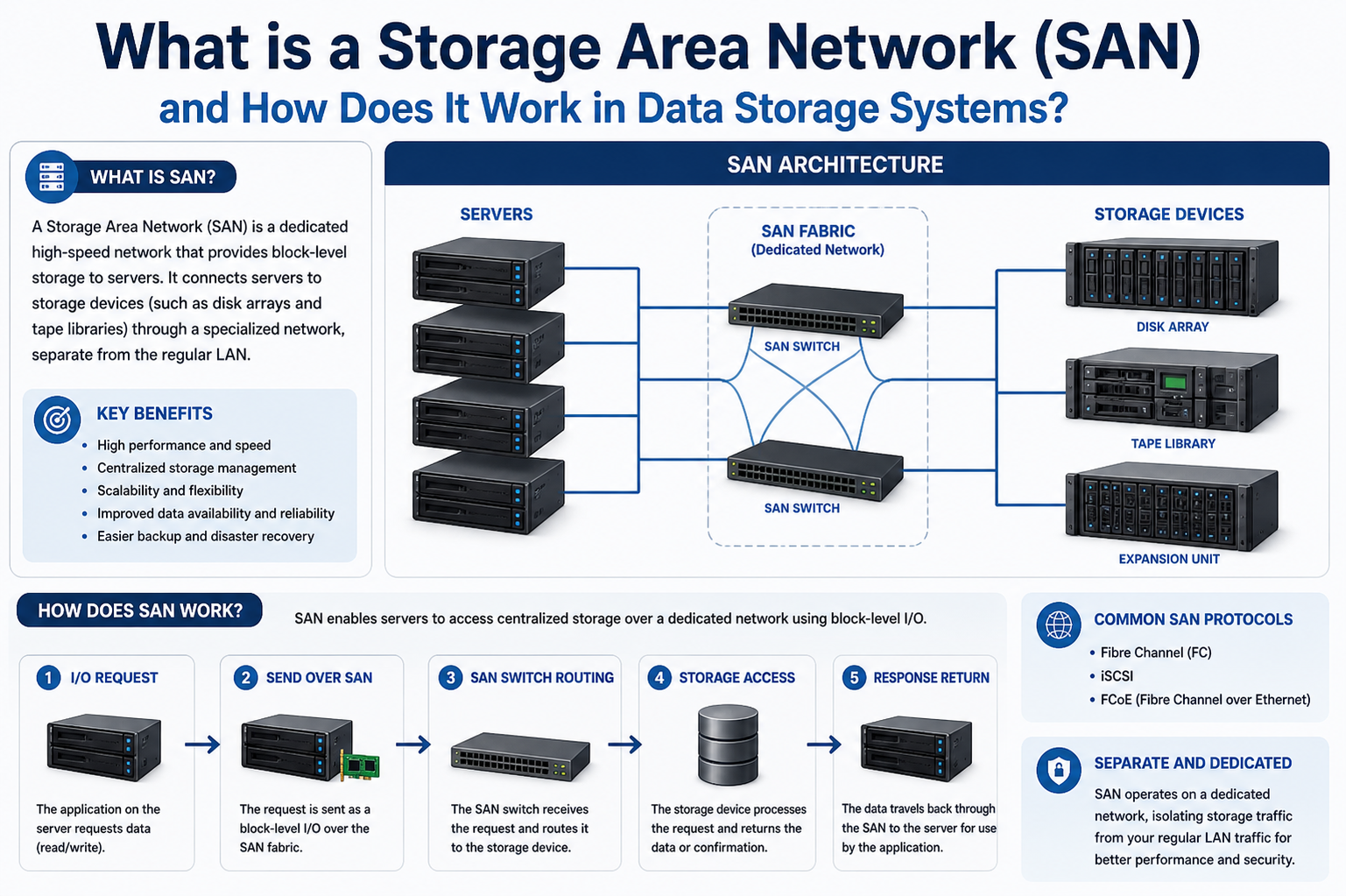
A Storage Area Network, commonly referred to as SAN, is a specialized and high-performance network designed to deliver block-level access to centralized storage resources. Unlike traditional storage methods where data is directly attached to a single server, SAN introduces a separate, dedicated network that connects multiple servers to shared storage devices. This approach transforms how data is stored, accessed, and managed within modern IT environments. By separating storage from individual machines and placing it on a robust network, organizations can achieve greater efficiency, flexibility, and performance. The concept revolves around providing servers with the illusion that storage is locally attached, even though it may reside across a network infrastructure, often miles away. This abstraction is one of the key factors that makes SAN such a powerful solution in enterprise computing.
Evolution from Traditional Storage to SAN
In earlier computing environments, storage was typically implemented using Directly Attached Storage, where disks were physically connected to a single server. While this approach was simple and cost-effective for small setups, it quickly became inefficient as organizations grew and data volumes expanded. Managing storage on a per-server basis led to issues such as underutilized capacity, limited scalability, and complex data management. As businesses began adopting virtualization and distributed applications, the need for a more flexible and centralized storage solution became apparent. SAN emerged as a response to these challenges, offering a way to decouple storage from servers and create a shared pool of resources accessible across the network. This shift marked a significant advancement in data center architecture, enabling organizations to handle large-scale workloads more effectively.
Core Purpose and Functionality of SAN
The primary purpose of a SAN is to provide high-speed, reliable access to storage resources for multiple servers simultaneously. It achieves this by using a dedicated network infrastructure that is optimized specifically for data transfer, minimizing latency and maximizing throughput. Unlike general-purpose networks that handle a variety of traffic types, a SAN focuses exclusively on storage communication, ensuring consistent performance. Servers connected to a SAN can read and write data as if they were interacting with local disks, even though the storage is centralized. This functionality is particularly important for applications that require rapid data access, such as databases, virtualization platforms, and enterprise resource planning systems. By delivering block-level storage, SAN allows applications to operate with precision and efficiency, making it a preferred choice for performance-critical environments.
How SAN Enables Centralized Storage Management
One of the defining features of a SAN is its ability to centralize storage resources into a single, manageable pool. Instead of managing individual disks across multiple servers, administrators can allocate and control storage from a unified interface. This centralization simplifies tasks such as provisioning new storage, expanding capacity, and monitoring performance. It also enhances resource utilization, as unused storage from one server can be reallocated to another without physical reconfiguration. Centralized management reduces administrative overhead and minimizes the risk of errors, making it easier to maintain a consistent and efficient storage environment. Additionally, it allows organizations to implement standardized policies for data protection, backup, and recovery, ensuring that critical information is always secure and accessible.
Role of High-Speed Networking in SAN
The effectiveness of a SAN largely depends on the speed and reliability of its underlying network. Unlike traditional networks that may experience congestion due to mixed traffic, SAN networks are designed for high-performance data transfer. They often utilize advanced technologies that support extremely fast communication between servers and storage devices. This dedicated network ensures that data flows smoothly without interference, enabling applications to perform at optimal levels. The use of specialized protocols and hardware further enhances performance by reducing latency and increasing bandwidth. As a result, SAN can handle large volumes of data with ease, making it suitable for environments where speed and responsiveness are critical. The emphasis on high-speed networking is what distinguishes SAN from other storage solutions and contributes to its widespread adoption in enterprise settings.
Block-Level Storage and Its Importance
A key characteristic of SAN is its use of block-level storage, which differs significantly from file-level storage used in other systems. In block-level storage, data is divided into fixed-size blocks that can be accessed directly by the operating system. This approach provides greater flexibility and control, as applications can manage data at a granular level. Block-level access is particularly beneficial for databases and transactional systems, where performance and precision are essential. It allows for faster read and write operations, reducing delays and improving overall efficiency. By providing direct access to storage blocks, SAN enables applications to operate more effectively, making it an ideal choice for demanding workloads. This capability is one of the reasons why SAN is often used in environments that require high performance and reliability.
Integration with Modern Data Centers
In today’s data centers, SAN plays a crucial role in supporting complex and dynamic IT environments. With the rise of virtualization and cloud computing, the demand for flexible and scalable storage solutions has increased significantly. SAN integrates seamlessly with these technologies, providing the foundation for virtual machines and applications to access shared storage resources. It allows administrators to allocate storage dynamically, ensuring that resources are available where they are needed most. This integration enhances the efficiency of data centers by enabling better resource management and reducing the need for physical hardware. As organizations continue to adopt modern computing paradigms, SAN remains a key component in delivering the performance and scalability required to support these advancements.
Scalability as a Fundamental Advantage
Scalability is one of the most important benefits offered by a SAN. As data requirements grow, organizations need a storage solution that can expand without causing disruptions. SAN addresses this need by allowing additional storage devices to be added بسهولة to the existing network. This expansion can often be performed without downtime, ensuring continuous operation of critical applications. The ability to scale storage independently of servers provides greater flexibility and reduces the need for costly hardware upgrades. It also enables organizations to plan for future growth, ensuring that their storage infrastructure can adapt to changing demands. This scalability makes SAN an attractive option for businesses of all sizes, from small enterprises to large corporations with extensive data needs.
Performance Optimization Through SAN Architecture
The architecture of a SAN is designed to deliver optimal performance for data-intensive applications. By using a dedicated network and advanced technologies, SAN minimizes delays and ensures consistent data access speeds. Techniques such as data striping and tiering further enhance performance by distributing data across multiple storage devices and prioritizing frequently accessed information. These optimizations allow applications to run more efficiently, reducing bottlenecks and improving user experience. The ability to maintain high performance even under heavy workloads is a key advantage of SAN, making it suitable for environments where reliability and speed are critical. This performance-focused design is what sets SAN apart from other storage solutions and makes it a preferred choice for enterprise applications.
Flexibility in Storage Allocation
Another significant aspect of SAN is its flexibility in allocating storage resources. Unlike traditional systems যেখানে storage is tied to specific hardware, SAN allows administrators to assign storage dynamically based on current needs. This means that storage can be increased, decreased, or reallocated without physically moving disks or reconfiguring servers. This flexibility simplifies management and ensures that resources are used efficiently. It also enables organizations to respond quickly to changing requirements, سواء it is supporting new applications or handling increased data volumes. By providing a flexible and adaptable storage environment, SAN helps organizations maintain efficiency and reduce operational complexity.
Support for Both Physical and Virtual Environments
SAN is designed to support a wide range of computing environments, including both physical servers and virtual machines. In traditional setups, physical servers can connect directly to the SAN and access shared storage resources. In virtualized environments, SAN provides the underlying storage infrastructure that enables virtual machines to operate efficiently. This dual support makes SAN a versatile solution that can adapt to مختلف IT architectures. It also ensures that organizations can leverage the benefits of virtualization without compromising on storage performance. By supporting both physical and virtual environments, SAN plays a crucial role in modern IT infrastructure, enabling organizations to maximize their resources and improve overall efficiency.
Simplification of Data Management Processes
Managing data across multiple systems can be a complex and time-consuming task. SAN simplifies this process by providing a centralized platform for storage management. Administrators can monitor performance, allocate resources, and implement policies from a single interface, reducing the need for manual intervention. This centralization not only improves efficiency but also enhances consistency, as all storage resources are managed وفق a unified set of rules. It also makes it easier to implement data protection measures, such as backups and replication, ensuring that critical information is always محفوظ. By streamlining data management processes, SAN يساعد organizations focus on their core operations rather than dealing with storage complexities.
Foundation for Advanced Storage Technologies
SAN serves as a foundation for many advanced storage technologies that are essential in modern computing. Features such as data replication, snapshots, and automated failover are often built on top of SAN infrastructure. These capabilities enhance data protection and ensure business continuity in the event of failures or disasters. By providing a reliable and scalable platform, SAN enables organizations to implement sophisticated storage strategies that go beyond basic data storage. This foundation supports innovation and allows businesses to adopt new technologies with confidence, knowing that their storage infrastructure can دعم their needs.
Distinguishing SAN from Other Storage Architectures
To fully understand the value of a Storage Area Network, it is important to compare it with other storage approaches commonly used in IT environments. Traditional storage models such as directly attached storage rely on physical connections between a server and its disks, which limits flexibility and scalability. In contrast, SAN introduces a network-based approach that separates storage from compute resources. Another widely used model is network-based file storage, where data is shared over standard networks using file-level protocols. While this method is effective for general file sharing, it does not match the performance and precision of block-level access provided by SAN. The distinction lies in how data is accessed and managed. SAN delivers raw storage blocks directly to applications, enabling faster processing and better control, whereas other systems often rely on higher-level abstractions that can introduce delays and limitations.
Understanding File-Level Versus Block-Level Access
One of the most significant differences between storage systems lies in how data is accessed. File-level storage presents data as complete files and directories, making it easy for users and applications to interact with information in a familiar way. However, this convenience comes with overhead, as the system must manage file structures and permissions. Block-level storage, which is the foundation of SAN, operates at a lower level by dividing data into smaller units called blocks. These blocks are managed directly by the operating system or application, allowing for more efficient data handling. This approach eliminates many of the bottlenecks associated with file-level systems and provides greater flexibility for performance tuning. Applications that require rapid and consistent data access, such as transactional databases, benefit greatly from this method, as it allows them to interact with storage in a more direct and efficient manner.
Architectural Design of a SAN Environment
A SAN environment is built on a carefully designed architecture that ensures high performance, reliability, and scalability. At its core, the architecture consists of interconnected components that work together to deliver seamless storage access. Servers act as the initiators, requesting data from storage devices, while the storage systems serve as targets, responding to those requests. Between these components lies the network fabric, which is responsible for transmitting data بسرعة and efficiently. This fabric is designed to handle large volumes of data traffic without congestion, ensuring consistent performance. The architecture also includes redundancy at multiple levels, بحيث even if one component fails, the system can continue operating without interruption. This design philosophy is essential for maintaining the availability of critical applications and services.
Role of SAN Switches in Network Fabric
SAN switches are a fundamental part of the network fabric, acting as the نقطة الاتصال that connects servers to storage devices. These switches are specifically designed to handle storage traffic and provide features that enhance performance and reliability. They support high-speed communication and offer advanced capabilities such as zoning, which controls access between different devices on the network. By تنظيم how data flows within the SAN, switches help prevent conflicts and ensure that resources are used efficiently. They also play a key role in maintaining redundancy, as multiple switches can be deployed to create alternative data paths. This ensures that even if one path fails, data can still reach its destination through another route, minimizing downtime and maintaining system stability.
Function of Host Bus Adapters in SAN Connectivity
Host Bus Adapters, often referred to as HBAs, are specialized hardware components installed in servers to enable communication with the SAN. These adapters act as the interface between the server’s internal system and the external storage network. They are responsible for converting data into a format that can be transmitted over the SAN and ensuring that communication is efficient and reliable. HBAs are designed to handle high-speed data transfer and support the protocols used in SAN environments. In virtualized systems, similar functionality can be achieved through virtual adapters, allowing virtual machines to connect to the SAN without requiring physical hardware. This capability extends the benefits of SAN to virtual environments, ensuring that all systems can access shared storage resources seamlessly.
Importance of Cabling and Physical Connectivity
The physical connections within a SAN are critical to its overall performance and reliability. High-quality cabling is used to link servers, switches, and storage devices, forming the backbone of the network. Depending on the requirements, different types of cables may be used to achieve the desired balance between speed, distance, and cost. Optical connections are often preferred for their ability to transmit data over long distances with minimal signal loss, بينما shorter connections may use alternative materials to reduce expenses. Proper installation and maintenance of these connections are essential for ensuring consistent performance. Any ضعف or failure in the physical layer can impact the entire network, highlighting the importance of careful planning and التنفيذ.
Storage Arrays and Their Role in Data Handling
Storage arrays are the قلب of a SAN, responsible for storing and managing data. These systems consist of multiple disks تعمل together to provide high capacity, performance, and reliability. Advanced techniques are used to protect data and ensure its availability, even in the event of hardware failures. For example, data can be distributed across multiple disks to improve performance and provide redundancy. Storage arrays also support features such as snapshots and replication, which enable efficient data protection and recovery. By centralizing storage within these arrays, organizations can achieve better control over their data and ensure that it is always accessible when needed. The design and configuration of storage arrays play a crucial role in determining the overall effectiveness of a SAN.
Management Software and Administrative Control
Managing a SAN requires specialized software that provides visibility and control over the entire storage environment. This software allows administrators to monitor performance, allocate resources, and configure settings according to organizational needs. Through a centralized interface, it becomes possible to manage complex storage infrastructures with ease. Tasks such as creating logical volumes, تنظیم access permissions, and tracking usage can all be performed from a single platform. This level of control is essential for maintaining efficiency and ensuring that resources are used effectively. Management software also provides insights into system performance, helping administrators identify potential issues and take corrective action before they impact operations.
Common Communication Protocols in SAN
Communication within a SAN is governed by specific protocols that define how data is transmitted between devices. These protocols are designed to ensure reliable and efficient data transfer, even under heavy workloads. Some protocols use dedicated network technologies to achieve extremely high speeds and low latency, making them ideal for performance-critical applications. Others leverage existing network infrastructure to provide a more cost-effective solution, while still delivering acceptable performance. There are also hybrid approaches that combine different technologies to maximize efficiency and flexibility. The choice of protocol depends on factors such as budget, الأداء requirements, and existing infrastructure. Understanding these protocols is essential for designing and implementing an effective SAN.
Performance Benefits of Dedicated Storage Networks
One of the primary advantages of a SAN is its ability to deliver consistent and high الأداء. By using a dedicated network for storage traffic, SAN eliminates the competition for bandwidth that occurs in shared networks. This ensures that data can be transferred بسرعة and without delays, even during peak usage periods. The separation of storage and general network traffic also enhances reliability, as issues in one network do not directly impact the other. This isolation is particularly important for applications that require uninterrupted access to data. By providing a stable and high-performance environment, SAN enables organizations to run critical workloads with confidence.
Redundancy and High Availability Features
High availability is a key requirement for modern IT systems, and SAN is designed to meet this need through built-in redundancy. Multiple components within the network, including switches, connections, and storage devices, are duplicated to provide backup in case of failure. If one component becomes unavailable, another can take over seamlessly, ensuring continuous operation. This redundancy extends to data paths, بحيث multiple routes are available for data to travel between servers and storage. These features minimize the risk of downtime and protect against data loss, making SAN a reliable choice for mission-critical applications. The emphasis on availability ensures that businesses can maintain operations even in the face of unexpected challenges.
Security Mechanisms Within SAN Environments
Security is an essential aspect of any storage system, and SAN توفر several mechanisms to protect data. Access to storage resources can be controlled at a granular level, ensuring that only authorized systems can interact with specific البيانات. Techniques such as zoning and masking are used to restrict communication between devices, reducing the risk of unauthorized access. Encryption can also be implemented to protect data أثناء transmission and storage, adding an extra layer of security. These measures help organizations safeguard sensitive information and comply with regulatory requirements. By integrating security into its design, SAN provides a robust and trustworthy storage solution.
Adaptability to Changing Business Requirements
Modern organizations operate in dynamic environments where requirements can change rapidly. SAN is designed to adapt to these changes by providing a flexible and scalable storage platform. New storage devices can be added, and existing resources can be reconfigured without significant disruption. This adaptability allows businesses to respond quickly to evolving needs, whether it involves زيادة capacity, تحسين performance, or supporting new applications. The ability to make changes without affecting ongoing operations is a major advantage, as it reduces downtime and ensures continuity. By offering a المستقبل-ready solution, SAN helps organizations stay competitive and prepared for growth.
Advantages of Centralized Storage in Enterprise Environments
Centralized storage is one of the most impactful advantages of a Storage Area Network, as it transforms how organizations handle data across multiple systems. Instead of distributing storage across individual servers, all data resides within a unified pool that can be accessed by authorized systems. This approach reduces duplication, improves consistency, and ensures that data is always available when needed. Centralization also simplifies administrative tasks, as IT teams can manage storage resources from a single point rather than التعامل with fragmented systems. It enhances visibility into storage usage, allowing organizations to make informed decisions about capacity planning and performance optimization. By consolidating storage, SAN creates a more organized and efficient infrastructure that supports modern workloads and business requirements.
Scalability and Seamless Expansion of Storage Resources
Scalability is a defining feature that allows SAN to accommodate growing data demands without major disruptions. As organizations generate more data, they require storage systems that can expand quickly and efficiently. SAN enables this by allowing additional storage devices to be integrated into the network with minimal effort. This expansion can often occur without interrupting ongoing operations, ensuring that applications remain available to users. The ability to scale independently of compute resources means that organizations do not need to upgrade servers simply to gain more storage capacity. This flexibility reduces costs and simplifies long-term planning. By providing a scalable foundation, SAN ensures that businesses can continue to grow without being constrained by storage limitations.
Enhanced Performance for Data-Intensive Applications
Performance is a critical consideration for applications that rely on fast and consistent data access. SAN is designed to deliver high الأداء by leveraging dedicated networks and advanced technologies that minimize latency and maximize throughput. This ensures that data can be accessed quickly, even under heavy workloads. Applications such as databases, analytics platforms, and virtualization systems benefit greatly from this الأداء, as they require rapid read and write operations to function effectively. SAN also supports techniques like load balancing and data distribution, which further تحسين performance by preventing bottlenecks. The result is a storage environment that can handle demanding workloads while maintaining reliability and efficiency.
High Availability and Fault Tolerance Mechanisms
Ensuring that data is always accessible is a top priority for organizations, and SAN addresses this requirement through robust availability features. Redundancy is built into the architecture at multiple levels, including storage devices, network paths, and controllers. If one component fails, another can take over without interrupting service. This fault-tolerant design minimizes downtime and protects against data loss, making SAN suitable for mission-critical applications. The ability to perform maintenance or upgrades without affecting availability is another advantage, as it allows systems to remain operational even during تغييرات. By prioritizing availability, SAN helps organizations maintain continuity and avoid costly disruptions.
Disaster Recovery and Data Protection Capabilities
Disaster recovery is an essential aspect of modern data management, and SAN provides powerful tools to support it. By centralizing storage, SAN makes it easier to replicate data to remote locations, ensuring that a backup is always available in case of failure. Replication can be configured to occur in real time or at scheduled intervals, depending on the organization’s needs. This capability enables سريع recovery of operations after unexpected events such as hardware failures, natural disasters, or cyber incidents. Additional features such as snapshots allow organizations to capture point-in-time copies of data, which can be used for recovery or testing purposes. These capabilities enhance resilience and ensure that critical data is protected against various risks.
Improved Security and Access Control
Security is a fundamental concern in any storage environment, and SAN provides advanced mechanisms to protect sensitive information. Access to storage resources can be tightly controlled, ensuring that only authorized systems and users can interact with specific data. Techniques such as logical segmentation of the network help isolate different أجزاء of the storage environment, reducing the risk of unauthorized access. Encryption can also be implemented to safeguard data both أثناء transmission and at rest, providing an additional layer of protection. These security features تساعد organizations comply with regulatory requirements and maintain the confidentiality of their data. By integrating security into its architecture, SAN offers a reliable solution for managing sensitive information.
Efficient Resource Utilization and Cost Optimization
One of the less obvious but highly valuable benefits of SAN is its ability to improve resource utilization. In traditional storage systems, capacity is often underutilized because it is tied to individual servers. SAN eliminates this inefficiency by creating a shared pool of storage that can be allocated dynamically based on الحاجة. This ensures that resources are used more effectively, reducing waste and lowering overall costs. Organizations can الاستثمار in storage infrastructure more strategically, adding capacity only when necessary. The ability to reallocate resources without physical changes further enhances efficiency, as it reduces the time and effort required for إدارة storage. By optimizing resource utilization, SAN يساعد organizations achieve better returns on their technology investments.
Simplified Backup and Data Management Processes
Backup and data management are critical tasks that can become complex in distributed storage environments. SAN simplifies these processes by centralizing data and providing tools for efficient management. Backups can be performed more quickly and reliably, as data is stored in a single location rather than spread across multiple systems. This centralization also makes it easier to implement consistent policies for data retention and حماية. Advanced features such as automated backups and replication reduce the need for manual intervention, saving time and minimizing errors. By streamlining these processes, SAN allows IT teams to focus on strategic initiatives rather than routine maintenance tasks.
Support for Virtualization and Cloud Integration
Virtualization has become a cornerstone of modern IT infrastructure, and SAN plays a key role in enabling it. By providing shared storage resources, SAN allows multiple virtual machines to access data simultaneously, supporting efficient resource utilization. This capability is essential for creating flexible and scalable virtual environments. SAN also integrates well with cloud technologies, enabling hybrid solutions that combine on-premises storage with cloud-based resources. This integration provides organizations with greater flexibility and allows them to adapt to changing business needs. By supporting both virtualization and cloud computing, SAN ensures that organizations can leverage the latest technologies without compromising on storage performance.
Automation and Storage Virtualization Features
Automation is becoming increasingly important in managing complex IT environments, and SAN offers features that support this trend. Storage virtualization allows physical storage resources to be abstracted and presented as logical units, simplifying management and allocation. This abstraction enables automated processes for provisioning, scaling, and إدارة storage, reducing the need for manual intervention. Automation also improves consistency, as tasks are performed according to predefined policies rather than individual actions. These features enhance efficiency and allow organizations to respond more quickly to changing requirements. By embracing automation, SAN helps organizations streamline operations and improve overall productivity.
Flexibility in Supporting Diverse Workloads
Modern organizations run a wide range of applications, each with its own storage requirements. SAN is designed to support this diversity by providing a flexible and adaptable storage environment. Different types of workloads can be accommodated within the same infrastructure, with resources allocated according to specific needs. This flexibility ensures that performance-sensitive applications receive the resources they require, while less demanding workloads are handled efficiently. The ability to support diverse workloads within a single system reduces complexity and improves overall efficiency. By offering a versatile solution, SAN enables organizations to meet the demands of مختلف applications without the need for separate storage systems.
Long-Term Benefits for Growing Organizations
As organizations grow, their storage needs become more complex and demanding. SAN provides a foundation that can support long-term growth by offering scalability, performance, and reliability. Its ability to adapt to changing requirements ensures that it remains relevant as technology evolves. The investment in a SAN infrastructure can deliver significant returns over time, as it reduces operational complexity and improves efficiency. By providing a robust and المستقبل-ready solution, SAN helps organizations build a storage environment that can support their أهداف for years to come.
Planning and Designing a Storage Area Network Environment
Implementing a Storage Area Network begins with careful planning and thoughtful design. This stage is critical لأنه determines how well the system will perform and scale over time. Organizations must evaluate their current storage usage, expected growth, and application requirements before selecting any hardware or software. Factors such as performance expectations, data availability, and security policies should be clearly defined at the outset. A well-designed SAN architecture considers not only immediate needs but also future expansion, ensuring that the infrastructure can adapt without major reconfiguration. خلال this phase, IT teams collaborate to map out how servers, storage devices, and network components will interact, creating a blueprint that guides the entire deployment process.
Selecting Appropriate Hardware and Infrastructure Components
Once planning is complete, the next step involves choosing the right hardware components that align with organizational requirements. This includes selecting storage arrays, network switches, adapters, and supporting الأجهزة that will form the SAN ecosystem. Each component must be evaluated based on performance, compatibility, and reliability. High-performance storage systems are essential for handling demanding workloads, while robust network devices ensure smooth communication between servers and storage. Organizations also consider redundancy features when selecting hardware, as these contribute to system availability and fault tolerance. The goal is to build a cohesive infrastructure where all components work seamlessly together to deliver consistent and efficient storage services.
Configuring Storage Systems for Optimal Performance
After acquiring the necessary hardware, the configuration of storage systems becomes a key focus. Storage arrays must be set up to balance performance, capacity, and data protection. This involves organizing physical disks into logical groups and defining how data will be distributed across them. Proper configuration ensures that storage resources are utilized efficiently and that performance requirements are met. Administrators also implement features such as snapshots and replication during this stage, enabling advanced data protection capabilities. Attention to detail during configuration is essential, as it directly impacts the reliability and responsiveness of the entire SAN environment.
Establishing Network Connectivity and Redundancy
The network layer of a SAN is responsible for connecting all components and enabling data transfer. Establishing reliable connectivity requires careful setup of switches, adapters, and cabling. Multiple data paths are عادة created to provide redundancy, ensuring that if one path fails, another can take over without interruption. This approach enhances availability and reduces the risk of downtime. Network configuration also involves defining how devices communicate and ensuring that traffic flows efficiently. By creating a resilient and well-structured network, organizations can maintain consistent performance and ensure that storage resources are always accessible.
Integration with Existing IT Systems and Applications
A SAN does not operate in isolation; it must integrate seamlessly with existing IT systems and applications. This includes connecting to physical servers, virtual environments, and enterprise software platforms. Compatibility is a crucial consideration, as different systems may have specific requirements for accessing storage. During integration, administrators ensure that applications can interact with the SAN without issues, maintaining performance and stability. This process may involve updating drivers, configuring access settings, and testing connectivity. Successful integration ensures that the SAN يصبح جزءًا طبيعيًا من the overall IT infrastructure, supporting applications without disruption.
Testing and Validation of SAN Deployment
Before a SAN is fully operational, it must undergo thorough testing and validation. This المرحلة ensures that all components function as expected and that performance targets are met. Tests are conducted to evaluate data transfer speeds, system responsiveness, and failover capabilities. Administrators simulate مختلف scenarios, including hardware failures, to verify that redundancy mechanisms work correctly. Security controls are also tested to ensure that access restrictions are properly enforced. Any issues identified during testing are addressed before the system goes live, reducing the risk of مشاكل in production. This validation process is essential for building confidence in the reliability and effectiveness of the SAN.
Monitoring Performance and Managing Capacity
Once the SAN is deployed, continuous monitoring becomes a critical aspect of its operation. Administrators track performance metrics such as latency, throughput, and resource utilization to ensure that the system operates efficiently. Monitoring tools provide real-time insights into the health of the infrastructure, allowing teams to identify and resolve issues quickly. Capacity management is also an ongoing task, as storage requirements change over time. By analyzing usage patterns, organizations can plan for expansion and avoid running out of storage space. Effective monitoring and management ensure that the SAN continues to meet organizational needs and delivers consistent performance.
Handling Growth and Scaling the SAN Infrastructure
As data volumes increase, the SAN must be able to scale to accommodate new requirements. Scaling involves adding additional storage devices, expanding network capacity, or upgrading existing components. One of the advantages of SAN is that these changes can often be made without disrupting العمليات. This flexibility allows organizations to grow their storage infrastructure تدريجيًا, aligning with business needs. Proper planning during the initial design phase makes scaling more straightforward, as the architecture is already prepared for expansion. By supporting seamless growth, SAN ensures that organizations can adapt to changing demands without compromising performance or availability.
Ensuring Security and Compliance in SAN Operations
Maintaining security within a SAN environment is an ongoing responsibility. Organizations must implement policies and controls to protect data from unauthorized access and potential threats. This includes managing user permissions, monitoring access activity, and applying encryption where necessary. Compliance with industry regulations is also important, as many organizations are required to follow specific guidelines for data protection. Regular audits and reviews help ensure that security measures remain effective and up to date. By prioritizing security and compliance, organizations can safeguard their data and maintain trust with العملاء and stakeholders.
Optimizing Performance Through Continuous Improvement
Even after deployment, there is always room for تحسين performance within a SAN environment. Administrators analyze system behavior and identify opportunities to enhance efficiency. This may involve adjusting configurations, redistributing workloads, or upgrading components. Continuous improvement ensures that the SAN remains aligned with evolving requirements and technological advancements. By proactively optimizing performance, organizations can maintain a high مستوى of الخدمة and ensure that applications run smoothly. This ongoing effort is essential for maximizing the value of the SAN الاستثمار.
Challenges and Considerations in SAN Implementation
While SAN offers numerous benefits, it also presents certain challenges that organizations must address. The complexity of the infrastructure requires skilled personnel to design, implement, and manage the system effectively. Initial costs can be significant, as high-performance hardware and specialized components are required. Additionally, integrating SAN with existing systems may involve overcoming compatibility issues. Organizations must also consider the ongoing تكلفة of maintenance and upgrades. Despite these challenges, the long-term benefits of SAN often outweigh the initial difficulties, making it a worthwhile investment for many enterprises.
Future Outlook and Role of SAN in Modern Technology
As technology continues to evolve, the role of SAN remains highly relevant in modern IT environments. Advances in storage technologies and networking continue to enhance the capabilities of SAN, making it more efficient and accessible. Organizations are increasingly تعتمد on data-driven operations, which require reliable and high-performance storage solutions. SAN provides the foundation for these العمليات, supporting everything from virtualization to advanced analytics. Its ability to adapt to new technologies ensures that it will continue to play a vital role in المستقبل of data storage and management.
Conclusion
A Storage Area Network represents a powerful and flexible approach to managing data in modern computing environments. By centralizing storage, improving performance, and enabling scalability, it addresses many of the challenges associated with traditional storage systems. From initial planning and deployment to ongoing management and optimization, SAN provides organizations with the tools they need to handle growing data demands efficiently. Its integration with advanced technologies and support for diverse workloads make it an essential component of enterprise IT infrastructure. While implementation requires careful planning and investment, the long-term advantages of reliability, performance, and adaptability make SAN a valuable solution for organizations seeking to build a robust and المستقبل-ready storage environment.