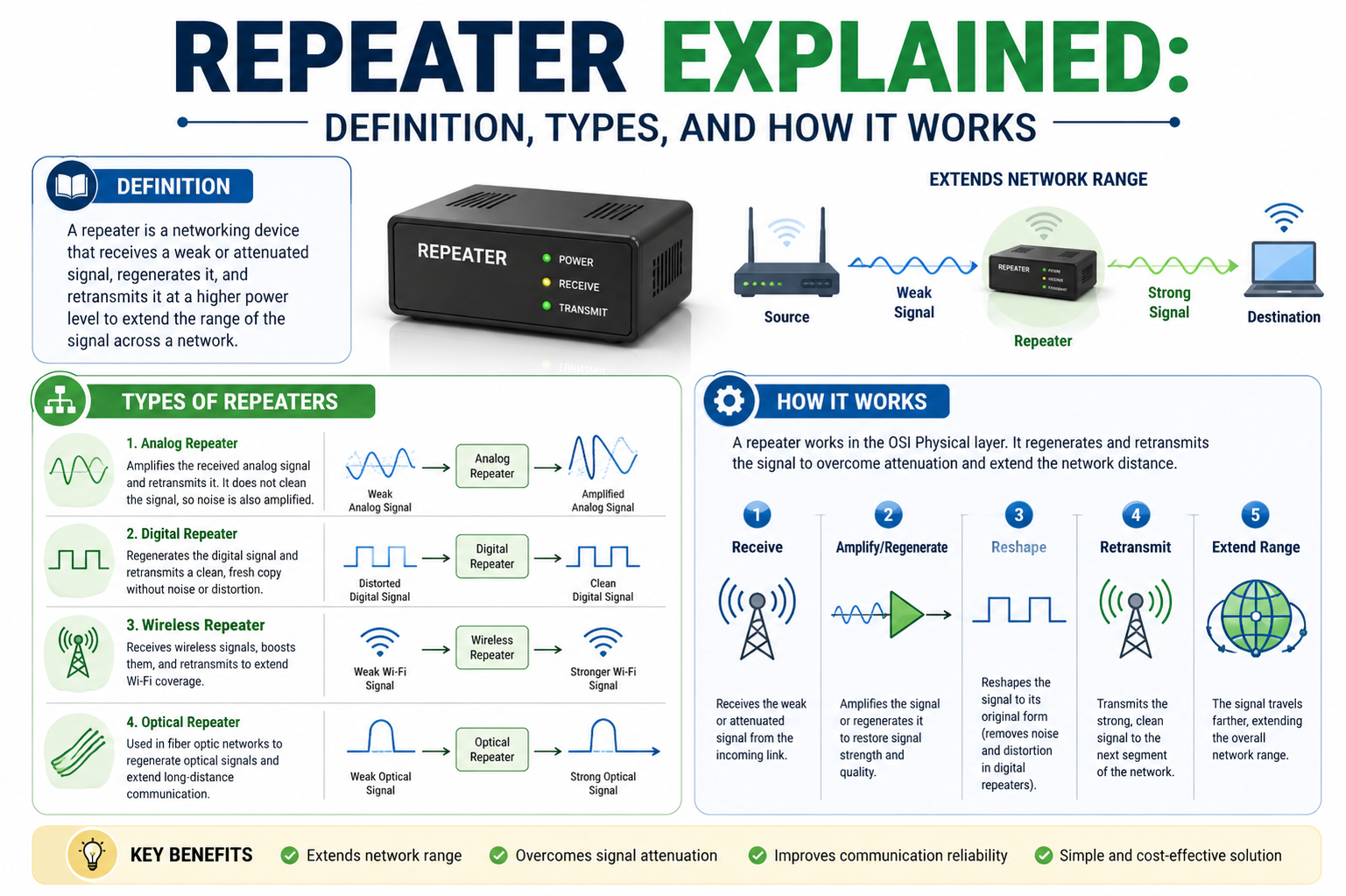
A repeater is a networking device designed to strengthen and extend the reach of data signals as they travel across a network. In simple terms, it receives a weak or fading signal, refreshes it, and sends it forward so that the information can continue traveling without losing quality. This process allows communication to cover longer distances than would normally be possible if the signal was left unassisted. Repeaters do not interpret, modify, or analyze the data they carry; their only responsibility is to ensure that the signal remains strong and usable from one point to another. In modern networking environments, they are essential for maintaining stable communication across large physical spaces or infrastructures where signal loss naturally occurs.
Why Repeaters Matter in Modern Networking
In today’s digital world, networks are everywhere, from homes and offices to massive industrial complexes and campus environments. As networks expand, the challenge of maintaining strong signal quality becomes more significant. Without reinforcement, signals weaken as they travel, resulting in slow performance, interruptions, or complete loss of connectivity. Repeaters solve this problem by acting as intermediate boosters that keep communication stable across long distances. They are especially useful in environments where devices are spread far apart or where physical barriers like walls and floors interfere with signal strength. By ensuring consistent data transmission, repeaters support smooth internet browsing, file sharing, video streaming, and real-time communication systems.
Basic Working Principle of a Repeater
The working principle of a repeater is based on receiving, restoring, and retransmitting signals. When a data signal travels through a medium such as a cable or wireless channel, it gradually loses strength due to resistance, interference, and distance. A repeater captures this weakened signal before it becomes unusable. It then reconstructs the signal to its original form and transmits it again at full strength. This process does not involve any decision-making or routing logic; instead, it is purely a physical-level operation focused on signal continuity. By repeating this cycle across multiple points in a network, communication can extend far beyond its natural limitations.
Understanding Signal Degradation
Signal degradation is one of the primary reasons repeaters are required in networking systems. As data moves through transmission mediums, it is affected by factors such as attenuation, noise, and interference. Attenuation refers to the gradual loss of signal strength over distance, while noise refers to unwanted electrical or electromagnetic disturbances that distort the original data. Interference can occur when multiple signals overlap or when external devices disrupt communication channels. These issues collectively reduce the clarity and reliability of transmitted data. Without correction, the receiving end may not interpret the information correctly, leading to errors or complete data loss. Repeaters help eliminate this problem by restoring signal quality at intermediate points.
Repeaters in Everyday Life Example
A simple example of a repeater’s function can be seen in home Wi-Fi networks. In many houses, the Wi-Fi router is placed in one location, but the signal does not always reach distant rooms effectively. As the signal passes through walls and floors, it becomes weaker. A repeater placed in a central location picks up this weakened Wi-Fi signal and retransmits it, allowing devices in far corners of the house to connect reliably. This improves coverage and ensures that users experience consistent internet speeds throughout the entire space. Similar principles apply in large offices, warehouses, and outdoor environments where network coverage needs to be extended beyond the range of a single router or access point.
Repeaters and the OSI Model (Layer 1)
To understand where repeaters operate in networking, it is important to look at the OSI model, which divides communication into seven layers. Repeaters function at the first layer, known as the physical layer. This layer is responsible for the actual transmission of raw binary data over physical media such as cables or wireless signals. At this level, there is no interpretation of data content, addressing, or routing decisions. Repeaters strictly deal with electrical or optical signals and ensure they remain strong as they move through the network. Their role is fundamental because all higher layers depend on the successful transmission of data at the physical layer before any meaningful communication can occur.
How Data Travels Through the Physical Layer
When data is sent across a network, it is first converted into signals that can travel through a medium such as copper wire, fiber optics, or radio waves. These signals move from one device to another, but as distance increases, their strength naturally decreases. The physical layer is responsible for ensuring that these signals are transmitted accurately without considering their meaning or purpose. Repeaters operate within this layer by receiving the weakened signal, cleaning it up, and transmitting it again. This ensures that even over long distances, the signal remains strong enough to be interpreted correctly by the receiving device.
Signal Regeneration and Signal Amplification Overview
Two important functions associated with repeaters are signal amplification and signal regeneration. Amplification refers to increasing the strength of a weak signal so it can travel further without fading. Regeneration goes a step further by reconstructing the signal into a clean, original form, removing noise and distortion that may have been introduced during transmission. While both processes aim to improve signal quality, regeneration is more precise because it restores the signal rather than simply boosting its power. These functions ensure that communication remains accurate and reliable across extended network paths.
Repeaters vs Routers vs Switches Introduction
Although repeaters, routers, and switches are all networking devices, their purposes are very different. A repeater focuses only on strengthening signals without making any decisions about where data should go. A switch operates within a local network and directs data to specific devices based on addresses, improving efficiency within a single network segment. A router connects different networks together and determines the best path for data to travel between them. Unlike these devices, repeaters do not manage traffic or interpret data; they simply ensure that signals remain strong as they move across physical distances. This distinction is important when designing or understanding network infrastructure.
Early Networking Challenges Without Repeaters
Before the widespread use of repeaters, networks faced significant limitations in terms of distance and reliability. Signals transmitted over long cables or large areas would quickly degrade, making communication unreliable beyond short ranges. This created challenges for organizations that needed to connect multiple buildings or devices spread across large spaces. Without a way to reinforce signals, networks required excessive cabling or multiple independent systems, which was inefficient and costly. The introduction of repeaters solved many of these problems by allowing signals to be extended without losing quality, enabling the development of larger and more complex network systems that form the foundation of modern communication infrastructure.
What is a Repeater (Extended Understanding)
A repeater is not just a simple signal booster in networking; it is a foundational device that enables communication to remain reliable across physically extended environments. In more advanced terms, it operates as a signal restoration point that ensures data integrity is preserved while traveling across network media. As networks scale in size and complexity, the importance of repeaters becomes more visible because they directly address one of the most fundamental limitations of communication systems: signal loss over distance. Whether the transmission occurs through copper cabling, fiber optics, or wireless channels, every medium introduces some level of degradation. Repeaters exist specifically to counter this degradation and maintain consistent communication quality across long network paths.
Types of Repeaters in Networking Systems
Repeaters can be categorized into different types based on how they process and transmit signals. One common classification is analog repeaters, which primarily amplify incoming signals without fully reconstructing them. These are often used in simpler or older communication systems where basic signal strengthening is sufficient. On the other hand, digital repeaters perform signal regeneration, meaning they completely rebuild the signal into its original digital form before retransmitting it. This makes digital repeaters more reliable in modern networking environments where accuracy and noise reduction are critical. Each type serves a specific purpose depending on the nature of the network and the required level of signal clarity.
Ethernet Repeaters and Their Role in Wired Networks
In wired networking environments, Ethernet repeaters are commonly used to extend the reach of local area networks. Ethernet cables have a limited transmission distance, and beyond that limit, signal quality begins to degrade significantly. An Ethernet repeater receives the weakened electrical signals traveling through the cable and regenerates them before sending them further along the network. This allows multiple network segments to be connected into a larger continuous system. Although modern switches have largely replaced traditional Ethernet repeaters in many setups, the underlying concept remains important in understanding how wired communication is extended across physical infrastructure.
Fiber Optic Repeaters in High-Speed Communication
Fiber optic networks transmit data using light signals instead of electrical impulses, allowing extremely high-speed communication over long distances. However, even light signals weaken over extended lengths due to dispersion and absorption within the fiber cable. Fiber optic repeaters, sometimes integrated into optical amplifiers, are used to restore the strength and clarity of these light signals. They either convert optical signals into electrical form for regeneration or directly amplify the light signal depending on the technology used. These repeaters are essential in backbone internet infrastructure, undersea communication cables, and long-distance telecommunication systems where maintaining signal integrity over thousands of kilometers is necessary.
Wireless Repeaters and Network Expansion
Wireless repeaters play a critical role in extending Wi-Fi and other wireless network signals. Unlike wired repeaters, they capture radio frequency signals transmitted by routers or access points and rebroadcast them to extend coverage areas. This is particularly useful in environments where physical barriers like walls, floors, or large open spaces weaken wireless signals. Wireless repeaters are commonly used in homes, offices, hotels, and public spaces to eliminate dead zones where connectivity is weak or unavailable. By strategically placing wireless repeaters, network administrators can ensure consistent coverage throughout a building or campus without needing additional wiring infrastructure.
Signal Delay and Its Impact on Network Performance
While repeaters significantly improve signal reach, they also introduce a small amount of delay known as latency. This delay occurs because the repeater must receive, process, and retransmit the signal before it continues its journey. In most cases, this delay is extremely minimal and does not noticeably affect everyday network performance. However, in high-speed or real-time applications such as online gaming, video conferencing, or financial trading systems, even small delays can become important. Network designers must therefore carefully plan repeater placement to balance extended coverage with acceptable performance levels.
Collision Domains and Network Behavior
In traditional networking systems, especially those using older repeater-based designs, all connected devices share a single collision domain. This means that if two devices attempt to transmit data simultaneously, their signals may interfere with each other, causing a collision and requiring retransmission. Repeaters do not have the ability to separate or manage these collisions because they operate at the physical layer without awareness of data structure. This limitation is one of the reasons modern networks prefer switches over repeaters, as switches divide networks into multiple collision domains, improving efficiency and reducing data conflicts.
Half-Duplex Communication in Repeater-Based Networks
Many networks that rely on repeaters operate in half-duplex mode, meaning data transmission can occur in only one direction at a time. This is due to the shared communication medium and the lack of traffic management at the repeater level. When one device is sending data, others must wait for their turn, which can reduce overall network efficiency in busy environments. While this limitation is less significant in small or lightly loaded networks, it becomes more noticeable as network traffic increases. Understanding this behavior is important when designing systems that require high performance and minimal delay.
Full-Duplex Limitations and Modern Network Evolution
Modern networking technologies have largely moved toward full-duplex communication, where data can be transmitted and received simultaneously. This is typically achieved using switches instead of repeaters. However, in repeater-based environments, full-duplex communication is either not supported or significantly limited because repeaters do not separate traffic paths. This restriction highlights the evolutionary step from basic signal extension devices to intelligent networking equipment capable of managing complex data flows. Despite this, repeaters still serve important roles in specific scenarios where simplicity and signal extension are the primary requirements.
Environmental Factors Affecting Repeater Performance
The performance of a repeater is heavily influenced by its physical environment. Factors such as electromagnetic interference, physical obstructions, temperature variations, and cable quality can all affect how effectively a repeater functions. For example, placing a repeater near heavy machinery or electronic devices can introduce noise into the signal, reducing overall clarity. Similarly, installing a repeater in an area with poor ventilation may cause overheating, leading to reduced performance or hardware failure. Proper environmental planning is therefore essential to ensure that repeaters operate at optimal efficiency.
Strategic Placement of Repeaters in Network Design
The placement of repeaters within a network is one of the most critical factors in determining their effectiveness. Ideally, repeaters should be positioned at points where the signal begins to weaken but has not yet degraded beyond recovery. This often means placing them at calculated intervals along long cable runs or within central locations in large buildings. Poor placement can lead to insufficient signal improvement or unnecessary network delays. Network designers must carefully analyze signal strength patterns and physical layouts to determine the most effective positions for repeaters.
Limitations of Repeaters in Modern Networking
Despite their usefulness, repeaters have several inherent limitations. They cannot filter data, manage traffic, or make intelligent routing decisions. They also cannot distinguish between different types of network errors or prioritize data transmission. As a result, they are less suitable for complex or high-performance networks where efficiency and control are important. Additionally, excessive use of repeaters in a single network can lead to increased latency and reduced overall efficiency. These limitations have led to the adoption of more advanced devices such as switches, routers, and access points in modern network architectures.
Role of Repeaters in Legacy and Specialized Systems
Even though newer technologies have replaced repeaters in many mainstream applications, they are still widely used in legacy systems and specialized environments. Industrial communication systems, remote monitoring setups, and certain telecommunication infrastructures continue to rely on repeaters due to their simplicity and reliability. In environments where upgrading entire systems is not practical, repeaters provide a cost-effective solution for extending network reach. Their continued relevance demonstrates that even basic networking devices can remain valuable when applied in the right context and configuration.
Physical Layer Behavior and Repeater Operation in Depth
Repeaters operate at the most fundamental level of networking, which is the physical layer. At this level, communication is not about understanding data meaning but purely about transmitting electrical or optical signals. The repeater’s job is to ensure that these signals remain strong and usable as they move through cables or wireless channels. When a signal enters a repeater, it is often distorted or weakened due to distance, interference, or medium resistance. The repeater does not interpret what the data represents; instead, it focuses entirely on restoring the signal’s shape, timing, and strength so that it can continue its journey without corruption. This behavior makes repeaters simple but extremely important components in network infrastructure.
Signal Timing and Synchronization in Repeaters
One of the less obvious but very important roles of a repeater is maintaining signal timing. Digital communication relies heavily on precise timing because data is transmitted in bits that must be interpreted in correct sequence. When signals travel long distances, timing can become distorted due to delays in the medium. Repeaters help re-synchronize incoming signals before retransmitting them. This ensures that the receiving devices can correctly interpret the bit sequence without errors. Although repeaters do not actively manage clock systems, their regeneration process helps maintain overall timing integrity across the network.
Noise Reduction and Signal Cleaning Process
As signals travel through physical mediums, they are exposed to various types of noise, including electromagnetic interference, thermal noise, and cross-signal interference. This noise can distort the original data and make it difficult for receiving devices to interpret the signal correctly. Repeaters help reduce this problem by cleaning and regenerating the signal before forwarding it. In digital repeaters, this process involves reconstructing the signal into a clean binary format, effectively removing unwanted distortions. This function is essential in environments where long cable runs or external interference are unavoidable, such as industrial plants or large office buildings.
Repeaters in Large-Scale Enterprise Networks
In enterprise environments, networks often span multiple floors, buildings, or even campuses. In such cases, signal loss becomes a significant challenge. Repeaters are used to bridge these physical gaps by extending network connectivity across large areas. They are strategically placed to ensure that no segment of the network suffers from weak signal strength. In older network designs, repeaters were commonly used to connect multiple network segments in a linear or branching structure. While modern systems often use switches and fiber backbones, the concept of signal regeneration introduced by repeaters still forms the foundation of large-scale network design.
Impact of Cable Quality on Repeater Efficiency
The efficiency of a repeater is closely tied to the quality of the transmission medium it supports. Poor-quality cables introduce higher levels of attenuation and noise, forcing repeaters to work harder to restore signal quality. For example, low-grade copper cables may degrade signals more quickly compared to high-quality shielded cables. Similarly, damaged or improperly installed cables can significantly reduce the effectiveness of repeaters. In fiber optic systems, even minor bends or impurities in the fiber can impact signal strength. Therefore, maintaining high-quality physical infrastructure is essential to maximize repeater performance.
Bandwidth Considerations in Repeater-Based Networks
Bandwidth refers to the amount of data that can be transmitted over a network in a given time. While repeaters do not directly control bandwidth, they indirectly influence it by maintaining signal strength over distance. In poorly maintained networks without repeaters, signal degradation can effectively reduce usable bandwidth because retransmissions and errors consume additional resources. By ensuring cleaner and stronger signals, repeaters help preserve effective bandwidth across long network paths. However, it is important to note that repeaters do not increase bandwidth capacity; they only preserve the quality of existing transmission capabilities.
Propagation Delay and Its Technical Implications
Propagation delay is the time it takes for a signal to travel from the sender to the receiver. When repeaters are introduced into a network, they add a small amount of additional delay because each signal must be received, processed, and retransmitted. While this delay is usually minimal, it becomes important in systems where timing is critical. In large networks with multiple repeaters, these delays can accumulate and affect overall performance. Network engineers must therefore calculate optimal repeater placement to minimize unnecessary delays while still ensuring signal strength.
Error Handling Limitations of Repeaters
Repeaters are not capable of detecting or correcting data-level errors. Their function is limited to physical signal regeneration, meaning they cannot determine whether the data being transmitted is correct or corrupted at the logical level. If a signal is already damaged beyond recognition, a repeater may still amplify or regenerate it without understanding the error. This limitation distinguishes repeaters from higher-layer networking devices such as switches or routers, which can analyze data packets and apply error-handling techniques. As a result, repeaters are best suited for environments where the signal is still relatively intact but needs strengthening.
Evolution from Repeaters to Modern Network Devices
The development of networking technology has significantly reduced the reliance on traditional repeaters. Modern networks now use intelligent devices such as switches, routers, and access points that combine signal management with data processing capabilities. However, the core concept introduced by repeaters—signal regeneration—remains essential. Many modern devices still perform repeater-like functions internally, even if they are not labeled as repeaters. For example, network switches regenerate signals at each port to maintain integrity across connections. This evolution shows how foundational repeater technology is to the development of advanced networking systems.
Wireless Signal Behavior and Repeater Functionality
Wireless communication introduces additional challenges compared to wired systems. Signals transmitted through the air are affected by distance, obstacles, weather conditions, and interference from other devices. Wireless repeaters capture these signals and rebroadcast them to extend coverage. Unlike wired repeaters, wireless repeaters must also manage frequency consistency and signal overlap to avoid creating interference loops. Proper placement is critical because poor positioning can lead to signal degradation instead of improvement. Wireless repeaters are widely used in residential, commercial, and outdoor environments to eliminate dead zones.
Multipath Interference and Signal Distortion
In both wired and wireless networks, signals can sometimes take multiple paths to reach the destination. This phenomenon, known as multipath propagation, can cause interference when signals arrive at different times and overlap incorrectly. Repeaters help reduce the impact of such distortions by regenerating a clean version of the signal at intermediate points. This helps reset the signal path and minimize cumulative distortion. While repeaters cannot eliminate multipath effects entirely, they significantly reduce their impact by refreshing the signal periodically along its route.
Power Requirements and Energy Considerations
Repeaters require a stable power source to function effectively. Since they actively process incoming signals, they consume electrical energy continuously during operation. In large network deployments, power management becomes an important consideration, especially in remote or outdoor locations. Backup power systems are often used to ensure uninterrupted operation. Energy efficiency can also vary depending on the type of repeater and the technology it uses. Modern designs aim to reduce power consumption while maintaining high signal performance.
Physical Installation Challenges of Repeaters
Installing repeaters in real-world environments can present several challenges. Physical access to installation points, cable routing, environmental protection, and interference avoidance must all be considered. In industrial or outdoor environments, repeaters may need protective enclosures to shield them from dust, moisture, or temperature extremes. Improper installation can lead to reduced performance or even complete failure of the device. Therefore, careful planning and testing are required before integrating repeaters into a live network environment.
Network Expansion Using Cascaded Repeaters
In some cases, a single repeater is not enough to cover a large distance. In such scenarios, multiple repeaters can be placed in a series, a setup known as cascading. Each repeater receives the signal, regenerates it, and passes it to the next one. While this method extends network reach significantly, it also increases overall delay and complexity. Cascaded repeater systems must be carefully designed to ensure that signal quality does not degrade due to excessive repetition or timing issues. Proper spacing between repeaters is essential for maintaining optimal performance.
Importance of Signal Threshold Levels
Every repeater operates based on a minimum signal threshold. If the incoming signal falls below this threshold, the repeater may not be able to correctly reconstruct it. This makes proper placement crucial because positioning a repeater too far from the source may result in unusable input signals. On the other hand, placing it too close may not provide sufficient extension of network range. Understanding signal thresholds helps network designers determine the most effective layout for repeater deployment in any given environment.
Advanced Role of Repeaters in Modern Network Architecture
In modern networking environments, repeaters still play a supportive but important role, even though many of their traditional functions have been absorbed by more advanced devices. Their core principle—signal regeneration—remains deeply embedded in today’s infrastructure. Modern systems rely on this concept to maintain data integrity across long distances and complex network paths. Even when repeaters are not physically visible as standalone devices, their functionality often exists inside switches, routers, and other networking hardware. This shows that the repeater concept is not outdated; instead, it has evolved and integrated into more intelligent systems that combine multiple networking functions in a single device.
Role in Backbone and Long-Distance Communication Systems
In large-scale communication networks such as internet backbones, undersea cables, and satellite communication systems, signal degradation is a major challenge due to extreme distances. Repeaters or repeater-like systems are placed at intervals along these transmission paths to restore signal strength. In undersea fiber optic cables, for example, optical repeaters are embedded along the cable route on the ocean floor. These devices amplify or regenerate light signals to ensure that data can travel across entire oceans without loss of information. Without such systems, global internet connectivity would not be possible at the scale we experience today.
Repeaters in Industrial and Harsh Environments
Industrial environments such as factories, power plants, and mining operations often require robust communication systems that can withstand harsh physical conditions. In these environments, signals are frequently disrupted by heavy machinery, electrical interference, and structural barriers. Repeaters help maintain stable communication between sensors, control systems, and monitoring devices. They are often built with rugged designs to withstand temperature extremes, dust, vibration, and moisture. Their ability to maintain signal integrity in such challenging conditions makes them essential for automation systems and industrial networking.
Data Flow Restoration in Multi-Segment Networks
In large networks that are divided into multiple segments, repeaters serve as restoration points that ensure continuous data flow between segments. Each segment of the network may experience different levels of signal degradation depending on distance and medium quality. By placing repeaters between segments, network designers ensure that each portion of the system receives a refreshed signal before passing it along. This prevents cumulative degradation that would otherwise occur if signals were transmitted across multiple segments without regeneration. The result is a more stable and predictable network performance across the entire system.
Interaction Between Repeaters and Network Protocols
Although repeaters operate at the physical layer and do not directly interact with network protocols, their behavior indirectly supports higher-layer protocols by ensuring reliable signal transmission. Protocols such as TCP rely on accurate data delivery, and any physical layer instability can lead to retransmissions or data loss. By maintaining strong signals, repeaters help reduce errors at higher layers of the OSI model. This indirect support highlights how even simple devices can have a significant impact on overall network reliability and performance.
Repeaters and Signal Jitter Management
Signal jitter refers to small variations in signal timing that can affect the accuracy of data interpretation. In high-speed networks, even minor timing inconsistencies can lead to errors or reduced performance. Repeaters help reduce jitter by regenerating signals at clean intervals, effectively resetting timing variations that accumulate during transmission. While they do not eliminate jitter completely, they help stabilize signal timing enough to maintain reliable communication. This is particularly important in systems that require synchronized data flow, such as voice communication or real-time monitoring systems.
Integration with Modern Networking Hardware
In today’s networking environments, the concept of a repeater is often integrated into multi-functional devices. For example, network switches regenerate signals at each port, effectively performing repeater-like functions while also managing data traffic. Wireless access points also include signal regeneration capabilities to extend wireless coverage. Even routers may perform signal strengthening internally when transmitting across different interfaces. This integration allows modern devices to handle multiple networking tasks simultaneously, reducing the need for standalone repeater devices in many scenarios.
Security Considerations in Repeater-Based Networks
Repeaters themselves do not provide any security features because they do not analyze or filter data. They simply retransmit signals without inspection. This means that any security measures must be implemented at higher network layers or through other devices such as firewalls and routers. In some cases, poorly designed repeater networks can unintentionally extend insecure signals over larger areas. Therefore, network designers must ensure that security protocols are properly enforced before data reaches repeater-based extensions. This separation of physical transmission and security control is a key aspect of network design.
Repeaters in Emergency Communication Systems
Emergency communication systems, such as disaster recovery networks and public safety infrastructure, often rely on repeaters to maintain connectivity in challenging environments. During natural disasters or infrastructure failures, communication lines may be damaged or disrupted. Portable or temporary repeaters can be deployed to restore communication links quickly. These systems help emergency responders maintain coordination and ensure that critical information can still be transmitted across affected areas. The reliability and simplicity of repeaters make them valuable in situations where complex infrastructure may not be available.
Scalability Challenges in Repeater Networks
While repeaters help extend network reach, they also introduce scalability challenges when used excessively. Each repeater adds a small amount of delay and may slightly reduce overall network efficiency. In very large networks, too many repeaters can lead to cumulative latency and performance degradation. Additionally, managing and maintaining a large number of repeaters can become operationally complex. For this reason, modern network designs often prefer hierarchical structures using switches and fiber backbones instead of relying heavily on repeaters. However, repeaters still remain useful in specific extension scenarios where simplicity is preferred.
Environmental Noise and Long-Term Stability
Over time, environmental factors can impact the stability of repeater-based networks. Electrical noise, temperature fluctuations, and physical wear can gradually reduce device performance. Regular monitoring is required to ensure that repeaters continue functioning correctly. In some cases, recalibration or replacement may be necessary to maintain network reliability. Long-term stability depends not only on the repeater itself but also on the surrounding infrastructure, including cables, connectors, and power systems. A well-maintained environment ensures that repeaters perform consistently over extended periods.
Future of Repeater Technology in Networking
Although traditional repeaters are less common in modern network designs, the underlying principle of signal regeneration continues to evolve. Future networking systems, especially those involving ultra-high-speed communication, quantum networking, or advanced wireless systems, will continue to rely on improved versions of repeater technology. These future systems may include intelligent signal processors capable of adaptive regeneration, error correction, and dynamic optimization. While the simple repeater may fade from direct use, its foundational concept will remain essential in shaping next-generation communication systems.
Final Conclusion
Repeaters represent one of the most fundamental building blocks in networking history. They address the basic but critical problem of signal loss over distance, enabling communication systems to expand beyond physical limitations. From simple home networks to global communication infrastructure, the principle of signal regeneration ensures that data can travel reliably across vast distances. Even though modern technologies have reduced the need for standalone repeaters, their influence remains deeply embedded in every layer of network design. Understanding repeaters provides essential insight into how communication systems maintain reliability, scalability, and global connectivity.