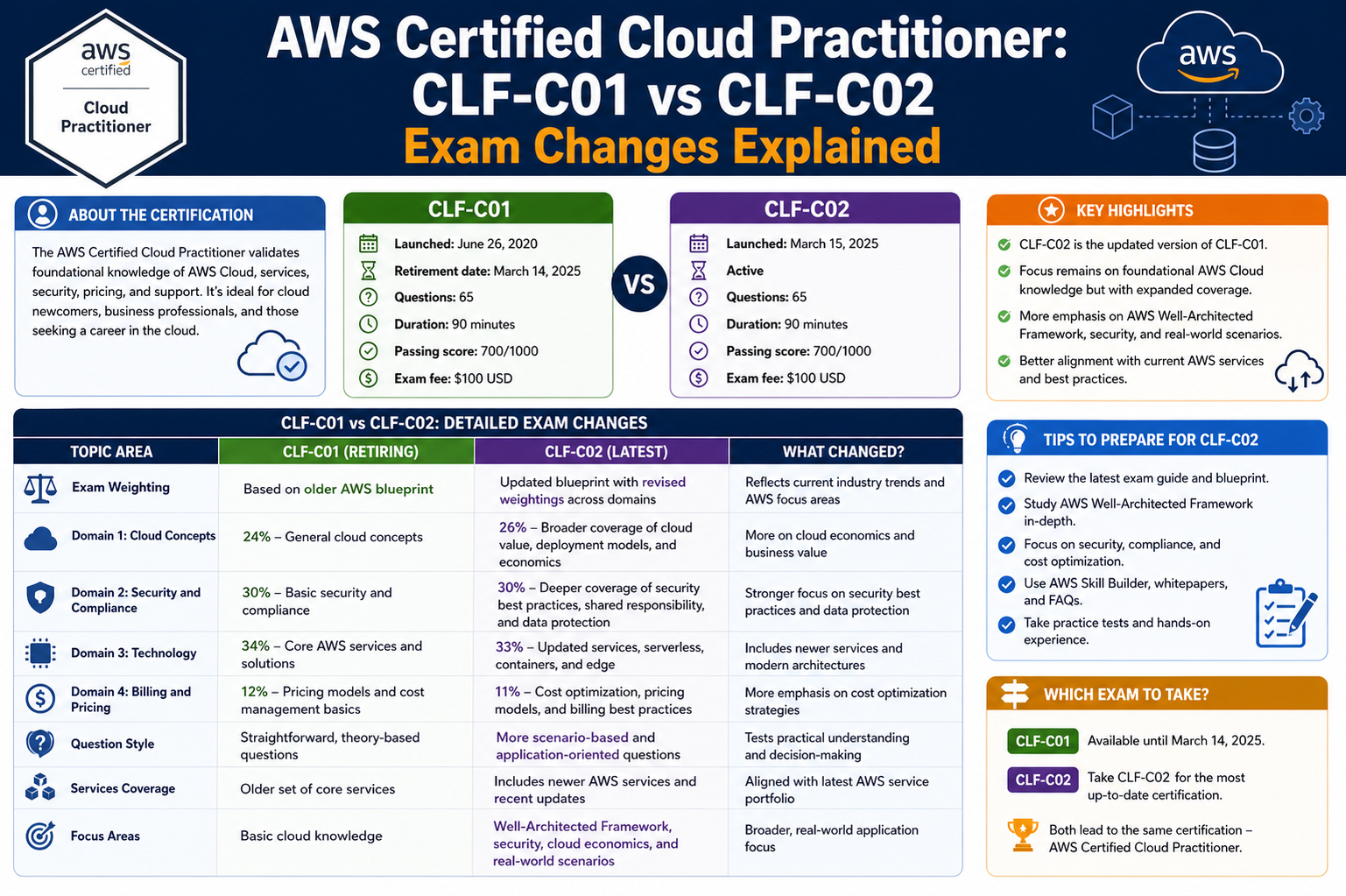
The AWS Certified Cloud Practitioner exam is designed as an introductory certification for individuals who want to understand the fundamentals of cloud computing through Amazon Web Services. It serves as a foundation-level assessment that validates a candidate’s overall awareness of AWS cloud concepts, core services, security principles, and pricing models. This exam is not intended for deep technical specialization but instead focuses on providing a broad understanding of how cloud environments function and how AWS delivers scalable, secure, and cost-effective solutions.
Over time, AWS continuously updates its certification exams to reflect the rapid evolution of cloud technologies and the introduction of new services. The shift from CLF-C01 to CLF-C02 represents this natural progression. As organizations increasingly rely on cloud infrastructure for critical operations, the expectations from even entry-level professionals have grown. The updated exam ensures that candidates are not only familiar with traditional cloud fundamentals but also aware of modern AWS offerings, architectural practices, and evolving security standards. This makes the certification more relevant in today’s cloud-driven industry.
Importance of Transition from CLF-C01 to CLF-C02
The transition from CLF-C01 to CLF-C02 is important because it reflects how AWS adapts its certification structure to match real-world cloud usage trends. Many learners who prepared for the earlier version often need to reassess their study approach because the updated version includes expanded service coverage and a stronger emphasis on certain domains. While the foundational knowledge remains similar, the depth and distribution of topics have shifted to align with modern AWS usage patterns.
The CLF-C01 exam focused more on basic cloud awareness, whereas CLF-C02 extends that foundation by incorporating newer services and broader conceptual understanding. This change ensures that certified individuals are better prepared to interact with current AWS environments. The updated version does not remove the old concepts entirely but builds upon them, meaning learners must expand rather than replace their knowledge base. This evolution highlights AWS’s commitment to keeping its certification relevant in a fast-changing technological landscape.
Exam Format and Structural Consistency
Despite the content updates, the overall structure of the AWS Cloud Practitioner exam remains consistent between CLF-C01 and CLF-C02. The exam duration is still approximately 90 minutes, and it continues to follow a multiple-choice and multiple-response question format. This consistency ensures that candidates do not need to adjust their test-taking strategy significantly when moving from one version to the next.
The key difference lies not in how the exam is delivered but in what it evaluates. CLF-C02 introduces more scenario-based questions that test a candidate’s ability to understand real-world applications of AWS services rather than simple definitions. This subtle shift increases the importance of conceptual clarity and practical awareness. Candidates are now expected to think in terms of use cases, service selection, and architectural decisions rather than just memorizing service names or basic functions.
Changes in Domain Weight Distribution
One of the most noticeable differences between CLF-C01 and CLF-C02 is the redistribution of domain weightings across the exam. While both versions cover similar categories such as cloud concepts, security, technology, and billing, the emphasis on each area has been adjusted to reflect current industry priorities.
In CLF-C02, security and compliance have gained greater importance, reflecting the growing emphasis on cloud security in real-world environments. This increase indicates that AWS expects even entry-level professionals to have a stronger awareness of security responsibilities and governance models. Meanwhile, billing and pricing have been slightly reduced in weight, suggesting that while cost awareness remains important, it is no longer the primary focus compared to security and operational understanding.
Cloud concepts and technology-related domains have also been refined to include more modern services and architectural approaches. These adjustments collectively ensure that candidates are evaluated on skills that are more aligned with actual cloud job requirements today.
Expansion of Cloud Concepts and AWS CAF Understanding
The cloud concepts domain in CLF-C02 introduces additional depth compared to CLF-C01, particularly with the inclusion of the AWS Cloud Adoption Framework. This framework is designed to help organizations and professionals understand how to plan and structure their cloud adoption journey effectively. It consists of multiple perspectives, including business, people, governance, platform, security, and operations.
Understanding AWS CAF is important because it connects technical cloud services with business strategy. Instead of viewing cloud computing as only a technical shift, candidates are expected to understand how it impacts organizational structure and decision-making processes. This broader perspective helps bridge the gap between technical teams and business stakeholders.
The updated exam ensures that candidates can identify how cloud adoption decisions affect scalability, cost efficiency, and operational performance. Compared to the earlier version, CLF-C02 places more emphasis on strategic thinking rather than purely technical memorization of cloud concepts.
Strengthened Focus on Security and IAM Practices
Security and compliance have become significantly more prominent in CLF-C02. This reflects the growing importance of secure cloud environments across industries. The updated exam places greater emphasis on the Shared Responsibility Model, which defines the division of security responsibilities between AWS and its customers.
Candidates are expected to demonstrate a clear understanding of Identity and Access Management principles, including how permissions, roles, and temporary credentials function within AWS environments. IAM is no longer treated as a basic concept but as a core operational skill that supports secure cloud usage.
Additionally, CLF-C02 introduces broader coverage of security services such as AWS Security Hub, AWS Detective, and Amazon GuardDuty. These services are designed to provide monitoring, threat detection, and security analysis across cloud environments. The exam now includes more scenario-based questions that require candidates to identify which security tools are best suited for specific situations, reinforcing practical understanding over theoretical knowledge.
Evolution of Cloud Technology and Service Coverage
The cloud technology and services domain has undergone significant expansion in CLF-C02 compared to CLF-C01. Earlier versions of the exam focused primarily on foundational AWS services such as compute, storage, and basic networking. The updated version broadens this scope to include modern architectural approaches and advanced service categories.
Serverless computing is now a key area of focus, with services such as AWS Lambda playing an important role in exam preparation. Candidates are also expected to understand container-based services and orchestration platforms, reflecting the shift toward microservices and distributed systems in modern application development.
Storage services have also evolved, with newer options such as intelligent storage tiering becoming part of the knowledge base. Networking concepts now include advanced connectivity solutions that support hybrid and multi-cloud environments. This expansion ensures that candidates are aware of how AWS services integrate into complex enterprise architectures rather than just isolated use cases.
Networking, Hybrid Architecture, and Infrastructure Expansion
Networking concepts in CLF-C02 extend beyond basic Virtual Private Cloud understanding. Candidates are now expected to be familiar with more advanced services that support global scalability and hybrid connectivity. This includes tools designed to improve performance, reduce latency, and manage traffic across distributed systems.
Hybrid networking solutions have become more important as organizations increasingly operate across both on-premises and cloud environments. The updated exam reflects this reality by including concepts that demonstrate how AWS integrates with traditional infrastructure. This ensures candidates understand not only cloud-native systems but also hybrid deployment models.
Additionally, global connectivity services and traffic management tools are introduced to highlight how AWS supports worldwide application delivery. These updates make the exam more aligned with enterprise-level cloud architecture, even at the foundational certification level.
Introduction of AI and Machine Learning Awareness
A major addition in CLF-C02 is the inclusion of artificial intelligence and machine learning services at a conceptual level. While the exam does not require deep technical expertise in machine learning, it does expect candidates to understand the purpose and basic use cases of services such as Amazon SageMaker, Amazon Rekognition, and Amazon Polly.
This inclusion reflects the growing role of AI-driven services in modern cloud ecosystems. AWS has integrated machine learning capabilities across many of its offerings, making it important for even entry-level professionals to recognize how these services contribute to automation, analytics, and customer experience enhancements.
The exam focuses on identifying appropriate use cases rather than implementation details. Candidates must be able to determine when AI services are relevant in business scenarios, reinforcing the importance of conceptual clarity over technical depth.
Changes in Billing, Pricing Models, and Cost Management Tools
The billing and pricing domain in CLF-C02 has been refined to focus more on modern cost optimization strategies. While traditional pricing models such as pay-as-you-go remain relevant, greater emphasis is now placed on flexible pricing mechanisms like Savings Plans.
Candidates are also expected to understand cost management tools that help organizations monitor and optimize cloud spending. These include services that provide visibility into usage patterns and budgeting controls. Compared to CLF-C01, the updated exam introduces a more practical approach to cost management rather than purely theoretical billing concepts.
Although this domain has slightly reduced weight, it remains important because cost optimization is a key aspect of cloud adoption. The exam ensures candidates can recognize tools and strategies that help manage expenses effectively in dynamic cloud environments.
Candidate Suitability and Exam Relevance
The CLF-C02 exam is designed for a wide range of individuals, including beginners, business professionals, and technical learners who want to build foundational AWS knowledge. It is particularly useful for those who are new to cloud computing or working in environments where AWS is already in use.
It also benefits individuals in non-technical roles who need to understand cloud economics, service capabilities, and operational implications. The accessibility of the exam makes it suitable for anyone seeking to establish a baseline understanding of cloud technologies without requiring prior experience.
The updated version ensures that candidates are better prepared for modern cloud environments by incorporating newer services and emphasizing real-world applications.
Deepening Understanding of Cloud Concepts in CLF-C02
The Cloud Concepts domain in CLF-C02 goes beyond simple definitions and requires a more structured understanding of how cloud computing supports business transformation. In CLF-C01, this area was primarily focused on identifying basic cloud characteristics such as elasticity, scalability, and pay-as-you-go models. However, the updated version expands this foundation by expecting candidates to understand how cloud adoption aligns with organizational strategy and long-term planning.
The inclusion of frameworks such as AWS Cloud Adoption Framework strengthens this domain significantly. Candidates are expected to recognize how different business perspectives influence cloud migration decisions. This includes understanding how leadership, operations, security, and governance teams collaborate during cloud transformation. Rather than focusing only on technical definitions, CLF-C02 encourages learners to think in terms of organizational impact and strategic cloud usage.
Another important enhancement is the emphasis on cloud value realization. Candidates are now expected to understand not just what cloud computing is, but why organizations choose to adopt it. This includes cost efficiency, operational agility, global scalability, and reduced infrastructure management. These expanded expectations make the Cloud Concepts domain more aligned with real-world enterprise cloud adoption scenarios.
Evolution of Security Responsibility Understanding
Security in CLF-C02 has evolved from a foundational awareness topic into a more applied and scenario-driven domain. In CLF-C01, candidates were primarily expected to understand basic principles such as shared responsibility and simple identity management concepts. The updated exam, however, requires deeper comprehension of how security is implemented across different layers of AWS environments.
The Shared Responsibility Model is now tested in more complex scenarios, where candidates must determine which security responsibilities belong to AWS and which belong to the customer. This shift ensures that learners can apply security principles in practical environments rather than simply memorizing definitions. It reflects real-world cloud operations where security responsibilities are distributed across multiple layers.
Identity and Access Management has also gained more importance. Candidates are expected to understand how roles, policies, and permissions interact in real cloud environments. Temporary credentials and secure access patterns are also emphasized more heavily. This reflects the growing need for secure authentication mechanisms in distributed systems where users and services interact dynamically.
Introduction of Advanced Security Services Awareness
CLF-C02 expands the range of security services that candidates must recognize and understand at a conceptual level. While CLF-C01 briefly introduced some AWS security tools, the updated version places greater emphasis on their purpose and application in monitoring and threat detection.
Services such as AWS Security Hub, AWS GuardDuty, and AWS Detective are now more prominently featured. Candidates are expected to understand what types of security problems each service addresses. For example, some tools focus on threat detection, while others provide centralized security visibility or investigative capabilities. This distinction is important in scenario-based questions where selecting the correct service is required.
The exam also introduces awareness of machine learning-based security tools that help detect anomalies and potential threats. Although deep technical implementation is not required, candidates must understand how these services contribute to proactive security management. This shift reflects the increasing reliance on automation and intelligence in cloud security systems.
Expanded Role of Cloud Technology and Service Diversity
The Cloud Technology and Services domain has undergone one of the most significant expansions in CLF-C02. In the earlier version, this domain focused primarily on core AWS services such as compute, storage, and basic networking. The updated exam broadens this scope significantly to include modern architectures and distributed system components.
Serverless computing is now a key area of focus. Candidates are expected to understand how services function without requiring infrastructure management. This includes recognizing how applications can scale automatically based on demand. The introduction of serverless concepts reflects the industry shift toward event-driven architectures and reduced operational overhead.
Container-based services have also become more relevant. Candidates are expected to understand how container orchestration supports scalable application deployment. This includes awareness of managed container services and their role in microservices architectures. These additions ensure that learners are familiar with modern application deployment strategies used in enterprise environments.
Growth of Storage and Data Management Concepts
Storage services in CLF-C02 have expanded beyond traditional object and block storage concepts. While foundational services remain important, the updated exam introduces intelligent storage optimization strategies that reflect real-world data management challenges.
Candidates are now expected to understand how data lifecycle management works in cloud environments. This includes automated tiering of data based on usage patterns and cost optimization strategies for long-term storage. These concepts are important for organizations managing large-scale data systems where efficiency and cost control are critical.
The emphasis is no longer only on identifying storage types but also on understanding when and why different storage solutions should be used. This requires candidates to evaluate use cases and select appropriate storage strategies based on performance, cost, and accessibility requirements.
Networking Evolution and Global Connectivity Awareness
Networking concepts in CLF-C02 have evolved to include more advanced global connectivity and hybrid infrastructure solutions. In CLF-C01, networking was largely focused on basic Virtual Private Cloud concepts and simple networking components. The updated exam introduces broader scenarios involving distributed systems and global application delivery.
Candidates are expected to understand how modern applications require low-latency access across different geographic regions. This includes awareness of services that optimize network performance and improve application responsiveness. These concepts reflect the growing demand for global-scale applications that serve users across multiple regions.
Hybrid networking is also more prominent in CLF-C02. Candidates must understand how cloud environments integrate with on-premises infrastructure. This reflects real-world enterprise environments where organizations often maintain a combination of traditional and cloud-based systems. The exam ensures learners can recognize solutions that support seamless integration between these environments.
Artificial Intelligence and Machine Learning Awareness Expansion
The introduction of artificial intelligence and machine learning concepts in CLF-C02 represents a significant modernization of the exam content. While CLF-C01 did not include these topics, the updated version introduces them at a conceptual level to reflect their growing importance in cloud ecosystems.
Candidates are expected to understand basic use cases for services that support image recognition, text-to-speech conversion, and predictive modeling. These services are widely used across industries for automation, analytics, and customer engagement. The exam focuses on identifying appropriate scenarios rather than requiring technical implementation knowledge.
This addition ensures that even entry-level professionals are aware of how AI is integrated into cloud platforms. It reflects the increasing role of intelligent systems in business operations and application development. By including these concepts, the exam prepares candidates for a future where AI-driven services are a standard part of cloud environments.
Shift in Billing Awareness and Cost Optimization Thinking
Billing and pricing concepts in CLF-C02 have been streamlined to reflect modern cloud cost management practices. While CLF-C01 focused heavily on traditional pricing models, the updated exam shifts toward understanding flexible and optimized pricing strategies.
Candidates are expected to understand how organizations manage cloud spending using advanced pricing models that offer flexibility based on usage patterns. This reflects the shift from static pricing structures to dynamic cost optimization approaches in cloud environments.
Cost management tools are also more prominent in CLF-C02. Candidates must understand how organizations monitor usage, set budgets, and track expenses across multiple services. This ensures that learners can recognize tools that help maintain financial control in large-scale cloud deployments.
Scenario-Based Questioning Approach in CLF-C02
One of the most important changes in CLF-C02 is the increased use of scenario-based questions. Instead of asking direct definition-based questions, the exam now presents real-world situations and requires candidates to select the most appropriate AWS service or solution.
This approach tests applied understanding rather than memorization. Candidates must analyze situations, identify requirements, and determine which AWS services best address those needs. This mirrors real job roles more closely, where professionals must make decisions based on business and technical requirements.
This shift also increases the importance of practical learning. Simply memorizing service names is no longer sufficient. Candidates must understand how services interact and how they are applied in different environments. This makes preparation more comprehensive and experience-based.
Changes in Learning Approach Between CLF-C01 and CLF-C02
The transition from CLF-C01 to CLF-C02 also changes how candidates should approach studying. Earlier versions of the exam allowed for more memorization-based preparation, but the updated version requires conceptual understanding and scenario interpretation.
Learners must now focus on understanding relationships between services rather than studying them in isolation. This includes how compute, storage, networking, and security services work together in real environments. This interconnected understanding is essential for answering scenario-based questions effectively.
Hands-on exposure, even at a basic level, becomes more important in CLF-C02 preparation. Familiarity with how AWS services appear and function in practice helps candidates better interpret exam scenarios and make informed choices.
Expanded Relevance for Modern Cloud Careers
The updates in CLF-C02 make the certification more relevant for modern cloud-related career paths. While it remains an entry-level certification, the expanded content ensures that learners gain exposure to technologies that are widely used in current industry environments.
This includes awareness of automation, security monitoring, distributed architecture, and intelligent cloud services. These skills are increasingly important across both technical and non-technical roles. The certification now serves not only as an introduction but also as a foundation for further specialization in AWS-related careers.
The broader scope of CLF-C02 ensures that candidates are better prepared for advanced certifications and real-world responsibilities. It acts as a stepping stone toward deeper cloud expertise while maintaining its accessibility for beginners.
Serverless Computing Emphasis in CLF-C02
Serverless computing has become one of the most important additions in CLF-C02 compared to CLF-C01, reflecting the broader industry shift toward event-driven and fully managed application architectures. In the earlier exam version, serverless was only briefly mentioned, often as part of general compute services. In the updated exam, however, it is treated as a core architectural concept that candidates are expected to understand at a functional level.
The focus is on how serverless solutions allow developers and organizations to run applications without managing underlying infrastructure. This means candidates must understand the benefits of reduced operational overhead, automatic scaling, and pay-per-use billing models. The exam does not require deep technical configuration knowledge but expects clarity on when serverless solutions are appropriate compared to traditional server-based systems.
AWS Lambda plays a central role in this domain, as it represents the foundation of serverless computing within AWS. Candidates are expected to understand how it executes code in response to events and how it integrates with other AWS services. This conceptual understanding is critical for scenario-based questions where selecting the correct compute model is required.
Container Services and Modern Application Deployment
Another major expansion in CLF-C02 is the inclusion of container-based services and modern application deployment concepts. While CLF-C01 briefly acknowledged containerization, it did not emphasize it as a key topic. The updated exam, however, reflects the increasing adoption of containers in real-world cloud architectures.
Containers are important because they allow applications to run consistently across different environments. Candidates are expected to understand the basic concept of containerization and how it differs from traditional virtual machines. This includes awareness of how containers package applications and dependencies together, making deployment more efficient and portable.
Managed container services are also part of the updated exam scope. Candidates should understand how AWS supports container orchestration and scaling. This includes recognizing use cases where container services are more appropriate than serverless or traditional compute options. The goal is to ensure candidates can evaluate different deployment strategies based on application requirements.
Expansion of Storage Strategy Awareness
Storage concepts in CLF-C02 have evolved beyond simple categorization into a more strategic understanding of data lifecycle and optimization. In CLF-C01, storage questions were mostly limited to identifying services like object storage, block storage, and archival storage. The updated version introduces a more practical approach that focuses on how data is managed over time.
Candidates are expected to understand how organizations optimize storage costs by automatically moving data between different storage tiers based on usage patterns. This reflects real-world practices where large volumes of data must be stored efficiently without unnecessary cost increases.
Intelligent storage management is now an important concept, where systems automatically determine the most cost-effective storage class for data. This reduces manual intervention and improves efficiency. The exam tests awareness of these capabilities and when they should be applied in business scenarios.
Data Availability and Durability Concepts
CLF-C02 places greater emphasis on understanding data availability and durability in cloud environments. While CLF-C01 introduced these concepts at a basic level, the updated exam integrates them more deeply into scenario-based questions.
Candidates must understand how AWS ensures that data remains accessible even in the event of hardware failure or regional disruption. This includes awareness of redundancy and replication strategies used across different storage systems. These concepts are critical in ensuring business continuity in cloud environments.
Durability is particularly important in cloud storage discussions, as it reflects the reliability of data over time. The exam expects candidates to understand how AWS achieves high durability through distributed infrastructure. This knowledge helps in selecting appropriate storage solutions for different business needs.
Networking Expansion and Global Infrastructure Understanding
Networking in CLF-C02 has been significantly expanded to include global infrastructure awareness and advanced connectivity options. In CLF-C01, networking was primarily focused on basic Virtual Private Cloud configuration and fundamental networking components. The updated exam broadens this scope to reflect modern distributed application requirements.
Candidates are now expected to understand how global applications are delivered efficiently across different geographic regions. This includes awareness of services that improve latency and optimize traffic routing. These concepts are important for ensuring high performance in applications used by a global audience.
Hybrid networking is also a key focus area. Candidates must understand how cloud environments integrate with on-premises systems. This reflects real-world enterprise scenarios where organizations maintain a combination of legacy infrastructure and modern cloud solutions. The exam ensures candidates can identify appropriate connectivity solutions for hybrid environments.
Introduction of Performance Optimization Concepts
Performance optimization has become an implicit part of several domains in CLF-C02, particularly in networking and compute-related topics. While CLF-C01 focused more on service identification, the updated version introduces scenarios where performance considerations influence service selection.
Candidates are expected to understand how different AWS services contribute to improved application performance. This includes selecting appropriate compute models, storage solutions, and networking configurations based on workload requirements. The goal is to ensure applications run efficiently under varying levels of demand.
Elasticity plays a key role in this context, as it allows systems to automatically adjust resources based on usage. The exam expects candidates to understand how elasticity supports performance optimization without requiring manual intervention. This reflects real-world cloud architecture principles.
Artificial Intelligence Integration in Cloud Services
The integration of artificial intelligence and machine learning into CLF-C02 represents a major modernization of the certification content. While CLF-C01 did not include AI-related services, the updated version introduces them to reflect their growing importance in cloud ecosystems.
Candidates are expected to understand the basic purpose of AI-driven services such as image recognition, speech processing, and predictive analytics. These services are widely used in industries ranging from retail to healthcare, making them relevant even at the foundational certification level.
The focus is not on technical implementation but on identifying appropriate use cases. Candidates must be able to determine when AI services provide value in business scenarios. This ensures that learners are aware of how modern applications leverage intelligent capabilities to enhance user experiences and operational efficiency.
Machine Learning Use Cases in Real-World Scenarios
Machine learning in CLF-C02 is presented through practical examples rather than theoretical models. Candidates are expected to understand how machine learning supports automation and decision-making processes in cloud environments.
This includes recognizing how predictive models can improve business outcomes by analyzing patterns in data. For example, recommendation systems, fraud detection, and customer behavior analysis are common use cases that may appear in exam scenarios.
The exam ensures that candidates are aware of the role machine learning plays in modern cloud ecosystems without requiring them to build or train models. This conceptual understanding is sufficient for entry-level certification but provides a foundation for more advanced learning.
Security Automation and Monitoring Enhancements
Security automation has become an important theme in CLF-C02, reflecting the increasing complexity of cloud environments. In CLF-C01, security was primarily focused on manual configuration concepts such as identity management and basic monitoring. The updated exam introduces automated security tools that enhance detection and response capabilities.
Candidates are expected to understand how AWS services continuously monitor environments for threats and vulnerabilities. This includes awareness of automated alerting systems and centralized security dashboards that provide visibility across multiple accounts and services.
The emphasis on automation reflects real-world cloud operations where manual monitoring is insufficient for large-scale environments. The exam ensures that candidates understand how automated tools improve response times and reduce security risks.
Governance and Compliance Awareness Expansion
Governance and compliance have also gained greater importance in CLF-C02. While CLF-C01 introduced basic compliance concepts, the updated version integrates governance more deeply into cloud decision-making scenarios.
Candidates are expected to understand how organizations maintain control over cloud resources while ensuring compliance with industry standards and regulations. This includes awareness of policies that govern access, usage, and data protection.
Compliance frameworks are important in regulated industries such as finance and healthcare. The exam ensures candidates understand how AWS supports compliance requirements through built-in tools and services. This reflects the growing importance of regulatory adherence in cloud adoption.
Operational Visibility and Monitoring Tools
Operational visibility has become a more prominent topic in CLF-C02, particularly in relation to monitoring and system performance tracking. Candidates are expected to understand how organizations gain insights into system behavior using cloud-native monitoring tools.
This includes awareness of metrics, logs, and alerts that help teams understand application performance. The goal is to ensure systems operate efficiently and issues are identified quickly. CLF-C02 emphasizes how monitoring contributes to overall system reliability and stability.
The exam also introduces scenarios where candidates must identify appropriate tools for specific monitoring requirements. This reinforces practical understanding and ensures candidates can apply knowledge in real-world contexts.
Expanded Understanding of Cloud Architecture Patterns
Cloud architecture patterns are indirectly emphasized in CLF-C02 through scenario-based questions. While CLF-C01 focused on individual services, the updated version encourages understanding of how services work together to form complete solutions.
Candidates are expected to recognize how compute, storage, networking, and security services interact within a single architecture. This includes understanding how applications are structured to achieve scalability, reliability, and performance.
This shift encourages a more holistic view of cloud systems. Instead of viewing services in isolation, candidates must understand how they combine to solve business problems. This architectural awareness is essential for answering complex scenario questions.
Increased Focus on Real-World Application Scenarios
One of the defining characteristics of CLF-C02 is its increased focus on real-world application scenarios. The exam is designed to simulate decision-making situations that professionals encounter in cloud environments.
Candidates are presented with business problems and must determine the most appropriate AWS solutions. This requires understanding not only what services do but also how they fit into broader business contexts.
This approach ensures that certification holders are better prepared for practical roles in cloud environments. It bridges the gap between theoretical knowledge and applied cloud usage, making the certification more valuable in professional settings.
Evolution of Learning Expectations for Candidates
The learning expectations for CLF-C02 are higher than those for CLF-C01, even though it remains an entry-level certification. Candidates are expected to develop a more structured understanding of cloud ecosystems and how different components interact.
This includes moving beyond memorization toward conceptual comprehension and scenario interpretation. Learners must understand relationships between services and how they contribute to overall system design.
This evolution reflects the growing complexity of cloud environments and the need for professionals who can think critically about technology decisions. It sets a stronger foundation for advanced certifications and career development in cloud computing.
Modernization of Cloud Services Understanding in CLF-C02
The CLF-C02 exam reflects a significant modernization of AWS service knowledge compared to CLF-C01. While the earlier version focused mainly on foundational services such as basic compute, storage, and networking, the updated exam expands this scope to include a broader and more current set of cloud technologies. This shift ensures that candidates are not only familiar with legacy AWS services but also with the modern tools that define today’s cloud ecosystem.
In practical terms, this means candidates are expected to recognize how AWS services have evolved to support scalable, distributed, and intelligent applications. The emphasis is no longer on isolated service knowledge but on understanding how services function together within integrated architectures. This modernization helps bridge the gap between entry-level learning and real-world cloud usage.
The updated exam content reflects how AWS continuously introduces new capabilities to support evolving industry needs. As organizations adopt cloud-native practices, the certification ensures that candidates remain aligned with current technological trends rather than outdated concepts.
Expanded Understanding of Multi-Service Integration
One of the most important developments in CLF-C02 is the expectation that candidates understand how multiple AWS services work together to form complete solutions. In CLF-C01, services were often tested individually, with limited emphasis on integration. The updated version changes this approach by focusing more on how services interact in real-world architectures.
Candidates are now expected to understand how compute, storage, networking, security, and analytics services combine to solve business problems. This includes recognizing how an application might use serverless compute for processing, object storage for data retention, and monitoring tools for performance tracking.
This integrated perspective is essential because modern cloud environments rarely rely on a single service. Instead, they depend on interconnected systems that must work seamlessly together. CLF-C02 ensures that learners can think beyond individual services and understand broader architectural relationships.
Improved Focus on Scalability and Elasticity Concepts
Scalability and elasticity are core principles of cloud computing, and CLF-C02 places greater emphasis on their practical application. While CLF-C01 introduced these concepts at a basic level, the updated exam integrates them more deeply into scenario-based questions.
Candidates are expected to understand how AWS services automatically scale to meet changing demand. This includes recognizing how applications adjust resource usage based on workload fluctuations without manual intervention. Elasticity ensures that systems remain efficient while maintaining performance during peak usage periods.
The exam tests whether candidates can identify services that support automatic scaling and understand when scalability is a critical requirement. This reflects real-world cloud environments where traffic patterns are unpredictable and systems must adapt dynamically.
Greater Emphasis on Reliability and Fault Tolerance
Reliability and fault tolerance have become more prominent themes in CLF-C02. In CLF-C01, these concepts were introduced in a limited context, but the updated version integrates them into broader architectural discussions.
Candidates are expected to understand how AWS ensures system reliability through redundancy and distributed infrastructure. This includes awareness of how services are designed to remain operational even when individual components fail.
Fault tolerance is particularly important in cloud environments because applications must continue functioning despite unexpected disruptions. The exam ensures that candidates understand how AWS architectures support high availability and minimize downtime. This knowledge is essential for selecting appropriate services in real-world scenarios.
Strengthened Awareness of Cloud Governance Models
Cloud governance is another area that has gained importance in CLF-C02. The updated exam expects candidates to understand how organizations manage cloud resources in a controlled and compliant manner. While CLF-C01 introduced governance concepts at a basic level, CLF-C02 expands this into more structured awareness.
Candidates must understand how policies, access controls, and organizational structures influence cloud usage. This includes recognizing how governance frameworks help maintain security, cost control, and operational efficiency across cloud environments.
The exam also highlights the importance of centralized management in large-scale AWS environments. This reflects real-world enterprise practices where multiple teams and departments must operate within shared cloud infrastructures while maintaining control and compliance.
Expanded Cost Awareness and Financial Optimization Concepts
Although billing and pricing carry less weight in CLF-C02 compared to CLF-C01, the concepts have become more practical and focused on optimization. Instead of simply understanding pricing models, candidates are now expected to recognize how organizations actively manage and reduce cloud costs.
This includes awareness of tools that provide cost visibility, budgeting capabilities, and usage tracking. Candidates must understand how organizations analyze spending patterns and make adjustments to improve efficiency.
The introduction of flexible pricing models such as Savings Plans reflects the shift toward more dynamic cost management strategies. These models allow organizations to optimize spending based on long-term usage patterns rather than fixed pricing structures. The exam ensures candidates understand these modern approaches to cloud financial management.
Broader Awareness of Data Analytics and Insights
CLF-C02 introduces a broader awareness of data analytics concepts within the AWS ecosystem. While deep analytics expertise is not required, candidates are expected to understand how data can be used to generate insights and support decision-making processes.
This includes recognizing how cloud services support data collection, processing, and visualization. The focus is on understanding how organizations leverage data to improve operations, customer experiences, and business outcomes.
The inclusion of analytics awareness reflects the growing importance of data-driven decision-making in modern businesses. Cloud platforms like AWS play a central role in enabling organizations to process large volumes of data efficiently and derive actionable insights.
Improved Understanding of Automation in Cloud Operations
Automation has become a key theme in CLF-C02, reflecting the broader industry trend toward reducing manual intervention in cloud operations. Candidates are expected to understand how AWS services automate tasks such as scaling, monitoring, and security management.
This includes awareness of how automation improves efficiency, reduces human error, and enhances system reliability. The exam tests whether candidates can identify scenarios where automated solutions are more effective than manual processes.
Automation is particularly important in large-scale cloud environments where managing resources manually would be inefficient. CLF-C02 ensures that learners understand the value of automation in maintaining operational consistency and performance.
Increased Relevance of Real-World Business Scenarios
A defining feature of CLF-C02 is its strong focus on real-world business scenarios. Instead of testing isolated technical knowledge, the exam presents practical situations where candidates must apply their understanding of AWS services to solve business problems.
These scenarios often involve selecting appropriate services based on requirements such as cost efficiency, scalability, security, or performance. This approach ensures that candidates develop decision-making skills that are directly applicable to professional environments.
The shift toward scenario-based learning makes the certification more relevant for workplace readiness. It helps bridge the gap between theoretical knowledge and practical application, preparing candidates for real cloud responsibilities.
Enhanced Understanding of Cloud Security Best Practices
Security best practices are more deeply integrated into CLF-C02 compared to CLF-C01. Rather than treating security as a standalone topic, the updated exam embeds it across multiple domains.
Candidates are expected to understand how security principles apply to compute, storage, networking, and application design. This includes awareness of least privilege access, secure configuration practices, and continuous monitoring.
The exam also emphasizes proactive security measures rather than reactive ones. This reflects modern cloud security strategies where prevention and early detection are prioritized over incident response alone.
Improved Clarity on Service Selection Decisions
Service selection is a key skill tested in CLF-C02. Candidates must be able to evaluate different AWS services and determine which is most appropriate for a given scenario. This requires understanding the strengths and limitations of each service.
Unlike CLF-C01, which often tested direct knowledge, the updated exam focuses on comparative decision-making. Candidates must analyze requirements and choose services that best align with those needs.
This skill is critical in real-world cloud environments where multiple services may appear suitable for a task, but only one provides the optimal balance of performance, cost, and scalability.
Expanded Awareness of Cloud Innovation Trends
CLF-C02 also introduces a broader awareness of cloud innovation trends. Candidates are expected to understand how cloud computing continues to evolve with new technologies and services.
This includes awareness of emerging areas such as artificial intelligence, machine learning, automation, and global infrastructure expansion. The goal is to ensure that learners remain informed about the direction of cloud technology development.
By including innovation awareness, the exam prepares candidates for long-term learning and adaptation in a rapidly changing industry. This is particularly important in cloud computing, where new services are frequently introduced.
Final Integration of Knowledge Across Domains
At the highest level, CLF-C02 emphasizes integration of knowledge across all domains. Candidates are expected to combine understanding from cloud concepts, security, technology, and billing to make informed decisions.
This integrated approach reflects real-world cloud environments where decisions are rarely isolated. Instead, they involve multiple considerations such as cost, security, performance, and scalability.
By requiring this level of integration, the exam ensures that candidates develop a holistic understanding of AWS cloud environments. This prepares them not only for certification success but also for practical roles in cloud-related fields.
Final Conclusion
The transition from CLF-C01 to CLF-C02 represents a meaningful evolution in AWS Cloud Practitioner certification. While the foundational purpose of the exam remains the same, the updated version reflects the growing complexity and maturity of cloud computing.
CLF-C02 introduces broader service coverage, stronger emphasis on security, deeper architectural understanding, and more scenario-based evaluation. It shifts the focus from basic awareness to applied knowledge, ensuring candidates are better prepared for modern cloud environments.
This evolution highlights AWS’s commitment to keeping its certifications aligned with real-world industry needs. The updated exam serves not only as an entry point into cloud computing but also as a strong foundation for future specialization and career growth in the AWS ecosystem.