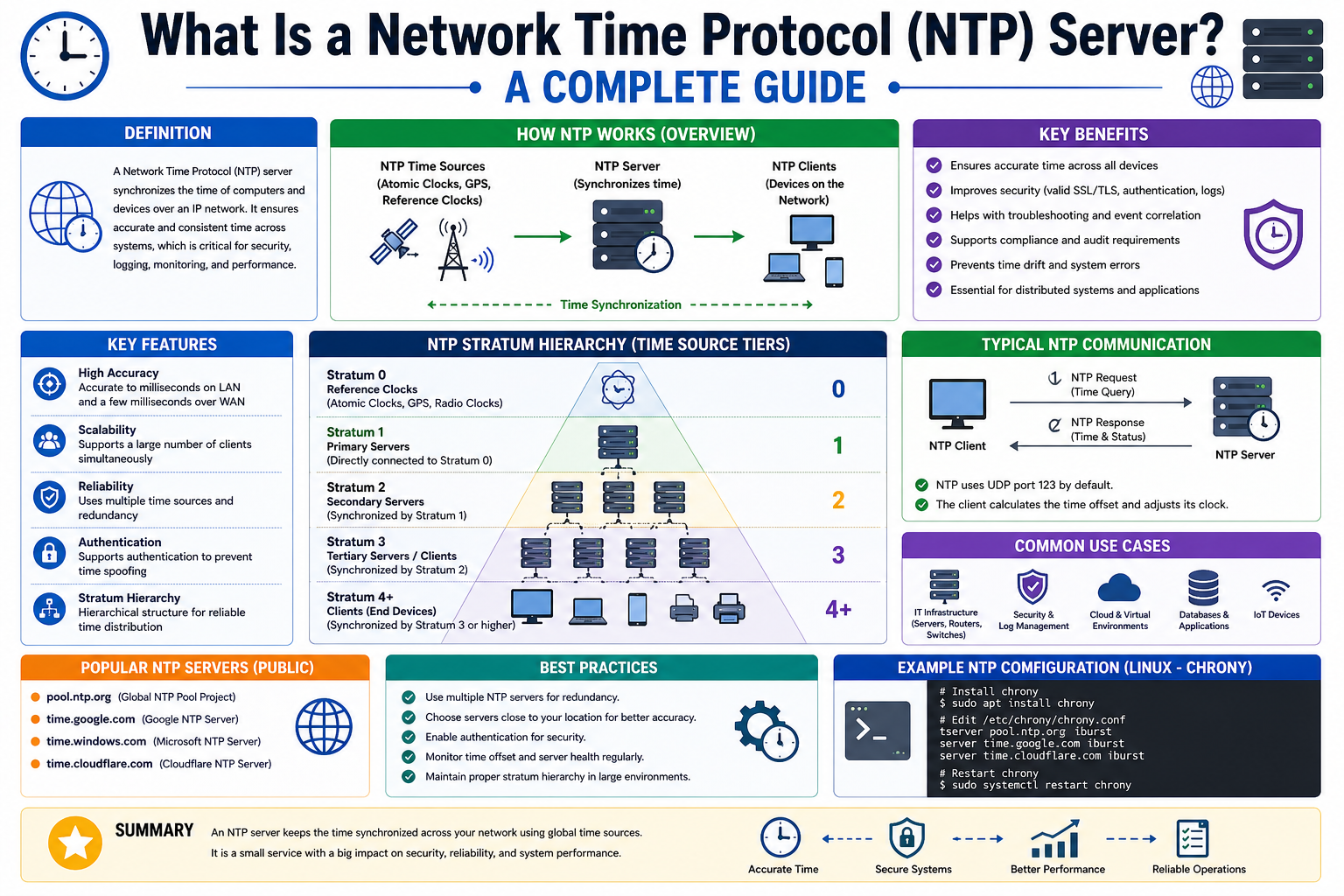
A Network Time Protocol (NTP) server is a specialized system designed to provide accurate and consistent time information to devices connected within a network. Its main role is to ensure that every computer, server, router, and digital device shares the same reference time. This shared time foundation is essential because modern computing depends heavily on precise timestamps for communication, logging, security, and coordination between systems. Without a unified time source, even small differences in system clocks can create confusion, errors, and failures in data processing.
Why Accurate Time Becomes Critical in Digital Systems
In any networked environment, time is not just a reference but a structural requirement. Every transaction, login attempt, file update, or system event is recorded with a timestamp. If devices disagree on the current time, logs become inconsistent, security systems may misinterpret events, and distributed applications can fail to coordinate properly. For example, financial systems require exact sequencing of transactions, while cybersecurity tools rely on precise timing to detect suspicious activities. Even a few seconds of difference between systems can create major operational issues in complex environments.
The Core Role of an NTP Server in Time Synchronization
An NTP server acts as a trusted authority that distributes correct time across all connected devices. Instead of each machine relying on its internal clock—which may drift over time due to hardware limitations—devices regularly consult the NTP server to adjust and correct their time. This ensures that all systems remain synchronized with minimal deviation. The process happens continuously in the background, making timekeeping seamless and automatic for users and applications.
How Time Drift Occurs in Computer Systems
Every computer has an internal clock powered by a hardware component that keeps track of time even when the system is turned off. However, these clocks are not perfectly accurate. Over time, they may run slightly fast or slow due to temperature changes, electrical variations, or hardware imperfections. This gradual deviation is known as time drift. Without correction, different devices on the same network can develop noticeable time differences, which can disrupt coordinated operations and data consistency.
The Importance of a Shared Time Reference
A shared time reference ensures that all systems interpret events in the same sequence. When devices operate independently without synchronization, it becomes difficult to determine the true order of events across a network. This is especially important in distributed systems where multiple machines work together to process data. A consistent time source provided by an NTP server eliminates ambiguity and ensures that every system is aligned to the same chronological framework.
The Early Development of Network Time Protocol
The concept of network-based time synchronization emerged during the early development of computer networking in the mid-1980s. At that time, networks were relatively small, and time differences between systems were not considered a major issue. However, as networks expanded and systems became more interconnected, the need for accurate time coordination became increasingly important. The earliest version of the protocol was designed to address these growing challenges by allowing machines to synchronize their clocks over a network.
Growth of the Internet and Rising Need for Precision
As the internet expanded rapidly in the late 1980s and 1990s, the complexity of distributed computing increased significantly. Organizations began relying on interconnected systems for communication, banking, research, and data storage. In this environment, even minor time inconsistencies could lead to serious problems such as duplicated transactions, incorrect logs, and system conflicts. This growing complexity made precise time synchronization not just useful but essential for reliable digital operations.
Introduction of Hierarchical Time Distribution
To manage time synchronization efficiently across large networks, a hierarchical structure was introduced within the protocol. This structure organizes time sources into different levels based on their accuracy and proximity to a reference clock. At the top of this hierarchy are extremely accurate time sources, while lower levels receive and distribute time based on their position in the structure. This layered approach ensures scalability and stability even in large, global networks.
Understanding the Concept of Stratum Levels
Stratum levels define the distance of a device from the primary time source. Devices directly connected to highly accurate reference clocks are considered the most precise, while those further down the chain are assigned higher stratum numbers. Each level in the hierarchy receives time from the level above it and passes it down to other systems. This structure allows thousands of devices to synchronize efficiently without overwhelming a single time source.
Stratum Zero as the Foundation of Accurate Time
At the very top of the hierarchy is the reference time source, often referred to as stratum zero. These sources include highly precise devices such as atomic clocks or GPS-based timing systems. They are not directly connected to the network but serve as the ultimate authority for time accuracy. Their measurements are used to synchronize higher-level servers, ensuring that the entire system is based on extremely precise time data.
Stratum One Servers and Their Role in Distribution
Stratum one servers are directly connected to stratum zero sources and act as the primary distributors of accurate time across the network. These servers are considered highly reliable because they receive time directly from the most accurate references available. They serve as the first layer in the network-based distribution system, passing precise time information to lower-level servers and clients.
Expansion of Lower Stratum Levels in Large Networks
As time information moves further away from the original reference source, it passes through multiple layers of servers, known as stratum two, three, and beyond. Each level receives time from the previous one and distributes it further. Although slight delays and minor variations can occur at each stage, the system is designed to minimize inaccuracies and maintain overall synchronization across vast networks.
How NTP Servers Communicate with Devices
An NTP server communicates with client devices by sending time updates at regular intervals. These updates allow each device to compare its internal clock with the server’s time and make necessary adjustments. The process is continuous and automatic, ensuring that devices remain synchronized without manual intervention. Communication occurs over network connections, making it suitable for both local and global systems.
The Relationship Between NTP Servers and Clients
In an NTP system, servers and clients work together in a structured relationship. The server provides authoritative time information, while clients receive and adjust their clocks accordingly. Clients can range from individual computers to large-scale systems such as databases or network infrastructure devices. This relationship ensures that all connected systems maintain a unified sense of time.
Importance of Time Synchronization in Network Stability
Time synchronization plays a crucial role in maintaining network stability. Many systems rely on accurate timestamps to function correctly, including authentication systems, data replication services, and logging mechanisms. When time is inconsistent, these systems may produce errors, reject valid data, or fail to coordinate properly. NTP servers help prevent these issues by maintaining consistent timing across all devices.
Evolution Toward Modern NTP Implementations
Over time, Network Time Protocol has evolved to handle increasing demands from modern digital environments. Improvements in accuracy, error correction, and scalability have made it suitable for large-scale global networks. Today’s implementations are capable of handling complex infrastructures with thousands or even millions of connected devices, ensuring precise synchronization across diverse systems.
Foundations of Reliable Time Distribution Systems
The effectiveness of an NTP server lies in its ability to provide a stable and reliable time source to all connected devices. By combining hierarchical structuring, continuous synchronization, and highly accurate reference sources, the system ensures that time remains consistent across networks of any size. This foundational stability is what allows modern digital systems to function smoothly and efficiently without time-related conflicts.
The Hierarchical Structure Behind NTP Time Distribution
Network Time Protocol relies on a carefully designed hierarchical structure that ensures time is distributed in an organized and scalable way across large networks. This structure is built so that the most accurate time originates from highly precise reference systems and gradually flows downward through multiple layers of servers until it reaches end devices. The purpose of this design is to prevent overload on primary time sources while still maintaining consistent accuracy across thousands or even millions of connected systems.
At the top of this structure are the most precise time sources, and as time moves downward through each layer, it is relayed, adjusted, and distributed to maintain synchronization. This layered approach ensures that even in large, complex environments, all devices can rely on a stable and consistent time reference without directly accessing the primary source.
Understanding the Role of Network Time Protocol in Synchronization
Network Time Protocol functions as the communication system that enables devices to synchronize their clocks with a trusted time source. Instead of each device relying on its own internal clock, which may drift or lose accuracy over time, NTP ensures that all systems regularly adjust their time based on external references. This continuous correction process keeps network-wide time consistent and reliable.
The protocol is designed to work even in environments with variable network conditions. It takes into account delays caused by data transmission and adjusts calculations accordingly. This ability to compensate for network latency is one of the key reasons NTP remains highly accurate even over long distances and complex infrastructures.
The Importance of Time Accuracy in Distributed Systems
In distributed computing environments, multiple systems work together to complete tasks. These systems often operate independently but must coordinate their actions precisely. Accurate time synchronization ensures that each system understands the exact order in which events occur. Without this alignment, data processing errors, conflicts, and inconsistencies can arise.
For example, in database systems, transactions must be recorded in the correct sequence to maintain data integrity. In cloud environments, services running on different machines must coordinate actions based on synchronized timing. Even small differences in system clocks can lead to mismatched data states or processing errors.
How NTP Servers Maintain Continuous Time Correction
NTP servers do not simply provide time once; instead, they continuously update connected devices. Clients regularly send requests to the server to compare their local time with the reference time. Based on the difference, small adjustments are made to gradually align the system clock with the correct value.
This gradual correction process is important because sudden changes in system time can disrupt running applications. Instead of abruptly changing the clock, NTP gently adjusts it over time, ensuring that applications continue running smoothly while synchronization is achieved in the background.
The Concept of Time Offset and Delay Measurement
One of the core functions of NTP is measuring the difference between the client’s local time and the server’s reference time. This difference is known as the time offset. However, because network communication is not instantaneous, NTP also accounts for delays that occur during data transmission.
To achieve this, the protocol uses round-trip timing measurements. It records how long it takes for a request to reach the server and for the response to return. By analyzing these delays, NTP can estimate the most accurate time adjustment needed for the client system.
How Network Conditions Influence Time Synchronization
Network conditions such as latency, congestion, and packet loss can affect how quickly and accurately time updates are received. However, NTP is designed to adapt to these variations. It continuously monitors network performance and adjusts its calculations to minimize errors caused by inconsistent connectivity.
Even in unstable network environments, NTP maintains reasonable accuracy by averaging multiple time samples and filtering out inconsistent results. This makes it highly resilient and reliable for use in both local networks and global systems.
The Importance of Stability in Timekeeping Systems
Stability is one of the most important characteristics of a reliable time synchronization system. Instead of reacting to every minor fluctuation in time readings, NTP focuses on long-term consistency. It smooths out small variations and prioritizes stable synchronization over instant correction.
This approach prevents unnecessary clock adjustments that could destabilize applications. By maintaining a steady and predictable time flow, NTP ensures that systems remain reliable even under changing network conditions.
How Devices Interact with Time Servers in Real Environments
In practical environments, devices such as computers, servers, and network equipment are configured to automatically connect to time servers. These devices periodically send requests to check whether their internal clocks are aligned with the reference time. If differences are detected, adjustments are made accordingly.
This interaction happens silently in the background, without requiring user intervention. It ensures that all systems remain synchronized without disrupting normal operations or requiring manual configuration updates.
The Role of Multiple Time Sources for Reliability
To improve reliability, many systems are configured to use multiple time sources instead of relying on a single server. This redundancy ensures that if one time source becomes unavailable or provides inaccurate data, others can continue supplying correct time information.
By comparing results from multiple servers, NTP can also detect anomalies and choose the most accurate time reference. This approach increases both reliability and resilience in time synchronization systems.
How NTP Handles Network Delays and Variations
Network delays are unavoidable in any digital communication system. Data packets may take different paths, experience congestion, or encounter temporary interruptions. NTP handles these variations by using statistical methods to estimate the most accurate time value despite inconsistencies.
Instead of relying on a single measurement, it collects multiple samples over time. These samples are analyzed to determine the most stable and reliable time correction, reducing the impact of unpredictable network behavior.
The Relationship Between Accuracy and Polling Frequency
Polling frequency refers to how often a device checks the time server for updates. Higher polling frequency can improve accuracy because the system adjusts more frequently. However, it also increases network traffic. Lower polling frequency reduces load but may allow minor time drift between updates.
Balancing these two factors is important for optimal performance. Systems typically adjust polling frequency dynamically based on stability, network conditions, and accuracy requirements.
How Time Consistency Supports Security Systems
Accurate timekeeping is essential for security mechanisms such as authentication, encryption, and access control. Many security protocols rely on timestamps to validate sessions, detect expired credentials, and log events securely. If system clocks are inconsistent, security checks may fail or become unreliable.
NTP helps maintain consistency across all systems, ensuring that security processes function correctly. This is especially important in environments where multiple systems must verify and trust each other based on time-based validation.
Time Synchronization in Large-Scale Infrastructure
In large-scale infrastructures such as cloud platforms and enterprise networks, thousands of devices may operate simultaneously. Coordinating time across such a large number of systems requires a highly efficient synchronization method.
NTP provides this scalability by distributing time through multiple layers of servers. Each layer handles a portion of the network, reducing load on central systems while maintaining consistent synchronization across all devices.
Ensuring Smooth Operation in Distributed Environments
Distributed environments rely heavily on accurate time coordination to function properly. Applications that run across multiple servers must ensure that all components operate in sync. NTP provides the foundation for this coordination by ensuring that every system shares a consistent time reference.
This consistency allows distributed applications to process data correctly, coordinate tasks efficiently, and maintain system integrity even when operating across different geographical locations.
The Continuous Nature of Time Synchronization
Time synchronization is not a one-time process but a continuous activity. Systems constantly adjust and refine their clocks to maintain accuracy over time. This ongoing process ensures that even small drifts are corrected before they become significant.
NTP operates silently in the background, making continuous adjustments without disrupting system performance. This constant refinement is what allows modern networks to maintain precise timing over long periods.
How NTP Client Modes Shape Time Synchronization Behavior
In network time synchronization, clients can operate in different communication styles depending on how they are configured to interact with time servers. These modes determine how time information is requested, distributed, and received across a network. The choice of mode affects efficiency, scalability, and reliability, especially in environments with many connected devices. Each mode serves a specific purpose, ensuring that time synchronization can adapt to different network designs and operational needs.
These modes are designed to balance accuracy with network performance. Instead of using a single method for all situations, NTP provides flexible communication approaches that can be tailored to small networks, enterprise systems, or large distributed infrastructures.
Unicast Mode and Direct Time Communication
Unicast mode is one of the most precise and commonly used methods of time synchronization. In this mode, a single client communicates directly with a specific time server. This one-to-one communication ensures that time updates are delivered in a controlled and secure manner, reducing unnecessary network traffic.
Because communication is direct, unicast mode allows for better monitoring of delay, accuracy, and reliability. Each client independently requests time updates, and the server responds specifically to that client. This approach is especially useful in environments where accuracy and security are priorities, as it minimizes external interference and provides more predictable synchronization behavior.
Broadcast Mode and Network-Wide Time Distribution
Broadcast mode works differently by sending time information to all devices within a network segment at once. Instead of each client requesting time individually, the server periodically sends out time updates to a general broadcast address. All listening devices receive and apply these updates simultaneously.
This method is efficient in environments where many devices need synchronized time within a local network. It reduces the number of requests sent to the server and simplifies communication. However, because it is a one-to-many approach, it offers less control compared to direct communication methods and is generally used in controlled network environments.
Multicast Mode and Group-Based Synchronization
Multicast mode provides a middle ground between unicast and broadcast communication. Instead of sending time updates to all devices or a single device, the server sends updates to a specific group of clients that are subscribed to a multicast address.
Only devices that are part of this group receive the time updates, which makes the process more efficient than broadcast while still reducing the overhead of individual client requests. This method is particularly useful in larger networks where only selected systems require synchronized timing from a shared source.
Why Different Modes Are Needed in Network Environments
Different network environments have different requirements. Small networks may only need direct communication between a few systems, while large enterprise environments may need to synchronize thousands of devices efficiently. By offering multiple communication modes, NTP ensures flexibility across all types of infrastructures.
Each mode is designed to solve specific challenges such as reducing network traffic, improving scalability, or enhancing accuracy. This adaptability is one of the reasons NTP remains widely used in both simple and complex systems.
The Role of Timing Intervals in Client Synchronization
Timing intervals define how often a client checks in with a time server to update its clock. These intervals are carefully managed to balance network efficiency with accuracy. Frequent updates can improve precision but may increase network load, while longer intervals reduce traffic but may allow slight time drift.
NTP dynamically adjusts these intervals based on network stability and synchronization accuracy. When a system is stable, updates may occur less frequently. If inconsistencies are detected, the system may increase the frequency of updates to restore accuracy more quickly.
How Client Systems Choose Time Servers
Client systems are usually configured with a list of available time servers rather than relying on a single source. This allows them to compare multiple time references and choose the most accurate one. The system evaluates factors such as response time, reliability, and consistency before selecting the best source.
This selection process ensures that even if one server becomes unreliable or unreachable, the client can continue synchronizing with alternative sources without interruption.
Importance of Redundancy in Time Synchronization
Redundancy is a critical design principle in NTP systems. By using multiple servers, systems ensure that time synchronization continues even if one or more sources fail. This approach improves reliability and prevents single points of failure from disrupting the entire network.
Redundancy also improves accuracy by allowing clients to compare results from different servers. If one server provides inconsistent data, it can be identified and excluded from synchronization calculations.
How Network Conditions Affect Mode Performance
Different NTP modes perform differently depending on network conditions. In stable and controlled environments, unicast mode provides excellent accuracy and security. In high-density networks, broadcast or multicast modes may be more efficient due to reduced communication overhead.
Network congestion, latency, and packet loss can influence how effectively each mode performs. NTP is designed to adapt to these conditions by continuously adjusting timing calculations and selecting the most reliable communication path.
The Importance of Consistent Time Across Devices
Consistent time across all devices in a network ensures that operations occur in the correct sequence. Whether it is logging system events, processing transactions, or coordinating distributed applications, synchronized time provides a shared reference point for all activities.
Without consistent time, systems may interpret events differently, leading to confusion, errors, and potential system failures. NTP ensures that every device operates within the same temporal framework, maintaining order and predictability.
How Client Systems Maintain Ongoing Synchronization
Once configured, NTP clients continuously maintain synchronization without manual intervention. They regularly communicate with time servers, compare their internal clocks, and make small adjustments as needed. This continuous process ensures that time drift is corrected before it becomes noticeable.
The system is designed to operate silently in the background, making adjustments gradually to avoid disrupting running applications or system processes.
The Science Behind Time Adjustment Calculations
NTP uses mathematical algorithms to calculate the difference between local system time and reference time. These calculations account for network delays, processing time, and transmission variations. By analyzing multiple time samples, the system determines the most accurate adjustment required.
Instead of applying abrupt changes, the system gradually corrects the clock, ensuring smooth transitions and avoiding disruptions in system operations.
How NTP Filters Out Inaccurate Time Data
Not all time measurements are reliable due to network instability or temporary errors. NTP uses filtering techniques to remove inconsistent or outlier data before making synchronization decisions. This ensures that only stable and reliable measurements influence time adjustments.
By continuously analyzing multiple sources, the system improves accuracy and reduces the impact of faulty or delayed responses.
Importance of Time Stability in Distributed Applications
Distributed applications depend heavily on stable time synchronization to function correctly. Systems working across multiple machines must coordinate tasks precisely. Even minor time differences can cause inconsistencies in data processing or task execution.
Stable time provided through NTP ensures that all components of a distributed system operate in harmony, regardless of physical location or network distance.
How NTP Supports Scalability in Large Networks
As networks grow in size, maintaining consistent time becomes more challenging. NTP supports scalability by distributing time synchronization responsibilities across multiple layers of servers. This reduces pressure on central servers while ensuring that all devices receive accurate time updates.
This layered structure allows NTP to function efficiently in environments ranging from small office networks to global-scale infrastructures.
Continuous Adaptation in Changing Network Conditions
Network environments are constantly changing due to traffic fluctuations, hardware changes, and connectivity variations. NTP continuously adapts to these changes by adjusting its synchronization behavior in real time.
This adaptability ensures that time accuracy is maintained even when network conditions are unpredictable or unstable.
Configuring NTP Clients for Reliable Time Synchronization
Proper configuration of NTP clients is essential for maintaining accurate and stable time across all systems in a network. When clients are correctly set up, they continuously align their internal clocks with trusted time sources, ensuring that every device operates with the same reference time. This consistency is critical in environments where precise timing affects system behavior, data integrity, and coordination between multiple services.
Configuration involves selecting appropriate time sources, defining synchronization intervals, and ensuring that clients can communicate efficiently with servers. Once configured, the system operates automatically, making small adjustments in the background without user intervention.
Selecting Reliable Time Sources for Clients
The accuracy of an NTP client depends heavily on the quality of the time sources it connects to. Reliable sources are typically those that are closer to the primary reference clocks in the hierarchy and have a strong reputation for stability. Clients are usually configured to connect to more than one server to ensure redundancy and improve reliability.
By using multiple time sources, clients can compare results and identify the most accurate readings. This reduces the risk of relying on a single unreliable server and improves overall synchronization accuracy across the network.
Balancing Accuracy and Network Efficiency
One of the key considerations in NTP configuration is balancing synchronization accuracy with network efficiency. Frequent time updates improve accuracy but increase network traffic, while less frequent updates reduce load but may allow slight time drift.
Systems are typically configured to adjust synchronization frequency based on stability. When the network is stable, updates occur less often. When inconsistencies are detected, the system increases synchronization frequency to quickly restore accuracy.
Polling Intervals and Their Impact on Performance
Polling intervals define how often a client contacts a time server for updates. These intervals play an important role in determining how responsive and efficient the synchronization process is. Short intervals result in faster corrections but may increase network usage, while longer intervals reduce traffic but allow more time drift between updates.
Modern NTP systems often adjust polling intervals dynamically based on observed network behavior and synchronization accuracy. This ensures that performance remains balanced without requiring constant manual adjustment.
Ensuring Consistency Across Multiple Devices
Consistency is a fundamental requirement in any network environment. When multiple devices operate together, they must share the same time reference to ensure coordinated behavior. NTP helps achieve this by ensuring that all clients follow the same synchronization rules and connect to compatible time sources.
Standardizing configurations across all devices reduces discrepancies and ensures that time remains uniform throughout the entire network infrastructure.
Monitoring Time Synchronization Status
Monitoring is an important part of maintaining a reliable NTP system. By regularly checking synchronization status, administrators can ensure that clients are correctly aligned with their time sources. Monitoring tools can detect delays, failures, or inconsistencies in synchronization behavior.
This ongoing observation helps identify potential issues early, allowing corrective actions to be taken before they affect system performance or data integrity.
Importance of Redundant Time Servers
Redundancy plays a crucial role in ensuring uninterrupted time synchronization. By configuring multiple time servers, systems can continue functioning even if one or more servers become unavailable. This redundancy protects against failures and ensures continuous access to accurate time information.
In addition to reliability, redundancy also improves accuracy by allowing clients to compare multiple time sources and select the most consistent readings.
Ensuring Compatibility Between Clients and Servers
Compatibility between NTP clients and servers is essential for smooth communication. Different versions of the protocol may include improvements, security updates, or changes in behavior. Ensuring that clients and servers are compatible helps prevent synchronization errors and communication issues.
Maintaining updated software versions across all systems improves stability and ensures that time synchronization operates efficiently.
Security Considerations in Time Synchronization
Security is an important aspect of NTP configuration. Since time plays a critical role in authentication, encryption, and logging systems, inaccurate or manipulated time can lead to serious vulnerabilities. Protecting NTP communication helps maintain the integrity of the entire network.
Secure configurations may include restricting access to trusted servers, using authentication mechanisms, and preventing unauthorized time sources from influencing system clocks.
Risks of Unauthorized Time Sources
If a system connects to untrusted or malicious time sources, it may receive incorrect time information. This can disrupt system behavior, invalidate security protocols, and create inconsistencies in logs and transactions. Such manipulation is known as time spoofing and can have serious consequences in sensitive environments.
To prevent this, systems are typically configured to only accept time updates from verified and trusted sources within a controlled environment.
Maintaining Integrity in Time-Based Systems
Many systems rely on time for validation, scheduling, and security checks. If time is inaccurate, these systems may behave unpredictably. Maintaining time integrity ensures that all operations based on timestamps function correctly.
NTP helps preserve this integrity by continuously aligning system clocks with trusted references, reducing the risk of inconsistencies across applications and services.
The Role of Continuous Synchronization
Time synchronization is not a one-time task but an ongoing process. Systems constantly compare their internal clocks with external references and make adjustments when necessary. This continuous process ensures that even small deviations are corrected before they grow into larger problems.
The background nature of this synchronization allows systems to remain accurate without disrupting normal operations or requiring user intervention.
How NTP Handles Minor Clock Adjustments
Instead of making abrupt changes, NTP gradually adjusts system clocks. This smooth correction process prevents sudden jumps in time that could disrupt running applications or processes. By slowly aligning the clock with the correct time, the system maintains stability while improving accuracy.
This method ensures that applications depending on time-sensitive operations continue functioning without interruption.
Importance of Time Accuracy in Security Protocols
Security systems rely heavily on accurate time for tasks such as authentication, certificate validation, and session management. If system clocks are not synchronized, valid credentials may appear expired or invalid, and security logs may become unreliable.
NTP ensures that all systems maintain consistent time, supporting the proper functioning of security protocols across the network.
Handling Network Variability in Synchronization
Network environments are not always stable. Variations in latency, congestion, and connectivity can affect communication between clients and servers. NTP is designed to handle these variations by analyzing multiple time samples and adjusting calculations accordingly.
This adaptability ensures that synchronization remains accurate even when network conditions fluctuate.
The Role of Algorithms in Time Correction
NTP uses advanced algorithms to calculate the most accurate time adjustments. These algorithms consider multiple factors such as network delay, response time, and historical accuracy. By analyzing this data, the system determines the best possible correction for each client.
This mathematical approach ensures precision and minimizes the impact of inconsistent or delayed responses.
Long-Term Stability in Time Synchronization Systems
The ultimate goal of NTP is to maintain long-term stability in timekeeping across all connected devices. By continuously adjusting clocks, filtering inaccurate data, and adapting to network conditions, the system ensures that time remains consistent over extended periods.
This stability is essential for modern digital infrastructures where precise timing underpins nearly every operation, from basic logging to complex distributed computing tasks.
Conclusion
Network Time Protocol servers form the backbone of accurate timekeeping in modern digital environments. By providing a consistent and reliable source of time, they ensure that all connected devices operate within a unified framework. This shared sense of time is essential for maintaining order in systems where even the smallest discrepancy can lead to errors, inconsistencies, or security concerns.
Throughout network operations, synchronized time supports everything from data integrity and transaction accuracy to system coordination and security validation. The structured hierarchy of time sources, combined with continuous synchronization processes, allows networks to scale efficiently while maintaining precision. Whether in small local setups or large global infrastructures, the role of NTP remains the same: to keep every device aligned with a trusted time reference.
The flexibility of client modes, the use of multiple time sources, and the ability to adapt to changing network conditions all contribute to the reliability of the system. Careful configuration and ongoing monitoring further strengthen this reliability, ensuring that synchronization remains stable over time. Security considerations also play a vital role, as protecting time sources helps preserve the integrity of systems that depend on accurate timestamps.
In a world where digital systems are deeply interconnected, precise timekeeping is no longer optional but essential. NTP servers provide the foundation that keeps systems synchronized, operations coordinated, and data trustworthy, making them a critical component of modern network infrastructure.