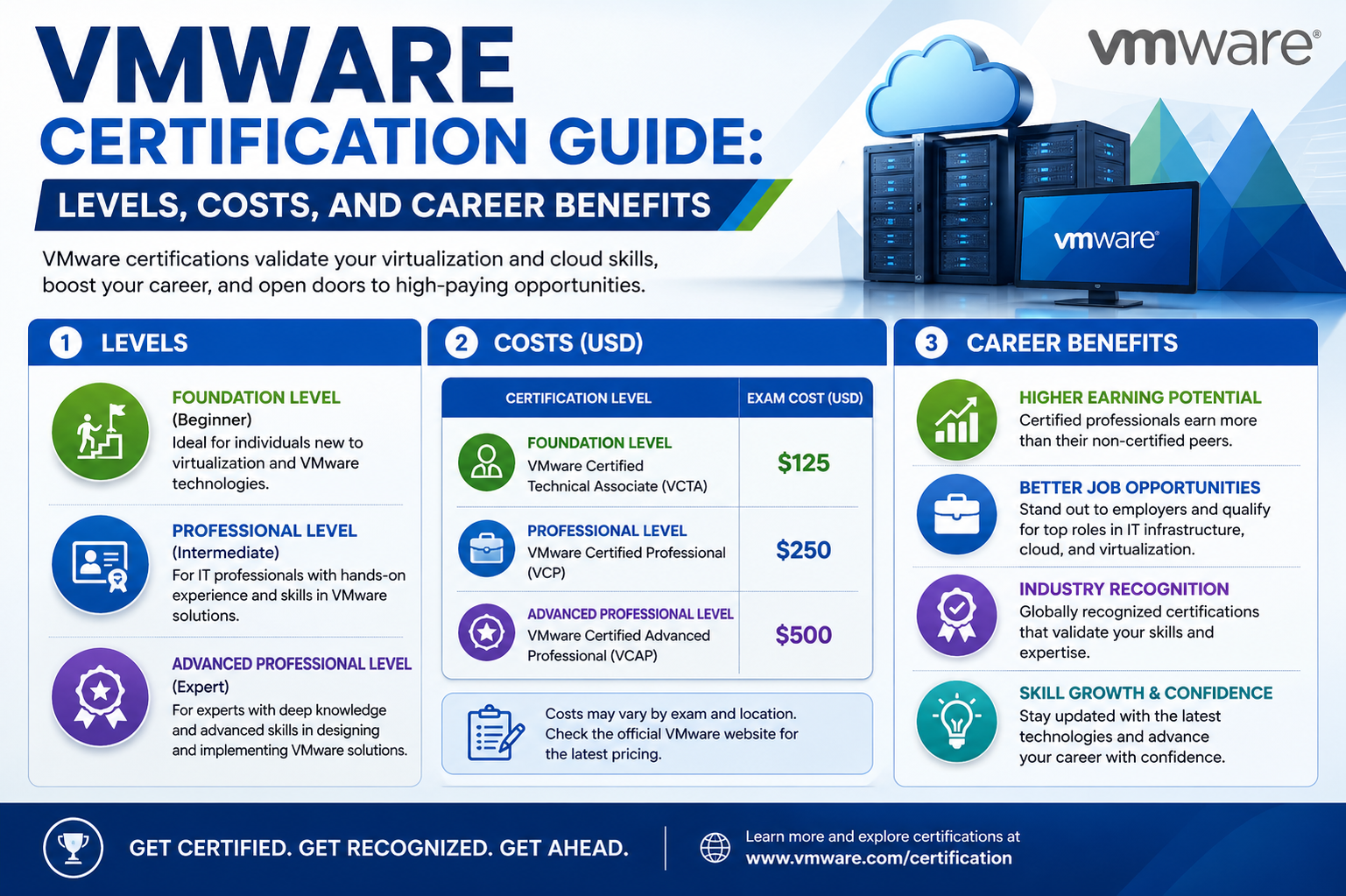
VMware has established itself as a global leader in virtualization and cloud infrastructure technologies, playing a critical role in modern IT environments. Organizations across industries rely on VMware solutions to optimize data centers, improve resource utilization, enhance scalability, and reduce operational costs. Because of this widespread adoption, professionals who understand VMware technologies are in high demand in the IT job market. VMware certifications are structured to validate these skills and ensure that IT professionals can effectively deploy, manage, and optimize virtualization environments in real-world scenarios. This guide provides a detailed understanding of VMware certifications, their structure, career relevance, and how they align with industry roles.
Understanding VMware Certification Pathways
VMware certifications are designed to assess and validate technical expertise in virtualization and cloud computing environments. These certifications are intended for IT professionals who want to build or advance their careers in areas such as data center management, network virtualization, cloud automation, and digital workspace technologies. Over time, VMware has evolved its certification structure to align more closely with job roles rather than generic skill levels. This shift ensures that candidates are evaluated based on practical, role-specific competencies that directly apply to enterprise IT environments.
Evolution from Traditional Levels to Role-Based Certifications
In earlier years, VMware certifications followed a structured four-level hierarchy. This traditional model categorized professionals based on increasing skill levels and expertise. However, VMware later transitioned toward a role-based certification framework to better match industry demands and real job functions. Instead of focusing solely on theoretical skill progression, the new model emphasizes practical knowledge tied to specific IT responsibilities. This change allows professionals to specialize in distinct technology areas such as cloud management, networking, security, or end-user computing.
Foundational VMware Certification Level Overview
At the entry level, VMware previously offered certifications designed for beginners who were new to virtualization concepts. This level helped professionals understand basic VMware technologies and prepare for more advanced roles. These foundational certifications have now been restructured into role-specific associate-level certifications. They focus on introducing core concepts such as virtualization fundamentals, basic infrastructure management, and introductory cloud concepts. These entry certifications are ideal for individuals starting their IT careers or transitioning into virtualization-focused roles.
Professional-Level VMware Certification Understanding
The professional-level certification represents one of the most widely recognized VMware qualifications. It is designed for IT professionals who work directly with VMware technologies in operational environments. These individuals typically handle installation, configuration, management, and optimization of VMware systems. The certification validates hands-on expertise in managing virtual environments and is commonly pursued by systems administrators, network engineers, and IT support professionals. It ensures that candidates can effectively manage enterprise-level VMware deployments.
Advanced VMware Certification Expertise
Advanced certifications are intended for professionals who already possess significant experience in VMware environments. These certifications focus on complex tasks such as designing enterprise solutions, optimizing large-scale infrastructures, and deploying advanced configurations. Candidates at this level are expected to demonstrate deep technical knowledge and problem-solving capabilities. The certification is typically aligned with senior engineering, architecture, and consulting roles where strategic planning and infrastructure design are key responsibilities.
Expert-Level VMware Certification Significance
The expert-level VMware certification represents the highest level of achievement within the VMware certification ecosystem. It is designed for professionals who specialize in designing and managing complex, large-scale virtualization infrastructures. Individuals at this level are often responsible for enterprise architecture decisions and advanced system integration. This certification requires extensive practical experience, technical depth, and the ability to defend design decisions in real-world scenarios. It is widely respected across the IT industry and is associated with senior architectural roles.
Transition to Role-Based Certification Framework
VMware has reorganized its certification structure into a role-based model that aligns with specific job functions. This approach ensures that professionals can specialize in areas that directly match their career paths. Instead of following a single linear progression, candidates can now choose certification tracks based on their job roles or interests. These role-based categories include data center virtualization, network virtualization, cloud management and automation, end-user computing, security, and application modernization. Each category contains multiple certification levels, allowing for both entry-level and advanced progression within a specific domain.
Data Center Virtualization Certification Path Overview
The data center virtualization track focuses on VMware vSphere technologies, which are widely used in enterprise data centers. This certification path validates skills related to virtual machines, storage management, and networking within virtual environments. Professionals in this track learn how to design, deploy, and manage scalable data center infrastructures using VMware solutions. The certifications in this category range from foundational knowledge to expert-level architectural design, making it one of the most comprehensive VMware certification paths.
Entry-Level Data Center Virtualization Skills
At the entry level of data center virtualization, professionals are introduced to fundamental concepts of virtualization. This includes understanding virtual machine operations, basic infrastructure components, and essential management tasks. The certification at this stage ensures that candidates can perform basic administrative functions in a VMware environment. It is particularly suitable for individuals beginning their journey in IT infrastructure or virtualization support roles.
Professional Data Center Virtualization Expertise
The professional level in data center virtualization builds on foundational knowledge and focuses on practical system administration. Professionals at this level are expected to manage virtual environments, configure resources, troubleshoot issues, and optimize performance. This certification demonstrates the ability to handle production environments and is often required for mid-level IT roles. It plays a crucial role in validating real-world technical capabilities in enterprise data center operations.
Advanced Design and Deployment in Data Centers
At the advanced level, VMware certifications focus on two key areas: design and deployment. Design-oriented certifications emphasize the ability to architect scalable and resilient virtual infrastructures, while deployment certifications focus on implementing and managing complex environments. Professionals at this level are expected to work with large-scale enterprise systems and make strategic infrastructure decisions that align with business needs. These certifications require strong analytical and technical expertise.
Expert Data Center Virtualization Mastery
The expert-level certification in data center virtualization represents the highest level of specialization. Professionals at this stage are responsible for designing and validating enterprise-grade virtualization architectures. They must demonstrate deep technical knowledge, extensive hands-on experience, and the ability to defend their design decisions. This certification is highly respected and is often associated with senior architectural roles in large organizations.
Career Roles in Data Center Virtualization
Professionals certified in data center virtualization can pursue a wide range of IT careers. Entry-level roles include virtualization technicians and junior administrators, while more advanced positions include system engineers, solution architects, and infrastructure designers. These roles involve managing enterprise IT systems, ensuring system availability, and optimizing virtual environments for performance and efficiency. The demand for skilled professionals in this area continues to grow as organizations increasingly adopt virtualization technologies.
Introduction to Network Virtualization Certification Path
Network virtualization is another major VMware certification track that focuses on software-defined networking technologies. This certification validates the ability to design, implement, and manage virtual networks using VMware NSX technologies. It is particularly important for professionals working in cloud networking and security environments. The certification levels in this track range from foundational knowledge to expert-level network architecture design.
Entry-Level Network Virtualization Understanding
At the foundational level, network virtualization certifications introduce basic networking concepts within a virtualized environment. Professionals learn how virtual networks operate, how security policies are applied, and how network components interact in a software-defined infrastructure. This level is ideal for individuals who are new to networking or transitioning into virtualization-focused network roles.
Professional and Advanced Network Virtualization Skills
At the professional level, candidates are expected to configure and manage virtual networks in enterprise environments. This includes deploying NSX solutions, managing network security policies, and troubleshooting network issues. Advanced certifications further expand on these skills by focusing on designing complex network architectures and implementing large-scale virtualization solutions. These roles require strong technical expertise and hands-on experience in enterprise networking.
Career Opportunities in Network Virtualization
Certified network virtualization professionals can work as network administrators, virtualization engineers, and network architects. These roles involve managing modern software-defined networks and ensuring secure, scalable connectivity across enterprise systems. As organizations continue to move toward cloud-based infrastructure, demand for these professionals continues to rise significantly.
Cloud Management and Automation Certification Overview
Cloud management and automation is one of the most important VMware certification paths, designed for professionals who work with modern cloud environments and infrastructure automation tools. This certification track focuses on VMware technologies that enable organizations to manage hybrid cloud systems efficiently, automate workflows, and optimize resource usage across distributed environments. It is particularly relevant for IT professionals involved in cloud operations, infrastructure orchestration, and digital transformation projects. VMware Aria and related platforms play a central role in this certification area, providing tools for monitoring, automation, and cloud governance.
Entry-Level Cloud Management and Automation Skills
At the foundational level, this certification introduces candidates to basic cloud computing concepts and VMware’s approach to cloud infrastructure management. Professionals learn how cloud environments are structured, how automation improves operational efficiency, and how VMware tools are used to manage workloads across different platforms. This stage is ideal for beginners who are entering cloud administration or transitioning from traditional IT infrastructure roles. The focus is on understanding how cloud systems function rather than deep technical implementation.
Professional Cloud Management Expertise
At the professional level, VMware certifications focus on practical implementation and management of cloud environments. Professionals are expected to configure cloud infrastructure, deploy automation workflows, and manage virtual resources effectively. This level emphasizes hands-on experience with VMware cloud tools and solutions. It prepares candidates for roles where they actively manage cloud platforms, optimize system performance, and ensure operational stability in enterprise environments.
Advanced Cloud Design and Automation
Advanced certifications in cloud management and automation focus on designing scalable and efficient cloud architectures. Professionals at this level are responsible for creating automated systems that support large-scale enterprise operations. They work with complex infrastructure designs that integrate multiple cloud environments and on-premises systems. This level requires strong analytical thinking and the ability to design solutions that improve efficiency, reduce costs, and enhance system reliability.
Expert-Level Cloud Architecture Mastery
The expert-level certification represents the highest level of achievement in cloud management and automation. Professionals at this stage are responsible for designing enterprise-grade cloud strategies and architectures. They must demonstrate deep technical expertise, leadership in cloud transformation projects, and the ability to guide organizations in adopting advanced automation practices. These individuals often work in senior architectural or consulting roles where strategic decision-making is a key responsibility.
Career Opportunities in Cloud Management and Automation
Professionals certified in this track can pursue roles such as cloud administrators, cloud engineers, infrastructure architects, and solutions architects. These roles involve managing hybrid cloud environments, implementing automation strategies, and optimizing enterprise cloud systems. As organizations increasingly adopt cloud-first strategies, the demand for skilled cloud professionals continues to grow rapidly across industries.
End-User Computing Certification Overview
The end-user computing certification path focuses on delivering and managing digital workspace solutions. This includes VMware technologies such as Workspace ONE and Horizon, which are widely used to manage virtual desktops and application delivery systems. This certification track is essential for professionals who work with desktop virtualization, user experience optimization, and enterprise mobility solutions. It ensures that IT professionals can deliver secure and efficient digital work environments to end users.
Entry-Level End-User Computing Skills
At the entry level, candidates are introduced to basic concepts of digital workspace management and virtual desktop infrastructure. This includes understanding how virtual desktops function, how applications are delivered to users, and how endpoint devices are managed in enterprise environments. This stage is suitable for individuals starting in desktop support or IT service management roles.
Professional Desktop and Digital Workspace Management
At the professional level, VMware certifications focus on managing enterprise-scale digital workspaces. Professionals are expected to configure and maintain virtual desktop environments, manage application delivery systems, and ensure secure access for users. This includes working with VMware Horizon and Workspace ONE solutions. Candidates at this level often work in IT support, system administration, or desktop engineering roles.
Advanced End-User Computing Design and Deployment
Advanced certifications in end-user computing focus on designing and deploying complex digital workspace solutions. Professionals at this level are responsible for creating scalable desktop virtualization infrastructures that support large numbers of users. They also optimize system performance, ensure security compliance, and manage application lifecycle delivery. These roles require strong technical knowledge and experience with enterprise IT environments.
Expert-Level Digital Workspace Architecture
The expert-level certification in end-user computing represents the highest level of specialization. Professionals at this stage design enterprise digital workspace strategies and lead large-scale virtualization projects. They are responsible for ensuring seamless user experiences across distributed environments while maintaining security and performance standards. This certification is typically associated with senior architectural roles in large organizations.
Career Roles in End-User Computing
Certified professionals in this track can pursue careers such as end-user computing administrators, desktop virtualization engineers, digital workspace consultants, and senior system architects. These roles focus on managing user environments, optimizing application delivery, and ensuring secure access to enterprise resources. The demand for these professionals continues to grow as remote work and digital workplaces become more common.
Security Certification Overview in VMware Ecosystem
VMware security certifications focus on validating skills related to securing virtualized environments and cloud infrastructures. These certifications are essential for IT professionals responsible for protecting enterprise systems from cyber threats and ensuring compliance with security policies. VMware security solutions such as NSX-T, Workspace ONE, and Carbon Black Cloud play a central role in this certification track.
Foundational VMware Security Skills
At the foundational level, security certifications introduce basic cybersecurity concepts within VMware environments. Candidates learn how security is integrated into virtual infrastructure and how to manage basic security features. This stage is suitable for entry-level IT professionals or those transitioning into cybersecurity roles.
Professional Security Management Expertise
At the professional level, VMware security certifications focus on implementing and managing security solutions in enterprise environments. Professionals are expected to configure security policies, monitor threats, and manage endpoint protection systems. This level is critical for roles that involve protecting organizational infrastructure from cyber risks.
Career Opportunities in VMware Security
Professionals certified in VMware security can work as security administrators, cybersecurity technicians, and infrastructure security specialists. These roles involve ensuring system security, managing access controls, and responding to security incidents. As cyber threats continue to increase, demand for skilled security professionals remains strong across industries.
Application Modernization Certification Overview
Application modernization certifications focus on modern software development and deployment practices, including containerization and Kubernetes technologies. This certification track is designed for professionals who work with cloud-native applications and modern development frameworks. VMware Tanzu plays a key role in this area by enabling organizations to build and manage containerized applications efficiently.
Entry-Level Application Modernization Skills
At the foundational level, candidates are introduced to basic concepts of modern application development and container technologies. This includes understanding how applications are packaged, deployed, and managed in cloud environments. This stage is suitable for developers or IT professionals entering cloud-native environments.
Professional Kubernetes and Container Management
At the professional level, VMware certifications focus on managing Kubernetes environments and containerized applications. Professionals are expected to deploy, manage, and optimize container platforms using VMware Tanzu solutions. This includes ensuring application scalability, performance, and reliability in cloud environments.
Career Opportunities in Application Modernization
Certified professionals in this track can work as cloud-native developers, platform engineers, Kubernetes administrators, and DevOps engineers. These roles involve building and managing modern application infrastructures that support agile development and continuous deployment practices.
VMware Certification Salary and Career Growth Overview
VMware certifications play a significant role in improving long-term career opportunities in the IT industry. As organizations continue to adopt virtualization, cloud computing, and software-defined infrastructure, the demand for VMware-skilled professionals has steadily increased. Certified individuals are often preferred for technical roles because they demonstrate verified knowledge of enterprise-level systems. Career growth in this field is not limited to one job role, as VMware expertise can lead to opportunities in system administration, cloud engineering, network architecture, cybersecurity, and IT consulting. With experience and certification progression, professionals can move from operational roles into senior engineering and architectural positions where they handle complex infrastructure decisions.
Salary Potential Across VMware Career Paths
One of the strongest advantages of VMware certification is its positive impact on salary potential. Entry-level certified professionals typically start in support or junior administrative roles, where salaries are competitive compared to other IT entry positions. As professionals gain experience and advance to professional-level certifications, their earning potential increases significantly. Mid-level engineers and system administrators with VMware expertise often earn substantially higher salaries due to their ability to manage enterprise environments. At advanced and expert levels, professionals working in architecture, consulting, or senior engineering roles can achieve top-tier compensation in the IT industry. Salary growth is closely tied to both certification level and real-world experience.
Factors That Influence VMware Certification Value
The value of VMware certification is influenced by several important factors. Practical experience is one of the most critical elements, as employers prioritize candidates who can apply theoretical knowledge in real environments. Industry demand also plays a key role, especially in organizations that rely heavily on virtualization and cloud infrastructure. Geographic location, company size, and job role specialization can also impact earning potential and career opportunities. In addition, continuous learning and staying updated with new VMware technologies help professionals maintain long-term relevance in the IT job market.
VMware Certification Cost Overview
The cost of VMware certification varies depending on the level of certification being pursued. Entry-level certifications are generally more affordable, making them accessible for beginners in the IT field. Professional-level certifications require a moderate investment, while advanced certifications are more expensive due to their complexity and practical evaluation requirements. Expert-level certifications involve the highest costs because they often include application fees, examination fees, and in some cases, additional evaluation or defense processes. Apart from exam fees, candidates may also need to invest in training materials, practice labs, and preparation courses, which contribute to the overall certification cost.
Training and Preparation Investment
Preparing for VMware certifications requires more than just exam fees. Many professionals invest in structured training programs, online courses, and virtual lab environments to gain hands-on experience. Practice labs are especially important because VMware exams focus heavily on real-world scenarios. Study guides, video courses, and practice exams also help candidates strengthen their understanding of key concepts. While this preparation requires time and financial investment, it significantly improves the chances of passing certification exams and building long-term technical skills.
Effective Study Approach for VMware Certification
A successful VMware certification journey requires a structured and consistent study approach. Understanding exam objectives is the first step, as it helps candidates focus on relevant topics. Hands-on practice is equally important, as theoretical knowledge alone is not sufficient for passing VMware exams. Working with virtual environments, configuring systems, and troubleshooting real scenarios help build practical expertise. Breaking study sessions into manageable topics and reviewing concepts regularly improves retention and understanding. Consistency in preparation is more effective than short-term intensive study.
Importance of Hands-On Experience in VMware Learning
Hands-on experience is one of the most important factors in mastering VMware technologies. Virtualization is a practical discipline where real understanding comes from working directly with systems. Setting up virtual machines, configuring networks, managing storage, and simulating real IT environments help professionals develop deeper technical skills. This practical exposure is essential for both certification success and real-world job performance. Many employers value hands-on experience even more than theoretical knowledge, making lab practice a critical part of preparation.
Industry Demand for VMware Professionals
The demand for VMware-certified professionals continues to grow as businesses increasingly rely on virtualization and cloud technologies. Organizations use VMware solutions to improve infrastructure efficiency, reduce costs, and enhance scalability. This has created a strong need for skilled professionals who can design, manage, and secure virtual environments. Industries such as finance, healthcare, telecommunications, and government sectors heavily depend on VMware technologies, making certification holders highly valuable across multiple job markets.
Long-Term Career Stability with VMware Skills
VMware skills provide long-term career stability because virtualization remains a core component of modern IT infrastructure. Even as cloud technologies evolve, VMware continues to play a key role in enterprise environments. Professionals with VMware expertise are well-positioned for long-term growth because their skills are transferable across different IT domains, including cloud computing, networking, security, and automation. This versatility makes VMware certification a strong foundation for a sustainable IT career.
Future Scope of VMware Technologies
The future of VMware technologies is closely connected to the continued growth of cloud computing, hybrid infrastructure, and digital transformation. As organizations move toward more automated and scalable environments, VMware solutions will remain essential for managing complex IT systems. Emerging technologies such as containerization, Kubernetes, and software-defined infrastructure are further expanding the relevance of VMware certifications. Professionals who stay updated with these advancements will continue to remain in high demand.
Real-World Application of VMware Skills in Enterprise Environments
VMware certifications are not only academic achievements but also practical tools used in real enterprise IT environments. Organizations deploy VMware technologies to build scalable virtual infrastructures that support thousands of users and applications. In real-world scenarios, VMware professionals are responsible for maintaining system uptime, optimizing resource usage, and ensuring smooth performance across virtual machines and cloud platforms. These responsibilities require strong technical understanding and the ability to apply certification knowledge in dynamic and often unpredictable environments. The value of VMware certification becomes especially clear when professionals handle real production systems where downtime or misconfiguration can directly impact business operations.
Importance of Problem-Solving Skills in VMware Roles
One of the most important skills for VMware-certified professionals is problem-solving. Virtual environments are complex and involve multiple interconnected systems such as storage, networking, compute resources, and security layers. When issues occur, professionals must quickly identify the root cause and apply appropriate solutions. This may involve analyzing system logs, checking resource allocation, or reviewing network configurations. VMware certifications help build this analytical mindset, but real expertise comes from continuous exposure to real-world troubleshooting scenarios. Strong problem-solving skills significantly improve job performance and career advancement opportunities.
Role of VMware in Cloud Transformation Projects
VMware plays a major role in modern cloud transformation projects, where organizations shift from traditional infrastructure to cloud-based systems. VMware technologies help bridge the gap between on-premises data centers and cloud platforms by enabling hybrid cloud environments. Professionals working in this space contribute to designing scalable architectures that support business growth and digital transformation goals. VMware-certified individuals are often involved in planning migrations, optimizing workloads, and ensuring seamless integration between different IT systems. This makes VMware expertise highly valuable in modern enterprise IT strategies.
Continuous Learning in VMware Ecosystem
The IT industry evolves rapidly, and VMware technologies are continuously updated to meet new demands. Because of this, continuous learning is essential for professionals in this field. Even after earning certification, professionals must stay updated with new features, tools, and best practices. This can be achieved through hands-on labs, technical communities, documentation updates, and advanced training programs. Continuous learning ensures that skills remain relevant and aligned with current industry standards. It also prepares professionals for higher-level certifications and more complex job roles.
Building a Long-Term Career Strategy with VMware Certifications
A successful VMware career is built on long-term planning rather than short-term certification goals. Professionals should view certifications as stepping stones that lead to specialized career paths. For example, starting with foundational certifications can lead to system administration roles, which can further progress into cloud architecture or infrastructure design positions. By aligning certification paths with career goals, professionals can create a structured growth roadmap that leads to leadership or expert-level roles in the IT industry. This strategic approach ensures continuous career development and long-term success.
How VMware Skills Are Applied in Large Organizations
In large enterprises, VMware technologies form the backbone of IT infrastructure. Companies use virtualization to run multiple servers on a single physical machine, reducing hardware costs and improving efficiency. VMware-certified professionals are responsible for ensuring these virtual environments run smoothly. They manage workloads, allocate system resources, and monitor performance to prevent downtime. In real environments such as banks, telecom companies, and government systems, even small configuration errors can cause major disruptions. This is why organizations rely heavily on trained VMware professionals who understand both the technical and operational aspects of virtualization systems.
Day-to-Day Responsibilities of VMware Professionals
The daily work of a VMware professional varies depending on their role, but typically includes monitoring virtual machines, troubleshooting performance issues, and ensuring system stability. System administrators focus on maintaining uptime and handling routine tasks such as provisioning new virtual machines or adjusting system resources. Cloud engineers work on optimizing infrastructure and integrating cloud services, while network specialists manage virtual networking configurations. Security-focused professionals monitor threats and ensure compliance with organizational policies. These responsibilities require both technical knowledge and the ability to respond quickly to system issues.
Importance of Virtualization in Modern IT Infrastructure
Virtualization has transformed the IT industry by allowing multiple operating systems and applications to run on a single physical server. This improves hardware utilization and reduces operational costs significantly. VMware is one of the pioneers of this technology and continues to dominate enterprise virtualization solutions. Without virtualization, modern cloud computing, hybrid infrastructure, and large-scale data centers would be far less efficient. VMware-certified professionals play a critical role in maintaining this ecosystem by ensuring that virtual environments are optimized, secure, and scalable.
Impact of VMware Certification on Job Interviews
Having VMware certification can significantly improve a candidate’s chances during job interviews. Employers often prioritize certified professionals because they already have validated technical knowledge. During interviews, candidates are frequently asked scenario-based questions related to troubleshooting, system design, and infrastructure management. VMware certification helps candidates answer these questions confidently because they have practical exposure to similar concepts during their training. In many cases, certification acts as proof that the candidate can handle real-world enterprise systems.
How VMware Supports Cloud and Digital Transformation
Modern businesses are rapidly moving toward cloud-based systems and digital transformation strategies. VMware plays a central role in this shift by providing tools that enable hybrid cloud environments, automation, and workload portability. Organizations can move applications between on-premises and cloud environments without major disruptions. VMware-certified professionals are essential in this process because they understand how to design and manage these hybrid systems. Their expertise ensures smooth migration, system reliability, and efficient resource utilization during transformation projects.
Common Challenges Faced by VMware Professionals
Despite strong career opportunities, VMware professionals often face challenges in their work environments. One of the main challenges is managing complex infrastructures where multiple systems are interconnected. A small issue in networking or storage can impact the entire virtual environment. Another challenge is keeping up with rapidly changing technologies, as VMware frequently updates its tools and features. Professionals must continuously learn and adapt to stay relevant. Additionally, troubleshooting distributed systems can be time-consuming and requires deep technical understanding.
Role of Automation in Reducing IT Workload
Automation is becoming increasingly important in VMware environments. Many routine IT tasks such as provisioning virtual machines, balancing workloads, and monitoring performance can now be automated using VMware tools. This reduces manual workload and allows IT teams to focus on more strategic tasks. Automation also improves consistency and reduces human errors. VMware-certified professionals who understand automation tools are highly valued because they help organizations improve efficiency and reduce operational costs.
Future Trends in VMware and Virtualization Industry
The future of VMware and virtualization is closely linked to cloud computing, artificial intelligence, and containerization technologies. As businesses continue to adopt multi-cloud environments, VMware is expected to play an even larger role in managing hybrid systems. Technologies like Kubernetes and cloud-native applications are becoming more common, and VMware is integrating these into its ecosystem. Professionals who stay updated with these trends will have strong career opportunities in the coming years.
Long-Term Career Progression Strategy
A successful VMware career is built through continuous progression. Professionals typically start with foundational knowledge and gradually move toward more advanced roles such as system engineers, cloud architects, and infrastructure consultants. Each certification level helps unlock new job opportunities and higher salary potential. Over time, experienced professionals can move into leadership roles where they design enterprise systems and guide IT strategy for organizations. Planning certifications strategically is key to long-term career success.
Final Conclusion
VMware certification is one of the most valuable qualifications in the IT industry because it combines theoretical knowledge with practical, real-world skills. It prepares professionals to work in complex IT environments involving virtualization, cloud computing, networking, security, and application modernization. Beyond certification exams, the true value lies in the ability to apply these skills in enterprise systems that power modern businesses. With strong global demand, high salary potential, and continuous technological growth, VMware certification remains a powerful pathway for building a stable and successful IT career. Professionals who invest in learning, hands-on practice, and continuous improvement can achieve long-term success in the ever-evolving technology industry.