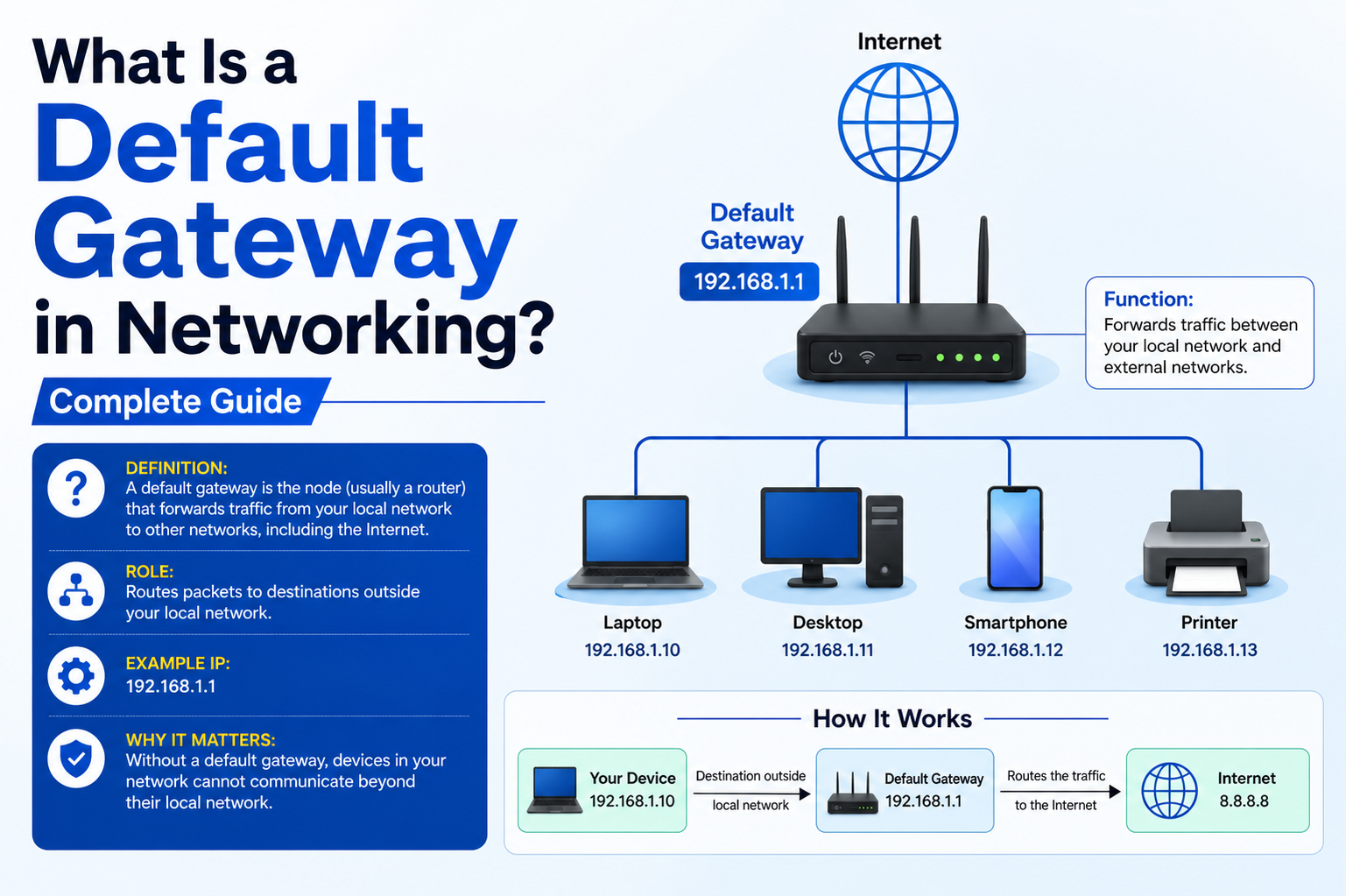
A default gateway is a network device, most commonly a router, that acts as the main exit and entry point for data traveling between a local network and other external networks. Whenever a device on a network needs to communicate with something outside its own network, it sends that data to the default gateway. In simple terms, it works like a doorway that connects your internal network to the outside world, allowing information to move in and out smoothly. Without this essential component, devices would only be able to communicate within their own local environment and would not be able to access external systems or the internet.
Role of the Default Gateway in Network Communication
In any network, communication between devices relies on proper routing of data. When devices such as computers, smartphones, or servers send information, that data is broken into packets and directed toward a destination. If the destination exists within the same network, the communication happens directly. However, when the destination lies outside the local network, the default gateway becomes responsible for handling that traffic. It receives outgoing data packets, determines where they need to go, and forwards them along the correct path. Similarly, it also receives incoming data from external networks and ensures it reaches the correct device within the local network.
How Routing Works with a Default Gateway
Routing is the process that ensures data packets reach their intended destinations across networks. Every device maintains a small routing table that helps it decide where to send data. When a device does not have a specific route for a destination, it automatically sends the data to the default gateway. The gateway then examines the destination address and decides the next step in the journey. This process is similar to a transportation system where local roads connect to highways, and the gateway acts as the main highway entrance guiding traffic toward distant locations.
Importance of Default Gateways in Modern Networks
Default gateways play a critical role in maintaining seamless connectivity across networks. Whether in a home setup or a large organization, they ensure that devices can communicate beyond their immediate surroundings. In small networks, the gateway is usually integrated into a single router that connects directly to the internet. In larger environments, multiple gateways may exist to handle complex traffic between different internal networks and external connections. Regardless of the size of the network, the default gateway remains a central component that keeps communication flowing efficiently.
Understanding Devices and Network Identification
Each device connected to a network is assigned a unique identifier known as an IP address. This address allows devices to recognize and communicate with each other within the same network. However, this identification alone is not enough when communication needs to occur outside the local network. The default gateway provides the necessary bridge by offering a path to external destinations. It uses its own IP address, which devices rely on whenever they need to send data beyond their local boundaries.
Difference Between Device IP and Gateway IP
The IP address assigned to a device identifies it within the local network, making it possible for other devices to communicate with it directly. On the other hand, the gateway IP address is used as a reference point for sending data outside the network. When a device attempts to reach an external destination, it does not send data directly to that destination. Instead, it forwards the data to the gateway’s IP address, which then takes responsibility for delivering it further. Understanding this distinction is essential for identifying and resolving network communication issues.
Placement of the Default Gateway in a Network
In most networks, the default gateway is positioned at the edge where the local network connects to external systems. In a typical home or small office setup, this is usually the router that connects to the internet service. In larger organizations, the gateway may be part of a more advanced infrastructure, sometimes involving multiple devices working together. These gateways can exist as physical hardware or virtual systems within a data center. Regardless of their form, they always serve the same purpose of linking different networks together.
How Devices Discover the Default Gateway
Devices need to know the address of the default gateway in order to communicate beyond the local network. This information can be configured manually or assigned automatically. In manual configuration, a user enters the gateway’s IP address directly into the device’s network settings. In automatic configuration, a system dynamically assigns the gateway address along with other network details. This automatic method is widely used because it simplifies the process and reduces the chances of configuration errors.
Manual and Automatic Configuration Methods
Setting up a default gateway manually involves entering the gateway’s IP address into the network configuration of each device. This approach provides full control but requires effort and consistency, especially in larger networks. Automatic configuration, on the other hand, allows devices to receive their network settings without manual input. This method is more efficient and is commonly used in homes and organizations because it saves time and ensures uniform configuration across multiple devices.
Changing the Default Gateway
There are situations where a device may need to use a different default gateway. This could be due to network changes, upgrades, or troubleshooting requirements. Changing the gateway involves updating the network settings with a new gateway IP address. Once the change is applied, the device will begin routing its traffic through the new gateway. This process must be done carefully to avoid connectivity issues, as an incorrect gateway address can prevent access to external networks.
Common Connectivity Issues Related to Gateways
Problems with the default gateway can lead to a range of connectivity issues. Devices may lose access to the internet or be unable to reach external resources while still communicating locally. These issues often arise from incorrect configuration, hardware problems, or network interruptions. Identifying whether the gateway is reachable is usually the first step in diagnosing such problems. If a device cannot communicate with the gateway, it will not be able to send or receive data from outside the network.
Basic Troubleshooting Approaches
When dealing with gateway-related issues, several simple checks can help restore connectivity. Verifying that the gateway address is correct is an important first step. Ensuring that physical connections, such as network cables, are properly attached can also resolve problems. Testing communication with the gateway helps determine whether it is reachable. Restarting network devices may also fix temporary issues. These basic troubleshooting steps are often effective in resolving common network problems.
Best Practices for Using Default Gateways
To maintain a stable and efficient network, certain best practices should be followed when working with default gateways. One important practice is ensuring reliability by having backup options available in case the primary gateway fails. This helps maintain uninterrupted connectivity. Another practice is selecting a gateway device that can handle the network’s traffic demands to avoid performance bottlenecks. Security is also a major consideration, as the gateway serves as the entry point to the network and must be protected against potential threats.
Security Considerations
Because the default gateway connects the internal network to external environments, it plays a significant role in network security. Proper configuration and protective measures help prevent unauthorized access and safeguard data. Security features such as monitoring, filtering, and controlled access are essential to ensure that the network remains protected while still allowing necessary communication.
Why Understanding Default Gateways Matters
Having a clear understanding of default gateways is essential for anyone working with networks. It helps in setting up systems correctly, maintaining efficient communication, and resolving issues when they arise. Whether in a simple home network or a complex organizational environment, the default gateway remains a fundamental component that ensures devices can connect beyond their immediate network.
Summary of Key Concepts
A default gateway serves as the main pathway for data traveling between a local network and external networks. It handles both outgoing and incoming traffic, ensuring that information reaches the correct destination. Devices rely on the gateway whenever they need to communicate beyond their local environment. Proper configuration and maintenance of the gateway are essential for smooth network operation. Understanding its role helps in building reliable and efficient network systems.
How Default Gateways Enable Seamless Data Flow
A default gateway ensures that communication between networks happens without interruption. When a device sends data beyond its local network, it does not need to understand the entire path to the destination. Instead, it relies on the gateway to take over that responsibility. This simplifies the communication process and allows devices to focus only on sending data to a single, known point. The gateway then manages the complexity of determining the best possible route for the data to travel, ensuring that it reaches the correct destination efficiently.
Interaction Between Local Networks and External Networks
Local networks are designed to allow devices within the same environment to communicate quickly and efficiently. However, modern communication requires access to resources outside these local boundaries. The default gateway acts as the bridge that connects internal systems to external ones. When a user accesses online services or connects to remote servers, the data passes through the gateway, which forwards it to the appropriate external network. This interaction allows organizations and individuals to stay connected with global systems without needing complex configurations on each device.
Handling Outgoing Traffic
When a device generates data intended for an external destination, it first checks whether the destination is within the same network. If it is not, the device forwards the data to the default gateway. The gateway then analyzes the destination address and determines where to send the data next. This process may involve passing the data through multiple intermediate systems before it finally reaches its target. The gateway plays a crucial role in initiating this journey and ensuring that the data leaves the local network correctly.
Managing Incoming Traffic
The default gateway is not only responsible for sending data out but also for handling incoming traffic. When external data arrives at the network, the gateway examines it and determines which internal device should receive it. This ensures that the correct device gets the information it requested. Without this process, incoming data would not know where to go once it reaches the network, leading to communication breakdowns.
The Concept of Next-Hop Decisions
One of the most important functions of a gateway is making next-hop decisions. After receiving data, the gateway determines the next destination in the path toward the final target. This step is repeated across multiple devices until the data reaches its endpoint. Each decision is based on routing information that helps guide the data efficiently. This layered process ensures that communication remains reliable even across complex and large-scale networks.
Default Gateway in Home Networks
In home environments, the default gateway is typically a single device that connects the local network to the internet. This device often combines multiple functions, including routing, wireless connectivity, and security features. It automatically assigns network settings to connected devices and manages traffic flow without requiring manual intervention. This simplicity makes it easy for users to connect their devices and access online services without needing advanced technical knowledge.
Default Gateway in Enterprise Networks
In larger organizational environments, default gateways are part of a more complex system. Instead of a single device, multiple gateways may be used to manage traffic between different departments, locations, and external connections. These gateways can be configured to handle specific types of traffic or to provide redundancy in case one gateway fails. This ensures that the network remains operational even under heavy usage or unexpected disruptions.
Role in Network Segmentation
Network segmentation involves dividing a network into smaller sections to improve performance and security. Default gateways play a key role in this process by controlling the flow of data between segments. Each segment may have its own gateway that manages communication with other parts of the network. This setup allows organizations to isolate sensitive areas while still maintaining connectivity where needed.
Impact on Network Performance
The performance of a network can be heavily influenced by the efficiency of its default gateway. A well-configured gateway ensures that data is routed quickly and accurately, minimizing delays. On the other hand, an overloaded or poorly configured gateway can create bottlenecks, slowing down communication across the network. Choosing the right gateway device and maintaining it properly are essential steps in ensuring optimal network performance.
Importance in Remote Connectivity
With the increasing need for remote access, default gateways have become even more important. They enable users to connect to networks from different locations, allowing access to shared resources and services. The gateway ensures that remote traffic is routed securely and efficiently, maintaining the integrity of the network while supporting flexible working environments.
Gateway and Security Layers
The default gateway often serves as the first line of defense in a network. It can enforce security policies that control which data is allowed to enter or leave the network. By filtering traffic and monitoring activity, the gateway helps protect against unauthorized access and potential threats. This makes it a critical component not only for connectivity but also for maintaining a secure network environment.
Interaction with Network Protocols
Communication across networks relies on standard protocols that define how data is transmitted and received. The default gateway works closely with these protocols to ensure compatibility and reliability. It interprets addressing information and uses it to make routing decisions. This coordination allows devices from different environments to communicate seamlessly, regardless of their underlying technologies.
Scalability and Network Growth
As networks expand, the role of the default gateway becomes more complex. It must handle increased traffic and manage connections across a wider range of devices and systems. Scalable gateway solutions allow networks to grow without sacrificing performance or reliability. This is especially important for organizations that continuously add new users, devices, and services to their infrastructure.
Challenges in Gateway Management
Managing a default gateway can present several challenges, particularly in large networks. Administrators must ensure that routing information is accurate, performance is optimized, and security measures are up to date. Misconfigurations can lead to connectivity issues, while outdated hardware may struggle to handle modern demands. Regular monitoring and maintenance are necessary to keep the gateway functioning effectively.
Monitoring and Maintenance Practices
To ensure reliable operation, gateways should be monitored regularly. This includes checking performance metrics, reviewing traffic patterns, and identifying potential issues before they escalate. Maintenance tasks such as updating configurations, applying security measures, and optimizing routing paths help keep the network running smoothly. Proactive management reduces downtime and improves overall efficiency.
Integration with Modern Technologies
Modern networks often include advanced technologies such as virtualization and cloud-based services. Default gateways must be capable of integrating with these technologies to support dynamic and flexible environments. Virtual gateways can be deployed within software-based systems, providing the same functionality as physical devices while offering greater flexibility. This integration allows networks to adapt to changing requirements more easily.
Reliability Through Redundancy
To prevent network outages, many systems implement multiple gateways that can take over if one fails. This approach ensures continuous connectivity even in the event of hardware or software issues. Redundant configurations allow traffic to be rerouted automatically, minimizing disruption and maintaining consistent performance. This level of reliability is essential for environments where uninterrupted communication is critical.
User Experience and Connectivity
From a user’s perspective, the default gateway operates behind the scenes, making network communication appear effortless. Whether browsing online, accessing shared resources, or connecting to remote systems, users rely on the gateway without being aware of its role. A properly functioning gateway ensures a smooth and responsive experience, while issues with the gateway can quickly become noticeable through slow or failed connections.
Evolving Role of Default Gateways
As technology continues to advance, the role of the default gateway evolves to meet new demands. It must support higher data speeds, increased security requirements, and more complex network structures. Despite these changes, its core function remains the same: to act as the central point that connects networks and directs traffic efficiently.
Deep Dive into Gateway Decision-Making
A default gateway performs more than simple forwarding; it continuously evaluates how data should move across networks. When it receives a packet, it examines the destination address and compares it with its routing knowledge. Based on this information, it selects the most appropriate path to move the data closer to its destination. This decision-making process happens in fractions of a second and is repeated for every packet traveling through the network. The efficiency of these decisions directly affects how quickly and reliably communication occurs.
Understanding Routing Tables in Gateways
At the core of a gateway’s functionality lies its routing table. This is a structured set of rules that tells the gateway where to send data based on destination addresses. Each entry in the table represents a known path to a network. When a packet arrives, the gateway searches for the best match in this table. If a specific route is not found, the gateway relies on default behavior to forward the packet to another network. This system allows gateways to handle both familiar and unknown destinations without interrupting communication.
Static and Dynamic Routing Behavior
Gateways can operate using different routing approaches. In static routing, paths are manually defined and remain fixed unless changed by an administrator. This approach is simple and predictable but may not adapt well to changes in the network. Dynamic routing, on the other hand, allows gateways to learn and update routes automatically based on current network conditions. This adaptability makes dynamic routing more suitable for larger or frequently changing environments, where flexibility is essential for maintaining connectivity.
Packet Forwarding Process Explained
When a data packet is sent from a device, it travels to the default gateway if the destination is outside the local network. The gateway then processes the packet by reading its header, identifying the destination, and determining the next step. It may forward the packet directly to another gateway or pass it through intermediate devices. Each step in this chain moves the packet closer to its final destination. This process continues until the data reaches the target device, completing the communication cycle.
Role of Address Resolution
Before a gateway can forward data within a local segment, it often needs to translate logical addresses into physical ones. This ensures that data reaches the correct hardware interface. Address resolution mechanisms help the gateway identify the physical location of devices associated with specific network addresses. This step is essential for accurate delivery within interconnected systems and ensures that packets are not lost or misdirected.
Handling Network Congestion
As networks grow and traffic increases, congestion can become a challenge. Gateways play a key role in managing this by controlling how data flows through the network. They may prioritize certain types of traffic, delay less critical data, or distribute traffic across multiple paths. These strategies help prevent overload and maintain smooth communication. Effective congestion management ensures that important data reaches its destination without unnecessary delays.
Load Balancing Across Gateways
In environments with multiple gateways, traffic can be distributed to improve efficiency. Load balancing allows data to be shared across different gateways rather than relying on a single device. This reduces the burden on any one gateway and improves overall performance. It also enhances reliability, as other gateways can handle traffic if one becomes unavailable. This approach is commonly used in larger networks to maintain consistent service levels.
Failover Mechanisms and Continuity
Network reliability is often supported by failover mechanisms. If a primary gateway fails, a secondary gateway can automatically take over its responsibilities. This transition happens with minimal disruption, ensuring that communication continues without noticeable interruption. Failover systems are essential in environments where downtime can have serious consequences. They provide an additional layer of protection against unexpected failures.
Gateway Role in Virtual Environments
With the rise of virtualization, gateways are no longer limited to physical devices. Virtual gateways can be deployed within software environments, offering the same functionality as traditional hardware. These virtual solutions are flexible and can be scaled according to network needs. They are particularly useful in modern infrastructures where resources are dynamically allocated and managed through software platforms.
Integration with Cloud-Based Networks
Cloud computing has introduced new challenges and opportunities for network design. Default gateways in cloud environments must handle traffic between local systems and remote cloud services. They ensure that data moves securely and efficiently between these environments. This integration allows organizations to extend their networks beyond physical boundaries, enabling access to distributed resources while maintaining centralized control.
Security Enforcement at the Gateway Level
Gateways often serve as control points for enforcing network security policies. They can inspect data, filter unwanted traffic, and restrict access based on predefined rules. By monitoring the flow of data, gateways help detect unusual activity and prevent potential threats from entering or leaving the network. This makes them a critical component in maintaining a secure communication environment.
Traffic Filtering and Access Control
Traffic filtering allows gateways to decide which data is permitted to pass through the network. This can be based on various criteria such as source, destination, or type of data. Access control mechanisms ensure that only authorized users and devices can communicate with external networks. These features help protect sensitive information and maintain the integrity of the network.
Monitoring Network Activity Through Gateways
Gateways provide valuable insights into network activity. By tracking data flow, administrators can identify patterns, detect anomalies, and measure performance. This information is useful for optimizing network operations and addressing potential issues. Continuous monitoring helps maintain a stable and efficient network environment, ensuring that problems are identified and resolved quickly.
Energy Efficiency and Hardware Considerations
Modern gateways are designed with efficiency in mind. They aim to deliver high performance while minimizing energy consumption. Selecting the right hardware involves balancing performance requirements with energy efficiency. This is particularly important in large-scale deployments where multiple gateways are used. Efficient hardware reduces operational costs and supports sustainable network practices.
Customization and Advanced Configuration
Gateways offer a wide range of configuration options that allow administrators to tailor network behavior. These settings can control routing preferences, security policies, and performance parameters. Advanced configurations enable precise control over how data is handled, making it possible to optimize the network for specific use cases. However, these configurations require careful planning to avoid unintended consequences.
Interoperability with Different Network Types
Networks often consist of diverse technologies and systems. Gateways must be capable of interacting with different network types to ensure seamless communication. This includes handling variations in protocols, addressing schemes, and transmission methods. Interoperability ensures that devices from different environments can work together without compatibility issues.
Impact on Application Performance
The performance of applications depends heavily on the efficiency of the network. Since the gateway is responsible for directing traffic, its performance directly influences how quickly applications can send and receive data. A well-optimized gateway contributes to faster response times and improved user experience, while a poorly performing gateway can cause delays and disruptions.
Future Trends in Gateway Technology
As networks continue to evolve, gateways are adapting to meet new demands. Emerging technologies are focusing on improving speed, intelligence, and automation. Future gateways may incorporate advanced analytics and automated decision-making to optimize traffic flow. These innovations aim to create more responsive and efficient networks that can handle increasing complexity.
Importance of Skilled Network Management
Managing gateways effectively requires a solid understanding of networking principles. Administrators must be able to configure, monitor, and troubleshoot gateways to ensure reliable operation. Skilled management helps prevent issues, optimize performance, and maintain security. As networks become more complex, the need for expertise in gateway management continues to grow.
Practical Applications of Default Gateways
Default gateways are used in almost every network environment, from simple home setups to complex enterprise infrastructures. In a household network, the gateway allows devices like phones, laptops, and smart appliances to access online services and communicate with external systems. In business environments, gateways enable communication between different departments, remote offices, and cloud-based platforms. They ensure that data flows correctly between internal systems and external resources, supporting daily operations and digital communication.
Default Gateway in Everyday Internet Usage
Whenever a user browses the internet, streams content, or sends messages, the default gateway is actively involved. It handles the transfer of requests from the user’s device to external servers and returns the responses back to the device. This entire process happens so quickly that users are usually unaware of the gateway’s role. Without it, accessing websites or online services would not be possible, as devices would lack a path to reach external destinations.
Use in Business and Organizational Networks
In professional environments, default gateways are essential for maintaining structured communication. Organizations often have multiple internal networks that need to interact with each other as well as with external systems. Gateways manage this interaction by directing traffic efficiently and securely. They also support communication between offices located in different regions, enabling collaboration and data sharing across large distances.
Supporting Remote Work and Connectivity
With the rise of remote work, default gateways have become even more important. They allow users to connect to organizational networks from different locations, ensuring access to essential resources. The gateway manages this remote traffic and ensures it is routed correctly while maintaining network security. This capability supports flexible work environments and allows users to remain productive regardless of their physical location.
Role in Network Expansion
As networks grow, default gateways help accommodate new devices and connections. They allow additional systems to join the network and communicate with external resources without requiring major changes to existing configurations. This scalability makes it easier to expand networks over time while maintaining consistent performance and connectivity.
Gateway Configuration in Large-Scale Systems
In large-scale environments, configuring gateways requires careful planning. Administrators must ensure that traffic is distributed efficiently and that routing decisions are optimized for performance. This may involve setting up multiple gateways, defining specific roles for each, and ensuring that they work together seamlessly. Proper configuration helps prevent congestion and ensures that the network operates smoothly even under heavy usage.
Automation in Gateway Management
Automation has become an important aspect of managing modern networks. Default gateways can be configured to automatically adjust settings based on changing conditions. This includes updating routing information, balancing traffic loads, and responding to network events. Automation reduces the need for manual intervention and helps maintain consistent performance across the network.
Security Enhancements Through Gateways
Default gateways contribute significantly to network security by acting as control points for incoming and outgoing traffic. They can enforce rules that limit access to certain resources, monitor activity for suspicious behavior, and prevent unauthorized communication. By controlling how data enters and leaves the network, gateways help protect sensitive information and maintain a secure environment.
Handling Multiple Network Connections
In some setups, networks may connect to multiple external sources. Default gateways help manage these connections by directing traffic through the most appropriate path. This ensures efficient use of available resources and provides flexibility in how the network communicates with external systems. Managing multiple connections also improves reliability, as alternative paths can be used if one connection becomes unavailable.
Improving Reliability with Backup Gateways
To ensure continuous operation, many networks implement backup gateways. If the primary gateway fails, the backup takes over and maintains connectivity. This redundancy is especially important in environments where downtime can disrupt critical operations. By having a backup in place, networks can continue functioning without noticeable interruptions.
Optimizing Network Traffic Flow
Efficient traffic management is essential for maintaining a high-performing network. Default gateways help optimize traffic flow by directing data along the most efficient routes. They can also prioritize certain types of traffic to ensure that important data is delivered بسرعة and without delay. This optimization improves overall network performance and enhances user experience.
Impact on Digital Services and Applications
Many digital services depend on reliable network connectivity. Default gateways ensure that applications can communicate with external systems without interruption. Whether it is accessing cloud-based tools, streaming media, or conducting online transactions, the gateway plays a vital role in maintaining smooth operation. Any issues with the gateway can directly affect the performance of these services.
Maintaining Network Stability
Stability is a key requirement for any network, and default gateways contribute to this by ensuring consistent communication paths. They handle changes in network conditions and adapt to maintain connectivity. Properly managed gateways help prevent disruptions and ensure that users can rely on the network for their daily activities.
Evolving Network Demands
As technology continues to advance, networks are expected to handle more data and support more devices than ever before. Default gateways must evolve to meet these demands by offering higher performance, better security, and greater flexibility. Modern gateways are designed to support these requirements, making them capable of handling complex and dynamic network environments.
Integration with Emerging Technologies
New technologies such as advanced networking systems and distributed computing environments rely heavily on efficient data routing. Default gateways integrate with these technologies to provide seamless connectivity. This integration allows networks to expand their capabilities and support innovative applications without compromising performance or reliability.
Administrative Control and Policy Enforcement
Network administrators use default gateways to enforce policies that govern how data is transmitted. These policies can include restrictions on certain types of traffic, rules for accessing external systems, and guidelines for maintaining security. By implementing these controls at the gateway level, administrators can manage the network more effectively and ensure compliance with organizational standards.
User Transparency and Experience
From the user’s perspective, the default gateway operates invisibly. It manages complex routing processes without requiring any input from the user. This transparency ensures that users can focus on their tasks without worrying about how data is being transmitted. A well-functioning gateway provides a smooth and uninterrupted experience, making network communication feel effortless.
Long-Term Importance of Default Gateways
Default gateways remain a fundamental component of networking, regardless of technological advancements. Their core function of connecting networks and directing traffic continues to be essential for communication. As networks grow more complex, the importance of gateways only increases, making them a key element in both current and future network designs.
Final Summary
A default gateway serves as the central point that connects a local network to external systems. It manages data flow, ensures proper routing, supports security, and maintains overall network performance. From everyday internet use to large-scale enterprise operations, gateways play a vital role in enabling communication across networks. Understanding their function and importance helps in building efficient, secure, and reliable network environments.