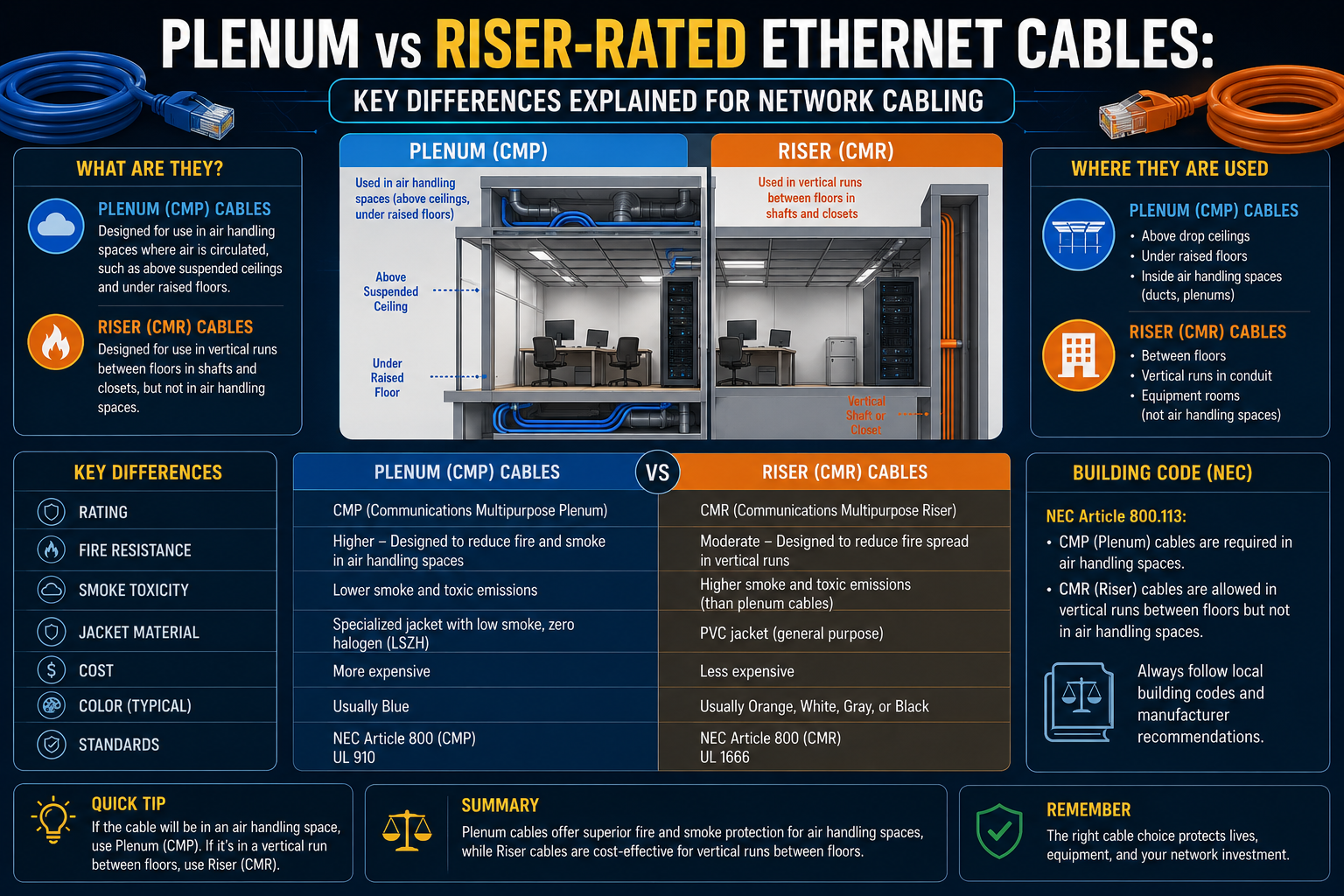
Behind every fast-loading webpage, every video call, and every seamless cloud application lies a physical layer that rarely gets attention: network cabling. While wireless technologies often dominate conversations about modern connectivity, the reality is that most enterprise-grade communication still depends heavily on structured cabling systems running through walls, ceilings, floors, and dedicated conduits.
Among the many types of cables used in these environments, two classifications stand out due to their importance in safety and compliance: plenum-rated cables and riser-rated cables. These are not just technical labels—they represent carefully engineered responses to fire safety challenges inside buildings.
Understanding these cable types goes beyond technical curiosity. It is essential knowledge for anyone involved in designing, installing, or maintaining network infrastructure in commercial or institutional environments. Choosing the wrong type can lead to safety risks, code violations, and long-term performance issues.
To understand why these distinctions exist, it is important to first explore how building environments themselves influence cable design.
Why Cable Ratings Exist in the First Place
Network cables are often assumed to be simple transmission lines carrying electrical signals from one device to another. In reality, they are materials embedded within complex building ecosystems. These ecosystems include ventilation systems, vertical shafts, electrical wiring, and enclosed wall spaces—all of which behave differently during emergencies such as fires.
The primary reason cable ratings exist is fire behavior control.
When a fire starts inside a building, cables can either help contain it or accelerate its spread. The materials used in cable jackets determine how they react to heat, flame exposure, and smoke production. Without strict standards, a small fire in one section of a building could rapidly spread through cable pathways, especially if those cables pass through interconnected spaces.
Two major vertical and horizontal zones inside buildings influence cable classification:
Horizontal air-handling spaces, where air circulates through ventilation systems.
Vertical riser spaces, which connect floors through shafts and conduits.
Each environment presents different risks, which is why plenum and riser cables were developed as specialized solutions rather than universal products.
The Concept of Plenum Spaces in Building Design
To understand plenum cables, one must first understand what a plenum space actually is. In building architecture, a plenum refers to any enclosed area used for air circulation. Most commonly, this includes the space between a dropped ceiling and the structural ceiling above it. In some cases, it may also include raised floors used for air distribution in high-density office environments.
These spaces are critical to heating, ventilation, and air conditioning systems. Air flows continuously through them, often without obstruction, to regulate temperature and maintain indoor air quality.
However, this same airflow creates a significant risk during fire incidents. If fire or smoke enters a plenum space, the moving air can distribute it rapidly throughout the building. This makes plenum spaces some of the most sensitive areas in terms of fire safety engineering.
Because of this risk, any material placed in a plenum space must meet strict fire-resistant and low-smoke requirements. This is where plenum-rated cables come into play.
What Makes Plenum Cables Different
Plenum cables are specifically engineered to perform safely in air-handling spaces. Their defining characteristic is the material used in their outer jacket. Instead of standard PVC insulation, plenum cables use specialized compounds designed to resist fire ignition and reduce toxic smoke emission.
Common materials include low-smoke PVC and fluorinated polymers. These materials are designed to behave differently when exposed to extreme heat. Instead of melting and releasing dense smoke, they slow combustion and produce significantly less harmful fumes.
This distinction is critical because smoke inhalation, not flame exposure, is one of the leading causes of harm during building fires.
Another important aspect of plenum cable construction is flame spread resistance. Even if a fire reaches the cable, it should not travel rapidly along its length. This containment behavior helps prevent fire from spreading through ventilation pathways.
In essence, plenum cables are not just communication tools—they are safety components embedded within building infrastructure.
Engineering Priorities Behind Plenum Cable Design
The design philosophy behind plenum cables prioritizes safety over convenience. Every aspect of their construction reflects this goal.
The outer jacket is engineered to withstand higher temperatures without contributing fuel to a fire. The insulation materials are selected not only for electrical performance but also for their behavior under combustion conditions. Even the manufacturing process is tightly controlled to ensure consistency in fire resistance.
This results in a cable that is often slightly stiffer and more rigid than standard alternatives. While this may seem like a disadvantage during installation, it is a direct consequence of using fire-retardant materials.
In many cases, plenum cables also undergo rigorous certification testing to ensure compliance with building safety standards. These tests evaluate flame spread, smoke density, and toxic gas emissions under controlled conditions.
Where Plenum Cables Are Required in Real Installations
Plenum-rated cables are typically required in environments where air circulation is active and uncontained fire spread could pose a major risk. These include office buildings, hospitals, educational institutions, and commercial complexes with centralized HVAC systems.
A common installation scenario involves routing network cables above suspended ceilings. Even though this space may seem physically protected, it is often part of the air circulation system. In such cases, building codes frequently mandate the use of plenum-rated cables.
Another example includes raised flooring systems in data-intensive environments. These spaces often double as air distribution channels, making them subject to the same safety requirements.
The key principle is simple: if air moves through the space, plenum-rated materials are typically required.
Cost and Practical Considerations of Plenum Cabling
Despite their safety advantages, plenum cables are not always the default choice in every installation. One of the most significant factors influencing their use is cost. Because of the specialized materials and manufacturing processes involved, plenum cables are generally more expensive than other cable types.
Installation can also be slightly more challenging. The added rigidity of fire-resistant jackets can make routing through tight spaces more difficult, especially in complex building layouts.
However, these challenges are often outweighed by regulatory requirements. In many commercial environments, the choice is not optional. Building codes dictate when plenum-rated cables must be used, and compliance is mandatory.
Even in situations where codes are less strict, many organizations still choose plenum cables for added safety assurance, particularly in high-value infrastructure environments such as data centers.
Understanding Riser Spaces in Building Architecture
While plenum spaces focus on horizontal air circulation, riser spaces are designed for vertical movement within buildings. These spaces typically include shafts, conduits, and enclosed pathways that connect one floor to another.
Riser spaces are not part of air-handling systems. Instead, they function as structural pathways for utilities such as electrical wiring, plumbing, and network cabling.
Because air does not actively circulate through these spaces, the fire risk dynamics are different from plenum environments. However, vertical fire spread remains a serious concern. A fire that travels upward through a riser can quickly affect multiple floors of a building.
This is where riser-rated cables play an important role.
What Defines a Riser-Rated Cable
Riser-rated cables are designed to prevent fire from traveling vertically between floors. Their primary function is containment rather than air-quality safety.
These cables are typically labeled as CMR (Communications Multipurpose Riser). The jacket material used in riser cables is fire-resistant but not as strict as plenum-rated materials. Instead of focusing heavily on smoke toxicity, riser cables prioritize flame containment within a single vertical section.
In practical terms, this means that if a fire occurs in one floor’s cable pathway, a riser-rated cable is designed to slow or prevent the fire from spreading to adjacent floors through the same shaft.
Material and Structural Differences in Riser Cables
Riser cables use fire-resistant PVC compounds that behave differently under heat compared to plenum materials. While they resist ignition and slow flame spread, they are not designed for air-handling environments.
The jacket is typically more flexible than plenum cable jackets, making installation easier in vertical shafts where bending and routing are frequent. This flexibility is one of the reasons riser cables are widely used in multi-floor buildings.
However, this flexibility comes with trade-offs. Riser cables are not suitable for environments where smoke control is a critical concern. They also do not meet the stricter emissions standards required for plenum spaces.
Typical Use Cases for Riser Cabling
Riser-rated cables are most commonly used in vertical installations between floors. This includes office towers, residential complexes, educational buildings, and industrial facilities with multiple levels.
They are usually installed inside dedicated riser shafts or conduits that run vertically through a building’s structure. These pathways are designed to organize utilities in a controlled manner while minimizing exposure to occupied spaces.
Unlike plenum environments, riser spaces are more predictable in terms of airflow and environmental exposure, which allows for slightly less restrictive cable requirements.
Safety Philosophy Behind Riser Cable Design
The primary safety objective of riser cables is vertical fire containment. Instead of focusing on air quality or smoke toxicity, the emphasis is on preventing fire from moving upward through a building’s infrastructure.
This reflects a broader principle in building safety design: different environments require different risk mitigation strategies. While plenum spaces demand smoke control, riser spaces demand structural fire separation.
Riser cables contribute to this strategy by acting as barriers that slow flame progression and provide additional time for emergency response systems to activate.
Practical Trade-Offs Between Plenum and Riser Cables
When comparing plenum and riser cables, it is important to recognize that neither is universally superior. Each is optimized for a specific environment.
Plenum cables offer higher fire safety standards and lower smoke emission, but come at a higher cost and reduced flexibility. Riser cables are more cost-effective and easier to install, but are limited to vertical, non-air-handling environments.
The decision between them is not purely technical—it is contextual. It depends on building design, regulatory requirements, installation environment, and risk assessment.
Misusing either cable type can lead to serious consequences, including safety hazards and compliance violations.
Early Design Decisions and Their Long-Term Impact
One of the most overlooked aspects of network cabling is how early design decisions influence long-term infrastructure performance. Choosing between plenum and riser cables is not just a procurement decision—it is a foundational architectural choice.
Once cables are installed within walls, ceilings, and conduits, replacing them becomes expensive and disruptive. This means that proper planning at the design stage is critical.
Engineers and installers must evaluate not only current building conditions but also potential future changes, such as renovations, occupancy shifts, or system upgrades.
In many cases, over-specifying safety (such as using plenum cables in uncertain environments) is preferred over under-specifying and risking non-compliance.
The Role of Standards and Building Regulations
Cable classification systems exist within a broader framework of building safety regulations. These standards are designed to ensure consistency across installations and minimize fire risks in complex structures.
Regulatory bodies define how cables should behave under fire conditions and specify where each type can be used. These standards are periodically updated to reflect new research, material innovations, and real-world fire incident analysis.
While the technical details of these standards vary by region, the underlying principles remain consistent: control fire spread, reduce smoke toxicity, and protect building occupants.
Understanding these principles is essential for anyone involved in infrastructure planning, even if they are not directly responsible for installation work.
Evolution of Cable Standards and Fire Safety Codes
The distinction between plenum and riser-rated cables did not emerge as a marketing classification. It developed gradually through decades of building safety evolution, shaped by real-world fire incidents, engineering failures, and improvements in material science.
Early network and telephone cables were primarily designed for electrical performance, with little consideration for how they behaved during fire conditions. As buildings became more complex and integrated with HVAC systems, engineers began noticing a dangerous pattern: traditional cable insulation contributed significantly to flame spread and smoke production.
This led to the introduction of standardized fire safety classifications for communication cables. Regulatory bodies began defining strict performance categories based on how cables behaved under controlled fire exposure tests. These tests evaluated flame propagation, smoke density, and toxicity levels.
Over time, these classifications became embedded in building codes. The modern framework commonly used today divides cables into categories such as plenum (CMP), riser (CMR), and general-purpose communication cables (CM). Each category corresponds to a specific risk environment within a building.
The introduction of plenum and riser ratings was not just a technical upgrade—it was a response to the increasing interdependence between networking infrastructure and life safety systems in modern architecture.
Material Science Behind Plenum and Riser Cable Jackets
At the core of the difference between plenum and riser cables lies material engineering. The outer jacket of a cable is not just a protective layer; it is a carefully formulated compound designed to behave predictably under extreme conditions.
Plenum-rated cables typically use fluoropolymer compounds or low-smoke polyvinyl chloride formulations. These materials are selected for their ability to resist ignition and minimize smoke production. When exposed to high heat, they tend to self-extinguish rather than continue burning. More importantly, they produce significantly fewer toxic gases compared to standard PVC materials.
The chemistry behind this behavior involves reducing the presence of halogen-based compounds that contribute to toxic smoke. Instead, plenum materials are engineered to maintain structural integrity longer under thermal stress, slowing the decomposition process that leads to combustion.
Riser-rated cables, on the other hand, rely on modified PVC compounds that are optimized for vertical flame resistance. These materials are designed to prevent fire from traveling upward along a cable pathway. However, they are not optimized for air circulation environments, which means their smoke emission characteristics are less strict than plenum materials.
This difference in material formulation explains why plenum cables are more expensive and slightly less flexible. The trade-off is deliberate: enhanced safety performance in exchange for increased manufacturing complexity and reduced mechanical ease.
Electrical Performance Differences and Signal Behavior
Although fire safety is the primary distinction between plenum and riser cables, both types must still meet strict electrical performance requirements. These include impedance control, signal attenuation limits, and crosstalk reduction.
In most modern installations, both plenum and riser cables are manufactured to support similar networking standards such as Cat5e, Cat6, and Cat6a. This means that from a purely data transmission perspective, their performance is often comparable.
However, subtle differences can emerge due to jacket material composition. Plenum cables, because of their denser and more rigid jackets, may exhibit slightly different thermal behavior under sustained load conditions. In high-density environments where cables are bundled tightly, heat dissipation becomes a minor but relevant factor.
Heat affects signal integrity by increasing resistance and potentially contributing to attenuation over long distances. While these effects are generally minimal in properly designed installations, they can become more noticeable in poorly ventilated cable pathways.
Riser cables, being slightly more flexible and less dense, may allow for marginally better handling in tight vertical spaces. However, this advantage is usually outweighed by environmental constraints rather than electrical performance differences.
Ultimately, both cable types are engineered to meet industry-wide electrical standards, meaning performance differences are secondary to environmental suitability.
Installation Practices in Real-World Building Environments
Cable installation is where theoretical design meets practical constraints. Even the most advanced cable can underperform if installed incorrectly.
In plenum spaces, installation requires careful routing to avoid obstructing airflow. Because these spaces are part of the building’s ventilation system, cable placement must not interfere with air circulation patterns. Installers often need to secure cables in ways that maintain open pathways for airflow while ensuring compliance with fire safety regulations.
The rigidity of plenum cables can make this process more challenging. Sharp bends and tight corners must be avoided to prevent damage to the cable jacket, which could compromise its fire-resistant properties.
Riser cable installation presents a different set of challenges. Vertical shafts often involve long cable runs with gravity-assisted tension. Proper support mechanisms must be used to prevent cable strain, especially in high-rise buildings where vertical distances are significant.
Cable anchoring becomes critical in riser installations. Without proper support, cables can stretch or shift over time, potentially affecting signal integrity or creating mechanical stress points.
Another important installation factor is separation from power lines. Both plenum and riser cables should be routed away from electrical wiring to minimize interference, but riser spaces often contain multiple utility systems in proximity, increasing the importance of careful planning.
Common Mistakes During Cable Deployment
One of the most frequent mistakes in structured cabling projects is misidentifying the required cable type for a given environment. This often occurs during early planning stages when building layouts are not fully understood.
Using riser-rated cable in a plenum space is one of the most serious violations. This not only violates safety codes but also introduces significant fire risks. In the event of a fire, improper cable materials can accelerate smoke spread through ventilation systems.
Another common issue is over-tight bundling of cables. When cables are tightly grouped, heat dissipation becomes restricted. Over time, this can degrade both electrical performance and material durability.
Improper bending radius is another frequent installation error. Both plenum and riser cables have minimum bend radius specifications that must be followed to avoid internal damage. Exceeding these limits can lead to signal degradation or complete cable failure.
Inadequate labeling and documentation also create long-term maintenance problems. Without clear identification of cable types and routes, troubleshooting becomes significantly more difficult during system upgrades or repairs.
Environmental Factors Affecting Cable Longevity
Once installed, network cables are exposed to a variety of environmental conditions that can influence their lifespan and performance.
Temperature fluctuations are one of the most important factors. Excessive heat can accelerate insulation degradation, while extreme cold can reduce jacket flexibility and increase brittleness.
Humidity is another critical factor. In environments with high moisture levels, poorly sealed cable jackets may allow gradual water ingress, which can affect signal transmission over time.
Chemical exposure is also relevant in industrial or laboratory environments. Certain chemicals can degrade PVC-based materials, leading to premature cable failure.
Physical stress, such as vibration or repeated movement, can also impact long-term performance. This is particularly relevant in environments with heavy machinery or frequent structural vibration.
Plenum cables tend to perform better in temperature-controlled environments due to their higher-grade materials, while riser cables may be more vulnerable in harsh environmental conditions if not properly protected.
Electromagnetic Interference and Shielding Considerations
In addition to physical and thermal factors, network cables must also contend with electromagnetic interference (EMI). This interference is generated by electrical devices, power lines, motors, and wireless equipment.
Shielded twisted pair cables are commonly used in environments where EMI is a concern. These cables include an additional conductive layer designed to block external electromagnetic signals from interfering with data transmission.
However, shielding introduces its own set of challenges. If not properly grounded, shielding can actually amplify noise instead of reducing it. This is why installation quality plays a critical role in determining overall system performance.
Plenum and riser ratings do not directly determine shielding capability, but they often correlate with installation environments where EMI levels differ. For example, plenum spaces in office buildings may have lower EMI exposure compared to riser shafts located near mechanical systems.
Proper cable routing is essential for minimizing interference. Keeping data cables away from high-voltage lines and heavy machinery reduces the likelihood of signal disruption.
Testing, Certification, and Quality Assurance Processes
Before cables are deployed in real-world environments, they undergo a series of standardized tests to ensure compliance with safety and performance requirements.
Fire resistance testing evaluates how a cable behaves when exposed to direct flame. This includes measuring flame spread distance, duration of combustion, and self-extinguishing properties.
Smoke emission testing measures the density and toxicity of smoke produced during combustion. This is especially important for plenum-rated cables used in air-handling spaces.
Electrical testing evaluates signal integrity, including parameters such as attenuation, return loss, and crosstalk. These tests ensure that cables can support the required data transmission speeds.
Mechanical testing assesses durability under physical stress, including bending, pulling, and compression.
Certification labels are then applied to cables that meet specific standards. These labels provide installers and inspectors with immediate identification of cable type and compliance level.
Infrastructure Planning and Network Design Decisions
Designing a structured cabling system requires more than selecting cable types. It involves a comprehensive understanding of building architecture, user requirements, and future scalability.
One of the key decisions in infrastructure planning is balancing cost with compliance. While riser cables are more cost-effective, they are not suitable for all environments. Plenum cables, while more expensive, provide broader compliance coverage in complex buildings.
Another important consideration is future expansion. Networks are rarely static, and cabling systems must accommodate growth in bandwidth demand and device density.
Routing paths must also be designed with maintenance access in mind. Cables that are difficult to reach or replace can create long-term operational challenges.
Proper documentation of cable pathways, types, and termination points ensures that future upgrades can be performed without unnecessary disruption.
Real-World Deployment Scenarios Across Different Environments
In office buildings, plenum cables are commonly used above ceilings where air circulation systems operate. These environments prioritize safety compliance and airflow management.
In residential complexes, riser cables are often used in vertical shafts connecting multiple floors. These installations focus on efficient connectivity distribution rather than air-handling safety.
In healthcare facilities, plenum-rated cabling is frequently required due to strict safety regulations and the critical nature of uninterrupted communication systems.
In industrial environments, cable selection becomes more complex due to exposure to EMI, temperature fluctuations, and mechanical stress. Shielding and protective conduits are often used alongside riser or plenum-rated cables, depending on location.
Data centers represent a hybrid environment where both cable types may coexist. Plenum cables are used in airflow-managed zones, while riser cables may be used for inter-floor backbone connections.
Each environment demonstrates how cable selection is deeply tied to architectural design, operational requirements, and safety considerations rather than simple performance metrics alone.
The Role of Regulatory Frameworks in Structured Cabling Design
As network infrastructure becomes more deeply embedded in building ecosystems, compliance with regulatory frameworks is no longer a secondary consideration—it is a foundational requirement. Plenum and riser-rated cables exist within a tightly controlled legal and engineering structure defined by building codes, fire safety regulations, and telecommunications standards.
One of the most influential frameworks is the National Electrical Code (NEC), which defines how cables must behave in different environmental zones within buildings. Within this system, cable classifications such as CMP (Communications Plenum) and CMR (Communications Riser) are not optional designations—they are enforceable compliance categories.
The NEC outlines precise definitions for where each cable type can be installed. Plenum-rated cables are required in air-handling spaces where airflow could distribute smoke or flames, while riser-rated cables are restricted to vertical pathways between floors. These distinctions are enforced during building inspections, renovations, and system certifications.
What makes these regulations particularly important is their integration into insurance requirements and occupancy approvals. In many cases, non-compliant cabling can delay building approvals or invalidate insurance coverage in the event of fire-related incidents.
This regulatory environment ensures that cable selection is not just a technical decision but also a legal and operational one.
Structured Cabling Architecture and Its Dependence on Cable Classification
Modern network design relies heavily on structured cabling systems, which organize physical infrastructure into standardized layers. These layers typically include backbone cabling, horizontal cabling, equipment rooms, and telecommunications outlets.
Plenum and riser cables play distinct roles within this hierarchy. Backbone cabling often uses riser-rated cables when connecting multiple floors through vertical shafts. Horizontal cabling, particularly in ceiling spaces, frequently requires plenum-rated cables due to air circulation considerations.
This structured approach ensures that cabling systems remain scalable, manageable, and compliant across large and complex installations. It also reduces the likelihood of ad-hoc installations that can create safety hazards or performance bottlenecks.
A well-designed, structured cabling system also anticipates future expansion. As organizations grow, additional devices, access points, and network endpoints are introduced. Proper cable classification ensures that these expansions do not violate safety codes or compromise system integrity.
Lifecycle Management of Network Cabling Systems
Network cables are often installed with the expectation that they will remain in service for many years. However, their lifecycle is influenced by environmental conditions, technological advancements, and organizational changes.
Lifecycle management begins at the design stage, where engineers must consider not only immediate requirements but also long-term scalability and maintainability. Choosing between plenum and riser cables is part of this broader lifecycle strategy.
During the operational phase, cables are subjected to continuous environmental stress, including temperature fluctuations, physical movement, and electromagnetic exposure. Over time, these factors can degrade performance, even if no visible damage is present.
Periodic inspection and testing are essential for maintaining network reliability. This includes verifying signal integrity, checking physical routing, and ensuring that cable labels remain accurate and legible.
Eventually, cables reach the end of their useful life. This may occur due to physical degradation, outdated performance standards, or changes in building use. At this stage, proper decommissioning and replacement strategies are required to maintain compliance and operational continuity.
Risk Assessment in Cable Selection and Deployment
Every cable installation carries inherent risk, and structured cabling design is fundamentally an exercise in risk management. The choice between plenum and riser-rated cables directly influences fire risk, compliance risk, and operational risk.
Fire risk is the most critical factor. Inadequate cable selection in air-handling spaces can accelerate flame spread and increase smoke toxicity, significantly endangering building occupants.
Compliance risk arises when installations do not meet regulatory requirements. This can result in failed inspections, legal penalties, or forced infrastructure redesigns.
Operational risk includes network downtime, signal degradation, and maintenance complexity. Poor cable selection or installation practices can lead to intermittent connectivity issues that are difficult to diagnose.
A structured risk assessment process evaluates environmental conditions, building design, occupancy type, and network criticality. Based on this assessment, engineers determine the appropriate cable classification and installation strategy.
Cable Management Systems and Physical Organization Strategies
Beyond cable type selection, physical organization plays a critical role in network reliability and safety. Cable management systems are designed to control routing, reduce strain, and maintain separation between different types of infrastructure.
In plenum environments, cable management must prioritize airflow preservation. Overcrowded cable trays or poorly routed bundles can obstruct ventilation systems, reducing HVAC efficiency and increasing fire risk.
In riser environments, vertical support systems are essential. These systems prevent cable sagging and reduce mechanical stress caused by gravity over long vertical distances. Without proper support, cables may stretch or deform, affecting both performance and safety.
Cable trays, conduits, and raceways are commonly used to organize both plenum and riser installations. These systems also simplify maintenance by providing structured access points for inspection and upgrades.
Proper labeling is another critical component of cable management. Each cable must be clearly identified by type, destination, and function. This becomes especially important in large installations where thousands of cables may coexist within a single building.
Troubleshooting Complex Network Issues in Mixed Cable Environments
As networks evolve, it is common for plenum and riser cables to coexist within the same infrastructure. While this is expected, it can introduce complexity when troubleshooting connectivity issues.
One of the most challenging scenarios occurs when intermittent performance issues arise due to environmental interference rather than hardware failure. In such cases, cable type alone may not be the root cause, but improper installation within the wrong environment can exacerbate the problem.
For example, a riser cable mistakenly installed in a plenum space may experience thermal stress due to airflow exposure. Over time, this can degrade insulation integrity and lead to signal instability.
Similarly, improperly shielded cables routed near electrical systems in riser shafts may experience electromagnetic interference that is difficult to isolate without specialized diagnostic tools.
Advanced troubleshooting often involves segmenting the network into logical zones and testing each segment independently. This allows technicians to identify whether issues originate from physical cabling, environmental conditions, or network hardware.
Integration with Power over Ethernet and Modern Device Ecosystems
Modern network infrastructure increasingly supports Power over Ethernet (PoE), which delivers both data and electrical power through the same cable. This adds another layer of complexity to cabling decisions.
When electrical current flows through network cables, heat generation becomes a significant factor. Poorly ventilated environments can amplify this effect, especially in densely packed cable bundles.
Plenum environments must account for both airflow and heat dissipation when supporting PoE systems. Excessive heat buildup can reduce cable lifespan and affect signal performance.
Riser environments, while less dependent on airflow, must still manage vertical heat distribution, particularly in high-density installations such as multi-floor enterprise networks.
Cable selection in PoE environments must therefore consider not only fire safety classification but also thermal performance under load.
Smart Buildings and the Increasing Demand for Intelligent Cabling Infrastructure
The rise of smart buildings has transformed network cabling from a passive infrastructure layer into an active component of building intelligence systems.
Sensors, automation systems, surveillance networks, and IoT devices all rely on structured cabling for connectivity and power delivery. This increases the density and complexity of cabling installations.
In smart environments, plenum and riser cables often coexist with fiber optic systems, wireless access points, and edge computing devices. This hybrid infrastructure requires careful planning to ensure interoperability and maintainability.
Plenum cables are particularly important in smart buildings due to their integration with HVAC-controlled environments. Air quality systems, environmental sensors, and automated ventilation systems all rely on stable and safe cable pathways.
Riser cables support vertical connectivity between building intelligence nodes, enabling communication between different floors and system layers.
As buildings become more automated, the demand for reliable and compliant cabling systems continues to increase.
Security Considerations at the Physical Layer
Network security is often associated with software, encryption, and access control systems. However, physical layer security is equally important, particularly in large-scale infrastructure environments.
Cable routing plays a critical role in preventing unauthorized access to network systems. Exposed or poorly secured cables can be physically tapped or tampered with, leading to data breaches.
Plenum and riser pathways must therefore be secured not only for fire safety but also for physical protection. Locked conduits, monitored access points, and controlled routing paths are commonly used in sensitive environments.
In high-security facilities, additional measures such as armored cabling or restricted access riser shafts may be implemented to enhance physical security.
Long-Term Maintenance Strategies for Enterprise Networks
Maintaining a large-scale network infrastructure requires continuous monitoring and periodic upgrades. Over time, even properly installed plenum and riser cables may need replacement due to technological advancements or environmental wear.
Maintenance strategies typically include scheduled inspections, performance testing, and environmental assessments. These processes help identify early signs of degradation before they impact network performance.
Documentation plays a critical role in maintenance efficiency. Accurate records of cable types, routes, and installation dates allow technicians to plan upgrades with minimal disruption.
In many enterprise environments, cable management systems are integrated with digital asset tracking tools. These systems provide real-time visibility into infrastructure layout and help streamline maintenance operations.
Sustainability and Environmental Impact of Cabling Materials
As sustainability becomes a priority in infrastructure design, the environmental impact of cabling materials is receiving increased attention.
Traditional PVC-based cables can contribute to environmental concerns during manufacturing and disposal. Plenum-rated cables, due to their specialized materials, often involve more complex chemical processes.
Efforts are underway to develop more environmentally friendly cable materials that maintain fire safety performance while reducing environmental impact.
Recycling and responsible disposal practices are also becoming more important. Old cabling infrastructure must be removed and processed in ways that minimize environmental harm.
Sustainable cabling design also involves optimizing installation practices to reduce material waste and improve long-term efficiency.
Future Trends in Network Cabling and Infrastructure Design
The future of network cabling is being shaped by several converging trends, including higher data transmission speeds, increased device density, and the expansion of smart environments.
As data requirements grow, cable performance standards will continue to evolve. This may lead to new classifications or enhanced versions of existing plenum and riser standards.
Hybrid infrastructure models that combine copper, fiber, and wireless technologies are becoming increasingly common. In these environments, traditional cabling still plays a foundational role but must integrate seamlessly with advanced communication systems.
Automation in building management is also influencing cabling design. Intelligent routing systems, predictive maintenance tools, and real-time monitoring technologies are changing how infrastructure is deployed and maintained.
Despite these advancements, the fundamental importance of plenum and riser cable classification remains unchanged. Fire safety, compliance, and environmental suitability continue to define the backbone of structured cabling systems in modern architecture.
Conclusion
Plenum and riser-rated Ethernet cables may look nearly identical at first glance, but their differences represent something far more important than physical appearance. They are the result of decades of engineering refinement, safety regulation, and real-world lessons learned from building design and fire behavior. In modern network infrastructure, these distinctions are not optional technical details—they are fundamental decisions that influence safety, compliance, performance stability, and long-term operational reliability.
At the core, the difference between plenum and riser cables is about the environment. Plenum-rated cables are designed for spaces where air circulates freely, such as the gaps above ceilings or below raised floors. These areas are part of a building’s ventilation system, which means any smoke or fire introduced into them can spread rapidly throughout multiple zones. Because of this, plenum cables are engineered with materials that limit flame propagation and significantly reduce the release of toxic smoke. Their purpose is not just to transmit data, but to help protect human life in environments where air movement can amplify danger.
Riser-rated cables, on the other hand, serve a different structural purpose. They are intended for vertical pathways between floors, where airflow is limited or contained. In these environments, the primary concern is preventing fire from moving upward through building shafts and affecting multiple levels. Riser cables are designed to slow flame spread in these vertical routes, acting as a containment barrier rather than an air-safety solution. This makes them suitable for inter-floor communication systems where cost efficiency and installation flexibility are important considerations.
Understanding when to use each type of cable is essential for anyone involved in network design or installation. Choosing the correct cable is not simply a matter of preference or budget—it is a compliance-driven requirement shaped by building codes and safety regulations. Installing the wrong type in the wrong environment can lead to serious consequences, including failed inspections, legal liabilities, and increased risk during emergencies. In many professional settings, compliance is enforced just as strictly as performance standards, making proper cable selection a critical responsibility.
Troubleshooting and maintenance further highlight the importance of proper cable selection. Many network issues that appear to be performance-related are actually rooted in installation environment mismatches or physical stress on cabling systems. Heat buildup, electromagnetic interference, and improper routing can all contribute to intermittent connectivity problems. Understanding the role of cable type in these scenarios allows technicians to diagnose issues more effectively and implement long-lasting solutions rather than temporary fixes.
As buildings become more advanced and interconnected, the role of structured cabling continues to evolve. Smart buildings, high-density data environments, and integrated automation systems all depend on reliable physical infrastructure to function correctly. Even as wireless technologies expand, wired networks remain the backbone of enterprise connectivity. In this context, plenum and riser cables continue to serve as essential building blocks of safe and efficient system design.
Looking ahead, future developments in cabling technology may introduce new materials, improved fire resistance standards, and more environmentally sustainable designs. However, the core principles behind plenum and riser classification are unlikely to disappear. The need to balance performance with safety, cost with compliance, and flexibility with regulation will always exist in network infrastructure design.
Ultimately, understanding plenum and riser-rated cables is about more than memorizing definitions. It is about recognizing how digital systems interact with physical environments and how engineering decisions impact safety and reliability on a large scale. Every cable installed within a building contributes to a larger ecosystem of communication, power distribution, and environmental control. When selected and installed correctly, these cables work silently in the background, supporting everything from business operations to emergency systems without drawing attention to themselves.