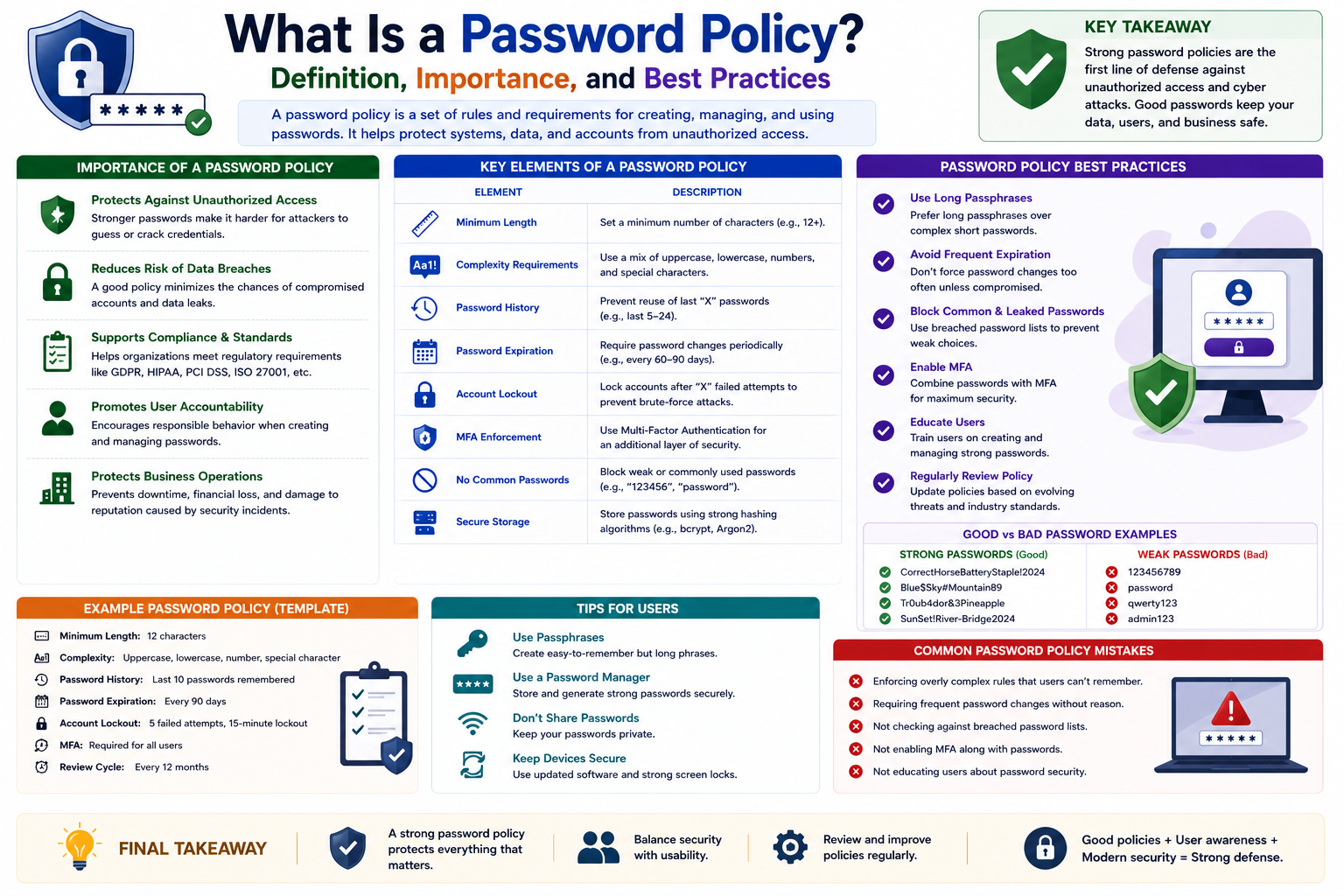
A password policy is a structured set of rules designed to guide how passwords are created, managed, and protected within a digital system. At its core, it exists to solve a very simple but critical problem: human beings naturally choose convenience over complexity, especially when it comes to remembering information. Without guidance, most users would select short, predictable passwords that are easy to recall but also easy for attackers to guess.
The purpose of a password policy is to introduce controlled discipline into this behavior. Instead of allowing free-form password creation, systems define boundaries such as minimum length, character diversity, reuse restrictions, and expiration timelines. These rules are not arbitrary; they are designed based on how attackers operate in real-world scenarios.
In modern digital environments, passwords serve as the first layer of identity verification. They are the gateway to emails, financial systems, databases, and private communications. A weak password can compromise an entire system, while a strong one can significantly reduce risk exposure. This is why organizations invest heavily in defining and enforcing password policies—they are not just technical rules, but foundational elements of digital trust.
A well-designed password policy also balances protection with practicality. If rules become too strict, users may struggle to remember their credentials or resort to unsafe practices like writing them down or reusing old passwords. Therefore, the effectiveness of a password policy depends not only on its security strength but also on how well it aligns with human behavior.
Evolution of Password Security in Digital Systems
Password policies have evolved significantly over time, reflecting the growing sophistication of cyber threats. In the early days of computing, passwords were often simple and short, sometimes even stored in plain text. Security concerns were minimal because systems were isolated and access was limited to small groups of trusted users.
As technology expanded and networks became interconnected, attackers discovered new opportunities. The rise of the internet introduced large-scale exposure, where a single compromised password could unlock multiple systems. This shift forced organizations to rethink how authentication worked.
Early password policies focused primarily on basic complexity. Users were required to include numbers or uppercase letters, but these rules were often predictable and easy to bypass using automated tools. Over time, attackers developed techniques like brute-force attacks, where millions of password combinations are tested in seconds, and dictionary attacks, where common words are systematically attempted.
To counter these methods, password policies became more sophisticated. Length requirements increased, special character usage became mandatory, and password history rules were introduced to prevent reuse. Systems also began enforcing lockout mechanisms after repeated failed attempts.
In more recent years, the evolution has continued toward adaptive and risk-based security models. Instead of relying solely on static rules, modern systems analyze user behavior, login patterns, and device information to determine whether additional authentication steps are needed. This reflects a broader shift in cybersecurity thinking—from rigid rules to dynamic, context-aware protection.
Despite all these advancements, passwords remain deeply embedded in digital systems. Even with emerging technologies like biometrics and multi-factor authentication, password policies continue to play a central role in identity protection.
Core Principles of Strong Password Policies
A strong password policy is built on several foundational principles that work together to reduce vulnerabilities. These principles are not random restrictions but carefully designed safeguards against specific types of cyber threats.
One of the most important principles is complexity. Passwords should not be simple words or predictable patterns. Instead, they should include a mix of uppercase letters, lowercase letters, numbers, and symbols. This increases the number of possible combinations, making it significantly harder for attackers to guess correctly.
Another key principle is length. Longer passwords exponentially increase security because each additional character expands the number of possible variations. A short password may be cracked in seconds, while a long one could take years of computational effort to break using traditional methods.
Uniqueness is also essential. Reusing the same password across multiple platforms creates a chain reaction risk. If one system is compromised, attackers can attempt to access other accounts using the same credentials. A strong password policy discourages or outright prevents reuse.
Regular updates are another principle often included in traditional policies. The idea is that even strong passwords can eventually become vulnerable if exposed over time. By requiring periodic changes, organizations aim to limit the window of opportunity for attackers.
However, modern thinking has started to question frequent forced changes, as they sometimes lead to weaker password choices. Instead, emphasis is shifting toward stronger initial passwords combined with better detection systems.
Finally, protection against guessability is critical. Passwords should not include personal information such as names, birthdays, or easily discoverable details. Attackers often gather such data from social media or public records to guess credentials.
Together, these principles form a layered defense strategy that strengthens authentication systems and reduces the likelihood of unauthorized access.
How Password Policies Shape User Behavior
One of the most important but often overlooked roles of password policies is their influence on human behavior. People naturally prefer simplicity, and without guidance, they tend to choose passwords that are easy to remember but also easy to crack.
Password policies act as behavioral frameworks that gently force users to make more secure decisions. For example, when a system requires a minimum of 12 characters with a mix of symbols and numbers, users are encouraged to move away from predictable choices like names or common words.
Over time, this shaping effect becomes internalized. Users begin to understand what a strong password looks like and gradually develop better habits. This educational aspect is just as important as the technical enforcement itself.
However, strict policies can also create frustration. When users are forced to remember highly complex passwords without any support mechanisms, they may resort to unsafe practices such as writing them down, storing them in unsecured files, or making only minor changes to existing passwords.
This is why modern password policy design increasingly focuses on usability. The goal is not to make passwords impossible to remember but to make weak passwords impossible to choose. Striking this balance is essential for long-term effectiveness.
Another behavioral impact is awareness. Password policies often serve as the first introduction to cybersecurity concepts for many users. They help individuals understand why security matters and how their choices directly affect system safety.
In organizational environments, consistent enforcement of password policies also creates a culture of security consciousness. Employees become more cautious about digital hygiene, which can reduce risks beyond just password-related threats.
Technical Foundations Behind Password Rules
Behind every password policy lies a technical framework that enforces rules automatically within systems. These mechanisms are built into authentication servers, identity management systems, and security protocols.
At a basic level, when a user creates or changes a password, the system evaluates it against predefined criteria. These criteria may include length, character composition, forbidden patterns, and similarity to previous passwords. If the password does not meet requirements, it is rejected immediately.
Modern systems often use hashing algorithms to store passwords securely. Instead of saving the actual password, the system converts it into a fixed-length cryptographic representation. Even if the database is compromised, the original password cannot easily be retrieved from the hash.
Salting is another important technique used in conjunction with hashing. A unique random value is added to each password before hashing, ensuring that even identical passwords produce different outputs. This prevents attackers from using precomputed lookup tables.
Account lockout mechanisms are also part of the technical enforcement layer. After a certain number of failed login attempts, the system temporarily disables access or introduces delays. This helps prevent automated brute-force attacks.
Some advanced systems incorporate rate limiting, which controls how frequently login attempts can be made from a single source. This slows down attackers significantly and reduces the effectiveness of automated tools.
Integration with identity management systems allows password policies to be applied consistently across multiple applications. This ensures that users follow the same security rules regardless of which service they are accessing.
These technical foundations work silently in the background, enforcing security without requiring constant user awareness.
Psychological Aspects of Password Creation
Human psychology plays a major role in how passwords are created and remembered. Most users rely on cognitive shortcuts when forming passwords, often choosing familiar words, patterns, or meaningful personal information.
This behavior is natural because the human brain is optimized for memorization efficiency rather than security complexity. However, this tendency creates vulnerabilities that attackers can exploit.
For example, many users choose passwords based on emotional significance, such as pet names, birthdays, or favorite phrases. While these are easy to remember, they are also relatively easy to guess, especially in the age of social media, where personal information is widely accessible.
Password policies attempt to counteract these psychological tendencies by forcing randomness and unpredictability. However, randomness is inherently difficult for humans to generate and remember.
To bridge this gap, some approaches encourage the use of passphrases—long sequences of unrelated words that are easier for humans to recall but harder for machines to guess. This aligns better with natural memory patterns while still providing strong security.
Another psychological factor is fatigue. When users are required to change passwords frequently or remember multiple complex credentials, they experience cognitive overload. This can lead to poor security decisions, such as reusing passwords or creating predictable variations.
Understanding these psychological challenges is essential for designing effective password policies. Security measures must work with human behavior rather than against it.
Common Weaknesses of Password Policies Aim to Prevent
Password policies are primarily designed to defend against predictable vulnerabilities that attackers exploit repeatedly. One of the most common weaknesses is the use of weak or common passwords. These include simple sequences, dictionary words, or easily guessable patterns.
Another major vulnerability is password reuse. When users use the same password across multiple platforms, a breach in one system can lead to a cascade of compromised accounts elsewhere.
Short passwords are also a significant risk because they reduce the number of possible combinations, making brute-force attacks much more feasible.
Predictable modifications of passwords, such as adding “123” or “!” at the end of a word, are another weakness. Attackers are well aware of these patterns and often include them in automated guessing tools.
Lack of multi-factor authentication further increases vulnerability. Even strong passwords can be compromised, so relying solely on them creates a single point of failure.
Poor storage practices, such as writing passwords in unsecured locations, also weaken overall security. While password policies cannot fully control user behavior outside systems, they often include educational components to discourage such practices.
By addressing these weaknesses, password policies aim to create multiple layers of defense against unauthorized access.
Role of Password Policies in Modern Digital Systems
In today’s interconnected digital landscape, password policies serve as a critical foundation for identity security. They are integrated into nearly every system that requires authentication, from personal devices to enterprise-level infrastructure.
Modern digital systems increasingly rely on centralized identity management, where password policies are applied uniformly across multiple services. This ensures consistency and reduces security gaps caused by fragmented authentication rules.
Password policies also support regulatory compliance in many industries. Organizations handling sensitive data must follow strict security guidelines, and password management is often a key component of these requirements.
In cloud-based environments, password policies work alongside advanced security mechanisms such as behavioral analytics and adaptive authentication. These systems continuously evaluate risk levels based on user activity, location, and device behavior.
Despite the emergence of alternative authentication methods like biometrics and token-based systems, passwords remain deeply embedded in digital architecture. This is largely due to their simplicity, universality, and compatibility with existing systems.
As digital threats continue to evolve, password policies will likely become more intelligent and adaptive. Instead of relying solely on fixed rules, future systems may incorporate real-time risk assessment and context-aware authentication decisions.
The role of password policies is therefore not diminishing but evolving, adapting to new challenges while continuing to serve as a foundational layer of cybersecurity.
Password Policy Enforcement in Real-World Systems
Designing a password policy is only the beginning. The real challenge lies in enforcing it consistently across systems, users, and environments. Enforcement is the mechanism that ensures rules are not just written in documentation but actively applied whenever a password is created, updated, or used for authentication.
In practical systems, enforcement happens at multiple layers. The first layer is the application level, where login and registration forms validate password input against predefined rules. If a password does not meet requirements, it is rejected instantly before it is stored or processed further.
The second layer exists at the identity management level, where centralized systems control authentication across multiple services. These systems ensure that the same password rules apply everywhere, preventing inconsistencies that could create security gaps.
A third layer of enforcement operates at the network or directory level in enterprise environments. Here, policies are applied to entire groups of users based on roles, departments, or security clearance levels. This allows organizations to enforce stricter rules for high-privilege accounts while maintaining usability for general users.
Enforcement also extends to monitoring systems that continuously evaluate compliance. These systems detect violations such as expired passwords, reused credentials, or suspicious login behavior. When issues are detected, corrective actions such as forced resets or account lockouts may be triggered automatically.
The effectiveness of enforcement depends heavily on automation. Manual enforcement is not scalable in modern environments where thousands or millions of user accounts may exist. Automated policy engines ensure consistency, reduce human error, and maintain real-time compliance across systems.
Organizational Models for Password Policy Design
Different organizations adopt different models for structuring password policies depending on their size, industry, and security requirements. There is no universal template that fits all environments, but several common approaches are widely used.
One common model is the centralized policy approach. In this structure, a single set of password rules is defined and applied uniformly across all users and systems. This simplifies management and ensures consistency, but may lack flexibility for diverse user roles.
Another model is the role-based policy approach. Here, password rules vary depending on the user’s role within the organization. For example, administrators or finance personnel may be required to use longer and more complex passwords compared to general staff. This model improves security where it matters most while maintaining usability elsewhere.
A more advanced model is risk-based policy design. In this system, password requirements adapt dynamically based on contextual risk factors. These may include login location, device type, time of access, or user behavior patterns. If risk is detected, the system may enforce stricter authentication requirements.
Hybrid models are also common, combining centralized rules with role-based and risk-based adjustments. This allows organizations to maintain a baseline level of security while adapting to specific scenarios.
The choice of model often depends on operational complexity. Smaller organizations may prefer centralized policies for simplicity, while large enterprises with complex infrastructures benefit more from layered or adaptive approaches.
The Science of Password Strength and Entropy
Password strength is not just about how complicated a password looks—it is fundamentally about entropy, which is a measure of randomness and unpredictability. Higher entropy means a password is more difficult to guess or crack using computational methods.
Entropy increases with both length and complexity. A password with more characters and a larger set of possible character types (letters, numbers, symbols) has significantly more possible combinations than a short or simple one.
For example, a password made of only lowercase letters has far fewer combinations than one that includes uppercase letters, numbers, and special characters. As each character is added, the number of possible variations grows exponentially rather than linearly.
However, real-world password strength is not determined by mathematics alone. Human predictability reduces effective entropy. Even complex-looking passwords may be weak if they follow common patterns, such as predictable substitutions or keyboard sequences.
Attackers exploit this human behavior by using pattern-based guessing techniques. Instead of testing random combinations, they prioritize likely choices based on leaked password datasets and behavioral analysis.
This is why modern password policies emphasize unpredictability over simple complexity. A truly strong password is not just complex—it is also unique and unrelated to personal or common patterns.
Understanding entropy helps organizations design better policies that focus on real security rather than superficial complexity requirements.
Credential-Based Attacks and Policy Defenses
Password policies exist primarily to defend against credential-based attacks, which are among the most common threats in digital environments. These attacks target authentication systems by attempting to obtain or guess valid login credentials.
One widely used attack method is a brute-force attack. In this approach, attackers systematically attempt every possible password combination until the correct one is found. While simple in concept, this method becomes increasingly difficult as password length and complexity increase.
Another major threat is a dictionary-based attack. Instead of trying random combinations, attackers use lists of common words, phrases, and previously leaked passwords. This method is highly effective against weak or predictable passwords.
Credential stuffing is another growing threat. In this scenario, attackers use usernames and passwords obtained from data breaches on one platform and attempt to reuse them on others. This works because many users reuse the same password across multiple services.
Phishing attacks also play a major role in credential theft. Instead of breaking passwords through technical means, attackers trick users into voluntarily revealing their credentials through fake login pages or deceptive messages.
Password policies defend against these threats in different ways. Complexity and length requirements reduce brute-force success rates. Uniqueness rules reduce the effectiveness of credential stuffing. User education helps mitigate phishing risks. Lockout mechanisms slow down repeated guessing attempts.
No single rule is sufficient on its own. Effective protection comes from combining multiple layers of defense.
Multi-Factor Authentication and Its Relationship with Password Policies
Multi-factor authentication (MFA) adds a layer of security beyond passwords. Instead of relying solely on something the user knows, MFA requires additional verification, such as something the user has or something the user is.
This could include a mobile device, a physical token, biometric verification, or time-based codes. By requiring multiple factors, MFA significantly reduces the risk of unauthorized access even if a password is compromised.
Password policies and MFA are closely related but serve different purposes. Password policies focus on strengthening the first factor of authentication, while MFA introduces additional barriers to entry.
In modern security architectures, MFA is often considered a mandatory complement to password policies rather than a replacement. Even strong passwords can be stolen or leaked, but MFA can prevent attackers from using them effectively.
The combination of both systems creates layered security. A password acts as the first checkpoint, while MFA acts as a secondary verification barrier. Together, they significantly increase the difficulty of unauthorized access.
However, MFA also introduces usability considerations. Additional steps in the login process can create friction for users. Balancing convenience and security remains an ongoing challenge in system design.
Password Storage Mechanisms and Security Design
How passwords are stored is just as important as how they are created. Even the strongest password policy becomes ineffective if stored insecurely.
Modern systems never store passwords in plain text. Instead, they use cryptographic hashing algorithms to convert passwords into fixed-length strings that cannot be easily reversed. When a user logs in, the system hashes the entered password and compares it to the stored hash.
To further enhance security, systems use salting techniques. A unique random value is added to each password before hashing. This ensures that even identical passwords produce different hash outputs, preventing attackers from using precomputed tables to reverse-engineer passwords.
Some systems also use iterative hashing, where the hashing process is repeated multiple times. This increases the computational effort required to test each password, slowing down brute-force attacks.
Secure storage also involves access control mechanisms. Only authorized system components should be able to access hashed password data. Even internal system users should not have direct access to authentication databases.
Encryption at rest and in transit further protects password-related data. If data is intercepted or stolen, encryption ensures it remains unreadable without the correct decryption keys.
Together, these mechanisms form a secure storage architecture that protects passwords even in the event of system compromise.
Usability Challenges in Password Policy Design
One of the biggest challenges in designing password policies is balancing security with usability. Highly secure systems often require complex passwords that are difficult to remember, while user-friendly systems may sacrifice security for convenience.
When password requirements become too strict, users often respond with compensating behaviors. These may include writing passwords down, reusing similar patterns across accounts, or choosing predictable variations of previous passwords.
Such behaviors can undermine the very security the policy is meant to enforce. This creates a paradox where overly strict rules can lead to weaker real-world security outcomes.
To address this, modern password policies increasingly focus on usability-centered design. Instead of forcing frequent password changes, many systems now prioritize stronger initial passwords combined with monitoring and breach detection.
Another usability challenge is cognitive overload. Users managing multiple accounts struggle to remember different complex passwords for each system. This leads to frustration and reduced compliance.
Password managers have emerged as a solution to this problem, allowing users to generate and store complex passwords securely without needing to memorize them. While not perfect, they significantly reduce the cognitive burden associated with strong password requirements.
The key principle in usability-focused design is sustainability. A password policy is only effective if users can consistently follow it without resorting to unsafe practices.
Enterprise-Level Password Governance Structures
In large organizations, password policies are not just technical rules but part of a broader governance structure. This structure defines how policies are created, enforced, reviewed, and updated over time.
Governance begins with policy definition, where security teams establish baseline requirements based on risk assessment and regulatory obligations. These requirements are then documented and communicated across the organization.
Next comes implementation, where technical teams configure systems to enforce these policies across applications, networks, and devices. This often involves integrating identity management systems that centralize authentication control.
Monitoring and auditing are critical governance components. Systems continuously track compliance, detect anomalies, and generate reports on password-related activity. These insights help identify weak points and potential risks.
Review cycles ensure that password policies remain relevant. As threats evolve, policies must be updated to reflect new attack methods and security standards. Without regular updates, even strong policies can become outdated.
Governance also includes incident response planning. If a password breach occurs, organizations must have procedures in place to contain damage, reset credentials, and investigate the source of the compromise.
Strong governance ensures that password policies are not static rules but dynamic components of an evolving security ecosystem.
Emerging Trends in Authentication and Policy Evolution
The future of password policies is being shaped by emerging authentication technologies. While passwords remain widely used, there is a gradual shift toward passwordless systems.
Biometric authentication, such as fingerprint and facial recognition, is becoming more common in consumer devices. These methods reduce reliance on traditional passwords but introduce new challenges related to privacy and data protection.
Token-based authentication systems are also gaining popularity. These systems use temporary credentials that expire after a short period, reducing the risk of long-term compromise.
Behavioral authentication is another emerging trend. Systems analyze user behavior patterns such as typing speed, mouse movement, and login habits to verify identity continuously.
Despite these innovations, passwords are unlikely to disappear entirely in the near future. Instead, they are evolving into one component of a multi-layered authentication ecosystem.
Password policies are also adapting to these changes. Rather than focusing solely on complexity rules, modern policies emphasize integration with broader security frameworks that include behavioral analysis and adaptive authentication.
This evolution reflects a broader shift in cybersecurity—from static protection mechanisms to dynamic, intelligence-driven systems that adapt to changing risk conditions.
Policy Lifecycle Management and Continuous Improvement
A password policy is not a static document that is written once and forgotten. It is a living security framework that must evolve alongside technology, user behavior, and emerging threats. Effective organizations treat password policy management as a continuous lifecycle rather than a one-time configuration.
The lifecycle begins with policy creation, where security teams define rules based on current risks and operational requirements. This stage involves evaluating how users interact with systems, what types of data are being protected, and what threat actors are most likely to target the environment.
Once deployed, the policy enters the enforcement stage, where technical systems apply rules automatically across authentication processes. However, enforcement alone is not enough. Continuous observation is required to understand how the policy performs in real-world conditions.
Over time, organizations collect data on login failures, password reset requests, account lockouts, and authentication anomalies. These metrics help determine whether the policy is too strict, too lenient, or appropriately balanced.
The improvement stage involves adjusting rules based on insights gathered during monitoring. For example, if users consistently struggle with password complexity requirements, the policy may need refinement. If attack attempts increase, stricter controls may be introduced.
Finally, the retirement and replacement phase ensures outdated policies are phased out safely. This is especially important when transitioning to newer authentication methods or updated security frameworks.
This continuous cycle ensures password policies remain effective and aligned with both human usability and evolving cybersecurity threats.
Standards and Frameworks That Shape Password Policies
Password policies are often influenced by broader security standards and governance frameworks that define best practices for authentication and identity protection. These frameworks provide structured guidance to ensure consistency, reliability, and regulatory alignment.
One of the key principles in modern frameworks is the shift away from overly restrictive password expiration rules. Instead of forcing frequent changes, emphasis is placed on stronger initial passwords and monitoring for compromise indicators.
Security frameworks also highlight the importance of breach resistance. This includes preventing users from choosing passwords that have appeared in known data breaches. Systems often maintain lists of compromised credentials and block their reuse automatically.
Another major theme is risk-based authentication. Instead of applying identical rules to all users, systems assess contextual risk factors and adjust authentication requirements dynamically. This improves both security and usability.
Frameworks also encourage layered authentication strategies. Passwords are no longer considered sufficient on their own but are treated as one component of a broader identity verification system.
Compliance-driven environments, such as those handling financial or medical data, often require stricter governance. Password policies in these environments must align with regulatory expectations regarding access control, auditability, and data protection.
By aligning with structured frameworks, organizations ensure that password policies are not arbitrary but grounded in proven security principles and industry standards.
The Role of Identity and Access Management Systems
Identity and Access Management (IAM) systems form the backbone of modern password policy enforcement. These systems control how users are authenticated, authorized, and managed across digital environments.
At the core of IAM is centralized identity control. Instead of managing passwords separately for each application, IAM systems unify authentication under a single identity framework. This allows password policies to be enforced consistently across all connected systems.
IAM platforms also support role-based access control. Users are assigned roles that determine what resources they can access and what level of password security they must follow. High-privilege accounts typically require stronger authentication measures.
Another key function of IAM is lifecycle management. This includes onboarding new users, updating credentials, and deactivating accounts when access is no longer needed. Password policies are embedded into these processes to ensure secure handling of credentials throughout their lifecycle.
IAM systems also enable single sign-on functionality. This reduces the number of passwords users must remember while maintaining centralized control over authentication security.
In modern environments, IAM is often integrated with cloud infrastructure, enabling organizations to enforce password policies across hybrid systems that span on-premises and cloud-based services.
Without IAM systems, enforcing consistent password policies at scale would be extremely difficult and error-prone.
Adaptive Authentication and Context-Aware Security
Traditional password policies rely on fixed rules that apply equally to all users and situations. However, modern security environments increasingly use adaptive authentication systems that adjust requirements based on context.
Context-aware security evaluates factors such as login location, device type, time of access, and user behavior patterns. If a login attempt appears normal and consistent with past behavior, authentication may proceed smoothly. If anomalies are detected, additional verification steps may be required.
This approach significantly improves security without placing an unnecessary burden on users during low-risk scenarios. For example, a user logging in from a familiar device at a usual time may only need a password. However, a login attempt from an unknown location may trigger additional verification.
Adaptive authentication also helps reduce the risk of compromised credentials being used successfully. Even if a password is stolen, unusual login behavior can trigger alerts or block access.
This model represents a shift from static password enforcement to intelligent risk-based decision-making. Instead of relying solely on password strength, systems continuously evaluate trust levels during authentication.
Password policies in adaptive environments become more flexible. Rather than enforcing rigid rules at all times, they work in combination with real-time risk assessment to determine appropriate security responses.
Password Reuse Prevention and Credential Hygiene
One of the most significant risks in authentication systems is password reuse. Users often reuse the same password across multiple platforms due to convenience. However, this behavior creates a major vulnerability.
If one system is compromised, attackers can attempt to use the same credentials across other systems. This technique is highly effective because it exploits human behavioral patterns rather than technical weaknesses.
To counter this, modern password policies include reuse prevention mechanisms. These systems track previously used passwords and prevent them from being reused for a specified period or indefinitely.
Credential hygiene extends beyond reuse prevention. It includes ensuring that passwords are not predictable variations of previous ones. Attackers often exploit patterns such as incremental changes or minor substitutions.
Some systems also check passwords against databases of known compromised credentials. If a password has been exposed in a data breach, it is immediately rejected during creation or reset.
Credential hygiene also involves monitoring for unusual login activity. Repeated failed login attempts or access from unfamiliar locations may indicate credential abuse.
By enforcing strong credential hygiene practices, organizations reduce the likelihood of long-term compromise and lateral movement within systems.
The Debate Around Password Expiration Policies
Password expiration has long been a standard component of traditional password policies. The idea is that forcing users to change passwords regularly reduces the risk of long-term exposure.
However, this approach has become controversial in modern cybersecurity discussions. Frequent password changes often lead to predictable user behavior, such as making small modifications to existing passwords.
This behavior can actually reduce security rather than improve it. Users may also experience frustration and cognitive overload, leading to weaker password choices.
Modern approaches increasingly recommend moving away from strict expiration schedules unless there is evidence of compromise. Instead, emphasis is placed on strong initial passwords, breach detection, and multi-factor authentication.
When expiration is used, it is often applied selectively based on risk level. High-privilege accounts may still require periodic updates, while standard accounts rely more on monitoring and detection.
The shift reflects a broader understanding that password quality is more important than frequent changes. Stability combined with strong monitoring often provides better protection than constant forced resets.
Password Management Tools and Organizational Integration
As password complexity increases, managing multiple credentials becomes increasingly difficult for users. This challenge has led to widespread adoption of password management tools within organizations.
These tools securely store and generate complex passwords, reducing the cognitive burden on users. Instead of remembering multiple credentials, users only need to remember a single master authentication method.
From a policy perspective, password managers align well with strong security requirements. They encourage the use of long, random, and unique passwords without sacrificing usability.
In organizational environments, password management tools can be integrated with identity systems to enforce compliance automatically. This ensures that stored passwords meet required standards.
However, adoption also introduces new considerations. If a password manager itself is compromised, it could potentially expose multiple credentials at once. Therefore, securing the manager becomes a critical priority.
Despite this risk, password managers are generally considered a net improvement in security posture compared to manual password handling practices.
Human Error and Security Misconfigurations
Even the strongest password policy can be undermined by human error or system misconfiguration. Human behavior remains one of the most unpredictable elements in cybersecurity.
Users may bypass security controls due to convenience, misunderstanding, or frustration. For example, they may share passwords with colleagues or store them in insecure locations.
Administrators may also introduce vulnerabilities through incorrect configuration of authentication systems. Weak default settings, improperly enforced policies, or inconsistent rule application can create security gaps.
Training and awareness programs play an important role in reducing human error. When users understand the reasoning behind password policies, they are more likely to comply with them.
However, training alone is not sufficient. Systems must be designed to minimize the possibility of unsafe behavior through technical enforcement and automation.
Reducing reliance on human decision-making is a key principle in secure system design. The more security is enforced automatically, the less dependent it becomes on individual behavior.
Machine Accounts, API Keys, and Non-Human Authentication
Password policies are not limited to human users. Many systems rely on machine accounts, service credentials, and automated processes that require authentication.
These non-human identities often use long-lived credentials that can become security risks if not properly managed. Unlike human users, machines do not forget passwords or rotate them voluntarily.
Service accounts often operate in the background, connecting applications, databases, and services. If compromised, they can provide attackers with persistent access to critical systems.
To address this, organizations implement specialized policies for machine credentials. These may include automated rotation, restricted permissions, and monitoring for unusual activity.
API keys and tokens are also subject to similar security considerations. Although they differ from traditional passwords, they serve the same purpose of authentication and must be protected accordingly.
In modern architectures, secret management systems are used to store and rotate machine credentials securely. This reduces the risk of exposure and improves overall system resilience.
Threat Modeling and Password Security Design
Threat modeling is a structured approach used to identify potential security risks in a system. When applied to password policies, it helps organizations anticipate how attackers might attempt to bypass authentication mechanisms.
This process involves analyzing different attack scenarios, such as brute-force attempts, credential theft, phishing, and insider threats. Each scenario is evaluated based on likelihood and potential impact.
By understanding how attackers operate, organizations can design password policies that directly address specific threats. For example, rate limiting can mitigate brute-force attacks, while user education can reduce phishing success rates.
Threat modeling also helps prioritize security investments. Instead of applying uniform controls everywhere, resources can be focused on the most critical risks.
This proactive approach ensures that password policies are not reactive but strategically designed based on realistic attack patterns.
Emerging Shift Toward Passwordless Authentication
While passwords remain widely used, there is a growing shift toward passwordless authentication methods. These systems aim to eliminate traditional passwords by replacing them with alternative verification mechanisms.
Biometric authentication is one such method, using physical characteristics like fingerprints or facial recognition. Another approach involves cryptographic authentication using secure devices or tokens.
Passwordless systems reduce reliance on human memory and eliminate many common password-related vulnerabilities. However, they also introduce new challenges related to device security and identity recovery.
Despite these advancements, passwords are still deeply embedded in most systems. Transitioning to passwordless environments requires significant infrastructure changes and user adaptation.
As a result, password policies will continue to play an important role during this transitional phase, often working alongside newer authentication methods rather than being fully replaced.
Conclusion
A password policy is a fundamental part of digital security that shapes how users create, manage, and protect their credentials. It goes far beyond a set of technical rules, acting as a structured defense mechanism against increasingly sophisticated cyber threats. By enforcing requirements such as complexity, length, uniqueness, and controlled access behavior, password policies reduce the risk of unauthorized entry and strengthen the overall security posture of systems.
At the same time, their effectiveness depends on balance. A policy that is too strict can frustrate users and lead to unsafe workarounds, while a policy that is too lenient leaves systems exposed to attacks. The strongest approaches combine security with usability, supported by technologies like multi-factor authentication, identity management systems, and continuous monitoring.
As digital environments continue to evolve, password policies are also adapting. They are becoming more dynamic, context-aware, and integrated with broader authentication strategies. Even as newer technologies move toward passwordless systems, strong password policies remain an essential foundation during this transition.
Ultimately, a well-designed password policy helps create a safer digital environment where both individuals and organizations can protect their information with greater confidence and resilience.